Changing the face of energy, The Age, Cole Latimer , 7 Jan 18 Australia’s energy sector and National Electricity Market is undergoing the largest transition in its history, both in the makeup of the grid and the face of this change.
Leading the char7bringing their experience in the utilities space and beyond to the fore as the energy sector sees industry-wide disruption.
Unlike many industries in Australia, energy has a strong representation of women at the top levels.
Kerry Schott and Clare Savage at the Energy Security Board; Audrey Zibelman at the Australian Energy Market Operator; Paula Conboy at the Australian Energy Regulator, and Catherine Tanna at the helm of EnergyAustralia are just some of the women making an impact at the heights of Australia’s energy sector………
Australian Energy Market Operator chief executive Audrey Zibelman said while she didn’t start in energy, she cut her teeth in renewables and soon expanded that experience to revolutionise New York’s public service utilities and bring reform to the industry.
Ms Zibelman said she finds the space one where she can make a difference on a grand scale.
“Our job is providing public benefit, and the people who work in this space have a real public spirit, they love the challenge, what they do, and how it can have a huge impact,” she said.
“There are few opportunities – in other careers – to say you can impact so many people every day, all day. It’s hard to find any industry where you can find both [that public benefit and impact].”
Ms Zibelman believes that the current energy landscape is one in which women can thrive, as it faces its greatest challenge in its history.
“We’re seeing women increasingly taking roles in energy leadership,” she said.
“For myself, in general, we’re seeing an industry undergoing a massive change transition.
“What I feel is that when it comes to women in energy leadership roles, we’re risk takers, and willing to challenge traditional thinking,” she said.
“Also, we’re collaborators, and women are able to create these social networks.”
Much like Audrey Zibelman, Energy Security chairman Board Kerry Schott didn’t start in the utility industry, but similar to Ms Zibelman, she has become one of Australia’s leading lights in this industry……….
The one thing they all agreed on is the need to work towards greater efficiency in the energy space, both in terms of evolving the National Electricity Market and the way in which more renewables are introduced into Australia’s energy generation mix.
Ms Zibelman said Australia’s real focus ahead should be on how to create a more reliable system with variable generation, such as wind and solar, as well as hydro and demand response……..
Jay Weatherill has held open the possibility of High Court action to stop a national nuclear waste dump in South Australia, despite his own failed proposal for the state to take the world’s most dangerous radioactive material.
The Labor Premier’s threat comes more than 13 years after his predecessor Mike Rann won a High Court challenge against Howard government plans to establish a national nuclear waste dump at Olympic Dam in the state’s north.
Radioactive waste is stored at more than 100 sites throughout Australia, with 656 cubic metres of intermediate waste at Lucas Heights in southern Sydney.
Asked if the state government would pursue a High Court case against the Turnbull government if a national facility were approved in South Australia, Mr Weatherill said: “We would have to explore our options to see what steps can be taken.”
The change of heart on nuclear waste, seven weeks before the state election, has taken the federal government by surprise as it considers three South Australian sites for a national low- and medium-level facility.
The state opposition accused Mr Weatherill of being “deceptive, sneaky and tricky”, noting the Premier had backed down last year on his own proposal to import the world’s nuclear waste only after a bungled community- consultation process and criticism from the state Liberal Party and Aboriginal groups.
Federal Resources Minister Matt Canavan told The Australian the Turnbull government was running a bipartisan process in communities that broadly supported the placement of a facility, including three South Australian properties — two near Kimba, on the Eyre Peninsula, and Wallerberdina Station, near Hawker in the Flinders Ranges.
Senator Canavan said the second phase of consultation had started only after landowners volunteered their land for consideration and the community was found to “broadly support continuing the conversation”.
“Up until now, the South Australian government has been supportive of this process … I wonder why the Premier would go against what is majority support so far in the communities around Wallerberdina Station and Kimba?” Senator Canavan said.
Mr Weatherill, who campaigned in regional South Australia this week, said his government now “opposed any further involvement in the nuclear fuel cycle, including waste repositories” whether high or low level.
This is despite establishing in 2015 a royal commission to pursue a greater involvement in the nuclear fuel cycle, including a proposal for South Australia to build a permanent facility to house the world’s high-level nuclear waste in return for more than $100 billion over 120 years. Mr Weatherill abandoned the plan last year. “The process they (federal government) have adopted is not one we support; it shouldn’t be driven by landowners, it should be driven by, essentially, communities and we think that the Aboriginal community also should be given special consideration,” he said.
Elizabeth Vos, The last two months have seen tectonic shifts regarding Julian Assange’s hopes of being able to safely leave the Ecuadorian embassy in London after what is now over seven years of arbitrary detention. The Wikileaks Editor In Chief was granted an Ecuadorian passport in December, which conferred on him the right of Ecuadorian citizenship. Potentially even more significant was Ecuador’s move to classify Assange as a Diplomat.
Wikileaks specifically noted Reuters’ coverage of these latest developments: “Depo Akande, an international law professor at Oxford University, said that Ecuador could argue that Britain had no right under international law to reject its declaration that Assange had diplomatic status.”
Additional press reports indicate that if the UK were ordered by the International Court to accept Ecuador’s decision to treat Assange as a diplomat, and were then to “declare him persona non grata, it would then ‘have to give him facilities to leave’ the country unhindered.” One hopes that the current Ecuadorian President, Lenín Moreno, will not bow to pressure from the United States to withdraw support from Assange. Ecuador’s former President, Rafael Correa, has indicated that this is a real possibility.
So far, legacy press has not taken the UK to task for attempting to “ignore” Assange’s new diplomatic role. Now more than ever, the media’s silence is important in informing or misinforming the public regarding Assange’s situation. The legal implications of Ecuador’s decision to confer Assange diplomatic status are potentially massive, but many outlets have been atrociously silent on the matter when they are not outright lying regarding Assange’s circumstances.
In light of the precariousness of recent events, human rights activist, journalist and Wikileaks supporter Randy Credico recently issued a call for Wikileaks supporters to ‘mobilize‘ in his support. This is a statement which should be taken seriously by the public and by independent media, which has increasingly been tasked with filling the void left by mainstream outlets that no longer function in the interest of honest reporting.
Telesur recently reported that former Ecuadorian President Rafael Correa had warned: “It will only take pressure from the United States to withdraw protection for Assange.” He added: “Surely it’s already being done, and maybe they await the results of the Feb. 4 (referendum) to make a decision.” Correa also referred to Ecuador’s current president as a “traitor.”
Over the last twelve months, Disobedient Media has reported extensively on the hypocrisy of legacy press, including The Washington Post. The outlet’s recent coverage of Assange’s circumstances serves as an emblem of the overall problem of intelligence agency narratives being pushed by a corporate press with which they are entangled.
The Washington Post exemplified the issue when it published an article erroneously titled: “Ecuador’s president calls Julian Assange ‘more than a nuisance.” The article in question incorrectly referenced Assange in the following incorrect terms: “the WikiLeaks founder was wanted in Sweden on sexual assault charges. Those have since been dropped. ” Assange was never charged with sexual assault, and Sweden ended their investigation into the subject.
Although false narratives around Wikileaks are nothing new for establishment press, the latest smear attempts are particularly important due to the precarious nature of Assange’s current position.
The Washington Post’s allusion to non-existent sexual assault charges dishonestly paints Assange and the reasons for his exile in the Ecuadorian embassy in a light that not only is factually untrue, but conveniently distracts from the manifold ways in which Assange and Wikileaks employees have been directly targeted as a result of their journalistic endeavors. As this author previously reported, there have been a plethora of calls to assassinate Assange from media pundits, as well as individuals associated with the Democratic Party establishment.
In light of all this, it is absurd to discuss Assange’s predicament without also addressing the intelligence community and plutocratic establishment that has fundamentally driven the situation from the beginning.
UN rulings on the matter of Assange’s detention have stated: “Assange has been arbitrarily detained by Sweden and the United Kingdom since his arrest in London on 7 December 2010, as a result of the legal action against him by both Governments, the United Nations Working Group on Arbitrary Detention said today.” In essence, even the UN has recognized that Assange’s longstanding exile in the Ecuadorian embassy is due to governments who feel threatened by the content of Wikileaks publications.
At this juncture, it bears reminding that Jeff Bezos, the current owner of the Washington Post, has a $600 million contract with the CIA in relation to his monolithic company Amazon. The Nation wrote in 2013:
“Amazon, under the Post’s new owner, Jeff Bezos, recently secured a $600 million contract from the CIA. That’s at least twice what Bezos paid for the Post this year. Bezos recently disclosed that the company’s Web-services business is building a “private cloud” for the CIA to use for its data needs. Critics charge that, at a minimum, the Post needs to disclose its CIA link whenever it reports on the agency. Over 15,000 have signed the petition this week hosted by RootsAction.”
The Nation’s coverage of the CIA’s contract with Amazon has since been removed from their web page for unknown reasons, but is available through archive services.
When discussing The Washington Post’s exercise in gaslighting, it is important to keep the outlet’s well-documented financial connection with the CIA through Bezos in mind. In so doing, it is also pertinent to note that the CIA has made its hatred for Assange very clear, especially over the course of the last year. CIA Director Mike Pompeo put the agency’s hatred for Wikileaks were on full display as recently as yesterday, when the CIA Director lambasted the journalistic organization as a threat on par with Al Qaeda. Pompeo said of Al Qaeda and Wikileaks: “They don’t have a flag at the UN, but they represent real threats to the United States of America.”
That a group who publishes information that is inconvenient for the CIA would be likened to a terrorist network speaks to the threat which Wikileaks represents not to the safety of the American public, but to the plutocratic class and the American deep state.
Pompeo is well known for his previous reference to Wikileaks as a “non-state hostile intelligence service.” The Hill wrote of the incident: “In his first major public appearance since taking the top intelligence post in the Trump administration, Pompeo took aim at WikiLeaks founder Julian Assange and former National Security Agency (NSA) contractor Edward Snowden…” The Hill also cited Pompeo’s characterization of Assange as a: “fraud, a coward hiding behind a screen.”
Pompeo’s vitriolic characterization of Wikileaks is helpful, because it demonstrates that the CIA’s response to Wikileaks is on par with the force with which terrorist organizations like Al Qaeda are pursued. In that light, the magnitude of the threat faced by Assange and Wikileaks associates cannot be over-estimated. Pompeo’s words are not only absurd in light of Wikileaks being an extremely accurate journalistic organization, but also depict the real impetus behind Assange having been trapped in the Ecuadorian embassy for years.
The CIA Director’s statements, even taken at face value, completely undercut the manipulative coverage of Wikileaks and Assange by outlets like the Washington Post. That providing evidence of corruption is considered an existential threat by the establishment is indicative of the value of Wikileaks to the public. The publisher is only a threat to those whose lies are exposed by their publications. The same plutocracy that has aggressively targeted Assange and Wikileaks has progressively strangled free press and freedom of thought in the United States and the world for decades.
The anger of intelligence agencies towards Assange and Wikileaks may seem superficially unrelated to the disgracefully inaccurate treatment of the publisher in American press. However, it is necessary to view mainstream outlet’s coverage of Assange, including both their misinformation and their resounding silence on his having been targeted by the intelligence community, as an expression of aggression from the American ‘deep state.’ This is especially noteworthy given the close ties of the intelligence community to legacy media, as encapsulated by The Washington Post.
Disobedient Media previously reported on the unanimous echo chamber of establishment political think-tanks and apparently left-wing news organizations when it comes to issues pushed by the intelligence community, including the reauthorization of deeply flawed FISA legislation. In the case of Assange, the litany of lies and gaps in coverage over the years are too numerous to recount in full, but represent a concerted effort to silence truth through deflection and manipulation.
Alternative media must refuse to be silenced by the American deep state’s fanatical crusade against Wikileaks and its supporters. If it were not for Wikileaks, the growing niche of independent journalism would have virtually zero factual standing when attempting to counter disinformation by press outlets that have completely abandoned their role as a watchdog against government abuses.
If there was ever a time to support Wikileaks and its Editor in Chief, that time is now. To abandon Assange at this critical moment would be more profound than its deleterious effect on the life of an individual: it would represent a complete forfeiture of integrity across the entire spectrum of journalistic endeavors.
Killing Country (Part 5): Native Title Colonialism, Racism And Mining For Manufactured Consent, New Matilda By Morgan Briggon
In the final of a five-part series on the battle by the Wangan and Jagalingou people of Central Queensland to halt the construction of the Carmichael coal mine by Indian mining giant Adani, Dr Morgan Brigg explains the problems with a native title system that continues to dispossess and disempower Australia’s First Peoples.
Wangan and Jagalingou people are the traditional owners of a vast swathe of Central-Western Queensland that is critical for the proposed Adani Carmichael mine, including a 2,750-hectare area over which native title rights must be extinguished for Adani to convert the land to freehold tenure for the infrastructure for mine operations.
The Wangan and Jagalingou are native title applicants with a prima facie claim to their lands, but the Wangan and Jagalingou Traditional Owners Family Council (W&J) are not following the establishment script of playing along with mining interests. Instead, they are vehemently resisting the proposed Adani Carmichael mine, including through native title law.
The fact that their rejection of Adani through four claim group meetings is not an open-and-shut case which sends the miners packing goes to the heart of what native title is and how it works in Australia
……… At the heart of the matter is that the native title regime is not a strong vehicle for the pursuit of Indigenous rights, including because it does not enable a veto, the possibility of which is the only true test of whether it can be said that free, prior and informed consent has been given. As W&J say, ‘no means no’.
Instead, native title facilitates the interests of state and capital by manufacturing consent through processes stacked against Indigenous people and backed up by the option of compulsory state acquisition of land.
The Australian establishment is accustomed to a highly inequitable approach to race politics. But the immorality of such legal deprivation is readily recognised on the world stage. The racially discriminatory nature of native title has previously been called out by the United Nations Committee on the Elimination of Racial Discrimination, and as the W&J’s recent submission to the CERD states, “a consultation process that conforms to international law is almost impossible under Australian law”.
Despite having the odds stacked against them, W&J are challenging Australia’s native title system and the notion that compliance with colonial-derived law and the imperatives of industrial projects is the way forward for Indigenous people……..
Manufacturing Consent, Denying Traditional Owners
Wangan and Jagalingou people rejected Adani’s proposals in December 2012 and October 2014. However, Adani went to the NNTT in 2013 and 2015, the Tribunal allowed the mining leases to be granted over the rejections of the claim group, and the Queensland Government duly complied. This is the most direct way in which native title facilitates the denial rather than the protection of Aboriginal rights.
There was no consent, and no requirement on Adani to continue to negotiate, or to accept a refusal.
In addition, and against Wangan and Jagalingou decisions in 2012 and 2014, QSNTS has continued to facilitate Adani’s ongoing efforts to seek agreement, through an ILUA, to the surrender of native title rights in up to 2,750 hectares of land that are necessary for infrastructure critical to the mine. QSNTS declined to in any way facilitate a ‘self-determined’ meeting of the claim group that was run in March 2016 – a meeting that once again rejected an ILUA with Adani, as well as any further dealings with them. They also refused to attend, or share the notice of the most recent claim group meetings in December 2017 – meetings to address the progress of the native title claim. These meetings also revisited, and as it turned out, de-authorised the ILUA that Adani was seeking to have registered………..
Meanwhile, the Queensland Government has remained silent in public while consistently joining court actions on the side of Adani, and actively facilitating the mine through the actions of the Coordinator-General. In this way, they prosecute an out-dated resource-intensive developmentalism at the expense of Indigenous rights, without publically saying that they oppose Indigenous rights.
As noted in a previous article in this series, “The ILUA process, in effect, enables the State Government to abrogate its responsibilities to mining companies in negotiations with Traditional Owners, despite the obvious unequal access to power and information that shapes both negotiation processes and their outcomes”.
However, depending on the outcome of the upcoming court case, the Queensland Government may be called upon to more explicitly deny the rights of Indigenous people as enabled by the native title regime.
Compulsory Acquisition and the Continuation of Colonial Violence
Should the objections of the W&J to the Adani ILUA process be upheld in the March 2018 court case, and if potential further Adani efforts to seek an ILUA are unsuccessful, the Queensland Government can compulsorily acquire the 2,750 hectares that Adani seeks. This action, which would be initiated through the Coordinator-General and require a decision of the Governor in Council, would see the state extinguish the native title rights of Wangan and Jagalingou people.
………W&J stand on the conflict-ridden frontier of these issues in real time where powerful forces – the state, miners, big money, and the established media – seek to overcome Aboriginal resistance that operates through the ‘right to say no’ that inspires older and rising generations of Aboriginal rights leaders.The W&J are pushing the limits of native title to prosecute their rights while opposing Adani’s proposed mine and making claims through Aboriginal law on their own terms. In doing so they are helping to show how native title is manifestly inadequate.
Hawaii’s false alarm: we’re right to question our safety from nuclear annihilation, Brisbane Times, By Smriti Keshari, Hawaiians recently experienced the most unimaginable nightmare, when an accidental alert went out a statewide warning of a “ballistic missile system” heading to the island. It happened at 8.07am on a Saturday.
Distraught residents did their best to find safety, parents drove miles to see their children one last time and some surfers even decided to paddle out for what they imagined was their last wave.
It was a false alarm, caused by human error, when a technician clicked on the wrong prompt on a computer screen.
Yet it served as a global wake-up call, and many around the world have begun to question the reality of whether their own country could be vulnerable to a similar incident.
In Australia, statewide emergency systems regularly use text alerts and landline phone messages to warn about bushfires, floods and other natural disasters. But could residents be woken one day by the threat of a missile headed towards Canberra, Sydney, Melbourne or the Pine Gap military facility near Alice Springs?
With no nuclear weapons of its own and no real nuclear-armed adversaries, the idea of an atomic-bomb attack may seem abstract to most Australians. But no country is safe from the nuclear threat. Defence analysts believe North Korea’s longest-range missiles could reach Australia. And although Australia’s geographic location makes it seem safe, experts say it is vulnerable to the effects of an all-out nuclear war between India and Pakistan.
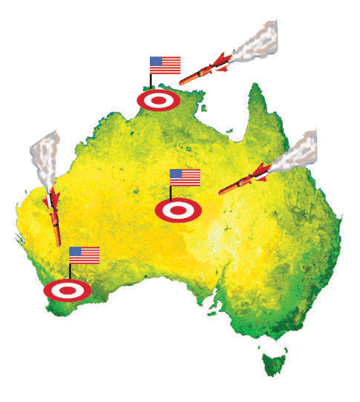
Additionally, as an ally of the United States, relying not only on the protection of America’s nuclear umbrella but also home to a strategic site in the US missile-defense system, Australia could be among the first targets to be hit in a surprise nuclear attack against the US………
Jim Green, Anti-nuclear & Clean Energy (ACE) Campaign, Friends of the Earth, Australia, www.nuclear.foe.org.au January 2018
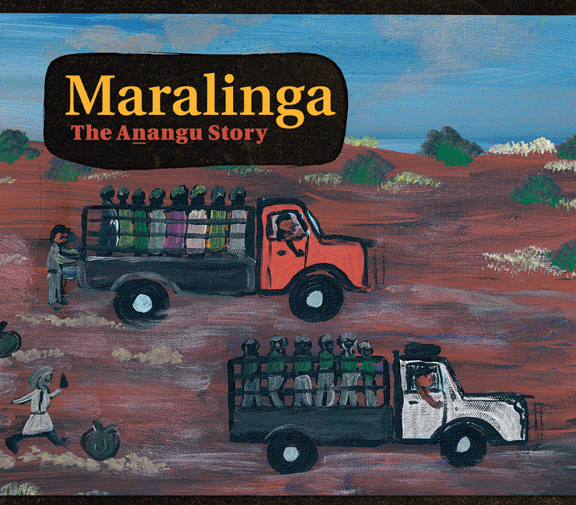
The British government conducted 12 nuclear bomb tests in Australia in the 1950s, most of them at Maralinga in South Australia. Permission was not sought from affected Aboriginal groups such as the Pitjantjatjara, Yankunytjatjara, Tjarutja and Kokatha. Thousands of people were adversely affected and the impact on Aboriginal people was particularly profound.
The 1985 Royal Commission found that regard for Aboriginal safety was characterised by “ignorance, incompetence and cynicism”. Many Aboriginal people were forcibly removed from their homelands and taken to places such as the Yalata mission in South Australia, which was effectively a prison camp.
In the late-1990s, the Australian government carried out a clean-up of the Maralinga nuclear test site. It was done on the cheap and many tonnes of debris contaminated with kilograms of plutonium remain buried in shallow, unlined pits in totally unsuitable geology. As nuclear engineer and whistleblower Alan Parkinson said of the ‘clean-up’ on ABC radio in August 2002: “What was done at Maralinga was a cheap and nasty solution that wouldn’t be adopted on white-fellas land.”
Barely a decade after the ‘clean-up’, a survey revealed that 19 of the 85 contaminated debris pits had been subject to erosion or subsidence. The half-life of plutonium-239 is 24,100 years.
Radioactive ransom − dumping on the NT
From 2005−2014 successive federal governments attempted to impose a nuclear waste dump at Muckaty, 110 km north of Tennant Creek in the Northern Territory. A toxic trade-off of basic services for a radioactive waste dump was part of this story from the start. The nomination of the Muckaty site was made with the promise of $12 million compensation package comprising roads, houses and scholarships. Muckaty Traditional Owner Kylie Sambo objected to this radioactive ransom: “I think that is a very, very stupid idea for us to sell our land to get better education and scholarships. As an Australian we should be already entitled to that.”
The Liberal/National Coalition government led by John Howard passed legislation − the Commonwealth Radioactive Waste Management Act 2005 − overriding the Aboriginal Heritage Act, undermining the Aboriginal Land Rights Act, and allowing the imposition of a nuclear dump with no Aboriginal consultation or consent.
The Australian Labor Party voted against the Commonwealth Radioactive Waste Management Act, with Labor parliamentarians describing it as “extreme”, “arrogant”, “draconian”, “sorry”, “sordid”, and “profoundly shameful”. At its 2007 national conference, Labor voted unanimously to repeal the legislation. Yet after the 2007 election, the Labor government passed legislation − the National Radioactive Waste Management Act (NRWMA) − which was almost as draconian and still permitted the imposition of a nuclear dump with no Aboriginal consultation or consent.
In February 2008, Labor Prime Minister Kevin Rudd highlighted the life-story of Lorna Fejo − a member of the stolen generation − in the National Apology in Parliament House. At the same time, the Rudd government was stealing her land for a nuclear dump. Fejo said: “I’m very, very disappointed and downhearted about that [NRWMA legislation]. I’m really sad. The thing is − when are we going to have a fair go? Australia is supposed to be the land of the fair go. When are we going to have fair go? I’ve been stolen from my mother and now they’re stealing my land off me.”
Shamefully, the NLC supported legislation disempowering the people it is meant to represent.
The Federal Court trial finally began in June 2014. After two weeks of evidence, the NLC gave up and agreed to recommend to the federal government the withdrawal of the nomination of Muckaty for a nuclear dump. The Coalition government led by Prime Minister Tony Abbott accepted the NLC’s recommendation.
Lorna Fejo said: “I feel ecstatic. I feel free because it was a long struggle to protect my land.”
Owners have won a significant battle for country and culture, but the problems and patterns of radioactive racism persist. Racism in the uranium mining industry involves ignoring the concerns of Traditional Owners; divide-and-rule tactics; radioactive ransom; ‘humbugging’ Traditional Owners (exerting persistent, unwanted pressure); providing Traditional Owners with false information; and threats, including legal threats.
In 1998, the Howard government announced its intention to build a nuclear waste dump near Woomera in South Australia. Leading the battle against the dump were the Kupa Piti Kungka Tjuta, a council of senior Aboriginal women from northern SA. Many of the Kungkas personally suffered the impacts of the British nuclear bomb tests at Maralinga and Emu in the 1950s.
The proposed dump generated such controversy in SA that the federal government hired a public relations company. Correspondence between the company and the government was released under Freedom of Information laws. In one exchange, a government official asked the PR company to remove sand-dunes from a photo to be used in a brochure. The explanation provided by the government official was that: “Dunes are a sensitive area with respect to Aboriginal Heritage”. The sand-dunes were removed from the photo, only for the government official to ask if the horizon could be straightened up as well. Terra nullius.
In 2003, the federal government used the Lands Acquisition Act 1989 to seize land for the dump. Native Title rights and interests were extinguished with the stroke of a pen. This took place with no forewarning and no consultation with Aboriginal people.
The Kungkas continued to implore the federal government to ‘get their ears out of their pockets’, and after six years the government did just that. In the lead-up to the 2004 federal election − after a Federal Court ruling that the federal government had acted illegally in stripping Traditional Owners of their native title rights, and with the dump issue biting politically in SA − the Howard government decided to cut its losses and abandon the dump plan.
The Kungkas wrote in an open letter: “People said that you can’t win against the Government. Just a few women. We just kept talking and telling them to get their ears out of their pockets and listen. We never said we were going to give up. Government has big money to buy their way out but we never gave up.”
Nuclear War
One example concerns the 1982 South Australian Roxby Downs Indenture Act, which sets the legal framework for the operation of BHP Billiton’s Olympic Dam uranium mine in SA. The Act was amended in 2011 but it retains exemptions from the SA Aboriginal Heritage Act. Traditional Owners were not even consulted. The SA government’s spokesperson in Parliament said: “BHP were satisfied with the current arrangements and insisted on the continuation of these arrangements, and the government did not consult further than that.”
That disgraceful performance illustrates a broader pattern. Aboriginal land rights and heritage protections are feeble at the best of times. But the legal rights and protections are repeatedly stripped away whenever they get in the way of nuclear or mining interests.
Thus the Olympic Dam mine is largely exempt from the SA Aboriginal Heritage Act. Sub-section 40(6) of the Commonwealth’s Aboriginal Land Rights Act exempts the Ranger uranium mine in the NT from the Act and thus removed the right of veto that Mirarr Traditional Owners would otherwise have enjoyed. New South Wales legislation exempts uranium mines from provisions of the NSW Aboriginal Land Rights Act. The Western Australian government is in the process of gutting the WA Aboriginal Heritage Act 1972 at the behest of the mining industry. Native Title rights were extinguished with the stroke of a pen to seize land for a radioactive waste dump in SA, and Aboriginal heritage laws and land rights were repeatedly overridden with the push to dump nuclear waste in the NT.
While a small group of Traditional Owners supported the dump, a large majority were opposed and some initiated legal action in the Federal Court challenging the nomination of the Muckaty site by the federal government and the Northern Land Council (NLC).
Muckaty Traditional Owners have won a famous victory, but the nuclear war against Aboriginal people continues − and it will continue to be resisted, with the Aboriginal-led Australian Nuclear Free Alliance playing a leading role.
More information: • Australian Nuclear Free Alliance www.anfa.org.au Friends of the Earth
‘The greatest minds in the nuclear establishment have been searching for an answer to the radioactive waste problem for fifty years, and they’ve finally got one: haul it down a dirt road and dump it on an Indian reservation.” −− Winona LaDuke, Indigenous World Uranium Summit, 2006
Tim Bickmore Fight To Stop Nuclear Waste Dump In Flinders Ranges SA, 29 Jan 18
Joint Committee on Findings of the Nuclear Fuel Cycle Royal Commission. Final report. Tabled in the SA Parliament October 2017…..
p19:
“The Royal Commission found that “both broad social consent and specific community consent must be obtained for any new nuclear activity to commence in South Australia”. (Finding No. 95).
……..
[Commissioner Scarce] …. We have seen overseas that a particular vote has been taken at a particular point in time and then the community has subsequently lost confidence in that process.
………
…it is not about just having one vote from the public at one point in time. Social licence is something that needs to be maintained for the life of a project, and it therefore needs to be an ongoing dialogue and an ongoing relationship between the developer and the public.
”
p29
“…….. based on the failure of pure voluntarism in the UK, the NDA is currently revising its policy away from this model. In order to obtain outcomes, and streamline negotiations, it aims to tighten definitions of “community”, “representation” and “consent”. ….. The NDA also hope that an appropriate definition of “community” will inhibit contribution from non-representative groups.”
Australia to become major defence exporter under $3.8b Turnbull plan, The Age, Adam Gartrell, 29 Jan 18,Australia is set to become one of the world’s top 10 defence exporters under an ambitious $3.8 billion government plan.
The new defence export strategy to be released by Prime Minister Malcolm Turnbull on Monday aims to put Australia on par with major arms-exporting countries like Britain, France and Germany within 10 years.
The government believes the strategy will create new jobs and bolster Australia’s troubled defence manufacturing industry, which struggles to sustain itself based on Australian Defence Force needs alone. A big boost in exports will insulate local manufacturers from the peaks and troughs – sometimes called the “valley of death” – of domestic demand.
“This strategy is about job creation. It will give Australian defence companies the support they need to grow, invest and deliver defence capability. It will make Australian defence exports among the best in the world,” Mr Turnbull said……..
The centrepiece of the strategy will be a new financing facility that will make up to $3.8 billion available to Australian defence companies looking to sell overseas…….
The government will seek to use the exports to cement relationships with key countries in volatile regions like the Middle East. Defence Industry Minister Christopher Pyne has previously nominated Australia’s relationship with the United Arab Emirates as one that could benefit from deeper, export-led economic ties…..
A new Australian Defence Export Office will be established to implement the strategy, and an Australian Defence Export Advocate will be appointed to co-ordinate with the industry, and state and territory governments.
Paul Waldon Fight To Stop Nuclear Waste Dump In Flinders Ranges SA 29 Jan 18 “People lie when they want something, because they think the truth wont get it for them.” (Cary Grant, Charade).
DIIS failure to catalogue the known risks of a radioactive waste dump in Hawker or Kimba may be testimony of burying the truth, in a attempt to jump-start the progress of waste abandonment, while knowing they can’t tick all the boxes.
We must remain resolute in our fight to preserve a clean, safe environment for future generations.
NUCLEAR MEDICINE AND THE PROPOSED NATIONAL RADIOACTIVE WASTE REPOSITORY , Jim Green 27 January 18, “As health organisations, we are appalled that access to nuclear medical procedures is being used to justify the proposed nuclear waste dump. Most waste from these procedures break down quickly and can be safely disposed of either on site or locally.” − Dr Bill Williams, Medical Association for the Prevention of War
“Linking the need for a centralized radioactive waste storage facility with the production of isotopes for nuclear medicine is misleading. The production of radioactive isotopes for nuclear medicine comprises a small percentage of the output of research reactors. The majority of the waste that is produced in these facilities occurs regardless of the nuclear medicine isotope production.”
− Nuclear Radiologist Dr Peter Karamoskos.
Proponents of a national radioactive waste facility (a repository for lower-level wastes and a co-located store for higher-level wastes) claim or imply that nuclear medicine would be jeopardised if the facility does not proceed. There is no basis to such claims – they amount to dishonest scare-mongering.
Proponents claim that most or all of the waste that the federal government wants to dispose of or store at a national repository/store arises from medicine, specifically the production and use of medical radioisotopes. However, measured by radioactivity, the true figure is just 10-20%. Measured by volume, the figure may be within that range or it may be higher than 20% − but it takes some creative accounting to justify the claim that most or even all of the waste is medical in origin.
In any case, the fact that some waste is of medical origin doesn’t mean that a national repository/store is the best way to manage the waste.
If the plan for a national repository/store does not proceed, medical waste will continue to be stored at the Lucas Heights reactor site operated by the Australian Nuclear Science and Technology Organisation (ANSTO) and, in much smaller volumes, at hospitals. Some waste is used in hospitals and then sent back to ANSTO (e.g. molybdenum ‘cows’ that have been ‘milked’ of the daughter radionuclide, technetium-99m − by far the most commonly used medical radioisotope). That is no problem since ANSTO and hospitals continue to produce radioactive waste and thus they have an ongoing need for on-site waste stores and waste management expertise regardless of the options for periodic off-site disposal.
Nuclear medicine is not being adversely affected by the absence of a national radioactive waste repository/store. Nuclear medicine will not benefit from the creation of a national radioactive waste repository/store.
The incessant references to nuclear medicine to ‘sell’ the proposed radioactive waste repository/store amount to emotive propaganda and scare-mongering. Ironically, that is what critics of the proposed national radioactive waste repository/store are routinely accused of!
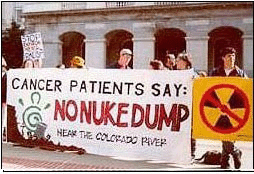
Dishonest scare-mongering linking nuclear medicine and radioactive waste dumps is also evident in other countries. Protests by cancer patients helped end plans to build a radioactive waste dump in Ward Valley, California. http://ens-newswire.com/ens/jun2002/2002-06-04-06.html
What should be done?
Two parallel processes should be initiated regarding radioactive waste management in Australia: a radioactive waste audit, and a National Commission or comparable public inquiry mechanism.
The federal government should immediately initiate an audit of existing waste stockpiles and storage. This could be led by the federal nuclear regulator ARPANSA in consultation with relevant state agencies with responsibility for radioactive waste. This audit would include developing a prioritised program to improve continuing waste storage and handling facilities, and identifying non-recurrent or legacy waste sites and exploring options to retire and de-commission these.
A National Commission would restore procedural and scientific rigour, and stakeholder and community confidence in radioactive waste management. It would identify and evaluate the full suite of radioactive waste management options. That would include the option of maintaining existing arrangements, keeping in mind that 95% of the waste is securely stored at two Commonwealth facilities: ANSTO’s Lucas Heights facility, and a large volume of very low level waste stored on Defence Department land at Woomera, SA.
Antinuclear Australia and associated social media will be following with interest the responses of South Australian election candidates to this very important survey
Dear [candidate or MP]
In 2017 South Australians were asked to consider a number of nuclear options for our state. With a State election to be held this year we consider that it is appropriate for all candidates contesting the election to clarify their position on nuclear issues.
Thus we respectfully ask all candidates for the S.A. 2018 election to provide answers to the questions on the accompanying Survey. These questions relate to the policy you will take to the election on :
.uranium mining in S.A.?
.a national nuclear waste dump in S.A.?
.nuclear for defence industry?
.nuclear power generation?
We would greatly appreciate it if you could take the time to answer these questions by circling the appropriate responses on the included survey form.
Thank you for your participation. Mnem Giles (for Anti-Nuclear Coalition SA) PO Box 504 MontacuteSA 5134
SURVEY OF CANDIDATES
CANDIDATE NAME:
CANDIDATE ELECTORATE:
please circle either YES or NO for each of the following questions
DO YOU SUPPORT :
Expansion of uranium mining in S.A.? YES NO
Nuclear power generation in S.A.? YES NO
A storage facility in S.A. for international nuclear waste ? YES NO
A storage facility in S.A. for Australian nuclear waste? YES NO
Increased isotope production at Lucas Heights for international market? YES NO
Construction of nuclear powered submarines in S.A.? YES NO
Australia signing the UN Treaty on the Prohibition of Nuclear Weapons? YES NO
8 Upholding S.A.’s Nuclear Waste Storage Facility (Prohibition) Act 2000 in the
case of the Federal Government wishing to impose a nuclear waste dump ? YES NO
Anti-Nuclear Coalition South Australia antinuclearcoalition@gmail.com 24 Jan 18The Federal Government proposes to establish a National Radioactive Waste Management Facility in SA. This ‘repository’ would co-locate:
Various low-level and hazardous but short lived intermediate level wastes requiring isolation for 300 years in a shallow ground repository.
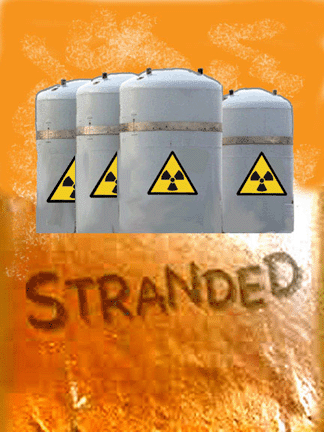
An above-ground store designed to operate for 100 years to house used reactor fuel from Lucas Heights. This intermediate-level long-lived waste requires isolation from the environment for over 10,000 years.
No plans have been made available for structures or maintenance for the first 100 years of this above-ground store. Plans for the ensuing 10,000 years are unavailable.
There are no plans available to establish a ‘permanent’ solution for this waste. It is not currently known how to safely store such higher level nuclear waste in isolation from the environment for such a long period of time.
Nuclear waste is currently stored at Lucas Heights where it is securely monitored.
Lucas Height’s ‘Interim Waste Store” has been identified by ANSTO as capable of safely storing reprocessed nuclear fuel waste and intermediate-level waste has been stored at Lucas Heights since the 1950s. Lucas Heights has been identified as the best resourced and secure facility to responsibly manage the extended storage of Australia’s nuclear waste.
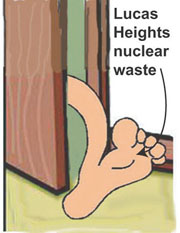
A national radioactive waste dump could be used as a “foot in the door” to establish an International Radioactive Waste dump at the same site or another site in the future. This was advocated as an objective by state Liberal Party adviser Richard Yeeles who advised that “…as a first step in such further development, the
S A Govt. offers to host a national facility for storage and disposal of Australia’s own low and intermediate-level radioactive waste with the ultimate aim of securing Federal Govt. support for hosting an international radioactive waste management facility in SA.”
Although plans for an international waste dump in SA have been rejected by the public at this time advocates for an international waste dump and the nuclear industry continue to lobby and work towards the establishment of such a dump. If a national waste dump was established with higher-level radioactive waste stored above ground at the same site, pressure could be brought to bear to establish a deep-level below ground facility to store both this waste and international radioactive waste from overseas.
‘Hallelujah’ moment: Revised TPP to be signed in March Radio New Zealand, 23 Jan 18The revised Trans-Pacific Partnership agreement is to be signed in March, the Trade Minister has confirmed. Australia’s Trade Minister, Steve Ciobo, said the 11 nations, including New Zealand, are “finally at the finish line” following talks between officials in Tokyo………
The rebranded the Comprehensive and Progressive Trans-Pacific Partnership (CPTPP), covers nearly 500 million people and the 11 countries involved make up 14 percent of global economic activity, or about $US10 trillion.
If the trade pact is successfully concluded, lower barriers and standardised rules are expected, making it easier for businesses to sell their goods and services in these markets.
Speaking at the World Economic Forum in Davos, Switzerland, Canada’s Prime Minister Justin Trudeau called the agreement the “right deal”.
The country’s trade minister said it included an improved arrangement on autos with Japan and the suspension of intellectual property provisions that had been a concern…….
Trade specialist Stephen Jacobi said it was a less problematic deal than the initial one.
“It suspends a number of the more problematic areas of TPP, particularly intellectual property provisions and some aspects of the investor state settlement that was very controversial in New Zealand.
“It’s taken the hard edge off TPP … in those areas.”
Minerals Council steps up coal advocacy despite BHP call for neutrality, MCA publicises report asking governments to commit similar resources to carbon capture and storage as to renewables, Guardian, Michael Slezak@MikeySlezak, The Minerals Council of Australia has stepped up its advocacy for coal power in spite of its biggest member, BHP, saying it will leave the group unless it shifts its stance to become technology-neutral.
On Tuesday the MCA publicised a report by the Coal Industry Advisory Board that called for governments to commit similar resources to carbon capture and storage as they do to renewable energy.
The report was written by representatives of some of the world’s biggest coalminers, including Anglo American, Glencore and Peabody, as well as by Peter Morris of the MCA.
In a section directly aimed at Australia, the report called for a public campaign to promote carbon capture and storage, and for governments to support so-called “high-efficiency low-emissions coal” (HELE) among other technologies……
In December a report from the Australian National Audit office sharply criticised the federal government’s investments in carbon capture and storage. It found that despite a commitment of more than $2bn, little had been achieved…….
Following a move by its own shareholders, BHP agreed to review its membership of industry and business groups such as the Minerals Council. That review, published in December, concluded that unless the MCA adapted its advocacy activities within a year, it would cancel its almost $2m yearly membership, which makes up about 17% of the MCA’s revenue from memberships.
But the latest attack goes beyond the sector and threatens democracy itself. The government is proposing to classify most major charities as “political campaigners”, allowing it to audit their advocacy work and their sources of income. It suggests an impurity of motive, yet nothing could be further from the truth.
This is because a new amendment to the Electoral Act would force any group to register as a political campaigner if it has spent more than $100,000 on “political expenditure” in a three-year period.
Political expenditure is defined as: “The public expression of any views on an issue that is, or is likely to be, before electors in an election (whether or not a writ has been issued for the election).”
In other words, this would apply to any comment on any policy issue at any time. Every charity that employs someone to analyse issues like aged care, homelessness, disability, living costs and virtually any other issue is likely to end up classified as a political campaigner.
The end result will be a set of requirements so complicated that some charities will be forced to hire staff simply to manage their compliance. Any charity would rather spend this money on their core mission. Others might stop speaking out altogether, deterred by the new requirements and huge penalties for getting it wrong – miscalculating the date that you become a “political campaigner” could cost up to $50,000 per day in fines.
So why, when almost everyone would agree that the most corrupting influence on public debate comes from lobbyists and big donors, is civil society being targeted?
Charities already enter the public debate with a huge disadvantage compared to moneyed interests. They are barred from endorsing candidates, donating to parties, or advocating outside their charitable purpose.
The big influencers in Australian politics can do all of this and more. Charities now have their DGR status threatened regularly, while business spending on advocacy and lobbying can be written off as a legitimate cost. Membership fees that companies pay to their own advocacy bodies are tax deductible. Even donations to political parties, from both businesses, unions and individuals, can be taken from pre-tax income. Just this week, the Minerals Council admitted that its donations are designed to buy access to decision-makers.
On top of that, big business and vested interests can afford to spend millions on lobbyists to help them secure important meetings, on advertising before elections, and on airspace to set the political agenda.
All of this is known to have a major impact on public debate, yet none of it would be curbed by the new rules. In light of that, attacking the groups who speak up for the public good, a purpose that goes beyond their own self-interest, seems perverse. Unless it was the point all along.
Maybe it simply suits governments these days for charities to provide essential services (work that many Australians would rather see done by government itself), without ever questioning the root causes of poverty, inequality, and homelessness. It serves the dual purpose of turning charities into an arm of government while also silencing the poor and protecting an unfair system from scrutiny.
The charity sector is uniting against the proposed changes. But seeing off the Electoral Act amendments won’t end the attacks. One of Gary Johns’ first major tasks as commissioner will be to review the ACNC, and there is every reason to be concerned that community advocacy will be threatened yet again.
It seems to us that all of these attacks are driven by an agenda to exclude the least powerful members of society, and those who speak up on their behalf, from public debate. By attacking charities and their ability to advocate, we’re creating a society where only those with power and access to start with have the ability to influence policy.
Community advocacy has proven to be one of the only ways we can balance the coordinated, self-interested, and privileged forces that drive decision making and policy in Australia. It is in everybody’s interests to protect it.
About the author: Kasy Chambers is executive director of Anglicare Australia. Anglicare Australia is a network of 40 agencies, more than 20,000 staff and volunteers, working with over 900,000 clients annually across Australia.













 Antinuclear