I will say NO to the waste dump
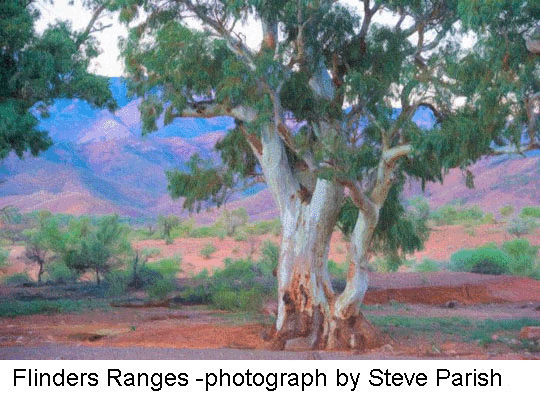 Regina McKenzie Fight To Stop Nuclear Waste Dump In Flinders Ranges SA, Back home on the Range, seeing it made a lump come into my throat, how can any one even think of putting a waste dump in such a beautiful ancient land?
We the people of this land comes from a group of nations, that were hunted in the past, the Government of them days actually supported the activity of early settlers, a five pound bounty, which was a lot of money in those days, was paid per scalp of Aboriginals, blankets that was exposed to small pox given out to unsuspecting yura’s, who then shared these gifts to the wider Aboriginal people, hence spreading the disease to people who had no immunity to it and can’t forget the water hole being poisoned, what I am getting at is back then, when we were hunted, this land was our sanctuary all the decimated nations fled into the hills, thus forming the Adnyamathanha people, adnya meaning rock and mathanaha meaning groups, it was the hills of this beautiful land that saved us,
I hear many say oh thank goodness for the missionaries they helped us ….. NO they only contained us on missions, taking control of our lives, banning the people to practice culture and making public enemies of the ones who stood strong, it was the land that gave us places to hide and why we are still here, so why do Yura’s take it for granted? why do they turn their back? why do they so cowardly bend their knee?
I will stand for the land, I will fight with every ounce of my strength, I live and breath this land, it is my solace, my love, the place where I am whole, I will say NO to the waste dump, I stand proud and I will protect my Mudah, my past, present and future https://www.facebook.com/groups/344452605899556/
South Australia’s new solar energy plan – an international first
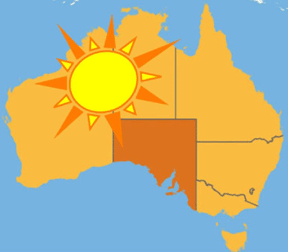 Reuters 4th Feb 2018, South Australia’s state premier Jay Weatherill announced a plan on Sunday to create a network of 50,000 home solar systems backed by Tesla Powerwall batteries, ahead of a state election in March.
“We lead the world in renewable energy with the world’s largest battery, the world’s largest solar thermal plant and now the world’s largest virtual power plant,” he said in a televised interview from the state capital of Adelaide. “The size of it is the reason why it’s going to be a success.” The project would begin with a trial on 1,100 public housing homes, the government said on its website.
https://uk.reuters.com/article/uk-australia-power-tesla/south-australia-promises-worlds-largest-virtual-power-plant-idUKKBN1FO029?rpc=401&
The Adani Carmichael coalmine will not receive federal funding from the Northern Australia Infrastructure Facility for a vital rail line

 Adani coalmine won’t get federal rail funding, Liberal minister says Concessional $900m loan cannot proceed without Queensland government approval, Karen Andrews says, Guardian, Paul Karp , 4 Feb 18,
The Adani Carmichael coalmine will not receive federal funding from the Northern Australia Infrastructure Facility for a vital rail line, a Turnbull government minister has said.
The announcement by Karen Andrews on Sunday is a major blow to Adani, which has sought a $900m concessional loan for rail to link the Carmichael mine to port – and could spell the end of the project entirely if it can’t secure private finance.
The Labor leader, Bill Shorten, stepped up the opposition’s rhetoric on the Adani mine last week, first refusing to rule out stopping the project on Tuesday and then on Friday threatening the mine’s licence in a bid to boost the party’s environmental credentials for the Batman byelection. Before its re-election last year, the Queensland Labor government promised to veto Adani’s application for a loan from the Naif.
Federal Labor, which has already ruled out providing a public subsidy or loan to the Adani mine, is now looking at further measures to block it……https://www.theguardian.com/environment/2018/feb/04/adani-coalmine-wont-get-federal-rail-funding-liberal-minister-says
Australian uranium mining company Paladin: most shares in hands of creditors

 Paladin to return to ASX, most shares in hands of creditors http://www.miningweekly.com/article/paladin-to-return-to-asx-most-shares-in-hands-of-creditors-2018-02-02/rep_id:3650 2ND FEBRUARY 2018 BY: MARIAAN WEBB CREAMER MEDIA SENIOR RESEARCHER AND DEPUTY EDITOR ONLINE JOHANNESBURG (miningweekly.com) – Uranium miner Paladin Energy will apply for its securities to be reinstated to official quotation on the ASX, the Australia-based company said on Friday, announcing the completion of its restructuring and the appointment of two new directors.
With the deed of company arrangement (DOCA) effected, deed administrators have retired and the day-to-day management and control of Paladin has reverted to the company’s directors. The two new board appointments are iCobalt MD David Riekie and former interim CEO and MD of Atlas Iron Daniel Harris.
The DOCA was put forward to the administrators of Paladinby a group of the company’s unsecured bondholders, known as the Ad Hoc Committee. The DOCA’s key terms included the debt-for-equity swap, the raising of $115-million pursuant to the issue of a high-yield secured note and the reinstatement of Paladin to trade on the ASX.
In terms of the DOCA, 98% of Paladin’s shares have been transferred to creditors and other investors and only 2% are retained by shareholders. If a shareholder held 10 000 Paladin shares before the restructuring, they will now hold 200 shares.
Creditors all agreed to a restructuring proposal in December, although major creditor Electricité de France (EDF) previously said that it may seek to have the DOCA terminated.
Paladin appointed administrators in July last year after the company was unable to agree a delay to the repayment of $277-million it owed EDF.
On Wednesday, Paladin published its quarterly activities reports for the June, September and December quarters, as well as its June 2017 annual report.
The most recent quarter’s results show that the Langer Heinrich mine, in Namibia, produced 873 107 lb of uranium oxide (U3O8), up 4% on the prior quarter. Sales were at 1.24-million U3O8 at an average selling price of $22.39/lb.
The Kayelekera mine, in Malawi, remains under care and maintenance. 
ARPANSA considering components in radioactive trash dump- asks for your comments

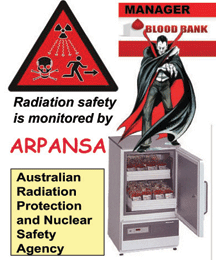 This process is about determining the nature of the material to be dumped in the proposed x3 SAust radioactive suppositories.
Currently there is no official determination about what is actually to be accumulated there – hence the delay in remediating the leaking drums @ Woomera & failure to properly inform the local communities.
Also thereby wrongfully expecting them to sign off on an unknown quality/quantity.
Submissions close Feb 23
ARPANSA is engaging in public consultation on the draft Code for Disposal of Solid Radioactive Waste (Radioactive Waste Disposal Code).
Australia’s nuclear macho men always wanted nuclear weapons, and they still do
What Dibb suggested is that Australia, under the guise of generating nuclear power or on another pretext, acquire the essential technology to produce the fissile material needed to build a nuclear weapon. The hypocrisy involved is staggering. Analysts making such proposals accuse countries like Iran and North Korea of putting such plans into practice, and support a US pre-emptive attack to eliminate the supposed threat.
Dibb is well aware that Australia is a signatory to the Nuclear Non-proliferation Treaty (NPT).
before signing the NPT in 1970 and ratifying it in 1973, the Australian government drew up plans for a commercial nuclear power plant at Jervis Bay, south of Sydney, that would covertly supply the enriched uranium needed to manufacture nuclear weapons. The Jervis Bay project, which was promoted by Prime Minister John Gorton, was mothballed after he was ousted in 1971 by Billy McMahon.
This discussion is tied to a broader push to boost military spending in preparation for war.
In its 2016 defence white paper the government already foreshadowed a multi-billion dollar military expansion, lifting the defence budget to at least 2 percent of gross domestic product and purchasing advanced weapons systems. In a related move, Prime Minister Malcolm Turnbull yesterday announced a vast expansion of military industries in the name of a drive to export arms and become one of the world’s top ten weapons exporters.
None of these steps has anything to do with “defence” or preserving peace.
 Renewed push for Australia to build nuclear
  weapons https://www.wsws.org/en/articles/2018/01/30/aust-j30.html#pk_campaign=sidebar&pk_kwd=textlink, By Peter Symonds , 30 January 2018
A discussion has begun over the past month in Australian strategic and military circles about the necessity of building nuclear weapons, or developing the capacity to do so, against the alleged threat posed by nuclear-armed powers, above all China.
The debate, in public at least, is quite cautious, given the widespread popular hostility to war and thus the potential for protests to erupt against any move to create a nuclear arsenal. However, the very fact that the issue is actively being discussed is another sign of rapidly sharpening geo-political tensions and the accelerating arms race by major powers around the world. Continue reading
Human error caused 71% of Australia’s radiation incidents in 2016: not a good omen for transporting radioactive trash
 Anti-Nuclear Coalition South Australia Australian Radiation Incident Register 2016, ARPANSA
71% of incidents was caused by human error, primarily in hospital based medical procedures. Radioactive waste had no statistically meaningful contribution within the Register.
Transporting radioactive waste across the country is bound to increase the probability of human error in previously unaffected environments nationwide; whilst placing a radioactive suppository in South Australia will not reduce human errors in hospitals.
https://www.arpansa.gov.au/s…/g/files/net3086/f/arir2016.pdf
Response to Electric Energy Society of Australia (EESA), on its pro nuclear seminar
 from Jim Green 3 Feb 2018 To: Electric Energy Society of Australia (EESA)
Re the Feb 21 EESA webinar with nuclear lobbyist Ben Heard talking about nuclear power:
1. Will EESA be organising a separate webinar to provide a perspective from someone who isn’t a nuclear lobbyist? If not, is that lack of balance consistent with the Engineers Australia Code of Ethics and Guidelines on Professional Conduct?
2. Will you amend the bio-note on the ESAA webpage to note that Mr Heard’s so-called environment group accepts secret corporate donations? If not, why not? The bio-note on the EESA webpage claims that his group ‘represents the community’ … if such dubious claims are allowed to stand then it surely needs to be acknowledged that his group accepts corporate donations including secret corporate donations. Is such disclosure not required by the Engineers Australia Code of Ethics and Guidelines on Professional Conduct?
3. During the webinar, will it be made clear that Mr Heard’s group accepts corporate donations including secret corporate donations? Is such disclosure not required by the Engineers Australia Code of Ethics and Guidelines on Professional Conduct?
4. During the webinar, will you make it clear that Mr Heard’s asinine contribution to the SA Royal Commission was rejected by the Commission? Specifically, the final report of the Royal Commission said: “[A]dvanced fast reactors and other innovative reactor designs are unlikely to be feasible or viable in the foreseeable future. The development of such a first-of-a-kind project in South Australia would have high commercial and technical risk. Although prototype and demonstration reactors are operating, there is no licensed, commercially proven design. Development to that point would require substantial capital investment.”
5. Will you ensure that webinar participants are provided with some basic factual information that Mr Heard certainly won’t be volunteering, e.g.
— A$40 billion capital cost for two new reactors in the UK (A$20 billion each)
— A$16 billion capital cost for new reactors in France and Finland
— bankruptcy filing of Westinghouse due to catastrophic cost overruns building conventional reactors in the US (including A$13+ billion wasted on reactors in South Carolina that were cancelled last year).
— Westinghouse, Toshiba and a number of other utilities exiting the reactor construction business
— Ziggy Switkowski, head of the Howard government’s Nuclear Energy review, now says he believes “the window for gigawatt-scale nuclear has closed”. He also said that nuclear is no longer lower cost than renewables and that the levelised cost of electricity of the two is rapidly diverging.
6. Will you ensure that webinar participants are informed that Mr Heard has continued lobbying for the importation of 138,000 tonnes of high-level nuclear waste to SA despite being well aware of the overwhelming opposition of Aboriginal Traditional Owners?
https://www.anfa.org.au/traditional-owners-statements/
7. What steps will you take to ensure that participants are provided with some credible information about high-temperature gas-cooled reactors given that these seem to be Mr Heard’s latest fixation? Some information is copied below.
8. If Mr Heard claims that high-temperature gas-cooled reactors are ‘meltdown-proof’, or other such inanities, will you ensure that his falsehoods are corrected? Continue reading
Recognising the people behind ICAN, and their vision
In Australia, ICAN began with Felicity Ruby, Dimity Hawkins, Dr. Bill Williams, Dr. Tilman Ruff, and others who launched the global effort with a strong medical and scientific perspective. According to Dr. Kathleen Sullivan, a disarmament educator in the United States, and one of the campaign’s earlier members, “the initial thinking revolved around horror, humor, and hope—to amplify the need for a louder nuclear taboo, to educate the public, reignite the movement fueled more by what we love than what we fear.”
Tim Wright, director of ICAN Australia, was the very first volunteer back in 2006. Tim has advocated for ICAN in the Asia-Pacific region, and around the globe.
 The People Who Made a Nuclear-Weapons-Prohibition Treaty Possible https://www.thenation.com/article/the-people-who-made-a-nuclear-weapons-prohibition-treaty-possible/ ICAN’s visionary work has brought us that much closer to a nuclear-free world—and won them a Nobel Peace Prize in the process.By Ari Beser 2 Feb 2018,
Labor Party branches want a new and more effective environment act and independent watchdog
 Labor branches push for new environment act and independent watchdog. ALP’s internal advocacy group wants sweeping reforms to protect natural heritage to be adopted as policy at next conference, Guardian, Adam Morton, 31 Jan 18,
Bill Shorten is facing rising internal pressure to make the environment central to Labor’s election pitch after 250 ALP branches passed a motion calling for strong new national laws and an independent agency akin to a “Reserve Bank for environmental management”.
Branches from every state and territory have backed a campaign by the Labor environment action network (Lean), an internal advocacy group, for sweeping reforms to protect natural heritage to be adopted as policy at this year’s ALP conference.
It would be backed by a “science-fuelled and politically empowered” agency with the authority of the Reserve Bank and watchdog powers to police the law.
Felicity Wade, Lean’s national convener, said protecting the environment was a legacy issue for Labor. This dates back to Gough Whitlam’s introduction of Australia’s first federal environment laws and Bob Hawke’s protection of iconic sites and early work factoring sustainability into government decisions.
She said the need to act was clear. “Australia’s identity is incredibly tied to this amazing landscape, yet things are crashing at an alarming rate,” she said. “We are one of the top 10 land-clearers in the world and we have one of the highest extinction rates in the world, yet we are one of the richest countries in the world.”
The Lean campaign was devised at a meeting of members in Canberra in August. It has precedent: in 2015, the group won the backing of 370 branches for a successful motion calling on the party to adopt a 50% renewable energy goaland an emissions reduction target for 2030 based on the advice of the federal Climate Change Authority.
………She said the need to act was clear. “Australia’s identity is incredibly tied to this amazing landscape, yet things are crashing at an alarming rate,” she said. “We are one of the top 10 land-clearers in the world and we have one of the highest extinction rates in the world, yet we are one of the richest countries in the world.”
The Lean campaign was devised at a meeting of members in Canberra in August. It has precedent: in 2015, the group won the backing of 370 branches for a successful motion calling on the party to adopt a 50% renewable energy goaland an emissions reduction target for 2030 based on the advice of the federal Climate Change Authority.
Wilderness Society’s national campaigns director, Lyndon Schneiders, said it would be a positive campaign. “We know 2018-19 is the once-in-a-generation chance to set up serious national environment laws,” he said. ……https://www.theguardian.com/environment/2018/jan/31/labor-branches-push-for-new-environment-act-and-independent-watchdog
Govt funding for environment languishes, as mining companies receive double the benefit in tax credits
Miners receive twice as much in tax credits as Australia spends on environment
Analysis shows federal and state environment spending cut while industry awarded $2.5bn in fuel tax credits, Guardian, Adam Morton, 2 Feb 18,
Mining companies will receive more than twice as much in fuel tax credits as the Turnbull government will spend on environment and biodiversity programs this financial year, an analysis has found.
Coalmining companies alone are expected to get more back than the diminishing funding allocated to the federal environment department.
The analysis by the Australian Conservation Foundation (ACF) found that, across commonwealth, state and territory governments, investment in environment and biodiversity programs was cut by 9% – from $6.95bn to $6.32bn – in the three years to 2016-17. Total budget spending rose by 10% in the same period, from $634.9bn to $701.5bn.
It adds to a weight of evidence that environment campaigners and political veterans say shows government support for environment protection is at its lowest ebb since before the landmark decisions to protect Kakadu, the Daintree rainforest and the Franklin river in the 1980s.
…….. The commonwealth’s state of the environment report last year found parts of Australia’s natural estate were in poor or deteriorating condition and there was insufficient public support for environmental management and restoration programs.https://www.theguardian.com/environment/2018/feb/02/miners-receive-twice-as-much-in-tax-credits-as-australia-spends-on-environment
‘Merchants of Death’: Profiteering from the arms trade
 Sisters of St Joseph January 2018 , The Sisters of St Joseph of the Sacred Heart, the religious Congregation founded by St Mary MacKillop, challenges the newly released plan of the Federal Government to increase weapons exports.
“Weapons are designed to kill and maim human beings,” said the Congregational Leader, Sister Monica Cavanagh. “We completely reject the philosophy which finds it acceptable to boost industry, create jobs, increase exports and protect local manufacturing via the arms trade.”
“We agree with Pope Francis that those who seek to benefit from trading in weapons are ‘merchants of death’,” she concluded.
Six major issues concern the sisters:
- The “mutually assured destruction” of the last forty years cannot guarantee deterrence in the future. Violence is escalating in proportion to the availability and destructive effect of new weapons.
- There is enormous difference between a defence manufacturing industry to protect Australia and the development of a weapons export industry.
- It is a matter of great concern and sorrow that Australia’s overseas aid has dropped to its lowest level ever, while at the same time plans are underway to increase the sale of weapons.
- The government’s assurances about establishing and maintaining “controls” over which nations access Australian weapons lack detail on methods of oversight and on how such controls would be policed.
- Australian capacity to deal in arms ethically is not evident in Australian history. Australia continued to provide military hardware and training to Indonesia between 1975 and 1999 during the occupation of East Timor in which up to 182,000 people died violently.
- Australia’s considerable design and production expertise would be better used in projects which promote peace among nations and care of earth, particularly in places and electorates where people lack employment opportunities.
The Sisters of St Joseph call on the Australian government to prioritise education, health and good governance initiatives among the deprived peoples and nations of the world, rather than spending billions of Australian people’s dollars on producing and exporting the means of destruction.
“We strongly urge the government to resist the hypocrisy of talking about peace while financing and supporting the arms trade,” Sister Monica reflected. “Over 90% of those who die in war zones are not soldiers, but civilians, including so many of the most defenceless humans – the children. It is reprehensible for government and industry authorities to pursue financial and electoral gain through promoting the weapons which enable the escalation of violence.”
AUSTRALIA’S HISTORY OF MISMANAGING RADIOACTIVE WASTE
| Friends of the Earth, Australia, www.nuclear.foe.org.au, January 2018 “The disposal of radioactive waste in Australia is ill-considered and irresponsible. Whether it is short-lived waste from Commonwealth facilities, long-lived plutonium waste from an atomic bomb test site on Aboriginal land, or reactor waste from Lucas Heights. The government applies double standards to suit its own agenda; there is no consistency, and little evidence of logic.” ‒ Nuclear engineer Alan Parkinson11 Alan Parkinson, 2002, ‘Double standards with radioactive waste’, Australasian Science, https://nuclear.foe.org.au/flawed-clean-up-of-maralinga/ 2 https://nuclear.foe.org.au/flawed-clean-up-of-maralinga/ RADIUM HILL: A radioactive waste repository at Radium Hill “is not engineered to a standard consistent with current internationally accepted practice” according to a 2003 SA government audit. PORT PIRIE: The Port Pirie uranium treatment plant is still contaminated over 50 years after its closure. It took a six-year community campaign just to get the site fenced off and to carry out a partial rehabilitation. As of July 2015, the SA government’s website states that “a long-term management strategy for the former site” is being developed. ARKAROOLA WILDERNESS SANCTUARY: SA regulators failed to detect Marathon Resource’s illegal dumping of low level radioactive waste in the Arkaroola Wilderness Sanctuary. If not for the detective work of the managers of the Arkaroola Wilderness Sanctuary, the illegal activities would likely be continuing to this day. The incident represents a serious failure of SA government regulation. The Royal Commission report dealt with this scandal in two sentences and failed to note that the SA government regulator did not detect the illegal dumping of radioactive waste. MARALINGA: The ‘clean-up’ of nuclear waste at the Maralinga nuclear test site in the late 1990s was a fiasco:2 • • Scientist Dale Timmons said the government’s technical report was littered with “gross misinformation”. • • Dr Geoff Williams, an officer with the Commonwealth nuclear regulator ARPANSA, said that the ‘clean-up’ was beset by a “host of indiscretions, short-cuts and cover-ups”. • • Nuclear physicist Prof. Peter Johnston (now with ARPANSA) noted that there were “very large expenditures and significant hazards resulting from the deficient management of the project”. If there was some honesty about the mismanagement of radioactive waste in Australia, coupled with remediation of contaminated sites, we might have some confidence that lessons have been learned and that radioactive waste will be managed more responsibly in future. But there is no such honesty from the government, and there are no plans to clean up contaminated sites. More information: Pages 11-15 in Submission to SA Joint Select Committee, https://tinyurl.com/jsc-sub |
Polling shows that even Liberals now opposing Adani coal megamine project
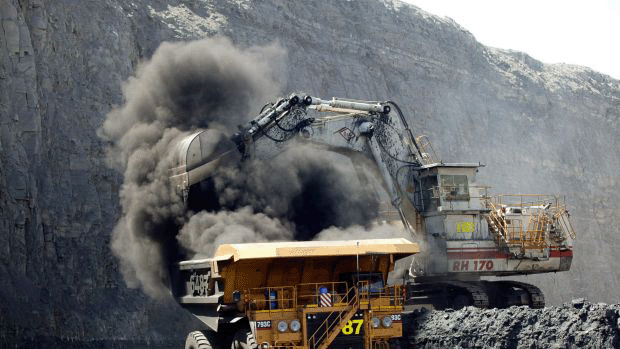 Big surge in opposition to Adani, new polling reveals, Brisbane Times, By James Massola, A growing majority of Australians now oppose the construction of Adani’s huge Carmichael coal mine, while environmental groups are ramping up pressure on Bill Shorten and federal Labor to rule out support for the project.
A poll of 3312 people, conducted by pollsters ReachTEL on January 25 and commissioned by the Stop Adani Alliance, found 65.1 per cent of Australians opposed or strongly opposed Indian mining company Adani building the new coal mine in Queensland.
The figure represents a 13.2 per cent rise – from 51.9 per cent – in opposition to the project compared to March 2017. Significantly, the latest poll found an outright majority of Nationals (55.3 per cent), One Nation (52.9 per cent), Labor (75.6 per cent) and Greens (94.2 per cent) voters all oppose the mine.
More Liberal voters (43.2 per cent) said they opposed or strongly opposed the project compared to 34.7 per cent who said they supported or strongly supported it.
The findings come a day after Mr Shorten told the National Press Club the project had to stack up commercially and environmentally for federal Labor to support it, and that more needed to be done to protect the Great Barrier Reef, which environmental groups warn will be negatively impacted by the project.
“If it doesn’t stack up commercially or if it doesn’t stack up environmentally, it will absolutely not receive our support,” Mr Shorten said………
The polling also showed 73.5 per cent support for stopping the expansion of all coal mining and accelerating the construction of solar power and storage to reduce the threat of climate change.
Australian Conservation Foundation chief executive Kelly O’Shanassy said the poll showed opposition to the coal mine was growing and was a reminder our to MPs that “they must listen to the will of the people and chart a course from our dirty coal fuelled present to a clean energy powered future”.
“We are encouraged by the comments of Opposition Leader Bill Shorten yesterday [Tuesday] that the ALP is scrutinising the merits of the dirty Adani project. Mr Shorten is right, you can’t have it both ways on climate change,” she said.
“He should reject the mine. A clear rejection of the mine and a pledge to stop it would be Mr Shorten’s Franklin River moment.”
If it goes ahead the mine would be Australia’s – and one of the world’s – largest coal mine. https://www.brisbanetimes.com.au/politics/federal/big-surge-in-opposition-to-adani-new-polling-reveals-20180131-p4yz4o.html
Australian women – no say in nuclear decisions. Time for “ME TOO in NUCLEAR” – theme for February 18
Historically, women have been excluded from Australia’s nuclear discussions and decision-making.
Today they still are. (but the “cool trendy” new nukes lobby is bending over backwards in the pretense that women are involved, and are part of the toxic nuclear industry machine)
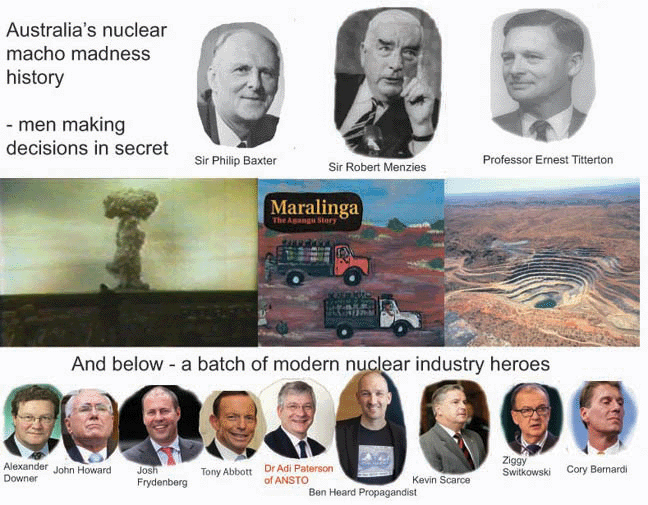
Oh dear – I did forget quite a few. For example: 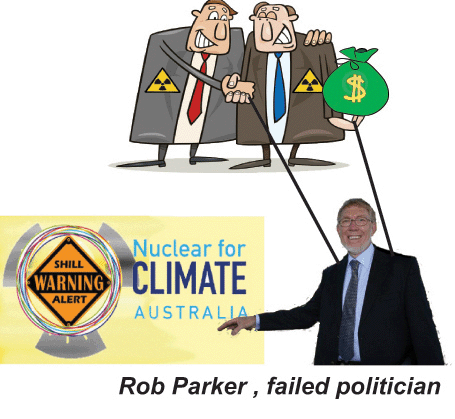
Now that Brewarrina Council in NSW is encouraging land-owners to nominate for hosting nuclear wastes, the council has engaged Robert Parker as their ‘consultant’ spin doctor! No facts, just spin.
1 This month
25 October – Film –Britain’s Nuclear Bomb Scandal: Our Story – part of the Adelaide Film Festival,
Screening and Conversation
A screening of Britain’s Nuclear Bomb Scandal: Our Story (2024) followed by a talk with 2026 Bettison and James Awardee and Tradtional Owner Karina Lester in conversation with Simone Tur.
When: Sun 25 Oct, 12:00pm-Screening, 1:15pm-Talk
Where: The Mercury
Free admission, register below by clicking on BUY TICKETS and select free event tickets, at end of web page:
https://www.adelaidefilmfestival.org/program/2026/britains-nuclear-bomb-scandal-our-story
.

Australians deserve the truth
about
AUKUS – https://aukuspublicinquiry.com/

PETITION – To: Prime Minister Anthony Albanese and the Australian Labor Government

of the week – Australians for War Powers Reform (AWPR)
To see nuclear-related stories in greater depth and intensity

