Current polling from Galaxy puts the ALP on track to win the required 47 seats for a majority, but as the Brisbane Courier-Mail reports, this will hinge on a number of factors, including unpredictable preference flows from One Nation supporters.
As at the federal level, politics in Queensland has been heavily focused on energy in the run-up to Saturday’s poll.
The Labor Palaszczuk government – which has a 50 per cent RET by 2030 for the state – has been campaigning strongly around renewables, with a particular focus on increasing rooftop solar uptakeas a way to cut power costs for businesses and homes around the state.
The new policies, launched in late October as part of the Palaszczuk government’s $2 billion Affordable Energy Plan, will offer no-interest loans to consumers wishing to invest in rooftop solar and battery storage, but lacking the up-front capital to do so.
They will also work to give landlords and renters equal access to solar, through a trial initially involving 1000 rental households. Queensland energy minister Mark Bailey said the rental solar scheme had the potential to save tenants up to 10 per cent off their annual bill, or up to $150 a year, while landlords could get a rebate of up to $520 per year.
On large-scale renewables, as we reported here, Labor, has promised to follow through on a program already underway to underwrite 400MW of renewable energy projects.
Following on from this, it has committed to support a further 1000MW of renewable energy projects via a new government power company; and to look to construct new transmission infrastructure in Northern Queensland that would unlock a vast new province of wind, solar and hydro power projects.
On the other side of the political divide, the LNP conservative coalition that is seeking to replace the current Labor government has made its intentions on energy clear: the end of renewables incentives; government money for a new coal generator in north Queensland; and support for the Adani coal mine.
The LNP is also claiming a huge reduction in consumer bills: $160 a year for two years, followed by savings of up to $460 a year in 2020.
But this is largely a mirage, as energy analyst Hugh Grant has pointed out. He noted that the only parties with policies that would deliver price reductions were the Greens, and Labor.
Not that Queenslanders got to read about that anywhere – apart from RenewEconomy, the local media refused to publish the results, as Michael West points out in this piece.
In the Conservative corner in the fight for new coal is federal minister for resources and northern Australia, Matt Canavan, who – recently restored to his portfolio – is as keen as ever to use the federal government’s Northern Australia Infrastructure Facility to help fund a new coal-fired power plant in Queensland’s north, as well as to get the Adani coal mine and port project off the ground.
One Nation is also keen to build a coal-fired power station west of Townsville, with party leader Pauline Hanson pledging to commit $1.5 billion to the project, which she wants built in Collinsville – a former coal hub of the state that is more recently turning to large-scale solar.
In fact, according to data gathered for RE’s Renewable Energy Index, the North Queensland region has more power generating capacity under construction than the entire state of NSW, and almost as much as Victoria, South Australia and Western Australia combined.
Meanwhile, Queensland home and business owners are leading the country – which in turn is leading the world – in rooftop solar uptake.
A Climate Council report last month showed that almost one third (31.6 per cent) of all Queensland homes now have solar panels, which puts the state ahead of South Australia, at 30.5 per cent, and Western Australia at 25.4 per cent.
What’s more, there are 14 postcodes in the Sunshine State alone where more than 50 per cent of households have rooftop solar, including the the Moreton Bay region town of Elimbah, where an impressive 63 per cent of homes have PV panels on their roofs.
The Australian Solar Council – newly rebranded as the Smart Energy Council – aren’t resting on their laurels, though. The peak solar industry body is spooked enough about a possible LNP victory that is has launched its own major election campaign, urging voters to put the Coalition last.
“Queensland voters face a stark choice at the election tomorrow,” the SEC said in an email to members on Friday:
“A new polluting coal-fired power station or a solar thermal plant providing 24-hour solar power; no new large-scale renewables and massive job losses or 1,000 megawatts of new large-scale renewable projects in regional Queensland; and a National Energy Guarantee that delivers the longest solar eclipse in history or sensible national energy policy.”
Our Constitution doesn’t contain an explicit paragraph for environmental protection, nor do we have a bill of rights.
Brendan Sydes said we have very few rights in our Constitution. “We don’t have the direct constitutional foundation for pursuing these sorts of actions,” he said.
“But there certainly is interest in … trying to find duties or obligations deep within our legal system that would force the Australian Government to take climate change and the need to reduce emissions farm more seriously than they are at the moment.
Dr Tom Baxter, corporate governance lecturer at the University of Tasmania, says the Federal Government hasn’t added a climate change trigger to Australia’s environment legislation. “Environmental lawyers are trying to use other mechanisms to prevent companies like Adani digging up the Galilee Basin and shipping coal out through the Great Barrier Reef.”
Greenpeace and the environmental group Youth and Nature are suing the Norwegian Government for granting Arctic oil drilling licenses.
Their argument is based on an article in the Norwegian constitution protecting the right to an environment that’s healthy and that long-term consideration be given to digging up natural resources.
Greenpeace Norway head Truls Gulowsen told Hack it all comes down to climate change and oil licenses.
“We had challenged the Norwegian state for handing out new licenses for drilling in the arctic in spite of the fact that they have signed the Paris Agreement,” he said on his way to court. “They acknowledge climate change is a problem, and they know that the world has already found more carbon, fossil carbon, than we can ever afford to burn.”
He said Norway’s constitution gives future generations the right to a healthy environment.
“[That] puts duties on the state to guarantee and safeguard those rights.”
Brendan Sydes, lawyer and CEO of Environmental Justice Australia, says the strategy used by Greenpeace goes to a country’s legal foundation, instead of working with a country’s environmental regulations. Continue reading →
Millions of dollars are being injected into the New England for large-scale renewable projects every year.
And while it might be daunting for many farmers, it’s a brave new world we have to get used to, Wind Alliance NSW organiser Charlie Prell says.
A fourth generation farmer from Crookwell and a turbine host himself, Mr Prell is holding a forum in Kentucky this week to shed light on common myths about renewable projects.
He said a major issue is when neighbouring properties are left with no say and no money while next door gets the benefits. “It’s really easy to solve,” he said. “The Wind Alliance has been promoting this thing called benefit sharing.” It’s all about strategic options for delivering ownership for wind farms in NSW, Mr Prell said.
“It’s so most people are not excluded from projects,” he said. “They probably won’t get paid as much as a host but at the moment there’s a cliff face where the host gets paid a lot and the neighbours get paid nothing.“Obviously they become disillusioned and skeptical by that process.”
Mr Prell said if neighbours are paid on a sliding scale depending on their proximity to the turbines, instead of a “cliff face” there’s a gradual decline.
“There’s no economic precedent for doing that but in small regional communities it actually makes a whole lot of social sense,” he said. Continue reading →
Northern Territory to release 50% renewables plan next week http://reneweconomy.com.au/northern-territory-release-50-renewables-plan-next-week-18260/ By Giles Parkinson on 24 November 2017 As Australia’s national energy policy enter a new hiatus – as the industry awaits some text to be inserted into the thought bubbles around the proposed National Energy Guarantee- some states and territories are getting on with their own plans.
The Labor government in the Northern Territory is expected next week, and possibly as early as Monday, to unveil the detail of its roadmap to a 50 per cent renewable energy target.
The government last year commissioned a special panel to put together the plan, which could result in some 400MW or more of mostly solar capacity in the territory over the next decade – not a huge sum by any means, but still significant given the potential investment droughts elsewhere.
The Labor government in the NT is taking a similar approach as the Labor government in Queensland with its 50 per cent renewable energy target, although the Queensland plans hinge on the outcome of the state election on Saturday. The results seem impossible to predict.
Victoria’s Labor government, meanwhile, has legislated a 40 per cent renewable energy target by 2025, and is conducting a 650MW auction – the largest ever in Australia – while the ACT has already contracted with some 700MW of wind and solar to meet its 100 per cent renewable energy target by 2020.
South Australia’s Labor government has already met its 50 per cent renewable energy target, and is keen on adding more, with numerous large scale solar, wind and storage projects lining up in the state.
Alice Springs has made a major push into solar – including 12MW of rooftop solar and the 4MW Uterne solar system (the first large scale system in Australia) – and is installing a 5MW battery storage unit to help allow more solar into its small grid.
The Department of Defence is also making a major push into solar, announcing tenders for a total of 12.5MW of utility-scale solar for the RAAF base and barracks in and around Darwin.
It was chaired by remote power system expert Alan Langworthy, and including Katherine Howard, former Australian Renewable Energy Agency chair Greg Bourne, Climate Council CEO Amanda McKenzie, and Lyndon Frearson, the head of solar and storage specialists Ekistica.
A National Energy Guarantee could be bad news for the ACT, Canberra Times, Katie Burgess , 24 Nov 17, A National Energy Guarantee could risk years of ACT energy policy and force Canberrans to pay more, ACT climate change minister Shane Rattenbury has warned.
The Greens minister met with his state and federal counterparts at the COAG Energy Council meeting in Hobart on Thursday and Friday.
But Mr Rattenbury said he was concerned that the guarantee would “stymie” new sources of renewable energy, the emission targets were too low, the agreement too short and the modelling was tailored to “inflate the apparent cost-savings”.
He also said an “artificially suppressed” wholesale price would impact on the contract-for-difference model the ACT used as part of its plan to go 100 per cent renewable by 2020.
Through its reverse auctions, ActewAGL pays each large-scale renewable energy generator the difference between their feed-in tariff and the current wholesale price per megawatt hour.
However when wholesale prices are higher than the feed-in tariff, the generator pays ActewAGL and the savings are passed onto customers.
That model has insulated Canberra customers from future price rises.
But if the wholesale price was pushed down, Mr Rattebury said the ACT could pay more.
“We are concerned it will suppress artificially prices in the wholesale market and we believe the wholesale market is an effective means of driving good energy outcomes so the transition across to a certificate-based approach we think distorts the price signalling effect the labour wholesale market is designed to operate,” Mr Rattenbury told a stakeholder meeting.
“As a jurisdiction it’s particularly problematic for us because we have set ourselves on a pathway that’s premised on having an effective wholesale price. For our consumers it’s going to represent a potentially significant cost increase because of the way our electricity contracts are set for the next 20 years.”………
The federal government chose not to adopt the Clean Energy Target recommended by Chief Scientist Alan Finkel, instead opting for a National Energy Agreement which would require energy retailers to meet a reliability and emissions guarantee.
The reliability guarantee compels retailers to make a proportion of electricity available from “dispatchable” sources like batteries, hydro or gas, that can be switched on when demand is high.
The emissions guarantee requires retailers to cut their greenhouse emissions by 26 per cent on 2005 by 2030.
The energy guarantee won’t apply to Western Australia and the Northern Territory, meaning those two jurisdictions will have no federal emissions reduction policy after the Renewable Energy Target is scrapped in 2020.
The ACT and South Australia called on the federal government to model the cost of a Clean Energy Target and a Renewable Energy Target as well but they refused.
Mr Rattenbury that was “deeply concerning”.
“We know the National Energy Guarantee is the fourth or fifth best choice because that’s what the backbench watered it down to.
It is notable that as late as two days before Australia’s energy ministers gathered in Hobart, the Turnbull government was still hoping to secure in-principle support for its national energy guarantee.
“Expecting us to sign up was a ridiculous proposition,” Lily D’Ambrosio, Victoria’s energy minister told Fairfax Media, adding there was a “massive pushback” against such undue haste.
So it’s perhaps no wonder the resulting COAG communique was unusually thin.
Indeed, the first pass at modelling the vaguely outlined policy was only completed and shared a few days earlier. Modelling can be made to do almost whatever you want it to do. That’s especially the case when the modeller – in this case, Frontier Economics – wasn’t commissioned to compare outcomes for other schemes.
South Australia and the ACT tried to have the Energy Security Board – which is supposed to answer to all COAG members but so far has served as chief cheerleader of the guarantee – expand the next stage of modelling to consider other options.
While on the face of it a reasonable request, the bid stirred anger from at least one other state because Josh Frydenberg, the environment and energy minister, would never have got such a proposal near his partyroom for approval.
More number crunching in any case may not be the answer – at least, not until the design of the two elements of the guarantee to curb emissions and boost reliability are better defined.
A better approximation of the market distortions caused by relying on the electricity retailers to carry the guarantee obligations – rather than generators, as other programs such as an emissions intensity scheme, would require – may also reveal smaller savings for consumers than being touted.
Closer scrutiny of the guarantee modelling to date only fans doubts.
As South Australia’s Tom Koutsantonis notes, renewable energy schemes of Victoria and Queensland have largely been ignored, while the massive Snowy 2.0 pumped hydro scheme that hasn’t passed a feasibility study is assumed as operating.
The emissions trajectory also falls far short of what has otherwise been projected for the electricity sector – an industry that accounts for about a third of Australia’s carbon pollution.
As Dylan McConnell of Melbourne University notes, the modelling to date has been based on sector emissions for the National Electricity Market, totalling 1352 million tonnes of carbon-dioxide equivalent for 2021 to 2030.
Separate work by the government’s Climate Change Authority last year, however, projected electricity sector emissions of 1600 MT of CO2 for the whole 2020-50 period, and included Western Australia and the Northern Territory in that total.
Compared with the Authority’s work then, the national energy guarantee would leave less than two years’ of current power sector emissions for the entire 20 years after 2030, he says.
It really does look like there’s a lot more work to be done.
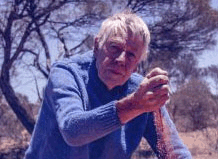
In his enthusiasm Mr Baker seems unaware that the processed nuclear waste returning from France is classified there as high level waste. The proposed dump for radioactive wastes in outback Australia is obviously intended to store those long-lasting toxic wastes. Australia’s nuclear reactor in Lucas Heights, Sydney produces these dangerous wastes, just the same as any other nuclear reactor.
The Leonora man behind plan for a radioactive waste dump in outback WA, ABC Goldfields ,By Jarrod Lucas, 23 Nov 17, A mining entrepreneur who came to WA’s northern Goldfields during the 1960s nickel boom is behind a new bid to develop an outback repository to store the nation’s radioactive waste.
The Shire of Leonora this week voted 5-2 in favour of joining forces with a private company, headed by former councillor Glenn Baker, to make a bid for Commonwealth funding to fast-track the project.
The council sought legal advice and waited until after last month’s local government elections before voting on the proposal to store medical, industrial and scientific waste underground.
The proposed site is on Clover Downs pastoral station, about 20 kilometres north-west of Leonora……..
Conflict of interest was a deal breaker for council
Mr Baker is a director of Azark Project Proprietary Limited alongside his business partner, Perth-based corporate lawyer and mining executive Peter Remta, with whom he has developed several gold mining projects since the 1980s.
The 79-year-old was behind a previous proposal for a waste storage site that failed to progress in 2015, and he quit the council last month after more than 30 years because of the conflict of interest.
“Now there is no conflict of interest, but it did come up a few times and I left the meetings on those occasions,” he said………
Residents could be offered shares in waste company
Mr Baker flagged the possibility of Leonora residents eventually being given the opportunity to invest in the company.
Sites in South Australia and the Northern Territory have been considered, but lengthy environmental assessments and community consultation mean a final decision is not expected until next year…….
Sites in South Australia and the Northern Territory have been considered, but lengthy environmental assessments and community consultation mean a final decision is not expected until next year……..
Traditional landowner Vicky Abdullah said she had previously organised a petition with 500 signatures opposing the project.
“From my point of view, they can do it somewhere else, not in Leonora,” she said.
Ms Abdullah said the local Indigenous community was yet to be effectively consulted about the revived proposal.
Environmentalists opposed to facility in outback WA
Australian Conservation Foundation nuclear campaigner Dave Sweeney said it was a long way from a “bad council decision” to a national radioactive waste dump in outback WA.
“It is pretty much radioactive groundhog day,” he said.
“It’s come up before in Leonora, and there was a strong and negative response from many there in the community.
“I’m obviously disappointed Leonora has put itself back in this frame, because it’s a divisive place to be.”
Mr Sweeney suggested it would not just be for low-level radioactive material.
“This has nothing to do with nuclear medicine, and everything to do with the operations of the Lucas Heights reactor,” he said.
Mr Baker disputed that point, saying it was one of the misconceptions about what was being proposed.
“People are confused when we talk about radiation … this is not a nuclear waste disposal facility,” he said.
“Australia does not have a nuclear industry, so has no nuclear waste to bury. That’s uranium 235 which is used in atomic bombs, powerhouses etc.
Australia facing climate disaster on its doorstep, government’s white paper warns
Foreign policy paper says climate-related conflict and migration could put Australia’s economic interests under pressure, Guardian, Katharine Murphy, 23 Nov 17,Climate change is creating a disaster on Australia’s doorstep, with environmental degradation and the demand for sustainable sources of food undermining stability in some countries, especially “fragile states”, according to the Australian government’s first foreign policy white paper in more than a decade.
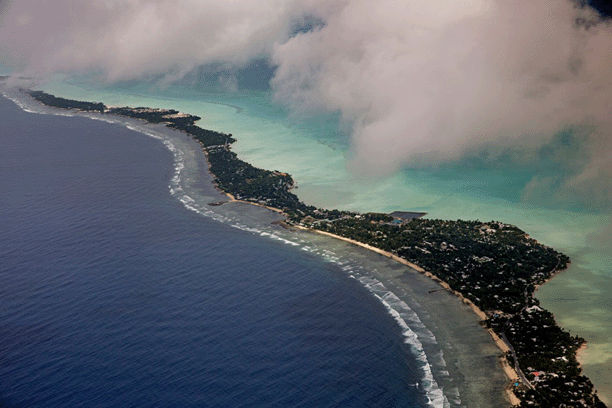
The new white paper, released on Thursday, contains warnings over the disruptive effects of climate change in Australia’s immediate region, noting that many small island states will be “severely affected in the long term”, and the coming decade will see increased need for disaster relief.
The white paper notes the demand for water and food will rise, with the world’s oceans and forests under intense pressure. It notes climate change and pressure on the environment could contribute to conflict and irregular migration, impacting specifically on Australia’s economic interests.
no amount of corporate black washing – including Indigenous participation plans that champion strong and effective relationships between Adani and W&J, alongside jobs and traineeships – can hide Adani’s direct and immediate part in walking over the rights of Traditional Owners.
Traditional Owners Expose Adani’s Relentless Pursuit of W&J Country, New Matilda By Kristen Lyonson
In the third in a five part series on the proposed Adani Carmichael coal mine, Kristen Lyons looks at a deal struck between the miners and the local traditional owners, and why it just adds to the smell that pervades the entire project.
Introduction
The Indian industrial conglomerate, Adani Enterprises – well known for environmental damage and human rights abuses at its project sites around the world, and built upon a complex business structure with tax havens in the Cayman Islands – entered Australia in 2010 with the purchase of coal tenements in the Galilee Basin, in Central Queensland.
Despite its controversial back story, some of which has only come to light since approvals were granted for its Australian project, Adani quickly rose to become a poster child for the State Government, based on promises its Carmichael mine project would deliver jobs and economic growth for regional Queensland.
Managed by its domestic arm, Adani Mining Pty Ltd, over the following years it developed a project proposal that included a coalmine, as well as rail and port infrastructure, thereby opening up the massive Galilee Basin for coal exports.
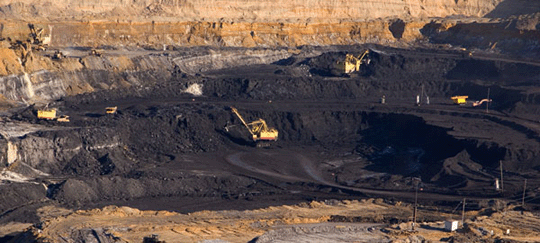
With seven years gone since acquisition of the coal tenements, and marred by substantial project downsizing, Adani is yet to start construction of its mega mine. Wangan and Jagalingou Traditional Owners Family Councils’ (W&J) defiant opposition to Adani’s proposed Carmichael mine has been central to this delay; opposition that has, in itself, exposed the dirty deeds Adani is willing to perpetrate against Traditional Owners who seek to defend their right to say no to a mine that would destroy their country.
This article exposes some of Adani’s deeds, including its nefarious actions in reaching an ‘agreement’ with Traditional Owners, Continue reading →
Queensland election: Palaszczuk refuses to rule out Adani mine road upgrade funding, ABC, By Chris O’Brien, 23 Nov 17, Premier Annastacia Palaszczuk has not ruled out helping central Queensland councils upgrade roads for Adani’s planned Carmichael mine.
Ms Palaszczuk previously stated that taxpayers’ money would not be provided for the mine.
The Greens outline their balance of power demands, Brisbane Times, By Felicity Caldwell, 23 Nov 17, Banning cash-for-access meetings, scrapping the royalty holiday to Adani and $1 public transport fares will be among the Greens’ demands if the party holds the balance of power in the Queensland Parliament.
Fairfax Media can reveal the list of seven key demands from the minor party ahead of Saturday’s state election………
The Greens’ negotiating demands are:
Ban corporate donations and cash-for-access meetings
End the social housing waiting list and address homelessness, by building enough homes to get 29,000 people off the social housing waiting list and house 20,000 homeless people
Scrap the royalty holiday for Adani, revoke Adani’s mining licence and access to ground water…….
The Greens’ campaign has been bolstered by an Essential Research poll of 430 people, which shows the party ahead in South Brisbane, currently held by Labor Deputy Premier Jackie Trad.
The poll has the Greens on 36 per cent of the first preference vote, 32 per cent to Labor, 24 per cent to the LNP and 8 per cent not sure.
However, the LNP will list the Greens last on its how-to-vote cards, which should give Ms Trad a boost in the two-party preferred count.
Qld farmers and graziers afraid to speak out against the Adani mine, says Bruce Currie, ABC AM By Katherine Gregory 23 Nov 17 It’s not just urban southern greenies and pro-coal country Queenslanders involved in the Adani debate — farmers and graziers in the north are also voicing their concerns. In north and central parts of Queensland, some say they are worried about the environmental impacts of the mine and their future livelihood.
Bruce Currie, who has land near Jericho, about 100 kilometres from the Adani site, said many graziers in the Galilee basin were worried about their groundwater security.
“The people I have spoken to on the actual site are very concerned,” he said.
“Because any discussions they’ve had with Adani, the company has not been prepared to accept the onus of proof.
“Court cases have shown it is going to be extremely hard, if near nearly impossible, for landholders to get their water supplies secure if they have to prove it’s a mining company that destroyed them.”
However, farmers like Mr Couture concerned about the mine face desperation for jobs in the region.
Mr Couture said though publicly the media was reporting that Bowen was pro Adani, in truth the town was split on the issue.
“I would say it’s 50/50. The silent majority is not game to talk in public, because you could upset your neighbour, you could upset your family, you could upset people that are pro Adani,” he said.
Mr Currie, who is running as an independent in the electorate of Gregory for the state election, said while Adani spoke about developing the Galilee Basin, that was not really happening.
“Once those mines have been and gone within the lifetime of my kids, there will be no mines, there will be no resources and no royalties, and they would have destroyed our water for perpetuity,” he said.
Concern about the mine has also extended hundreds of kilometres further east to Bowen, about three hours drive south of Townsville.
Dennis Couture, a fruit and vegetable grower in Bowen, said the growing region and Great Barrier Reef could be under threat in the future.
“For the future generation, to be able to give them something that won’t be destructed and wrecked,” he said.
However he said he mostly unhappy with what appeared to be a double standard by the Queensland Government.
“The Government will permit Adani to use as much water as they want,” he said.
Forget COAG – how durable is Coalition support for the NEG?
When the NEG was nebulous, its boosters were able to promise all things to all people. Now, with slightly more detail out, it will be a really hard sell.
COAG agrees to put wind and solar sectors in no-man’s land
COAG agrees to commission more design work on the Turnbull government’s proposed National Energy Guarantee, forcing the renewable energy industries in Australia into yet another period of policy uncertainty.
Queensland poll could be a show-stopper for solar, and consumers
As Queensland prepares to vote in the state election on Saturday, we look at what’s at stake for the renewables industry – particularly if Labor loses.
Delta Energy Systems charges EV convoy to top of Cradle Mountain
This is the first event where electric vehicles demonstrated that the drive from Devonport to Cradle Mountain, a popular tourist destination, is entirely possible using standard production EVs currently available in Australia.
NEG is supposed to be better than nothing. But is it?
The NEG is yet another case of Australian exceptionalism in energy, typical of the toxic mix of muddled thinking and ideology that dominates regulatory oversight of this industry.
HOWZAT! Adelaide over on front foot with project putting energy efficiency up in lights
Adelaide Oval has unveiled a world class audience experience created through a CEFC-financed major lighting upgrade that goes all out to put substantial runs on the energy efficiency scoreboard.
How tech nerds can reinvent electricity before it’s too late
There’s a growing mob that thinks it can reinvent electricity, from old to new, and from a supply-dominated industry-based model to consumers-in-control.
CEFC targets energy hungry shopping centres, with $200m finance deal
CEFC tips $200m debt finance into QIC’s Global Real Estate flagship Shopping Centre Fund, in deal expected to deliver energy savings of between 30-40% using solar and energy efficiency.
Is NEG just an elaborate plan to fund Turnbull’s vanity project?
Latest advice from Energy Security board makes it clear that on current policy settings the NEG will not reduce emissions, cut costs or invite new wind and solar investment. But there may be something else afoot – Malcolm Turnbull’s vanity project.
Anti-Adani protesters defy council, police in last-ditch action before election, SMH, Toby Crockford , 21 Nov 17 More than 200 anti-Adani activists have defied council and police by gathering in the heart of Brisbane for a last-ditch protest just days before the Queensland election.
Organisers hinted there could be mass arrests on Tuesday evening after Brisbane City Council and the Queensland Police Service refused to issue permits for the action, but despite a strong police presence, no arrests were made…….
Cr Sri also asked protesters to take pictures from the rally and post them onto social media in order to generate discussion about the Adani proposal in the days before voters head to the polls.
“No one wants the coal, the business model’s all wrong,” he sang.
“And if the trucks start to roll, you better bet we’re locking on.
“There are thousands of us, our supporters number millions, we’re gonna mobilise, a whole army of civilians.
25 October – Film –Britain’s Nuclear Bomb Scandal: Our Story – part of the Adelaide Film Festival,
Screening and Conversation
A screening of Britain’s Nuclear Bomb Scandal: Our Story (2024) followed by a talk with 2026 Bettison and James Awardee and Tradtional Owner Karina Lester in conversation with Simone Tur.
When: Sun 25 Oct, 12:00pm-Screening, 1:15pm-Talk
Where: The Mercury
Free admission, register below by clicking on BUY TICKETS and select free event tickets, at end of web page: