1 November More REneweconomy news
-
 Gupta plans to take Sydney, Melbourne steel plants 100% renewableGupta says bigger steel plants in Sydney and Melbourne will go 100% renewable, and there is no reason why an aluminium smelter could not follow.
 -
Five reasons not to build new coal plant in QueenslandClimate Council report on Queensland renewables offers timely reminder that building a new coal plant in the state’s north is a terrible idea.
-
Explainer: The big 3 projects making South Australia capital of battery storageThe 100MW/100MWh battery storage project proposed for Whyalla is one of three big projects that will make South Australia the leader in battery storage, as well as wind and solar.
-
NEG must grow new renewable energy capacity, not shrink itIt remains unclear how the NEG will ensure the investor confidence required to deliver a strong pipeline of new clean energy projects.
-
Battery of the Nation worthy of national significanceBattery of the Nation would double Tasmania’s renewable energy capacity from 2,500MW to about 5,000MW, through a combination of pumped hydro storage development, private wind power development, and boosting the efficiency of existing hydropower assets.
-
Vector wins new Australian smart metering contractVector has announced it has executed a contract to provide metering services to EnergyAustralia with an initial three-year deployment period that will commence before the end of 2017.
-
LONGi selected into “New China Nifty 50” by Goldman SachsRecently, the world’s largest investment bank Goldman Sachs selected 50 stocks reflecting the Chinese economy at the new stage, known as the “New China Nifty 50”.

Shock Jock Alan Jones comes out swinging against Adani coal megamine project
“I’m not so stupid as not to understand the money is being tipped into major political parties with a view to getting an end result they seek, including a billion dollars of taxpayers’ money to build a railway line. Why? When they get the railway line they believe further mine approvals will be given and make a fortune out of the coal traffic along the railway line. This is smelly no matter how it’s viewed.”
Alan Jones Cries Conspiracy Over Adani’s Carmichael Coal Mine, “This is smelly no matter how it’s viewed.” Veteran radio broadcaster Alan Jones unleashed a scathing rant against Adani’s proposed $21 billion Carmichael mine on Monday night, criticising the connections the Indian group has in Australian politics through foreign donations.
“There’s something very smelly about this that the Federal Liberal Government, the Federal Labor Opposition, the Queensland Labor Government and the Queensland Liberal Opposition all have got their hands up saying they’re going to support this entity,” he said.
Australia’s clean energy transition is underway – and fast!
 Time for Australia to wake up to scale and pace of clean energy transition, REneweconomy By Giles Parkinson on 1 November 2017 UK billionaire Sanjeev Gupta is a very rich man, with a very big business that consumes a lot of energy.
In the last few months he has come to the same conclusion as tens of thousands of Australian homeowners and thousands of businesses, big and small: the best way to cut your bill for energy is to generate your own.
Gupta this week unveiled the details of his plans to build 1 gigawatt of large-scale solar, battery storage, pumped hydro and demand management for the Whyalla steel works and other big energy users in South Australia.
Gupta reckons it will slash his company’s energy bills by around 40 per cent, and he intends to repeat the dose in his even bigger steel plants in Melbourne and Sydney, which he says will be powered 100 per cent by renewable energy within a few years.
Most businesses reckon they can achieve similar savings, which is why the likes of Nectar Farms are turning to wind and battery storage for a $750 million investment in a new glass house and energy park near Stawell in Victoria, and why zinc refiner Zinc Metals is turning to solar to slash the costs of electricity in north Queensland and, like Gupta, help to expand the business.
It’s why Telstra has contracted to take the output of a 72MW solar farm in Queensland, and will do the same with many more such facilities; it’s why Foster’s Brewing is going 100 per cent renewables;why Woolworths is also turning to solar, along with countless other large retailers, and mining groups.
Households can do even better. The pay-back for a rooftop solar system is probably less than five years – for an asset that will last 25 years. The savings on an electricity bill, even without the generous “premium” tariffs that too many still enjoy, are well over 50 per cent.
As Gupta says, and nearly two million household and businesses understand, it’s not a difficult equation. The cost of solar has plunged 90 per cent in the last five years, and the cost of storage is following suit.
The cost of grid power, on the other hand, has more than doubled…… http://reneweconomy.com.au/time-for-australia-to-wake-up-to-scale-and-pace-of-clean-energy-transition-
Well deserved award for RenewEconomy founder Giles Parkinson
 RenewEconomy founder Giles Parkinson wins award, as RE page views hit 25 million, http://reneweconomy.com.au/reneweconomy-founder-giles-parkinson-wins-award-as-re-page-views-hit-25-million-61271/ RenewEconomy founder and editor Giles Parkinson on Monday was announced as the winner of a major environmental prize, the Deni Greene award, as the cumulative total of page views on the website passed 25 million.In a ceremony in Hobart on Monday, the prize for environmental leadership in a professional capacity was presented to Giles by Bob Brown, the head of the Bob Brown Foundation and the former Senator and Australian Greens leader.
Also receiving awards were Stop Adani activists Adrian Burragubba, (Environmentalist of the Year), Murrawah Maroochy Johnson (Young Environmentalist of the Year), and Ken Peters-Dodd, on behalf of Reef Defenders (Community Environment Prize).
Brown said it was appropriate that the prizes went to activists working to stop the Adani mega coal mine, given that it was a landmark issue that ranked in importance with the Franklin Dam campaigns in Tasmania in the 1980s.
Brown quoted polls that showed the overwhelming majority of Australians were opposed to the mine. Yet, he noted, in the last federal election, 90 per cent of votes were made for parties that do not oppose the project. (The Greens are the only party that do).
Parkinson said he was delighted to receive the reward, and the recognition of RenewEconomy’s growing stature as a source of news, information and analysis that is all but impossible to find in mainstream media.
Deni Greene was a US energy expert, who first came to Australia to advise on energy efficiency and co-generation projects to provide an alternative to damming the Franklin River and building other dams.
She became a leading expert and helped design some of Australia’s formative climate change and clean energy policy documents.
Alan Pears, a previous winner of the award, told RenewEconomy that in 1990 Greene led a project that produced a report showing how Australia could cut its emissions by 20 per cent by 2005 – and benefit from this effort by $6 billion.
“She was mercilessly attacked by the energy establishment, and paid a high price in lost work. But that study was very solid – it just challenged the group-think about the cost and practicality of addressing climate change. In another decade or so, many people will realise she was right,” Pears said.
And as a sign of that growing interest in climate and clean energy solutions, RenewEconomy’s total page views since its launch in 2012 has soared through 25 million in October.
Page views have grown 50 per cent over the last 12 months and now average around 800,000 per month. Monthly unique visitors average nearly 300,000 – an extraordinary number for a niche publication.
Parkinson said that readers were attracted to the website’s two major themes: the falling costs and exciting developments in renewable and storage and grid technologies, and the growing frustration with policy design, politicians and regulators.
1 November REneweconomy news
-
-
Is there a future for ‘pro-nuclear environmentalism’?Nuclear lobbyists – especially the self-styled ‘pro-nuclear environmentalists’ – are few in number. So how much longer can they keep flogging a dead horse?
-
Could Tesla have bigger plans for Australia than the Big Battery?A comment posted, and then deleted, by Tesla marketing has piqued interest in the EV maker’s plans for Australia.
-
Graph of the Day: Victoria nears 50% renewables over weekendHot and windy Spring weather saw Victorian solar and wind power generate enough to meet to 44.6 per cent of local demand on Sunday.
-
Labor needs to head left, and drop Adani, to win Queensland pollQueensland Premier Annastacia Palaszczuk today called the state election for 25 November, about two months before the three-year anniversary of Labor’s shock win in January 2015.
-
Know your NEM: Climbing a wall of worry over wind and solarWind and solar PV account for 54 per cent of demand in South Australia since the closure of Hazelwood, and the grid is still functioning.
-
“Shame on you:” Frydenberg admits he doesn’t have rooftop solar60 Minutes interview reveals Australia’s energy and environment minister has not installed rooftop solar at his family home – and why.
-
-
Concerns over 5-minute rule as ESB warns of perils of wind and solarESB briefing raises concerns about future of 5-minute rule, its description of wind and solar as a threat to the system, and the hiring of Frontier Economics to do its modeling.
Top spinner Michael SHILLenberger to spread pro nuclear falsehoods in Australia
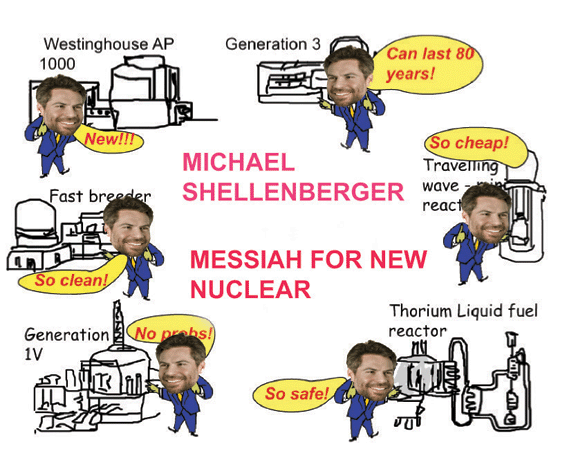
The nuclear power industry is having one of its worst ever years. Environmental Progress is warning about nuclear power’s “rapidly accelerating crisis” and other pro-nuclear lobbyists have noted that “the industry is on life support in the United States and other developed economies“.
Is there a future for ‘pro-nuclear environmentalism’? Jim Green, 30 Oct 2017, http://reneweconomy.com.au/is-there-a-future-for-pro-nuclear-environmentalism-94038/
Michael Shellenberger is visiting Australia this week. He has been a prominent environmentalist (of sorts) since he co-authored the 2004 essay, The Death of Environmentalism. These days, as the President of the California-based ‘Environmental Progress’ lobby group, he is stridently pro-nuclear, hostile towards renewable energy and hostile towards the environment movement.
Shellenberger is visiting to speak at the International Mining and Resources Conference in Melbourne. His visit was promoted by Graham Lloyd in The Australian in September. Shellenberger is “one of the world’s leading new-generation environmental thinkers” according to The Australian, and if the newspaper is any guide he is here to promote his message that wind and solar have failed, that they are doubling the cost of electricity, and that “all existing renewable technologies do is make the electricity system chaotic and provide greenwash for fossil fuels.”
Trawling through Environmental Progress literature, one of their recurring themes is the falsehood that “every time nuclear plants close they are replaced almost entirely by fossil fuels”. South Korea, for example, plans to reduce reliance on coal and nuclear under recently-elected President Moon Jae-in, and to boost reliance on gas and renewables. But Shellenberger and Environmental Progress ignore those plans and concoct their own scare-story in which coal and gas replace nuclear power, electricity prices soar, thousands die from increased air pollution, and greenhouse emissions increase.
Fake scientists and radiation quackery
Environmental Progress’ UK director John Lindberg is described as an “expert on radiation” on the lobby group’s website. In fact, he has no scientific qualifications. Likewise, a South Korean article falsely claims that Shellenberger is a scientist and that article is reposted, without correction, on the Environmental Progress website.
Shellenberger says that at a recent talk in Berlin: “Many Germans simply could not believe how few people died and will die from the Chernobyl accident (under 200) and that nobody died or will die from the meltdowns at Fukushima. How could it be that everything we were told is not only wrong, but often the opposite of the truth?”
There’s a simple reason that Germans didn’t believe Shellenberger’s claims about Chernobyl and Fukushima ‒ they are false. Shellenberger claims that “under 200” people have died and will die from the Chernobyl disaster, but in fact the lowest of the estimates of the Chernobyl cancer death toll is the World Health Organization’s estimate of “up to 9,000 excess cancer deaths” in the most contaminated parts of the former Soviet Union. And of course there are higher estimates for the death toll across Europe.
Shellenberger claims that the Fukushima meltdowns “killed precisely no one” and that “nobody died or will die from the meltdowns at Fukushima”. An Environmental Progress report has this to say about Fukushima: “[T]he science is unequivocal: nobody has gotten sick much less died from the radiation that escaped from three meltdowns followed by three hydrogen gas explosions. And there will be no increase in cancer rates.”
In support of those assertions, Environmental Progress cites a World Health Organization report that directly contradicts the lobby group’s claims. The WHO report concluded that for people in the most contaminated areas in Fukushima Prefecture, the estimated increased risk for all solid cancers will be around 4% in females exposed as infants; a 6% increased risk of breast cancer for females exposed as infants; a 7% increased risk of leukaemia for males exposed as infants; and for thyroid cancer among females exposed as infants, an increased risk of up to 70% (from a 0.75% lifetime risk up to 1.25%).
Applying a linear-no threshold (LNT) risk factor to the estimated collective radiation dose from Fukushima fallout gives an estimated long-term cancer death toll of around 5,000 people. Nuclear lobbyists are quick to point out that LNT may overestimate risks from low dose and low dose-rate exposure ‒ but LNT may also underestimate the risks according to expert bodies such as the US National Academy of Sciences’ Committee on the Biological Effects of Ionizing Radiation.
Attacking environment groups Continue reading
Australia’s Foreign Minister Julie Bishop ‘s timely warning on the danger if USA were to scrap the Iran nuclear agreement
 Julie Bishop warns Donald Trump’s Iran backflip could weaken pressure on North Korea, SMH, David Wroe, 29 Oct 17,
Foreign Affairs Minister Julie Bishop has said there is a “powerful argument” that US President Donald Trump’s threat to scrap the Iran nuclear deal could imperil efforts to negotiate a peaceful outcome with North Korea.
In a significant sharpening of Australia’s public rhetoric on the Obama-era Iran agreement, Ms Bishop said she had asked US officials, including Secretary of State Rex Tillerson, how they would counter the argument that North Korea could not trust the US if it walked away from previous international agreements…..
The US President vowed during his election campaign to tear up the deal, but this month kicked the issue to the US Congress, effectively demanding it either come up with a tougher approach or he would follow through on his threat to scrap it.
By endorsing the argument that ditching the deal could set back efforts to negotiate with North Korea over its nuclear program, Ms Bishop has taken the firm, if diplomatically sensitive position, of pressuring the White House not to push ahead with what many international experts say would be a self-defeating move but one in which Mr Trump is personally invested.
Ms Bishop said she had discussed the matter with American officials last month after Iran mounted the argument to the United Nations General Assembly that the US would lose credibility including in its stand-off with North Korea.
“Iran was immediately on the front foot saying … ‘Why would North Korea sit down and negotiate with the United States as we, Iran did, if the United States feels that it’s able to walk away from an agreement that was embodied in a UN Security Council resolution?'” Ms Bishop told Fairfax Media…….http://www.smh.com.au/federal-politics/political-news/bishop-warns-trumps-iran-backflip-could-weaken-pressure-on-north-korea-20171027-gz9t0j.html
Anti Adani coal mine protests to be a continuing feature of Queensland election
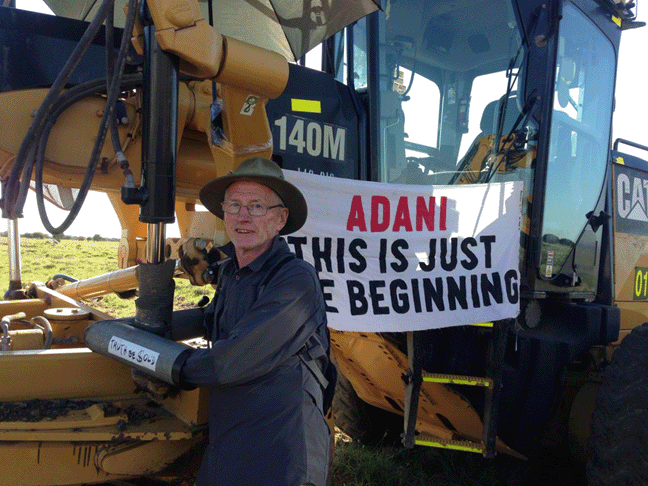 Anti-Adani protests to dog Qld election, Herald Sun, Ed Jackson, Australian Associated Press, October 29, 2017 Anti-Adani protesters have tried to upstage Annastacia Palaszczuk as she tried to kick of the Queensland election……Anti-Adani protesters were also waiting outside Government House when she called on the acting governor Catherine Holmes to request writs be issued for the November 25 election.
What High Court ruling means for climate, renewables
 Joyce out, Canavan in, Roberts out – What High Court ruling means for climate, renewables, http://reneweconomy.com.au/updated-joyce-out-canavan-in-roberts-out-what-high-court-ruling-means-for-climate-renewables-20175/ By Sophie Vorrath on 27 October 2017 Australia’s deputy prime minister and leader of the National Party, Barnaby Joyce, is headed for a by-election, after the High Court ruled him ineligible to hold his seat due to his dual Australia-New Zealand citizenship.
The ruling – which has also disqualified fellow “citizenship 7” members, Nationals Deputy Fiona Nash, Greens Senator Scottt Ludlam, Greens Deputy Larissa Waters, and Pauline Hanson’s One Nation party senator, Malcolm Roberts – leaves the Turnbull government without its one seat majority in the House of Representatives. At least until the result of the December by-election.
But what does it mean for the clean energy and climate policy debate in Australia?
For starters, the Court’s decision removes Parliament’s chief flat-earther, in Malcolm Roberts – although he is not the only federal parliamentarian to deny climate change (see Fiona Nash, below).
On energy, Roberts – like Hanson’s One Nation – is broadly anti-renewables and pro-fossil fuels. He notably anointed the Turnbull government’s National Energy Guarantee as both “atrocious”, but also in line with the his party’s desire for the RET to be scrapped and its support of “clean coal.”
In a speech to the Minerals Week Seminar, the deputy PM painted a picture of a nation under attack from a sort of economy destroying “green peril” that would shut down coal power plants, kill coal exports and – of course – turn the lights out.
“Around about January, ladies and gentlemen, families are going to come back from holiday, mum and dad are going to go back to work, mum’s going to turn on the air conditioner, get the kids ready for school, school’s going to turn on the power, and if we don’t watch out, the lights are going to go out,” Joyce said.
“And this will be a salutary lesson on how economics really work. A salutary lesson against the fatuous economics that’s being peddled.
(“In the) Galilee Basin, we are in the fight of our lives trying to open up a mechanism that will create wealth for this nation. Total insanity!” he said. “What’s one of our biggest exports, or our biggest export? Coal. And what are we making the argument against? That we should use coal. It’s absurd. …I just don’t get it.”
Joyce also doesn’t get climate science, and like his compatriot, Fiona Nash, is skeptical about the research credentials of global warming. Look….I just – I’m always skeptical of the idea that the way that anybody’s going to change the climate – and I’m driving in this morning and we’re driving through a frost – is with bureaucrats and taxes,” he told conservative commentator and noted climate denier Andrew Bolt in an interview in 2015.
“All that does is….it’s a self-fulfilling prophecy. I make you feel guilty so I can get your money and put it in my pocket and send reports backwards and forth to one another,” he said.
But Joyce may not be gone for long. The by-election is expected to be held very soon, probably December 2, and Joyce is expected to win,
And Joyce’s brief absence should be countered by the safe return of Matt Canavan, the Queensland Nationals Senator who, along with SA independent Nick Xenophon, was cleared by the High Court, despite having dual Italian citizenship. The Court ruled that Canavan did not know about his Italian citizenship, and so could not have taken all reasonable measures to renounce it.
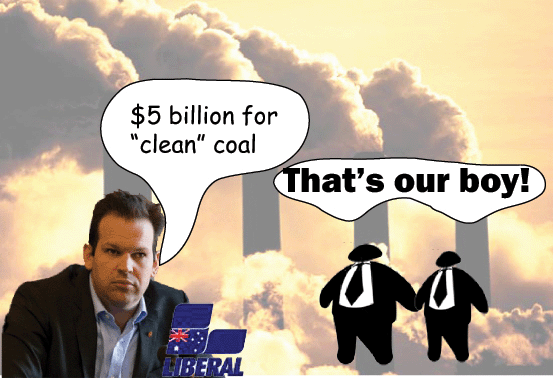 Canavan, who has already been reinstated as the federal minister for resources and northern Australia, was recently dubbed the “minister for the mining sector”, after his heartfelt farewell to the sector when the citizenship scandal first reared its ugly head in July and he stepped aside.
“It has been such an honour to represent the Australian mining sector over the past year,” he wrote on Facebook. “From the small, gambling explorers and prospectors to the large, world-beating multi-nationals, the industry provides rich and diverse experiences that can take you to the smallest towns of outback Australia to the biggest cities in the world.”
The note sparked instant outrage from readers, who noted Canavan was “supposed to represent the people of Queensland, and not private mining companies.” We will see whether his priorities have changed any when he returns to work.
The disqualification of Nationals Senator number three – and deputy leader of that party – NSW Fiona Nash (minister for regional development) could be chalked up as a small win for climate policy. Nash, like Joyce, is skeptical about the science, telling Sky News last year “I don’t think it is certainly necessarily settled.”
To Malcolm Roberts, it is farewell, after just one year in Parliament. During this short period of time, Roberts has distinguished himself by repeatedly denying the human influence on climate change; by introducing a hoax “conceptual penis” research paper to Parliament in an effort to undermine the validity of peer reviewed science; and asked Chief Scientist Alan Finkel if it was important for scientists to have an open mind, to which Finkel responded: “yes, but not so much that your brain leaks out.”
In a statement on Friday afternoon, Roberts said he was sad to leave federal parliament, but accepted the High Court decision entirely. Probably because it’s not based on science. Roberts will now run for the seat of Ipswich – the “heart of One Nation” – in Queensland state politics.
One Nation, meanwhile, still holds four seats in federal parliament. Next in line for Roberts’ seat is Fraser Anning – a publican from the Queensland coal region of Gladstone, who attracted just 19 first preference votes last year. His stance on renewables and climate is not immediately clear – neither his Facebook page nor his One Nation profile were accessible at the time of publication – but he is a fan of a good conspiracy theory.
For the Turnbull government, it is a blow, and an embarrassment, whether the PM likes to admit it or not.
n an upbeat address to reporters on Friday afternoon, Turnbull said the Coalition had remained focused on the business of government pending the Court’s decision, and pointed to his National Energy Guarantee as evidence of that. Never mind that the NEG has been widely derided as non-policy; at best an outline of one possible framework among many.
Turnbull even took the opportunity to do some energy politicking, telling reporters “we all know that Labor’s (energy policy) would see prices rising as far as the eye can see.”
Tony Windsor, who has confirmed he will not be contesting the by-election, said one of the main things that kept him interested in federal politics was the “discgraceful” short-term politics Coalition members like Abbott and Joyce, who supported climate and energy policies that “do nothing” to solve the problems of the future.
And he also noted that, despite Joyce’s position as the front runner for New England, the by-election would open up a key seat to other candidates, who could campaign on some of the key, long0-term political issues that he felt the Turnbull government had fudged.
“The government has a majority of one,” he told the ABC on Friday afternoon. “Now that ‘one’ is going to be out of town for a while. … so if people want to get up there and talk about the significant issues that affect New England, I’ll be right up there supporting them,” Windsor said.
Weird award for crummy Nuclear Fuel Chain Royal Commission agency
Dumped nuclear consultation wins international kudos The abandoned community engagement program for South Australia’s doomed nuclear repository has won a brace of international awards in an ironic footnote to the waste dump debate. In Daily, Tom Richardson @tomrichardson. 27 Oct 17 ” …. Nuclear Fuel Cycle Royal Commission Consultation and Response Agency launched in the middle of 2016 was tasked with visiting communities to “explain the Royal Commission’s report and gather important feedback”, with sessions featuring interactive displays, models, videos and fact sheets, “as well as having members of the Response Agency team on hand to answer questions and take community responses”.
A separate specific indigenous engagement program was also undertaken.
The Response Agency was quietly wound up earlier this year, with the Opposition subsequently criticising its budget expenditure
Freedom of Information documents released to the Opposition in August and handed to the Advertiser showed the agency’s budget blew out by $400,000 to $7.6 million, with a $182,580 catering bill coming in for particular criticism.
The agency also spent $185,477 for media monitoring, $1.04 million for photography, audio-visual and production, $152,373 for local accommodation, $256,771 for international and domestic travel, and $1.08 million on contractors.
Shadow Treasurer Rob Lucas said at the time that “taxpayers should be concerned about how their money was spent chasing the Weatherill Government’s nuclear thought bubble’’.
But in a bittersweet finale for the disbanded response agency, it scooped some significant gongs at last week’s International Association for Public Participation 2017 Core Values Awards.
…….The nuclear response agency’s Aboriginal Engagement Program was named “Project of the Year” and also won the awards’ “Indigenous” category, while the broader Community Engagement Program picked up a high commendation in the “Planning” category…….
Ironically, a lack of indigenous support became a major stumbling block for Jay Weatherill’s nuclear vision, with the Premier forced to concede a power of veto to Aboriginal communities before walking away from the plan altogether earlier this year.
Weatherill told InDaily in a statement: “This was the largest consultation program in our state’s history, and I’m pleased the work that went into this project has been recognised with this award.”
But opponents of the waste dump plan were less impressed, with Greens MLC Mark Parnell calling the consultation “a one-sided, biased process that tried valiantly, but ultimately failed to convince South Australians of the merits of an international nuclear waste dump”.
“It does not deserve an award,” he told InDaily. https://indaily.com.au/news/2017/10/27/dumped-nuclear-consultation-wins-international-kudos/
Australian Productivity Commission (hardly radicals!) wants clean energy target
What the National Energy Guarantee lacks though is a formal clean energy target, which, in the absence of a carbon pricing scheme, would at least be a market-based mechanism that provides incentives for low emissions and renewable generation.
the report concludes that advocates of coal-fired generating capacity who oppose carbon pricing are doing themselves a disservice, as investors are unlikely to commit to the investment needed, given future regulatory risks.
 Report throws book at ‘energy mess’ saying governments must get serious on carbon emissions http://www.couriermail.com.au/news/opinion/opinion-report-throws-book-at-energy-mess-saying-governments-must-get-serious-on-carbon-emissions/news-story/b121d3e13e10d74cfce74b8816de2e88, Paul Syvret, The Courier-Mail, October 28, 2017
THE Australian Productivity Commission – the Federal Government’s economic advisory body that recommended cuts to weekend penalty rates – is not renowned as a hotbed of left-wing activism.
On Tuesday Treasurer Scott Morrison released the first of the commission’s five-year reviews, using the document as a platform to mount a case for continuing economic reforms to lift Australia’s productivity rate.
The ideas in the 1200-page document – ranging across the full spectrum of the Australian economy – should have dominated debate at a time when the Government is trying to wrest back control of the political agenda.
The Michaelia Cash trainwreck put paid to that, despite Morrison’s best efforts to warn that “the price of a generation of Australians growing up without ever having known a recession is that reform comes more stubbornly and incrementally”.
What Morrison didn’t highlight though was Chapter 5 of the Productivity Commission report, titled “Fixing the energy mess”.
In this section, the commission says Australian governments “must stop the piecemeal and stop-start approach to emission reduction and adopt a proper vehicle for reducing carbon emissions that puts a single effective price on carbon”. Continue reading
28 October REneweconomy news
-
Graph of the Day: Negative prices in windy South AustraliaSouth Australia electricity prices plunge into negative territory.
-
A coal-based grid in 2030 will make Australia un-competitiveBuilder of world’s first wind, solar and battery storage project in Queensland says renewables will beat even existing coal within a few years, and relying on a coal and gas fired grid in 2030 will make the Australian economy uncompetitive.
-
Climate peace in our time?Pressure could mount to set a significantly tighter emissions target for the electricity sector – which does not bode well for a climate truce.
-
Solar-powered Sion completes successful test-drive tourSono Motors is approaching the end of a successful test drive tour of its new Sion all-electric vehicle.
-
Victoria big solar pipeline adds two new projectsA 120MW solar project is being proposed for Glenrowan by ESCO Pacific, and planning approval secured for 30MW project in the Gannawarra Shire.
-
World-first “solar train” about to be launched in Byron BayA world-first “solar train”, including Kokam batteries and flexible panels supplied by solar pioneer Zhengrong Shi, is about to make its debut in Byron Bay.
-
The NEG: No guarantee of successFar from being a “solution” to Australia’s power sector ills, the NEG, in its current state, raises as many questions as it purports to answer.
Mark Parnell on the final report of the Joint Committee on Findings of the Nuclear Fuel Cycle Royal Commission

What we saw with the royal commission is that they had a number of paid consultants—paid by you and I, the taxpayers—and they engaged these consultants who had clear, ongoing connections with the nuclear industry, often as lobbyists for the industry.
It became apparent very early on that the state was off on a frolic of its own. It was embarking on this major investigation about having a nuclear waste dump in South Australia when everyone knew that the bulk of the laws that regulate these things are at the commonwealth level.
Nuclear Fuel Cycle Royal Commission – Parliamentary Committee Report, Legislative Council, October 18th, 2017 http://www.markparnell.org.au/speech_prn.php?speech=1532
The final report of the Joint Committee on Findings of the Nuclear Fuel Cycle Royal Commission was tabled in the South Australian Parliament on October 17 2017. A copy of the report can be found here.
As a Member of the Parliamentary Committee, Mark spoke to the Report on October 18, and outlined his findings and recommendations in the Greens’ Minority Report.
The Hon. M.C. PARNELL: The notion that South Australia could become fabulously wealthy if only we would agree to take the world’s high-level nuclear waste was ill-conceived from the very beginning. The committee heard evidence about previous attempts to establish nuclear waste dumps in other parts of the world and in Australia. Those attempts have mostly failed because the fundamentals just do not stack up. The liability lasts forever, the technology is unproven and risky, the economics are flawed and the public do not want it under any circumstances, according to the South Australian citizens’ jury. So, this current proposal for South Australia has predictably and properly gone the way of its predecessors and it has been comprehensively dumped.
Whilst the Greens welcome the inevitable abandonment of this project, it has come at a significant cost to the community. Millions of dollars of public funds have been wasted pursuing this folly, and the community is rightly angry that other worthwhile projects and other investigations have suffered through this unnecessary distraction from the real issues that are facing South Australia.
The committee only had one recommendation that received majority support. That is the recommendation that no further public money be spent on a nuclear waste dump in South Australia. Continue reading
Anti Adani coal project protestors lock themselves to heavy machinery
Protesters strap selves to Adani machines, AAP http://www.theage.com.au/business/mining-and-resources/protesters-strap-selves-to-adani-machines-20171024-p4ywmv.html Anti-coal activists have locked themselves to heavy machinery to protest Adani’s mega mine in central Queensland. Three members of the Frontline Action on Coal group have used a sleeping dragon technique – which involves wrapping their arms around equipment then locking their hands inside metal pipes so they can’t be removed by outsiders – to attach themselves to a grader, excavator and front-end loader near one of the workers’ camps at Belyando.
Protesters have vowed to “do whatever it takes to peacefully stop” the $21.7 billion coal mine and rail project.
Chief Scientist contradicts Liberal Senator – says far fewer coal-fired power stations being planned
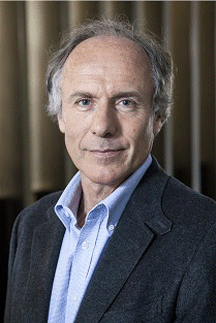 Alan Finkel disputes figures used by supporters of coal power https://www.theguardian.com/australia-news/2017/oct/26/alan-finkel-disputes-figures-used-by-supporters-of-coal-power
Chief scientist says far fewer coal-fired power stations being planned around the world than previously projected The chief scientist, Alan Finkel, has challenged figures used by supporters of coal-fired power stations in a Senate estimates hearing.
Liberal senator Ian Macdonald suggested there were more than 600 coal plants under way around the world, which would undermine any emissions reduction achieved by Australia.
Finkel told the hearing on Thursday he had seen a range of figures. However, he understood the number of coal plants in China and India in the initial planning stage or being built was “far less than what was projected a year ago”.
[China] has a commitment as a country to reduce emissions. They are finding they are reaping the benefits of their commitments to wind and solar at a faster rate than they thought,” he said.
Asked about developments in Europe, Finkel said he was aware of only one high-efficiency coal plant currently being built and it was in trouble.
Finkel said the modelling he produced in his review of Australia’s electricity sector had been provided to the Energy Security Board as it put flesh to the bones of the proposed national energy guarantee policy.
He believed the national energy guarantee modelling could be produced in time for a Council of Australian Governments energy council meeting in late November.
But he said the states and electricity sector needed to be properly consulted. “The ramifications of getting any aspect of the rules wrong are very serious,” he said.
1 This month


Help Aunty Sue Protect Her Land and Sacred Sites From Destructive Rocket Testing.
.

Australians deserve the truth
about
AUKUS – https://aukuspublicinquiry.com/

PETITION – To: Prime Minister Anthony Albanese and the Australian Labor Government

of the week – Australians for War Powers Reform (AWPR)
To see nuclear-related stories in greater depth and intensity

