Criticism of Townsville City Council for giving Adani $19 million for airstrip for coal mining
 Adani coal mine: Townsville City Council under fire for pumping $19m into airstrip, ABC,
The council agreed to contribute up to $18.5 million to finance the airstrip at the proposed Carmichael mine site, about 300 kilometres south of the city.
Rockhampton Regional Council also agreed to contribute to the project, which is estimated to be costing about $30 million.
Under the arrangement with Adani, the Indian company would source the bulk of its mine and construction fly-in-fly-out workforce from the two cities.
“Why does a billionaire want two councils in Queensland to pay $36 million for an airstrip?” Peter Newey, convenor of the Townsville Residents and Ratepayers Association, said. “He [Gautam Adani] would be able to afford at least two dozen of them and then gold plate them. “It just doesn’t make sense.”
More than 50,000 people have signed an online petition — started by Mr Newey — calling for Townsville City Council to withdraw its support for the airstrip.
A member of the council’s city image committee, business owner Lucy Downes, also had concerns. “I despaired to be honest, because that money could have been used to reactivate the CBD,” she said…..
Townsville wants guarantee from AdaniTownsville City Council is seeking a bank guarantee from Adani to refund any losses, should the Carmichael coal and rail project not proceed. Mayor Jenny Hill told 7.30 she would like construction on the airstrip to start this year, despite Adani not yet securing bank finance for the $16 billion project……..
Adani waiting for loan Adani said it may not secure bank finance until next March, and it postponed plans last month for a ground-breaking ceremony…….Adani also said it is critical that it receives a loan from the Federal Government’s North Australia Infrastructure Facility (NAIF).
A decision on the NAIF loan, believed to worth hundreds of millions of dollars, is due by the end of the year. http://www.abc.net.au/news/2017-11-01/adani-coal-mine-townsville-city-council-under-fire-over-airstrip/9103492
The $16-billion Adani coal mine project is dividing the Australian public

Adani’s Australia Story: How a Massive Coal Mine is Sparking a New Wave of Environmental Concerns ‘With the $16-billion Adani coal mine dividing the Australian public, The Wire looks at the country’s environmental concerns and how the Carmichael project adds to them.’
thewire.in/193156/adanis-australia-story-massive-coal-mine-sparking-new-wave-environmental-concerns, Kabir Agarwal on 01/11/2017 thewire.in/author/kabir-agarwal
‘This is the third story in a five-part series that examines the controversial Adani and Carmichael coal mine.
Read the first thewire.in/188092/adanis-australia-story-whats-the-fuss-all-about
and second part. thewire.in/189547/adanis-australia-story-thousands-people-protesting-16-billion-coal-mine ‘
‘ … The Wangan and Jagalingou people, who are also fighting a court battle to retain their right over their land, are of the view that if the Adani coal mine is built, their cultural heritage will be destroyed beyond repair.
‘“The land, the springs, the waterways, the mountain ranges, are not just physical forms for us.
They are remnants of our ancient culture.
‘If the mine is built, there will be no record of us ever having been there”,” said Adrian Burragubba, spokesperson of the Wangan and Jagalingou Traditional Owners Family Council.
‘They said that they are prepared to battle it out for as long as it takes.
‘“Every inch of that land is mine. Every blade of grass, every drop of water, each leaf on a tree, each bird, each animal, is mine. And I am going to fight for it. I want to tell Adani – I am not your slave,” an animated Burragubba said when I met him in Brisbane in late July. … ‘
Read more of Kabir’s comprehensive and informative article:
thewire.in/193156/adanis-australia-story-massive-coal-mine-sparking-new-wave-environmental-concerns
‘Kabir Agarwal is an independent journalist whose writings have appeared in
The Kashmir Walla, The Times of India, Mint, Al Jazeera English and The Caravan.
He can be found on twitter @kabira_tweeting.’
thewire.in/author/kabir-agarwal
Aid Charities Call on Government to Protect Charities’ Right to Advocate
Lina Caneva | | @ProBonoNews 2 Nov 17, Australia’s international development charities have passed a resolution at the sector’s annual conference in Melbourne calling on the federal government to halt “disturbing developments” which are set to restrict Australian charities’ funding and advocacy.
In a preamble, the resolution expressed concern at a “number of disturbing developments in Australia (which) may constrain the role of charities in undertaking advocacy”.
ACFID’s members voted to call on the government not to impose proposals on expenditure-caps advocacy by charities and a ban on international philanthropy to charities who undertake advocacy……..
“Increasingly, fear and division are being used around the world as a precursor for draconian laws and regulations which are crippling democratic freedoms and stifling citizen-led groups. ACFID’s members are all too aware of this trend as they are forced to adjust to severely constrained operating environments, instituted by governments overseas.
“A free and vibrant civil society is crucial in maintaining peace; keeping governments accountable; and protecting people’s rights.
“Backed by Australia’s democratic values and with our membership of the Human Rights Council, the Australian government is well-placed to defend civil society space on the international stage. We are calling on the government to embrace this opportunity.”
ACFID said it was continuing to work with its members and a consortium of charities to support and protect space for civil society overseas and in Australia.
Earlier this year ACFID released a position paper outlining concerns about the ban on foreign donations to political parties which it said may result in charities who advocate being prevented from accepting international philanthropy.
The paper was prepared by a consortium of charities, led by ACFID, Philanthropy Australia and the Community Council for Australia. https://probonoaustralia.com.au/news/2017/11/aid-charities-call-government-protect-charities-right-advocate/
3 November: More REneweconomy news
 RenewEconomy
-
ESB to use inflated costs for wind and solar to justify NEGEnergy Security Board to use vastly inflated costs of wind and solar to justify its National Energy Guarantee. By using prices around 30-40 per cent above actual costs, will support its argument for little new wind and solar to be built in the coming decade.
-
Lets be honest: Australia is well behind on renewablesAustralia’s fossil fuel share of electricity generation is higher than that of our peers. This chart is ugly for Australians who care about doing our bit in the 21st century.
-
RES drops 758MW wind farm proposal, amid Victoria boomAnti-wind resistance appears to win the day as RES Australia confirms Penshurst Wind Farm no longer an ongoing development opportunity.
-
NE: A rushed job that takes us backwards, not forwardsNational Energy Guarantee appears to be a plan to get through the Coalition Party Room, and then a plan to have a plan. Unfortunately, that means many more months of uncertainty.
-
Musk says Tesla big battery now more than 80% completeElon Musk says Tesla big battery in South Australia now more than 80% complete, but even bigger storage installations likely to follow.
-
Tesla falls behind on Model 3 production, burns cash at record rateProduction line “bottlenecks” at Tesla’s Nevada Gigafactory push Model 3 delivery target out 3 months. Musk says, “we’ve got it covered.”
-
China contractors and finance may help Adani’s mega coal mineThe potential involvement of China state-owned contractors and financiers may help Adani in its push for the mega coal mine in Queensland.
-
Rejected teenagers: the trend of closing young coal plantsIt’s not just old coal power plants that are being closed down. In Italy, the US, and the Netherlands, coal plants that are barely teenagers are being targeted for closure.
Environmental Law cases – Queensland and Adani coal project
Supreme Court of Qld: Environmental Law Australia envlaw.com.au
‘This case study involves a major dispute in the Land Court of Queensland
over the Carmichael Coal Mine proposed in the Galilee Basin of central Queensland
and a subsequent judicial review challenge to the mine’s approval
in the Supreme Court of Queensland.’
envlaw.com.au/carmichael-coal-mine-case
‘ … Two separate disputes (also not the subject of this case study) about the mine involve native title issues
raised by the Traditional Owners of the land on which the mine was proposed,
the Wangan and Jagalingou People.
‘The first of these disputes involved hearings in the National Native Title Tribunal (NNTT) and
the Federal Court under the Native Title Act 1993 (Cth) (NTA) after the
Wangan and Jagalingou People rejected an Indigenous Land Use Agreement (ILUA) proposed by Adani
for the grant of the mining lease for the mine. …
‘The second dispute concerning native title issues involved an application by
elders of the Wangan and Jagalingou People in the Supreme Court of Queensland for judicial review
of the grant of the mining lease under the MRA based on native title grounds.
That application was also dismissed.
An appeal in the Queensland Court of Appeal was also dismissed in August 2017.
Australian tourism industry must develop an effective climate change policy
Australian tourism policies fail to address climate change https://phys.org/news/2017-11-australian-tourism-policies-climate.html November 2, 2017 Australia’s Federal and State governments are failing to produce effective long-term tourism policy to address climate change, according to the findings of new QUT-led research.
Tourism policy on climate change in Australia is inconsistent and ineffective
Federal and state governments are not collaborating on best practice approaches to tourism policy on climate change
The tourism industry can contribute to the sustainable management of climate changeDr Char-lee Moyle, from QUT’s Australian Centre for Entrepreneurship Research, and her co-authors from Griffith University and James Cook University analysed 477 relevant documents for their paper – Have Australia’s tourism strategies incorporated climate change?
Just published in the international Journal of Sustainable Tourism, it reveals only 21% of Australia’s tourism strategies mention climate change, with most simply acknowledging it as an issue.
“Despite the fact tourism is worth billions of dollars to our economy and has been found by scientists to accelerate climate change, only five Australian tourism strategies analysed by us (one per cent of the entire sample) even recognised the sector’s impact,” Dr Moyle said.
“Looking at policy documents from 2000-2014, we have seen Australia’s tourism strategies increasingly focus on adaptation strategies, with mitigation appearing to have fallen off the policy agenda in recent years.
“Even certification and accreditation schemes are essentially viewed by industry as adaptation measures and a way to reduce climate change induced costs such as rising electricity bills.”
Dr Moyle emphasised the link between tourism climate change rhetoric and federal government election cycles.
“We found significantly more tourism climate change strategies were produced during the years the Australian Labor Party was in power at the federal level, with a peak in 2007,” she said.
“State Governments appear to be far less proactive in considering climate change in relation to tourism and, conspicuously, New South Wales did not even mention climate change in any state-level tourism strategies.”
Dr Moyle said there was significant room for the tourism sector to improve and step up action, particularly in developing tangible adaptation and mitigation policies.
“There are opportunities for the tourism industry to contribute to the sustainable management of climate change, including through the development of more ‘green’ products and implementing more environmentally-friendly practices,” Dr Moyle said.
She added that many initiatives proposed and subsequently implemented no longer exist, indicating an extremely dynamic climate change policy environment, as well as a lack of long-term consistent support and planning for tourism climate change response.
“On a positive note, there has been an increased focus on identifying opportunities, strategic needs, barriers, challenges and potential actions in relation to climate change since 2008,” Dr Moyle said.
 Explore further: Climate change action focuses on tourist traps, say researchers
More information: Char-lee J. Moyle et al, Have Australia’s tourism strategies incorporated climate change?, Journal of Sustainable Tourism (2017). DOI: 10.1080/09669582.2017.1387121
Provided by: Queensland University of Technology
3 November REneweconomy news
-
 Energy technologies and business model innovator Justine Jarvinen takes up role as Wattwatchers ChairEnergy technology pacesetter Wattwatchers is delighted to announce the appointment of Justine Jarvinen as non-executive Chair. Ms Jarvinen is currently Chief Operating Officer of the Energy Institute at the University of New South Wales (UNSW) and her prior corporate roles include Head of Emerging Technologies at AGL Energy. Ms Jarvinen will lead the Wattwatchers Board […]
 -
Rooftop solar pushes WA grid demand to 8-year lowRooftop solar has helped push grid demand in Western Australia to its lowest levels in more than eight years.
The costs -financial, environmental, human, – of plutonium-fuelled space exploration
 Australia’s international space agency hype https://independentaustralia.net/environment/environment-display/australias-international-space-agency-hype,10876 s the current hype about space travel justified, and what of the human and environmental cost? Noel Wauchope reports.
ENTHUSIASM for space travel has been mounting since Australia hosted the recent International Astronautical Congress (IAC), held in Adelaide in September.
Then there was the announcement that Australia is getting a space agency!
We are informed by space scientist Dr Megan Clarke:
“ … more than 3000 of the world’s top space experts wildly cheered [and] all aspects of Australian society were united on the need for a national agency.”
In November, the very brilliant and appealing space travel and nuclear power enthusiast, Professor Brian Cox is to tour Australia! Champion astronaut Scott Kelly has just published his exciting book, Endurance: a Year in Space, A Lifetime of Discovery.
Dare anyone throw cold water on all this joy?
Intriguingly, the Australian Government, while proudly hyping up this initiative, has not yet come up with a title for the new agency. However, someone else has and they have set up an elegant and professional-looking website for it: Australian Research and Space Exploration (ARSE).
Let’s start with that most important consideration — money Continue reading
Nuclear fuel waste: Extended Storage at Lucas Heights or target SA?
The proposed Intermediate Level Waste Store is predominantly for ANSTO reactor wastes
 Briefer (Nov 2017) by David Noonan, Independent
  Environment Campaigner The Federal government has divided Australian community and is compromising safety in proposed import and indefinite above ground storage of ANSTO nuclear wastes in South Australia.
Since April 2016 the Federal government has solely targeted regional communities in SA for a proposed above ground Store to take irradiated Nuclear Fuel Waste (NFW) and long lived Intermediate Level Waste (ILW) from the ANSTO Lucas Heights reactor facility in NSW.
The ARPANSA CEO formally considered this proposed NRWMF Store and stated in May 2015:
“This plan will have the provision for ILW storage above ground for approximately 100 years.”
This nuclear waste storage plan compromises safety by importing long lived reactor waste to SA without any waste disposal capacity or even a program or plan for potential disposal of NFW and ILW. Safety requires these nuclear wastes are isolated from the environment for over 10,000 years.
The proposed 100 year Store in SA for 10,000 year nuclear wastes is a divisive, unsafe and unnecessary plan – given ANSTO’s capacity to retain these nuclear wastes at Lucas Heights.
Federal Contingency options to store Nuclear Fuel Wastes at Lucas Heights: Continue reading
UN rejects nuclear industry participating in clean energy forum: Ben Heard spits the dummy
THE AUSTRALIAN, 31 Oct 17 The UN has blocked the nuclear industry from participating in an international forum on clean energy….
The London-based World Nuclear Association was originally accepted by the organisers of next month’s Sustainable Innovation Forum as a £40,000 ($68,338) gold sponsor, but the deal was rescinded a week later after intervention by the UN environment program.
The organisers then offered a watered-down sponsorship that would include no branding presence, but that deal was also vetoed by UNEP………
Next month’s forum takes place on the sidelines of the UN’s COP 23 climate change conference, where government representatives from around the world will meet to discuss progress towards meeting international emission-reduction targets.
The Sustainable Innovation Forum will be hosted in the purpose-built Climate Action Dome, which itself will be powered by energy generated using food waste from the conference.
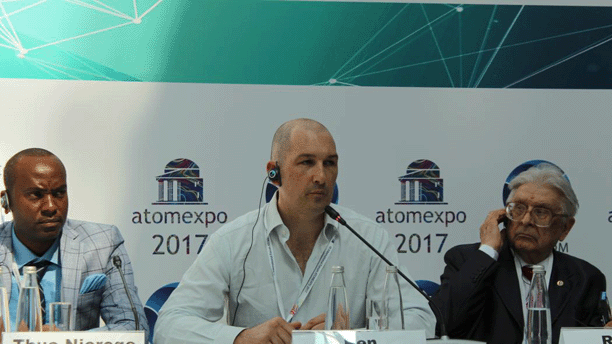
Ben Heard, an energy researcher [ ed. more correctly a nuclear promoter] with the University of Adelaide and an advocate for the climate benefits of nuclear energy, described the UN’s intervention as “frightening” and an example of “outright prejudice”. “This family of technologies has been the principal source of carbon-free energy for the last four decades. Along with hydro-electricity, they have been the two big hitters that have actually delivered, and you’re running a climate change conference and you won’t let the representatives of that industry through the door,” he said.
“For me it’s gobsmacking to see this. I’m an advocate for this technology on environmental grounds but it struggles, and part of the reason is time after time it faces this kind of institutional bias which means no-one can even have a conversation about it.”
Unity in Christian churches: bishops of Townsville speak out against Adani coal megamine
Brisbane Times, It may have the Turnbull and Palaszczuk governments firmly in its corner, but the Adani super-mine is facing a formidable new opponent: the Christian faith.
The Catholic and Anglican bishops of Townsville have issued a joint statement to their followers criticising “projected mega-mining developments across Queensland, especially the Galilee Basin”, and accusing politicians and big business of failing to protect the common good.
The bishops’ message puts them head-to-head with Adani, the Indian mining behemoth behind the $16.5 billion Carmichael mine proposed for the Galilee Basin. It also puts them at odds with the local council and state and federal governments, which resoundingly support the project.
Adani has located its regional headquarters in Townsville, and the statement will fuel debate in the already divided community over what would be Australia’s biggest coal mine.
The Right Reverend William Ray of the Anglican Diocese of North Queensland, and the Most Reverend Timothy Harris of the Catholic Diocese of Townsville, issued the statement to their parishes on Saturday.
They cited Pope Francis’ groundbreaking encyclical on the environment in June 2015, in which he said “the Earth, our home, is beginning to look … like an immense pile of filth”.
“We, too, as bishops in north Queensland, have concerns about many global and local issues that are impacting negatively on our environment and which require greater dialogue, examination, prayer and action,” the statement said.
The bishops said human dominion over the planet should be understood as “responsible stewardship”, especially to future generations…..https://www.brisbanetimes.com.au/politics/federal/catholic-anglican-bishops-unite-in-opposition-to-adani-megamine-20171030-gzaqxf.html
South Australia’s Whyalla to become a booming renewable energy hub
Whyalla steel city goes green with 1GW of solar and storage, http://reneweconomy.com.au/whyalla-steel-city-goes-green-with-1gw-of-solar-and-storage-92904/ UK billionaire Sanjeev Gupta has made good on his commitment to transform his newly acquired Australian steel business into a renewable energy powerhouses, announcing massive investments in solar and storage that will knock 40 per cent off his electricity costs.
Gupta said on Monday that he would build 1 gigawatt (1,000MW) of dispatchable renewables in and around Whyalla, where his major steel plant is located. This would comprise huge investments in solar, battery storage, pumped hydro and demand management.
He won’t stop there. Gupta is looking to repeat the dose – although with varying mixes and scale of renewables and storage – to power the company’s steel operations in Melbourne, Sydney and Newcastle. He said on Tuesday he wanted these bigger plants to be powered 100 per cent by renewable energy.
The initial development will see a proposed 80MW solar farm at Whyalla expanded to 200MW and completed by the first quarter of 2019.
Queensland Government worried about viability of Adani’s $16.5 billion Carmichael mine
 Adani could cost my seat: Trad
Queensland Deputy Premier Jackie Trad has cast doubt on the viability of Adani’s $16.5 billion Carmichael mine, which she concedes her electorate is “very strongly” against.
http://www.afr.com/news/politics/jackie-trad-admits-her-electorate-feels-very-strongly-against-adani-20171030-gzbigv
Queensland election 2017: Coal-fired power station report to embarrass Government
http://www.couriermail.com.au/news/queensland/state-election-2017/queensland-election-2017-coalfired-power-station-report-to-embarrass-government/news-story/7da7a0c139ef1222cce9bce7a280470c
Don’t fund Adani coal project: Pacific Islanders’ call to Australian government
Pacific Islanders call for Australia not to fund Adani coalmine, Caritas says thousands face threats to their wellbeing, livelihoods and ‘their very existence’ due to rising sea levels, Guardian, Naaman Zhou, 1 Nov 17, Pacific Islanders whose homes face eradication by rising sea levels have called on Australia to not fund the Adani Carmichael coalmine, as a new report reveals the worsening impact of climate change across Oceania.
Residents of the endangered islands have described their forced displacement as like “having your heart ripped out of your chest” as they called on the Australian government to do more to combat climate change.
A report released by international aid group Caritas on Wednesday found that thousands of Pacific people across the region faced “threats to their wellbeing, livelihoods and, in some places, their very existence” due to rising sea levels, king tides and natural disasters brought about by climate change.
n Papua New Guinea, 2,000 households across 35 coastal communities were displaced by coastal erosion over the past year. In Samoa, 60% of the village of Solosolo was relocated to higher ground.
In the Torres Strait, 15 island communities were identified as at risk over the next 50 years.
The mayor of the Torres Straight Island regional council, Fred Gela, described the forcible removals as like having your heart ripped out “because you are told you’re not able to live on your land”.
Erietera Aram, a resident of Kiribati who works for the Department of Fisheries, said he decided to visit Australia to ask its government to take action.
“We talk about the Adani coalmine,” he said. “That’s a new one. I think it’s not a good idea – it makes the world worse for all of us. It is inconsiderate of other humans on this planet.
“We didn’t think of Australia as a country that would do that. We looked at it as our bigger brother. Proceeding with that new mine is a sad move. We live together in the environment but it’s like they are ignoring us.
“We’re two metres above sea level. With the sea level rise, most of our lands have been taken by coastal erosion. We love our country and we want our children to live there as well, hopefully forever. It’s hard to talk about leaving the place where you belong.”
According to the report’s authors, the impact of coastal erosion and flooding reached “severe” levels in 2016, upgraded from “high” the year before. Climate change also made it “increasingly difficult to maintain the health and integrity” of food and water sources. Water scarcity was deemed a “serious slow-onset problem throughout Oceania”…… https://www.theguardian.com/environment/2017/nov/01/pacific-islanders-call-for-australia-not-to-fund-adani-coalmine
Australian emissions to ‘far exceed’ 2030 Paris pledge
 Australian emissions to ‘far exceed’ 2030 Paris pledge as need for action rises: UN http://www.smh.com.au/environment/climate-change/australia-to-far-exceed-2030-paris-climate-pledge-as-need-for-action-rises-un-20171030-gzbiwj.html, Peter Hannam, 31 Oct 17
National pledges to cut carbon emissions fall well short of what’s needed to avoid dangerous climate change, with Australia likely to miss its 2030 commitment by a wide margin, a United Nations body said.
The UN Environment Programme’s Emissions Gap 2017 report found pledges to cut pollution made at the Paris climate summit two years ago are only about one-third of what’s needed to be on a “least-cost pathway” to stopping the worst effects of climate change.
The target is to stop global average temperatures rising two degrees or more above pre-industrial levels. Change on the scale is expected to cause major droughts, food shortages and damaging sea level rise.
The emissions gap to keep with a 1.5-degree goal is 16-19 gigatonnes of carbon-dioxide equivalent, while the 2-degree target would need an extra 11.13.5 gigatonnes of CO2-e of cuts by 2030 to be attained, the report said.
“There is an urgent need for accelerated short-term action and enhanced longer-term national ambition, if the goals of the Paris Agreement are to remain achievable,” the report said.
The positive news is that global emissions have largely flatlined for the past three years, thanks in large part to a plateauing in China. Still, other potent greenhouse gases such as methane are rising, and carbon dioxide emissions could accelerate if global economic growth picks up.
Frank Jotzo, a professor at the Australian National University’s Crawford School and a contributor to the report, said tumbling costs of renewable energy and other low-carbon technologies suggest nations could increase their emissions cuts “and it won’t be terribly hard”.
“More climate action and deeper commitments are needed, but it’s eminently possible to achieve [the Paris climate goal] from the economic and technical perspective,” Professor Jotzo said. “It’s the politics that get in the way.” Continue reading
1 This month
25 October – Film –Britain’s Nuclear Bomb Scandal: Our Story – part of the Adelaide Film Festival,
Screening and Conversation
A screening of Britain’s Nuclear Bomb Scandal: Our Story (2024) followed by a talk with 2026 Bettison and James Awardee and Tradtional Owner Karina Lester in conversation with Simone Tur.
When: Sun 25 Oct, 12:00pm-Screening, 1:15pm-Talk
Where: The Mercury
Free admission, register below by clicking on BUY TICKETS and select free event tickets, at end of web page:
https://www.adelaidefilmfestival.org/program/2026/britains-nuclear-bomb-scandal-our-story
.

Australians deserve the truth
about
AUKUS – https://aukuspublicinquiry.com/

PETITION – To: Prime Minister Anthony Albanese and the Australian Labor Government

of the week – Australians for War Powers Reform (AWPR)
To see nuclear-related stories in greater depth and intensity

