“The Advertiser’s” nuclear advertising article drew strong responses
Jim Green, 18 Oct 17 Dean Jaensch makes two comments about nuclear power ‒ both of them false (‘Nuclear power could be the solution for Australia’s energry crisis‘, The Advertiser, yesterday). He claims that 19 of the G20 utilise nuclear energy in their power production. But in fact, Indonesia Turkey, and Saudi Arabia have no reactors.
And in most of the G20 countries that operate reactors, nuclear power is either negligible or in a world of trouble. In Japan, for example, less than one-tenth of the pre-Fukushima reactor fleet is operating. Estimated clean-up and compensation costs for the 2011 Fukushima disaster have doubled and doubled again and now stand at $245 billion.
Could the state economy cope with a $245 billion hit if Fukushima happened in SA? Of course not.
Jaensch’s claim that nuclear power “emits absolutely no carbon” is also false as a cursory review of the relevant literature demonstrates.
 Robyn Wood, 19 Oct 17 Regarding nuclear power, Dean Jaensch is very mistaken when he claims that nuclear power emits no carbon (Advertiser 17/10/17). He forgets to include the fossil fuel burned during uranium mining, transport of uranium by truck, train or sea, plus the construction of a waste facility along with associated transport of waste.
He also forgets that last year’s nuclear Royal Commission 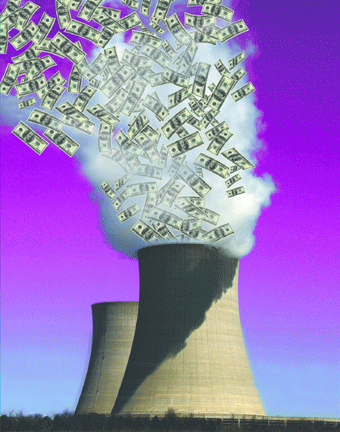 found that nuclear power is currently uneconomic compared to other sources of power. Costs for the construction of new nuclear power plants around the world are skyrocketing while the costs of renewables are rapidly falling. If our government is wise enough to also invest in constructing pumped hydro dams which act as energy storage, then renewable energy can be stabilised to provide continuous electricity for the benefit of all Australians.
Remote seismic station in the Northern Territory plays critical role in monitoring North Korea’s nuclear testing
Why Turnbull’s energy plan could be disaster for renewables, climate, prices
 REneweconomy, By Giles Parkinson on 18 October 2017 http://reneweconomy.com.au/why-turnbulls-plan-could-be-disaster-for-renewables-climate-prices-57822/
On the face of it a twin-pronged system focusing on reliability and environmental outcomes could have appeal. But we just don’t know because the details of Malcolm Turnbull’s National Energy Guarantee (NEG), and even the basics of how it will work, have not been explained.As one clean energy advocate said on Tuesday: “We’re still trying to understand whether we love or hate the NEG”. Part of that hesitation is based around the oft-made assumption that it might be better to have something, rather than nothing. But that remains to be seen.
The mainstream media certainly embraced it, but analysts see red flags all over the place – it is potentially bad news for renewables, bad news for emissions, and bad news for prices. It is potentially Turnbull’s energy trilemma turned upside down.
Most of all, the proposal appears to be the most ill-considered, poorly detailed and potentially useless policy that anyone can remember – the work of Australia’s so-called “energy mafia” hungry to defend the power of the incumbent oligopoly, commercial interests and their ideology.
The emissions reduction target that the ESB was asked to work with – a 26 per cent cut in electricity emissions from 2005 levels by 2030 – is manifestly inadequate, for even Australia’s current climate commitment (it loads a lot of effort on to other sectors), but also to the ultimate goal of capping global warming well below 2°C.
Even Origin Energy recognises this, noting the cavernous gap between the Paris target and the current emissions trajectory, a trajectory made worse by the government’s hint that any emissions targets will be “back-ended” to 2030. Continue reading
Turnbull govt – dumping clean energy target for “national energy guarantee”
 Turnbull dumps clean energy target for “national energy guarantee”, REneweconomy, By Giles Parkinson on 17 October 2017 (note: This story updates a previous article, based on the release of further policy details).
Well, looks like he has actually done it. The Turnbull government has formally abandoned the idea of a Clean Energy Target, proposed by chief scientist Alan Finkel and endorsed by nearly everyone, in favour of a new policy that will protect fossil fuel generation and slow down the uptake of renewable energy.
The new National Energy Guarantee marks a major switch in government policy – at least on the face of it. But the major problem is, we just don’t know because there are so few details.
But it appears to hand extraordinary market power to the country’s big utilities and fossil fuel generators, and gives no obvious incentive to introduce new generation, which one would expect would be the key to lowering prices.
Dumped is any form of visible subsidy scheme – be it a renewable energy target, or carbon price, or clean energy mechanism – in favour of changes to energy market rules that put an additional burden on retailers for a “reliability guarantee” and an “emissions guarantee.”
But these guarantees can also be traded – in the form of contracts between utilities. Potentially, it will generate credits in dirty energy, as this table above [on original] illustrates.
Quite how this works is not clear, and energy participants were struggling to get their heads around it. They may struggle for a while, because the levels of these reliability and emissions guarantees have not been set, and the reliability settings will vary from state to state, depending on their level of wind and solar.
Western Australia, for instance, has been ignored and is not part of the plan, because it only applies to the National Electricity Market, which excludes WA.
It appears to allow enormous discretion on the part of the Australian Energy Market Operator and the Australian Energy Market Commission. Some described it as an emissions intensity scheme in disguise, but couldn’t be sure because of the lack of detail.
It also appears that retailers may be able to satisfy their emissions guarantee through international carbon markets. One thing is certain, the Turnbull government has undertaken not to go any further than its current Paris target of a 26-28 per cent reduction by 2030, and that is a blow to renewables.
This appears to be the minimum demand of the Coalition’s right wing, and is in effect an abrogation of the Paris climate treaty, which is to make all efforts to keep global warming well below 2°C.
The impact on the renewable sector is hard to predict, but it is clearly not good. Modelling for the government suggests that the share of renewables in total generation will be 28-36 per cent by 2030 – and the level of wind and solar 18-24 per cent.
This compares to a level of 42 per cent suggested by Finkel, Labor’s 50 per cent target, and the 70 per cent deemed necessary if Australia was to get serious about meeting the international 2°C target.
This new modelling represents only a modest increase in renewables, and possibly a virtual stop, particularly if it includes behind the meter rooftop solar, which it appears to do. If it does represent some sort of target, then it could likely bring new large-scale development of wind and solar to a halt…….
The fact that this proposal comes from the Energy Security Board also raises some questions. Finkel took nearly a year to put together his review and his painstaking modelling of a clean energy target.
The ESB, chaired by Kerry Schott, and including the heads of the AEMC, AEMO and the AER, was formed less than two months ago and only had its first meeting four weeks ago.
Little wonder that the details are so vague. Apparently it was delivered to the government last week. Investors may be mindful of Schott’s comments a few weeks ago: harnessing demand management in Australia, means “we can all stop worrying about building new plants of any description.”
The other issue about the ESB is that it is required only to look at the issue of energy security, not emissions. It appears to have been given the arbitrary number of electricity accounting for one-third of anticipated emission reductions by 2030. Who is going to do the rest?
But the involvement of the ESB has provided Turnbull with an element of political cover, saying that he was “relying on the experts”. Indeed, at the press conference, he refused to answer any question in detail, deferring instead to the members of the ESB.
Minutes later, in question time, it was obvious that the political rhetoric hadn’t changed. Quoting complete nonsense from The Australian and other conservative commentators, Turnbull claimed that the renewable energy target would cost $66 billion in renewable energy certificates, a cost imposed on consumers.
It’s rubbish, of course. Most new projects ascribe no value at all to those renewable energy certificates.
And it is this that raises concerns. The conditions of the right wing rump of the Coalition, which have been holding the government, and the nation, hostage to their demands, were laid clear by Craig Kelly, the climate change science denier who acts as chair of the Coalition’s environmental committee.
Kelly says the target must not allow renewables to get near 50 per cent, and must not go further than the 26-28 per cent committed by the Abbott government, and certainly not the 45 per cent emission cuts recommended by the Climate Change Authority, and other climate scientists, and endorsed by Labor.
In other words, it wants Australia to tear up its Paris climate commitment to keep global warming well below 2°C, and possibly as low as 1.5°C……
market power remains with the big generators – the very ones that have been dudding consumers on retail and wholesale costs for the last few years. The ESB modelling effectively locks in the recent high prices, offering only an 8-10 per cent fall over the next decade.
The ESB says this may translate into consumer savings of some $100 a year – over a 10-year period – over and above the Finkel Review. But it is not clear how if the wholesale savings are so small……. http://reneweconomy.com.au/turnbull-dumps-clean-energy-target-for-national-energy-guarantee-32239/
Rockhampton’s Mayor Strelow misrepresents Wanganand Jagalingou
Mayor Strelow misrepresents Wanganand Jagalingou
‘Rockhampton Mayor Margaret Strelow’s
‘thanks’ to the the Wangan and Jagalingou people for ‘our support’ is disingenuous
and clearly misrepresents the position of the Traditional Owners
of the proposed Carmichael mine area.
‘We do not support a FIFO (fly in fly out) hub that allows
a mass of people who have no respect for our land to fly in
and destroy our country and culture, and fly out again.
‘The Wangan and Jagalingou Traditional Owners Council
don’t know who Mayor Strelow is talking to,
but it’s clearly not the W&J Applicant or the claim group or our families.
‘A majority of Wangan and Jagalingou families have
consistently rejected Adani’s sham ILUA for the mine.
Adani has no agreement with Traditional Owners
and an ILUA has not been registered.
The purported ILUA is subject to a Federal Court trial in March 2018.
‘Our court action in March will expose the underhanded way
in which our position on the mine is misrepresented by Adani,
and our supposed support was engineered.
‘We have provided evidence to the court of Adani’s bad faith and
we will pursue this constant misrepresentation of our people and
our position on the mine until we can demonstrate once and for all
we do not and never will support this coal mine
or any project or enterprise aligned to it. …’
To continue reading this excellent statement by Wangan and Jagalingou People go here:
wanganjagalingou.com.au/traditional-owners-do-not-support-rockhampton-fifo-hub
Tradiational land owners Wangan and Jagalingou (W&J) people at forefront of opposition to Adani coal mine
‘Opposition from traditional owners of the land
‘The Wangan and Jagalingou (W&J) people are the traditional owners of the land
on which the Adani group has proposed to build its mine and they argue
that if this mine was to be built on their homelands,
it would irreversibly destroy their customs, culture and heritage. …
‘The Wangan and Jagalingou Traditional Owners Family Council
is at the forefront of the tussle with the Adani group and
have taken the matter to the federal court of Australia.
‘The matter is up for hearing in March 2018 and is being seen
as the last legal hurdle in the way of the Carmichael coal mine. … ‘
‘Note: This is the first in a three-part series
that will examine how the Adani and Carmichael coal mine has divided the Australian public
and in the process, sparked fierce debate on issues such as
coal-based energy, energy financing, jobs and the rights of indigenous people.’
To continue reading this comprehensive overview go here:
thewire.in/188092/adanis-australia-story-whats-the-fuss-all-about
Tony Abbott’s successful influence on Coalition energy policy
Abbott 1, Consumer 0. Turnbull’s energy fudge locks in high prices http://reneweconomy.com.au/abbott-1-consumer-0-turnbulls-energy-fudge-locks-in-high-prices-11158/By Giles Parkinson on 17 October 2017 Whatever else you can say about Malcolm Turnbull’s new energy policy one thing is clear: Tony Abbott has won, and consumers have lost. Even in the most optimistic scenario presented by the government, energy consumers will see little reduction in their energy bills over the next decade.
That’s outrageous. Australians are paying absurd prices for their electricity – upwards of 40c/kWh and not just in South Australia – and this new scheme can envisage only a slight reduction over the next 12 years.
In an era where renewable energy costs are plunging, where the costs of rooftop solar are about one-sixth the cost of grid power, that spells an abrogation of the government’s duty, and it spells trouble for the future.
To please Abbott and the vast rump of climate deniers and renewable energy nay-sayers in the Coalition and the conservative commentariat, Turnbull has effectively abandoned the Paris climate target and closed the door on new renewable energy projects.
Renewable energy is abandoned because there is no obvious incentive to develop new generation. And consumers can rest assured they will be screwed because the power, quite literally, is conferred upon the big retailers and generators and their complicated series of price caps and hedges.
The government would like us to believe that this new plan is the work, solely and uniquely, of the newly established Energy Security Board. Given that this board only met for the first time a month ago, that seems unlikely, despite the fact that the directors were co-opted to attend the Turnbull policy launch.
More likely, this is the work of the vested interests who have controlled debate and policy making in Australia for all but the Gillard years of carbon pricing. The fact the current high levels of wholesale prices are, by the government’s own admissions, locked in for another decade at least, is confirmation of this.
Turnbull says it is about reliability, emissions and affordability. But it appears an own goal on all three counts: Australia simply cannot afford to dump climate targets, wind and solar are clearly cheaper than fossil fuels, and relying on ageing coal generators seems a recipe for disaster
The policy unveiled on Tuesday means he is effectively tearing up Australia’s commitment to the Paris treaty, because there is no path to 2°C.
It throws a wall of protection around the fossil fuel industry – as if it hasn’t benefited from enough political favours – and raises the drawbridge on new large-scale renewable energy investments
The details of how this scheme will operate are far from clear. There are reliability and emissions standards to meet, but no decision on what these might be. We only know that they vary from state to state, and will be at the discretion of the AEMO and the AEMC.
Turnbull hailed the initiative as a significant breakthrough and a game-changer for the industry. Minutes later he was back in the parliament sprouting complete nonsense about the cost of the renewable energy target, quoting a discredited series of stories in The Australian that claim the cost is $66 billion.
And that’s the point. Renewable don’t need subsidies, and many new projects aren’t getting them. But they do need a target, and an incentive to encourage utilities to move beyond their current coal and gas interests.
For Turnbull, the politics haven’t changed at all – and that’s why the renewable energy industry and the consumer should remain suspicious. There is no path to the decarbonised electricity grid that the CSIRO, the networks and any number of energy analysts have said is not just doable, but eminently affordable.
There is no path for falling energy costs, because the system will rely on the very institutions that have been gaming the market for the last decade. Reliability may be maintained, but at the cost of gold plating the coal and gas industry in the same way that regulators encourage and allowed the networks to do.
Most of all, it’s killed the chance of a bipartisan agreement. It’s a sorry tale. And unless something mighty surprising emerges in the next few months, when the policy details are finalised, it will have got us nowhere.
18 October REneweconomy news
-
Abbott 1, Consumer 0. Turnbull’s energy fudge locks in high pricesIf one thing is clear from the Coalition’s new energy policy announcement today, it is that Tony Abbott has won, and consumers have lost. Even in the most optimistic scenario presented by the government, energy consumers will see little reduction in their energy bills over the next decade. And that’s outrageous.
-
Origin teams with UK start-up in SA demand-response trialOrigin Energy rolls out flexible energy trial in South Australia, allowing commercial and industrial customers to align demand with renewables output.
-
Live: Turnbull unveils new energy plan – national energy guaranteeThe Turnbull Coalition government unveils its new energy policy.
-
Know your NEM: Laws of physics grind slowly, but surelyWith energy policy set to remain a political battleground in Australia, physics, in the form of global warming, will continue to gradually push decarbonization to the top of the policy agenda.
-
Can solar on the roof really power your EV?With China, India, Norway, UK, France and California planning to ban manufacture and sales of new internal combustion engine cars, and EVs on the rise, will a solar roof become popular add-on option for plug in EV’s?
-
Innovation: UNSW “microfactories” transform waste into green goldA team of Australian researchers is turning the notion of recycling on its head, while also building a new green manufacturing sector.
-
Battery storage? Australia’s rooftop solar boom has only just begunThe buzz might be about batteries, but the mass adoption of solar PV by Australian homes – and the efficient use of this asset – has only just begun, as prices reach levels that appeal to the late majority, and as early adopters look to upsize their systems.
-
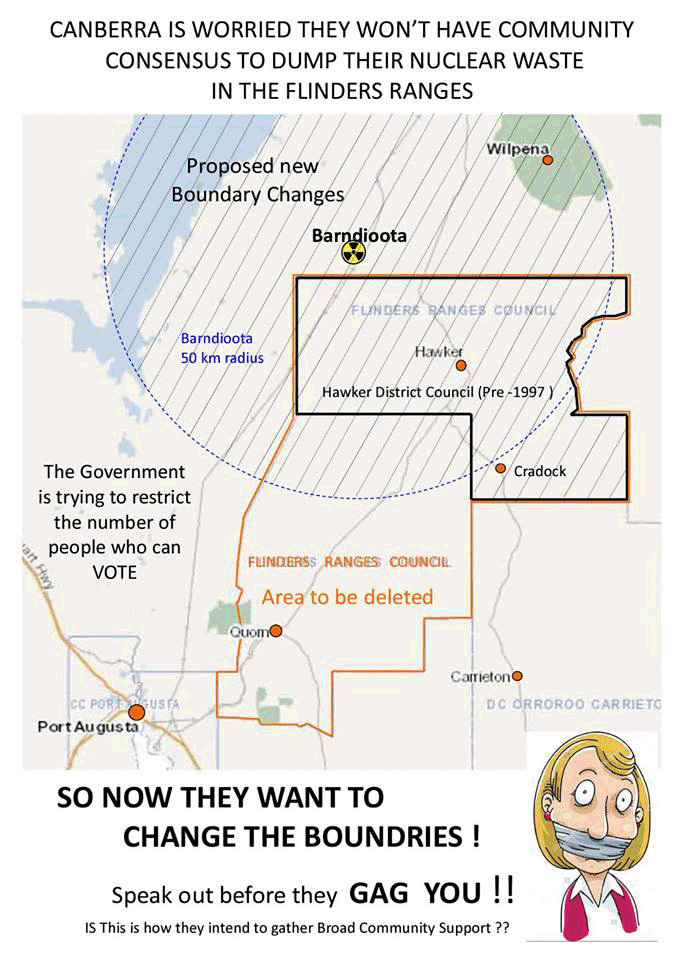
Australian govt changing electoral boundaries, in effort to get support for radioactive waste dump in South Australia?
New South Wales Senate debated the idea of a nuclear power station for Jervis Bay
NSW senate debates Jervis Bay nuclear plant, South Coast Register,  @fistjourno
NSW deputy premier John Barilaro called for a debate in the senate, and the contentious issue was discussed on Thursday.
“The technology they use today is a lot safer than what they used in Chernobyl, but Jervis Bay is not the place,” Christian Democratic Party member Paul Green said. “Not in Jervis Bay’s clean, green, pristine environment.“Over my dead body Jervis Bay will end up with one there.”
Meanwhile, his colleague Fred Nile, was open to the idea….. http://www.southcoastregister.com.au/story/4984329/nsw-senate-debates-jervis-bay-nuclear-plant/
A futuristic family car at the World Solar Challenge
Guardian 15th Oct 2017, A futuristic family car that not only uses the sun as power but supplies
energy back to the grid has been hailed as “the future” as the annual
World Solar Challenge wrapped up in Australia. The innovative bi-annual
contest, first run in 1987, began in Darwin a week ago with 41 vehicles
setting off on a 3,000km (1,860-mile) trip through the heart of Australia
to Adelaide. A Dutch car, Nuna 9, won the race for the third-straight time,
crossing the finish line on Thursday after travelling at an average speed
of 81.2kmh (55.5 mph).
https://www.theguardian.com/environment/2017/oct/15/this-is-the-future-solar-powered-family-car-hailed-by-experts
Adani needs $2bn of loans for Abbot Point coal terminal: Westpac Bank may not refinance Adani
 Abbot Point coal terminal: Westpac may not refinance Adani loan, Guardian, Michael Slezak, 12 Oct 17 Report reveals Adani needs to refinance $2bn of loans for Abbot Point coal terminal, which is more than it paid for it in 2011. Adani’s financing for its proposed Carmichael coalmine could face a further hurdle, with Westpac appearing to indicate it will not refinance its existing loan to Adani’s coal terminal at Abbot Point.
A recent report by the Institute for Energy Economics and Financial Analysis (Ieefa) revealed Adani needed to refinance more than $2bn worth of loans for its Abbot Point coal terminal in the coming year – an amount that is more than it paid for the port in 2011. That means the company has negative equity on the facility – owing banks more than it is worth.
The refinancing of its port comes as the company must find $5bn of loans for its Carmichael coalmine, which every Australian bank – and many international banks – have said they will not support.
Moreover, the two projects are entirely linked, meaning any bank that decides to support one project is supporting the other and taking a bet on its success: the Port’s financial viability depends on coal coming from the mine, and the mine will not be able to be built without the port operating.
The news that one of Adani’s major existing lenders is likely to withdraw support for Abbott Point therefore adds to ongoing doubts about the ability of the company to find financing for the controversial coalmine, and could jeopardise any potential loan it might get from the government’s $5bn Northern Australia Infrastructure Facility.
In April Westpac released its new climate policy, in which it revealed it would only lend money to projects supporting existing coal basins – not ones that opened up new coal basins. It also said it would only lend to projects that supported mining of coal that had energy content “in at least the top 15% globally”.
Both rules would rule out Westpac lending to the Carmichael mine. But Westpac already lent hundreds of millions of dollars to Adani for its Abbot point terminal, and questions remained whether it would refinance that loan at the end of its term…….
Julien Vincent from financial activist group Market Forces said all eyes will now be on the refinancing arrangements with Commonwealth Bank, with whom Adani has borrowed more money for Abbot Point.
The Commonwealth Bank, has not said it will not continue to invest in Abbot Point, but in August it did explicitly say that it would not be lending to the Carmichael coalmine….https://www.theguardian.com/environment/2017/oct/12/abbot-point-coal-terminal-westpac-may-not-refinance-adani-loan
Tony Abbott warns Prime Minister Malcolm Turnbull against supporting renewable energy
 Tony Abbott launches warning shot on climate policy, SMH, Mark Kenny, 16 Oct 17 Tony Abbott has fired a telling shot across Malcolm Turnbull’s bow, warning that any energy package agreed to in cabinet must also pass a party room wary of anything approaching a clean energy target or other subsidy scheme for renewables.
It came as the Turnbull government received more bad news in the fortnightly Newspoll series, prompting Mr Abbott to declare a future return to the leadership was possible but would occur only if he was drafted by colleagues, which he described as “almost impossible to imagine”.
Signalling that Coalition MPs will be no rubber stamp on energy, the dumped former prime minister said the backbench deserved “plenty of chance to digest” the formula.
Mr Abbott’s blunt message sets the stage for another showdown over a policy area that has divided moderates and conservatives within the Coalition for a decade, and become a constant cipher for simmering leadership rivalries…….http://www.smh.com.au/federal-politics/political-news/tony-abbott-launches-warning-shot-on-climate-policy-20171016-gz1m6z.html
Deceptive trickery of Native Title processes
Ghillar Michael Anderson, 16 Oct 17, First Nations inherent sovereign rights are being grossly and repeatedly violated.
‘It is shameful that the parliamentary lawmakers and the lawyers who call themselves ‘specialist Native Title lawyers’ have complete disregard for the fundamental Human Rights of First Nations Peoples.
The time has come for people to make a stand against these criminals who are making a complete mockery of the judicial process, while at the same time writing deceptive agreements that deny Aboriginal people the future right to challenge and appeal these major injustices.
‘Our Peoples have no protection against these wonton Human Rights abusers and violators,
who can get away with this because our people are kept in poverty by the Crown and
are without sufficient financial support that will allow us to make legal challenges
to right these wrong doings.
‘On the other hand, there are some of our people who choose to take the easy road
and do not want to create any form of confrontation over the breaching of our inherent sovereign rights.
In other words, the two-bob mob are prepared to take what’s on offer and shut up.
This stems from the problem of losing pride, identity and dignity and/or
being educated exclusively white-way and losing touch with core values of our Law and culture.
Independent action to free ourselves
‘I now make a call to all those protagonists, white and black, to lessen the damage that has been created by the likes of those who run ‘reconciliation’, ‘recognise campaign’, referendum council campaign’, ‘constitutional reform campaigns’ and those who are prepared to be agents of the coloniser and be on their payroll.
‘One of our main antidotes to the scourge of colonialism is to take our own independent actions to free ourselves from the tyranny of oppression and injustice by:
Mapping our respective Nation’s territorial boundaries;
declaring independent Sovereignty by way of Unilateral Declarations of Independence (UDIs);
designing and flying your own Nation’s flag;
writing the code of laws, traditional constitutional rules and laws;
presenting them to the Crown and governments saying: “This is what applies to our Country/our Nation.”
‘If Nations seek to incorporate both law-ways then it is time to negotiate Peace Accords or Treaties with each respective Nation.
‘We must now put paid to racially discriminatory legislation in all its forms and thereby end the scourge of colonialism in all its manifestations. … ‘
To continue reading Ghillar’s excellent and inciteful MR go to this link: www.sovereignunion.mobi/content/deceptive-trickery-native-title-processes
Richard Di Natale – Adani’s Carmichael coalmine won’t go ahead
Adani’s Carmichael coalmine won’t go ahead, Greens leader says
Richard Di Natale ‘confident’ if project can’t be stopped in parliament or for financial reasons, Australians will stand in front of bulldozers, Guardian, Amy Remeikis, 15 Oct 17, Adani’s Carmichael coalmine won’t go ahead, the Greens leader Richard Di Natale said, predicting “many, many thousands” of Australians would come together to protest any moves to stop the project.
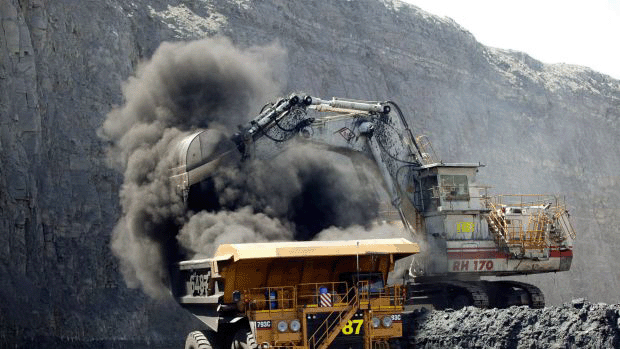
Di Natale said he believed Australians largely stood against the Carmichael coalmine, choosing the Great Barrier Reef and the environment over the construction of what has been billed as the largest coal project in the southern hemisphere…….
Di Natale said he would “absolutely 100%” join in any on-the-ground protest against the mine, if it went ahead, predicting it would be as big as the protest movement which stopped the Franklin Dam from going ahead in Tasmania three decades ago.
“I’ll be more than happy to join those activists right across the country, many of whom I know are preparing, should we fail in the parliament, to ensure that we win it by standing in front of the bulldozers.”
Di Natale said it was about saving both the environment and jobs of the future, instead of a “short-term hit” he said the Carmichael mine would provide……. https://www.theguardian.com/environment/2017/oct/15/adanis-carmichael-coalmine-wont-go-ahead-greens-leader-says
1 This month


Help Aunty Sue Protect Her Land and Sacred Sites From Destructive Rocket Testing.
.

Australians deserve the truth
about
AUKUS – https://aukuspublicinquiry.com/

PETITION – To: Prime Minister Anthony Albanese and the Australian Labor Government

of the week – Australians for War Powers Reform (AWPR)
To see nuclear-related stories in greater depth and intensity

