30 September REneweconomy news
-
 Queensland council saves $1.9m in grid costs from single Tesla PowerpackA Queensland local government council has installed what is believed to be Australia’s first off-grid solar and battery storage system to use a Tesla Powerpack, to maintain local drinking water quality around the clock.
 -
UK solar fund buys up 110MW PV project that will power Melbourne tramsUK solar fund buys major stake in 110MW Bannerton solar farm as part of plan to grow investments in “attractive” geographies.
-
Renewables experts advise on the project financing of the Lilyvale Solar FarmHerbert Smith Freehills’ full service project finance team has advised on the project financing of the Lilyvale Solar Farm, located 50km north east of Emerald in the Central Highlands region of Queensland.
-
Barnaby and Kelly’s constituents want a Clean Energy Target, not more coalPolling of over 1,000 voters in the Deputy Prime Minister’s electorate of New England shows strong support for renewable energy investment over coal.
-
Tesla big battery will be on time, but households need to waitTesla’s big battery will be delivered on time, or even ahead of schedule, but overwhelming demand and diversions to hurricane-affected areas mean households will have to wait for their battery storage.
-
Time for old coal to hang up the bootsAt this time of year, football matters, but in the case of Australia’s energy system, the stakes are much higher and it affects us all.
-
Regulator cracks down on double dipping for replacing “dodgy” rooftop solarClean Energy Regulator says new rule will make replacement rooftop solar panels ineligible for the government rebate, in an effort to boost the standard of installs.
-
South Australia leads again as saltwater pumped hydro storage takes shapeSouth Australia is ready to lead again, this time with saltwater pumped hydro storage. Here’s an inside look at what is planned.
-
Graph of the Day: Australia’s surging fossil fuel emissionsAustralia’s fossil fuel emissions have hit record levels, and there is no federal policy in place to address them.
-
The Pears Report: Summertime, and the living ain’t easyWith summer approaching, there’s a flurry of activity to ensure reliable energy generation under peak loads.
NO to Deputy Premier and Nationals Leader, John Barilaro: New South Wales does NOT need nuclear power

This follows musing by Deputy Premier and Nationals Leader, John Barilaro, that nuclear reactors could be operating in NSW within 10 years. Mr Barilaro said on social media: “We could have them (small nuclear reactors) operating here in a decade – which is not long for the energy industry…”
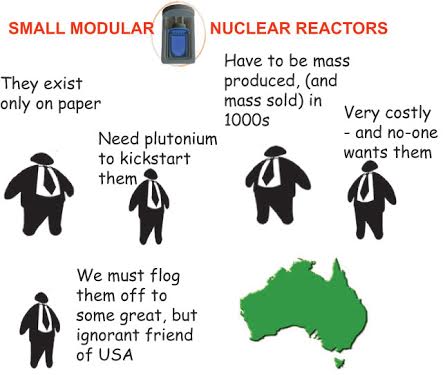
Opposition Energy spokesman Adam Searle said it was the second time this year Mr Barilaro had raised the possibility of nuclear energy for the State.
In May, Mr Barilaro said he was “prepared to talk about nuclear as an option”. One pro-nuclear power group, Nuclear for Climate Australia, has identified 12 regions of NSW as possible sites for nuclear reactors – including on the North Coast.
“A pro-nuclear power group is on the record suggesting reactors should be on the North Coast – does Mr Barilaro agree?” Mr Searle said.
“He should be clear with the public on where he thinks the nuclear reactors should be.
“Our farmers’ clean and green reputation is known throughout the world but a nuclear industry in these areas would end all that.”
South Australia’s Chief Scientist Leanna Read publicly advocating for illegal nuclear waste imports
“Why would South Australians want to become further involved in this industry when there are much safer alternatives available for people, the environment, country, culture and the economy?”
Kaurna ask the Scarn (South Auustralia Nuclear Fuel Chain Royal Commission) to justify the illegal immoral plotting which is being paid for by our tax dollars at the rate of a million dollars per month … a simple question which exposes the wasteful stupidity of the Scarn and the evil of radioactive poisons.
http://nuclearrc.sa.gov.au/…/2016/03/Kaurna-Yerta-04-09-201…
Australia’s rooftop solar boom now taking to business buildings
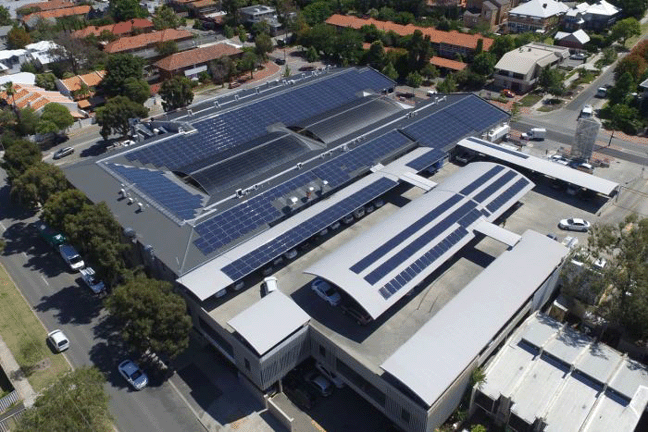
Above: Broadway shopping centre in Perth
The solar boom started in our suburbs, but now it’s moved out of home, ABC News, By Kathryn Diss, 28 Sept 17, Australian households have led the world in installing rooftop solar panels and now businesses are following suit as energy prices start to bite.
Nearly a quarter of the nation’s households have installed rooftop solar panels in recent years as consumers have looked for ways to offset their ever-increasing power bills.
But new research by consultancy firm SunWiz has found business solar installations have jumped 60 per cent during the past 18 months to 40,736 systems.
“It’s accelerated significantly in recent years and continues to be a popular investment for businesses wanting to take care of their electricity prices,” the company’s managing director Warwick Johnston said…….
Business backs renewables as politicians bicker
The research comes as federal politicians argue over what fuel source should be used to guarantee the nation’s future energy supply, with the east coast facing looming gas shortages……..http://www.abc.net.au/news/2017-09-28/solar-power-perth-businesses-energy-boom/8994314
South Australia’s network of charging stations for electric cars
Tesla charging stations to link Adelaide with world’s largest battery http://reneweconomy.com.au/tesla-charging-stations-link-adelaide-worlds-largest-battery-20202/ By Andrew Spence on 28 September 2017, The Lead
A network of car charging stations is being developed in South Australia to allow Tesla drivers to visit the world’s biggest lithium-ion battery being built by Elon Musk in the state’s north.
Eight fast charging stations: four generic chargers for a range of electric vehicles, and four Tesla Superchargers, opened today in the capital city of Adelaide, completing an Australian Tesla charging network that stretches to Brisbane.
The fastest electric car charging units available in Australia, the Tesla Superchargers can charge Tesla Model S and X vehicles in 30 minutes, allowing a range of 270km.A Tesla charging station also opened today at the Clare Country Club to complement two existing chargers in the wine region about 140km north of Adelaide. From there, it is only about 90km further to the site of the world’s largest battery being installed by Tesla at Neoen’s Hornsdale Wind Farm north of Jamestown.
Tesla CEO Elon Musk flew into Adelaide, the South Australian capital, in July to announce his company would build the 100MW/129MWh lithium-ion battery in the state’s Mid-North.
The tech billionaire told reporters the Tesla Powerpack would be three times as powerful as the next largest lithium ion battery.
“I was made aware there was this opportunity to make this significant statement about renewable energy to the world,” Musk said in July.
“Coal does not have a long-term future.”
Musk will be back in Adelaide on Friday to update the International Astronautical Congress on plans by his company SpaceX to send humans to Mars in its Big Falcon Rocket.
It is not known if he will use the opportunity to make the trip north to Jamestown to check on the progress of the battery.
South Australian Energy Minister Tom Koutsantonis said construction at the site was well underway and the batteries were on track to be operational by December 1, the start of the Australian summer.
Last month, Fluid Solar took its four-storey, renewable energy powered headquarters about 30km north of Adelaide off the main electricity grid.
Surplus electricity generated at the site will be used as part of Tesla’s car-charging network, with 11 electric vehicle bays that will be supplied completely by solar power harvested from a 98 kWp array of 378 PV solar panels on the building’s roof.
Eleven more electric vehicle charging points will be installed in the Adelaide Central Market car park in the centre of the city by the end of November and another 25 will be built around the city by mid next year.
South Australia leads the nation in the uptake of wind energy and roof-top solar with renewable sources accounting for almost 50 per cent of the electricity generated in the state.
However, the closure of two coal-fired power stations in recent years has increased South Australia’s reliance on energy supplies from the eastern Australian states, particularly in times of peak demand.
Yes, Mr Prime Minister: there IS an answer to all your energy problems – it’s wind and solar
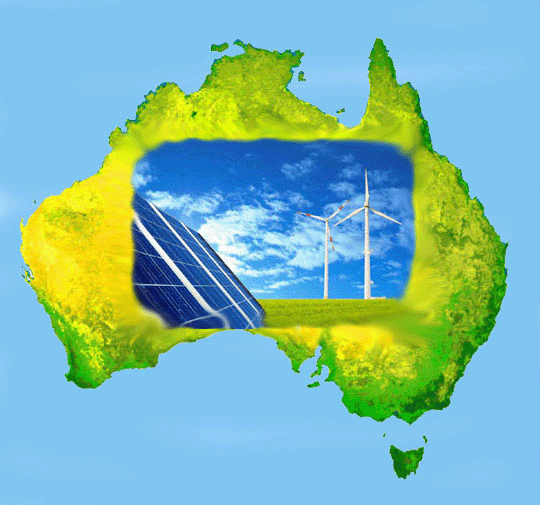 One year on from the state-wide blackout in South Australia that sparked the Coalition’s extraordinary jihad against wind and solar, it is clear that the answer to the trumped up energy crisis is exactly what the Coalition doesn’t want it to be: yet more wind and solar.
The message coming from the market operator, from the networks, from the CSIRO, from industry, and from the energy sector itself is that the best way to address the anticipated shortage of electricity, the soaring cost of gas, surging retail prices and cutting emissions is the same: more wind and solar.
More wind and solar – the answer to all Turnbull’s  energy problems http://reneweconomy.com.au/more-wind-and-solar-the-answer-to-all-turnbulls-energy-problems-14789/ By Giles Parkinson on 28 September 2017 AGL on Wednesday unveiled what it proposes as a substitute for the ageing, clapped out Liddell coal generator it plans to close in 2022: it suggests mostly a mix of wind and solar, topped with its own big battery, demand management and some gas power to help meet demand peaks.
The response of deputy prime minister Barnaby Joyce? He decided to compare Liddell and Bayswater with old cars and embraced the idea that Liddell was just like an old FJ Holden. Continue reading
29 September – more REneweconomy news
 RenewEconomy
-
Future Grid teams with WattWatchers to tap demand response energy market“Software meets hardware” partnership aims to tap booming behind-the-meter energy market – a key part of future NEM.FRV reaches financial close on 100MW Lilyvale solar farmFRV reaches financial close on 100MW Lilyvale solar farm in central Queensland.
-
ARENA backs RayGen solar tower technology with $4.8m investmentARENA tips another $4.8m into RayGen Resources, to boost manufacture and commercialisation of home-grown PV Ultra solar tower power technology.Why isn’t energy productivity part of national debate on electricity costs and security?In the ongoing furore over energy and climate policy, the energy productivity opportunity is being ignored as a solution despite its potential for energy cost reductions.
29 September REneweconomy news
RenewEconomy-
Adani’s Whyalla 140MW solar plant set for construction in 2018Green industrial revolution continues at Whyalla, with Adani Group’s 140MW solar farm approved for construction.
-
Adelaide charged up as hub for electric vehiclesThe City of Adelaide is now a hub for South Australia’s electric vehicle charging network with eight fast charging stations opening today within a new dedicated EV parking area.
-
Hackett steps aside as chair, CEO of battery storage company RedflowHackett steps down from twin roles at Redflow as company focuses on new manufacturing facility and cutting costs.
-
AGL looks at 250MW battery storage plant for LiddellAGL outlines plans to install 250MW of battery storage at Liddell, and to invest in Bayswater upgrade, new gas generators, demand response, and huge amount of wind and solar to replace Liddell.
-
Goulburn Council floats solar PV as a way to cut water costsGoulburn Council to commission feasibility studies into installing floating solar on government water stores, to slash power costs.
-
Graph of the Day: Green Bond issuance to soon pass $100 billionGreen Bond issues expected to surpass $US100 billion for the first time in a single year in 2017.
Campaign to get more MPs to work for Australia to sign and ratify the Nuclear Weapons Ban Treaty
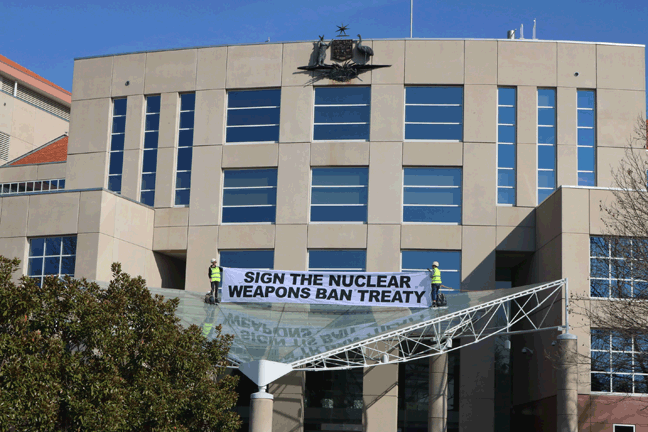
Gem Romuld, 25 Sept 17, Today marks the UN International Day for the Total Elimination of Nuclear Weapons. We took a big step towards that goal when the Treaty on the Prohibition of Nuclear Weapons opened for signature last Wednesday, gaining 53 signatories within the first 3 days. Many of our regional neighbours have signed on, including New Zealand, Indonesia, Malaysia and the Philippines.
Unfortunately, while Julie Bishop was at the United Nations, she failed to sign Australia on to the Treaty. To shine a spotlight on Australia’s dismal record on nuclear disarmament, activists scaled the front awning of the Foreign Affairs Department in Canberra.
This peaceful action was reported on television news, print and online. You can see the full list on our media page.
A September ReachTEL poll commissioned by Greenpeace Australia Pacific shows that 72% of the public supports the ban treaty. In Bishop’s own electorate of Curtin, 70% want her to sign on for Australia. Activists in Perth delivered a giant copy of the treaty and a giant pen to Julie Bishop’s electorate office, to remind her of what to do.
Please help us build support for the Treaty within federal parliament by signing up MPs and Senators to the Parliamentary Pledge. So far, 54 parliamentarians from all sides of politics have pledged to work for Australia’s signature and ratification of the Treaty. Let’s get more on board. Please check the list here and reach out to those who haven’t yet signed on.
With sadness, we farewell the Sydney-based author and Hiroshima survivor, Junko Morimoto, who passed away on September 21. In her final month, she urged Prime Minister Turnbull to sign Australia on to the nuclear weapons ban treaty.
While the nuclear threat continues to escalate, we must call on our government to reject these weapons of mass destruction entirely. Please support our efforts to get Australia and our regional neighbours to sign and ratify this vital new treaty.
Aborigines fight to block nuclear wastes from Scotland ending up dumped in rural South Australia
 Australian Aborigines move to block shipments of Scottish nuclear waste http://www.heraldscotland.com/news/15554758.Australian_Aborigines_move_to_block_shipments_of_Scottish_nuclear_waste/?ref=fbshr 26 Sept 17, ABORIGINES in South Australia are fighting a plan to ship nuclear waste from Scotland amid fears it will be dumped on land regarded as culturally and spiritually sacred.
Wallerberdina, around 280 miles north of Adelaide, has been earmarked as a possible location for Australia’s first nuclear waste dump despite claims that it is a priceless heritage site rich in archaeological treasures including burial mounds, fossilised bones and stone tools.
Some have claimed the impact would be similar to “building a waste dump at the heart of the Vatican”.
Now campaigners have appealed to the Scottish Government to halt controversial plans to ship nuclear waste processed at Dounreay in Caithness to Australia, amid concerns that it will eventually end up on the culturally sensitive land.
The waste transfer is part of a deal with saw spent fuel from nuclear reactors in Australia, Belgium, Germany and Italy processed at Dounreay – the nuclear facility in Caithness currently being decommissioned – to enable it to be safely stored after being returned to its country of origin.
The UK government has previously confirmed that “a very small quantity of Australian-owned radioactive waste” is currently stored in the country.
Scottish Government policy allows for the substitution of nuclear waste with a “radiologically equivalent” amount of materials from Sellafield in Cumbria.
The Herald understands that a shipment of such material is due to take place by 2020.
While the waste will be initially stored at a facility near Sydney, concern is growing that it could end up at Wallerberdina, one of two areas under consideration as a nuclear waste dump site.
As well as sparking anger over the site’s cultural and sacred connections, the proposed location has angered local people who still recall British atomic bomb tests in the area in the 1950s without permission from the affected Aboriginal groups.
Thousands were adversely affected with many Aboriginal people left suffering from radiological poisoning
Gary Cushway, a dual Australian/British citizen living in Glasgow, has now written to the First Minister asking that the Scottish Government review the agreement to transfer the material “until a satisfactory final destination for the waste is finalised by the Australian Government.”
He argues that doing so would allow the government to “take the lead in mitigating mistakes of the past that the UK government has made in regards to indigenous Australians.”
The proposed dump site is next to an Indigenous Protected Area where Aborigines are still allowed to hunt, and is part of the traditional home of the Adnyamathanha people, one of several hundred indigenous groups in Australia.
1461 scientists speak up for saving Australia’ oceans
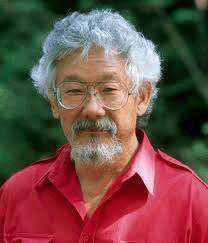 Conservationist and 1,461 other scientists release statement describing Australia’s oceans as a ‘global asset’ that must be protected, https://www.theguardian.com/environment/2017/sep/27/david-suzuki-australia-sickening-threat-to-marine-reserves-undermines-global-protection
Guardian,Michael Slezak, 26 Sept 17, Growing global momentum to protect the world’s oceans from overfishing could be undermined by Australia, warns renowned conservationist David Suzuki and more than 1,461 other scientists.David Suzuki: Australia’s ‘sickening’ threat to marine reserves undermines global protection He said Australia needed to face up to the interconnected issues of climate change and ocean health, both of which it was failing to address.
“I’m sorry Australia, wake up,” Suzuki said. “The oceans are a mess and a great deal of the mess is a reflection of climate change. Climate change is the overarching issue that is hammering the oceans as well as terrestrial areas. And it is absolutely disgusting that coal is still considered a great economic input to Australia.
“When you’ve got something that [other countries] would die for – you’ve got sunlight up the ying yang, why isn’t Australia the world leader in this incredible form of energy? It makes me sick. You’ve got great research facilities. You’ve got great scientists. You’ve got everything going to be a world leader in the energy of the future and you’re not doing it. And it’s not surprising then that you are doing the same to the oceans. What is it going to take for Australia to wake up to the opportunities?”
Australia is currently considering the world’s biggest downgrading of a protected area with a reduction in the size of its network of marine reserves. Continue reading
Some recycling of lithium already going on in Australia
 LITHIUM ION BATTERIES ore http://www.batteryrecycling.org.au/recycling/lithium-ion-batteries The number of lithium-ion reaching end of life is expected to increase exponentially over the next 20 years. A report from Randell Environmental Consulting and Blue Environment can be downloaded here.
A report from Anna Boyden on the environmental impacts of lithium ion batteries provides useful background material and can be downloaded here.
Lithium-ion batteries (UN No. 3480) are classified as Dangerous Goods under the Australian Code for the Transport of Dangerous Goods by Road and Rail (ADG Code).
The ADG Code requires all dangerous goods, including lithium ion batteries, to be carried in a secure, safe and environmentally controlled manner. The carrier has the right to refuse carriage if dangerous goods are not packed in accordance with the regulations. There is a special provision (377) and packaging instruction (P909) for ‘lithium ion and lithium metal cells and batteries and equipment containing such cells and batteries transported for disposal or recycling, either packed together with or packed without non-lithium batteries…’
The following ABRI members provide a collection and recycling service for used lithium-ion batteries. Contact the company or check their web site for details. Continue reading
27 September REneweconomy news
RenewEconomy-
Sonnen waives monthly fees for battery customers in new deal with installersSonnen offers “free energy” for households using approved installers, and says it has 2,000 battery sales so far in 2017 and keen to play FCAS market.
-
ABB to acquire GE Industrial SolutionsABB today announced the acquisition of GE Industrial Solutions, GE’s global electrification solutions business.
-
Stunning tipping points mean coal will never be great againThe global energy industry is experiencing two major tipping points for wind and solar that mean that coal will never be great again, no matter how much Conservative politicians and columnists may wish it to be so.
-
Why the Tesla truck will turn freight industry upside ownElon Musk prepares to unveil Tesla’s next big thing – the all electric truck. Analysts expect it to be the biggest thing in the trucking industry for decades, and will slash transport costs.
-
Origin and Santos: Australia’s bungling Gas GiantsThere is no easy answer to Australia’s gas shortfall and high prices – and certainly not Turnbull’s Venezuala-style solution. The best bets might be gas imports, and to build more renewables …
Walkatjurra Walkabout: For country, against uranium.
September 23, 2017 .Lauren http://www.riverredgum.com/walkatjurra-walkabout-for-country-against-uranium/
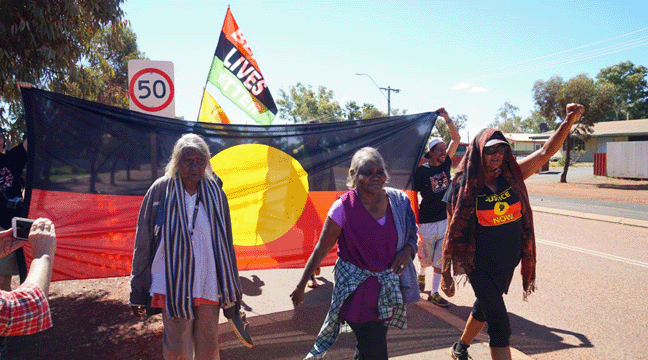
‘This is my first post in my ‘Real Life Ideas’ area and I wanted to share this as an idea because what I experienced on over the last month really made me think about different types of activism, what the word really means and how we can connect to the planet in a spiritual way while involving ourselves in activism and campaigning.
‘I also truly hope that the idea of a nuclear free world is one that will spread throughout
the world before more beautiful beings are harmed by its dangers. …
‘As the global nuclear free movement grows, so too will the attention given to this land.
It is in for a turbulent next few years, but no matter what any corporations, or selfish politicians say,
there is no denying the dangers and outright absurdities of uranium.
‘Too many people have been and will be hurt by nuclear weapons and nuclear power failures
and many more in the future will be effected by radioactive waste that we are accumulating.
‘Here’s an idea to say no to uranium, leave it in the ground.
‘Here’s an idea to say no to colonialism and exploitative western powers.
Six international academics refute the attack on renewable energy by Ben Heard and others
Response to ‘Burden of proof: A comprehensive review of the feasibility of 100% renewable-electricity systems’ AUTHORS W. Browna,(a) , T. Bischof-Niemz (b) , K. Blok(c) , C. Breyerc(d) , H. Lund (e) , B.V. Mathiesen (f ) (Their university positions are listed at the end of this post) September 2017
 Abstract A recent article ‘Burden of proof: A comprehensive review of the feasibility of 100% renewable-electricity systems’ [by Ben Heard, Barry Brook, Tom Wigley and Corey Bradshaw] claims that many studies of 100% renewable electricity systems do not demonstrate sufficient technical feasibility, according to the authors’ criteria.
Here we analyse the authors’ methodology and find it problematic. The feasibility criteria chosen by the authors are important, but are also easily addressed at low cost, while not affecting the main conclusions of the reviewed studies and certainly not affecting their technical feasibility.
A more thorough review reveals that all of the issues have already been addressed in the engineering and modelling literature. Nuclear power, as advocated by some of the authors, faces other, genuine feasibility problems, such as the finiteness of uranium resources and a reliance on unproven technologies in the medium- to long-term. Energy systems based on renewables, on the other hand, are not only feasible, but already economically viable and getting cheaper every day.
Contents Continue reading
1 This month


Help Aunty Sue Protect Her Land and Sacred Sites From Destructive Rocket Testing.
.

Australians deserve the truth
about
AUKUS – https://aukuspublicinquiry.com/

PETITION – To: Prime Minister Anthony Albanese and the Australian Labor Government

of the week – Australians for War Powers Reform (AWPR)
To see nuclear-related stories in greater depth and intensity

