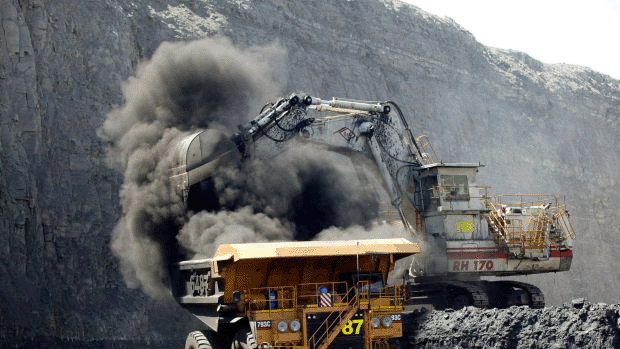
 Adani: Government body board members considering rail loan ‘linked to companies who may benefit’ Mark Willacy and Alexandra Blucher, ABC News 29 May 17, Conflict of interest concerns have been raised about two board members of federal government bodies involved in the consideration of a billion-dollar loan to Indian mining giant Adani.
Adani is seeking the loan from the Northern Australia Infrastructure Facility (NAIF) for a rail line linking its proposed Carmichael coal mine to the port of Abbot Point in north Queensland.
Green group Environmental Justice Australia said the two board members had connections to Queensland mining companies that could benefit financially if the Adani mine is approved and as such have a potential conflict of interest.
They have written to the NAIF and to the Export Finance and Insurance Corporation (Efic), the government credit agency, which is helping to evaluate the loan.
Environmental Justice Australia said Annabelle Chaplain was a board member of Efic but also a director of Downer EDI, which has a $2 billion commercial arrangement with Adani.
It also said Karla Way-McPhail was a NAIF board member as well as being the chief executive of two companies that do work in the mining industry. One is Undamine Industries, which hires out labour and machinery to support mining operations.
The second is Coal Train Australia, a mining training company based in central Queensland.
Efic board member Ms Chaplain is listed as an independent non-executive director of Downer EDI, whose $2 billion arrangement is to conduct drilling, blasting and coal haulage at the Carmichael Mine, if it goes ahead.
According to Downer EDI’s last annual report, Ms Chaplain held 74,000 shares in the company, putting her stake at more than $450,000. Downer EDI chief executive Grant Fenn told The Australian Financial Review last year the company was a “supporter” of the Adani mine and that the Indian giant was “a very large potential customer”.
‘Clear connections’ to companies that could gain from loan
Environmental Justice Australia said both Ms Way-McPhail and Ms Chaplain had clear connections to companies that could benefit financially if the Adani project was approved.
“We understand NAIF is considering proposals by an [Adani company] and Aurizon Holdings Ltd for Galilee Basin rail projects that would cart thermal coal to the Great Barrier Reef Coast,” Environmental Justice Australia wrote in its letter to both government bodies.
“There is a perception that Ms Way-McPhail could gain an advantage if either project were to proceed.”
Efic told the ABC Ms Chaplain was unavailable for interview…….
The NAIF has been accused of excessive secrecy over the operation of its board and the board’s deliberations. The ABC reported earlier this year the NAIF rejected a freedom of information request for the dates and locations of its upcoming board meetings. The NAIF chief executive said the “disclosure of the dates of board meetings could reasonably be expected to adversely affect the NAIF’s operations” by creating media attention and protest activity……http://www.abc.net.au/news/2017-05-29/conflict-of-interest-concerns-over-adani-rail-loan/8564368
May 29, 2017
Posted by Christina Macpherson |
AUSTRALIA - NATIONAL, politics, secrets and lies |
Leave a comment
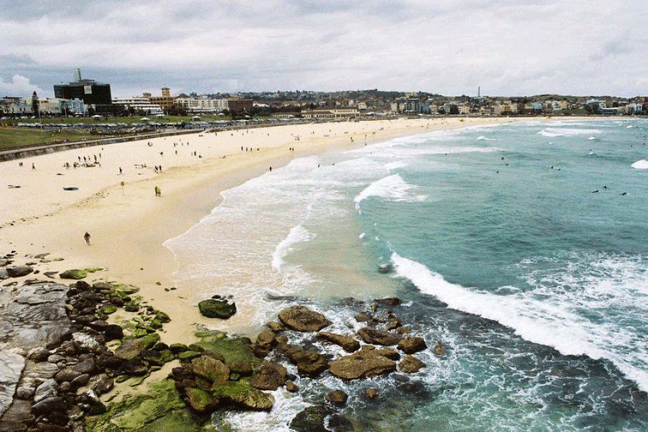 New data has coastal communities all at sea http://www.examiner.com.au/story/4689488/new-data-has-coastal-communities-all-at-sea/?cs=97
28 May 2017, New modelling on sea level rise caused by climate change shows that what was once considered the worst-case scenario, only four years ago, is now more likely if we continue on a high-emissions path. In January, the National Oceanic and Atmospheric Administration (NOAA) in the US released a report detailing global and regional mean sea level rise.
Scientists found that a rise of up to 2.7 metres by 2100 is in fact plausible, whereas the previous high scenario from the 2013 report – from the Intergovernmental Panel for Climate Change – was around 74 centimetres for the same year.
So why the increase? This year’s NOAA report includes the latest science on the rapid ice melt in Greenland and Antarctica as well as the latest results regarding Antarctic ice sheet instability and how these factors will contribute to global mean sea level rise.
These results align with other data. According to NOAA, in 2016 we experienced the warmest global surface temperature on record, having set new records for the previous two years.
In April this year there was record-low Arctic and near-record-low Antarctic sea ice.
These events have massive implications for Australia. Our coastal communities will be impacted by sea level rise and billions of dollars of infrastructure will be at risk. To quote Barrack Obama, “we are the first generation to experience climate change and the last generation that can do something about it”.
We now have a picture of what our worst-case scenario looks like for our coastal communities. Reducing emission levels will limit the impact of sea level rise. But sea level rise will happen and we need to understand the level of local risk to our coastal communities so that we can invest in protecting them.Nathan Eaton is Principal Consultant for NGIS and creator of the website, Coastal Risk Australia
May 29, 2017
Posted by Christina Macpherson |
AUSTRALIA - NATIONAL |
Leave a comment
South Coast 2100: what sea level rise could do to Canberra’s beach getaways http://www.canberratimes.com.au/act-news/south-coast-2100-what-sea-level-rise-could-do-to-canberras-beach-getaways-20170524-gwc19u.html Stephen Jeffery Canberra holidaymakers at the end of this century could drive down the Kings Highway to find the villas and waterfront homes of Batemans Bay below the high tide line.
Updated mapping from Coastal Risk Australia has estimated the effect of plausible sea level rises on the south coast by 2100.
Earlier this year, the United States National Oceanic and Atmospheric Administration this year lifted the “plausible” sea level rise to as high as between 2 and 2.7 metres by 2100 if emissions remained at their current levels.
The map showed the highest risk scenario, a two metre rise during the highest tides, would engulf most beachfront properties and promenades in Batemans Bay and Batehaven.
-
- Further north, the Shoalhaven River would claim much of the low-lying farmland between Nowra and the ocean, stranding Shoalhaven Heads, Greenwell Point and Culbarra Beach.
The canal properties that front Sussex Inlet would go underwater, while the Princes Highway would be cut at Dolphin Point and on either side of Moruya.
- Merimbula Airport would be inundated, according to the forecast, as would the marina and Market Street bridge over Boggy Creek.
The worst effects of the sea level rise would be felt elsewhere in the state, including in the Illawarra, Newcastle, Port Macquarie, Ballina and Byron Bay.
Parts of Sydney, including two airport runways, would also be adversely affected, based on the estimates.
NOAA estimated sea levels rose 0.65 millimetres per year between 1886 and 2010 in Sydney, with a global mean rise of about 3.2 millimetres per year between 1993 and 2014.
NGIS, which developed the mapping tool, used Google technology and local tide measurements to create Coastal Risk Australia.
The NOAA report, published in January, was developed through analysis of the expected melting rate of Greenland’s and Antarctica’s ice sheets.
“Recent results regarding Antarctic icesheet instability indicate that such outcomes [higher sea level rises] may be more likely than previously thought,” the report said.
“There has been continued and growing evidence that both Antarctica and Greenland are losing mass at an accelerated rate.”
Shoalhaven and Eurobodalla councils developed a south coast regional sea level rise policy in 2014.
Shoalhaven adopted a projected 36 centimetre sea level rise by 2100 in 2015, but agreed to conduct revised projections every seven years.
Eurobodalla has adopted a 50-year planning period for residential development and 23 centimetre sea level rise by 2050, but will also revise the guidelines every five to seven years.
Bega Valley Shire Council’s climate change strategy warned of a rise of up to 91 centimetres by 2100.
The strategy recommended future risk assessments, a coastal strategy and the incorporation of sea level rise consideration into environmental planning, infrastructure development and emergency management.
May 29, 2017
Posted by Christina Macpherson |
climate change - global warming, New South Wales |
Leave a comment

I wonder if the radioactively polluted area in Hunter’s Hill is included in this. Also, just how clean is the Lucas Heights area? Or should I say Baren Ridge – sounds cleaner than Lucas Heights, doncha think?
Environment Minister Gabrielle Upton announced the review on Saturday after Fairfax Media revealed that the Environment Protection Authority had been keeping “significant” chemical contamination hidden to protect residential property prices.
“There will be an independent urgent review into the procedural guidelines for contaminated land management,” Ms Upton said in a statement…..
An independent review last year found the authority had decided “not to routinely declare all sites where the contamination is significant enough to warrant regulation”.
The authority wanted to avoid “blighting” land prices but its head, Barry Buffier, denied that property prices were the “driving factor” in the organisation’s decision-making.
Environmentalists and the state’s opposition said they were alarmed that residents throughout the state could be unknowingly living on top of dangerous chemicals.
Fairfax also revealed the EPA was struggling to assess and prioritise many thousands of sites that had been reported as contaminated. …..http://www.smh.com.au/nsw/land-contamination-review-follows-fairfax-media-toxic-state-investigation-20170527-gwek1e.html
May 29, 2017
Posted by Christina Macpherson |
environment, New South Wales |
Leave a comment
 Federal Labor feels the heat over Adani, and Coalition is sweating too, Guardian, Katharine Murphy, 26 May 17
The biggest environmental campaign seen in Australia since the 80s is causing bumps in the road for both sides of politics When it comes to the Adani Carmichael coalmine, the spotlight this week has been trained on Queensland as the state government battled an internal split on whether to give the project a royalties holiday. There have also been murmurings in Canberra, where Labor MPs are starting to express public opposition to a project many have been privately wringing their hands about.
But to fathom the next phase in the political battle against the project, we need to train our eyes a bit further south.
Over this past week in Victoria, the Greens have launched a new fundraising drive to produce placards which will begin appearing shortly around the electorates of Melbourne, Batman, Wills and Melbourne Ports.
The placards have a simple message, easily consumed from a passing car or tram. They say: Stop Labor’s Adani Mine. It won’t stop with some signage. The Greens are planning to door knock the inner urban electorates where they now slug it out with Labor in hand-to-hand combat during federal elections.
While a couple of Labor MPs, David Feeney and Peter Khalil, have got out ahead of the new onslaught by outing themselves as opponents of Adani, the Greens are telling their supporters the objective is to force the federal Labor leader, Bill Shorten, to rule out supporting the Adani coalmine…..
The anti-Adani effort links in to coordinated global efforts by the environment movement to stop new coalmines. #StopAdani (and the associated activities) is the environmental movement’s equivalent of a multinational corporation – with Queensland the local frontline of a global, anti-coal offensive……
One Liberal said to me forcefully this week when I asked how Adani was playing out on home turf: “Christ, I wish it would just go away.”
One Labor figure puts the problem for his party this way: “It is talismanic. It’s the litmus test. Adani has become shorthand for ‘are you serious about climate change?’.” https://www.theguardian.com/environment/2017/may/27/federal-labor-feels-the-heat-over-adani-and-coalition-is-sweating-too
May 26, 2017
Posted by Christina Macpherson |
AUSTRALIA - NATIONAL, climate change - global warming, politics |
Leave a comment
 Palaszczuk rules out royalty holiday for Adani http://www.brisbanetimes.com.au/business/mining-and-resources/palaszczuk-rules-out-royalty-holiday-for-adani-20170526-gwe937.html Felicity Caldwell, 27 May 17
Queensland cabinet has decided not to grant a royalty holiday for the Adani Carmichael mine.
It comes after ongoing reports of tension between the Left and Right factions in the Palaszczuk cabinet over royalties for the Adani mine. Adani released a statement on Friday evening following news of the unanimous decision.
“Adani Australia will give urgent consideration of state cabinet’s decision tonight on a royalties arrangement for the $16.5 billion Carmichael coal mine project.” “Adani will analyse the details when they have been formally provided (and) confirms again that it will pay every cent of royalties to the state as was always the case.”
Ministers were called to a cabinet meeting on Friday afternoon to make a decision on the issue. In a brief statement released at 5.29pm on Friday, Ms Palaszczuk said state cabinet had “unanimously agreed to a new policy approach for the future development of the Galilee and Surat Basins and the North West Mineral Province”.
“Under this new policy, the Adani Carmichael mine will pay every cent of royalties in full,” Ms Palaszczuk said. “There will be no royalty holiday for the Adani Carmichael mine.”
On Monday, May 22, Adani announced it would postpone its final investment decision on the $21 billion central Queensland project after learning the cabinet did not make a ruling on royalties.
Earlier this week, Ms Palaszczuk told journalists that cabinet would meet as usual on Monday, May 29. She did not flag the unexpected Friday afternoon meet-up. More details would be released in “due course”, Ms Palaszczuk said.
May 26, 2017
Posted by Christina Macpherson |
climate change - global warming, politics, Queensland |
Leave a comment
 German battery giant Sonnen teams with Australian solar tile maker to take on Tesla, One Step Off The Grid, By Sophie Vorrath on May 25, 2017
 German battery storage giant and major Tesla rival, Sonnen, has opened up competition on yet another front in Australia, with the announcement this week of a partnership with a local roofing company that is set to launch its own version of an integrated solar tile.
Sonnen said on Thursday that it had signed an agreement with Australian company Bristile Roofing to be the national supplier of solar powered energy storage systems for homes using its new solar tile, which is due to hit the market in September.
Under the deal, Bristile will offer the Sonnen AC Coupled modular battery storage system to the builder market, as well as its new Sonnen DC Hybrid range.
The storage system includes an inverter, battery modules, and an energy management system with built-in smart appliance control. The systems have a 10-year guarantee, but are designed for a 20-year life, according to Sonnen.
Bristile, which is a part of the building materials group Brickworks, says it expects to target the estimated 102,000 new-build homes throughout Australia in 2017-18, with a number of builders the company deals with “looking to offer integrated solar systems” as a standard feature of off-the-plan homes…..
The deal come’s just weeks after Tesla announced that its own, much-hyped solar roofing tiles were open for Australian orders, with down-payments, ahead of delivery in 2018.
Tesla, which has previously claimed the tiles would be no more expensive that a regular roof, making the solar power generation “a bonus”, has estimated that the “typical homeowner” should expect to pay $US21.85 per square foot for the tiles. Bloomberg, however, puts the price at $US42 per sqaure foot, including materials and labour.
Prices are yet to be revealed for the Bristile Solartile. https://onestepoffthegrid.com.au/german-battery-giant-teams-australian-solar-tile-maker-take-tesla/
May 26, 2017
Posted by Christina Macpherson |
AUSTRALIA - NATIONAL, solar |
Leave a comment
 AEMO says major market reform essential to cut energy prices http://reneweconomy.com.au/aemo-says-major-market-reform-essential-to-cut-energy-prices-28327/ By Giles Parkinson on 26 May 2017
Two key Australian energy institutions have again pushed for more rapid and wholesale changes of market rules, saying this was essential if Australia was to manage new technologies and return to its former status of a low-cost energy nation.
Testimony from the Australian Energy Market Operator and the Australian Renewable Energy Agency underlined their plea for changes to market rules, changes which many in the industry say have been stalled under the current market rule maker. New AEMO chief executive Audrey Zibelman says Australia used to have low energy prices, but had obviously lost that status. “The question is, how do we use the resources we have to get back to that level of affordability?” she told a parliamentary inquiry in Canberra.
The answer was with new technologies like battery storage and demand management, a new set of market rules. “What we need is to think how to get these opportunities into the market. We are operating 20th Century power system trying to keep pace with 21st Century change,” Zibelman said.
Both AEMO and ARENA have been highly critical of the slow pace of reform of Australian energy market rules, the province of the Australian Energy Market Commission and the COAG energy ministers.
In its submission to the parliamentary inquiry into a modern electricity system, AEMO said that Australia’s rule making was not sufficiently forward-looking to meet the needs of the “paradigm shifts” the National Electricity Market was undergoing.
In particular, AEMO and ARENA want rule changes that can encourage battery storage and demand management, and that will address the over-investment in networks and generators that are responsible for Australia now having some of the highest electricity prices in the western world. Continue reading →
May 26, 2017
Posted by Christina Macpherson |
AUSTRALIA - NATIONAL, energy |
Leave a comment
 Nuclear the NSW Nationals’ solution to energy crisis, JAMES WAGSTAFF, The Weekly Times, May 24, 2017 “…..NSW Deputy Premier John Barilaro said with rising energy costs “crushing businesses, farmers and families”, all available options, “including nuclear energy”, must be considered…….
NSW Greens energy spokesman Jeremy Buckingham labelled the comments as “extreme” and an example the Nationals were “stuck in the wrong century pushing coal and nuclear, and ignoring the massive renewable energy potential of Australia”.
Victorian Farmers Federation president David Jochinke said he would be “open to discussing any strategy that has sound economic, social and environmental principles; however, an opinion needs to be backed by a fact”…..
National Irrigators Council chief executive Steve Whan said that while irrigators were “agnostic about sources of power — including renewables — as long as it’s reasonably priced and reliable” nuclear was “probably unrealistic” given high construction costs and the likelihood of community opposition…..http://www.weeklytimesnow.com.au/news/national/nuclear-the-nsw-nationals-solution-to-energy-crisis/news-story/6cedf439e992fd746b1606fb2fff5c49
May 26, 2017
Posted by Christina Macpherson |
AUSTRALIA - NATIONAL, politics |
Leave a comment
Most Queensland voters oppose taxpayer support for Adani coalmine – poll
59% give thumbs down to state or federal assistance for Carmichael mine as state government faces factional fight over whether to give project a royalties holiday, Guardian, Katherine Murphy, 25 May 17 Queensland voters have given the thumbs down to taxpayer support for the controversial Adani coalmine, with 59% saying they were opposed to state or federal assistance.
A new poll of 1,618 Queenslanders taken by ReachTel indicates 57% of the sample objected to a loan for a rail link between the mine and Abbot point, which is championed by the federal resources minister Matt Canavan.
Just over 50% of the sample said a decision by the Queensland government to grant the project a royalties holiday would be a broken election promise.
The poll was commissioned by the progressive thinktank the Australian Institute.
It comes as the state Labor government is battling an internal split on whether or not to give the project a royalties holiday.
Federal government sources have also told Guardian Australia that Canavan can expect strong internal pushback against any proposal to grant a concessional loan to Adani. Some argue the concept is objectionable.
This week officials from Infrastructure Australia told Senate estimates they had not identified the proposed rail line as a priority, and they had not consulted the body which is expected to stump up a concessional loan, the Northern Australia Infrastructure Facility.
Adani is seeking a $900m concessional loan from the Naif for the rail line. Infrastructure Australia and the Naif are required to consult on projects worth more than $100m.
As well as facing internal resistance to taxpayer support, the environment group, the Australian Conservation Foundation, has warned the Turnbull government it will pursue all avenues, including possible legal action, to stop a concessional loan being granted to the rail line.
The new poll also comes as federal Labor MPs this week have also broken ranks to express public objections to the controversial project…… https://www.theguardian.com/environment/2017/may/25/most-queensland-voters-oppose-taxpayer-support-for-adani-coalmine-poll
May 26, 2017
Posted by Christina Macpherson |
climate change - global warming, politics, Queensland |
Leave a comment
I do believe that Treaty is the mechanism in which we can hold the government to account for past and present atrocities; it is our means of asserting our sovereignty and ensuring the structures that will see our communities flourish are funded.
The Treaty model I support is one where parallel to the existing Australian framework is an Indigenous organisational framework brought about by the signing of a treaty. In the same way, mainstream Australia has local government councils, Indigenous nations can have their own nation councils to deal with local issues.
 The Uluru walkout: Constitutional recognition, Treaty and structural change, Independent Australia Natalie Cromb 26 May 2017, Yesterday, several Indigenous delegates walked out of a Constitutional recognition summit. Indigenous affairs editor Natalie Cromb explains why, before proposing a better way.
Indigenous Australians have for some time been discussing Constitutional recognition via the well-known Recognise campaign, as well as some smaller conservative offshoots, which have alternative Constitutional recognition models.
This week, a national First People’s summit has been holding a Constitutional convention to discuss constitutional recognition at Uluru in the Northern Territory. Yesterday, seven delegates and a large number of their supporters walked out of this Convention.
SBS reported their reasons why: Continue reading →
May 26, 2017
Posted by Christina Macpherson |
aboriginal issues, AUSTRALIA - NATIONAL |
Leave a comment
 REneweconomy, By Sophie Vorrath on 24 May 2017 The Clean Energy Seed Fund established just under a year ago as the first investment of the Coalition government’s re-badged Clean Energy Innovation Fund, has this week completed a $26 million capital raising, easily surpassing its $20 million target.
The fund’s manager, Artesian Venture Partners, said on Wednesday that the bumper capital raising included $10 million commitments from cornerstone investor the Clean Energy Finance Corporation (CEFC) and Australian Ethical Investment, and further investments from Hostplus and Future Super.
Launched in September 2016 with a $10 million cornerstone commitment from the $1 billion CEIF, the fund was set up to focus on clean energy sub-sectors including the internet of things, battery storage, biofuels and metering and control.
It aims to provide “pull-model” venture capital support to encourage greater investment and participation in the early-stage cleantech sector and co-investment from a wide range of investors, including high net worth individuals, angel investors, venture capital firms, corporates and institutions.
In the short-term, its goal is to invest at seed, angel and later stage follow-on rounds in 30-50 startups over a four-year investment period.
The fund also draws on the finance and skills of both the CEFC and the Australian Renewable Energy Agency (ARENA), the latter of which was, at the time of the fund’s establishment, facing steep budget cuts.
CEFC investment development director, Blair Pritchard said the $26 million of funds raised would be enough to see more dedicated clean energy accelerators popping up around the country….. http://reneweconomy.com.au/clean-energy-seed-fund-raises-26m-vote-confidence-sector-96236/
May 26, 2017
Posted by Christina Macpherson |
AUSTRALIA - NATIONAL, business, energy |
Leave a comment
 Video ft. Fred Hooper, Dubbo delegate
“But seven delegates & about a dozen of their supporters from NSW & Vic derailed the meeting on its second day by staging a walkout and stating ‘we won’t sell out our mob’.
“The dissenters claim their calls for a treaty are being diminished in favour of constitutional recognition. …
“Dubbo delegate Fred Hooper believes indigenous Australians should follow their Canadian and New Zealand counterparts in negotiating a treaty for compensation and land reparations. … ”
http://www.skynews.com.au/news/politics/federal/2017/05/25/uluru-summit-hears-calls-for-a-treaty.html
May 26, 2017
Posted by Christina Macpherson |
aboriginal issues, AUSTRALIA - NATIONAL |
Leave a comment
Should Australia invest funds and resources in developing Generation IV nuclear reactors? Online opinion,
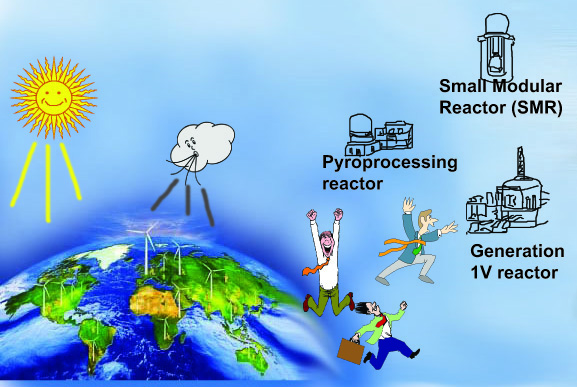
| By Noel Wauchope, 23 May 2017 Without any fanfare, with no media coverage, Australia’s Parliamentary Joint Standing Committee on Treaties (JSCOT) is presently considering Australia signing up to the International Framework for Generation IV Nuclear Energy Systems (GIF), which will commit this nation to take part in developing new nuclear reactors.Dr Adi Paterson, CEO of the Australia Nuclear Science and Technology Organisation, signed up to this GIF Framework last year. However, that does require confirmation by the Australian government. Hence there was the need for the JSCOT Committee to at least take a look at it, before the government completes the membership. Apparently there is no need for public discussion, or probably even Parliamentary discussion.
This Committee very quietly invited submissions, and very few were in the know about this. Now the received submissions have been published – at http://www.aph.gov.au/Parliamentary_Business/Committees/Joint/Treaties/NuclearEnergy/Submissions.
Anyway, it looks as if ANSTO is the driving force behind this process, and judging by the submissions received, the nuclear lobby was in the know, even if the public was not. Fourteen submissions were received. Of these, eleven were strongly pro- nuclear, and three were opposed. The opposing submissions came from Friends of the Earth (FOE), (jointly with the Australian Conservation Foundation (ACF ), Medical Association For The Prevention of War (MAPW), and myself, (I came upon the Parliamentary website just by chance).
In assessing these submissions, of course, I have to admit to bias on my part. Still, I think that any reader would find that there is one submission that stands out for clarity, and a detailed, factual discussion of the GIF plan. That is the one written by Jim Green and Dave Sweeney, for FOE and ACF.
Green and Sweeney respond to assertions made in ANSTO’s National Interest Analysis. They question claims that the new reactors reduce weapons proliferation risks, are economic, efficient, and solve waste problems. They rebuke the claim of ANSTO that “a significant expansion in nuclear power production is underway “, listing the overall decline in nuclear power growth, with the exception of China. They discuss at length the very long time frame expected even by nuclear industry experts, before any Generation IV reactors could be commercially viable.
They go on to discuss each of the six proposed new nuclear reactors, giving a detailed history of the attempts to develop each, and factual information that refutes those claims made by ANSTO. For all of their statements, Green and Sweeney provide evidence and references.
The Medical Association for Prevention of War (MAPW)’s submission questions the government’s high subsidising of ANSTO, and points out the poor prospects for private investment in new nuclear power. It refutes the argument that Gen IV reactors would solve the nuclear waste problem, quoting analysis by the US National Academy of Sciences. They discuss the history of attempts to develop Gen IV nuclear reactors: ” a track record of repeated failure and massive cost”. They discuss the direct and indirect costs, and ANSTO’s secrecy about nuclear costs. Safety and reliability issues, and proliferation risks, are examined. They also point out that the recent Nuclear Fuel Cycle Royal Commission (NFCRC) was not supportive of new nuclear technology. The Commission proposed:
…monitoring and reporting” of new designs, not participation in research and active subsidization. The Royal Commission also places emphasis on economic value for nuclear power generation, which is clearly entirely absent from fast reactor operations.
My own submission also discusses non-proliferation, nuclear waste, and claims about climate change, but it focuses on the lack of public information and discussion. In view of Australia’s laws prohibiting the development of nuclear power in Australia, I find it disturbing that the government is about to put money and resources into developing new nuclear reactors.
Now – to the eleven pro nuclear submissions. In general these faithfully repeat the claims made by ANSTO, stressing the value of Australia participating in an international forum. (e.g: submission from Australian Nuclear Association)
Now – to the eleven pro nuclear submissions. In general these faithfully repeat the claims made by ANSTO, stressing the value of Australia participating in an international forum. (e.g: submission from Australian Nuclear Association)
- Most submissions praise ANSTO and universities ANU and UNSW for their expertise.
- Then there’s the claim that nuclear power will decarbonise the economy. (submission by The Australian Academy of Technology and Engineering (ATSE)). (and from Barrie Murphy)
- Joining GIF will increase the visibility of Australia’s cutting-edge research (from Nuclear Engineering Research Group, School of Electrical Engineering, Faculty of Engineering, UNSW Sydney)
- Would increase Australia’s ability to influence international policy – will increase the international status of ANSTO and Australia’s universities. (from Warren Centre for Advanced Engineering)
|
Continue reading →
May 24, 2017
Posted by Christina Macpherson |
AUSTRALIA - NATIONAL, politics, secrets and lies, technology |
Leave a comment
 Australian Conservation Foundation vows to pursue all avenues to stop Adani loan
Environmental group warns it will take legal action against Northern Australia Infrastructure Facility directors if funding granted for rail line, Guardian, Katharine Murphy, 24 May 17, Infrastructure Australia produces a priority list of nationally significant investments which is supposed to guide government investment decisions.
Infrastructure Australia’s chief executive, Philip Davies, said he had not yet discussed the Adani project with the Naif, even though the rail project has completed a preliminary assessment and been referred for further consideration.
Adani is seeking a $900m concessional loan from the Naif for the rail line which links the mine with Abbot point. Infrastructure Australia and the Naif are required to consult on projects worth more than $100m.
Cousins said the evidence given in Senate estimates this week indicated the loan was nowhere near being granted. “Clearly all the rumours that this loan is about to be granted are untrue,” he said.
“I cannot see from this evidence that there is any way this loan can be granted.”
Cousins contends the directors of the Naif could be in breach of their fiduciary duties if they approve a loan to the project…….https://www.theguardian.com/environment/2017/may/23/australian-conservation-foundation-vows-to-pursue-all-avenues-to-stop-adani-loan
May 24, 2017
Posted by Christina Macpherson |
AUSTRALIA - NATIONAL, climate change - global warming |
Leave a comment