Final investment decision postponed by Adani, regarding Carmichael coal mine
 Adani indefinitely postpones final investment decision on Carmichael coal mine, ABC News, 23 May 17 Senior Queensland Government members were in meetings on Monday night, discussing how to urgently convince Indian company Adani to proceed with a board meeting to fund the proposed Carmichael coal mine.
The mining giant has postponed its final investment decision on the $16.5-billion project in central Queensland until the State Government gives “clarity” over lower or deferred royalties.
A company spokesman said they were waiting for the State Government to advise on whether it would offer a lower royalty rate or deferred royalties.
The Adani board was to meet in India next week for final approval but has postponed the meeting.
The State Cabinet on Monday discussed whether to give Adani a royalty discount or deferral, but no decision has been made…….
The proposed royalty deal is understood to have caused division among Labor factions.
Deputy Premier Jackie Trad and Roads Minister Mark Bailey, from the Left faction, have publicly opposed any government subsidy of the mine and said that had been Labor’s position since before the 2015 state election.
However earlier on Monday, Agriculture Minister Bill Byrne said royalty arrangements were being considered by the Government…….
Greens, activists accuse Adani of bullying
Queensland Greens senator Larissa Waters said the mining company was trying to bully the State Government into handing over $320 million in free coal.
“So far, Adani is in line for a $1 billion handout, unlimited free water, new legal loopholes, special changes to Native Title, a free pass on reef destruction,” she said.
She called on the Queensland and Federal Governments to abandon their support for the project.
Activist group Get Up said if Adani could not afford the project without a royalty holiday, it was not financially viable. http://www.abc.net.au/news/2017-05-22/adani-indefinitely-postpones-final-carmichael-coal-mine-decision/8548164
‘Dirty Deeds’ – The shady web behind potential Adani coal mine finance
https://www.acf.org.au/dirty_deeds STOP ADANI 24 MAY 2017
An Australian Conservation Foundation (ACF) investigation has discovered the publically funded Export Finance Investment Corporation (Efic) could be used as a backdoor option to finance Adani’s Carmichael coal mine.
An Australian Conservation Foundation (ACF) investigation has discovered the publically funded Export Finance Investment Corporation (Efic) could be used as a backdoor option to finance Adani’s Carmichael coal mine.
Efic could provide loan insurance to private investors for Adani’s Carmichael coal mine, leaving Australians exposed to billions of dollars being lost to a useless stranded asset.
These findings are part of a new report from ACF exposing the web of ties between the fossil fuels industry, the government, the Northern Australia Infrastructure Facility (NAIF) and Efic.
- Five of the seven NAIF directors have close connections to the fossil fuel industry.
- NAIF Board has lack of experience with industries such as communications and renewable energy which are critical to the development from Northern Australia.
- NAIF’s chief adviser, Efic, has a track record of investing in large fossil fuel projects, backing fossil fuels over renewables at a rate of more than 100:1.
- Efic could insure private investment in Adani coal mine – Turnbull government has refused to rule it out.
Download the investigation, and watch a video below showing the web of NAIF and Efic coal interests.
“That public money could be put on the line to protect private profit from the Adani coal mine that will help destroy the Reef and Australian tourism jobs is a truly gobsmacking and outrageous idea.” said Kelly O’Shanassy, Australian Conservation Foundation CEO.
“Both NAIF and Efic must be prevented from supporting a mine that will end up being a stranded asset, potentially wasting billions in public money. The Turnbull government must take responsibility and rule it out immediately.
“When the Adani mine fails, the Australian public will be the very last people to get their money back and probably won’t.
“Public investment in coal is a losing proposition for public money, the Reef and the 70,000 tourism jobs that rely on it.”
Australian Renewable Energy Association funding next generation solar PV
 ARENA opens $20m funding round for next generation solar PV
ARENA switches focus of solar PV support back to R&D, in bid to achieve more cost savings and ensure solar can provide nearly one third
http://reneweconomy.com.au/arena-opens-20m-funding-round-for-next-generation-solar-pv-98140/
Spark’s bright on energy changes
Spark Infrastructure believes changes to the grid to accommodate renewable energy and batteries are an opportunity.
http://www.theaustralian.com.au/business/mining-energy/spark-hails-energy-changes-as-an-opportunity/news-story/af7d888c88376e006517e6195bbdedcc
Is the Australian govt secretly planning for tax-payers to finance Adani coal mine?
Report; EFIC may finance Adani coal mine, Michael West, May 23, 2017 Is the government secretly planning to put taxpayers on the hook to build the world’s biggest new thermal coal mine? It is refusing to rule it out.
Until now, speculation has centred on a $1 billion discount loan from the Northern Australia Infrastructure Facility (NAIF) to Indian billionaire Gautam Adani to build a rail line from the Galilee Basin to Abbot Point on the Queensland coast. This is a “cart before the horse” proposition however. There can be no rail line without a mining project, and Adani is yet to attract project finance from commercial banks to build its mine.
A new report by the Australian Conservation Foundation notes that a number of approaches were made to the Federal Government and its credit agency, Export Finance and Insurance Corporation (EFIC), asking whether the agency was considering supporting the Carmichael thermal coal project. Already EFIC has a team working within NAIF on project evaluation. Continue reading
Australian cities becoming urban heat islands
Urban island heat effect: Rising temperatures in Aussie cities could create death traps
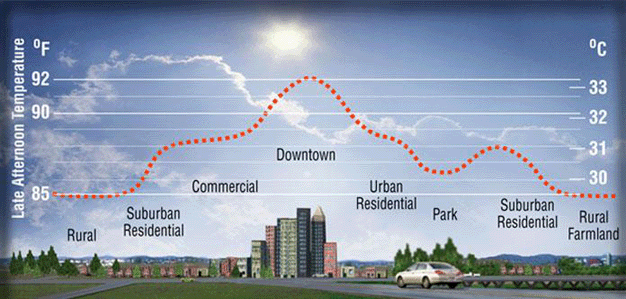
SOME parts of Australia are very hot – unnaturally hot, in fact. They’re turning into death traps, and it’s our own fault. news.com.au Megan Palin@megan_palin 23 May 17 AUSTRALIAN cities are 5C hotter compared to surrounding areas because of a phenomenon known as the ‘Urban Island Heat’ effect that could eventually turn them into death traps.Densely populated urban areas including Sydney, Melbourne and Brisbane are baring the brunt of the UHI across the country and not even a looming winter can stop it.
The UHI occurs when natural permeable surfaces including grass, plants or bush land are replaced with concrete, asphalt and infrastructure.
According to the Centre for Science
AUSTRALIAN cities are 5C hotter compared to surrounding areas because of a phenomenon known as the ‘Urban Island Heat’ effect that could eventually turn them into death traps.
Densely populated urban areas including Sydney, Melbourne and Brisbane are baring the brunt of the UHI across the country and not even a looming winter can stop it.
The UHI occurs when natural permeable surfaces including grass, plants or bush land are replaced with concrete, asphalt and infrastructure.
According to the Centre for Science Education (UCAR), urban development causes surfaces that were once permeable and moist to become impermeable and dry. They heat up during the day and retain the warmth but infrastructure prevents it from escaping into the cold night.
These changes cause urban regions to become warmer than their rural surroundings, forming an “island” of higher temperatures in the area.
“These surfaces absorb — rather than reflect — the sun’s heat, causing surface temperatures and overall ambient temperatures to rise,” according to a statement from UCAR.
“Displacing trees and vegetation minimised the natural cooling effects of shading and evaporation of water from soil and leaves.
“Tall buildings and narrow streets can heat air trapped between them and reduce air flow. Waste heat from vehicles, factories, and air conditioners may add warmth to their surroundings, further exacerbating the heat island effect.”
The UHI is perpetuated by residents in urban areas who suffer from the effects and increase usage of electric fans and airconditioners for relief. The increased energy demands strain resources which often leads to ‘rolling blackouts’ or power outages and contributed to an even hotter UHI.
But that’s not the only significant impact of the phenomenon.
According to UNSW researchers, extreme city heat could cause train lines to crumble and could cause heat stress, damaging our organs.
“Since 1900, extreme heat events have killed more Australians than bushfires, cyclones, earthquakes, floods and severe storms combined,” the researchers said.
WHAT’S BEING DONE ABOUT IT?……. http://www.news. com.au/technology/environment/ climate-change/urban-island- heat-effect-rising- temperatures-in-aussie-cities- could-create-death-traps/news- story/ 0b035c4707ea8f81e32ee0df4fa546 bf
CSIRO is back on the world climate stage, in alliance with China’s largest marine science research institute
 Science is the winner from alliance, PETER BOYER, Mercury May 23, 2017 CSIRO is back in town and back on the world climate research stage. That was the real news in yesterday’s welcome announcement of a new Hobart-based Centre for Southern Hemisphere Oceans Research.
Australia could use hydrogen to export solar energy
Guardian 19th May 2017 Using hydrogen on a large scale – either for electricity generation or transportation fuel – requires significant infrastructure investment; for example in hydrogen fuelling stations.
Zhang points out that Australia’s geography and scattered population makes that an expensive prospect, at least for the time being. Because of this, some are focusing on the perhaps more achievable prospect of Australia becoming an exporter of energy in the form of hydrogen.
Dr Michael Dolan, principal research scientist at CSIRO, says this is an attractive scenario because Australia has such an enormous capacity to generate renewable energy compared to a country like Japan, which has limited free land and sunshine…. https://www.theguardian.com/sustainable-business/2017/may/19/how-australia-can-use-hydrogen-to-export-its-solar-power-around-the-world
Federal and State policies betray Australia’s environment, and fail climate action
ClimateFail: Turnbull Government abandons any pretence of climate policy, Independent Australia Sue Arnold 22 May 2017 ‘A mountain of strategies, plans, reviews, meetings of ministers and promises substitute for any action at a time when climate change is wreaking havoc on the environment and wildlife.’A MASSIVE BETRAYAL of environmental issues is now entrenched in Federal and state government policies.
The failure to provide adequate funding in the Turnbull/Morrison 2017 Budget should eradicate any lingering doubts over the attitude and policy failures of this appalling Coalition Government and the spin-off impacts at the State level. The Budget miserliness is a clue to a much bigger picture.
In essence, the environment has been pushed to the back of the bus. International obligations under conventions that Australia has ratified are ignored. Entire forests must have disappeared to provide for the mountains of paper and verbiage paying lip service to Australia’s unique biodiversity and environmental heritage.
In 2010, the Federal Government published ‘Australia’s Biodiversity Conservation Strategy‘ under the auspices of the National Resource Management Ministerial Council (NRMMC). The strategy stretched from 2010-2030 and was tasked to the National Biodiversity Strategy Review Task Group.
The report is described as:
‘ … the guiding framework for governments to conserve our national biodiversity to 2030. It provides an overview of the state of Australia’s biodiversity and outlines collective priorities for conservation.’
Not only is the strategy a national framework for biodiversity conservation, it also acts as Australia’s principal instrument for implementing the United Nations Convention on Biodiversity.
Ten national targets were identified in the strategy to be completed by 2015:……….
In the meantime, the NRMMC disappeared, as did the National Biodiversity Strategy Review Task Group. A spokesperson from the Department of the Environment and Energy was unable to detail who exactly did away with these two bodies, but it appears that under PM Tony Abbott at the 2013 COAG meeting, COAG agreed that its council system should be streamlined and refocussed on COAG’s priorities over the next 12–18 months. 22 councils were reduced to eight, including the eradication of the Council on Environmental Regulation Reform.
Nevertheless, in 2015 as required under the strategy, a review of the first five years conducted by the Australian Government, State and Territory governments and the Australian Local Government Association examined the operation and implementation of the strategy.
The results are a damning indictment of not only a national failure to uphold any of the ten national targets but also a failure by state and local governments………
An analysis of the Federal Government’s Listed Key Threatening Processes demonstrates a bizarre list, which completely fails to include loss of habitat, the primary cause of extinction. The focus is on damage caused by rabbits, goats, fire ants and cane toads. Human created developments such as mining, forestry, dams and other environmentally damaging practices are ignored.
Listed species are required to have recovery plans under the Environment Protection & Biodiversity Conservation Act l999 (EPBC). Under the Act, the minister can and does delay recovery plans for up to six years. There is no legal process that allows the public interest to force the minister to speed up the finalisation or implementation of any Recovery Plan.
The procedure to nominate listing a species starts off with a minimum time frame of 4.5 months to overcome bureaucratic hurdles and an infinite time for the Minister to make a final decision.
His decision does not have to take into account any recommendations made by the Threatened Species Committee.
There is little doubt that the environment has become the lowest policy priority for state and Federal governments.
Instead, a mountain of strategies, plans, reviews, meetings of ministers and promises substitute for any action at a time when climate change is wreaking havoc on the environment and wildlife.
You can follow Sue Arnold on Twitter @koalacrisis and Koala Crisis on Facebook here. https://independentaustralia.net/politics/politics-display/climatefail-turnbull-government-abandons-any-pretence-of-climate-policy,10322
Sea level threat rising faster than was predicted
‘The great unknown’: New climate change data lifts the sea-level threat, SMH , Peter Hannam, 23 May 17 The giant ice sheets of Antarctica and Greenland are melting faster than scientists previously estimated, raising the prospect of faster sea level rise placing at risk low-lying areas of Sydney and similar exposed cities around the world.
New research, including from the US National Oceanic and Atmospheric Administration (NOAA), has lifted the “plausible” sea level rise by 2100 to as much as two metres to 2.7 metres.
That has superseded earlier estimates, such as the 2013 Intergovernmental Panel on Climate Change (IPCC), that placed the likely top range of sea level rise at about one metre if greenhouse gas emission rises continued unabated.
Those higher forecasts have now been included in new mapping by Coastal Risk Australia that combines the estimates with national high-tide data and the shape of our coastline.
The resulting maps show airports in Sydney, Brisbane and Hobart will be largely under water by 2100 if that two-metre rise happens.
Other areas at risk in Sydney from such a rise include Circular Quay, Wentworth Park, the Royal Botanic Gardens, Woolloomooloo and Rose Bay. ………
Rising seas
NOAA estimates global mean sea levels have risen about 3.4 millimetres a year since 1993, roughly double the average rate of increase during the 20th century.
Even the last century’s pace of increase was the fastest in at least 2800 years, NOAA said.
Global warming is driving the increase in sea levels by melting land ice – such as glaciers and ice sheets – and from the thermal expansion of the warmer oceans.
John Church, a global sea level expert at the Climate Change Research Centre at the University of NSW, said other new research indicated Antarctica’s contribution to rising seas appears to particularly sensitive to carbon emissions rates – underscoring the urgency to reduce them…….http://www.smh.com.au/environment/climate-change/the-great-unknown-new-climate-change-data-lifts-the-sealevel-threat-20170522-gwa963.html
Poll shows that Australian voters decisively reject Adani coal mine expansion
Just 7 per cent of voters want the government to invest in Adani mine: poll http://www.theage.com.au/federal-politics/political-news/just-7-per-cent-of-voters-want-the-government-to-invest-in-adani-mine-poll-20170521-gw9k4g.html Adam Gartrell, 22 May 17,
Just 7 per cent of voters want money from the federal government’s northern Australia investment used to prop up Adani’s giant coalmine, while nine times that number say they would prefer taxpayer cash going towards renewable energy or education infrastructure.
A new poll ReachTEL poll has found just 6.8 per cent of people support the idea of using public money to support coal mine projects such as the Indian mining conglomerate’s controversial Carmichael proposal, which would be Australia’s biggest coalmine.
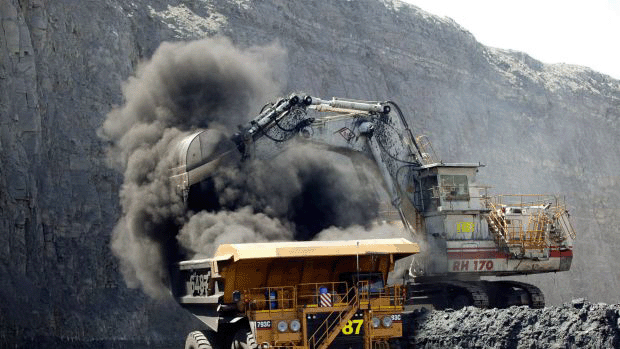
Adani is seeking a $1 billion concessional loan from the Turnbull government’s Northern Australia Infrastructure Facility to build a railway for the mine. The application will be assessed by the fund’s independent board but the government supports the plan.
But the new poll of nearly 3000 people – commissioned by the Australian Conservation Foundation – suggests the public wants NAIF investments made elsewhere. Even among Coalition voters there was only 10.5 per cent support for public money going into coalmine infrastructure.
The poll found nearly 33 per cent of people believe renewable energy projects should be NAIF’s top priority. Nearly 28 per cent believe schools and universities should be first in line for funding, with tourism and telecommunications infrastructure also attracting more support than coal.
The polling accompanies a new ACF research paper on the “opportunity cost” to northern Australia of funding the mine in Queensland’s Galilee Basin, identifying scores of other job-creating projects.
ACF economist Matt Rose says across Queensland, Western Australian and the Northern Territory there are 20 alternative proposals for jobs-rich large-scale solar plants.
There are 20 potential higher education campuses, 67 Indigenous ranger groups with no certainty of long-term funding and hundreds of locations with poor phones or internet.
“Any NAIF investment in coal will come at a huge cost to Northern Australia in terms of missed opportunities for a cleaner, smarter future,” Mr Rose said.
“Public investment in Adani coal would cheat Australians in the north out of jobs in renewable energy, better education facilities and tourism.”
Respondents to the poll also showed support for strong restrictions on any NAIF lending, with 60 per cent saying they agreed the government should “only provide funding to companies that meet minimum social and environmental standards”.
The ReachTEL poll surveyed 2984 residents across Australia in late April.
ACF is one of 130 groups involved in trying to stop the $21 billion mine, which is shaping up as one of the country’s big environmental battles.
The big four banks have all ruled out funding for the mine, angering Resources Minister Matt Canavan. But Mr Turnbull has defended the potential use of the NAIF, saying the mine would create “tens of thousands” of jobs and boost state and federal budgets.
The Queensland Labor government last week flagged it may provide Adani with a $320m “royalty holiday” to help get the mine up and running. It has also offered it free water in the form of an unlimited water licence.
At a federal level, Opposition Leader Bill Shorten has suggested the mine should only go ahead if it stacks up environmentally and commercially – and that means no federal loan. However some federal Labor MPs do not believe the mine should go ahead at all.
NATIONALS SHOULD NAME LOCATIONS FOR NUTTY NUCLEAR POWER PLANT PLAN
 The Greens NSW Energy spokesperson Jeremy Buckingham today slammed the National Party and NSW Deputy Premier John Barilaro for raising the prospect of a nuclear power plant in NSW saying renewable energy is safer, cheaper, and more effective at combatting climate change.
“I challenge John Barilaro and Gladys Berejiklian to name which electorate, which suburb and which town in NSW they think a nuclear power plant should be built in,” Greens MP Jeremy Buckingham said.
“They also need to come clean with where they are planning to have a nuclear waste dump to manage the highly radioactive waste fuel that will be produced.
“Nuclear power is an enormous risk that is not worth taking. We should learn the lessons from Fukushima and Chernobyl that nuclear power can be catastrophic.
“This is just another nutty, extreme idea from the National Party who is stuck in the wrong century pushing coal and nuclear and ignoring the massive renewable energy potential of Australia.
“Launching their nuclear ambitions in Broken Hill shows the Nationals are completely out of touch with the community and the future of energy supply in Australia.
“One of the largest solar farms in the country, the Broken Hill Solar Plant, has just been built and the nearby Silverton Wind Farm will be the largest wind project in NSW once it is constructed.
“The declining cost of renewables means nuclear energy does not make financial sense, as we can see with Japanese giant Toshiba going broke because of its involvement in nuclear power plants.
“Even if the Nationals could force nuclear power through massive community opposition, it is not an answer to our energy needs or climate crisis with plants taking more than a decade to be built.
“The Greens believe the future of energy supply is renewables, not dirty coal and dangerous nuclear power,” Mr Buckingham concluded.
Energy, climate, emissions news 21 May 17
National
Summer energy crisis looms without reforms, Grattan Institute warns
Panicking politicians who make kneejerk decisions to bolster Australia’s energy security run the risk of fuelling a power crisis with more blackouts and restrictions, a Grattan Institute report says.
http://www.abc.net.au/news/2017-05-21/grattan-institute-warns-of-looming-summer-energy-crisis/8545522
New coalmines will worsen poverty and escalate climate change, report finds
Oxfam attacks Australia’s ‘climate policy paralysis’ and urges it to promise no new coalmines and end public subsidies
https://www.theguardian.com/environment/2017/may/22/new-coalmines-will-worsen-poverty-and-escalate-climate-change-report-finds
Cheap way to cut emissions
Graham Lloyd
Land clearing – Australia could meet a 2C warming target under the Paris agreement at no cost to business.
http://www.theaustralian.com.au/national-affairs/climate/land-management-changes-the-lowcost-way-to-cut-emissions/news-story/eaa311fadd2d5963774b94c3bcf9bb95
Nature Conservation Council of NSW slams Deputy Premier’s nuclear power plan
Green groups shut down nuclear NSW talk, http://www.news.com.au/national/breaking-news/green-groups-shut-down-nuclear-nsw-talk/news-story/0a4b29c1a3ae25ad8e67ce3c0130b6a2 Green groups have reacted swiftly to condemn an attempt by Deputy NSW Premier John Barilaro to place nuclear energy back on the agenda.
Mr Barilaro told the NSW Nationals Annual Conference in Broken Hill on Thursday nuclear energy could mean “guaranteed power to millions, lower bills and next to no emissions” in the face of a power crisis.
He said energy costs were crushing businesses, farmers and families.
The Nature Conservation Council of NSW called on Premier Gladys Berejiklian to declare nuclear options weren’t on the table.
“Renewables are by far the cheapest, cleanest and most sustainable way to meet our energy needs,” chief executive Kate Smolski said in a statement.
She said nuclear power was “dirty, dangerous and expensive” and could leave a “toxic legacy”.
Ms Smolski challenged Mr Barilaro to explain which electorate would house a nuclear reactor, uranium processing plant and radioactive waste dumps.
The NSW Greens energy spokesperson Jeremy Buckingham said Mr Barilaro’s comments showed the party was out of touch with the community.
“This is just another nutty, extreme idea from the National Party who is stuck in the wrong century pushing coal and nuclear and ignoring the massive renewable energy potential of Australia,” he said.
New South Wales Green Groups challenge Deputy Premier John Barilaro on nuclear power
Green groups shut down nuclear NSW talk http://www.sbs.com.au/news/article/2017/05/20/green-groups-shut-down-nuclear-nsw-talk
Green groups have ridiculed talk of nuclear power being placed back on the agenda by NSW Deputy Premier John Barilaro as a “nutty” idea.
Green groups have reacted swiftly to condemn an attempt by Deputy NSW Premier John Barilaro to place nuclear energy back on the agenda.
Mr Barilaro told the NSW Nationals Annual Conference in Broken Hill on Thursday nuclear energy could mean “guaranteed power to millions, lower bills and next to no emissions” in the face of a power crisis. He said energy costs were crushing businesses, farmers and families.
The Nature Conservation Council of NSW called on Premier Gladys Berejiklian to declare nuclear options weren’t on the table.
“Renewables are by far the cheapest, cleanest and most sustainable way to meet our energy needs,” chief executive Kate Smolski said in a statement.
She said nuclear power was “dirty, dangerous and expensive” and could leave a “toxic legacy”.
Ms Smolski challenged Mr Barilaro to explain which electorate would house a nuclear reactor, uranium processing plant and radioactive waste dumps.
The NSW Greens energy spokesperson Jeremy Buckingham said Mr Barilaro’s comments showed the party was out of touch with the community.
“This is just another nutty, extreme idea from the National Party who is stuck in the wrong century pushing coal and nuclear and ignoring the massive renewable energy potential of Australia,” he said.
New South Wales govt about to go all enthusiastic about nuclear power?
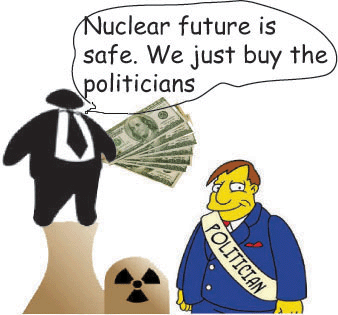 Nuclear power on the agenda in NSW as Deputy Premier claims ‘we’ve been led by fear and mistruths’ ABC News By state political reporter Lucy McNally, 19 May 17, New South Wales Deputy Premier John Barilaro has put nuclear energy on the agenda, arguing it would help secure the state’s power supply in the future.
Mr Barilaro, the leader of the NSW Nationals, will address his party’s annual conference in Broken Hill today, where he will make the case for a nuclear debate.
“I’m challenging my members to look for exciting solutions and think about the generations to come,” he said.”We live in a resource-rich nation, where energy should be our competitive advantage, but we’ve had the settings wrong, we’ve been led by political correctness and unfortunately by fear and mistruths.”
Mr Barilaro said those “mistruths” had stifled debate……
“Look at France, they currently rely heavily on nuclear energy which they import from places next door like the Czech Republic and other European nations,” Mr Barilaro said.
“Yet they have made a commitment to build a plant in France. Places like the US and Korea have all decided to look at building nuclear plants.”….. [ed note – this is simply incorrect]
Premier Gladys Berejiklian said she was not convinced of the merits of nuclear power.
“My view always is that science and safety have to stack up, on anything,” she said.
“So I’m in the camp of the jury’s still out.”
Ms Berejiklian said she was open to discussing the issue, including at the next Council of Australian Governments meeting in June…….
The State Opposition’s energy spokesman, Adam Searle, has dismissed the comments as a “thought bubble”. “The fact is nuclear energy is enormously expensive, consumes huge amounts of water — and of course Australia doesn’t have a lot of spare water — to say nothing of the environmental issues,” he said.
“Who’s going to build it? Who’s going to fund it? It’s just ridiculous.” http://www.abc.net.au/news/2017-05-19/nuclear-power-nsw-nationals-leader-wants-to-open-debate/8540274
1 This month
17 October, Free Public Talk on Nuclear Issues in South Australia
David Noonan will speak on public interest concerns over the new Roxby Downs Indenture Act 2026 on BHP copper-uranium mining and ore processing in SA, and on how AUKUS may face SA with a High-Level nuclear waste agenda.
Dr Jim Green will discuss international developments in the field of nuclear power including ‘small modular reactors’ and Generation 4 ‘advanced’ nuclear reactor concepts.


Help Aunty Sue Protect Her Land and Sacred Sites From Destructive Rocket Testing.
.

Australians deserve the truth
about
AUKUS – https://aukuspublicinquiry.com/

PETITION – To: Prime Minister Anthony Albanese and the Australian Labor Government

of the week – Australians for War Powers Reform (AWPR)
To see nuclear-related stories in greater depth and intensity

