Australian Energy Market Operator (AEMO) goes for smarter ways to deal with electricity supply and demand
 The demand response proposal signals greater co-operation between AEMO and ARENA, particularly on the integration of renewables. A trial using wind energy to provide frequency control is to be held in South Australia next month.
AEMO looks at smarter ways to deal with extreme peaks and  heatwaves http://reneweconomy.com.au/aemo-looks-at-smarter-ways-to-deal-with-extreme-peaks-and-heatwaves-40094/ By Giles Parkinson on 19 May 2017 The new direction of a rejuvenated Australian Energy Market Operator is starting to take shape, with the organisation announcing plans to have 100MW of demand response capacity in the Victorian and South Australian markets in time for the summer peaks and heatwaves.
The program, being run jointly with the Australian Renewable Energy Agency, signals a tangible change in focus for AEMO, and the market in general, in finding smarter ways to manage supply and demand rather than simply building more fossil fuel plants and poles and wires.
AEMO’s new CEO Audrey Zibelman is already a champion of demand response and it was one of the major levers that she pulled when running New York’s Reforming the Energy Vision program that aims for more decentralised power, and 50 per cent renewable energy by 2030.
In the PJM market, one of the biggest in the US, demand response accounts for 10 per cent of total capacity, and Zibelman sees no reason why it cannot grow to be at least 30 per cent of the Australian market.
That’s because Australia has a ready-made investment in the technologies that are needed. More than 1.6 million homes and businesses have installed rooftop solar, and many of these will install battery storage as well.
“If you have solar on your roof and you are putting in storage, it is saying that during certain hours of the day you use solar to charge up the battery, and then, rather than relying on grid, you reduce demand on the grid. For us (the grid operator) that’s the same as increasing generation.”
Zibelman says it is an obvious solution to provide a price signal to use these resources, as well as rewarding others – such as manufacturers and large businesses – for cutting back on their power usage at critical moments, rather than spending more money on new plant.
“If we can reduce the amount of demand, that has the same benefit as the grid, and is a lot less expensive than building a new power plant that is only used for a few hours a year,” she says. Continue reading
Australia should not throw away $1 billion on a destructive and doomed Adani coal project
The first stage currently being discussed involves a total investment of around $5 billion, of which the Australian public is supposed to contribute at least a $1 billion.
we may easily end up with the worst of all worlds: no royalties and few jobs for a project that will contribute massively to environmental destruction both locally and globally.
We shouldn’t throw it away on a doomed project that will leave us with, at best, a stranded asset and a legacy of massive environmental damage.
There are better things to spend $1 billion on than the Adani coal mine, Brisbane Times, John Quiggin, 18 May 17

Ever since taking office, the Palaszczuk government has been walking a tightrope with respect to the Adani Group’s proposed Carmichael mine in the Galilee Basin.
On the one hand, it’s obvious that the project is both environmentally disastrous and economically dubious. The government has been keen to avoid putting public money into this mess. On the other hand, if the project falls over, as still appears quite likely, the government is keen to avoid the blame.
The supposed benefits of 10,000 jobs and billions of dollars in royalties make an appealing case to voters at any time and particularly with the mining boom on the edge of failing. For most of the past 18 months, the government has managed the tightrope act successfully, but now it appears to be on the verge of falling. Adani is pushing for a ‘holiday’ from royalties, which might last as long as nine years. The project may go ahead if the government accepts, but the promised benefits to the Queensland public will disappear into the never-never.
The holiday is supposed to be temporary, but that’s unlikely. Continue reading
Australia isn’t trying to stop global warming. We’re subsidising it.
Palaszczuk and Turnbull governments are Adani mine’s lonely fans, Canberra Times, Ebony Bennett, 20 May 17 Australia isn’t trying to stop global warming. We’re subsidising it.
While the ACT is on track to source 100 per cent of our electricity from renewable energy by 2020, Queensland’s state government is doubling down on the No. 1 contributor to climate change: coal. Despite banks, economists and Australians in general showing little interest in handing Indian coal giant Adani billions of dollars to dig up a heap of carbon, many politicians just can’t seem to wait to throw your money at it. The Queensland government’s enthusiasm is exceeded only by that of Turnbull government ministers, who have taken to fondling lumps of coal on the floor of Parliament.
Ten days before the last Queensland election, then opposition leader Annastacia Palaszczuk blasted the Newman’s government for picking winners and losers, warning: “What we’re seeing at the moment is Campbell Newman throwing a bucket of taxpayers’ cash … at one particular company [Adani].”
She further promised that “Queenslander taxpayers’ money is not going to be used to fund commercial operations”. She then went on to win the election in one of Australia’s biggest political upsets.
Coal subsidies are unpopular
Despite being elected on a “no subsidies” platform, the Palaszczuk government has since offered Adani free water (in the form of an unlimited, unchallengeable water licence), free coal (in the form of a reported $320 million “royalty holiday”) and a possible 39-year raincheck on the clean-up bill. It’s also on track for a $1 billion subsidised loan for its rail line from the federal government’s Northern Australia Infrastructure Facility.
At this rate, we’ll soon be paying Adani to dig up our coal. And voters don’t appear to be impressed. Continue reading
Dennis Matthews scrutinises the “ELECTRICITY NETWORK TRANSFORMATION ROADMAP: FINAL REPORT
 Comments on “ELECTRICITY NETWORK TRANSFORMATION ROADMAP: FINAL
  REPORT Energy Networks Australia and CSIRO Dennis Matthews, April 2017”
INTRODUCTION This 100-page document is a composite of two distinctly different contributions. The smaller part, which appears to be the work of CSIRO, is technical, relatively free of jargon, to the point, objective and mostly about computer modelling studies.
The majority of the report is loaded with jargon, feel-good words and phrases, and gives the general impression of a sales document. For example, “network platforms”, “service platform”, “incentivise”, “new information platforms will be required to animate new distributed energy resources”, “intelligent networks and markets”, “empowered”, . This latter part is presumably the work of Energy Networks Australia.
CSIRO is a well known and generally respected government organisation. Energy Networks Australia comprises electricity low voltage distribution and high voltage transmission network companies.
The report is best understood from the point of view of electricity distribution and transmission monopolies that are seeing a rapid erosion of their businesses because of the rapid uptake of rooftop solar electricity generators and associated battery storage. These (rooftop solar + battery) systems are an emerging competitive threat to monopolistic electricity network companies, which are seeking to short-circuit the threat by co-opting these small, distributed electricity suppliers with a variety of financial “rewards”.
The report emphasises the “customer” and is almost entirely about how the electricity consumer-cum-generator (gensumer) will benefit from working with the distributor. There is no mention of how the electricity distributor will benefit from this arrangement.
The following comments use the same headings as the report.
EXECUTIVE SUMMARY After acknowledging the customer-driven nature of changes in the electricity system (“transformation on an unprecedented scale”), the report concludes:
“By connecting millions of customer owned generators and energy storage systems to each other, networks can act as platforms which help match supply and demand and reduce the need for inefficient duplication of energy investments.”
- INTRODUCTION
Under the heading “customer oriented electricity” we are promised that “transformed electricity networks actively connect customers with a growing range of market actors and customized electricity solutions”.
Under “Incentives and network regulation” there will be “A fairer system through active implementation of network tariff and retail pricing reform and modernised regulation and competition frameworks.” In the past, privatised electricity distribution networks have opposed regulation and have resisted attempts to constrain network tariffs, the latter causing expense to the electricity consumer through court costs, which are recovered from the consumer.
Achieving “full development of a customer oriented network” will require “a network optimisation market (NOM) where distributed energy resources services can be procured”. This new electricity market would be in addition to the present, strongly criticized, national electricity market (NEM).
The Roadmap is divided into two phases, the Foundation Phase (2017-22) and the Implementation Phase (2023-27). The former may be considered a realistic timeframe but the latter is highly speculative. It is the latter phase that is claimed to “deliver enhanced customer choice and value”.
“Optimisation” means greater use of the electricity network, which will undoubtedly be financially beneficial to the owners of the electricity network, but no data is given on how much of this financial benefit is passed on to the consumer; presumably this is “commercial in confidence”.
At no stage in the Roadmap is the effect of privatisation (vs public ownership) of the electricity distribution system evaluated.
The Roadmap supports “advanced metering” but only gives a broad description of what an “advanced meter” will do. For decades, the electricity industry has resisted the simple idea of having a meter placed where customers can get instantaneous feedback on usage and cost in a way that will help customers manage their demand. This has clear benefits to customers but would probably lower revenue to the electricity industry. Continue reading
Sweden cancels investigation of Julian Assange, removes arrest warrant
 Sweden shuts down Julian Assange rape investigation, TT/The Local news@thelocal.se 19 May 2017, Swedish prosecutors have decided to end the rape investigation into Julian Assange and lift the Europe-wide arrest warrant against him, but UK police say they will still arrest him.In a statement on its website, the Swedish prosecution authority said that the “Director of Public Prosecution, Ms Marianne Ny, has today decided to discontinue the investigation regarding suspected rape (lesser degree) by Julian Assange”.
“I have therefore today lifted the decision to remand Julian Assange in his absence,” she added.
In a press conference later in the day, Ny elaborated that it was not possible to formally serve Assange with notice of the suspicions against him, a prerequisite under Swedish law if the investigation was to progress further:
“Ecuador granted legal assistance and made it clear that all measures would be performed with full voluntary participation of Mr. Assange (…) Formal issues are important in a legal system in terms of legal certainty, it is important to be able to serve the suspect with suspicions. The decision to discontinue the investigation is not because we’ve been able to make a full assessment of the evidence, but because we didn’t see possibilities to advance the investigation. So we won’t make any statements on the issue of guilt”………
Assange’s lawyer Per Samuelsson said his client was now considering suing Sweden.
“It’s not about money but redress,” Samuelsson told news agency TT.
He added that he believed Assange would eventually try to move to Ecuador.
The WikiLeaks founder’s lawyer filed a request at Stockholm District Court earlier in May asking for an end to the arrest warrant against his client, arguing it should be dropped now that the US has expressed a desire to charge the 45-year-old.
Assange had been remanded in custody by Sweden ‘in absentia’ over a 2010 rape allegation, and has been taking refuge inside Ecuador’s embassy in London since 2012 in order to escape the warrant, citing fears he may be extradited to the US to be tried over WikiLeaks’ publication of thousands of classified documents.
One of Assange’s lawyers, Melinda Taylor, indicated earlier on Friday that the preliminary investigation into him being closed or the lifting of the European arrest warrant would not necessarily mean the Australian would make a hasty exit for Ecuador.
“The first thing one likely needs to do is seek guarantees from the British authorities that he won’t be seized in some other way,” she told news agency TT.
Both British and American authorities have “consistently refused to confirm or deny” if there is a request for extradition to the US, she said. Assange is also accused of breaching his bail conditions in the UK for fleeing to Ecuador’s embassy, she noted.
And in a statement released on Friday afternoon, the Metropolitan Police confirmed it is obliged to arrest Assange should he leave the embassy…….
When the Swedish announcement was made on Friday, WikiLeaks commented through its Twitter account that the “focus now moves to the UK”……
After refusing to travel to Sweden for questioning, Assange was grilled last December by an Ecuadorian prosecutor on questions provided by Swedish officials, with Swedish prosecutor Ingrid Isgren present.
He has always maintained that he is innocent of the rape accusation from 2010….https://www.thelocal.se/20170519/breaking-sweden-lifts-arrest-warrant-against-julian-assange-and-ends-investigation
Western Australia’s large-scale Greenough River solar farm to quadruple in size
 Australia’s first large-scale solar farm to quadruple in size http://reneweconomy.com.au/australias-first-large-scale-solar-farm-to-quadruple-in-size-20618 By Giles Parkinson on 19 May 2017
The plans by co-owners Synergy, the government-owned generator and retailer, and US energy giant General Electric, were unveiled in a submission to WA’s Economic Regulation Authority, and reveal that two new 15MW arrays will be built either side of the existing facility, around 50km south-east of Geraldton.
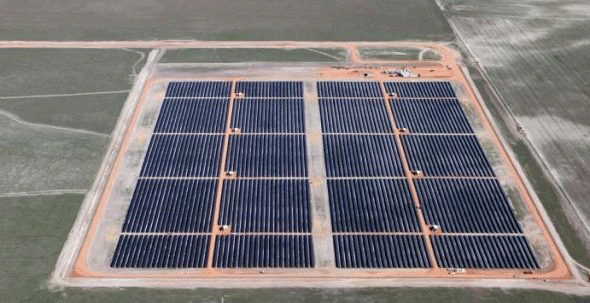
The new arrays, will use First Solar modules, as did the first, but unlike the first installation these will deploy single axis tracking technology to improve the yield. More than 90 per cent of solar farms in Australia are now using tracking technology. SMA is providing the inverters.
Synergy and GE say that the solar farm will seek a power purchase agreement, but presumably that will come from Synergy itself, as it is it the biggest utility in the state and has yet to meet all its renewable energy target commitments.
Greenough River was built in 2012 and remains the only solar farm connected to the main grid in Western Australia, although several other projects have begun, or are about to begin, construction. These include the 30MW Byford solar farm south-east of Perth and a 10MWW solar farm planned near Northam by Carnegie Clean Energy.
Across Australia, however, the large-scale solar boom is accelerating. Eight grid-connected large-scale solar farms have now been completed and another 30 are under construction, or have reached financial closure and are about to begin.
The joint owners of Greenough River says the solar plant, located on a wheat farm, “has been extremely warmly welcomed by what is a very small remote community. No public complaints or opposition have been received.”
Turnbull government budget ignores health impacts of climate change
 Shortsighted Budget 2017 ignores health impacts of climate change, Independent Australia Kristine Barnden 19 May 2017, The Turnbull Government has once again prioritised growing the economy over human lives, writes Dr Kris Barnden.
ACTION TO PROTECT AUSTRALIA from climate change was a policy free zone in the 2017 Budget. Despite strong scientific and economic consensus on the urgent need to transition away from fossil fuels, our government has prioritized efforts to grow the economy using a business as usual approach.
Doctors have been speaking out about the adverse health effects of climate change, as well as the health co-benefits of policies aimed at mitigating and adapting to climate change. In Australia, air pollution from coal fired power stations contributes a significant proportion of the over 3000 deaths per annum from pollution and a plea has been made by doctors for a rapid transition away from coal fired power.
Agriculture is another area where actions to reduce green house gas emissions are likely to be associated with multiple benefits, including health. In last week’s Budget, agriculture and regional Australia are seen as winners only from expenditure on rail. However, we need to recognize that agriculture is an important contributor to greenhouse emissions and also extremely vulnerable to their effects as recognized by the farming industry. These factors are budgetary items and need to be built into national financial policy. Indeed as President Obama has noted, food security is a world issue and we carry responsibility as a food exporter……….
Agriculture, the environment, the economy and human health interact at many levels, and we face significant difficulties on all fronts. All will be affected by climate change, and we cannot afford to consider each in isolation. We need strong leadership, and the ability to look beyond short term political and ideological considerations to longer term gains.
Dr Kristine Barnden is a member of the management committee of Doctors for the Environment Australia. https://independentaustralia.net/politics/politics-display/budget-2017-ignores-health-impacts-of-climate-change,10314
Queensland govt must resist bullying by resources industry: mine rehabilitation should be progressive
Queensland mine rehabilitation should be progressive, not left as one big job: Miles, ABC News, By Louisa Rebgetz, 19 May 17, Environmental groups are urging the Queensland Government not to be “bullied” by the resources industry in a bid to fix a $10-billion legacy of mine rehabilitation.
It comes as the State Government is on a hard sell to tighten the demands on miners to ensure financial assurance and progressive rehabilitation with a discussion paper out until mid-June.
Campaigner with Lock the Gate Alliance, Rick Humphries, said the reforms were “long overdue” but the “devil will be in the detail”.
“It’s long overdue, the cause for reform. We see all the numbers going the wrong way in terms of the amount of progressive rehab,” Mr Humphries said.
“The devil will be in the detail and already there are some emerging concerns.
“The major issue though is in the past the mining industry has generally bullied governments of all persuasions in the past to drop any reforms, so the Government has really got to focus on the public interest and protecting the environment and make sure these reforms are solid and get the job done.”
Reforms to apply to existing and new operations: Miles
One mine’s progressive rehabilitation has Queensland Environment Minister Steven Miles interested, who said it was what all mines would be expected to do under the proposed changes.
Hail Creek Coal Mine, in the heart of coal country in Queensland’s Bowen Basin, is one of the largest coal reserves in the country.
Rio Tinto exports about 10 million tonnes a year of coking coal from the site.
During a tour of the mine, Hail Creek’s Acting General Manager Michael Priestly said about 360 hectares had already been rehabilitated.
“It would be pretty close to what it looked like. Obviously the topography changes a little bit around with the dumps,” Mr Priestly said.
“It’s really a matter of tipping the dumps, shaping them and then progressively rehabilitating them with topsoil and natural vegetation.”
The Minister said the reforms would apply to both existing and new operations, including Adani’s proposed $21-billion Carmichael mine in Central Queensland. This program of reforms is all about making sure rehabilitation happens progressively so it is not left as one big job for the end of the mine’s life, and also ensuring that we have sufficient financial assurance every time one of those mines has been abandoned,” Mr Miles said.
Mr Miles said he hoped it would also create jobs for regions currently struggling through the mining downturn.
Fears clean-up for Ebenezer Mine will be left to taxpayers
Queensland has more than 15,000 abandoned mines ranging from small infrastructure to mega-sized mines.
Mr Humphries said Ebenezer Mine, on the outskirts of Ipswich, was a classic example of failed regulation in Queensland.
The coal mine has been in care and maintenance since 2002. The former operator, Japanese company Idemitsu, transferred the lease to Zedemar Holdings, who had planned to on-sell the site, but the deal fell through.
Mr Humphries said he feared it would be left to the taxpayer to fund the rehabilitation of the site…… http://www.abc.net.au/news/2017-05-19/queensland-mine-rehabilitation-progressive-reform-steven-miles/8540586
New South Wales National Party to embrace nuclear energy
 Nuclear energy must be considered for NSW: Nationals leader ANDREW CLENNELL, STATE POLITICAL EDITOR, The Daily Telegraph , May 19, 2017 NUCLEAR energy should be considered as a way forward to provide energy security in NSW, Deputy Premier John Barilaro will tell his first National party conference as leader today.
Adani Carmichael coal mine: climate, health and economics are against it
Climate Council: climate, health and economics are against Carmichael mine https://theconversation.com/climate-council-climate-health-and-economics-are-against-carmichael-mine-77940, Emeritus professor, Fenner School of Environment and Society, Australian National University, Head of School, School of Public Health and Social Work, Queensland University of Technology May 19, 2017 Despite the overwhelming evidence that fossil fuels are killing the Great Barrier Reef and making many extreme weather events worse; despite the emphatic thumbs-down from the finance sector; and despite the growing awareness of the serious health impacts of coal, the proposed Carmichael coal mine staggers on, zombie-like, amid reports it has been offered a deferment of A$320 million in royalty payments.
A new Climate Council report, Risky Business: Health, Climate and Economic Risks of the Carmichael Coalmine, makes an emphatic case against development of the proposed mine, or of any other coal deposits in Queensland’s Galilee Basin, or indeed elsewhere around the world.
Burning coal is a major contributor to climate change. Australia is already reeling from the escalating impacts of a warming climate. Heatwaves and other extreme weather events are worsening. The Great Barrier Reef has suffered consecutive mass bleaching events in 2016 and 2017. Climate change is likely making drought conditions worse in the agricultural belts of southwest and southeast Australia. Our coastal regions are increasingly exposed to erosion and flooding as sea level rises.
If we are to slow these disturbing trends and stabilise the climate at a level with which we might be able to cope, only a relatively small amount of the world’s remaining coal, oil and gas reserves can actually be used.
The majority must be left unburned in the ground, without developing vast new coal deposits such as those in the Galilee Basin.
On budget
The amount of fossil fuels we can burn for a given temperature target (such as the 1.5℃ and 2℃ targets of the Paris climate agreement) is known as the “carbon budget”.
To give ourselves just a 50% chance of staying within the 2℃ Paris target, we can burn only 38% of the world’s existing fossil fuel reserves. When this budget is apportioned among the various types of fossil fuels, coal is the big loser, because it is more emissions-intensive than other fuels. Nearly 90% of the world’s existing coal reserves must be left in the ground to stay within the 2℃ budget.
When the carbon budget is apportioned by region to maximise the economic benefit of the remaining budget, Australian coal in particular is a big loser. More than 95% of Australia’s existing coal reserves cannot be burned, and the development of new deposits, such as the Galilee Basin, is ruled out.
The health case
Exploiting coal is very harmful to human health, with serious impacts all the way through the process from mining to combustion. Recently the life-threatening “black lung” (coal workers’ pneumoconiosis) has re-emerged in Queensland, with 21 reported cases. Across Australia, the estimated costs of health damages associated with the combustion of coal amount to A$2.6 billion per year.
In India, the country to which coal from the proposed Carmichael mine would likely be exported, coal combustion already takes a heavy toll. An estimated 80,000-115,000 deaths, as well as 20 million cases of asthma, were attributed to pollutants emitted from coal-fired power stations in 2010-11. Up to 10,000 children under the age of five died because of coal pollution in 2012 alone.
Compared with the domestic coal resources in India, Carmichael coal will not reduce these health risks much at all. Galilee Basin coal is of poorer quality than that from other regions of Australia. Its estimated ash content of about 26% is double the Australian benchmark.
This is bad news for children in India or in any other country that ends up burning it.
The economics
The economic case for the Carmichael mine doesn’t stack up either. Converging global trends all point to rapidly reducing demand for coal.
The cost of renewable energy is plummeting, and efficient and increasingly affordable storage technologies are emerging. Coal demand in China is dropping as it ramps up the rollout of renewables. India is moving towards energy independence, and is eyeing its northern neighbour’s push towards renewables.
All of these trends greatly increase the risk that any new coal developments will become stranded assets. It’s little wonder that the financial sector has turned a cold shoulder to the Carmichael mine, and Galilee Basin coal development in general. Some 17 banks worldwide, including the “big four” in Australia, have ruled out any investment in the Carmichael mine.
From any perspective – climate, health, economy – the proposed mine is hard to justify. And yet the project keeps on keeping on.
Australia’s Attorney General Brandis intervenes in W and J court action against Adani
 Traditional Owners fighting Adani appalled at improper political interference http://wanganjagalingou.com.au/brandis-intervenes-in-indigenous-court-action-against-adani/
“The Attorney General, George Brandis, has intervened in a Federal Court hearing in which the Traditional Owners fighting Adani’s proposed coal mine are seeking to strike out a fake agreement Adani claims to have for the mine to proceed.
“Senator Brandis’ intervention follows his second failure to rush through changes to the Native Title Act….
“Senior spokesperson for the Wangan and Jagalingou (W&J)Traditional Owners Council, Adrian Burragubba, said,
““The Attorney General has made an extraordinary and political intervention in matters before the court. Intervening in our case shows Brandis is working in billionaire Adani’s interests, not ensuring the proper administration of justice. Again, Brandis is making Native Title all about Adani’s mine instead of good law reform. …
“Youth spokesperson for the W&J Traditional Owners Council, MsMurrawah Johnson, said,
““Adani didn’t negotiate and achieve the free prior informed consent of the W&J people. The meeting, which Adani and its barrackers claim achieved consent, with a 294 to 1 vote, is as fake as its ILUA.
It is not a true expression of the W&J Traditional Owners.
““Over 220 of the attendees at Adani’s meeting are people who have never been involved in the W&J claim or decision making, and who are identified with other nations and claims, or didn’t identify an apical descent line. …
“Lawyer for the W&J Traditional Owners Council, Mr Colin Hardie, said,
“My clients have four strong grounds against Adani’s purported ILUA. …
19 May climate news in Australia
National
Time for the climate policy review we had to have
Peter Castellas
It’s time to get serious about climate policy, and set Australia up to make the most of the zero carbon transition that is undoubtedly underway.
http://reneweconomy.com.au/time-climate-policy-review-23038/
Australia risking its international standing over climate change inaction: Marshall Islands
The President of the Marshall Islands compares Australia to a “big brother or big sister” openly mocking science on climate change, saying inaction “weakens your ability to be a force for good on the world stage”.
http://www.abc.net.au/news/2017-05-17/marshall-islands-urge-australia-to-support-climate-change/8533434
Lucy Manne
Banks are walking away from mining projects that harm our planet, and our people. But one Australian Government organisation still isn’t getting the message
https://newmatilda.com/2017/05/17/propping-up-climate-destruction-human-rights-abuses-efic-abroad/
The Brisbane suburbs that will suffer ‘extreme’ temperature rises under infill
http://www.brisbanetimes.com.au/queensland/the-brisbane-suburbs-that-will-suffer-extreme-temperature-rises-under-infill-20170517-gw76m0.html
19 May Renewable energy news in Australia
Rob Passey and Ben Elliston
Work on regional plans for 100 per cent renewable energy highlight importance of storage to soak up daytime supply, and the need to reduce night-time loads and shift them to the day.
http://reneweconomy.com.au/maximising-local-benefits-uptake-renewable-energy-energy-efficiency-67872/
Sydney’s CBD has huge untapped rooftop solar potential that could save businesses and homes $70m a year on power costs, according to new study that has lessons for all Australia’s capital cities.
http://reneweconomy.com.au/rooftop-solar-sydney-cbds-barely-tapped-solar-goldmines-86204/
Sydney’s CBD has huge untapped rooftop solar potential that could save businesses and homes $70m a year on power costs, according to new study that has lessons for all Australia’s capital cities.
http://reneweconomy.com.au/rooftop-solar-sydney-cbds-barely-tapped-solar-goldmines-86204/
Rooftop solar saved NSW consumers nearly $1 billion in heatwave
Rooftop solar likely saved nearly $1 billion in electricity costs during the February heatwave in NSW, as well as helping to keep the lights on. But solar households and businesses got little reward for their contribution.
http://reneweconomy.com.au/rooftop-solar-saved-nsw-consumers-nearly-1-billion-heatwave-45093/
ANU breakthrough: Butterfly effect could boost solar cell efficiency
ANU researchers develop butterfly wing-inspired nano-technology that could improve the efficiency of solar cells.
http://reneweconomy.com.au/anu-breakthrough-butterfly-effect-boost-solar-cell-efficiency-14263/
Korean Zinc refiner says 116MW solar plant it’s building near Townsville will underpin the expansion of its north Queensland operations.
http://reneweconomy.com.au/sun-metals-says-new-solar-farm-will-underpin-zinc-refinery-expansion-28753/
The Australian Competition and Consumer Commission issues final approval for 27 of South Australia’s largest businesses to bulk buy electricity, in a move aimed at securing a better deal as the wholesale cost of power soars.
http://www.abc.net.au/news/2017-05-17/sa-companies-power-bulk-buy-ticked-off-by-competition-watchdog/8533090
NO PUBLIC DISCUSSION! Australia’s Generation IV Nuclear Energy Accession
 Submission to: Inquiry: The Generation IV Nuclear Energy – Accession. by Noel Wauchope, 24 April 2017
First of all, I find it very strange that this agreement has been signed up to in advance, not by any elected representative of the Australian Parliament, but by Dr Adi Patterson CEO of the Australia Nuclear Science and Technology Organisation, apparently pre-empting the results of this Inquiry!
I find it disturbing that this Inquiry is being held without any public information or discussion. Are we to assume that the decision to join this “Charter” is being taken without prior public knowledge?
It is a pretty momentous decision. According to the World Nuclear Association the 2005 Framework agreement “formally commits them (signatories) to participate in the development of one or more Generation IV systems selected by GIF for further R&D.”
The Environment Protection and Biodiversity Conservation Act 1999 currently prohibits the development of nuclear power in Australia. Nuclear power cannot be approved under either the EPBC Act or the Australian Radiation Protection and Nuclear Safety Act 1998. These prohibitions are, as I understand it, supported by all major parties in Australia?
This would be an extraordinary step for Australia to take, especially in the light of the recent South Australian Nuclear Fuel Cycle Royal Commission (NFCRC) pro-nuclear Royal Commission, which, while recommending South Australia for an international nuclear waste dump, nevertheless stated that
“The recent conclusion of the Generation IV International Forum (GIF), which issued updated projections for fast reactor and innovative systems in January 2014, suggests the most advanced system will start a demonstration phase (which involves completing the detailed design of a prototype system and undertaking its licensing, construction and operation) in about 2021. The demonstration phase is expected to last at least 10 years and each system demonstrated will require funding of several billion US dollars. As a result, the earliest possible date for the commercial operation of fast reactor and other innovative reactor designs is 2031. This timeframe is subject to significant project, technical and funding risk. It extends by six years a similar assessment undertaken by GIF in 2002. This means that such designs could not realistically be ready for commercial deployment in South Australia or elsewhere before the late 2030s, and possibly later.”
This was hardly a ringing endorsement of Generation IV nuclear reactors.
The South Australian Citizens Jury, Community Consultations, numerous economists, and the S.A. Liberal Party all rejected that nuclear waste plan, as not economically viable. A huge amount of preparation was done by the NFCRC in investigating the phases of the nuclear Fuel Cycle (more accurately Chain) to arrive at their rather negative view of Generation IV nuclear reactors.
That makes it all the more extraordinary that the Australian government would be willing to sign up so quickly to ANSTO’s request that Australia put resources into these untested, and so far, non-existent nuclear technologies.
I hope that the Committee is aware of the present financial troubles of the giant nuclear corporations, such as AREVA, Toshiba, and Westinghouse Electric. Nuclear power is turning out to be a financial liability wherever it is not funded by the tax-payer, (as in China and Russia). (1)
The World Nuclear Association describes the Generation IV International Forum (GIF) as countries for whom nuclear energy is significant now or seen as vital in the future. Australia’s situation in no way fits these criteria.
Nuclear energy is not significant now in Australia, and even the NRCRC nuclear proponents do not see it as vital for Australia’s future. It is almost laughable, that right now, renewable energy systems are taking off in Australia – both as large solar and wind farms, and as a huge increase in small decentralised systems such as home and business solar panel installations.
That’s where Australia should be putting its resources of human energy, talent, and funding.
The claims made by the nuclear lobby, ANSTO and some politicians, notably Christopher Pyne and Julie Bishop, about Generation Iv nuclear reactors, do not stand up to scrutiny:
Non proliferation “- Furthering Australia’s non-proliferation and nuclear safety objectives.” The well-known claim that a “conventional” nuclear bomb cannot be made from these new types of reactor, might be true, to a certain extent. However, IFRs and other plutonium-based nuclear power concepts fail the WMD proliferation test, i.e. they can too easily be used to produce fissile material for nuclear weapons. The use of thorium as a nuclear fuel doesn’t solve the WMD proliferation problem. Irradiation of thorium (indirectly) produces uranium-233, a fissile material which can be used in nuclear weapons. These materials can be used to make a “dirty bomb” – irradiating a city or other target. They would require the same expensive security measures that apply with conventional nuclear reactors.
If the purpose in joining the GIF is to strengthen non-proliferation and safety – why is ANSTO the implementing agent not the Australia Safeguards and Non-Proliferation Office?
Solving nuclear waste problem? Claims that these new nuclear reactors will solve the problem of nuclear wastes are turning out to be spurious. For example, Nuclear energy startup Transatomic Power has backed away from bold claims for its advanced reactor technology after an informal review by MIT professors highlighted serious errors in the company’s calculations. (2) Even at the best of times, the “new nuclear” lobby admits that their Gen IV reactors will produce highly toxic radioactive wastes, requiring security for up to 300 years.
The Integral Fast Reactor is called “integral” because it would process used reactor fuel on-site, separating plutonium (a weapons explosive) and other long-lived radioactive isotopes from the used fuel, to be fed back into the reactor. It essentially converts long-lived waste into shorter lived waste. This waste would still remain dangerous for a minimum of 200 years (provided it is not contaminated with high level waste products), so we are still left with a waste problem that spans generations. (3)
Climate change. The claim that new nuclear power will solve climate change is spurious. This ignores life-cycle CO2 emissions
Nuclear energy is not zero carbon.
Emissions from nuclear will increase significantly over the next few decades as high grade ore is depleted, and increasing amounts of fossil fuels are required to access, mine and mill low-grade ore.
To stay below the 2 degrees of global warming that climate scientists widely agree is necessary to avert catastrophic consequences for humans and physical systems, we need to significantly reduce our emissions by 2050, and to do this we need to start this decade. Nuclear is a slow technology:
The “Generation IV” demonstration plants projected for 2030-2040 will be too late, and there is no guarantee the pilots will be successful.
Nuclear Economics. For “a time when significant expansion in nuclear power production is underway” – this is a laughable falsehood. In reality, nuclear power economics are in a state of crisis, most notably in America, but it is a world-wide slowdown. (4)
The vagueness of the Generation IV International Forum (GIF) agreement is a worry. Australia is to formally commit to participate in the development of one or more Generation IV systems selected by GIF for further R&D. Surely Australia is not going to sign up to this, without any detail on what kind of research, what kind of reactor, what amount of funding we would be committing to the GIF.
And all this without any public discussion!
- https://www.theguardian.com/business/2017/apr/11/toshiba-losses-uk-moorside-nuclear-plant-westinghouse
- https://www.technologyreview.com/s/603731/nuclear-energy- startup-transatomic-backtracks-on-key-promises/
- https://skeptoid.com/episodes/4555
- http://reneweconomy.com.au/nuclear-industry-crisis-29735/
Big solar energy projects taking off across Australia
12 from 12: ARENA’s big solar plans take off across the country http://reneweconomy.com.au/12-from-12-arenas-big-solar-plans-take-off-across-the-country-81918/ By Giles Parkinson on 16 May 2017 The Australian Renewable Energy Agency has announced that all 12  of the projects that won funding under its large-scale solar program have now reached financial close and will begin construction shortly, if they haven’t already.
The last of the 12 projects to get to financial close – the 20MW White Rock solar farm in northern NSW – did so late last week. Funding was never really in doubt considering that the project is owned by Chinese giant Goldwind, which is building a 175MW wind farm by the same name at the same place.
ARENA, however, used the milestone to hail its $90 million initiative as a huge success, helping to bring down the cost of large-scale solar to the level of wind energy – and five years ahead of what had been expected.
The 12 projects have also benefited from $320 million in low-cost finance from the Clean Energy Finance Corporation, as the country’s major banks tried to wrap their mind around this new technology.
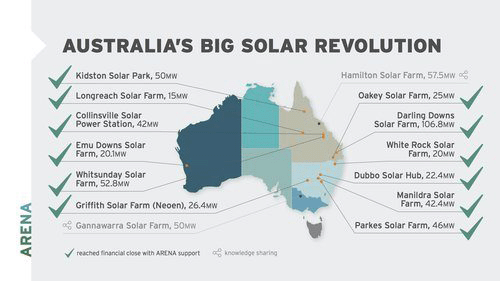
But there is every sign that they have, and have lowered the risk quotient on their financing, at least for those with long-term power purchase agreements. While the ARENA program will deliver 490MW of large-scale solar, another 1,500MW is thought to be also under construction, or about to begin, around the country.
“This competitive round is the perfect demonstration of how ARENA is accelerating Australia’s shift to a low emission, renewable energy future,” Frischknecht said in a statement. “From zero to more than 20 plants in five years, Australia’s large-scale solar industry has grown at a tremendous pace thanks to concerted efforts by ARENA and the CEFC.
“We know of at least six new plants that are being developed without any ARENA grant funding support.”
He said the ARENA program had unlocked $1 billion in investment from other sources and regional economies would benefit, with an estimated 2,300 direct jobs and thousands more indirect jobs expected to be created by these plants.
Frischknecht said planning, developing and financing large-scale solar projects remained a complex task involving multiple different parties. That’s why the knowledge gained from the project is so valuable. “ARENA believes in the power of shared knowledge. That’s why we require project developers to share the learning from each stage of development, construction and connection with the renewable energy sector,” Mr Frischknecht said.
“Our support for Whitsunday Solar Farm assisted project developer Edify Energy to secure debt finance for two additional plants, Hamilton Solar Farm in Queensland and Gannawarra Solar Farm in Victoria. ARENA is benefitting from knowledge sharing activities across the three projects.”
The projects are expected to be completed between late-2017 and mid-2018, and will help reduce wholesale prices in all three states where these projects will be built when they come on stream.
1 This month
17 October, Free Public Talk on Nuclear Issues in South Australia
David Noonan will speak on public interest concerns over the new Roxby Downs Indenture Act 2026 on BHP copper-uranium mining and ore processing in SA, and on how AUKUS may face SA with a High-Level nuclear waste agenda.
Dr Jim Green will discuss international developments in the field of nuclear power including ‘small modular reactors’ and Generation 4 ‘advanced’ nuclear reactor concepts.


Help Aunty Sue Protect Her Land and Sacred Sites From Destructive Rocket Testing.
.

Australians deserve the truth
about
AUKUS – https://aukuspublicinquiry.com/

PETITION – To: Prime Minister Anthony Albanese and the Australian Labor Government

of the week – Australians for War Powers Reform (AWPR)
To see nuclear-related stories in greater depth and intensity

