Guardian 15th May 2017, Archbishop of Canterbury plays crucial role in BMO Global Asset Management’s decision to dump £20m of shares in firms such as BHP Billiton One of Britain’s biggest managers of ethical funds is to dump £20m of shares in fossil fuel companies in one of the biggest divestments so farbecause of climate change.
Shares in BHP Billiton, the Anglo-Australian mining giant, will be among those sold by BMO Global Asset Management’s range of “responsible” funds, which manage £1.5bn of assets. They were previously known as the “stewardship” funds, the first ethical funds launched in Britain. The archbishop of Canterbury, Justin Welby, played a crucial role in the divestment, as president of BMO’s responsible investment council. The Church of England has already pulled out of investing in companies that make more than 10% of its revenues from thermal coal or oil from tar sands….. https://www.theguardian.com/environment/2017/may/15/top-uk-fund-manager-divests-from-fossil-fuels
Solar power has become so popular in some parts of Western Australia that there are more households equipped with panels than without.
The national leader is Baldivis, south of Perth, where two-thirds of households feature rooftop solar. Other strong WA performers include Byford (56%) and Rockingham (53%).
There is now six gigawatts of solar power installed across the country.The Australian Photovoltaic Institute chair, Renate Egan, said an additional 1GW was added over the past year by household-scale solar in tandem with commercial and large-scale solar farms.
Once considered an eco-warrior’s pipe dream, renewable energy is rapidly gaining ground in the traditional mining state of Western Australia, Guardian, Max Opray, 15 May 17, Along the remote southern coastline of Western Australia, the locals have cottoned on to a new, surefire way to keep their beer cold. Continue reading →
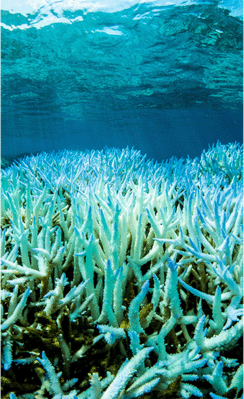
Dahr Jamail | Coral Reefs Could All Die Off by 2050, May 15, 2017, By Dahr Jamail, Truthout | Report“…… over the last two years, the Great Barrier Reef, which is so dear to Miller and countless others who revel in the beauty and mysteries of the oceans, has been dying off at an unprecedented rate due primarily to warming ocean waters.
Coral bleaching occurs when corals become stressed by warmer-than-normal water, causing them to expel symbiotic algae that live in their tissues, from which they get their energy. Coral turns completely white when it bleaches. If it remains bleached long enough, it dies.
One scientist has already gone so far as to declare the Great Barrier Reef is now in a “terminal stage.” Most of those studying the reef agree that what is happening is unprecedented. This is because, at a minimum, two-thirds of the 1,400-mile long reef bleached out last year, which led to 22 percent of it dying. Now another bleaching event has resulted in at least two-thirds of the reef bleached again.
“The bleaching this year has moved much farther south and has taken scientists by surprise in its severity and extent,” Miller said. And he fears the state of the reef could be even worse than scientists realize, since only aerial surveys have been conducted to assess the damage and no research vessel is currently active on the reef to provide finer details.
With ocean temperatures rising across the globe as anthropogenic climate disruption (ACD) continues to pick up speed, the Great Barrier Reef, the largest coral ecosystem on Earth, may well be an example of what is happening to all of the coral on the planet.
Overcoming the military-industrial complex: nuclear has always been a centralized industry, with just a few firms that have very close contacts to the government. And keeping nuclear skills for military purposes seems to be a driver in the UK’s push for new nuclear.
The US (and Australian) nuclear camp critiques studies for 100% renewables. Without reading them. Energy Transition ,by Craig Morris, 15 May 2017
Over the past year, the Anglo world has become interested in nuclear as a complement for wind and solar towards “deep decarbonization,” or a (nearly) 100% carbon-free supply of energy or possibly just electricity. Today, Craig Morris reviews a few papers by Americans and Australians and advises them to tackle the best European studies for 100% renewables head-on, not ignore them.
The first paper is by Stephen Brick and Samuel Thernstrom. Thernstrom has been calling nuclear “an essential part of the puzzle” since at least 2010. The paper is peer-reviewed; unfortunately, none of the reviewers noticed the oversights I found. Continue reading →
A City of Sydney proposal to double down on local government sustainability and climate targets has been unanimously supported by council, adding stronger environmental targets and greater support for technology and digital infrastructure to the city’s already ambitious plan.
First adopted in 2008, the Sustainable Sydney 2030 action plan will now be updated by council with a reinforced commitment to net zero emissions by 2050, sourcing half of its energy from renewables by 2030 and zero increase in water usage.
The refresh of the document also confirms the City’s alignment with the 100 Resilient Cities initiative and the United Nation’s Sustainable Development Goals. Continue reading →
ABC RNBy Damien Carrick and Tegan Osborne for The Law Report, 17 May 17 What are your legal rights if a neighbour decides to build up and block direct sunlight from hitting your solar panels?
It’s a problem central Adelaide resident Jo Thomas was forced to confront when she learned a developer had plans to build a four-storey building next door.
Ausnet Services, the largest operator of electricity and gas networks in Victoria, has given its vision of what the grid of the future might look like in that state – and it is one dominated by wind and solar.
That is probably not surprising, given that the state government is likely to have its target of 40 per cent renewable energy generation by 2025 locked into legislation in the next few months. But it does reflect how quickly the nature of generation in the state most dependent on brown coal will change. Continue reading →
Here’s another fine submission to Australia’s Parliamentary Inquiry into Australia joining the Framework Agreement for Generation IV Nuclear Energy Systems . This one blows out of the water any idea that these so far non existent reactors could solve any nuclear waste problem, or be in any way economically viable. It also throws the spotlight on The Australian Nuclear Science and Technology Organisation (ANSTO). Just how much of tax-payers’ money is going to this secretive organisation?
The latest reason for generation IV reactors centres on the unsolved problem of how to safely dispose of spent nuclear fuel. The proposition is that plutonium and other long lived transuranics in reactor fuel (that like plutonium also create a disposal problem) could be used up in so called “burner” reactors.
Analysis by the US National Academy of Sciences found this proposal to have such very high cost and so little benefit that it would take hundreds of years of recycling to reduce most of the global inventory.
Should ANSTO propose collaboration can occur without further cost to the taxpayer, then a funding review should be conducted to establish what research is already being done by ANSTO, at what cost, for what purpose and at whose behest. With an average loss of A$200 million annually, ANSTO should be able to provide disaggregated accounts for both transparency and accountability.
Generation IV Nuclear Energy – Accession Submission Medical Association for Prevention of War (MAPW) PO Box 1379, Carlton VIC 3053 Australia (03) 9023 195 m. 0431 475 465 e. eo@mapw.org.au w. http://www.mapw.org.au
Executive Summary
MAPW recommends strongly against Australia becoming a party to this agreement. There is no proposal for Australia to get a nuclear power program.
This framework agreement applies to technologies that are economically, socially, environmentally, and from a nuclear security perspective, very dubious. Generation IV reactors are an assortment of proposed technologies that have been put forward over the last 70 years, tried and failed.
ANSTO is already very heavily subsidised by the Australian government, and extending its operations into this research sphere will require further scientific effort, expertise and funding. This is highly inappropriate given the current major constraints on government spending, and the urgent need to focus research energies on realistic, financially viable and proven measures to contain emissions from electricity generation.
Collaboration would mean taxpayer subsidies would go to an industry which has already wasted many billions in public funds and resulted in major adverse legacies. No private industry is prepared to invest in this research without large government subsidies because none are prepared to lose so much money.
It is also clear that Australia has no policy to use these long promised and never commercially delivered reactors. Therefore any involvement just subsidises those who hope to use them. If Australia wishes to expand its nuclear expertise, then research into “non nuclear waste” generating technologies (such as those to produce medical isotopes) would be much more productive and also be of positive benefit to the Australian population.
‘Monumental experiment’: Concerns raised over Adani’s mine rehab plans, Brisbane Times, Peter Hannam , 15 May 17 Mine rehabilitation plans for the proposed giant Carmichael coal mine in Queensland fall far short of best practice and will expose the environment and taxpayers to huge risks, according to anti-mine group Lock the Gate.
On its submitted plans, the $16 billion-plus mine would disturb some 280 square kilometres of land, with 1.85 billion tonnes of potentially acid-forming material unearthed, and six giant voids left unfilled, Lock the Gate said in a new report. Some 88 kilometres of streams would also be disrupted and not restored.
“This is a monumental experiment on altering a landscape to a scale we’ve never seen before and believing a company that is saying already it doesn’t think it can put it back to remotely close to what was there before,” said Rick Humphries, co-ordinator of the group’s mine rehabilitation reform campaign.
“We are asking them to be shifted from a low-end, minimalist cheapest [rehab] option to leading practice,” said Mr Humphries, an environmental scientist who previously helped Rio Tinto develop their rehab plans.
The federal and state governments are backing the giant mine, which could produce as much as 60 million tonnes of coal for export a year. Carmichael’s development could also help open up other coal mines in the Galilee Basin.
A report last week by the NSW Auditor-General found that state’s mine rehabilitation guarantees held by the government to be inadequate and requirements for restoring land after a mine’s closure to be vague. The state’s rules, though, were superior to those in Queensland and Victoria, it said…….
According to Lock the Gate, Adani wouldn’t have to begin rehabilitation work until 39 years into its operations, well shy of the “continuous” rehab work that is considered best practice.
Adani may be offered as much as $1 billion in loans from the federal government to help build the rail link from the mine to the coast. Its board still aims to give its final investment decision in the next few weeks, the spokesman said.
CSIRO: Time for a ‘science culture’ again, says leading climatologist John Church ABC, Gregg Borschmann for The Science Show 13 May 17
One of Australia’s leading climate scientists, Dr John Church, has called for a major shake-up of management and the return of a ‘science culture’ at Australia’s leading science and research agency, the CSIRO.
“We’re lacking in the senior leadership in CSIRO … [they’re] no longer world-leading scientists,” Dr Church told RN’s Science Show. “I think we need to get back to the stage where we have world-leading scientists as the CEO of CSIRO and the chiefs of divisions, etc … that’s required to really address the important issues and bring a science culture back to the organisation.”
Last year, the internationally renowned expert in sea level rise was axed from his position as a project leader in CSIRO’s Oceans and Atmosphere Division as the organisation wound back climate research.
He is now at the Climate Change Research Centre of UNSW and continues his work at the global level for the Intergovernmental Panel on Climate Change (IPCC).
Dr Church said his trust in CSIRO had been rapidly destroyed during his last years at the organisation as it became more “risk averse” on issues like climate change……..
Urgency needed on climate change Dr Church, who co-authored chapters on sea level rise for the IPCC in 2007 and 2013, said there was an urgency for politicians and decision makers to understand the challenge of climate change.
“The commitments … we’re locking in — in terms of future climate change, both for sea level but also for temperatures and impacts on society — you can see these impacts accelerating, but we’re not making a lot of headway on real mitigation efforts,” Dr Church said.
He said the threshold for locking in long-term global sea-level rise would be crossed if carbon emissions continue unabated into the 22nd century.
In addition, there will be significant contributions from Antarctica plus smaller country contributions from melting of glaciers and ocean thermal expansion.
Today, I am taking the unusual step of publishing an entire submission. That’s because it is so good. The nuclear lobby pulled a swifty on Australians, by having government and media very quietly do what is sure to be a “rubber stamp” job on Australia joining up to the Framework Agreement for Generation IV Nuclear Energy Systems.
They allowed a very short time for submissions to the Parliamentary Inquiry. The nuke lobby must have been in the know, as they put in 11, whereas there were only 3, (one mine) critical of the plan.
Fortunately the critical ones contain compelling information. So, here, in full, is the:
Submission from Friends of the Earth Australia and the Australian Conservation Foundation .
Contacts:
• Jim Green (Friends of the Earth, Australia) jim.green@foe.org.au, 0417 318 368
• Dave Sweeney (Australian Conservation Foundation) dave.sweeney@acf.org.au, 0408 317 812
Contents
1. Introduction and Response to National Interest Analysis
INTRODUCTION AND RESPONSE TO NATIONAL INTEREST ANALYSIS Friends of the Earth Australia and the Australian Conservation Foundation welcome the opportunity to make a submission to this inquiry and would welcome the opportunity to appear before a hearing of the Committee.
The Committee will likely receive submissions promoting the construction of Generation IV reactors in Australia and it is therefore worth noting comments by the SA Nuclear Fuel Cycle Royal Commission in its May 2016 Final Report: “[A]dvanced fast reactors and other innovative reactor designs are unlikely to be feasible or viable in the foreseeable future. The development of such a first-of-a-kind project in South Australia would have high commercial and technical risk. Although prototype and demonstration reactors are operating, there is no licensed, commercially proven design. Development to that point would require substantial capital investment. Moreover, electricity generated from such reactors has not been demonstrated to be cost competitive with current light water reactor designs.”1
Here we provide brief responses to a number of comments in the National Interest Analysis (NIA).2
The NIA asserts that participation in the Generation IV International Forum (GIF) will further Australia’s non-proliferation and nuclear safety objectives. No evidence is supplied to justify the tenuous assertion. There is much else that Australia could do ‒ but is not doing ‒ that would demonstrably further non-proliferation objectives, e.g. a ban on reprocessing Australian Obligated Nuclear Materials (AONM); a reversal of the decision to permit uranium sales to countries that have not signed or ratified the NPT; or refusing uranium sales to countries that refuse to sign or ratify the Comprehensive Test Ban Treaty. There is much else that Australia could do ‒ but is not doing ‒ that would demonstrably further safety objectives, e.g. revisiting the decision to sell uranium to Ukraine in light of the ongoing conflict in that country, refusing to supply uranium to nuclear weapon states that are not fulfilling their NPT obligations, insisting that uranium customer countries establish a strong, independent regulatory regime (as opposed to the inadequate regulation in a number of customer countries, e.g. China, India, Russia, Ukraine and others).
Nuclear non-proliferation would also be far better realised by active Australian engagement in the current UN process around the development of a nuclear weapons ban treaty. Instead Australia has spurned this pivotally important initiative and is refusing to participate. If Australia is serious about its international standing, our representatives would be at the table in New York.
The NIA states that ongoing participation in GIF will help Australia maintain its permanent position on the IAEA’s 35-member Board of Governors. ANSTO routinely makes such arguments ‒ in support of the construction of the OPAL reactor, in support of the development of nuclear power in Australia, and now in support of Australian participation in GIF. Australia has held a permanent position on the IAEA’s Board of Governors for decades and there is no reason to believe that participation or non-participation in GIF will change that situation.
The NIA asserts that accession to the Agreement and participation in GIF will have important economic benefits. No evidence is supplied to justify that tenuous assertion. There are no demonstrated economic benefits from participation in GIF ‒ however there are clear costs.
The NIA states that the “costs of participation in the System Arrangements will be borne by ANSTO from existing funds.” ANSTO should be required to provide a detailed account of past expenditure relating to this Agreement and anticipated future expenditure.
The NIA states that ongoing participation in GIF “will improve the Australian Government’s awareness and understanding of nuclear energy developments throughout the region and around the world, and contribute to the ability of the Australian Nuclear Science and Technology Organisation (ANSTO) to continue to provide timely and comprehensive advice on nuclear issues.” Those arguments are tenuous, especially given that little about GIF is secret.
The NIA states that “Generation IV designs will use fuel more efficiently, reduce waste production, be economically competitive, and meet stringent standards of safety and proliferation resistance.” Those false claims are rebuked in later sections of this submission.
The NIA states that the success of Australia’s bid for membership of GIF was based in part on ANSTO’s “world-class capabilities and expertise” in the “development of nuclear safety cases.” ANSTO should be asked to justify that assertion. ANSTO could also be asked whether, based on its “world-class” expertise in nuclear safety, whether it considers it is appropriate for Australia to sell uranium to countries with demonstrably inadequate nuclear regulatory regimes, e.g. China, India, Russia, Ukraine and others.
The NIA asserts that “a significant expansion in nuclear power production is underway or under consideration by a number of countries, including several in the Asia Pacific region.” In fact:
Globally, nuclear power has been stagnant for the past 20 years.
For the foreseeable future, there is zero likelihood of a “significant” nuclear expansion of nuclear power and there will be an overall decline unless growth in China matches the decline elsewhere. Declines can be predicted with great confidence in North America, across all EU countries combined, in Japan, and in numerous other countries and regions ‒ and a very large majority of the world’s countries (about five out of six) are nuclear-free and plan to stay that way.
No country in the Asia Pacific or South East Asia is seriously planning to introduce nuclear power. The only country that was seriously planning to introduce nuclear power in the region ‒ Vietnam ‒ abandoned those plans last year.
The NIA states that Australia’s participation in GIF falls within the existing functions of ANSTO under Section 5 of the Australian Nuclear Science and Technology Organisation Act 1987. The Joint Standing Committee on Treaties should assess whether Australia’s participation in GIF is consistent with legislation banning nuclear power in Australia (the EPBC and ARPANS Acts). 2.
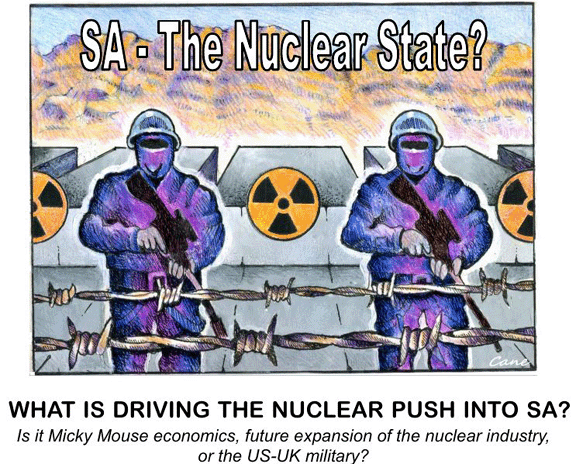
With a nuclear waste dump in South Australia that accepts international shipments, the full range of the “nuclear industry” in the state would be complete, truly making it the “Defense State” that has become the state motto.[9]
SOUTH AUSTRALIA’S NUCLEAR MILITARY-INDUSTRIAL COMPLEX: THE GLOBAL CONTEXT, Spirit of Eureka ,Talk by David Palmer at “SA The Nuclear State” forum 03 May 2017 “……..If citizens – the people – whether they are in the Fukushima region of Japan or in Adelaide, South Australia – have a right to speak out on the dangers of the nuclear industry, then who are the elites promoting the nuclear industry? If we look at prominent figures in government the institutional linkages become all too clear. Consider the example of Kevin Scarce, Governor of South Australia until 2014, a Rear Admiral retired from the Royal Australian Navy, current Chancellor of the University of Adelaide, and Deputy Chairman of Seeley International, the largest air conditioning company in Australia that is known for energy-efficiency. Scarce led the Nuclear Fuel Cycle Royal Commission and was the primary author of the report that recommended the South Australian government accept a nuclear waste dump. All the links are there in Scarce’s connections and positions: military, university, corporate, and government.
Furthermore, the Royal Commission did not focus solely on a nuclear waste dump. It considered possible expansion of nuclear industries in the state that encompassed mining, enrichment, and power generation. The Royal Commission report states that “The activity under consideration is the further processing of minerals, and the processing and manufacturing of materials containing radioactive and nuclear substances (but not for, or from, military uses) including conversion, enrichment, fabrication or reprocessing in South Australia.”[3]
But during the time this Royal Commission report was being prepared and finally delivered, Adelaide became the focal point for naval shipbuilding contracts, particularly submarines. Both Labor and Liberal politicians sought to outdo each other in pushing for submarines to be built in Adelaide. They will be diesel powered, but the majority of submarines internationally use nuclear power propulsion. Potential overseas contractors also use designs geared for nuclear power. There are those in Australian naval circles who would like to see these Australian subs with nuclear, not diesel, power. And where will these submarines be used, and with what international interests? We know the answer to that question, as recent events in the Western Pacific have confirmed. The USS Carl Vinson, the nuclear powered air craft carrier, was on exercises in the Indian Ocean in early April with Australia’s HMAS Ballarat, when it was ordered to the Korean peninsula this month in response to the North Korean threat to explode a nuclear bomb.[4] This latest development is just one example of the escalating naval tensions on our side of the Pacific. Crises like this will potentially increase pressure for Australia to build submarines – and possibly other naval vessels – that are nuclear powered.
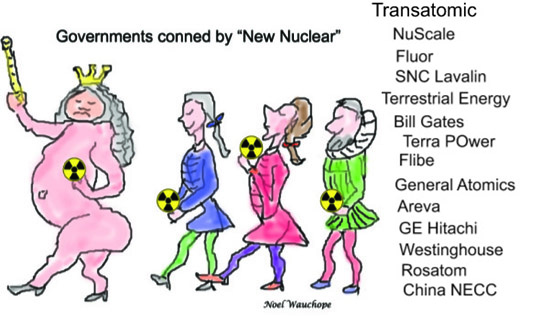
What does the corporate profile of the “nuclear industry” look like? Continue reading →
These women defy the illusion that you have to have a Ph.D. in nuclear physics or in nuclear engineering – that you must be a Ben Heard – to have a legitimate voice about nuclear power and the potential dangers of nuclear industry accidents. Our movement needs scientific experts, but all of us can gain basic knowledge and speak out
SOUTH AUSTRALIA’S NUCLEAR MILITARY-INDUSTRIAL COMPLEX: THE GLOBAL CONTEXT, Spirit of Eureka Talk by David Palmer at “SA The Nuclear State” forum 03 May 2017 There are other speakers and participants here today who have more expertise in the scientific and engineering details of this controversy than I do. My comments are aimed, instead, at those powerful elite stakeholders who are at the core of what we know as the military-industrial complex – here in South Australia, our country, but also globally, with its centre in the United States.
Is this issue of a nuclear waste dump advocated for South Australia just about jobs and economic prosperity, as Premier Wetherill claims? Or is it far broader? The words of Ben Heard, former executive director of pro-nuclear power lobby group Bright New World, sum it up well: “We must be a full service provider to the nuclear back-end.”[1] Adelaide’s Advertiser reported last month that “a new open letter [has been sent] to state MPs, 42 influential people demand[ing] the State Government commits to completing first-stage investigations of the proposed high-level repository.”[2] Many of these “influential people” signed a similar letter back in December demanding the same thing, through Ben Heard’s pro-nuclear Bright New World.
But just what is this “nuclear back-end” – the back end of what? Nuclear materials have a wide range of uses, including medical and commercial ones that are distinct from their main uses for power generation and weapons. The vast majority of government expenditures related to nuclear materials goes toward nuclear weapons and military uses (such as naval propulsion systems), and nuclear power. In the United States, virtually all nuclear-related industries and products in the energy and military-application areas are joint operations involving private companies working under government contracts and regulations. The scientific and engineering knowledge required for the nuclear industry means that universities and university-linked research centres play a major role in bringing these two institutions – private companies and government – together. In South Australia, Ben Heard (who is connected to University of Adelaide) is symbolic of this key link connecting networked institutions and elites. Continue reading →
The Parliamentary Committee Inquiry on Australia joining the Framework Agreement for International Collaboration on Research and Development of Generation IV Nuclear Energy Systems has now published the submissions that it received.
As this Inquiry has been kept quite secret from the media and the public, it is not surprising that nearly all of the submissions have come from companies and individuals with either a very clear, or a vested, interest in the nuclear industry.
For the moment, I will just single out one that particularly interested me. This is from SMR Nuclear Technology Pty Ltd . They don’t actually have much to say about Small Modular Nuclear Reactors, but just go on to fulsome praise of Generation IV nuclear reactors in general, and of ANSTO.:
“…….SMR Nuclear Technology Pty Ltd is an independent Australian specialist consultancy established to advise on the siting, development and operation of safe nuclear power generation technologies, principally Small Modular Reactors (SMRs). Two of SMR-NT’s directors were senior managers at ANSTO and have a good understanding of the facilities and capabilities of ANSTO…..
SMR Nuclear Technology Pty Ltd most warmly supports Australia acceding to the Framework Agreement for International Collaboration on Research and Development of Generation IV Nuclear Energy Systems as extended by the Agreement extending the Framework Agreement for International Collaboration on Research and Development of Generation IV Nuclear Energy Systems” more http://www.aph.gov.au/Parliamentary_Business/Committees/Joint/Treaties/NuclearEnergy/Submissions
SMR Nuclear Technologies sounds pretty much like ANSTO in disguise.
They dropped a little hint of what ANSTO is up to, in their previous, (rather weak and contradictory) submission to the Nuclear Fuel Cycle Royal Commission, in which they stated: “Thorium is now being revisited, particularly in China. Australia (ANSTO) is assisting with this work” – http://nuclearrc.sa.gov.au/app/uploads/2016/03/SMR-Nuclear-Technology-Pty-Ltd-30-07-2015.pdf
We didn’t know that the Australian tax-payer was funding thorium nuclear reactor development in China, did we?
By Annie McGovern. 23rd April 2017 (this is an extract from the Adelaide Forum held very recently, to discuss this question) “….ENDNOTE These observations have been gleaned from a fairly random search for relevant information which was also confined by the time available to process and present these findings. These are offered at this time as an additional body of information that may help fill some of the gaps in the thrust to force further nuclear energy production and waste disposal on the people of S. A.
Amongst the many recommendations of the Nuclear Fuel Cycle Royal Commission there were 3 major points which raise concerns regarding the possible imminent changes to Legislation in S.A. The Royal Commission has urged the State Government to fast-track these Legislative changes, even though there are no current viable plans for any nuclear industry developments in S.A. at this time.
Modification of the State Waste Dump Prohibition Laws. This Legislation was almost immediately amended following presentation of the Royal Commission’s findings, to allow Government spending on proposals for the Waste Dumps. The further question of approval of nuclear waste dumps in S.A. was put to the Labour State Conference and became a stalemate to which no decision could be made. Progress of changes to Legislation on this proposal was interrupted.
Legislation that would allow contracts of Uranium sales to be tied to obligations on S.A. taking back the resultant waste. The Royal Commission sees this possibility as an enhancement to capture sales of Uranium, despite there being no approval for waste disposal in S. A. at this time, and, the fact that no such facility would be capable of fulfilling the contract until well into the future. The Royal Commission appears to be determined to place the people of S.A. into an intractable situation where industry is forcing obligation through contractual arrangements. However, a caveat might be placed on such contracts that are not plausible…an explicit caveat and the risk is borne by the signing parties. A letter of advice is provided to the signatory and the Annual AGM of companies involved informed of this unethical business practice.
Legislative changes to allow Nuclear Power production. Despite there being no overt plans for these developments within the foreseeable future, the Royal Commission is encouraging making changes now for future development. The absence of a ready nuclear waste disposal dump has historically been a constraint on Australia and the world in the development of greater Nuclear ambitions. Reports of illegal dumping and covert placement of radioactive waste abound both here and across the world. Reports of French waste being held at Lucas Heights and American wasteat Pine Gap are recent additions to these claims.Despite peoples’ efforts over many generations to call for and act on Peaceful Principles in our World, Environmental Sustainability and Productivity based on Need rather than Greed, capitalism and its theory of perpetual growth continues to drive forward in an overtly destructive manner.
The continued focus on South Australia to perpetuate the nuclear travesty on our planet is acknowledged through this Forum and collectively we stand against this invasion. We walk with the Protectors of Country with Respect for Life.
David Noonan will speak on public interest concerns over the new Roxby Downs Indenture Act 2026 on BHP copper-uranium mining and ore processing in SA, and on how AUKUS may face SA with a High-Level nuclear waste agenda.
Dr Jim Green will discuss international developments in the field of nuclear power including ‘small modular reactors’ and Generation 4 ‘advanced’ nuclear reactor concepts.