Donald Trump, as a shareholder in Raytheon, maker of anti-radiation missiles, should be pleased about this.
Australia seeking to spend $180 million on US anti-radiation missiles, Australia is looking to buy anti-radiation missiles from the United States worth about $183.7 million, according to the US Defense Security Cooperation Agency.
Source: AAP 29 APR 2017
Australia is looking to spend about $183.7 million on anti-radiation missiles for its Growler aircraft fleet, according to a US defence agency.
The US State Department has approved the possible sale and Congress has been notified, a news release from the country’s Defense Security Cooperation Agency says.
The sale would include up to 70 high speed anti-radiation missiles, 40 advanced anti-radiation guided missiles and training missiles as well as other support equipment.
The total estimated cost is $US137.6 million, or $183.7 million.
“Australia is requesting these missiles for its Electronic Attack EA-18G Growler aircraft,” it says about the missiles, which are designed for attacking ground-based radar.
“Australia will use this capability as a deterrent to regional threats and to strengthen its homeland defense.”
The notice is only of potential sale, not that the sale has concluded.
If it goes ahead, the “sale will contribute to the foreign policy and national security” of the US, by “helping to improve the security of a major contributor to political stability, security, and economic development in the Western Pacific”.
“Australia is an important major non-NATO ally and partner that contributes significantly to peacekeeping and humanitarian operations around the world,” the notice reads.
“It is vital to the US national interest to assist our ally in developing and maintaining a strong and ready self-defense capability.” http://www.sbs.com.au/news/article/2017/04/29/australia-seeking-spend-180-million-us-anti-radiation-missiles
May 12, 2017
Posted by Christina Macpherson |
AUSTRALIA - NATIONAL, weapons and war |
Leave a comment
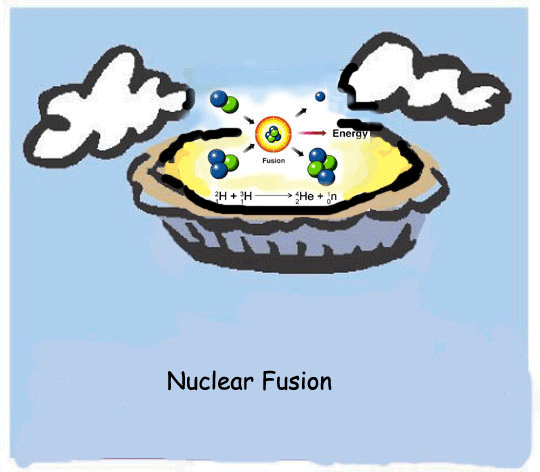
 ANU partner with China on nuclear fusion technology for power supply, The Age, Georgina Connery , 5 May 17, ANU has handed over the keys to its $35 million nuclear fusion stellarator as part of a technology exchange with China aimed at creating a new viable base-load power source by 2050.
Many nations, scrambling to find a solution to the energy crisis, view nuclear fusion as a sustainable solution…….ANU Australian Plasma Fusion Research Facility director Dr Cormac Corr said a memorandum of understanding signed with University of South China in April underpinned the exchange…..
In September 2016, Australia became the first non-member state to enter a formal collaborative agreement with ITER – set to be the world’s largest Tokamak fusion reactor and the first to create net power.
China, the European Union, India, Korea, Russia, Japan and the United States are jointly funding the construction of the $30 billion nuclear fusion demonstration facility in France.
Australia is trying to position itself as a major player in the ITER project by providing the technology to see volatile plasma, which is otherwise invisible when it reaches temperatures of 150 million degrees inside the reactor…..
ANU professor John Howard and fellow fusion science experts are lobbying, through the Australian Nuclear Science and Technology Organisation, for a $30 million federal program over the next three decades to further plasma fusion capabilities.
“We want to get an instrument that Australia owns on ITER in prime core space, so we are not relegated to a side show,” Professor Howard said…..
Research conducted at the ANU facility would feed into Australia’s materials and monitoring advice to the ITER project…..http://www.theage.com.au/act-news/anu-partner-with-china-on-nuclear-fusion-technology-for-power-supply-20170505-gvz7qc.html
May 12, 2017
Posted by Christina Macpherson |
AUSTRALIA - NATIONAL, technology |
Leave a comment
Native Title Act changes stuck amid stand-off between major parties, ABC News By political reporter Dan Conifer, 11 May 17, Native Title Act changes the Government declared urgent in February will not pass Parliament until at least mid-June, amid a stand-off between the major parties.
Key points:
- Coalition moved to amend native title laws after major deal with WA Government and traditional owners scuttled in court
- Federal Court ruling threw hundreds of agreements around the country into doubt
- Coalition proposed legislation that would allow ILUAs to be registered with consent from most claimants
The Coalition moved to amend the law months ago after a court scuttled a major deal between the West Australian Government and traditional owners.
The Federal Court ruling overturned years of established law, throwing doubt over more than 100 agreements nationwide, including one covering Adani’s proposed multi-billion-dollar Queensland coal mine. The decision meant Indigenous land use agreements (ILUAs) needed to be signed by all native title claimants before coming into force. The Coalition proposed legislation that would allow ILUAs to be registered with consent from most claimants.
Since February, the bill has been repeatedly amended, with two revisions coming just this week……. The Upper House next sits on June 13. http://www.abc.net.au/news/2017-05-11/native-title-act-changes-wont-pass-until-mid-june/8519174
May 12, 2017
Posted by Christina Macpherson |
aboriginal issues, AUSTRALIA - NATIONAL, politics |
Leave a comment
 Turnbull abandons fig leaf and stands naked on climate policy, REneweconomy, By Giles Parkinson on 10 May 2017 You would think that with all the hoo-ha about the scandalous increases in electricity prices that it would have rated some sort of mention in the budget. You know, one of the biggest cost inputs for business being addressed in the government’s economic centrepiece.
But no. The 2nd Morrison/Turnbull fiscal document blithely ignores the issue, despite the fact that their lack of policy direction in the last few years has been the major contributor to the price surges that are scorching household and business budgets.
There’s some pointless extra money for coal seam gas, the removal of some funds for carbon capture (finally) and some previously promised funds for solar thermal (about time), and even another thought bubble on Snowy Hydro – this time to buy it out from the state governments. See Matt Rose’s article for more details.
But there is nothing on climate change, no grand vision on energy. There are no new funds for the Direct Action policy that Turnbull had once ridiculed as a fig leaf for a climate action, and nothing on what might take Australia along the path to the pledge it signed in the Paris deal – effectively to reach zero net emissions by 2050.

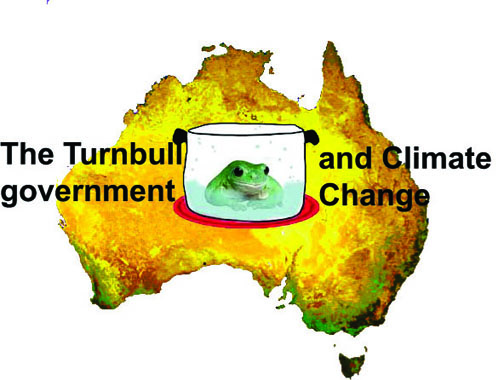
As Labor’s Mark Butler noted this morning, the Coalition’s climate change policy has officially gone from that fig-leaf to a non-existent farce.
Nearly three years after celebrating the dumping the carbon price (above), slashing the RET and ignoring expert advice (CCA and the Climate Council), the Coalition government has no actual policy, on energy or climate, and its negligence is adding to the stunning rise in electricity prices it is trying to blame on everything and everyone else.
“Malcolm Turnbull, the Prime Minister who once said he didn’t want to lead a Liberal Party that didn’t feel as strongly about climate change as he did, is now the Prime Minister who has completely dropped any pretence of attempting to combat climate change,” Butler says in his statement, noting that climate change did not rate a single mention in the Budget speech.
“As the central pillar of the Direct Action policy, the Emission Reduction Fund, runs out of funds, this budget delivers ZERO new policies or funding to drive down pollution and combat climate change. This budget allocates more new money to the Department of the House of Representatives than it does to tackling climate change.
“Budgets are about choices and priorities, and this budget makes it perfectly clear the Turnbull government isn’t choosing a safe climate because they don’t think it is a priority. This budget finally makes official what we already know; this Liberal government is failing all future generations of Australians.”
We took big slabs of Butler’s comments because we don’t think we could say it any better……. http://reneweconomy.com.au/turnbull-abandons-fig-leaf-and-stands-naked-on-climate-policy-79879/
May 12, 2017
Posted by Christina Macpherson |
AUSTRALIA - NATIONAL, climate change - global warming |
Leave a comment
Traditional Owners fighting Adani heartened by Senate’s defence of native title,
deferred vote on changes http://wanganjagalingou.com.au/senate-frustrates-governments-push-to-pass-native-title-bill/~ Wangan and Jagalingou (W&J) wanganjagalingou.com.au 11 May 2017:
“Despite the Prime Minister recently reassuring billionaire Gautam Adani that he will ‘fix’ native title laws to enable Adani’s controversial mine to go ahead, the Turnbull Government failed in the Senate again today, with its Native Title Amendment Bill being pushed off to June.
“Senior spokesperson for the Wangan and Jagalingou (W&J)Traditional Owners Council, Burragubba, said “The Senate blew the Government’s cover on the false urgency it has been relying on to push the Bill through. It is clear that there is no immediate threat to Indigenous Land Use Agreements (ILUAs) from the recent Federal Court McGlade decision.
““The Wangan and Jagalingou Council are heartened that our right to object to a land use agreement over our lands, because our common law native title is threatened with extinguishment, has gained recognition in the Federal Parliament.
““Opposition and Greens Senators spoke clearly and strongly about the need to put the native title rights of Traditional Owners ahead of all other interests, including mining, when making changes to the Native Title Act. …
“Youth spokesperson for the W&J Traditional Owners Council, MsMurrawah Johnson, said, “The Government has again failed to pass the changes to the Native Title Act
it has been seeking in its clamour to back the Adani mine.” “The Coalition has worked furiously to fast-track these amendments to overturn the recent McGlade decision in the Federal Court, which render Adani’s purported land use agreement incapable of registration.
““The Turnbull government has treated our native title as worthless and ignored the wishes of the Australian people in trying to push through this bill. We have had immense support from thousands of Australians who have implored the Parliament not to mess with our rights and those of Traditional Owners around the country.
““This reflects a recent national poll which showed that nearly two-thirds of Australians
believe that where Traditional Owners are opposed to Adani’s mine being being built on their lands,
State and Federal governments should wait for consent rather than push ahead with the mine. … “
May 12, 2017
Posted by Christina Macpherson |
aboriginal issues, AUSTRALIA - NATIONAL, politics |
Leave a comment
ABC Rural By Babs McHugh, 11 May 17 The Federal budget includes a number of multi-million-dollar measures to ensure more gas is available and shore up east-coast supplies.
May 12, 2017
Posted by Christina Macpherson |
AUSTRALIA - NATIONAL, energy, politics |
Leave a comment
 Nobody Mentioned It, But Do We Stand To Lose Our Best Defence Against Climate Change? Huff Post, Anthony Sharwood, 11 May 17 Good luck, Australia. We’re going to need it. 10/05/2017
 You’ve probably never heard of the National Climate Change Adaptation Research Facility. We hadn’t. And after reading the 2017 Federal Budget, the indications are we never will again.
Here’s why this matters.
The NCCARF, in its own words, “works to support decision makers throughout Australia as they prepare for and manage the risks of climate change and sea-level rise”.
This means it’s Australia’s only government-funded body which takes established climate science, assesses the likely impacts of climate change, then tells us what the heck we should do about it.
You can see examples of NCCARF’S excellent work
here,
here or
here. It provides solid, practical advice and strategies for dealing with things which affect so many Australians — like more intense heatwaves and bushfires, and increased coastal erosion.
Budget Paper No. 2 confirms confirms that its modest funding of $600,000 will continue for another year.
The Government will provide $0.6 million in 2017‑18 to the Commonwealth Scientific and Industrial Research Organisation and National Climate Change Adaptation Research Facility. This measure supports existing online platforms that inform decision makers seeking to adapt to changes in climate.
And then? Well down on page 57 of the Environment Portfolio Budget Statements, the funding looks like it dries up after the end of the 2017/18 financial year. No more NCCARF. It may merge with the CSIRO, or it may just be lost.
“I think it’s got another year to find a funding mechanism that is stable, that’s my reading of the situation,” NCARFF Director Professor Jean Palutikof told HuffPost Australia…….
Australian Conservation Foundation CEO Kelly O’Shanassy told HuffPost Australia that NCCARF was now “a research facility without funding for research”.
“The budget commitment is for $600,000 next year with CSIRO to maintain an online database of specific parts of its research. It has no funding after that.”………
More broadly, this was a budget in which the term “climate change” barely rated a mention.
“There’s nothing on climate change and very little on the environment. It’s like someone’s gone ‘Control Alt Delete’ and the whole thing’s disappeared from the budget papers,” Greens Senator Sarah Hanson-Young told HuffPost Australia politics editor Karen Barlow.
Gemma Borgo-Caratti, the National Director of the Australian Youth Climate Coalition, said “the Budget ignores climate change which in turn handballs Australia’s biggest problem to the next generation to deal with”.
Greenpeace Asia Pacific said “the Turnbull government has continued to ignore climate change and the need to fund renewable energy at a time when the country is demanding leadership on the most serious threat of our age”……http://www.huffingtonpost.com.au/2017/05/10/nobody-mentioned-it-but-we-stand-to-lose-our-best-defense-again_a_22078630/
May 12, 2017
Posted by Christina Macpherson |
AUSTRALIA - NATIONAL, climate change - global warming |
Leave a comment
Renewable hydrogen could fuel Australia’s next export boom after CSIRO breakthrough, ABC News, 11 May 17, By Rebecca Turner Australia’s next big export industry could be its sunlight and wind, as game-changing technology makes it easier to transport and deliver their energy as hydrogen.
Industry players are even talking up renewable hydrogen as the next liquefied natural gas (LNG) industry, which could supply hydrogen to power cars, buses, trucks and trains in Japan, South Korea and even Europe.
Their plans have been given a boost by a CSIRO-developed metal membrane, which allows the high-purity hydrogen needed for hydrogen-powered cars to be separated from ammonia.
What is renewable hydrogen?
- Hydrogen is a carrier of energy
- Renewable hydrogen is produced by purifying seawater, then separating the hydrogen and oxygen via electrolysis
- The process of separation is powered by solar or wind energy
- The hydrogen becomes a vehicle for storing renewable energy such as solar or wind
- It is converted into transportable forms for export
CSIRO principal research scientist Michael Dolan said the technology, now being trialled on an industrial scale in Australia, was “the missing link” which allowed hydrogen to be transported and used as an energy source.
“There’s potentially a very big market for the technology, given these cars are starting to get onto the road in pretty big numbers in Asian and Europe,” Dr Dolan said.
While there are only four hydrogen cars in Australia — produced by Hyundai and Toyota — South Korea already has hydrogen-powered taxis on its streets……http://www.abc.net.au/news/2017-05-11/hydrogen-breakthrough-could-fuel-renewable-energy-export-boom/8518916
May 12, 2017
Posted by Christina Macpherson |
AUSTRALIA - NATIONAL, energy |
Leave a comment
 AusNet trial successfully takes part of Melbourne suburb off-grid http://reneweconomy.com.au/ausnet-trial-successfully-takes-part-melbourne-suburb-off-grid-21015/ By Sophie Vorrath on 11 May 2017 A solar and battery storage mini-grid trial by Victorian network operator AusNet Services has succeeded in taking part of a Melbourne suburb completely off grid, demonstrating how utilities can use solar, battery storage and the internet of things to boost energy security and reliability in the future.
AusNet said on Wednesday that eight homes had been successfully separated from Victoria’s main electricity grid and operated together as a stand-alone solar and battery storage powered mini grid, as part of the company’s Mooroolbark Mini Grid trial.
The homes, including two that had neither solar or batteries, were able to maintain power by sharing electricity via AusNet’s powerlines that connect the mini grid, before being successfully re-integrated with the main grid.
AusNet said the cloud-based mini grid control system – which has been provided by locally-based energy technology company GreenSync – and the stabiliser took the mini grid through a sequence of stages to test the stability of the mini grid as an independent, unified renewable energy system.
The stabiliser, developed by Power Technology Engineered Solutions, is essentially a smart battery storage system that smooths renewable energy supply and consumption across the mini grid by either delivering or absorbing power when needed.
Parker, speaking at Energy Network Australia’s Welcome to the Grid Edge conference on Wednesday, said that the achievement was a “major milestone” on the road to a future grid with high penetration of solar and storage.
“The electricity network will continue to play an important role in our energy future, but we need to make sure it is able to support technology such as solar panels and battery storage for the benefit of all customers,” he said.
“In the future, we may be able to use this technology to keep homes powered during major storm events.
“We could also use (it) to smooth peak demand on our network, helping to reduce the need to build expensive power stations and therefore reducing costs to customers.”
The next step for the trial is to test additional control functionality to manage peak loads and generation on the network, as well as further testing of the stand-alone supply scenario involving additional customers being integrated into the stand-alone mini grid.
May 12, 2017
Posted by Christina Macpherson |
solar, Victoria |
Leave a comment
Other announcements included the Government reaffirming their $110m loan commitment for the solar thermal project in Port Augusta.
Most of the package will go to measures that will accelerate exploration and assessment of onshore gas and lay the groundwork for new gas pipelines.
It is clear from this budget that the Coalition government is failing to undertake the longer term strategic thinking that is needed to transform Australia’s energy system and wider economy to address Australia’s growing emissions
 Turnbull’s budget ignores energy crisis and dodges climate http://reneweconomy.com.au/turnbulls-budget-ignores-energy-crisis-dodges-climate-24886/ By Matthew Rose on 10 May 2017
Budgets are centrepiece moments for governments. They lay out spending and savings but they also highlight values and choices, along with the agenda the government will pursue in the coming financial year. Decisions often have legislative implications that must be wrangled through the Senate and therefore dominate the political agenda for months if not the following year.
Unfortunately, the second budget of the Turnbull Government continues their dire management of Australia’s energy and climate change policy. By the government’s own admission, they are in the grip of an ‘energy crisis’ largely concerning east coast gas supplies. The energy sector overall has been plagued by policy uncertainty.
Earlier in the week the Energy and Environment Minister admitted Australia wouldn’t meet its Paris Commitment of net zero emissions by 2050 and instead the end of the century was a more realistic ambition.
This ambition ignores the overwhelming scientific evidence that net zero emissions by the end of the century is totally inadequate in avoiding extremely dangerous climate change. It is inconsistent with the Paris Agreement goal of holding global warming well below 2 degrees and to pursue a 1.5-degree limit. In short, it is a grossly negligent position from Australia’s environment minister.
Despite these self-identified challenges the Federal Budget fails to address them. The current centrepiece of the Government’s climate policy the Emission Reduction Fund (ERF) remains under a cloud with no further funding allocated in the Budget. Continue reading →
May 11, 2017
Posted by Christina Macpherson |
AUSTRALIA - NATIONAL, climate change - global warming, energy, politics |
Leave a comment
2017 – Federal Budget – nuclear issues SUMMARY
Budget Paper 1.
Risks
- There may be potential claims made in relation to asbestos relates diseases from asbestos at the ANSTO site – potential costs have not been identified
- The Government has formally agreed (21/04/2016) to indemnify ANSTO and ANSTO officers, and ANM and ANM Officers from any loss or liability arising from claims caused by ionising radiation. This is in place until April 2026.
- The Government claims it has already indemnified the Maralinga Tjarutja people in respect of claims arising from test site contamination (through the terms of the Maralinga Nuclear Test Site Handback Deed.)
- Cessation of funding for the development of a detailed business case for the National Radioactive Waste Management Facility
Budget Paper 2.
Expenses * British Nuclear Test Veterans * three different figures (pg’s 48,57, 59, 175 &186) *more details on pg 93 of Budget Paper 4.
$133.1 over four years for health care (public or private) for any medical condition, irrespective of whether the condition is linked to their service. Includes participants in the British nuclear test program in Australia and vetereans of the British Commonwealth Occupation Force (who were deployed in or near Hiroshima).
National Medical Stockpile. Pg – 188.
The government will provide $85.4 million over 3 years to replenish national medial stockpiles – a strategic reserve in response to any chemical, biological or nuclear event.
Budget Paper 3.
Rum Jungle, pg 55
Environmental Management of the former Rum Jungle uranium mine site: $6.1 million 2017-2018, and $4 million in 2018-2019. This funding is a National Partnership payment to support State environment services. The funding is for a program of work established to improve the management of the site and further develop a rehab strategy.
Ranger, pg 77
Commonwealth provides general assistance to the NT on uranium at Ranger (because the Commonwealth owns NT uranium) *payments are made at a royalty rate of 1.25 % of net proceeds of sales. *** unclear what $ if any goes from Commonwealth to the NT….
May 10, 2017
Posted by Christina Macpherson |
AUSTRALIA - NATIONAL, politics |
Leave a comment
It’s budget night, and while the government was tight-lipped about measures affecting Indigenous Australians, there were a number of leaks ahead of the treasurer’s announcments.
On Monday afternoon, it transpired that the Veteran’s Affairs Minister, Dan Tehan, was preparing to announce that Aboriginal people who were near British nuclear testing in the in 1950s and 1960s would finally receive a gold health card, which would mean access to improved health care, and most costs covered.
“The measure will provide Gold Cards to Indigenous people present at or near Maralinga, Emu Fields or the Monte Bello Islands at the time of the British Nuclear Tests in the 1950s or 1960s,” Mr Tehan told the ABC’s Q&A program.
The Government will also provide a gold card to cover the health care costs of the surviving participants of the British Nuclear Test program and veterans who served as part of the British Commonwealth Occupation Force (BCOF). The Government has allocated $133.1 million for this initiative to cover eligible veterans.
The announcement has been a long time coming for many Indigenous people and veterans alike, who have campaigned for decades to receive compensation.
Yankunytjatjara man Yami Lester, who was blinded by atomic fallout says the support comes “60 years too late”.
“Most of our people have passed away. They were young ones then, now they’re older ones now, a few of them still living now today.”
May 10, 2017
Posted by Christina Macpherson |
aboriginal issues, AUSTRALIA - NATIONAL |
1 Comment
Atomic veterans to be recognised after 61 years, Mandurah Mail, 8 May 17, The service of veterans exposed to British atomic testing off the coast of Western Australia in the 1950s is to be recognised in the federal budget on Tuesday.
On Sunday Canning MP Andrew Hastie announced $133 million would be spent giving the men who served in the Montebello Islands, where three nuclear weapons tests took place in 1952 and 1956, access to Department of Veterans Affairs gold cards.
Mr Hastie said the gold cards, which entitled the veterans to free public and private health care, were an acknowledgment the men had served in dangerous circumstances.
“It says to them that the Australian government, on behalf of the Australian people, care about them and are going to see their responsibility to care for them through,” he said.
“For these men it is recognition they did serve in hazardous conditions, that they were exposed to nuclear radiation after atomic testing, so for them it means a lot, especially since quite a few of them have suffered from cancer.”
Only 51 of the 89 servicemen who were conscripted to assist with the atomic tests are still alive.
Half of those who have since died succumbed to cancer……..
Many of the veterans said they had not been told of the dangers of nuclear radiation and were not issued protective gear.
“We got up there and didn’t even know what was happening, all we knew is that something big was happening so we got out on the upper deck and the count down came down,” Australian Ex-Services Atomic Survivors Association secretary Jim Marlow said.
“We were told to turn our backs, so we turned our backs and there was a blinding flash and a push of wind and a whole lot of noise and we turned back again and saw the smoke going up.”
Mr Marlow said he was back working in the ship 10 minutes after the blast.
He said the survivors association had been lobbying for recognition for more than a decade. http://www.mandurahmail.com.au/story/4647184/atomic-veterans-to-be-recognised-after-61-years/
May 10, 2017
Posted by Christina Macpherson |
AUSTRALIA - NATIONAL, health, weapons and war |
Leave a comment
http://wanganjagalingou.com.au/senate-should-not-reward-brandis-native-title-bill-scam/9 May 2017
Proper consultation with Indigenous Leaders needed
Adani shouldn’t determine Native Title reform agenda
“The Attorney General George Brandis has cut corners and conducted a shabby consultation process on the Native Title Bill to be debated in the Senate this Wednesday, failing to include
Traditional Owners across Australia, say Wangan and Jagalingou Traditional Owners fighting Adani’s coal mine in Central Queensland.
“Senior spokesperson for the Wangan and Jagalingou (W&J)Traditional Owners Council, Mr Adrian Burragubba said, “The Attorney General has whipped up a false sense of urgency so he can push through this Bill, which is designed for everyone but the Traditional Owners whose rights it is meant to uphold.
““Brandis has engineered a cursory and limited consultation process which is grossly inadequate for amendments which will have such a significant and long term impact on our rights. …
“The Labor Party, who were the original architects of native title laws under Prime Minister Paul Keating, understood that good native title laws are built on direct consultation with a broad group of Aboriginal leaders, and are meant to right an historic wrong.
““We are encouraged by reports that the Opposition, in this 25th anniversary year of the Mabo decision,
is troubled by the Government’s handling of this Bill,
and is seeking to ensure proper consultations with Traditional Owners.
We have urged all Labor, Green and Xenophon Senators not to pass this bill. …
“Youth spokesperson for the W&J Traditional Owners Council, MsMurrawah Johnson, said, “As Traditional Owners we have a right to determine our own future and make our own decisions about our lands and waters. It is not up to unelected CEOs and lawyers who are talking to the Government.
““The Government has failed to make a case for why this Bill is urgent, or make a convincing argument why it needs to overturn the Federal Court’s decision in McGlade. …
May 10, 2017
Posted by Christina Macpherson |
aboriginal issues, AUSTRALIA - NATIONAL |
Leave a comment