Victoria’s opportunity for profitable leadership in community renewable energy
 Renewable power to the people could reap profits in Victoria, The Age, Benjamin Preiss , 6 Mar 17 Electricity bill shock has become a distant problem for residents in Soren Hermansen’s hometown in Denmark. It is far more likely they will receive a cheque in the mail for their power on Samso Island. The island is carbon neutral and runs on renewable energy, with power and profits flowing back into the community.
Now Mr Hermansen travels the world championing community-owned power generation methods. Most recently he was in Victoria discussing with local communities how they can harness the power of the sun, wind and other renewable sources.
Last week Mr Hermansen spent a day in the Latrobe Valley meeting with residents who are concerned about how their communities will cope once the Hazelwood power station and mine close at the end of this month.
On Samso most of the wind turbines are mostly owned by locals. The island is powered by 11 onshore and 10 offshore wind power turbines, a solar plant and three straw-fired plants………..
Mr Hermansen believes Victoria is ripe with opportunities for community renewable energy generation, including the Latrobe Valley.
He suggested the Latrobe Valley could form part of a renewable energy distribution hub, capitalising on existing infrastructure and skills.
Latrobe City mayor Kellie O’Callaghan said Mr Hermansen’s visit was a “natural extension” of discussions already taking place in the community.
She agreed the Latrobe Valley already offered sound energy distribution infrastructure and expertise that could translate well into the community renewable energy projects.
Cr O’Callaghan said an “employee transition centre” set up to deal with the looming closure of Hazelwood had already included a “vision” for community-owned and operated energy generation.
“It is based in a firm belief community ownership means no longer being subject to the commercial whims of a large multinational company,” she said.
Mr Hermansen said the Hepburn Wind project in near Daylesford was proof that community energy was viable in Victoria. Hepburn Wind is a community owned wind farm with two turbines producing enough power for 2000 homes. http://www.theage.com.au/victoria/renewable-power-to-the-people-could-reap-profits-in-victoria-20170305-guqzt8.html
Queensland coal town “rebranding” as a solar town
 Coal mining town Collinsville vies to become Australia’s solar capital, ABC By Ben Millington, 5 Mar 17, While many of Australia’s mining regions have been hit hard by the resources sector downturn, solar is providing rays of hope for the small town of Collinsville in north Queensland.
Three hours south of Townsville, Collinsville has a proud, long history of coal mining, boasting it had the last working pit ponies in Australia — up until 1990.
But this coal-fired town is poised for a rebrand. Solar companies are vying to take advantage of the region’s 300 days a year of perfect sunshine.
In August, the Australian Renewable Energy Agency announced it would provide $9.5 million to both Edify Energy’s 70MW Whitsunday Solar Farm and RATCH Australia Corporation’s 43MW Collinsville Solar Project.
Edify Energy director John Cole said, given the potential size and scale of projects in the region, Collinsville could be the solar capital of Australia.
“It’s a very good place for solar because of the radiation levels in north Queensland,” he said. “For example, our site in Collinsville will produce double the amount of power than a project in the UK, and about 5 to 10 per cent more than in New South Wales or Victoria.”
Plan to pump energy into Queensland grid Another advantage in Collinsville is a decommissioned power station that sits on its outskirts. Both projects plan to utilise the infrastructure to pump energy straight into the Queensland grid.
Edify Energy plans to start the construction of phase one this year.A nine-month build time is expected and 200 jobs will be offered to a town in desperate need of them.Local councillor Peter Ramage said the last four years had been devastating for the community…….http://www.abc.net.au/news/2017-03-05/collinsville-coal-mining-town-moves-to-solar-capital-north-qld/8023384
“Smart Houses” to save Australia’s farms from climate change?
 Farmers plant paddocks in smart houses to safeguard against climate change ABC
Decision reserved by Federal Court on Adani coal mine issue
 Federal Court reserves Adani decision http://www.theage.com.
 au/business/mining-and-resources/federal-court-reserves-adani-decision-20170303-guq2gd.html
The Australian Conservation Foundation must wait to learn if its latest challenge against the controversial Adani coalmine in Queensland’s Galilee Basin has been successful.
The ACF appeared before the Federal Court in Brisbane on Friday to appeal a decision last year that gave the huge Carmichael project the green light.
But the full bench reserved its judgment after it heard submissions from the environmental group, federal Environment Minister Josh Frydenberg and Adani.
ACF barrister Saul Holt QC argued the original judge had erred when he found in favour of Mr Frydenberg and the Indian mining giant in August.
Mr Holt claimed the environment minister had not applied or misconstrued the law when he claimed if the mine didn’t go ahead, the same amount of coal could still be produced somewhere else in the world.
Mr Holt said the argument failed to address the impact the Adani mine would have on global warming and in particular, warmer water temperatures on the Great Barrier Reef.
“What someone else might do if this action doesn’t go ahead is irrelevant,” he said.
“The harm is still done by the emission of the carbon by Adani’s coal.”
However Richard Lancaster SC, representing Mr Frydenberg, said the original judge was correct when he agreed his client could only be “speculative” when it came to the impact Adani’s possible emissions would have on global warming.
Mr Lancaster said the projection that 4.64 billion tonnes of coal, or one-183rd of total worldwide emissions, could be produced by the Queensland mine was the “worst case scenario”.
Mr Lancaster said neither the original judge nor the environment minister had erred in their interpretation of the relevant acts.
The full bench of the Federal Court will hand down its decision at a later date.
Economist Prof John Quiggan puts convincing case for public-owned Australian power grid
 Public-owned Australian power grid could solve energy issues, paper argues https://www.theguardian.com/business/2017/mar/03/public-owned-australian-power-grid-could-solve-energy-issues-paper-argues
Economist says national electricity market has been crippled by design flaws and a failure to take climate change into account Australia’s electricity woes could be solved through a unified and publicly owned national power grid, a discussion paper has said.
The paper authored by University of Queensland economist Prof John Quigginsays the creation of the national electricity market in the 1990s has failed to lower power prices and improve system reliability or environmental sustainability.
It argues the electricity grid, including physical transmission networks in each state and interconnectors linking them, should instead be publicly owned.
And it says that “renationalised” grid should be responsible for maintaining a secure power supply and moving towards a zero emissions industry.
Quiggin said minor changes to the current national electricity market would not be able to resolve the “energy instability” that was holding Australia back.
He said some believed a publicly owned power grid was “unthinkable” but recent political upheavals were proof unthinkable ideas should not be dismissed.
“It is the only coherent response to the failure of neoliberal electricity reform, just as the establishment of a publicly owned national broadband network was the only feasible response to the failure of telecommunications reform,” he said.
The director of Flinders University’s Australian industrial transformation institute, which has released the paper, said it laid down a challenge to governments of all persuasions to create a policy in the nation’s interest.
“It is clear that the current system is unreliable and untenable,” Prof John Spoehr said. “This is a discussion we have to have, as a catalyst for genuine, nation building reform.”
Turnbull govt appoints coal and uranium boss, Vanessa Guthrie, to the ABC board
In an interview with the Australian Financial Review last year, Dr Guthrie attacked social media activism against fossil fuels, taking aim at “inner-city smashed avocado eaters” for unfairly targeting coal and the minerals industry more broadly…….
 Turnbull government ignores advice, appoints Minerals Council boss Vanessa Guthrie to ABC, SMH, Adam Gartrell 28 Mar 17
The Turnbull government has overruled an independent selection panel to appoint the chairwoman of the Minerals Council to the ABC board.
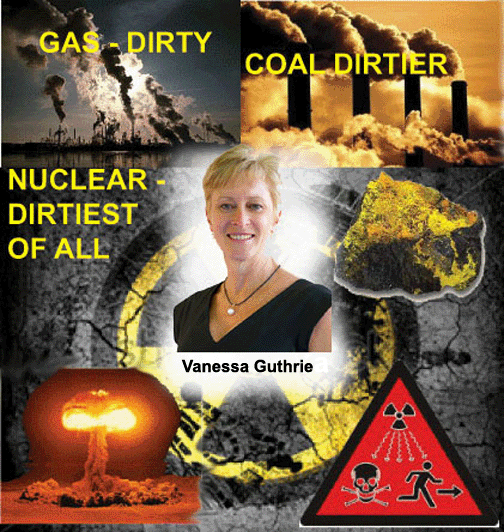
Communications Minister Mitch Fifield said Vanessa Guthrie has the “requisite skills” to be on the board, despite not making the final list of recommendations put forward by the Nomination Panel for ABC and SBS Board Appointments.
The five-year appointment comes amid heated political debate about the role of fossil fuels and renewable energy in Australia, and follows government criticism of the public broadcaster’s coverage of coal mining and energy security.
The Perth-based Dr Guthrie has more than 30 years of experience in the mining and resources industries, holding a variety of senior executive roles at Alcoa, Woodside Energy and Goldfields Limited.
She was WA’s first female mine manager and eventually rose to the rank of managing director and chief executive officer of Toro Energy, a job she left last year. She is the first female chair of the Minerals Council, one of the most powerful lobby groups in the land…….
The government has been fiercely critical of the ABC’s coverage of energy, with Resources Minister Matt Canavan accusing it in December of running “fake news” as part of a campaign against the proposed Adani coalmine in Queensland.
The ABC was also accused of bias against the NSW Shenhua coal mine proposal but was cleared by a review.
The Institute of Public Affairs – which has spawned a number of Coalition MPs – claims the ABC has a “systemic bias”, giving the renewable energy industry favourable coverage but showing hostility towards coal and other fossil fuels.
In an interview with the Australian Financial Review last year, Dr Guthrie attacked social media activism against fossil fuels, taking aim at “inner-city smashed avocado eaters” for unfairly targeting coal and the minerals industry more broadly…….
Labor frontbencher Mark Dreyfus said the ABC should be above politics and called on Senator Fifield to explain why the panel’s recommendations were disregarded.
“The Australian people deserve to know whose idea it was to appoint the head of a mining lobby group to the ABC board and why Dr Guthrie merits the appointment,” he said……http://www.smh.com.au/federal-politics/political-news/turnbull-government-ignores-advice-appoints-minerals-council-boss-vanessa-guthrie-to-abc-board-20170227-gum4hc.html
Does the Adelaide Advertiser get its nuclear material from nuclear lobbyist Ben Heard?
Advertiser reporter Paul Starick apparently wrote this. But pro nuclear lobbyist Ben Heard claimed  credit for it tweeting:
“New push for nuclear industry in South Australia: This effort was brought to you by Bright New World “
New push for high-level international nuclear waste dump in South Australia Paul Starick, Chief Reporter, The Advertiser March 2, 2017 FORMER Port Adelaide Football Club chief Brian Cunningham and Economic Development Board chairman Raymond Spencer are among prominent South Australians launching a fresh push to progress a proposed $257 billion international nuclear waste repository.
Australia’s tourism c ompanies complicit in ignoring climate change
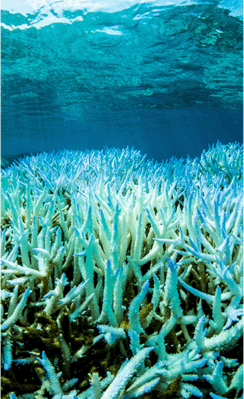 Silence is Complicity in Reef’s Destructuon #auspol , John Pratt, 1 M ar 17 Big tourism must demand action to save the reef – its business depends on it
Which raises the question, why isn’t the Mantra Group – one of Australia’s largest hotel and resort operators, with more than $8bn in asset management including a string of resorts in north Queensland – vociferous in demanding action to save the reef?
The question could not be more pertinent given the return of the threat of coral bleaching.
Nor have any of these companies spoken out strongly against the Carmichael coalmine proposal – despite the mortal threat that fossil-fuel expansion poses to the reef their businesses depend on.
As the Queensland Tourism Industry Council boss, Daniel Gschwind, told the Monthly:
“It’s hard to see how the further development or expansion of the coal industry can support or in any way contribute positively to the future of the reef … There is no denying that the further extraction and burning of fossil fuels is a negative for the reef.”
Port Douglas sits at the hinge of the central and northern sectors of the Great Barrier Reef.
Presumably a large number of those who choose to stay in resorts like the Mantra Aqueous – or the Accor-owned Sea Temple or the Marriott-owned Sheraton Mirage, both also in Port Douglas – have been drawn there by the promise of the reef.
And while the vast majority of the reef experienced some damage, it is the northern sector that experienced the worst.
Last November a team of experts from James Cook University led by Prof Terry Hughes estimated that two-thirds of the corals in the reef’s northern part had died.
I snorkelled some of the impacted areas. I’d seen plenty of images and vision but nothing really prepares you for the scale of the carnage when the algae-covered remains spread out beneath you, all around, in every direction, as far as your goggled eyes can see.
Gschwind believes that most tour operators are not just on the reef “to make a buck” but rather “have a deep, almost spiritual, connection to the places they visit and take their visitors to” so “their interest is very much also in conservation”. The 170 tourism operators who wrote an open letter to the prime minister last year opposing the Carmichael coalmine are no doubt in this category.
But in the fight for the reef’s future, the big end of the tourism street has gone missing. The likes of Mantra, Accor and Marriott profit from the astonishing beauty of the fish and the coral – but where is the much-vaunted corporate leadership when the Great Barrier Reef needs defenders?……. https://wordpress.com/read/feeds/17124327/posts/1356978618
Coal power now “univestable”, but Australian government keen to subsidise it
 Coalition’s “clean coal” plan to power Gina, Clive, Adani in Galilee basin, REneweconomy. By Giles Parkinson on 1 March 2017 The so-called “clean coal” power generator being promoted by the Coalition has been revealed to be a 2009 proposal from businessman Clive Palmer that would be used to help provide electricity to Galilee coal mines planned by Palmer himself, Gina Rinehart, and Indian group Adani.
Waratah Coal, the company owned by Palmer’s Mineralogy, confirmed to the ABC on Tuesday that it had made an application to the Clean Energy Finance Corporation last Friday to finance a proposed 900MW coal generator that proposes to use an unproven technology, carbon capture and storage.
The revived plan was originated in 2009, and the details can be found here. It proposed to bury the emissions from the coal plant under the very same coal province that the three mining groups propose to mine – except that it will be “sequestered” in an “un-mineable” area of coal seams some 1km underground.
The $1.25 billion figure comes from its 2009 estimates, but it is expected that this is well out of the ball-park now. It also does not, the application makes clear, include the cost of carbon capture and sequestration.
No plant in the world has come close to making this a commercially viable proposition and the owners of the most advanced project, Kemper in Georgia, now admit it would be impossible make money from coal generation and CCS.
But that hasn’t stopped the Coalition continuing to push “clean coal” over renewables, despite overwhelming consensus that it would cost at least twice as much – and possibly four times as much with CCS – than wind and solar alternatives.
Prime minister Malcolm Turnbull – who as recently as 2010 supported 100 per cent renewable energy scenarios – has now pitched the Coalition’s energy policy firmly behind the construction of new “ultra supercritical” coal plants.
Resources minister Matt Canavan has been particularly vocal in support of a new coal-fired power station in north Queensland. This proposal, from Palmer, is the only proposal in the pipeline. Most other energy investors in the area are instead looking to solar and wind farms.
This comes as new data shows that Australia’s greenhouse gas emissions continue to rise, jumping another 2.2 per cent in the last financial year and taking the growth since the repeal of the carbon price to more than 7 per cent.
Much of this growth has come from the electricity sector, due to increased coal-fired generation, and from the new LNG export facilities in Queensland, where more coal and gas is being burned to power the liquefaction of coal seam gas, so it can be shipped overseas.
New studies have again questioned whether coal seam gas is any “cleaner” than coal power, given evidence that “rogue methane emissions” which are not measured by the gas companies, are actually making CSG a dirtier power source than coal…..
The Minerals Council, it has been widely reported, supplied the lump of coal brought into Question Time last month by treasurer Scott Morrison, in the middle of a record-breaking heat wave. The coal was lacquered so Coalition ministers and MPs would not get their hands dirty.
The proposed coal-fired power station in the Galilee Basin reveals the farcical depths of Australia’s energy policy debate. Even the Energy Supply Council, which represents the country’s fossil fuel generators, admits that new coal power is now “un-investable”.
The Coalition wants such coal plants to be funded by the Clean Energy Finance Corporation, but this has been dismissed on several occasions by CEO Oliver Yates, who points out that co-financiers would be impossible to find, and any such investment would require billions of dollars in government guarantees and indemnities against a future carbon price.
The Minerals Council, though, is pushing the Galilee coal basin hard. It has previously fought against a carbon price and has launched numerous campaigns to promote coal as a commodity……http://reneweconomy.com.au/coalitions-clean-coal-plan-power-gina-clive-adani-galilee-basin-35115/
Government appoints TWO Minerals Council members to the board of the Australian Broadcasting Corporation (ABC)
Coalition’s “clean coal” plan to power Gina, Clive, Adani in Galilee basin, REneweconomy. By Giles Parkinson on 1 March 2017 “……. the Coalition’s ties with the coal lobby have deepened. Sid Marris, a former analyst with the Minerals Council of Australia, and a 16-year veteran of News Ltd, has joined Turnbull’s staff as an advisor.
This week, the chairman of the Minerals Council of Australia, the most vocal coal lobby group, Vanessa Guthrie, was appointed to the ABC board despite not making the shortlist prepared by an independent panel.
The Minerals Council, it has been widely reported, supplied the lump of coal brought into Question Time last month by treasurer Scott Morrison, in the middle of a record-breaking heat wave. The coal was lacquered so Coalition ministers and MPs would not get their hands dirty……http://reneweconomy.com.au/coalitions-clean-coal-plan-power-gina-clive-adani-galilee-basin-35115/
Clean Energy Finance Corporation to repeat solar success in battery storage
 CEFC plans to repeat solar success in battery storage, REneweconomy, By Sophie Vorrath on 2 March 2017 Clean Energy Finance Corporation chair, Jillian Broadbent, says Australia’s energy system can safely accommodate significantly higher levels of renewable energy, as long as this was “planned and coordinated” with the rollout of smart technologies, including demand management and battery storage.
Speaking on the subject of Australia’s Energy Future, at a conference hosted by UTS, ISF and BNEF on Thursday, Broadbent outlined the kind of technological solutions the green bank would be backing to help achieve what the PM likes to call the “energy trifecta” of security, sustainability and affordability.
Notably, after a month in which the Malcolm Turnbull and his Coalition has relentlessly campaigned in favour of CEFC being used to finance clean coal, clean coal was not on her list.
Instead, Broadbent used the Sydney event to highlight the organisation’s plans to fast-track the roll-out of large-scale energy storage in Australia, in the same way its $250 million large-scale solar financing program boosted big solar development by bringing down costs.
“We’re close to finalising the transactions under our (large-scale solar) program, and we’re seeing falling technology costs,” she told the conference.
“Now we’re looking to have the same impact with large-scale storage, also working alongside ARENA to support the accelerated deployment of batteries and pumped hydro.
“Just this week we had a roomful of investors meet with 10 clean energy entrepreneurs seeking finance in our first Innovators Demo Day. One strong theme was the focus on the integration of sustainable energy production and storage at the household level, fortifying the grid’s stability and making energy more affordable.”
Further focuses for CEFC funds, Broadbent said, would include strengthened transmission infrastructure, behind-the-meter solutions, innovative business models to get more value from distributed energy resources, and frequency control services including hardware, data collection and control software……http://reneweconomy.com.au/cefc-plans-repeat-solar-success-battery-storage-78533/
Solar farms to benefit farmers in Geelong, Ballarat and Bendigo areas
 Solar farms: ‘Farming sun, instead of wheat’ http://www.weeklytimesnow.com.au/news/national/solar-farms-farming-sun-instead-of-wheat/news-story/339cad050ebf0e75d5eb373eeed8d160 KATH SULLIVAN, The Weekly Times March 2, 2017
THREE solar farms with the ability to generate enough electricity to power Geelong, Ballarat and Bendigo will be built in northwest Victoria this year.
A $500 million investment by Australian-owned Overland Sun Farming and London-based Island Green Power will see construction at Wemen, Iraak and Yatpool.
Two hundred jobs are expected to be created in the construction phase, which will begin in the second quarter.
Each solar farm is expected to begin producing energy from January 1 next year.
Overland chief executive Brett Thomas said he had worked with landholders and local government for three years to develop the plans.
He said each farm would cover up to 300ha, with farmers paid for use of the land — typically wheat and grazing country — for up to 30 years. “It provides a strong off-farm income for farmers,” Mr Thomas said, likening the project to primary production.“We’re farming sun, instead of wheat,” he said.
Mr Thomas described the technology as “relatively simple, the same as roof tops” however solar panels would use mechanical trackers to move east to west and follow the sun.
Mildura Development Corporation chair Jenny Grigg described the project as “massive” for the region.“It’s a great regional development opportunity,” Ms Grigg said.She said she expected that up to $30 million would be spent in the local economy during the construction phase of the farms.
New South Wales is set to experience many more hot summers, with extreme heat days
 Climate scientists say likelihood of extreme summers surging due to global warming
Report’s authors say Sydney unprepared for knock-on effects of a significant increase in average summer temperatures, Guardian, Calla Wahlquist, 2 Mar 17, New South Wales, which has just experienced its hottest summer on record, is 50 times more likely to experience another similarly hot summer and 10 times more likely to experience extremely hot days under climate change, according to a group of Australian climate scientists.
The mean temperature in Sydney was 2.8C above average in December, January, and February, according to the Bureau of Meteorology, and the three-day heatwave from 9 February to 11 was the hottest on record from Sydney to Brisbane, breaking records set in 1939.
It us the kind of weather event that would have been considered a one in 500-year occurrence before 1910, before global warming had a significant impact on the climate system, but had now become a one in 50-year event, according to a new analysis released on Thursday.
“In the future, a summer as hot as this past summer in NSW is likely to happen roughly once every five years,” the report said.
It could make Sydney a less liveable city, one of the report’s authors, Dr Sarah Perkins-Kirkpatrick, said. Perkins-Kirkpatrick is a research fellow at the University of New South Wales’ Climate Change Research Centre and said Sydney was unprepared for the knock-on effects of a significant increase in average summer temperatures……..
Melbourne University’s Dr Andrew King, another author of the report, said that while Australia had experienced extremely hot days or extreme weather events in the past, the data showed the frequency and severity of those events had increased markedly in the past 20 years and would continue to increase unless drastic action was taken to reduce greenhouse gas emissions.
“Yes, people would have experienced 40C days several decades ago around different parts of Australia and in Sydney but we know that these incidences of very hot days are getting more frequent and we are setting more records for heat,” he said.
Australia broke 12 times more records for hot weather than cool weather between 2000 and 2014.
“The purpose of the analysis in this report is to raise awareness that climate change is already impacting on weather in Australia,” King said. “Hopefully it motivates action on climate change, because we know what the solution to climate change is.”https://www.theguardian.com/environment/2017/mar/02/climate-scientists-say-likelihood-of-extreme-summers-surging-due-to-global-warming
More Bleaching on Great Barrier Reef #auspol
https://wordpress.com/read/feeds/17124327/posts/1359555949 John Pratt 2 Mar 17 Just when you thought the situation couldn’t get much worse for the Great Barrier Reef comes news that devastating coral bleaching will almost certainly increase significantly — again — in the coming months.
Record bleaching hit the 1,400-mile-long reef system in 2016, for the third year in a row, killing more than 65 percent of the coral of the northern reef. Climate change has impacted the ecosystem, as the colorful zooxanthellae are expelled from the coral during times of stress, according to numerous studies and the Australian Government’s Great Barrier Reef Marine Park Authority.
Press link for more: Huffington Post
Aerospace Australia Ltd a registered charity? why Australia’s defence splurging?
AIRSHOW 2017 will feature the raw potency and power of modern military aviation. The thrust and grunt of the latest military heavy metal will take centre stage. The stars of the show will be state-of-the-art jet fighters, bombers and giant heavy lift leviathans from home and abroad. See them so close you could almost touch them. Shudder to the roar of their mighty jet turbines as they perform high octane routines and simulated combat manoeuvres. Marvel as swarms of attack helicopters join in the fray.
Oh, and it’s free for the under fives and there’s plenty of parking!
Avalon airport has a long-standing military connection. Currently owned by the Linfox group the strip was first used by federal agencies 65 years ago as the site for the development of the RAAF’s Canberra bomber.
Over the course of the week long event, around 200,000 people are expected to join air force representatives from Australia, France, Japan, Singapore, the UK, Canada, New Zealand and, of course, the US to ‘feel the power’.
Behind the disturbing images exhorting civilian families to bring their loved ones to the new Colosseum is a far more deeply disturbing trend towards uncontested war planning, spending and legitimising.
The sponsors of the event include the Federal and state governments, along with a who’s who of arms corporations.
BAE and Raytheon are giving away show bags, while nuclear weapons heavyweight Lockheed Martin will no doubt be spruiking its controversial new relationship with Melbourne University.
General Atomics, a shadowy group that has a finger in poisoned pies from drones to uranium mining in South Australia, is hosting the reception at the U.S. pavilion. Northrop Grumman, which has a cyber division that boasts of being able to “project force” globally is another of the cash-splashers.
And these corporations have cash to splash.
In 2015, the leading U.S. arms corporations generated more than $US200 billion.
A recent analysis by the International Institute for Strategic Studies shows with an annual spend of around $600 billion the U.S. is home to 40 per cent of the entire globe’s annual military outlay.
And with the new U.S. President planning a “massive” military budget increase and trumpeting “peace through strength“, these are good times for the MBA heavy masters of war.
But there are big questions that should be ventilated, along with the jet fuel and av-gas.
With the state governments of South Australia, Victoria and Queensland all touting for contracts, what is the role of the defence sector? Should Australian academic institutions enter into commercial-in-confidence research arrangements with corporations that trade in weapons, including nuclear weapons? Why is Australian defence spending growing and who are we protecting – and from what threat – with our $20 billion plus annual spend? And how can the event’s organiser, Aerospace Australia Ltd, be a registered charity?
Alongside the warplanes, it’s time for some plain truths and some “full throttle” answers.
Dave Sweeney is the nuclear free campaigner with the Australian Conservation Foundation. You can follow him on Twitter @nukedavesweeney. https://independentaustralia.net/article-display/melbournes-air-warfare-convention-the-ultimate-family-adventure,10073
1 This month
17 October, Free Public Talk on Nuclear Issues in South Australia
David Noonan will speak on public interest concerns over the new Roxby Downs Indenture Act 2026 on BHP copper-uranium mining and ore processing in SA, and on how AUKUS may face SA with a High-Level nuclear waste agenda.
Dr Jim Green will discuss international developments in the field of nuclear power including ‘small modular reactors’ and Generation 4 ‘advanced’ nuclear reactor concepts.


Help Aunty Sue Protect Her Land and Sacred Sites From Destructive Rocket Testing.
.

Australians deserve the truth
about
AUKUS – https://aukuspublicinquiry.com/

PETITION – To: Prime Minister Anthony Albanese and the Australian Labor Government

of the week – Australians for War Powers Reform (AWPR)
To see nuclear-related stories in greater depth and intensity

