 ~ Sovereign Union http://www.sovereignunion.mobi/ http://www.sovereignunion.mobi/content/block-native-title-amendment-indigenous-land-use-agreements-bill-2017 16 February 2017: “There is a grave concern that the national parliament will accept the bleeting of the racist fear mongers
who run immediately to the king of racism, George Brandis, Attorney-General, to amend the Native Title Act.
The Commonwealth government is now desperate to overturn the recent decision of the full bench of the Federal Court in the McGlade v Native Title Registrar case v Native Title Registrar case, which puts the validity of many ILUAs in doubt as not all ‘named applicants’ who needed to sign an ILUA did so.
Incl: Hansard 2nd Reading Native Title Amendment”
“It truly represents that the Coalition government and the conservative Labor party govern for the non-Aboriginal society with little or no concern for inherent Aboriginal rights and this is despite years of condemnation by the United Nations Human Rights Commission and other treaty bodies such as the CERD, Committee for the Elimination of Racial Discrimination.
“We cannot accept any further adverse changes to the Native Title Act, because the John Howard’s 10 Point Plan facilitated a repression and smothering of our inherent legal rights as the true land owners of this continent.
After the 1993 Native Title Act was passed, the late Nugget Coombs condemned the Keating Labor government and its Aboriginal advisors for agreeing to an Act to suppress Aboriginal rights and interests, in favour of ensuring a free pathway of access to Aboriginal lands in right of the multi-national and trans-national corporations, in order to exploit mineral wealth and natural resources without having to pay any fair and equitable compensation and royalty to the rightful owners.
“I call upon the Aboriginal members in both upper and lower houses of Federal parliament to stand their ground and not allow the current Native Title Amendment (Indigenous Land Use Agreements) Bill
to pass through the Federal Parliament. There can be no compromise on this issue. … “
February 27, 2017
Posted by Christina Macpherson |
aboriginal issues, AUSTRALIA - NATIONAL, politics |
Leave a comment

Has Australia’s mainstream media not noticed this? And if so, why so?
 Australian state passes bill to reduce emissions to zero by 2050, http://www.ammonia21.com/articles/7460/australian_state_passes_bill_to_reduce_emissions_to_zero_by_2050 By Charlotte McLaughlin, Feb 24, 2017, The southern Australian state of Victoria passed the climate change bill yesterday. The legislature of Victoria, Australia has passed a climate change bill committing the state to reduce emissions to zero by 2050. Achieving this would imply phasing out super-pollutants like hydroflurocarbons (HFCs).
HFCs are some of the fastest-growing climate pollutants. R404A, an HFC commonly used in refrigeration and air-conditioning, has a global warming potential (GWP) of 3,922 (in other words, 3,922 times that of carbon dioxide).
The Victoria bill sets out how to achieve the long-term target by “determining the amount of total greenhouse gas emissions attributable to the State, including any removals of greenhouse gas emissions from the atmosphere due to activities within the State; and (b) deducting from that amount any eligible offsets from outside of the State”.
Options for reducing emissions to zero may see Victoria take part in an emissions trading scheme or introduce carbon capture measures.
The state government will determine targets for each year once they have received feedback from experts on how to achieve this ambitious goal. It will then give relevant departments and local government “a description of actions” that they need to achieve over the next five years to work towards the goal of reducing emissions completely.
Extreme weather nudging Australia in right direction
The legislation marks an important step for Australia on climate change, whose federal and state governments have been traditionally hesitant to act.
The conservative Liberal Party and the primarily rural-based National Party, who control the national government, revoked Australia’s carbon trading scheme two years ago.
Australia is also the least-active country among the biggest global economies that make up the G20 when it comes to climate protection, according to a 2016 report from Climate Transparency, an NGO.
Public opinion is shifting in the wake of Australia experiencing record temperatures of over 47oC in the past few weeks. A recent poll by Essential Media puts the number of people who agree with the statement that “climate change is happening and is caused by human activity” at 60%.
According to Accelerate Australia & NZ reports that the federal government in Canberra will table an HFC phase-down plan by the end of next month and pass it by June of this year.
February 25, 2017
Posted by Christina Macpherson |
climate change - global warming, Victoria |
Leave a comment
 Like Trump, Turnbull’s environmental WTFness is a propelling us to disaster, Independent Australia Sue Arnold 25 February 2017, Like many Americans, Australians are wondering how the hell we ended up with a PM whose environment policies are a recipe for disaster. Sue Arnold reports.
AS THE Trump horror reality show unfolds, a collective shudder is being felt around the world. His anti environmental policies are winding back half a century of progressive laws created to ensure healthy human and animal habitats for current and future generations.
With the U. S. Environment Protection Agency now in the hands of climate sceptic and resource industry front man, Scott Pruitt , the Agency is scheduled to be repealed in 2018. The Endangered Species Act is also on the hit list and a U.S. withdrawal from the Paris Agreement is definitely on the cards.
At the same time, scientists have announced that the ocean oxygen levels have dropped by 2% in 50 years, a truly frightening scenario. According to the WWF Report 2015, populations of marine vertebrates have declined by up to 50% since l970. Coral reefs are predicted to be extinct by 2050.
According to Dr Richard Leakey, author of The Sixth Extinction, within the next 30 years half of the species on earth could die in one of the fastest mass extinctions in the planet’s 4.5 billion years of history.
Yet the legacy of future generations has no currency with the world’s most powerful leader.
Banging the drum for “clean coal” and “putting the miners back to work,” Trump is ensuring pollution of rivers, forests, air, water, and the agricultural lands on which we depend for the very stuff of life. His refusal to acknowledge the damage climate change is wreaking on the planet is a threat to human existence.
A similar scene is unfolding in Australia as Malcolm Turnbull leads the way with a similar mindless rejection of environmental reality. Witness his latest Trump style policy to use the Clean Energy Finance Corporation to fund “clean coal”. Utter madness.
Where does this arrogance originate?…..
It’s almost impossible to separate Turnbull and Trump in terms of their attitudes towards the environment. The record speaks for itself. Given the current PM’s repeated assertions he’s an environmentalist, his sell-out on climate change, and his obvious deference to the extreme right wing of the Liberal Party, perhaps it’s time to change the definition of environmentalism. With “clean coal” now his government’s mantra, the PM is better described as a hypocrite, blind to the appalling state of this country’s environment.
Look at the record.
The most recent State of the Environment Report is dated 2011.
Key findings include: -……….
Several bills languishing in the parliament demonstrate the future of Australia’s unique environmental legacy under a Coalition Government, highlighting the move towards Trump extinction policies.
The Environment Protection and Biodiversity Conservation Amendment (Standing) Bill 2015 aims to remove extended standing for community members (including environment groups) to seek judicial review of decisions made under the EPBC Act. Standing would then be restricted to a person “whose interests are adversely affected by the decision”. If this bill is passed by the Senate, the onus of protecting specific environmental matters would be in the hands of individuals who could demonstrate their “interests are adversely affected by the decision”. Common law has interpreted this to require “special interest”.
The likelihood of individuals mounting lawsuits against the Federal Government is remote. https://independentaustralia.net/environment/environment-display/like-trump-turnbulls-environmental-wtfness-is-a-propelling-us-to-disaster,10056
February 25, 2017
Posted by Christina Macpherson |
AUSTRALIA - NATIONAL, environment, politics |
Leave a comment
It means the costs of cleaning up oil spills from exploration wells would be tax deductible, and could be held over and “uplifted” into future years at an annual rate of 17.5%……
 “The rules are written so if a company created an oil spill with their exploration rig, they could make a profit from it,” – Greens senator Peter Whish-Wilson
“A standard tax deduction for an oil spill clean-up would be bad enough, but in this case the deduction grows in value every year. No other sector, no other set of businesses gets such ridiculous and costly deductions.”
Taxpayers to pay for oil spill clean-ups under petroleum resource rent tax https://www.theguardian.com/australia-news/2017/feb/25/taxpayers-to-pay-for-oil-spill-clean-ups-under-petroleum-resource-rent-tax Treasury confirms companies would be able to claim tax deduction for expenses incurred from cleaning up pollution, Australian taxpayers will be forced to subsidise the clean-up costs of oil spills in the Great Australian Bight thanks to the terms of the controversial petroleum resource rent tax. Continue reading →
February 25, 2017
Posted by Christina Macpherson |
AUSTRALIA - NATIONAL, environment, politics |
Leave a comment
REneweconomy By Giles Parkinson & Sophie Vorrath on 24 February 2017 The world’s biggest battery manufacturing brands and clean energy lobby groups have signalled they will fight proposed new guidelines and recommendations that could effectively ban battery storage units from inside homes and garages, saying the restrictions are over the top and don’t conform to international standards.
Standards Australia is believed to be preparing the release of new standards that would effectively force most battery storage units to be put in a free-standing and fireproof enclosure, possibly adding thousands of dollars to the cost of installation and making it uneconomic.
As a precursor to that move, Queensland workplace regulators unveiled new recommendations last week that suggested no battery storage units be installed inside homes and garage or adjoining sheds, and instead be put in separate enclosures.
The restriction appears to apply to all battery storage units, and not just lithium chemistries
Some in the industry have branded the suggestions as ridiculous…….http://reneweconomy.com.au/global-battery-storage-industry-fight-australia-home-bans-52711/
February 25, 2017
Posted by Christina Macpherson |
AUSTRALIA - NATIONAL, Queensland, storage |
1 Comment

The consortium is launching two pilot projects in the ACT and on Victoria’s Mornington Peninsula, each involving around 5,000 households. The projects are also being overseen by a reference group that includes the Australian Energy Market Operator, the Australian Energy Market Commission and Energy Consumers Australia.
Australian consortium launches world-first digital energy marketplace for rooftop solar https://www.theguardian.com/sustainable-business/2017/feb/23/australian-consortium-launches-world-first-digital-energy-marketplace-for-rooftop-solar
Pilot program will allow homeowners to tap into a network of ‘virtual’ power stations made up of smart grids of rooftop solar and batteries, Guardian, Bianca Nogrady, 24 Feb 17, With that challenge in mind, in 2016, GreenSync got together with electricity network operators United Energy and ActewAGL, energy tech startup Reposit Power, and energy retailer Mojo under the auspices of the Australian Renewable Energy Agency’s A-Lab; an initiative that the Arena chief executive, Ivor Frischknecht, describes as an “innovation sandbox”. Arena contributed $450,000 towards the total project cost of $930,000.
What they came up with has yet to be done anywhere in the world: a network of “virtual” power stations made up smart grids of rooftop solar panels and batteries. Continue reading →
February 24, 2017
Posted by Christina Macpherson |
ACT, solar, Victoria |
Leave a comment
“If a project of this scale, a pumped hydro project of this scale, had been available recently in South Australia, there wouldn’t have needed to been the load shedding that occurred there,” Mr Turnbull said.
Pumped hydro power station ideal for SA Spencer Gulf site, EnergyAustralia says http://www.abc.net.au/news/2017-02-22/pumped-hydro-power-in-spencer-gulf-energy-australia/8292596 PM By Khama Reid A desert site at the top of Spencer Gulf in South Australia is perfect for a pumped hydro venture, EnergyAustralia chief executive Catherine Tanna has said.
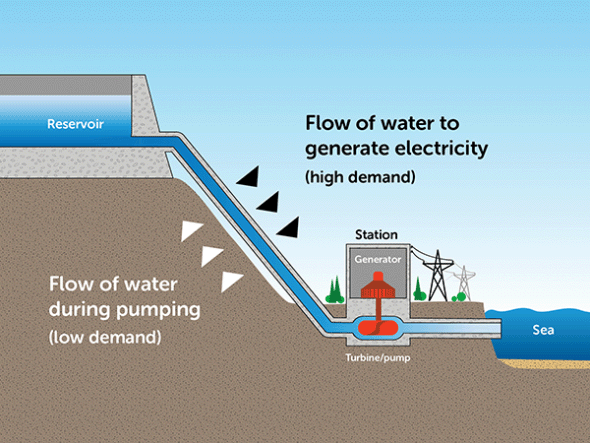
 What is pumped hydro?
- Power is generated by releasing sea water from a top dam, through a turbine, into a lower dam
- During times of plentiful energy on the network, seawater is pumped up into the top dam, like charging a battery
- The top dam would hold about eight hours of power which can be switch on at short notice
Backed by federal funding, the company and its partners will investigate the proposal further, with hopes it could be operational by the end of the decade.
“What’s required is to find a site, obviously being pumped hydro, that has water, but we also look for a site that has the right geography and topography … elevation, but also a site that has proximity to transmission,” Ms Tanna said.
Using $450,000 received from the Australian Renewable Energy Agency, the company will look at whether it is feasible to put a 100 to 200-megawatt power station close to Port Augusta and Whyalla. Continue reading →
February 24, 2017
Posted by Christina Macpherson |
South Australia, storage |
Leave a comment
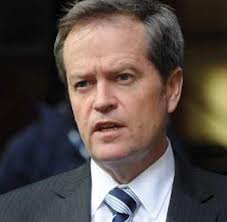
 Shorten goes on front foot over 50% renewables ‘target’, The Conversation, Michelle Grattan, Professorial Fellow, University of Canberra February 22, 2017 Australia could be the “energy capital of Asia” but instead it is going backwards, Bill Shorten will say in a speech on Thursday, vigorously defending Labor’s target of 50% of Australia’s electricity coming from renewables by 2030.
As the government floats the prospect of help for cleaner-coal power stations and attacks Labor for committing too strongly to renewables, Shorten will say that to achieve the ALP’s 50% target much more private investment in renewable generation and technology will be needed than the amount required to get to the legislated Renewable Energy Target (RET). The RET is for 23.5% of Australia’s electricity generation in 2020 to come from renewable sources.
He will say that what is required is an emissions-intensity scheme (EIS) for the electricity sector, ongoing support for research and investments in renewable energy technology, and a plan to modernise the National Electricity Market.
The speech comes as an Essential poll this week found nearly two-thirds (65%) approved of Labor’s target of 50%; 18% disapproved. Support for the policy was 55% among Coalition voters.
After much debate last week about the precise nature of Labor’s 50% commitment – whether it was a “goal” or a “target” – Shorten will take a more assertive line. “Forget the word games – 50% renewables by 2030 is Labor’s target, our goal, our objective and our aspiration,” he will say.
“We can be the energy capital of Asia. And if Australia nails the energy question, we will collect a growth dividend that can set us up for the century.
“But despite the prize on offer, despite all our natural advantages, we’re not just stuck in the gates – we are going backwards.
“When the Coalition came to office and declared war on the RET scheme, investment in large-scale renewables fell by 88% in one year.
“After being rated one of the four most attractive destinations in the world for renewable energy investment in 2013, we now don’t even crack the top ten.
“In the last three years, the world has added nearly three million jobs in renewables energy – and Australia has lost 3000,” Shorten will say, speaking at Bloomberg…….
The first and most important step to provide that certainty and to assist the transition to renewable energy is to establish an EIS for the electricity sector, he will say. An EIS rewards energy generators that produce pollution levels lower than a set benchmark.
An EIS would drive investment in new sources of energy – renewables but also gas, Shorten will say.
“An EIS doesn’t rely on taxpayer funding or government officials making investment decisions. It leaves both decisions and funding to the private sector, to the market,” he will say. “It will reduce power bills and reduce pollution.”
Malcolm Turnbull has ruled out an EIS despite the preliminary report of the Finkel inquiry into future security of the national electricity market giving it a positive nod…….https://theconversation.com/shorten-goes-on-front-foot-over-50-renewables-target-73460
February 24, 2017
Posted by Christina Macpherson |
AUSTRALIA - NATIONAL, energy, politics |
Leave a comment
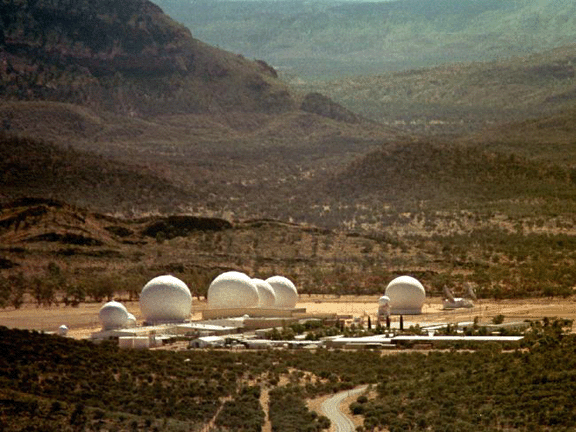
 Pine Gap protesters to be prosecuted after Attorney-General gives go-
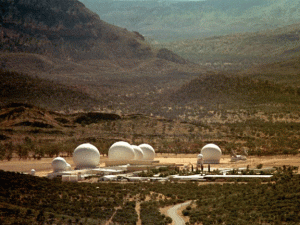 ahead http://www.abc.net.au/news/2017-02-21/pine-gap-protesters-to-be-prosecuted/8290624By Tom Maddocks, The federal Attorney-General has approved the prosecution launched against protesters who broke into top-secret military base, Pine Gap.
In September last year, six anti-war activists were arrested after they breached the perimeter into the joint US-Australian defence facility outside Alice Springs.
However, they were freed and the charges laid against the group were thrown out of court because police failed to gain the consent of the federal Attorney-General before the prosecution began.
At the time, Judge Daynor Trigg described the legislation as “nonsense” and said the police prosecution was “flawed”.
In documents tendered to the Alice Springs Local Court today, Attorney-General George Brandis gave consent to prosecute.
The protesters, who live in Queensland, did not appear in court but their defence lawyer, Russell Goldflam, said they would contest the charges.
The Commonwealth offence of entering a prohibited area carries a maximum penalty of seven years in prison. The case will return to court next month and is eventually expected to head to the Supreme Court for trial by jury.
It is only the second time there will be a prosecution made under this act.
In 2005, four activists broke into Pine Gap and the matter proceeded to trial.
The group was convicted and fined but they appealed and the conviction was quashed and they were acquitted.
February 22, 2017
Posted by Christina Macpherson |
AUSTRALIA - NATIONAL, media |
Leave a comment

 The climate bombshell the politicians didn’t touch, SMH, Business, Michael Pasco, 21 Feb 17 , Never mind the politicisation of energy and carbon policy – the market and legal system is moving rapidly to instil the discipline and punishment the government isn’t game to discuss.That was the core of the climate change bombshell dropped by the Australian Prudential Regulation Authority on Friday. The policy vacuum will be filled by the personal liability of company directors and the disclosure requirements of financial regulators.
If the ABC’s Insiders program and the federal Environment and Energy Minister, Josh Frydenberg, are any guide, Canberra hasn’t yet grasped the importance of the speech by APRA executive board member, Geoff Summerhayes, to the Insurance Council of Australia forum.In keeping with the Paris Agreement Australia has signed and the Financial Stability Board’s (FSB) policy development, APRA leaves no room for climate sceptics. Both the obvious physical and perhaps less obvious “transition” risks of climate change are real and present dangers to the financial system APRA is charged with safeguarding.
And it’s the transition risks of moving to a low-carbon economy that Summerhayes fingered as being particularly important for financial entities. APRA and its international counterparts fear the impact on banks, superannuation funds and asset managers of changes in policy, law, markets, technology and prices that are part of the agreed transition to a low-carbon economy.
Spare a thought here for the board of the Northern Australia Infrastructure Facility (NAIF) as it considers Adani’s application for a billion-dollar loan to build a railway from the Galilee Basin to the Queensland coast. While being lent on by pro-coal government members, NAIF directors would do well to consider why Australia’s banks seem to have no interest in financing the line. It’s not just a green PR issue – it’s the danger of being left with a stranded asset and directors being personally liable.
Summerhayes quoted legal opinion that it’s only a matter of time before directors who fail to properly consider and disclose foreseeable climate-related risks are held personally liable for breaching their statutory duty of care and diligence under the Corporations Act.The same consideration would weigh heavily on Clean Energy Finance Corporation (CEFC) directors if the government changes the legislation to allow CEFC to lend to new coal-powered electricity generators
Summerhayes noted that much of the early focus on climate change risks had been on insurance firms and their exposure to losses from increasingly frequent and severe natural disasters, but there were a variety of other potential issues.”These include the potential exposure of banks’ and insurers’ balance sheets to real estate impacted by climate change and to re-pricing or even ‘stranding’ of carbon-intensive assets in other parts of their loan books,” he said.
“They also include exposure of asset owners and managers – an important consideration given the size of Australia’s superannuation sector and its heavy weighting towards carbon-intensive equities and a relatively resource-intensive domestic economy.”
Frydenberg on Sunday gave the impression the government was determined to bet Australia’s energy future on the coal industry finding a way to make carbon capture and storage (CCS) economically viable.
Given the Coalition’s refusal to price carbon so as to give CCS here even a small chance of success, that looks as sensible as an individual betting their financial future on winning OzLotto. That sort of policy response, driven by the coalition’s internal ructions, climate sceptics and concentration on simplistic immediate “hip pocket” politics, contrasts with broader forces APRA comprehends.APRA’s view is that the Paris Agreement provided a very reliable signal that policy and regulatory efforts would intensify…….http://www.smh.com.au/business/the-climate-bombshell-the-politicians-didnt-touch-20170219-gugn0r.html
February 22, 2017
Posted by Christina Macpherson |
AUSTRALIA - NATIONAL, climate change - global warming |
Leave a comment
EnergyAustralia outlines plans for 100MW pumped hydro plant in SA http://reneweconomy.com.au/energyaustralia-outlines-plans-for-100mw-pumped-hydro-plant-in-sa-68973/ By Sophie Vorrath on 21 February 2017 Having chalked up three major solar power purchase agreements in as many months, EnergyAustralia is talking large-scale energy storage this week, in a briefing with the federal government on the potential for a massive pumped hydro project in the renewables rich state of South Australia.
EnergyAustralia managing director Catherine Tanna, along with the company’s executive for energy, Mark Collette, were in Sydney on Tuesday updating the Cabinet Energy Committee on the progress they have made, along with their research partners Melbourne Energy Institute and Arup Group, investigating the viability of a pumped hydro energy storage plant using seawater.
In a statement on Tuesday, Arup Group said that the proposed South Australia project would have the capacity to produce around 100MW of electricity with six-to-eight hours of storage – the equivalent of 60,000 home battery systems, EnergyAustralia says, but at “one-third of the cost.”
Pumped hydro, one of the oldest and most basic and low-cost forms of energy storage, converts electrical energy into potential energy by pumping water up to the top of a hill, storing it there in a reservoir, and then using it when needed to generate electricity at very high efficiency.
Most recently in Australia, it has been linked with a ground-breaking project being developed by Genex Power, which proposes to convert an old gold mine into a 330MWh pumped hydro storage project, to go alongside a 150MW solar PV array.
But its potential for Australia has come into sharper focus in recent months, as governments and electricity market operators grapple with the problem of how to support the smooth transition of electricity networks to renewable energy generation. Continue reading →
February 22, 2017
Posted by Christina Macpherson |
South Australia, storage |
Leave a comment
February 22, 2017 A SUPPLEMENTARY environmental report for a $1.19 billion rare earths mine north of Alice Springs has been lodged with the NT Environment Protection Authority.
The lodgement represents a significant milestone in Arafura Resource’s Nolans Project.
Arafura plans to mine, concentrate and chemically process rare earths at the Nolans site, 135km north-northwest of Alice Springs.The project is estimated to create up to 500 jobs in the two-to-three year construction phase, and employ a peak workforce of 300 in the operation phase, which is expected to exceed 40 years.
Construction is estimated to cost $866 million at Nolans, including an estimated $145 million in the Territory and $70 million in Central Australia. It is expected to cost $188 million a year to operate.
The draft EIS and associated specialist studies were on public exhibition for eight weeks last year and attracted 21 submissions, mostly from government departments.
Arafura’s NT general manager Brian Fowler said they were hoping to complete the environmental part of the project this year.
“All matters raised in these submissions were provided to Arafura for consideration and are responded to in the EIS supplement,” he said.
“We look forward to completing the approvals process for the environmental component of the project later this year.”
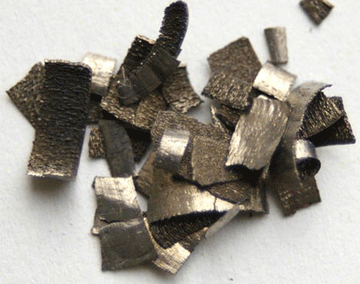
Rare earths are a collection of 15 elements in the periodic table that are relatively abundant in the earth’s crust, but uncommon to find in quantities that can be recovered economically, Mr Fowler said.
“They are essential to products with significant growth potential in markets associated with the electronics and technology industries, energy efficiency and greenhouse gas reduction,” he said.
Until recently, rare earths were mostly mined, processed and refined in China and, along with Japan and the USA, China accounts for most of the world’s demand for rare earths. Continue reading →
February 22, 2017
Posted by Christina Macpherson |
Northern Territory, rare earths |
Leave a comment
More than 70% believe Coalition not doing enough on energy – poll
Guardian Essential survey shows a clear majority supports Labor’s goal of sourcing 50% of energy from renewables by 2030, Guardian,
A majority of voters surveyed in the latest Guardian Essential poll supports Labor’s renewable goal, suggesting Coalition attacks are not working. Guardian, Katharine Murphy, 21 Feb 17, More than 70% of voters think the Turnbull government is not doing enough to ensure affordable, reliable and clean energy for Australian households and businesses – and a clear majority also supports Labor’s goal of sourcing 50% of energy from renewable sources by 2030.
The latest Guardian Essential poll suggests that the Turnbull government’s relentless partisan attacks on Labor’s 50% renewable energy policy, and its concerted efforts early in the new political year to position itself as the party of cheaper and more secure power, haven’t yielded the desired result.
The poll shows 71% of the sample think the federal government is not doing enough to ensure affordable, reliable and clean energy – and only 12% rate the current effort as satisfactory.
Even among their own constituency, Liberal and National voters, 62% of the sample said the government was not doing enough.
When asked about the ALP’s aspirational goal to source 50% of energy from renewable sources by 2030, 65% of voters registered their approval of the concept.
The policy – which has been repeatedly branded reckless and ideological by the prime minister – won strong majority approval from both Labor and Green voters. Coalition voters were also more likely to approve of the target than disapprove.
The political campaign by the government hasn’t moved the dial in any significant way. Attitudes to the policy have changed little since it was unveiled by Bill Shorten in 2015.
Voters were also divided about whether or not Australia should build new coal-fired power stations but a clear majority opposed the idea. Forty-five per cent of the sample said it was a bad idea and 31% supported building new coal-fired power stations.
The people positive about the idea of building new coal-fired power stations were Liberal/National voters (47%),men (39%) and people aged 65 and over (53%)……
Most voters are also attributing power blackouts in South Australia to failures of the energy market in responding to extreme weather events (45%), rather than to problems with too many windfarms……https://www.theguardian.com/australia-news/2017/feb/21/more-than-70-believe-coalition-not-doing-enough-on-energy-poll
February 22, 2017
Posted by Christina Macpherson |
AUSTRALIA - NATIONAL, energy, politics |
Leave a comment
Climate scepticism is a far-right badge of honour – even in sweltering Australia, Guardian, Paul Mason It’s up to progressives to fight back against this idiocy-promoting rhetoric and save the Earth Tuesday 21 February 2017
It hits you in the face and clings to you. It makes tall buildings whine as their air conditioning plants struggle to cope. It makes the streets deserted and the ice-cold salons of corner pubs get crowded with people who don’t like beer. It is the Aussie heatwave: and it is no joke.

Temperatures in the western suburbs of Sydney, far from the upmarket beachside glamour, reached 47C (117F) last week, topping the 44C I experienced there the week before. For reference, if it reached 47C in the middle of the Sahara desert, that would be an unusually hot day.
For Sydney, 2017 was the hottest January on record. This after 2016 was declared the world’s hottest year on record. Climate change, even in some developed societies, is becoming climate disruption – and according to a UN report, one of the biggest disruptions may only now be getting under way.
El Niño, a temperature change in the Pacific ocean that happens cyclically, may have begun interacting with the long-term process of global warming, with catastrophic results…….
What cannot be disputed is that the most recent El Niño in 2015/16 contributed to the extreme weather patterns of the past 18 months, hiking global temperatures that were already setting records. (Although, such is the level of rising, both 2015 and 2016 would have still been the hottest ever without El Niño.) Sixty million people were “severely affected” according to the UN, while 23 countries – some of which no longer aid recipients – had to call for urgent humanitarian aid. The catastrophe prompted the head of the World Meteorological Association to warn: “This naturally occurring El Niño event and human-induced climate change may interact and modify each other in ways that we have never before experienced.”
The warning was enough to prompt the UN to issue a global action plan, with early warning systems, beefed-up aid networks and disaster relief preparation, and calls for developing countries to “climate proof” their economic plans.
Compare all this – the science, the modelling, the economic foresight and the attempt to design multilateral blueprint – with the actions of the jackass who runs Australia’s finance ministry.
Scott Morrison barged into the parliament chamber to wave a lump of coal at the Labor and Green opposition benches, taunting them: “Don’t be afraid, don’t be scared. It’s coal. It was dug up by men and women who work in the electorate of those who sit opposite.” Coal, argues the Australian conservative government, has given the economy “competitive energy advantage for more than 100 years”. Labor and the Greens had called, after the Paris climate accord, for an orderly shutdown of the coal-fired power stations that produce 60% of the country’s energy.
The Aussie culture war over coal is being fuelled by the resurgence of the white-supremacist One Nation party, led by Pauline Hanson, which is pressuring mainstream conservatives to drop commitments to the Paris accord and, instead, launch a “royal commission into the corruption of climate science”, which its members believe is a money-making scam.
All over the world, know-nothing xenophobes are claiming – without evidence – that climate science is rigged. Their goal is to defend coal-burning energy, promote fracking, suppress the development of renewable energies and shatter the multilateral Paris agreement of 2015.
Opposition to climate science has become not just the badge of honour for far-right politicians like Ukip’s Paul Nuttall. It has become the central tenet of their appeal to unreason…….https://www.theguardian.com/commentisfree/2017/feb/20/sweltering-aussies-rightwing-climate-of-fear
February 22, 2017
Posted by Christina Macpherson |
AUSTRALIA - NATIONAL, climate change - global warming |
Leave a comment
 Why new coal? Solar towers + storage beats it on all counts http://reneweconomy.com.au/why-new-coal-solar-towers-storage-beats-it-on-all-counts-16080/ By Giles Parkinson on 21 February 2017
The US-based developers of the world’s leading solar tower and storage technologies has expressed surprise that Australia’s federal government is pursuing “new coal” plants, saying that solar towers with storage beats coal on just about all fronts.
Tom Georgis, the head of international development for SolarReserve, says solar towers and storage can match and beat coal on capability – providing baseload and flexible generation – and match new coal on cost, and provide zero emissions output as a bonus.
“This is just not a direction that financial markets are heading in,” Georgis told RenewEconomy in an interview on Tuesday, during a visit to Australia, where the company is hoping to build a $700 million, 110MW solar tower and storage facility in Port Augusta, and in other states too.
“In our opinion it is almost backward looking,” Georgis said, adding that carbon capture and storage in electricity generation is unproven and not cost-effective, and coal generation needs to take account of the impact of mining, and of emissions.
The Australian energy industry, including fossil fuel generators, have reacted to the Coalition’s push for new coal plants with a mixture of surprise and disbelief, saying any such plant is “uninvestable”.
Bloomberg New Energy Finance has estimated costs at between $138/MWh and more than $200/MWh, and significantly higher with CCS. It and others say estimate emissions reductions are grossly over-estimated.
SolarReserve says its own technology costs are “well under ” coal, even without CCS. It has been coy about its costs in Australia, having never built a plant here before, although CEFC executive director Simon Brooker told a Senate inquiry this month that a cost of around $150/MWh was being talked about for a first of its kind plant. Costs would then fall quickly as others are built.
SolarReserve is believed to be participating in a South Australian government tender for 75 per cent of its electricity needs, competing mostly with new gas stations and existing mothballed ones. It has talked with both the CEFC and ARENA.
Interestingly, Engie, the owner of the mothballed Pelican Point gas station near Adelaide considered to be its biggest rival in the tender, reportedly told the same inquiry on Monday that running the generator would not be economic, even with a government contract, because of the cost and availability of gas.
This may have prompted S.A. energy minister Tom Koutsantonis to say some positive things about solar towers and storage last week. Both the federal Coalition and Labor have promised to help promote solar towers, but have done nothing since the election.
Georgis says SolarReserve has already beaten gas generators on price in a tender in Chile last year, and is confident it can beat new gas generation in Australia too. Its main issue lies in the length of a contract, which will be crucial in its ability to secure finance.
Georgis again underlined the capability of solar towers and storage, and its ability to provide baseload power, power on demand, bulk storage, and use its steam turbines to provide the ancillary services normally delivered by fossil fuel generation.
He says battery storage will make sense for short-period needs, and as a cheaper option to network upgrades and for accompanying solar in distributed generation, but battery storage could not deliver or compete on price for bulk storage.
Pumped hydro was also unlikely to provide a “baseload” option, and was reliant on arbitrage opportunities (pumping water up hill while prices were low, and generating power when prices were high) to make it economic. Solar towers, on the other hand, had zero fuel costs.
February 22, 2017
Posted by Christina Macpherson |
AUSTRALIA - NATIONAL, solar |
Leave a comment