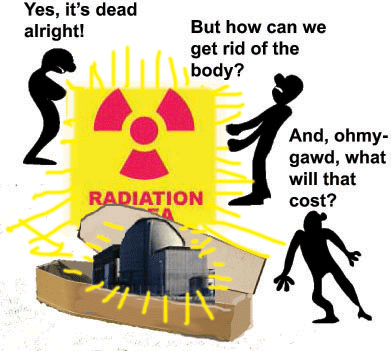
 Frydenberg on blackouts: No mention of failing network, gas, software, REneweconomy, By Giles Parkinson on 21 February 2017 Federal energy minister Josh Frydenberg has put the blame for recent blackouts in South Australia directly on the state’s high penetration of wind and solar, and attributed no blame to network faults, storms or failing gas plants.
In a speech on energy security to the right-leaning Sydney Institute on Monday night, Frydenberg listed four black-out events that had hit South Australia since and including the “unprecedented” state-wide outage on September 28.
 He made no mention of the fierce storms, the falling power lines, the network faults that caused outages in December and February, or the role of gas plants that sat idle, or had to shed capacity because of the heat and other technical faults.
Nor did he mention the software glitch that meant 90,000 households, rather than 30,000, suffered power cuts in South Australia earlier this month when demand hit record highs.
Instead, Frydenberg pointed only to the roles of wind and solar, both of which he said were producing at a fraction of their capacity when the rolling blackouts were implemented.
“This means that the days of easily forecastable supply are over,” he said. “Nowhere was this more clear than during the last South Australian blackout, when 90,000 consumers lost power.”
An Australian Energy Market Operator report last week said the cause of the problem was bad forecasting, not just of supply, but of demand. It was caught short when demand spiked and could not wake a gas generator from its slumber.
Another 300MW of gas capacity was unavailable because it was broken – with half of it failing in the hours before the blackout. Wind energy was producing twice as much power as had been forecast a day earlier. Solar was the only local generation that produced exactly as predicted.
As AEMO told the Senate inquiry last week: “It is going back to the unforced and unplanned outages that eroded our reserves at that time in such a short period of time.
“Yes, we knew the wind would drop-off and we knew the solar would drop-off at a particular time, but our reserves were fine up until the point when we had forced outages.” i.e. the gas plants.
Frydenberg also spoke of South Australia’s price spikes, but made no mention of similar price spikes in Queensland and South Australia.
Indeed, average wholesale electricity prices in coal-dependent Queensland so far this month have average $301/MWh, nearly 50 per cent more than South Australia last July ($201/MWh), when network supplies from Victoria were restricted by an upgrade and which helped trigger the Coalition’s anti-renewable campaign.
In February this year, NSW has averaged $214/MWh while South Australia has averaged $210/MWh. In January, average wholesale prices in Queensland were at $197/MWh, while in South Australia they averaged just $84/MWh.
AEMO, in its report, has insisted that it is not the nature of wind energy or solar that have contributed to the various blackouts. Frydenberg, however, is having none of it….http://reneweconomy.com.au/frydenberg-on-blackouts-no-mention-of-failing-network-gas-software-19688/
February 22, 2017
Posted by Christina Macpherson |
AUSTRALIA - NATIONAL, energy, politics |
Leave a comment
 SA power bills rose less in past decade than coal states, REneweconomy By Sophie Vorrath on 21 February 2017 A new report charting Australia’s rising power prices over the past decade has undermined claims that South Australia’s high electricity prices have been driven by the state’s uptake wind and solar, showing that its rises have been less than in coal dependent states.
The argument that South Australia’s high electricity prices are a result of its pursuit of wind and solar is an argument prosecuted by conservative media and politicians alike, but the new report from the Australian National University underlines the fact that its prices have always been high, but have moderated since its investment in renewable energy.
The ANU report, commissioned by News Limited, but available here, shows that average household electricity bills have increased less in the renewables-rich state of South Australia over the past 10 years than they have in Australia’s eastern states, which are predominantly powered by coal and gas-fired generation…….. http://reneweconomy.com.au/sa-power-bills-rose-less-past-decade-coal-states-95588/
February 22, 2017
Posted by Christina Macpherson |
energy, South Australia |
Leave a comment
Solar power battery storage would solve SA’s electricity problems, company says, ABC News, By Claire Campbell, 21 Feb 17, The company behind a $100-million solar plant with battery storage says its project could solve South Australia’s energy woes as the Federal Government announces a $445,000 investment into a pumped hydro-station for the state.
South Australia’s power supply has been scrutinised since the state was plunged into darkness last September, and was forced to “load shed” during a recent heatwave.
South Australian-based renewable energy company Zen Energy is working to build a $100-million solar power plant with 100 megawatts of battery storage in the region.
Chairman Professor Ross Garnaut said the battery would “solve most” of the state’s energy problems and if increased by a further 50MW it would solve “all” energy issues.
“The blackouts of the past year would not have happened if this was in place,” he said.
“We think that it can make a major contribution both to grid stability and also to provide a buffer for when peak demand for power exceeds supply from other sources.”…… http://www.abc.net.au/news/2017-02-21/solar-power-battery-storage-could-have-prevented-sa-blackout/8290304
February 22, 2017
Posted by Christina Macpherson |
South Australia, storage |
Leave a comment
Pre-election coal advertising funded by money meant for clean coal research, ABC News, By Stephen Long 21 Feb 17 The coal industry’s multi-million-dollar advertising and lobbying campaign in the run-up to the last federal election was bankrolled by money deducted from state mining royalty payments and meant to fund research into “clean coal”.
Key points:
- Coal21 fund launched in 2004, aiming to create $1 billion to research “clean coal technologies”
- Fund’s coal levy was suspended from mid-2012 to mid-2016
- In 2013 coal lobby changed mandate of Coal21 to allow its funds to be used for “coal promotion”
The mining industry spent $2.5 million pushing the case for lower-emissions, coal-fired power plants in the run-up to last year’s election — a cause the Federal Government has since taken up with gusto.
The source of the funds was a voluntary levy on coal companies, originally intended to fund research into “clean coal” technologies, which coal producers could deduct from state mining royalties.
Instead, some of the money raised paid for phone polling, literature and TV ads that declared “coal — it’s an amazing thing”.
The funds were channelled through the Australian Coal Association Low Emissions Technology Limited (ACALET), formerly owned by the Australian Coal Association and now part of the Minerals Council for Australia.
Queensland Government documents list “the COAL21 levy payable to Australian Coal Association Low Emissions Technologies Ltd (ACALET)” as an eligible deduction against royalty payments in the state.
A “coal research” levy in NSW is also deductible against coal mining royalty payments, under a deal signed off by the disgraced former NSW Labor minister Ian Macdonald, who was charged with criminal offences after an ICAC inquiry.
But it was not clear from the ABC’s research whether the NSW money funded the body behind the coal industry’s campaign.
Coal21 was launched more than a decade ago, with the aim of creating a $1 billion fund for research into “clean coal” technologies like carbon capture and storage (CCS), but only a fraction of the money was raised or spent.
With a lack of research projects to finance, the levy was suspended in 2012. In 2013, the coal lobby changed the mandate of Coal21 to downplay research and allow its funds to be used for “coal promotion”.
Critics ‘outraged’ by industry’s use of funding
Funding the industry campaign from money that otherwise would have been paid to state governments as mining royalties has outraged the Federal Opposition and the coal industry’s critics.
“It is a huge shame that Coal21 funding, which was mean to go into genuine CCS research, is now being used to finance advertising and political campaigns,” Labor’s environment spokesman Mark Butler said.
Australia Institute chief economist Richard Denniss said it was “scandalous”.
“Every dollar spent on advertising as part of the coal industry campaign was a dollar that should have gone into consolidated revenue,” he said.
“Citizens funded a propaganda campaign with money that would otherwise have gone into public revenue to fund schools and hospitals.”
February 22, 2017
Posted by Christina Macpherson |
AUSTRALIA - NATIONAL, climate change - global warming, secrets and lies |
Leave a comment
We have now reached a time where an overwhelming majority of the world’s nations are ready to outlaw nuclear weapons, just as the world outlawed chemical and biological weapons and land mines.
There is no reason why we should not be providing leadership in the effort to ban nuclear weapons.
Australia must play our part. Malcolm Turnbull should commit to attending the 2017 negotiating conference. If Australia fails to participate, this will tarnish our international reputation as a disarmament supporter and, in doing so, fail to act to promote safety in our world.
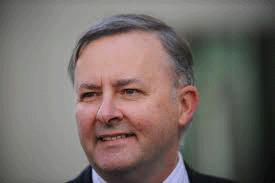 AUSTRALIA MUST PLAY ITS PART IN ABOLISHING NUCLEAR WEAPONS , ANTHONY ALBANESE MP, SPEECH TO THE TOM UREN MEMORIAL FOUNDATION FOR THE INTERNATIONAL CAMPAIGN TO ABOLISH NUCLEAR WEAPONS , 12 Feb 17
 In 1961 John F Kennedy told the United Nations:
Today, every inhabitant of this planet must contemplate the day when this planet may no longer be habitable. Every man, woman and child lives under a nuclear sword of Damocles, hanging by the slenderest of threads, capable of being cut at any moment by accident or miscalculation or by madness. The weapons of war must be abolished before they abolish us.
It is incredible to think that almost six decades on, this threat still exists. We must continue to dedicate ourselves to eliminating this threat. Every nation has a responsibility to work for a world free of nuclear weapons.
Australia is no exception.
That is why the work of ICAN in Australia and around the world, in helping to progress the disarmament agenda, is so important.
I come to this debate with the benefit of the testimony of a man who saw the horror of nuclear weapons first hand. Tom Uren was imprisoned in a POW camp on the island of Omuta on 9 August 1945. Just after 11am, the US detonated an atomic bomb over the city of Nagasaki about 80km away. Estimates of the death toll ranged between 40,000 and 80,000. That’s men, women and children. Nuclear weapons don’t discriminate.
Continue reading →
February 20, 2017
Posted by Christina Macpherson |
AUSTRALIA - NATIONAL, politics, weapons and war |
Leave a comment
Tim Wright, the Asia-Pacific director of the International Campaign to Abolish Nuclear Weapons, said Australia was turning its back on the UN at a time when multilateral cooperation was more important than ever. He accused Australia of “taking orders from the Trump administration”.
“Every country in south-east Asia and nearly all countries in the Pacific have declared their strong support for the upcoming UN negotiations. Australia will be sitting in self-imposed exile from one of the biggest and most important international treaty-making initiatives in recent history.
“This will be the first time that Australia has ever boycotted disarmament negotiations.
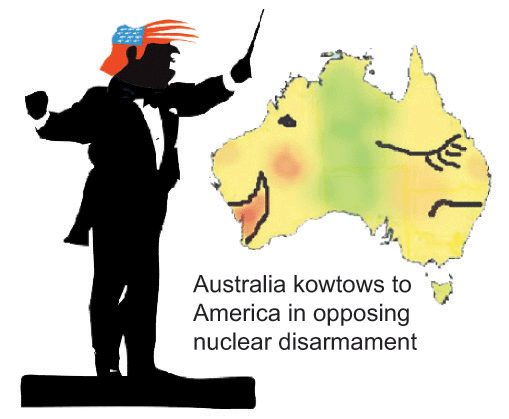
Australia to boycott global summit on treaty to ban nuclear weapons https://www.theguardian.com/world/2017/feb/17/australia-to-boycott-global-summit-on-treaty-to-ban-nuclear-weapons
Anti-nuclear campaigners accuse Australia of turning its back on the UN and ‘taking orders from the Trump administration’, Ben Doherty, Australia will boycott global negotiations on a treaty to ban nuclear weapons at the United Nations next month.
The global summit, to be held in New York on 27 March, will go ahead with Australia out of the room. Continue reading →
February 20, 2017
Posted by Christina Macpherson |
AUSTRALIA - NATIONAL, politics international, weapons and war |
Leave a comment
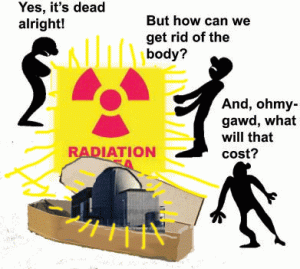 Tim Bickmore , Fight to stop Nuclear Waste Dump in South Australia February 18 There is also another elephant in the room which is yet to rate a mention. At Lucas heights there are 2 reactors – OPAL & HIFAR. OPAL is the working reactor, whilst HIFAR is the old one now undergoing de-commissioning – which includes dealing with more radioactive waste. Is the HIFAR waste
  (= old reactor parts) also destined for the dump? Considering the decommission schedule, this seems highly probable & where else would it go……
“HIFAR is currently being decommissioned and will be totally decommissioned by 2018.” HTTPS://WWW.FACEBOOK.COM/GROUPS/344452605899556/
February 20, 2017
Posted by Christina Macpherson |
Federal nuclear waste dump, New South Wales, South Australia |
Leave a comment
Josh Frydenberg flags changes to allow CEFC to invest in carbon capture and storage, ABC News, AM By Eliza Borrello, 20 Feb 17, Federal Energy Minister Josh Frydenberg has revealed the Government is considering lifting a ban on allowing the Clean Energy Finance Corporation (CEFC) to invest in carbon capture and storage……At the moment the CEFC, the Government’s green bank, is not allowed to invest in it.
But amid the Coalition’s renewed support for coal-fired power, Mr Frydenberg said that could change…..
Shadow Energy Minister Mark Butler said it would require the kind of legislation Labor would strongly oppose. “This would be an outrageous act of vandalism against a successful financing mechanism for renewable energy, for energy efficiency projects and for genuine low-carbon technology,” he said.”It’s no real surprise, I guess, because the Liberal Party has never really supported the CEFC. “It tried to abolish it for three years and now seems committed to making it a finance mechanism for the coal industry, which is unable to attract finance from the private sector.”
Government interested in low-emission coal-fired plants Mr Frydenberg said he was also interested in investment in high-efficiency, low-emission coal-fired plants.
Currently they are not green enough for the CEFC to invest in, but Mr Frydenberg has flagged changing the rules. “The Government could issue a new mandate to the CEFC which would then inform its guidelines and would make possible an investment in a high-efficiency low-emission power plant,” he said……
But Mr Butler said the market was not interested in the kind of plants Mr Frydenberg was suggesting.
“It doesn’t reflect the reality in the electricity industry. No-one in the industry is talking about the reality of building new coal-fired power stations,” he said. http://www.abc.net.au/news/2017-02-20/government-interested-in-carbon-capture-tech-frydenberg-says/8284682
February 20, 2017
Posted by Christina Macpherson |
AUSTRALIA - NATIONAL, energy, politics |
Leave a comment
 Climate change could threaten entire financial system, APRA warns, ABC News, 17 Feb 17, By Stephen Long Climate change could threaten the stability of the entire financial system, the prudential regulator has warned, as it prepares to apply climate change “stress tests” to the nation’s financial institutions.
In its first major speech on climate change, the Australian Prudential Regulation Authority chastised companies for a lack of action on the risks it poses.
“While climate risks have been broadly recognised, they have often been seen as a future problem or a non-financial problem,” APRA executive board member Geoff Summerhayes told an Insurance Council conference in Sydney.
“Many of these risks are foreseeable, material and actionable now.
The speech comes as the Government and the Opposition bicker about renewable energy targets amid dismay among industry leaders about a lack of certainty on climate change policy.
The Climate Institute’s CEO John Connor described the speech as a “huge” development.
“APRA has never gone out there like this before,” he said.
“It’s an antidote to the hyper partisan political culture war on climate policy; our regulator’s moved to the front foot in managing climate risks.”
The Climate Institute and the Investor Group on Climate Change wrote jointly to the Council of Financial Regulators two years calling for regulatory action on the financial risks from climate change.
Lack of policy ‘could greatly increase financial risks’
APRA warned in the speech that lack of policy and regulatory action could make the financial risks posed by climate change “greater and more abrupt”.
“There could be either sharper, more significant policy changes and market adjustments down the track, or the physical impacts of climate change could become more severe, more likely and more unpredictable,” Mr Summerhayes said.
“Like all risks, it is better they are explicitly considered and managed as appropriate, rather than simply ignored or neglected.
“So what can you expect to see from us? A greater emphasis on stress testing for organisational and systemic resilience in the face of adverse shocks.
“Just as we would expect to see more sophisticated scenario-based analysis of climate risks at the firm level, we look at these risks as part of our system-wide stress testing.”
APRA’s intervention follows a similar though more pointed warning two years ago by the head of the Bank of England about the threats climate change posed to financial stability…….http://www.abc.net.au/news/2017-02-17/climate-change-could-threaten-entire-financial-system-apra/8281436?pfmredir=sm
February 20, 2017
Posted by Christina Macpherson |
AUSTRALIA - NATIONAL, business, climate change - global warming |
Leave a comment
most of the Mineral Council’s biggest members are multinationals, listed on Australian and overseas stock exchanges. Could their membership fees or fighting fund donations be used for the MCA’s political campaigns if foreign donations were banned? Should their individual contributions be revealed?
Deep-pocketed miners don’t like it when those with different views wield clout, Guardian, Lenore Taylor @lenoretaylor 18 February 2017 In 2010 the mining industry’s $22m campaign against Kevin Rudd’s resources tax helped bring down a prime minister. For years it has spent huge sums on donations and advertising and lobbying to exert enormous political influence. But the deep-pocketed miners really don’t like it when those with different views find the cash and the smarts to wield some clout.

February 20, 2017
Posted by Christina Macpherson |
AUSTRALIA - NATIONAL, politics |
Leave a comment
 About Seed http://www.seedmob.org.au/about_seed
“Seed is Australia’s first Indigenous youth climate network.
We are building a movement of Aboriginal and Torres Strait Islander young people for climate justice with the Australian Youth Climate Coalition.
“Our vision is for a just and sustainable future with strong cultures and communities, powered by renewable energy.
“Climate change is one of the greatest threats facing humanity, but we also know it is an opportunity to create a more just and sustainable world.”
February 20, 2017
Posted by Christina Macpherson |
aboriginal issues, AUSTRALIA - NATIONAL, climate change - global warming |
Leave a comment
 The Adani Brief: our summary https://www.acf.org.au/adani_brief_summary
https://groups.google.com/forum/#!topic/wgar-news/QkXUYq11cmQ 15 February 2017:
“Background
The brief is the result of months of international investigation by Environmental Justice Australia and
USA-based environmental law non-profit EarthJustice into the global legal compliance record of the Adani Group.
It puts governments and private stakeholders on notice that backing Adani’s Carmichael
coal mine and rail project in Queensland’s Galilee Basin
may expose them to financial and reputational risks.
“Key findings
“Environmental destruction:
Adani Group companies have a record of environmental destruction and non-compliance with environmental regulations.
Some examples are: …
“‘Black money’: …
“Bribery and illegal exports: …
“Confusing and opaque corporate structures: …
“This is a company the government is entrusting: … ”
The Adani Brief:
What governments and financiers need to know
about the Adani Group’s record overseas
https://groups.google.com/forum/#!topic/wgar-news/QkXUYq11cmQ
https://envirojustice.org.au/sites/default/files/files/Submissions%20and%20reports/The_Adani_Brief_by_Environmental_Justice_Australia.pdf
February 20, 2017
Posted by Christina Macpherson |
business, environment, politics, Queensland, secrets and lies |
Leave a comment
Artists paint the truth of SA nuclear la la land https://www.eurekastreet.com.au/article.aspx?aeid=50616#.WKpGiNJ97Gg Michele Madigan | 12 February 2017
‘It will be your artists: the poets, painters, actors, dancers, musicians, orators — they will be the ones to lead the changes.’ It was one of the many international invited guests, a Maori woman speaker, who made this prediction to the huge 40,000 strong crowd; to the 30,000 First Nations people from across the nation and 10,000 of us non-Aboriginal supporters who had joined them enroute to Hyde Park, Sydney, on 26 January 1988.
In South Australia almost 30 years later, this prophecy continues to unfold in the ongoing high-stakes battle for country that surrounds the proposed nuclear waste dump.
The orators have been long leading the way. ‘We can’t sell that country — we can’t sell it. Just like selling your own kid, own grandmother, own grandfather,’ said Arabunna Elder Kevin Buzzacott at the 1998 Global Survival and Indigenous Rights Conference in Melbourne 1998.
Tjunmutja Myra Watson told the Olympic Games international media, Botany Bay, 2000: ‘We already lost everything at Maralinga’ — the site of the 1950s and 1960s British nuclear tests.
‘We thought that Maralinga would be the last one … We love our land … We got the Dreaming, we got the songs and we got the culture. We’re going to fight to keep it. Let’s keep it, let’s keep the country, not this man coming in and digging up our spirit and our land and all our songs. They’re spoiling it when they put the poison in. They’re taking everything and they did it before.’
They are joined in the struggle by other artists: painters Eileen Wani Wingfield and Eileen Unkari Crombie; dancers Eileen Kampakuta Brown, Edie Nyimpula King and other Kupa Piti Kungka Tjuta, dancing for protection of country in the bush; singers like Ivy Makinti Stewart, whose astonishing voice filled the Adelaide Town Hall with the lament of the Seven Sisters: Irati Wanti — the poison — leave it! Continue reading →
February 20, 2017
Posted by Christina Macpherson |
art and culture, South Australia |
Leave a comment
Why is Labor so hopeless at defending renewables policy? REneweconomy By Giles Parkinson on 16 February 2017 Federal Labor has effectively abandoned its 50 per cent renewable energy target after its leaders failed hopelessly to identify the obvious arguments to defend the policy.
Instead – less than a week after the Coalition made idiots of themselves by bringing a lump of coal into Question Time, Labor appears to have thrown its lot in to a new scheme that could mean little new wind and solar over the coming decade.
The feeble backsliding was revealed by climate and clean energy spokesman Mark Butler on Thursday, trying to cover the tracks of a pathetic performance from his leader, Bill Shorten, on the ABC Radio “AM” program a day earlier.
And by defending him, Labor appears to have thrown the renewables industry under a bus. Butler effectively admitted there would be no stand-alone renewable energy target, instead of relying on an emissions trading scheme to bring on wind and solar.
And what do the architects of that EIS expect will happen under such a scheme? As we pointed out in detail late last year, no growth at all in large-scale wind and solar between 2020 and 2030. The EIS has been designed to support gas, not wind and solar.
According to the modelling commissioned by the Australian Energy Market Commission, under an EIS fossil fuels will thrive and still make up 80 per cent of the country’s electricity mix by 2030. By adopting that policy, Labor could be killing wind and solar in its tracks, or at least after the end of the current target in 2020.
Let’s go back one step: The only thing more frustrating about the Coalition government’s attack on renewable energy in Australia has been the hopeless effort put up by Labor in defending its 50 per cent renewable energy target for 2030.
Prime Minister Malcolm Turnbull and his ministers, despite operating in a debate almost devoid of facts, is running rings around Labor by accusing it of risking both surging electricity prices and regular blackouts. Labor’s response has been ordinary at best.
Leader Bill Shorten gave the impression of being a rabbit in the headlights when interviewed on ABC Radio’s AM program on Wednesday, when asked four times about the potential cost of the target……
One thing that we’ve learned from the rise of Trump, Brexit and One Nation is that even without facts, clarity wins votes. Labor had the advantage of having facts on its side, but now it looks like they’ve gone and thrown it away.
As The Greens Adam Bandt noted, this is a capitulation, a betrayal and an act of cowardice. And everyone has a right to be angry. http://reneweconomy.com.au/why-is-labor-so-hopeless-at-defending-renewables-policy-67678/
February 20, 2017
Posted by Christina Macpherson |
AUSTRALIA - NATIONAL, politics |
Leave a comment
 It is extraordinary that some French wine producers are accompanying the Australian and French nuclear promoters spruiking the benefits of nuclear waste dumping to the community in the Barndioota region of South Australia. Not only are many vital questions unanswered as ENuFF SA (Everyone for a Nuclear Free Future SA) has shown, but this propaganda campaign completely ignores both the opposition to nuclear waste dumping, in France and the radioactive danger to France’s Champagne vineyards
“The Champagne producers are facing two nuclear timebombs – one already leaking at Soulaine, and one planned at Bure. The wine producers in the Rhone region stood up to the nuclear state in France and won. The Champagne region needs to act fast before it’s too late,” said Fred Marillier of Greenpeace France. “The French Government must stop this madness. The new facility must not accept any more waste, and an immediate investigation launched into how to stop further contamination of ground water.”
Radioactive waste leaking into Champagne Water Supply, Levels set to rise warns Greenpeace, Greenpeace 30 May, 2006 Greenpeace today revealed that France’s iconic sparkling wine, Champagne, is threatened by radioactive contamination leaking from a nuclear waste dumpsite in the region. Low levels of radioactivity have already been found in underground water less than 10 km from the famous Champagne vineyards.
Problems at the dumpsite, including water migration leading to fissures in the storage cells have been reported to French nuclear safety agency in recent weeks (1). Greenpeace has written to the Comita des Producteur de Champagne to warn them that their production risks contamination, as experienced by dairy farmers in la Hague, Normandy.
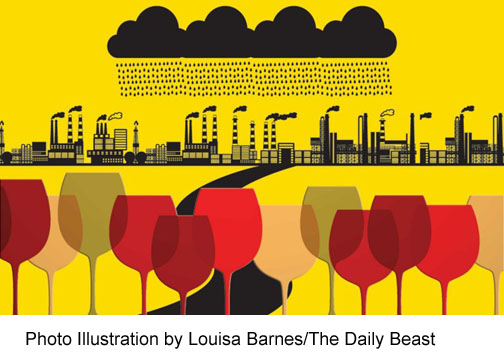
The waste dump, Centre Stockage l’Aube (CSA) in Soulaine eastern France, contains mostly waste from Electricite de France (EdF) and AREVA, but also includes foreign nuclear waste disposed of illegally under French law (2). Every week nuclear waste is trucked across France to the Champagne site. Once full, the dumpsite will be one of the world’s largest with over 1 million cubic meters of waste, including plutonium and other radionuclides.
ANDRA, the national nuclear waste agency operating the site, stated that it would not release any radioactivity into the environment when given permission for the dumpsite in the late 1980’s. Greenpeace research released last week showed levels of radioactivity leaking from another dumpsite run by ANDRA in Normandy were up to 90 times above European safety limits in underground water used by farmers, and that the contamination was spreading into the countryside Continue reading →
February 10, 2017
Posted by Christina Macpherson |
Federal nuclear waste dump, South Australia |
Leave a comment