Some straight questions asked on nuclear wastes – to Australia’s government authorities

 To ANSTO, ARPANSA & the DEPARTMENT OF INDUSTRY, INNOVATION and SCIENCE
From ENuFF SA (Everyone for a Nuclear Free Future SA) , Pt. Augusta February 8, 2017
We would like some straight answers to the following questions:
The current National Radioactive Waste Management Facility (NRWMF) is the third attempt in a decade to locate a site for a national radioactive waste dump:
Question: Are any designs for a dump planned? The last shipment of nuclear waste returned to Australia following reprocessing in France, in late 2015. It was categorised by the French authorities as high-level waste (HLW). The SA Nuclear Fuel Cycle Royal Commission Report (May 2016) states on page 95 that reprocessed waste is high level. But ANSTO classifies this highly hazardous material as intermediate-level waste (ILW).
Question: Why do the Australian agencies responsible for nuclear waste mislead the public about radiation levels?
Question: Why is spent fuel from both the retired HIFAR and currently operating OPAL reactor not classified HLW? Is it the only spent fuel in the world to be classified ILW?
Question: Would ANSTO explain how the radioisotopes in spent fuel from its research reactors differ from that of nuclear power reactors? When nuclear waste is reprocessed, waste from other countries is mixed together in the reprocessing liquor. Returning material would, therefore, come from other reactors in France (or the UK) or other client country’s reactors, as well as Australia’s.
Question: When will this be explained to the public? Reprocessing of spent fuel cannot remove ALL of the fissile material: Plutonium and Uranium.
Question: Why, then, does information provided by ANSTO state that there is no fissile material remaining in the returned reprocessed waste? And, when will the agency correct this misinformation?
Question: For how long is spent fuel stored at Lucas Heights before transporting it overseas?
Question: What quantity of spent fuel is currently stored at Lucas Heights, and how is it stored?
Question: Is it the case that the Lucas Heights facility holds about 50% of Australia’s nuclear waste, the remainder being held by the Defence Department and CSIRO?
Question: Therefore, where is it intended to dispose of the remainder of Australia’s waste not currently held at Lucas Heights?
Question: What type of research is conducted at the Lucas Heights OPAL reactor?
Question: Is food irradiation occurring in Australia?
ANSTO plans a significant increase in its production of medical isotopes (in particular Molybdenum-99 MO- 99) at the OPAL reactor.
Question: When will ANSTO, and other agencies, explain how much the OPAL waste stream would grow as a result of this production of isotopes for export to other countries? ANSTO is reported to be planning to build a Synroc facility.
Question: Where would a Synroc facility be located; at Lucas Heights or elsewhere?
Question: Does such a project indicate that Australia would no longer transport spent fuel overseas forreprocessing? Or, is it for repackaging already returned reprocessed waste?
Question: When will ANSTO, ARPANSA and the Department of Industry etc. clarify exactly what waste isplanned for permanent disposal at a proposed NRWMF and what is planned for storage at such a facility?
Question: Furthermore, when will ANSTO et al clarify for how long any stored waste would be locatedat, or nearby, such a facility?
Question: Are licences for disposal/storage of any of the national waste time-limited or not? (e.g. 100, 1,000 or 10,000 years)
Question: Will ANSTO and ARPANSA or the government explain to the SA people, particularly those in the Flinders Ranges and Eyre Peninsular, that the community nearby Lucas Heights, when consulted, rejected permanent disposal of waste at that site?
Question: Do the agencies responsible for the nation’s radioactive waste not agree that it is a pointless and unnecessarily hazardous exercise to transport HLW (called ILW in Australia) to temporarily store it for up to 100 years, when it could remain at its present site?
To relocate this waste for an indefinite period is the height of irresponsibility when the Regulatory Guide for Licensing a Radioactive Waste Storage and Disposal Facility (ARPANSA) states that such waste, “must not be less than 10,000 years for disposal of ILW.”
STOP PRODUCING THE WASTE, THEN WE WILL TALK ABOUT DISPOSAL
South Australia’s Liberal leader Steven Marshall wants nuclear power
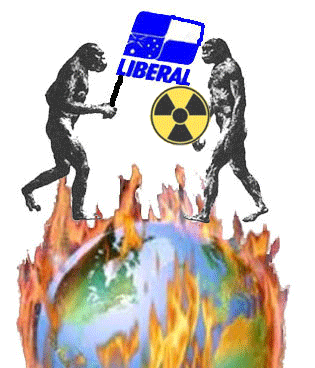 SA power cuts: Nuclear energy should be considered as solution, state Liberals say, ABC News 9 Feb 17 Despite opposing a high-level nuclear waste dump in South Australia, state Liberal leader Steven Marshall is now proposing nuclear power as a potential solution to the state’s energy reliability issues….
A citizens’ jury rejected high-level nuclear waste storage in November, prompting Mr Marshall to declare plans of “turning South Australia into a nuclear waste dump” were “now dead”. But today he said that did not mean he or his party were against the production of high-level nuclear waste in South Australia, via nuclear energy generation.
“We’ve never ruled out the nuclear opportunity for energy. We made it very clear that we were not in the slightest bit interested in continuing to pour money into the hopeless case which was a nuclear repository in South Australia,” he said.
“The royal commissioner ruled out nuclear energy in South Australia but there will be a time when it may become viable, and desperate times call for desperate solutions, and we are in a desperate situation.”
Mr Marshall denied the policy was hypocritical, but did not offer an explanation as to what would become of the highly radioactive spent fuel rods if a nuclear reactor was built in South Australia….. http://www.abc.net.au/news/2017-02-09/sa-power-cuts-could-be-solved-by-nuclear-energy-say-liberals/8256814
Fossil fuel generators, not renewables, are to blame for high electricity prices
The number of high-priced events in Queensland so far this year are 40 (yes, forty) times more common than in renewables-strong South Australia. Did we hear a peep of protest from the Coalition about this? No.
There is no doubt that more renewables, and more competition, will reduce that pricing power. That is a given.
But the Coalition and many in the mainstream media simply don’t want to know. They have barely reported on the high-priced events in Queensland and NSW, or on the real cause of those events in South Australia.
They don’t want to know: politics and ideology are at play.
 High energy prices? Blame fossil fuel generators, not renewables, REneweconomy, By Giles Parkinson on 8 February 2017 It seems that you can ask the Coalition government a question about pretty much anything – plunging polls, Donald Trump, Cory Bernardi or even the weather – and the answer will always be the same: “We’re focused on electricity prices.”
Great. But what exactly is the Coalition doing about it? On the evidence to date, not a whole lot, apart from blaming renewables for soaring wholesale electricity costs and promoting something called “clean coal,” despite all the evidence pointing to the fact that coal generation it is not very clean, and not cheap.
They are chasing the wrong target. Australia has experienced some extraordinary high wholesale electricity prices this summer, and most of these price surges have come in states with little large-scale wind or solar.
It is the activities of the fossil fuel generators that are to blame. This is about competition, or the lack of it, and the fossil fuel generators have been going to extraordinary lengths to get rid of competition.
The Australian Energy Regulator has been investigating more than half a dozen “high priced” events, as it is required to do when prices jump above $5,000/MWh. Some of the reports it has already completed make astonishing reading. Continue reading
Australian Energy Council warns on likely electricity problems in New South Wales
 SA power woes to spread nation-wide, starting with Victoria, Australian Energy Council warns, ABC News 9 Feb 17 By Claire Campbell The Federal Government needs to take urgent action to improve its energy policies before the rest of Australia falls victim to the type of large-scale blackouts experienced in South Australia, the Australian Energy Council has warned.
About 90,000 South Australian homes and businesses were blacked out Wednesday when the Australian Energy Market Operator (AEMO) issued a load-shedding order to avoid potential damage to the network equipment due to supply deficiency.
It asked for more power generators to be switched on but did not receive “sufficient bids” and said it did not have enough time to turn on the second unit at Pelican Point. AEC chief executive officer Matthew Warren said there was no shortage of electrons and available power, but it was not dispatched when required.
He said the entire nation’s system needed upgrading quickly because energy reliability was not just a state issue…….
AEMO has warned that load-shedding is possible in New South Wales on Friday. http://www.abc.net.au/news/2017-02-09/sa-power-woes-to-spread-through-rest-of-australia-aec-warns/8257032
Climate change report: Australia’s heatwaves to be hotter, longer and more frequent
 Heatwaves to be hotter, longer and more frequent, climate change report says, ABC News 9 Feb 17 By Lexy Hamilton-Smith Heatwaves are becoming hotter, lasting longer and occurring more often, the Climate Council’s latest report card on climate change says.
The Cranking Up The Intensity: Climate Change and Extreme Weather Events report has found 2016 was the hottest year on record globally.
Climate scientist Professor Will Steffen warned extreme weather events were projected to worsen across Australia as the climate warmed further. He said the extreme heat had to be “taken really seriously, first and foremost”. “It is a risk for human health, particularly for the most vulnerable — the elderly, very young people, and exposed outdoor workers,” he said.
“It is obviously a risk for the agricultural industry, it is a risk for natural ecosystems.
“We saw an underwater heatwave about a year ago wipe out a large part of the Great Barrier Reef.”A lot of these impacts we are seeing occurring now are occurring earlier than we had projected a few years ago.
“It is giving us some cause for concern that the climate system may be shifting a bit faster than we originally thought.”
Impact varies for each state Continue reading
Powershop electricity customers funding community renewable energy
 Powershop reveals cash for renewable projects from customers who paid more https://www.theguardian.com/environment/2017/feb/09/powershop-reveals-cash-for-renewable-projects-from-customers-who-paid-more
Energy retailer raised $100,000 from customers, which will be given out as grants to community-owned energy projects, Guardian, Michael Slezak, 9 Feb 17, Amid fresh attacks on renewable energy targets from the federal government and large energy retailer ERM Power, smaller electricity retailer Powershop has raised $100,000 from its customers to be given out as grants to 10 community-owned projects around the country.
Three months ago Powershop launched the Your Community Energy initiative, where they gave customers the opportunity to pay higher rates, which it said would then be distributed to renewable energy projects that were community-owned.
Powershop aimed to raise $20,000 by the end of 2016 but, as of February 2017, it had raised $100,000.
One project – rooftop solar on the Centre for Education and Research in Environmental Strategies (Ceres) centre in Melbourne – has already received $10,000 from the initiative and used that to complete their 15 KW solar installation.
A spokeswoman for Ceres, Judy Glick, said the installation would save the community group $2,000 each year and reduce their yearly emissions by almost 16 tonnes of CO2. “Ceres is on a mission to achieve zero emissions by 2025,” she said.
Five other projects were also announced as recipients of a share of the money. Continue reading
Attack on both climate and tax-payers’ money – subsidies to coal power
 Why coal-fired power handouts would be an attack on climate and common sense
The evidence suggests the push for government help is an attempt to squeeze money out of unwise investments made at the end of the mining boom, Guardian, 9 Feb 17, Michael Slezak, The recent coordinated push for new coal-powered electricity generators in Australia comes as the industry is on its last legs.
The intensified push for government handouts can be seen as a last-ditch attempt for the coal industry to squeeze some money out of the unwise investments it made at the end of the mining boom.
Here are the facts and figures that point towards that conclusion.
The coal industry knows that to stop runaway climate change all coal-powered generators need to close
Australia joined 174 countries and the European Union in 2015, signing the Paris agreement. In doing so, Australia agreed to do its part in keeping the global temperature rise “well below” 2C.
It also commits countries to achieving net-zero emissions “in the second half of this century”.
According to the International Energy Agency, OECD countries such as Australia need to shut down almost all of their coal-fired power stations by about 2035.
And the rest of the world will need to phase out coal power by 2050, it says. [excellent graph on original] With coal-fired power stations taking up to a decade to build, and designed to last 30 or 40 years, building new ones now is obviously inconsistent with those commitments.
In particular, Australia has committed to reducing its emissions by 26% below 2005 levels by 2030 – a commitment that is not strong enough to limit global warming at 2C and will need to be “ratcheted up”.
But the Australian government recently released projections of the country’s carbon emissions showing that current policies are going to cause emissions to rise to 2030, not drop, leaving Australia overshooting that commitment by a long way. [graph on original] …….
New coal is the most expensive form of energy
While the proponents of coal talk about coal power being “cheap and reliable”, they are wrong on both fronts. Coal is now the most expensive form of new power. According to Bloomberg New Energy Finance, the cost of energy from a new coal power plant would be $134-$203/MWh.
That’s more expensive than wind, solar or highly efficient combined-cycle gas (costing $61-$118/MWh, $78-$140/MWh and $74-$90/MWh, respectively)………
The global coal industry recently saw its biggest player, Peabody, go bankrupt in the US. If companies are forced to take write-downs for these projects by admitting they will never go ahead, it could mean the end for some of the companies.
At his National Press Club address last week, Malcolm Turnbull appeared to point to this as the reason he is now looking to subsidise the most expensive and dirtiest form of energy, saying that it could help our mining industry. He said: “As the world’s largest coal exporter, we have a vested interest in showing that we can provide both lower emissions and reliable baseload power with state-of-the-art, clean, coal-fired technology.” https://www.theguardian.com/environment/2017/feb/07/why-coal-fired-power-handouts-would-be-an-attack-on-climate-and-common-sense
Taxpayers would put up 21 times subsidy for Carmichael coal mine, than they would for renewables
Carmichael mine jobs need ’21 times the subsidies’ of renewables, says lobby group
Federal funding for Adani project amounts to $683,060 a job, compared with $32,191 a worker in Queensland’s clean energy sector, 350.org says, Guardian, Joshua Robertson, 8 Feb 17, Clean energy projects in Queensland are already on track to create more employment than Australia’s largest proposed coalmine, which if funded federally would cost taxpayers 21 times more per job, according to new study.

Federal government agencies are investing $71.4m in seven solar farms and a windfarm in Queensland, which are set to deliver a total of 2,218 jobs, according to analysis by climate advocacy group 350.org.
Adani’s proposed Carmichael coal project in central Queensland, which has obtained conditional approval for a $1bn federal infrastructure loan, is predicted to deliver 1,464 jobs.
The level of federal subsidy for Adani would amount to $683,060 a job, compared with $32,191 a worker in Queensland’s clean energy sector.
The Queensland government has accused the federal government of misrepresenting key data while talking up coal in an ideological attack on renewable energy. Continue reading
Western Australian Greens propose solar battery rebate scheme
 Solar battery rebate scheme pushed by Greens in WA election pitch, ABC News , 9 Feb 17 By Laura Gartry More than 100,000 WA households could be entirely powered by their own solar energy using battery storage within five years under a 50 per cent tax rebate proposed by the Greens.
In one of first major election commitments by the party, Upper House candidate Tim Clifford said the cost of battery units were currently out of reach for a lot of people.
The Greens’ proposed rebate would allow individuals to get up to half the cost of their storage system covered to a maximum of $5,000 in the first year and tapering off to $1,500 in five years.
The $290 million scheme would also provide a $5,000 upfront grant to install solar for families earning less than $80,000. Households with solar panels in WA are looking to batteries as a way to offset the sharp fall in rebates Synergy pays them for their electricity.
It is hoped the scheme would kick-start the industry and drive down the cost of units and power bills.
Energy Minister Mike Nahan said a possible battery subsidy was discussed, but would not be implemented by the Government…..
Mr Clifford said up to 3,000 WA businesses could also benefit, allowing their battery storage assets to be depreciated over three years rather than 15, which could pay off their battery storage unit within 10 years.
The scheme would be co-funded from the removal of federal fossil fuel and mining subsidies……http://www.abc.net.au/news/2017-02-08/solar-rebates-mooted-by-greens-wa-election/8252706
A responsible global citizen would not sell uranium to Ukraine
 7 Feb 17 Selling Australian uranium to Ukraine would increase the risks of war, civil unrest and corruption in the eastern European country, the Australian Conservation Foundation said today.
The Joint Standing Committee on Treaties today recommended the conditional ratification of the nuclear co-operation agreement with Ukraine even though the committee’s own investigation conceded existing safeguards were ‘not sufficient’ and there was a risk Australian nuclear material would disappear off the radar in Ukraine.
“Australia, the nation that fuelled Fukushima should not sell uranium to the country that gave us Chernobyl,” said ACF’s Dave Sweeney.
“The treaties committee’s report found ‘Australian nuclear material should never be placed in a situation where there is a risk that regulatory control of the material will be lost’ (2.53), yet that is exactly what could happen under the inadequate checks and balances that apply to exported Australian uranium.
“The committee’s report clearly states the Australian government must undertake a detailed and proper risk assessment and develop an effective contingency plan for the removal of ‘at risk’ Australian nuclear material.
“There can be no justification for seeking to fast-track uranium sales based on this report.
“Australia should be very cautious about contributing nuclear fuel to an already tense geo-political situation in eastern Europe. Tensions recently flared again in Ukraine.
“Ukraine’s nuclear sector is plagued by serious and unresolved safety, security and governance issues.
“Two-thirds of Ukraine’s aging fleet of 15 nuclear reactors will be past its design lifetime use-by date in just four years.
“This is an insecure and unsafe sector and a risky sales plan.
“ACF calls on the federal government to be a responsible global citizen and not to advance uranium sales to Ukraine.”
Cory Bernardi spouts the climate denialism of American right-wing “think tanks”
Australia’s richest woman, the mining magnate Gina Rinehart, is also reportedly backing Bernardi and joined him in meetings in New York in late 2016 with key figures from the Donald Trump camp.
Rinehart has previously supported speaking tours by Lord Christopher Monckton, the British climate science denier once described as a “vaudeville artist” by a former version of Malcolm Turnbull (the one that claimed to care deeply about climate change).
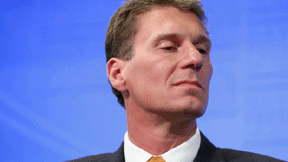 How Cory Bernardi was inspired to push climate denial from US conservative groups, Guardian, Graham Readfearn, 7 Feb 17 Climate science denial group the Heartland Institute helped inspire Cory Bernardi and Malcolm Roberts to push back against policies to cut emissions I
If the dissident conservative senator Cory Bernardi’s new political party shares the views of its founder, then we can chalk up it up as another fringe party firmly in the climate science denial camp.
Ignoring mountains of evidence from multiple lines of inquiry carried out over many decades, Bernardi has for a long time chosen to listen instead to fake experts pushing talking points that walk like zombies through barbecue conversations across Australia.
A Bernardi-led party would join One Nation, Family First, the Liberal Democratsand Rise Up Australia in rejecting the evidence for action on cutting greenhouse gas emissions.
Many of the climate change talking points pushed individually and collectively by these political groups perfectly match the propagandised science pushed by conservative “free market” thinktanks in the US.
Like Bernardi, the likes of One Nation and Family First have taken their cues and inspiration from that US network of ideological “thinktanks”that push climate science denial as if their lives, or their salaries, depended on it.
Bernardi has been much more than just an outspoken politician who thinks human-caused climate change is mostly a fraud and that carbon prices are just “a form of socialism”.
Bernardi has been a funder and an organiser of the opposition to action on climate change in Australia for years. Continue reading
Chief Scientist Alan Finkel warns of Trump’s Stalin-like attack on science
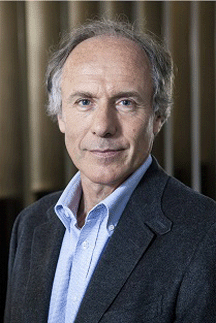 Australia’s chief scientist compares Trump to Stalin over climate censorship
Alan Finkel warns that forcing EPA data to undergo political review before publication will ‘cause long-term harm’, Guardian, Gareth Hutchens, 7 Feb 17, Australia’s chief scientist has slammed Donald Trump’s attempt to censor environmental data, saying the US president’s behaviour was comparable to the manipulation of science by the Soviet Union.
Speaking at a scientific roundtable in Canberra on Monday, Alan Finkel warned science was “literally under attack” in the United States and urged his colleagues to keep giving “frank and fearless” advice despite the political opposition.
“The Trump administration has mandated that scientific data published by the United States Environmental Protection Agency from last week going forward has to undergo review by political appointees before that data can be published on the EPA website or elsewhere,” he said.
“It defies logic. It will almost certainly cause long-term harm. It’s reminiscent of the censorship exerted by political officers in the old Soviet Union.
“Every military commander there had a political officer second-guessing his decisions.”
Last month Trump’s administration mandated that any studies or data from scientists at the EPA undergo review by political appointeesbefore they can be released to the public.
The communications director for Trump’s transition team at the EPA, Doug Ericksen, said the review also extended to content on the federal agency’s website, including details of scientific evidence showing the Earth’s climate was warming and human-induced carbon emissions were to blame.
Finkel compared the Trump administration’s attempt to censor science to the behaviour of Soviet dictator Josef Stalin.
“Soviet agricultural science was held back for decades because of the ideology of Trofim Lysenko, who was a proponent of Lamarckism,” he said……..https://www.theguardian.com/science/2017/feb/06/australias-chief-scientist-compares-trump-to-stalin-over-climate-censorship
Malcolm Turnbull’s political double-speak on energy policy
 Is Malcolm Turnbull’s priority really just keeping the lights on?, Guardian, Kristina Keneally, 6 Feb 17 It seems Turnbull is basing his core political agenda for 2017 on a rare weather event. It’s a textbook definition of being buffeted by events rather than shaping them Imagine a severe thunderstorm had not hit South Australia last September and caused a state-wide blackout. What on earth would the Turnbull government have to talk about?
The day after the South Australian storm, the energy minister, Josh Frydenberg, nominated “energy security” as the government’s number one priority.
Last week at the National Press Club, Malcolm Turnbull said that this year his government would prioritise energy security and storage.
The Turnbull government is basing its core political agenda for 2017 on a once-in-50-years weather event. This must be the textbook definition of a government buffeted by events rather than shaping them.
Let’s set aside – for a moment – the happenstance nature of the Turnbull government’s top policy priority and instead consider the relevance of its pitch to voters. What does energy security even mean? When was the last time you used that phrase in conversation? Does it have something to do with defence? Is it keeping our power plants safe from attack?
And if that is the Turnbull government’s priority, well, that’s pathetic. So much for innovation, agility, jobs and growth, and budget repair. The Turnbull government is flat out making sure our fridges are still running and we can still charge our mobile phones. They have no ambition or time for anything greater.
But the biggest joke of all is that Turnbull can’t even manage to pretend for more than a week that energy security is his number one priority. Last night Turnbull told Channel Nine’s Laurie Oakes that “what I set out is our agenda for this year and what we’re going to deal with is energy prices”.
Energy security and energy prices. Yeah, they are not the same thing. Continue reading
“Alternative facts” form the basis of Trump and Turnbull’s energy policies
Turnbull’s over-riding ambition is to last at least one day longer as prime minister than Abbott. That means that he will remain beholden to the right, who are ready to push the self-destruct button at any moment in the fervent belief that they can win power, if not immediately then after a single term of Labor.
Like Trump, Turnbull’s energy policy is based on “alternative facts”http://reneweconomy.com.au/like-trump-turnbulls-energy-policy-is-based-on-alternative-facts-25100/ By Giles Parkinson on 7 February 2017 The first few weeks of the Trump administration have been extraordinary, and quite frightening – not just because of the incompetence of a president who appears to be little more than a self-obsessed idiot, but by the actions of the dangerous ideologues at the helm of the world’s biggest economy and military power.
There have been shocks across the policy spectrum, but probably none more so than in climate and clean energy, where Trump has promised to throw the baby out with the bathwater, quit the Paris deal, disband or dismember environmental regulations, “re-invent” coal, stop renewables and build more gas  pipelines.
It might sound stone-cold crazy to many people in Australia, but it should be familiar: There is little that Trump and his regime is doing on climate and clean energy that has not already achieved, or attempted, by the current Coalition government in Canberra. Continue reading
Australian Energy Market Operator confident of wind power security in South Australia
“If the same sequence of events happened today the system black would not occur,” Marxsen told the audience, according to one source.
This is an important concession from AEMO. It suggests that South Australia, even with around 40 per cent wind energy and a further 6 per cent from rooftop solar, is not at risk of a system-wide shut-down that affected the state late last year.
AEMO says wind farm changes mean SA blackout won’t be repeated http://reneweconomy.com.au/aemo-says-wind-farm-changes-mean-sa-blackout-wont-repeated-43631/ By Giles Parkinson on 6 February 2017
AEMO chairman Tony Marxsen told more than 100 energy experts at a presentation under the auspices of the Electrical Energy Society of Australia last week that the “system black” event in South Australia in September – which has set off a huge debate about renewable energy across the country – would not be repeated. Continue reading
1 This month
17 October, Free Public Talk on Nuclear Issues in South Australia
David Noonan will speak on public interest concerns over the new Roxby Downs Indenture Act 2026 on BHP copper-uranium mining and ore processing in SA, and on how AUKUS may face SA with a High-Level nuclear waste agenda.
Dr Jim Green will discuss international developments in the field of nuclear power including ‘small modular reactors’ and Generation 4 ‘advanced’ nuclear reactor concepts.


Help Aunty Sue Protect Her Land and Sacred Sites From Destructive Rocket Testing.
.

Australians deserve the truth
about
AUKUS – https://aukuspublicinquiry.com/

PETITION – To: Prime Minister Anthony Albanese and the Australian Labor Government

of the week – Australians for War Powers Reform (AWPR)
To see nuclear-related stories in greater depth and intensity

