South Australia needs a level playing field for rooftop solar
 Dennis Matthews, 1 Jan 17 Australia’s Chief Scientist, Alan Finkel, has recently
 drawn attention to a problem in adopting new energy technology.
When home owners consider installing rooftop photovoltaic (PV) electricity generators they are faced with up-front costs.
By comparison, electricity supplied through the grid by large scale electricity generators is provided at no up-front cost to the consumer. The consumer eventually pays the generators’ up-front costs (plus interest) through quarterly bills over a period of several years.
The solution to the problem has been known for several decades – provide a level playing field by having PV up-front costs financed by either an electricity service provider or government with the costs plus interest being recovered over time through the usual quarterly bill.
Such a simple arrangement would not only make rooftop PV competitive (including for rental properties) with grid electricity but would also make energy conservation measures, such as double glazing, more competitive.
Battle Lines Drawn Over Indian Mega Mine
‘Murrawah Johnson, 21, of the Wangan and Jagalingou Family Council,
is among those standing in the way of the huge Carmichael coal mine project
in Australia’s Queensland state.’ http://menafn.com/1095149597/Battle-Lines-Drawn-Over-Indian-Mega-Mine Stephen de Tarczynski | MENAFN Press 30 December 2016:
“‘Our people are the unique people from that country,’ says Murrawah, whose name means ‘rainbow’ in the indigenous Gubbi Gubbi language.
‘That is who we are in our identity, in our culture, in our song and in our dance,’ she adds.
The mine’s estimated average annual carbon emissions of 79 million tonnes are three times those of New Delhi, six times those of Amsterdam and double Tokyo’s average annual emissions.
“The Wangan and Jagalingou, numbering up to 500 people, regard the Carmichael coal mine
as a threat to their very existence and have repeatedly rejected the advances of Adani Mining,
the company behind the project.
The traditional owners argue the mine would destroy their land, which ‘means that our story is then destroyed. And we as a people and our identity, as well,’
Murrawah, a spokesperson for her people’s Family Council, told IPS. … “
Former Liberal leader Peter Reith now a lobbyist for nuclear related company Bechtel
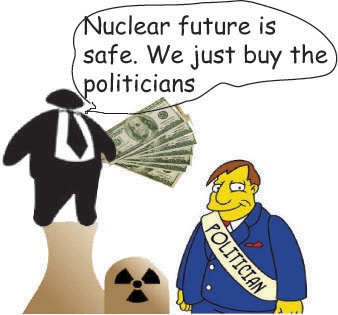 Dan Monceaux Nuclear Fuel Cycle Watch South Australia, December 2016
His current book lists just two clients: Bechtel Infrastructure (Australia) Pty Ltd and G4S Custodial Services Pty Ltd.
Internationally, Bechtel has worked on a variety of substantial projects in the nuclear fuel cycle. Examples include:
Advanced Mixed Waste, Idaho, USA
Chernobyl Shelter and Confinement, Ukraine
Davis-Besse Nuclear Power Station, Ohio, USA
Hanford Waste Treatment Plant, Washington, USA
Horizon Wylfa Newydd, Isle of Anglesey, Wales, UK
Reagan Test Site, Marshall Islands
Savannah River Remediation, South Carolina, USA
Sellafield Pile Fuel Cladding Silo Retrieval, England
U.S. Nuclear Security Enterprise, Texas and Tennessee, USA
Uranium Processing Facility, Oak Ridge, Tennessee, USA
Watts Bar Completion, Tennessee, USA
Yucca Mountain Nuclear Waste Repository, Nevada, USA http://www.dpc.sa.gov.au/documents/rendition/B18707
Australian government plays dirty tricks with language on High Level nuclear Wastes (HLW)
 Steve Dale Fight To Stop Nuclear Waste Dump In Flinders Ranges SA, 27 Dec 16
UK government avoids the question on nuclear waste going to Aboriginal land
 Radioactive Waste:Written question – 46886
Margaret Henry Fight To Stop Nuclear Waste Dump In Flinders Ranges SA
HERE IS THE ANSWER –
“There is a very small quantity of Australian owned radioactive waste currently stored in the UK. We anticipate that this will be returned to Australia in due course in line with contractual commitments. The location of any storage and disposal facilities for this waste will be a matter for the Australian authorities.
Any shipment of radioactive material out of the UK will comply with all relevant international laws and use ships which meet national and international requirements.” https://www.facebook.com/groups/344452605899556/
Bob Hawke spruiking nuclear power again – to an unreceptive audience
 Bob Hawke pushes nuclear power at Woodford Folk Festival north of Brisbane BY MEGAN KINNINMENT ABC NEWS WED DEC 28 Former prime minister Bob Hawke’s assertion that nuclear power is the salvation for a planet ravaged by global warming divided the crowd at the Woodford Folk Festival, north of Brisbane today. But it was his assertion that Australia should take on the world’s nuclear waste that had the crowd most worked up, prompting several calls of “no thanks” from the audience.
Last night, pop singer Paul Kelly said Mr Hawke was a hard act to follow after he had the crowd singing along to Waltzing Matilda at the festival’s opening ceremony.
But today’s address under the big top did not meet with universal acclaim.
“The time has come when we’ve got to think big if we’re going to face the big issues of our time,” Mr Hawke told those assembled.
“We’re going to have to be prepared to think about changes that are quite radical.”
That comment was greeted with a round of applause.
Then he began to elaborate, advocating nuclear power.
“Nuclear power would be a win for the environment and an essential part of the attacking that must be made on this grievous and dangerous global warming,” he said.
“It would be a win for the global environment and a win for Australia.”…..Mr Hawke said Australia would benefit financially from the transaction and could use profits towards ending Indigenous poverty. http://mobile.abc.net.au/news/2016-12-28/we-must-embrace-nuclear-power-bob-hawke-divides-audience/8151346?pfmredir=sm
British and Australian governments wash their hands of radioactive contamination of Aboriginal lands
Bronwyn Lucas Fight To Stop Nuclear Waste Dump In Flinders Ranges SA, 30 Dec 16 I heard that the British did an absolutely appalling job of cleanup at Maralinga … it was hardly worth the effort, as I understand it. I heard stories of hot winds blowing, dust everywhere, a cursory undertaking. One would think we still had Menzies at the helm. The Dark Side is in this together … if we think our government is taking care of us, I’d say to think again.Margaret Henry Fight To Stop Nuclear Waste Dump In Flinders Ranges SA, 30 Dec 16 In the UK parliament in January 2016, they were asked if the Government will issue an apology to the indigenous people of Australia for British nuclear tests carried out on their land in the 1950s and 1960s.
ANSWER-
“In 1968, Australia signed an agreement with the UK confirming that the clean-up of all test sites had been completed satisfactorily. As announced to the House on 10 December 1993,(Official Report, column 421), the Government agreed to make an ex gratia payment of £20 million to the Federal Government of Australia as a contribution to the cost of the further clean-up of the Maralinga site. A copy of the note giving effect to this agreement was placed in the Library of the House. The note also records that the Government of Australia indemnified the Government of the UK against claims from Australian nationals or residents. The Government now regards the matter as closed.” https://www.facebook.com/groups/344452605899556/
Australia must stop undermining the nuclear disarmament process
To realise the full significance of this, consider the fact that other weapons of mass destruction – chemical weapons, biological weapons, landmines, cluster bombs – have all been prohibited by their respective treaties, and the threats posed by these weapons dramatically reduced as a result. But for nuclear weapons, which literally threaten life on Earth, there is currently no equivalent.
One might have expected that our Foreign Minister, Julie Bishop, who likes spruiking Australia’s commitment to a “rules-based international order”, would welcome the imminent closure of this legal anomaly. On the contrary, however, Australia has been leading the charge to undermine the process.
Australia claims that the ban treaty process has not taken into account the security needs of “all nations” (for which read the US), a curious claim given that our ally stands out as more vulnerable than most to a nuclear weapons attack. In any event, is she really suggesting that the security needs claimed by the nine nuclear-armed nations outweigh the right of the other 187 of us to be rid of this diabolical threat?
That’s a bit like cutting President Bashar al-Assad some slack over his alleged use of chemical weapons in Syria because he has “security needs”. Weapons of mass destruction are not somehow more acceptable because a handful of nations claim that they, and only they, must have them. But, the ban treaty critics say, nuclear weapons are different, and the countries with the weapons will just thumb their collective noses at it.
Not according to a letter in October from the US mission to NATO to its European allies, urging that they oppose the treaty. With an air of desperation to sabotage the whole thing, the US stated that efforts to delegitimise nuclear weapons are at odds with its policy of nuclear deterrence, including extended deterrence for its allies (such as NATO members and Australia). Further, horror of horrors, it “could make it impossible to undertake nuclear planning or training”. Well, yes, that’s the general idea, to delegitimise every aspect of nuclear weapons possession and planning; and all indications are that that goal will be achieved, regardless of who signs the treaty. So much for the toothless tiger notion.
Nevertheless, Australia presses on with its defence of US nuclear weapons, including their possible use on our behalf, not veering from its chosen “progressive” approach to disarmament. This consists of a number of steps that have progressed more slowly over decades than a drunken snail.
The Comprehensive Test Ban Treaty has languished since it was completed in 1996, with little prospect of ever coming into force, and the Fissile Material Cut-off Treaty has been moribund for even longer. In other words, we are told that a stagnant business-as-usual agenda is the way to go, even as 15,000-plus nuclear weapons – 1800 of them still on hair-trigger alert – continue to threaten human suffering of the most grotesque proportions, and all warnings point to increasing risk of their use.
Australia will have to decide very quickly whether we support the majority of nations that have come to their senses and are about to outlaw nuclear weapons, or the Trumps and Putins of this world with their chilling Cold War-style ravings. For a nation that boasts commitment to a “rules-based international order”, the choice hardly seems difficult.
The reality of moving one big step closer to stigmatising, prohibiting and eliminating the most destructive, inhumane, indiscriminate devices ever created is cause for celebration. However, there is another cause for celebration, and that is the capacity of civil society – without which the nuclear weapons ban would not be happening – to mobilise, organise, work with supportive governments and set the agenda for a better world. As the politics of violence, division and hatred loom large on many fronts, such capacity is desperately needed for the huge challenges ahead.
Dr Sue Wareham is a board member of ICAN (Australia), the International Campaign to Abolish Nuclear Weapons.
Australia’s responsibility to face up to its radioactive wastes produced at Lucas Heights
 Storing the reprocessed nuclear fuel that is to come back from France at Lucas Heights seems the best of a poor set of alternatives.
We are stuck with highly radioactive material for which we are responsible. Like all countries with nuclear reactors, we should not have produced it in the first place until safe storage technology existed.
 Radioactive game of passing the parcel http://www.brisbanetimes.com.au/opinion/politics/radioactive-game-of-passing-the-parcel-20120523-1z582.html#ixzz1vp20gX9X Richard Broinowski May 24, 2012 Reports indicate France is soon to return reprocessed nuclear waste generated at Lucas Heights to Australia. The federal nuclear agency says the waste is ”intermediate level”, small in volume, and to be stored temporarily at Lucas Heights.
These assurances are misleading in all three respects: the volume of the waste, its toxicity, and its future disposal.
Australia’s first research reactor, the high flux Australian reactor, went critical in January 1958. It was fuelled by highly enriched bomb-grade American uranium. Although small compared with power
reactors, it discharged 37 spent fuel rods a year, each containing the same weapons-grade uranium, plutonium and fission products as its big brothers.
By 2002, it had produced 1665 such rods. Some were sent to Britain and the US for reprocessing. But by 2003, four metric tonnes remained in temporary storage at Lucas Heights
When political pressure forced Britain to cease reprocessing in Scotland, Australia’s nuclear agency arranged with the French company COGEMA to reprocess the rods. Australia is legally bound to take the
lot back – plus, one assumes, the separated plutonium and uranium-235. The problem is there is no agreed permanent place in Australia to put it.
In 2007 the old reactor was decommissioned and replaced by one designed by the Argentine company INVAP. Before construction began, the government stipulated a high-level waste site was to be identified
and a feasibility study completed. No site was found and the stipulation was modified to a strategy for disposal.
The situation becomes more complicated. Argentina initially agreed to take back the spent fuel rods from the reactor for reprocessing, returning the waste to Australia and keeping the weapons-grade uranium-235 and plutonium-239 under full-scope international safeguards. But its officials asserted such reprocessing was in violation of Argentina’s constitution. Australian officials appear not to be worried because they say the reactor has a storage pool with capacity for nine years’ worth of spent fuel rods. A solution, they imply, will turn up.
But like the rapidly filling storage ponds at all civil reactors around the world, this is a short-term solution. The problem of ultimate disposal of irradiated fuel continues unresolved. Australia does not even have a designated repository for low-level nuclear waste such as contaminated clothing and discarded radio pharmaceutical equipment from hospitals.
In 2002, three possible low-level sites were identified in South Australia. But the sites were judged too risky because an errant missile could land on the dump, scattering radioactive debris in all
directions. The state’s then premier, Mike Rann, strenuously opposed it. South Australia, he declared, would not become Australia’s ”nuclear waste state”.
Nor, according to their premiers, would any other Australian state. Australians seem complacent about exporting uranium but become unsettled about storing its end products here, even waste generated by
our reactors.
By February 2010, the only site still under consideration as a nuclear waste dump was Muckaty Station in the Northern Territory, where the federal government can overrule the Legislative Assembly in Darwin.
But deciding on Muckaty was controversial. First, although a small group of traditional owners of the land supported the decision, a greater number opposed it. They launched a case in the Federal Court opposing it.
Second, the site is meant to take low- and intermediate-level waste. But intermediate waste is a narrow definition based on calorific output. If heat is dissipated, runs the argument, high-level waste
becomes intermediate. But whatever its temperature, the waste still contains all the fission byproducts and actinides of high-level waste.
Storing the reprocessed nuclear fuel that is to come back from France at Lucas Heights seems the best of a poor set of alternatives. There are at least suitable storage facilities and chemists and physicists
who know how to handle the material.
But what Australia needs urgently is a solution. We are stuck with highly radioactive material for which we are responsible. Like all countries with nuclear reactors, we should not have produced it in the first place until safe storage technology existed.
Australian government OK about dealing with corrupt firms – whether coal or nuclear
DCNS Opens New Australia-Based Office to Support Country’s Submarine Replacement Project http://blog.executivebiz.com/2016/12/dcns-opens-new-australia-based-office-to-support-countrys-submarine-replacement-project/on: December 22, 2016 France-based naval shipbuilder DCNS has established a new headquarters for its Australian subsidiary that will design the future submarine of Australia’s navy as part of an intergovernmental agreement between the two countries.
DCNS said Wednesday its Adelaide Future Submarine Facility is scheduled to begin operations in early 2017 and will support activities such as the transfer of technology from France to Australia, development of a supply chain and design of a shipyard in Adelaide.
“This facility, and our local Adelaide workforce starting with 50 people in 2017, marks the beginning of our relationship as part of the community,” said Herve Guillou, DCNS Group chairman and global CEO.
The Australian government selected DCNS in April to provide design services for the country’s estimated $38.7 billion SEA 1000 Future Submarine Program.
Marise Payne and Jean-Yves Le Drian, respective defense ministers of Australia and France have signed an agreement that establishes a framework for the two countries on the development of the Australian navy’s fleet of submarines.
France’s submarine sales firm DCNS is notorious for corruption
“DCNS’s operations face questions across almost the entire globe, including in Pakistan, Malaysia, India, Saudi Arabia and Chile, with bribes and kickbacks reportedly comprising 8 per cent to 12 per cent of DCNS’s entire budget.”

 French subs builder’s record of corruption, The Saturday Paper, HAMISH MCDONALD, 30 Apr 16 “…….The Defence Department has been dazzled by promises from shipbuilder DCNS of ultra-quiet pulse-jet propulsion, a powerful sonar array from Thales, a comfortable space for the crew, and a very long range. Now all that has to be done is design the new boat, replacing the nuclear reactor in the Barracuda with diesels, batteries and fuel cells, and fitting in fuel tanks.
As the Hong Kong-based website Asia Sentinel has pointed out, “DCNS’s operations face questions across almost the entire globe, including in Pakistan, Malaysia, India, Saudi Arabia and Chile, with bribes and kickbacks reportedly comprising 8 per cent to 12 per cent of DCNS’s entire budget.”
No doubt our politicians and officials are aware of all this, and will be ready to account for any largesse. Perhaps they should automatically knock off 8 to 12 per cent of any price quoted by DCNS. https://www.thesaturdaypaper.com.au/world/north-america/2016/04/30/french-subs-builders-record-corruption/14619384003178
Secret history of Maralinga nuclear bomb tests
The half-life of plutonium is 24,000 years. At this rate of decay, the Maralinga  lands would be contaminated for the next half-million years.…..A variety of factors underlay the harm to public health, Aboriginal culture and the natural environment which the British tests entailed. Perhaps most significant was the secrecy surrounding the testing program….There seems little doubt that the secrecy in which the entire testing program was cloaked served British rather than Australian interests…..Information passed to Australian officials was kept to the minimum necessary to facilitate their assistance in the conduct of the testing program. The use of plutonium in the minor trials was not disclosed……
A toxic legacy : British nuclear weapons testing in Australia, Australian Institute of Criminology. “…… Three days after the conclusion of the Totem trials, the Australian government was formally advised of British desires to establish a permanent testing site in Australia. In August 1954, the Australian Cabinet agreed to the establishment of a permanent testing ground at a site that became named Maralinga, Continue reading
Australia’s greenhouse gas emissions increasing, government admits
 Turnbull government confirms Australia’s greenhouse gas emissions are rising, SMH,
The department analysis shows the increase largely came from electricity generation – the country used more power without much change in its reliance on fossil fuels – and new liquefied natural gas projects.
In per capita terms, emissions per person continued to fall – to less than 23 tonnes of carbon dioxide, down from about 26 tonnes a decade ago – as population growth outpaced the rise in pollution……
Australian Conservation Foundation economist Matt Rose said the government was failing to cut climate pollution, and was holding back evidence of its poor performance from the public.
Documents released to the foundation after a Freedom of Information request showed it had been sitting on the data since September, but chose to release it just three days before Christmas…….
The government is reviewing climate policies next year, but has already ruled out any form of carbon pricing that would penalise big emitters.
Business and environment groups are urging the government to keep all options, including a form of carbon pricing known as an emission intensity scheme, open to ensure cuts are made as cheaply as possible. http://www.smh.com.au/federal-politics/political-news/turnbull-government-confirms-australias-greenhouse-gas-emissions-are-rising-20161222-gtgolq.html
In 1985 Australians’ opposition to nuclear weapons and uranium mining was widespread
Opposition to nuclear weapons and uranium mining was widespread
That February Hawke’s public announcement that US aircraft monitoring the tests would be allowed to land in Australia created a storm of protest, which he later relayed to the US at meetings in Washington.
The US decided to press on without the use of Australian support facilities.
Archives reveal depth of opposition to nuclear tests
http://www.nzherald.co.nz/world/news/article.cfm?c_id=2&objectid=10856999
By Greg Ansley
Jan 2, 2013 Nuclear weapons and the United States alliance were causing Australia more than its share of grief in 1985, Cabinet documents by the National Archives of Australia reveal.
Prime Minister Bob Hawke’s Labor Government was trapped by the commitment of its Liberal predecessor to America’s controversial programme to develop the new MX intercontinental ballistic missile, whose planned deployment threatened to heighten nuclear tensions with the former Soviet Union.
The MX programme originally included 200 of what became the most powerful missile in America’s nuclear arsenal, each armed with 10 warheads and transported on a circular rail track between 4600 silos to confuse Soviet war planners. It was later pruned to just 50missiles, which were withdrawn from service by 2005.
In 1981, Malcolm Fraser’s Liberal Government secretly agreed to support the programme with the splashdown of two missiles about 200km off eastern Tasmania. Continue reading
Community involvement in Wesfarmers-owned solar energy project in Western Australia
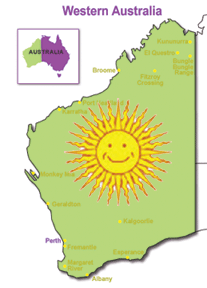 Solar switch for one of Australia’s biggest companies funded by community http://www.abc.net.au/news/2016-12-22/wesfarmers-wa-company-switches-to-solar-on-community-investment/8143048 By Ursula Malone Mum and dad investors are using their savings to fund a half-a-million-dollar solar energy project at the Wesfarmers-owned Blackwoods distribution depot at Canning Vale in Western Australia.
Blackwood is the country’s largest distributor of industrial and safety supplies and its Canning Vale depot will have 630 solar panels installed on its roof in the New Year. “Wesfarmers is an enormous company but it is also Australia’s largest private employer so there is an enormous connection [with the community] already,” said Wesfarmers sustainability lead Patrick Heagney.
“We have an internal target to reduce our greenhouse gas emissions, so this is something we’re very proud of.”
The 200-kilowatt system will supply a quarter of the business’s electricity needs.
Mr Heagney said it was the biggest single solar installation in the Wesfarmers group, and the first funded by community investors.
Investors expecting solid returns The community funding model for solar projects was developed by solar innovator Huon Hoogesteger and Emeritus Professor of Economics at University of Technology Sydney, Warren Yeates. “Within 48 hours we had fully subscribed investors for that particular installation,” said Mr Hoogesteger. Continue reading
1 This month
17 October, Free Public Talk on Nuclear Issues in South Australia
David Noonan will speak on public interest concerns over the new Roxby Downs Indenture Act 2026 on BHP copper-uranium mining and ore processing in SA, and on how AUKUS may face SA with a High-Level nuclear waste agenda.
Dr Jim Green will discuss international developments in the field of nuclear power including ‘small modular reactors’ and Generation 4 ‘advanced’ nuclear reactor concepts.


Help Aunty Sue Protect Her Land and Sacred Sites From Destructive Rocket Testing.
.

Australians deserve the truth
about
AUKUS – https://aukuspublicinquiry.com/

PETITION – To: Prime Minister Anthony Albanese and the Australian Labor Government

of the week – Australians for War Powers Reform (AWPR)
To see nuclear-related stories in greater depth and intensity

