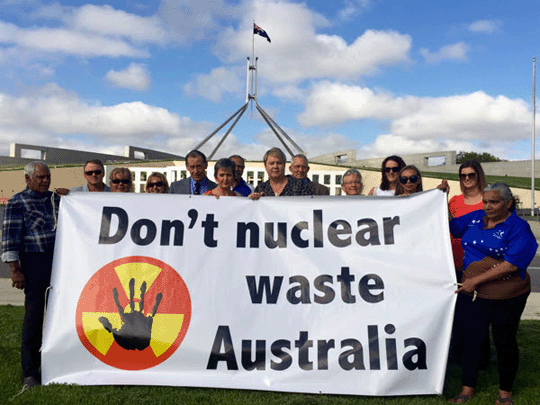
The Citizen Jury set up to consider a nuclear waste dump for SA has comprehensively rejected the idea, with a thumping 2/3 majority saying no under any circumstances.
“This is a clear and comprehensive rejection by ordinary South Australians of the Royal Commission’s nuclear waste dump dream,” said Craig Wilkins, Chief Executive of the state’s peak environment body, Conservation SA.
“The nuclear industry likes to push a myth that the more people get to understand nuclear issues, the more supportive they are. Well, 350 South Australians have spent over 40 hours hearing about a nuclear dump for SA and the more they heard about it, the less they liked.
“The Royal Commission has put forward a deeply flawed plan, and the citizen jury has comprehensively rejected it.
“The dollars don’t stack up, the safety concerns are enormous, Traditional Owners have said no, and now a citizen jury made up of randomly selected South Australians from across the state have well and truly rejected it as well.
“The message to Premier Weatherill is clear: it’s time to stop nuclear-wasting our time and money.
“Last month the Premier said: ‘the most powerful force that we have in this state and this nation is the common sense judgment of ordinary, everyday citizens’
“Well, ordinary, everyday citizens have spoken and it’s time for the Premier to listen,” he said.
The South Australian Nuclear Citizens’ Jury has come up with a damning report – damning the Nuclear Fuel Chain Royal Commission South Australia’s (NFCRC’s) plan for importing radioactive trash.
The Nuclear Fuel Chain Royal Commission was a shoddy and biased affair with pro nuclear Commissoner Kevin Scarce. Then came the Citizens’ Juries, who were given loaded questions, with a few biased and ignorant witnesses ( especially in early sessions on the subject of ionising radiation), and some oversight by pro nuclear indiviuals, some from the NFCRC.
It is a tribute to the South Australian firm DemocracyCo that they still managed to run the process in a very fair way.
However, despite the jury’s strong rejection of the plan, there was a minority report, calling for more economic modelling delay in the decision.
Premier Weatherill made it clear that the discussion will continue.
We can expect the pro nuclear camp – Labor and Liberal to now trash the whole idea of Citizens’ Juries (though if there had been a “neutral” or “yes” result, they would have praised it!)
And – let’s not forget, that other nuclear waste plan. The Federal government wants to impose a radioactive waste dump at Barndioota in the Flinders Ranges. The pretense is that it is for the (very short-lived medical radioactive wastes). The reality is that it is for the radioactive trash that originated from the Lucas Heights nuclear reactor in Sydney.
What’s in store at the Marrakech climate talks – and will Australia still back coal?, Guardian, Graham Readfearn,6 Nov 16
The US presidential race is guaranteed to prove a distraction at the Morocco COP22 gathering, where action is on the agenda. he Australian government takes a delegation to the United Nations climate change talks in Morocco starting Monday – two weeks that are sure to be dominated by, well, who knows?
Because, during the first week, the United States will go to the polls to pick a new president – an event that will act like a giant weapon of mass distraction in Marrakech.
The Republican candidate, Donald Trump, has pledged to pull the US out of the UN process on climate change and cancel the global deal agreed at the last talks in Paris…….
aside from the distraction of US politics, what else for Marrakech – a meeting known as COP22 (so called, if you must ask, because this is the 22nd meeting of the conference of the parties to the UN framework convention on climate change)? And what about Australia’s position?
This process, known as “entry into force”, required at least 55 “parties” representing about 55% of global greenhouse gas emissions to ratify the agreement.
Australia has still not ratified the Paris agreement but there are reports this could happen before the talks close on 18 November……
Australia pledged that by 2030, it would cut emissions between 26% and 28% below where they were in 2005.
While the Department of Foreign Affairs and Trade stands by the target as being ambitious and fair, there are many critics who say it’s anything but……
Australia remains an influential country in the talks, owing in part to its position as chair of the umbrella group of countries – one of many negotiating groups.
As yet there has been no formal announcement from the Australian government on who will attend, but there is an expectation among some that the foreign minister, Julie Bishop, will be there for the “high-level segment” that starts in week two.
The Australian delegation will also have a new diplomat in charge. Replacing Peter Woolcott as climate change ambassador is Patrick Suckling, who took over the role in February after serving as Australia’s high commissioner in India.
During his time in New Delhi Suckling made several statements supporting the controversial Carmichael mega-coalmine project in Queensland, being proposed by Indian company Adani.
“This project will drive economic growth and create more than 6,000 jobs in Australia,” he said in 2014. “It will also boost India’s development by providing electricity to 100 million Indians.”
In one report in the Economic Times, Suckling was quoted as saying the Australian government was trying to tighten legal rules around who could and could not challenge coalmines through the courts (a theme that has re-emerged in recent weeks).
“We are actively thinking of possible ways to limit the scope of litigation to only those with a real standing in a project,” he was quoted as saying.
Language like this tends not to go down well with the army of NGOs, campaigners and civil society groups who attend the climate talks and have given Australia more then a fair share of “fossil” awards over the years.
The perception among many has been that Australia has sought to defend the coal industry too many times at UN meetings.
Solar energy: Sunny western Queensland to become a hub for power farms, ABC News, 6 Nov 16 By Lucy Murray Western Queensland is becoming a major hub for solar energy, with the state’s largest solar power farm soon to go online near Barcaldine and construction of another major project about to get underway in Longreach.
Six solar projects partially funded by the Australian Renewable Energy Agency (ARENA) were either recently completed or being built across Queensland.
Construction is expected to begin on another six projects next year.
With construction of the 25 megawatt (MW) Barcaldine solar farm now finished, work is underway to connect the 79,000 panels to the state’s electricity grid with about 580 kilometres of cable.
It will feed the grid with the capacity to power more than 8,000 homes once finished by mid-December, enough to light up Barcaldine 11 times over.
A short distance away, work will soon begin on the 15MW Longreach Solar Farm.
Tim Bickmore Nuclear Citizens Jury Watch South Australia, 6 Nov 16“What I would like to see happen tomorrow is every juror,at the start of the day, be given a small piece of paper and then asked to put where they stand on the paper, either NO or Yes or Maybe. then hand in the paper to DemCo. Results should be tallied, any vote with more than one word on it should be discarded as informal, and the results then revealed to the jury.
To me this is the only way to gauge the feeling of the entire group.
It will not happen of course.”
The aggressive neo-liberal land grab is dividing Aboriginal communities and even brothers. As one Traditional Owner in the Northern Territory told me recently, “these mining deals can give one or two families a big pay but generally they don’t improve the community. Money goes on a few new cars and more grog comes in. We never see things get better but someone is getting very rich on our land.”
In the Kimberley and Pilbara in Western Australia, across the Northern Territory, on Cape York and in parts of NSW and South Australia, it is disturbing to see the divide and conquer tactics of mining companies and governments………..
Privatisation of land is the neo-liberal spearhead hurled deep into the heart of the traditional Aboriginal way of life…….. The Intervention’s extraordinary damage to the Aboriginal sense of control and wellbeing makes it the gravest policy disaster in Australia since the removal of Aboriginal children in the Stolen Generations.
THE WAY AHEAD: The new land grab Tracker, BY JEFF MCMULLEN, JUNE 21, 2013 NATIONAL: Neo-liberalism is a
hungry beast and this 21st Century strain of capitalism is shaping the agenda for control of Aboriginal lands, writes JEFF MCMULLEN.
You only have to listen to Professor Marcia Langton’s Boyer Lectures on ABC Radio or read Noel Pearson’s sermons on acquisition to see how this virulent form of free-market fundamentalism has gathered influential adherents, including policy makers in both political
parties.
Australian Government policy is heavily influenced by neo-liberalism through its extraordinary emphasis on managing access for mining
companies to resources on Aboriginal lands. This involves controlling what is still perceived as ‘the Aboriginal problem’ and forcing a
social transition from traditional values and Cultural practice to ‘mainstream’ modernism of a particular brand. It also involves
displacing many Aboriginal people from their traditional lands and concentrating them in ‘growth towns’. Continue reading →
Tim Bickmoreand … “According to the Nuclear Fuel Chain Royal Commission South Australia report;
…”While not prohibited under Federal laws, constructing a facility for storage or disposal of radioactive waste, would require approval from …the Nuclear Non-proliferation [Safeguard] Act 1987…. and the Environmental Protection and Biodiversity Conservationa Act 1999…as a ‘nuclear action’ likely to have a significant impact on the environment…and conveys approval authority on the Federal Minister for the Environment. It is not a regime specifically targetted to the regulation of nuclear facilities”Yes, Yes or no, the Federal Minister of the Environment, should now make it public that The Federal Government, is looking into giving advice to the legality of the RC report recommendations, in relationship to environmental and Internatioanl non-poliferation, and is make it public to all Australians. This confirmation will show if SA is wasting time and money, before any other amendment to existing legislation are clearly and transparently put forward in SA, and before any further action is considered. As the tennis balls are all in Federal and International regulatory control. https://www.facebook.com/groups/1172938779440750/
Tim BickmoreNuclear Citizens Jury Watch South Australia, 5 Nov 16, quotes from a juror
“Dear Fellow Jurors
I have read the discussions but have not posted until now. I came to the Jury with an interest in being well informed on this issue and a mildly positive attitude towards the idea. I am now strongly against because
1. I reject the RC financial modelling because there are way too many unknowns.
2. The safety and financial risks for transport and above ground storage of high level waste without knowing if we have a suitable site, have consent from landowners, and can afford to dig the hole is just too great. We could end up being responsible for thousands of tons of high level waste to be managed at our cost and risk. Safety depends on rigorous regulation and I do not trust future governments not to privatise control or reduce funding to the regulator, resulting in accidents ( evidence WIPP for human error and sloppy regulation)
3. The aboriginal community are dead against the idea and will fight it to the high court, causing costs and delays even if they don’t win. Maybe it is time to honour their wishes on this important matter.
4. This scheme does not deliver jobs in great enough numbers or soon enough to be worth the risks. Better to invest in research and development of industries which contribute to employment , the health and wellbeing of the population and the state’s reputation as a clean food producer and a beautiful place to visit.
5. 120 years to completion is way too long. There will be developments that we cannot imagine in that time, including ways to deal with nuclear waste. IAEA will continue to work on that and a solution may well be found that makes this proposal redundant.
JUST TOO RISKY IN MY OPINION” https://www.facebook.com/groups/1172938779440750/
The Paris climate deal has come into force – what next for Australia?, The Conversation, Peter Christoff, 4 Nov 16 “……… From Paris to Australia Australia is expected to ratify the Agreement later this year. When it does so, it will be committing itself to regularly increasing its efforts to reduce greenhouse gases, improve climate adaptation, and provide climate finance.
Like other nations, Australia will have to review and toughen its climate targets every five years, starting no later than 2020, and report back regularly on its efforts.
While Australia’s 2020 and 2030 emissions targets are seen as weak by international standards, doubts have still been expressed about the federal government’s ability to reach them.
Modelling suggests Australia’s emissions are projected to rise to 21% above 2005 levels by 2030 – rather than fall by the 26-28% proclaimed in its official target.
Australia’s Emissions Reduction Fund has been criticised as being underfunded and focused on the wrong projects. Recent analysis of the contracts awarded through the scheme’s “reverse auctions” confirms that little real additional abatement has been achieved.
Moreover, likely future changes in land use and forestry (mainly reductions in land clearing) will be insufficient to achieve these goals in isolation or to contribute significantly to future ones. The current policy mix means that tougher – and perhaps even existing – national targets could only be met by buying international carbon credits.
In addition, Australia’s reports to the UN will have to reflect “environmental integrity, transparency, accuracy, completeness, comparability and consistency in accordance to rules to be adopted by parties to the Agreement”. The transparency and accountability of Australia’s emissions reporting was recently questioned by the United Nations and by other parties to the Climate Convention. This too will have to improve.
Like other parties, by 2020 Australia will also be invited to provide the UN Climate Secretariat with a long-term low-carbon strategy to run until 2050. Designing an effective transition strategy will require extensive consultation with state and territory governments, industries, and other stakeholders. Such attention to detail, although essential for building wide and deep support for a future low-carbon economy, has so far been well beyond the ability of politicians stuck in Canberra’s toxic climate policy culture.
In all, the Paris Agreement, although voluntary, can be thought of as a global climate safety net held by all nations. This inclusiveness means that Australia will no longer be able to point to the absence of other states as an excuse for its recalcitrance. It will increasingly be held to account by other nations, and the need for meaningful action will become ever more irresistible, as the net gradually tightens. https://theconversation.com/the-paris-climate-deal-has-come-into-force-what-next-for-australia-68140
The second citizens’ jury examining the proposal to establish a high-level nuclear waste dump in South Australia is close to presenting its report to the state government.
The 350-member jury will gather for the last time in Adelaide on Saturday and Sunday as they seek to answer the question of under what circumstances, if any, could SA store and dispose of nuclear waste from other countries.
By Sunday afternoon, the group will present its report to Premier Jay Weatherill which is expected to summarise the key themes and considerations discussed by the jury over their six sitting days.
In its deliberations the jury has heard from experts, has considered the recommendations from the royal commission into the nuclear fuel cycle and has also examined feedback from three months of community consultation.
The state government has pledged to make a decision on the the dump issue by the end of the year but to proceed much further will require a change of Labor Party policy at both a state and federal level.
Last weekend the state Labor conference voted to put the issue to a special convention.
Tim BickmoreNuclear Citizens Jury Watch South Australia, 5 Nov 16 quotes from a Jury member ,“….. I want to be assured by the government that any report drafted during this process will not be considered to substitute or abrogate the rights of other citizens who were not able to participate in this process. We have not been told how social consent will be obtained and the Premier has expressed opposition to a referendum, which has historically been used when significant legislative amendments which affected the rights of citizens have been proposed. How can I say go ahead and change the laws on behalf of other citizens? It is my strongly held view that I cannot, and indeed should not.
Our ability to give or withhold consent goes to human dignity, which is a fundamental human right. Much more needs to be done to obtain it, before any more South Australian public money is laid down by the government on this issue. ” https://www.facebook.com/groups/1172938779440750/
Tim Bickmore 0750/ Nuclear Citizens Jury Watch South Australia, 4 Nov 16
CJ Message Board Nov4 by Yuri Poetzl “Any One Game to Touch This One? When this Nuclear Royal Commission saga gets reviewed down the track, I anticipate snippets of this footage will be featured in documentaries.
I know you are all busy, but you might want spare a couple of minutes and watch this you-tube clip of Kevin Scarces 2014 Investigator Lecture – Rear Admiral the Honourable Kevin Scarce AC CSC RAN Rtd
At the 39 minute mark ol’ mate Kev starts talking about expanding SA’s nuclear involvement. At the 47.30 mark he seems to admit being an advocate for the nuclear industry!
This was filmed before he was selected as Royal Commissioner and seems to contradict his later claims of impartiality. Does this diminish his credibility?
Under the Royal Commissions Act: Royal Commissions are obliged to act with procedural fairness. This includes observing the rules of natural justice, which require an unbiased Commission…
Have the SA public received natural justice?
Have we been issued a fair and unbiased assessment of the Nuclear Industry, or have we been issued an extensive and expensive sales brochure?
The Royal Commission was over seen by Attorney General John Rau. Mr Rau has previously labelled community groups as “morons”.
Clearly, Australia, Japan and South Korea voted in solidarity with their U.S. nuclear protector and against the overwhelming sentiment of their Asian and Pacific neighbors as well as against global opinion. Being on the wrong side of geography as well as history is not a good look. Their vote might also attract charges of hypocrisy the next time they criticize North Korea’s nuclear program
Rattling the nuclear cage, and look who is terrified, Japan Times, BY RAMESH THAKUR , 4 Nov 16, “…….on Oct. 27 the First Committee of the U.N. General Assembly adopted, by the overwhelming vote of 123-38 (with 16 abstentions), Resolution A/C.1/71/L.41, which calls for negotiations on a “legally binding instrument to prohibit nuclear weapons, leading toward their total elimination.” Two conferences will be convened next year in New York (March 27 to 31 and June 15 to July 7). The resolution fulfills the 127-nation humanitarian pledge “to stigmatize, prohibit and eliminate nuclear weapons.”
The strengthening international sentiment was evident at the U.N. working group’s disarmament meeting in Geneva in August when Australia angered many countries by insisting on a recorded vote instead of approving a consensus report calling for negotiations on a ban to begin in 2017. Continue reading →
SA blackout: Wind farm industry ‘hung out to dry’ by energy market operator AEMO RN By David Lewis for Background Briefing , 4 Nov 16, The organisation that manages the national electricity market has been accused of leaving wind farms “hung out to dry” after the recent statewide blackout in South Australia.
The Australian Energy Market Operator (AEMO) is still investigating the cause of the blackout, which plunged 1.7 million people into darkness on Wednesday, September 28.
The catastrophic power outage sparked furious disagreement about whether the state’s heavy reliance on wind farms contributed to the event.
Giles Parkinson, a veteran journalist and founder of the website RenewEconomy, believes AEMO has added fuel to the fire in a deliberate attempt to deflect attention away from its own role.
“I think people are quite confused about what the market operator seems to be doing and I think some people think it’s more interested in protecting its own reputation at this stage than getting to the bottom of it,” he said.
“It’s basically left the wind industry hung out to dry, leaving enough inference in there for people who do not favour wind to find it guilty and write and declare all sorts of things about the wind industry and the weakness of wind energy.”……..
AEMO made ‘foolhardy’ decisions
Mr Parkinson said he believed the emotionally charged wind-versus-coal debate is distracting from the mistakes AEMO made when preparing for the storm.
He pointed out that when assessing the severity of the approaching weather system, AEMO decided against declaring a “credible contingency”.
“In other words, (AEMO) saw no risk to the transmission or the generation assets despite the fact this storm was approaching and it was packing wind speeds well beyond the stated limits of many of the wind farms that were operating at the time.”
Had AEMO declared a “credible contingency”, it could have intervened in the market by reducing the amount of electricity being produced by generators, including the interconnector to Victoria.
“It was basically running the interconnector not at full throttle but pretty close to full throttle,” Mr Parkinson said……..
David Leitch, the principal at electricity consultancy firm ITK, said he agreed.
“The Heywood interconnector could have been derated an hour earlier so that when the wind generation went off, the Heywood interconnector could have picked up more electricity from Victoria and put it in and that probably would have helped a lot,” he told Background Briefing…….
AEMO unaware of safety settings
AEMO has also been criticised for not having enough information about the safety settings on wind turbines across the state.
In its second report into the blackout, the market operator admits it had no idea how many system faults individual wind farms could ride through before shutting down.
Kobad Bhavnagri, the head of Bloomberg New Energy Finance in Australia, described this gap in knowledge as one of the “big issues” with AEMO’s handling of the disaster.
Australia risks being excluded from the first meeting of countries signed up to a landmark deal on climate change because parliament is yet to ratify the agreement, an international agency warns.
The annual United Nations climate change conference starts in Marrakech on Monday and will also serve as the first official meeting of parties to the Paris agreement struck in 2015.
That deal comes into effect on Friday after 55 per cent of the world’s emitters ratified it but Australia isn’t among them, with the government blaming the timing of the federal election for the delay.
It hopes to have parliament ratify the deal by year’s end.
Oxfam Australia’s climate change adviser says the failure to ratify is a disappointment that risks Australia being excluded from the international meeting.
Simon Bradshaw said there was also a bigger issue around the “yawning gap” between Australia’s commitments and the demands on climate action under the Paris agreement.
The deal signed by global leaders agrees to limit global warming to two degrees and commit countries to updating emissions reduction targets every five years. “Australia’s continued recalcitrance risks not only greater harm to vulnerable communities, but also threatens our own economic prosperity in a world shifting ever more rapidly away from fossil fuels,” Dr Bradshaw said on Thursday.
David Noonan will speak on public interest concerns over the new Roxby Downs Indenture Act 2026 on BHP copper-uranium mining and ore processing in SA, and on how AUKUS may face SA with a High-Level nuclear waste agenda.
Dr Jim Green will discuss international developments in the field of nuclear power including ‘small modular reactors’ and Generation 4 ‘advanced’ nuclear reactor concepts.