The danger of nuclear waste transport, a topic pretty much ignored by the South Australian Nuclear Royal Commission
 Jim Green, Facebook, 31 Oct 16 Numerous train derailments involving nuclear materials transport have been documented (but not in the Royal Commission’s report, of course).
Transport incidents and accidents are routine in countries with significant nuclear industries. For example a UK government database contains information on 1018 events from 1958 to 2011 (an average of 19 incidents each year). There were 187 events during the shipment of spent nuclear fuel flasks from 1958−2004 in the UK (an average of four per year) – 46% involved excess contamination and 24% involved collisions and/or low speed derailments.
Tax-payer funding goes to South Australian nuclear propaganda event Nov 15-16
The Weatherill government continues to break South Australia’s law against tax-payer funding of promotion of nuclear waste importing. Of course, they’ve been doing this for nearly two years now, with close to $10 million on the Nuclear Fuel Chain Royal Commission, the Nuclear Citizens’ Juries and on the blanket of pro nuclear propaganda across the State.
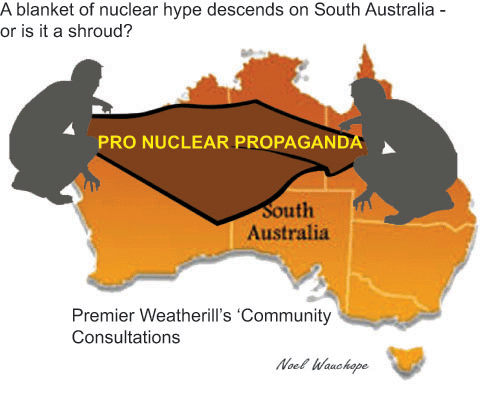
The latest is A new conference called “Australian Nuclear Fuel Cycle ’16 – Managing Radioactive Waste & Spent Nuclear Fuel” , being held in Adelaide on November 15-16 to discuss nuclear waste storage prospects.
Sponsors include the University of South Australia (a public university), ANSTO (a Federal gov’t agency) and UCL (whose Australian campus was publicly supported financially).
Victoria’s Point Lonsdale beach – just one example of rising sea levels
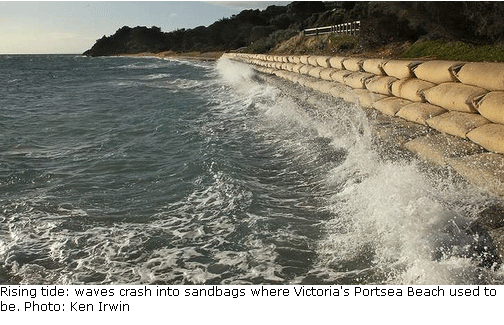 Rising sea levels, stronger waves speeding up Victorian coastal erosion, CSIRO says, ABC News 30 Oct 16 By Joanna Crothers Rising sea levels and more frequent storms are increasing the rate of erosion across Australia’s southern coastline, the CSIRO has said, while locals at one Victorian beach are concerned it is not safe for summer holidaymakers.
Key points:
- CSIRO warns of rising sea levels and a statewide trend of more storms
- Since 2010, Government has spent $450,000 on maintenance at Point Lonsdale
- In the past five years, erosion near Apollo Bay has increased from 8cm to one metre per year
Kathleen McInnes, a CSIRO sea level and coastal extremes expert, said more powerful waves were also contributing to the problem. “Sea levels have risen some 20 centimetres over the past 100 years, and are currently rising at about three millimetres per year,” she said. “There is also evidence that winds in the southern ocean are intensifying and this is driving a positive trend in wave energy reaching our coastline. “So this is creating a double whammy for coastal impacts.”
Individual storms have also become more frequent and intense, meaning beaches do not have as much time to recover after a harsh winter.”They’re driving higher waves which means a higher wave energy [is] reaching the shore,” Ms McInnes said.
Point Lonsdale beach ‘dangerous’, not ready for holidays The beachfront at Point Lonsdale, on the Bellarine Peninsula, has been badly eroded over the past decade and local residents said there was a risk children could slipping and cracking their heads open near the seawall…….http://www.abc.net.au/news/2016-10-30/rising-sea-levels-speeding-up-coastal-erosion-csiro-says/7972924
The danger for Australia as Turnbull wants to change Australia’s environment act
None of these decisions would have been possible without the groups’ standing under Section 487 of the EPBC Act. Removing these provisions undermines the foundational objectives of Australia’s national environmental act at a time when its protective capabilities are needed most.
 Turnbull wants to change Australia’s environment act – here’s what we stand to lose, The Conversation, Director of the Centre for Energy and Natural Resources Law, Deakin Law School, Deakin University October 31, 2016 Prime Minister Malcolm Turnbull is seeking changes to Australia’s national environment act to stop conservation groups from challenging ministerial decisions on major resource developments and other matters of environmental importance.
Turnbull is reviving a bid made by former Prime Minister Tony Abbott to abolish Section 487 of the Environment Protection and Biodiversity Conservation Act (EPBC Act) – a bid rejected in the Senate in 2015. If it goes ahead, the change will significantly diminish the functionality of the act.
The EPBC Act, introduced by the Howard government in 1999, has an established record of success. Judicial oversight of ministerial discretion, enabled by expanded standing under Section 487, has been crucial to its success.
Section 487 allows individuals and groups to challenge ministerial decisions on resources, developments and other issues under the EPBC Act. An organisation can establish standing by showing they have engaged in activities for the “protection or conservation of, or research into, the environment” within the previous two years. They must also show that their purpose is environmental protection.
Repealing this provision would remove the standing of these groups to seek judicial review of decisions. Standing would then revert to the common law position. That means parties would need to prove they are a “person aggrieved” by showing that their interests have been impacted directly.
Many environmental groups will be unable to satisfy the common law test, leaving a very small group of people with the right to request judicial review – essentially, the right to check that federal ministerial power under the EPBC Act has been exercised properly.
This is likely to have a devastating impact on fragile ecological systems and biodiversity conservation strategies.
This is particularly concerning given the dramatic changes affecting the environment from the expansion of onshore resource development and the acceleration of climate change.
Why do we have the EPBC Act?
The hypocrisy of attack on ‘foreign-funded’ environment groups
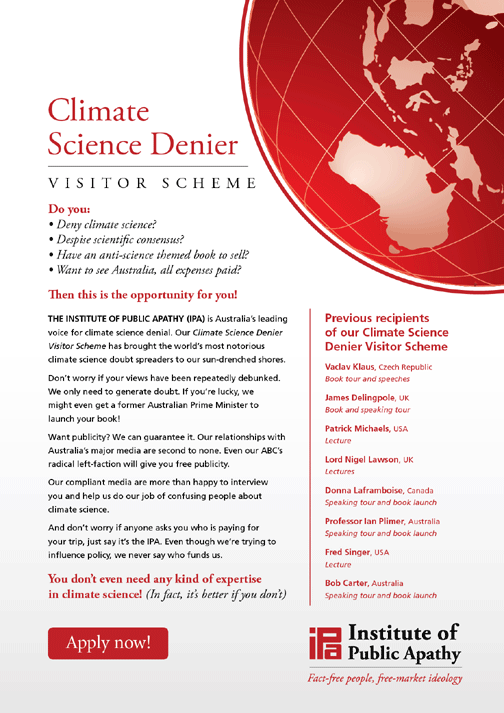
Why only “environment groups”? Why not take a look at the tax-deductible recipient status of all charities, such as the Institute of Public Affairs?
The IPA is using its tax-deductibility status to raise cash for a third edition of its climate science denial book Climate Change: The Facts, with contributions from US-based and UK-based contrarian scientists, alongside the likes of Clive James and Bjørn Lomborg.
Why the attack on ‘foreign-funded’ environment groups stinks of hypocrisy, Guardian,  Graham Readfearn, 30 Oct 16 Supporters of coal projects want transparency and proper use of charity status – but only when they support their arguments You might have noticed that all of a sudden, Australians are supposed to be appalled by foreign interests getting in the way of us digging up as much coal as we want, thanks very much.
Last weekend the Australian newspaper started running stories based on a “revelation” from the inbox of John Podesta, the chairman of Democratic nominee for president Hillary Clinton’s election campaign.
One email forwarded to Podesta showed the philanthropic group the Sandler Foundation, based in San Francisco, was a funder of Australian group the Sunrise Project. The emails were published by WikiLeaks.
Sunrise, run by the former Greenpeace campaigner John Hepburn, has been involved in supporting some of the court cases brought against proposed coal projects – chiefly, the massive Adani coalmine in Queensland.
According to an editorial in the Australian, “thinking Australians” should be “appalled” by this news.
On the back of these stories, there have been shouts for more transparency, while Turnbull government ministers have used the coverage as a pivot to call for environment groups to be stripped of their charitable status. The climate change impacts of burning coal, meanwhile, have been summarily discounted or ignored.
So let us count the ways that Australians should not be “appalled” and, on the way, examine some of the bald hypocrisy that has been on display this week. Continue reading
Western Australia missing its opportunity to become a renewable energy superpower
WA must embrace dawn of renewable energy era or risk being left behind https://www.theguardian.com/sustainable-business/2016/oct/27/wa-must-embrace-dawn-of-renewable-energy-era-or-risk-being-left-behind Michael Lord
Western Australia could become a renewable energy superpower – if the government halts LNG expansion plans and creates an innovation fund
Last year the world’s governments finally got their act together on climate change, agreeing to limit global warming to well under two degrees. To meet this commitment, we need a rapid global transition to net zero greenhouse gas emissions. The fossil fuel age is over.
The new era, powered by renewable energy, will be swept in on a massive wave of investment. According to Beyond Zero Emissions’ report, Renewable Energy Superpower, the world will invest $US28tn in renewable energy and energy efficiency in the next 20 years.
But Western Australia risks being left behind. Here investors have poured more than $100bn into liquefied natural gas (LNG) over the past decade yet the state has little to show for it. Another $60bn is slated for LNG development, but with current low gas prices, the sense of that investment is questionable. Energy consumers fork out for coal-fired power that goes unused and endure endless debate about grid privatisation. Meanwhile Western Australia’s electricity-related emissions are rising, just as almost all other states are managing to reduce them.
The irony is that Western Australia should welcome the dawn of the renewable energy era. The state’s enormous resources of sunshine, wind and wave mean it could become a renewable energy superpower of the future. Our report shows how Australia’s world-beating renewable energy resources represent a huge economic opportunity. Incredibly the report shows that in Western Australia alone, there is enough wind and solar, available at competitive prices, to provide almost 9% of the world’s energy every year. In other words Western Australia has more renewable energy than fossil energy. Continue reading
Australian to head Green Climate Fund
29 October 2016. The Green Climate Fund will this year approve hundreds of billions of dollars towards projects that help poorer nations mitigate the effects of climate change and transition to low-emission technologies.
Howard Barmsey, a former Australian climate change envoy and former head of the Global Green Growth Institute, will lead the GCF which will play a role in trying to fulfil the Paris Agreement to limit the world’s temperature increase to below 2 degrees Celsius.
http://www.abc.net.au/radionational/programs/saturdayextra/green-climate-fund/7976180
The Road to a Treaty
By Jeff McMullen https://newmatilda.com/2016/10/27/the-road-to-a-treaty/
 27 October 2016: “Our nation’s future lies in settling the demons of our past.
A Treaty with Australia’s First Peoples is the best path to get us there,
writes Jeff McMullen. …
“This leads me to my major proposal.
To end the continuing tragedy of the poverty and widespread inequality endured by our First People in their own land,
a national Treaty should recognise Indigenous law and custom,
immediately settle the remaining Native Title claims stuck in the courts and
also guarantee Aboriginal and Torres Strait Islander people the sub-surface mineral rights to the wealth of their lands.
“My logic is that the depths of poverty, welfare dependence, chronic illness, housing shortages, unemployment, over-incarceration and suicide
impacting so many of Australia’s 750,000 Indigenous people, can only be overcome through
a transformational shift of some of the bounty of this land that is rightfully theirs. … “
New South Wales households lose feedin tariff benefits
Households face steep hike in power charges as solar subsidies end, The Age, 28 Oct 16 Brian Robins Tens of thousands of households are facing a surge in their electricity bills from the start of the new year as the NSW government’s subsidy for rooftop solar panels expires.
This could add more than $1600 to the annual electricity bill as the so-called ‘feed-in tariff’, the price received for surplus electricity sold into the electricity grid, is slashed by as much as 90 per cent in some cases.
Under the original government program, households which installed solar systems received as much as 60¢ a kilowatt hour for surplus electricity sold into the grid. This will fall to 6¢, or possibly less, depending on the deals done with your electricity retailer. The state government’s pricing regulator IPART, the Independent Pricing and Regulatory Tribunal, has recommended electricity companies pay 5.5-7.2¢ per kilowatt hour for electricity bought from households with solar systems…….http://www.theage.com.au/business/households-face-steep-hike-in-power-charges-as-solar-subsidies-end-20161028-gscu4s.html
Nuclear Waste Importing: latest comments for Citizens Jury on Your Say site
 The South Australian government set up this site for comments on the plan. Comments close at 5 pm today (30 October). I wonder if the Citizens Jury members will have managed to see them – the vast majority of comments were very negative about the plan Here are some of the most recent:
Claudio Pompili 28 Oct 2016
“Your Say” comment on Safety of Nuclear Waste Importing
Noel Wauchope 30 Oct 2016 I trust that the Nuclear Citizens’ jury has noted the fact that there are  only two situations under which any commercial nuclear reactor could ever be built.
The first is the situation for democracies , such as the United States. They set the pattern by passing the Price Anderson Act, ensuring that the tax-payer would cover the monumental costs of any serious accident.
The second is for totalitarian states such as China and Russia. Here the taxpayer pays for the whole lot, from nuclear construction to waste disposal.
If South Australia is foolish enough to set up a waste import and disposal industry, South Australia will be following the Russian and Chinese examples. Not being a private enterprise job, I guess they won’t need a Price Anderson Act. I do hope that the Citizens’ Jury members are aware of this.
“Your Say” comment on Trust in South Australia’s Nuclear Royal Commission
Trust – hmmm How can anyone trust a process that began with the charade of the Nuclear Fuel Chain Royal Commission South Australia?
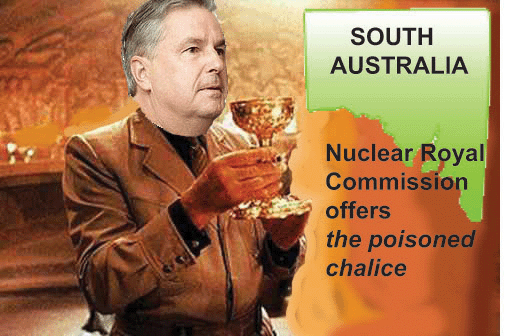 For a start – what a strange topic for a Royal Commission (RC) . RCs are called when there is an urgent problem, ?scandal to address.- child abuse, Aboriginal deaths in custody, detention of juveniles. I know of no other RC called to study a commercial enterprise. RCs are up until now, chaired by persons of legal knowledge and a legal background, generally retired judges. They are not chaired by military men. In this case, the Royal Commissioner Kevin Scarce is a person of defence industry background and clearly a previous promoter of the nuclear industry – clearly biased choice for a clearly unsuitable topic for a Royal Commission.
The Weatherill government then set up a State wide blanket of promotion, (despite the law prohibiting such spending taxpayers money on such a nuclear promnotion. Then set up the Citizens’ Jury process – designed to delay decision, and get some sort of claim to community support. The Citizens’ juries were given loaded questions, designed to prevent any verdict, and to produce a veneer of support. Some of the witnesses were poorly informed and biased, especially in the First Jury sessions, on the subject of ionising radiation and health.
At the very worst, the Juries are expected to produce a report that says “Further discussion is needed” and certainly, by the wording of their questions – not able to produce a “NO to Nuclear Dumping” answer.
The surprising factor in all this, is – as far as I can see, the Weatherill government, the nuclear lobby, and the shonky Nuclear RC have underestimated the intelligence of the jury members. The took it seriously, and asked inconvenient questions.
Your Say comment on Consent to Nuclear Waste Importing
 Noel Wauchope 30 Oct 2016 How on earth can consent be given to the plan to import and store and dispose of nuclear wastes when nobody knows where they will be put? Do we have the majority of South Australians, and of course the majority of Australians, too.l consenting too have nuclear wastes dumped on the land where only a minority live?
The only way that I can imagine consent ever being given for this is if that happens – and the minority is outvoted. Or perhaps the Aboriginal people can be expected to accept massive financial bribes? We all know damn well that if it’s to put not exactly on Aboriginal land, it will be put next door to Aboriginal land – with all the risks to land, groundwater, sacred sites involved in the transport of wastes etc. Well, bribing the Aborigines has been tried for over 20 years, for radioactive trash dumping on their land. It has never worked, and won’t work this time.
“Your Say” comment on Economics of Nuclear Waste Importing
 John Collins 30 Oct 2016
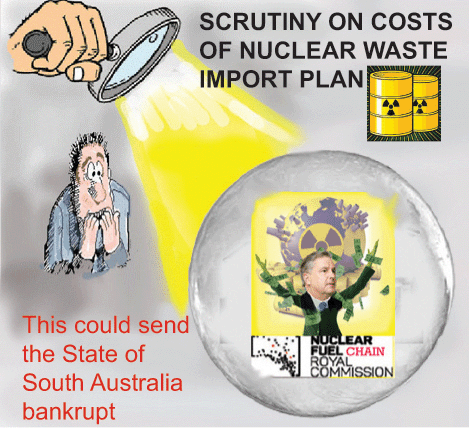
While, for me, the risks of irretrievable environmental disaster are paramount, the purported ‘economics’ are also relevant.
Firstly the RC Report states: “There is no existing market to ascertain the price a customer may be willing to pay for the permanent disposal of used fuel.” (p.93)
It goes on, “the baseline scenario assumes that 50 per cent of the accessible quantities of used fuel and intermediate level waste will be stored and disposed of in South Australian facilities” (p.292 – see also p.98 and p.298)
To assume that a start-up venture for what is made out to be a highly profitable, low-risk undertaking will be able to capture a 50% market share seems most unlikely noting that the report itself acknowledges; “(i)t should be underscored that there is significant potential for other countries to develop a domestic solution …” (p.97)
The RC Report states: “The modelling assumed the establishment of a reserve fund to provide for the costs of decommissioning, remediation of surface facilities, closure, back fill of underground facilities and the ongoing, post-closure monitoring phase.” (p.301) The report also acknowledges that; “(t)he consequences of human error and ‘normal’ accidents must be anticipated, expected and planned for in system design and operation.” (p.91) It appears that the costing for these eventualities (noting the life of the dump is “at least 10 000 years and up to a million years” (p.85) has not been taking into account.
It seems to me that at very best the figures are ‘rubbery’.
And again I would ask the basic test question, ‘if importing high level waste is so straightforward, safe and so very, very profitable why are no other countries (or Australian States or Territories) doing so already?’ Noting that ‘other countries’ that could consider such a project are entrepreneurial, technically advanced, and, most importantly, experienced in handling nuclear waste (unlike SA). Such countries include, China, USA, Russia and the Scandinavian and EU countries.
Another “Your Say” comment on Economics of Nuclear Waste Importing
It’s a pity that this radioactive trash import plan has not been knocked out on grounds of risks to health, damage to environment, disrespect of Aboriginal people, and importantly – on its real purpose – to save and promote the global nuclear industry.
At least the Nuclear Fuel Chain Royal Commission South Australia had to admit that there is no argument for nuclear waste importing actually benefiting the Nation’ or the State’s health, environment, or indigenous people.
 The Nuclear Fuel Chain Royal Commission had only one argument for the plan – that it would be an economic bonanza for South Australia. I could list the economic analysts who have destroyed that argument. But the well known Blind Freddie could see the economic flaws. South Australia is supposed to set up “interim” waste storage before the famous underground dump is built, – sort of using the money that will be paid for the dump to finance it – or some plan like that. South Australia has to spend $millions on the plan, for years before it gets any revenue. The planned revenue is entirely speculative, as there is no market for nuclear waste importing. If it goes ahead – any financial benefit will be decades away, yet South Australia needs economic development now, not decades later. If it were to go ahead, it could grind to a halt at any time – with changes in governments overseas, collapse of nuclear companies or untoward events, such as a disaster in the transport of the wastes. South Australia could well be left with expensive, dangerous, and useless Stranded Radioactive Trash.
Meanwhile, other clean, and quicker alternatives – in renewable energy, energy efficient design for example, have been neglected while South Australia pursues this toxic dream – which has the very real potential to bankrupt the state.
1 This month
17 October, Free Public Talk on Nuclear Issues in South Australia
David Noonan will speak on public interest concerns over the new Roxby Downs Indenture Act 2026 on BHP copper-uranium mining and ore processing in SA, and on how AUKUS may face SA with a High-Level nuclear waste agenda.
Dr Jim Green will discuss international developments in the field of nuclear power including ‘small modular reactors’ and Generation 4 ‘advanced’ nuclear reactor concepts.


Help Aunty Sue Protect Her Land and Sacred Sites From Destructive Rocket Testing.
.

Australians deserve the truth
about
AUKUS – https://aukuspublicinquiry.com/

PETITION – To: Prime Minister Anthony Albanese and the Australian Labor Government

of the week – Australians for War Powers Reform (AWPR)
To see nuclear-related stories in greater depth and intensity


I was shocked to read in 26 October’s InDaily:
Jay spruiks nuclear expansion as an agent of economic change
Jay Weatherill has told a nuclear industry forum in Adelaide he is personally convinced of the potential for an expansion of South Australia’s role in the fuel cycle, framing the push as part of his ambition to forge a “new economy”.
It appears that Premiere Weatherill has at last come out and played his pro-nuke card. So much for his publicly-avowed position that he would make up his mind when the whole process of the RC has been undertaken. It’s patently clear that he’s been captured by the nuclear industry and foisted an expensive sham of a royal commission onto the SA public, which overwhelmingly has repeatedly been opposed to expansion of nuclear in this state.
The Royal Commission process and the biased ‘findings’ of its subsequent Report are deeply flawed on a range of issues from the dubious economics right through to the non-existent risk assessment. No project of this magnitude, scope, cost and risks into the far-distant future, should be entertained without a comprehensive Risk Assessment Plan. The Report does not meet the criterion in the Terms of Reference to present “the risks and opportunities associated with establishing and operating those facilities” It does present the supposed opportunities but dismisses the risks and assures us that risk assessments will be done in due course. Continue reading →