Labor Party dithers in vote over nuclear waste dumping in South Australia
 Nuclear waste dump: Labor votes at SA convention to delay decision on proposal, ABC News By Daniel Keane, 29 Oct 16, “……Inside the conference, Mr Weatherill defended the decision to explore the nuclear option, but Labor MP Steph Key told the gathering of ministers, MPs and party members her constituents strongly opposed the idea.
“People in Ashford don’t favour a high-level nuclear waste dump,” she said.
“We think there needs to be a special convention so that we can talk about these issues in detail within the party, and see whether or not there is a social licence within the Labor Party first of all for such a thing.”
Frontbencher Peter Malinauskas used his speech to mock the demonstrators.
“We’re all here past lunchtime, unlike the protesters,” he said.
“The difference between us and them, of course, is that we take very seriously our obligation to make sure that our ideology is underpinned by evidence.”
But Labor voted to delay a decision on whether to pursue a nuclear dump until it holds a special convention, in line with Ms Key’s suggestion, at the end of the community consultation process.
Citizens’ jury hears from expert witnesses The party conference coincides with a royal commission citizens’ jury at the Adelaide Convention Centre, where about 350 randomly selected people are meeting this weekend to discuss the state’s possible involvement in the nuclear fuel cycle.
Mr Weatherill has previously been confronted by protesters over the issue, and was heckled on his way into a previous citizens’ jury. “I don’t know where this debate is ultimately going to end, either in the community or in this party,” he told the convention…..
The citizens’ jury is hearing from more than 30 experts witnesses over two days. A report prepared after the citizens’ jury meetings will be presented to Mr Weatherill next month.http://www.abc.net.au/news/2016-10-29/sa-nuclear-dump-decision-delayed-at-labor-state-conference/7977670
South Australian Premier Weatherill heckled by anti nuclear protestors
 Adam Langenberg, Political reporter, The Advertiser October 29, 2016 PREMIER Jay Weatherill and ALP colleagues were heckled by anti-nuclear protesters as he headed into the Labor State Convention in Adelaide today.
The Premier and Senator Penny Wong entered the venue amid cries of “nuclear waste, what a disgrace”, with a number of senior party ministers including Police Minister Peter Malinauskas also lobbied by protesters.
Eleven separate motions about a proposal to establish a nuclear waste dump in the state will be heard at the conference this afternoon, with many calling on Labor to immediately rule out establishing a dump.
……….More than 130 motions will be debated at the convention. http://www.adelaidenow.com.au/news/south-australia/jay-weatherill-colleagues-heckled-by-antinuclear-protesters-at-labor-state-convention-in-adelaide/news-story/93593b17164cba17c78cbaf6d856bb63
Delaying tactics on the nuclear waste agenda at South Australia’s Labor party Conference
 Treasurer defends SA dump debate Read more at http://www.9news.com.au/national/2016/10/28/12/18/treasurer-defends-sa-dump-debate#rpdClBGbUpWJ4umI.99 October 28, 2016 The Labor party is no different to a football club or a family barbecue when it comes to debating the merits of establishing a nuclear waste dump in South Australia, Treasurer Tom Koutsantonis says.
The issue will come under discussion at the party’s state convention on Saturday, with a number of motions to be debated, some calling for any plans for a dump to be scrapped and others buying the state government some time before having to make a decision. Mr Koutsantonis says the party is rightly engaged in the same discussion that mums and dads are having across South Australia, weighing up the pros and cons of taking high-level waste from overseas.
“People are just talking about what do we do next? Do we do this or don’t we do this? What are the risks, what are the rewards.
“So absolutely we should have this debate.”
Among motions to be debated at the convention, one calls for the government to hold a state referendum on the issue of a dump, others call for the government to delay any decision until after the issue is discussed at the next national ALP conference and one calls for a special state convention to be called.
There is also one that calls for the state government to “cease and desist” any further action to consider nuclear waste dumps of any kind.
Mr Koutsantonis acknowledged there were strong feelings within the party on the question of nuclear waste. “Our view, very simply is, we want to continue the debate,” he said. “The party is allowed to express its views, individuals are allowed to express their views.”
Also this weekend the second citizen’s jury will continue to deliberate on the dump proposal, which was raised as possibility by a royal commission conducted into SA’s future involvement in the nuclear fuel cycle.
The 350 people making up the jury will present their final report to Premier Jay Weatherill on Sunday.
The No Dump Alliance, which plans to stage a protest outside the convention on Saturday, said the ALP should “close the door on this deeply flawed and reckless plan”.
“Despite a huge amount of taxpayer-funded promotion, opposition to an international nuclear dump is growing within the Labor Party and the wider community,” spokesman Craig Wilkins said.

UN vote to start negotiating treaty to ban nuclear weapons- Australia voted against it
UN votes to start negotiating treaty to ban nuclear weapons
Australia votes with major nuclear powers against the resolution – including US, Russia and Israel – but 123 nations vote in favour, Guardian Ben Doherty, 28 Oct 16, United Nations member states have voted overwhelmingly to start negotiations on a treaty to ban nuclear weapons, despite strong opposition from nuclear-armed nations and their allies.
In the vote in the UN disarmament and international security committee on Thursday, 123 nations were in favour of the resolution, 38 opposed and 16 abstained.
Nuclear powers the United States, Russia, Israel, France and the United Kingdom were among those that opposed the measure.
Australia, as forecast last week, and as a long-time dependant on the US’s extended nuclear deterrence, also voted no.
The resolution now goes to a full general assembly vote some time in December.
The resolution aims to hold a conference in March 2017 to negotiate a “legally binding instrument to prohibit nuclear weapons, leading towards their total elimination”.
Support for a ban treaty has been growing steadily over months of negotiations, but it has no support from the nine known nuclear states – the US, China, France, Britain, Russia, India, Pakistan, Israel and North Korea – which includes the veto-wielding permanent five members of the security council.
But Australia has been the most outspoken of the non-nuclear states.
During months of negotiations, Australia has lobbied other countries, pressing the case for what it describes as a “building blocks” approach of engaging with nuclear powers to reduce the global stockpile of 15,000 weapons…….
Professor Tilman Ruff, founding chair of the International Campaign to Abolish Nuclear Weapons and co-president of the International Physicians for the Prevention of Nuclear War, said the vote was a “historic step” for the world that “heralds an end to two decades of paralysis in multilateral nuclear disarmament”.
“The numbers are especially encouraging given the ferocious pressure on countries to vote no by the nuclear-armed states, who see that this will fundamentally challenge their continued possession of nuclear weapons,” he said.
The treaty will fill the legal gap by which the most destructive of all weapons – nuclear weapons – are the only weapon of mass destruction to not yet be outlawed by international treaty.”
Ruff said Australia should reverse its opposition “and get on the right side of humanity”.
“Australia is doing dirty work for Washington, and is willing for US nuclear weapons to be used on its behalf, and potentially with its assistance,” he said.
“It is inconceivable that Australia would not eventually sign up to a treaty prohibiting the last to be banned and worst [weapons of mass destruction]. We’ve signed every other treaty banning an unacceptable weapon, and on some, like chemical weapons, we were a leader.”…….https://www.theguardian.com/world/2016/oct/28/un-votes-to-start-negotiating-treaty-to-ban-nuclear-weapons
Adani coal mine: Queensland Government publicly embarrassed over handling of megamine
October 26, 2016. A POWERFUL lobby of regional councils and business groups have started to publicly embarrass the State and Federal governments over their inability to pave the way for the $21 billion Adani megamine… (subscribers only)
http://www.couriermail.com.au/news/queensland/adani-coal-mine-queensland-government-publicly-embarrassed-over-handling-of-megamine/news-story/5fe5d13935e1c187df9c0248a3d81053
Kimberley’s Indigenous fire management experts featuring at UNESCO climate talks
Kimberley representatives head to Morocco to share traditional fire management techniques ABC Kimberley By Leah McLennan, Matt Bamford and Fi Poole, Representatives from the Kimberley region of Western Australia will travel to climate talks in Morocco to discuss their strategic burning methods.
Traditional fire management techniques have generated more than $85 million for Indigenous groups across northern Australia.
Kimberley Land Council chief executive Nolan Hunter will deliver a presentation on Indigenous fire management in Australia at the UNESCO Indigenous Knowledge and Climate Change conference in Marrakech next month.
“We have been invited to go over there to present the work we have been doing with traditional owner groups in the north Kimberley on fire abatement and the role of Indigenous people in climate change and biodiversity,” Mr Hunter said……http://www.abc.net.au/news/2016-10-28/indigenous-fire-management-delegation-climate-change-conference/7972486
Will Australia become the global nuclear toilet? Events in Adelaide 29 October

Will Australia become the global nuclear toilet?, [corrected version] Noel Wauchope, 29 Oct 16 It’s not obvious to the rest of the nation, but this question is about to be advocated in two South Australian events, that will have repercussions for the whole of Australia. These are the second Nuclear Citizens’ Jury in Adelaide on October 29 and the South
Australian Labor Party Conference, also on October 29. The ALP conference is really the most important one, as Premier Weatherill will surely need the backing of his own party as he moves to the process of overturning South Australia’s law against nuclear waste importing.
Indeed, the Nuclear Citizens’ Jury is really irrelevant. Whatever decision it makes, is in no way binding on the government. And anyway, this so-called “Jury” of 350 persons cannot make a convincing decision. The brief given to them is worded, in terms that come straight from the Nuclear Fuel Cycle Royal Commission South Australia’s (NFCRC) report that advocated nuclear waste importing:
Under what circumstances, if any, could South Australia pursue the opportunity to store and dispose of nuclear waste from other countries?
I understand that some jurors wanted a change from this question, but no change was allowed.
The previous Citizens’ Jury had some very dubious witness presentations, particularly on the health effects of ionising radiation. This was not entirely the fault of the organisers, DemocracyCo, as the 50 jury members themselves selected the witnesses to be invited.
One might expect this second Citizens’ jury to be better served by witnesses, but the new witness list is a curiously mixed bag. Of the 31 names, 16 are likely to be supporters of nuclear waste importing, 11 opposing it, and 4 appear to be neutral.
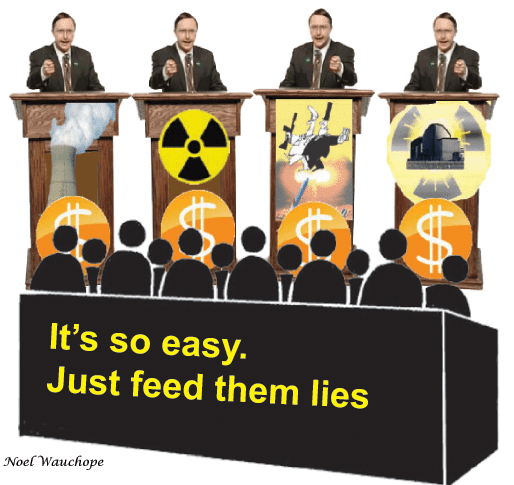 The most worrying section in this Citizens’ Jury is the session on SAFETY, dealing with general safety, siting and transport. For this session, there are 7 witnesses. Of these, only one witness, Dean Summers , appears to be anti nuclear, and one a neutral expert. This is Professor Sandy Steacy who knows all about earthquakes.
The witnesses are:
- Professor David Giles, of Minerals & Resources Engineering Future Industries Institute has all too strong a background in the mining industry.
- Dr John Loy: his theme is all about medical waste(an almost negligible component of Australia’s own Lucas Heights nuclear waste), and over-confidence on the safety of nuclear waste facilities. He has a background in promoting nuclear power to United Arab Emirates.
- Frank Boulton, General Manager WMC (Olympic Dam Marketing) Pty Ltd
- Dr AndrewHerczeg, formerly of the International Atomic Energy Agency
- Ian Hore-Lacy formerly of the Uranium Institute in Australia-he now works for the World Nuclear Association. Mr Hore-Lacy is unusual: he sees support for nuclear power as areligious and moral duty (He is also very critical of Pope Francis’ ideas on environment)
These pro nuclear experts have had much to say on storage of nuclear wastes. But none seems to have taken much interest in the issues around transporting highly radioactive wastes over thousands of kilometres across oceans and land. With the increasing volatility of weather events, as climate change progresses, and with the also growing concerns about terrorism, this omission is one of the greatest weaknesses of the case for importing nuclear wastes. The subject just glossed over in a few brief paragraphs in the NFCRC Report.
On the subject of SAFETY, focussing on the aspect of human health, one witness, Tony Hooker is a bit of a worry. He worked with Professor Pamela Sykes on her mouse studies, at Flinders University? Funded by America’s Department of Energy, Syke’s research purported to show that low dose radiation is actually good for you.
The 6 witnesss for this section are not evenly matched, with Dr Margaret Beavis and Dr Robert Hall opposing nuclear waste importing, and Dr Paul Degman, Dr Sami Hautakangas , Dr Stephan Bayer and Dr Tony Hooker likely to support it.
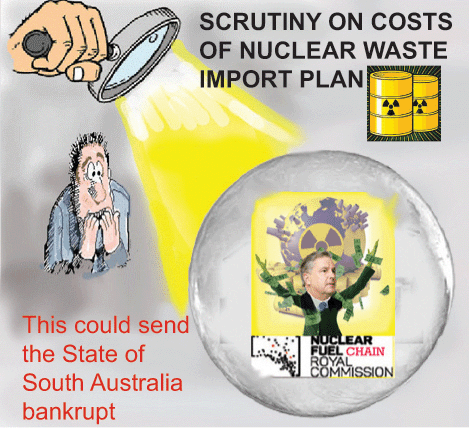 The vital section could well turn out to be ECONOMICS. And here, there IS a surprise, with an apparent bias towards the negative camp. Speakers Adjunct Professor Richard Blandy,Richard Dennis, Professor Barbara Pocock and Assoc. Professor Mark Diesendorf (via Skype) all have views opposing waste importation. The remaining speaker, Tim Johnson, from Jacobs, is supportive of the plan, but only cautiously so.
If economics were the only consideration, the waste import plan might conceivably die a quiet death, following this Citizens’ Jury, and a possibly negative report from a Parliamentary Inquiry. However, there are other considerations, such as underlying connections with the defence industry.
The South Australian Labor government, led by Premier Jay Weatherill, is enthusiastically backing the nuclear lobby’s campaign for setting up South Australia as the first place in the world to invite in the world’s nuclear waste, as a profit-making enterprise.
In practical terms, you can forget this government’s extravagant public relations promotion of the nuclear industry, culminating in these “Citizens’ Juries”. They really matter very little, in comparison with the actual steps to be taken for the pro nuclear campaign to succeed.
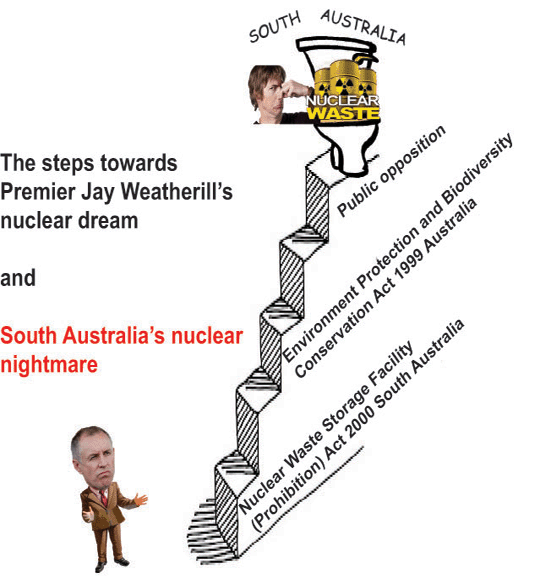 Step One is to overturn a South Australian law – the NuclearWaste Storage Facility (Prohibition) Act 2000. It includes:
8 Prohibition against construction or operation of nuclear waste storage facility
9 Prohibition against importation or transportation of nuclear waste for delivery to nuclear waste storage facility (The Act does have exemptions for the nuclear waste generated within Australia, e.g from Australia’s research reactor at Lucas Heights).
The government has already weakened this Act (In April 2016) by amending this provision:
13—No public money to be used to encourage or finance construction or operation of nuclear waste storage facility
(1) Despite any other Act or law to the contrary, no public money may be appropriated, expended or advanced to any person for the purpose of encouraging or financing any activity associated with the construction or operation of a nuclear waste storage facility in this State.
They had to change it quickly – to allow for financing community consultation or debate on the desirability or otherwise of constructing or operating a nuclear waste storage facility in this State. – seeing that they had already spent $7.2 million promoting nuclear waste storage, in the NFCRC
Anyway, prior to overturning this Act, Premier Weatherill is surely going to need to have the Labor Party onside. At last year’s ALP Conference, He and State Labor president Peter Malinauskas made a big push for South Australia going nuclear As the national ALP policy remains clearly opposed to all nuclear industry further development, we can expect that Weatherill will meet with some opposition to his nuclear plan from Labor members at the conference.
Perhaps the nuclear lobby, their captive South Australian Premier, and subservient national media, will not be able to press on with their plan without an unpleasant fracas.
Nuclear showdown for South Australia’s Labor Party Conference – perhaps
Steve Dale , Nuclear Fuel Watch South Australia Watch out, there is also a group trying to delay decision making about the dump for a few months. They say they are anti-dump but the agenda is probably to defuse maritime/transport/fire/.. unions anger over this crazy plan. These unions who will have to handle this poisonous muck are rightfully angry. They should kill this plan off on Saturday unless they want their workers killed by this cancer causing poison years later.https://www.facebook.com/groups/1021186047913052/permalink/1342858522412468/?comment_id=1342893619075625
 http://www.adelaidenow.com.au/news/south-australia/labor-readies-for-tense-nuclear-showdown-amid-opposition-at-state-meeting/news-story/94b465193620d74f489a1f0cd3fc6e40 Political Reporter Sheradyn Holderhead, The Advertiser October 27 2016
PREMIER Jay Weatherill faces a tense showdown over his Government’s nuclear strategy at a state Labor meeting this weekend.
Three motions have been listed for a vote that essentially call on the Government to abandon the proposed nuclear waste dump while others call for further consultation or a referendum. A joint motion from the Maritime and Rail, Tram and Bus unions demands the State Government “immediately cease and desist any further action or consideration” of any type of nuclear dump.
Among its concerns are a weak economic case, high upfront cost, political damage to Labor, safety risks to workers and the public, and ignoring the rights of Aboriginal people.
The moves make good on threats of a heated fight from powerful union figures who have publicly backed anti-dump campaigners. The Advertiser revealed last month that some within Labor were talking about a repeat of the union campaign against Mike Rann, which boiled over in 2010 when he needed a police escort through protesters at Labor’s state convention.
Anti-dump protesters are expected at the West Adelaide Football Club, which is the venue for Saturday’s meeting. Mr Weatherill declined to comment on the meeting.
The Government is pinning its hopes on an alternative motion that would buy time on a vote to overturn the longstanding party policy to oppose nuclear reactors and imported waste storage.
It instead calls for a Special State ALP Convention on the matter to be held at the conclusion of community consultation but before a decision was made on whether to develop a dump.
 Labor MP Tom Kenyon said he hoped the convention would show there was support within the party to continue investigating the $445 billion project, which he called a “tremendous opportunity” for SA.
Mr Kenyon, also a member of a parliamentary committee considering the project, said making it easier for other countries to have nuclear power could potentially do more to address climate change than efforts toward renewables.
He said while the party always “finds something to be excited about” at conventions this issue was unique.
“This is unusual because since the ‘70s, the Labor Party has had a very strong anti-nuclear position. It’s almost an article of faith,” Mr Kenyon said.
“At some point the party will have to grapple with this deeply and consider its position at the state and federal level.”
Health Services Union state secretary Jorge Navas, who also put forward a motion to reaffirm the existing policy of opposition to a dump said safety risks remained a significant concern.
He likened pursuit of the nuclear industry to asbestos.
“It was profitable but the consequences are devastating,” he said.
Extreme heat events increase: State of the Climate report 2016
 State of the Climate report 2016: Extreme heat events increasing in duration, frequency and intensity By national science reporter Jake Sturmer, ABC News 28 Oct 16 The duration, frequency and intensity of extreme heat events have increased across large parts of Australia, a climate report has found.The Bureau of Meteorology and CSIRO’s biennial State of the Climate report also found May-July rainfall had reduced by around 19 per cent since 1970 in the south-west of Australia.
The report offers a snapshot of how Australia’s weather has changed over the last two years. According the latest report, there has been an increase in extreme fire weather days, and a longer fire season, across large parts of Australia since the 1970s.
Temperatures in Australia — both in the air and on the sea surface — have warmed by a degree since 1910, the report said.
It may not sound like much, but according to the Bureau of Meteorology’s Karl Braganza, it is a big deal.
“It’s not significant when you think about the shift from night to day, but we’re talking about a shift in the actual climatology of Australia,” Dr Braganza said.
“If you move from one climate zone to another in Australia — where there’s only a degree or two of difference — you’ll notice quite a different environment.”
So is anything changing globally? Last year was the warmest on record for the globe since reliable surface air temperature records began in 1880 — 15 of the last 16 years have been the hottest recorded.
Sea levels globally have risen more than 20 centimetres since the late 19th century — one third of this rise is because of ocean warming and the rest from water stored on the land and melting land ice.
It is that melting land ice that could cause a huge shift in sea levels.
Take the ice on Greenland, for example. CSIRO’s Steve Rintoul said if that melted, there would be enough ice to raise global sea level by seven metres.
What makes this even more challenging is that scientists are not sure at what level of temperature rise this melt would happen.
“It could be as low as 1.5 degrees Celsius [or] it could be as high as 3C, but once we cross that threshold we have committed ourselves to losing most of the ice on Greenland,” Dr Rintoul said.
What do we do about it?
Scientists say there is not a moment to lose and we must reduce the consumption of fossil fuels and consequently lower CO2 emissions……..http://www.abc.net.au/news/2016-10-27/extreme-heat-events-increasing-in-duration-frequency-bom-report/7965650
How USA got rid of Australian Prime Minister Whitlam – it was all about Pine Gap
Whitlam demanded to know if and why the CIA was running a spy base at Pine Gap near Alice Springs, a giant vacuum cleaner which, as Edward Snowden revealed recently, allows the US to spy on everyone. “Try to screw us or bounce us,”the prime minister warned the US ambassador, “[and Pine Gap] will become a matter of contention”.
Victor Marchetti, the CIA officer who had helped set up Pine Gap, later told me, “This threat to close Pine Gap caused apoplexy in the White House. … a kind of Chile [coup] was set in motion.”
Pine Gap’s top-secret messages were de-coded by a CIA contractor, TRW. One of the de-coders was Christopher Boyce, a young man troubled by the “deception and betrayal of an ally”. Boyce revealed that the CIA had infiltrated the Australian political and trade union elite and referred to the Governor-General of Australia, Sir John Kerr, as “our man Kerr”.
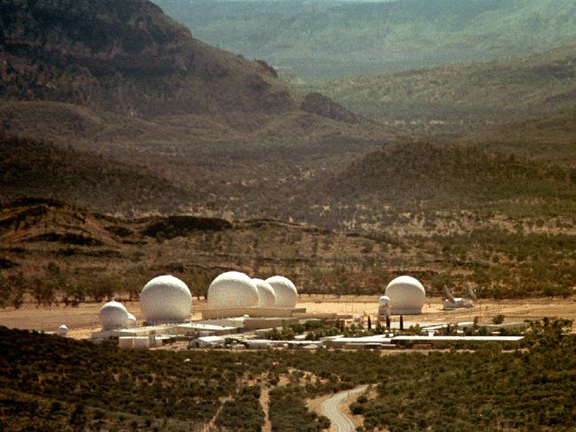
By John Pilger 23 Oct, 2014 Across the political and media elite in Australia, a silence has descended on the memory of the great, reforming prime minister Gough Whitlam, who has died. His achievements are recognized, if grudgingly, his mistakes noted in false sorrow.
But a critical reason for his extraordinary political demise will, they hope, be buried with him. Australia briefly became an independent state during the Whitlam years, 1972-75. An American commentator wrote that no country had “reversed its posture in international affairs so totally without going through a domestic revolution”.Whitlam ended his nation’s colonial servility. He abolished Royal patronage, moved Australia towards the Non-Aligned Movement, supported “zones of peace” and opposed nuclear weapons testing.
Although not regarded as on the left of the Labor Party, Whitlam was a maverick social democrat of principle, pride and propriety. He believed that a foreign power should not control his country’s resources and dictate its economic and foreign policies. He proposed to “buy back the farm”. In drafting the first Aboriginal lands rights legislation, his government raised the ghost of the greatest land grab in human history, Britain’s colonization of Australia, and the question of who owned the island-continent’s vast natural wealth. Continue reading
Jobs in a clean energy future
http://apo.org.au/resource/jobs-clean-energy-future
25 October 2016 Download file
By committing to the Paris Agreement, the world recognised the need to work together to keep global warming well below 2 degrees. Around the world, other governments are embracing the opportunities of transitioning to a clean energy future. But at home, Australia’s pollution continues to rise and Australia remains as one of the biggest per capita polluters in the world. There is still no coherent national plan to transition Australia to a net zero emissions economy.
Jobs in a clean energy future updates our 2010 collaboration Creating Jobs – Cutting Pollution and demonstrates, yet again, that creating a brighter future for the Australian community and our environment go hand in hand.
This report presents a clear choice. If Australia continues with business as usual, pollution will continue to rise and the health of the people and our natural world will continue to deteriorate. If the government acts now and implements policies under a strong action scenario we can create one million more jobs by 2040. People and nature will be better off and the places we love will thrive. If we increase public transport and clean energy Australia’s cities, towns and regions will be more liveable, smarter and healthier places to live. By embracing these opportunities Australia can be a world leader and create jobs and industries that are at the forefront of the transition.
Canavan doing foreign miner Adani’s bidding
http://wanganjagalingou.com.au/canavan-doing-foreign-miner-adanis-bidding/
~ Wangan & Jagalingou http://wanganjagalingou.com.au/
23 October 2016:
“Rockhampton-based Minister for Resources and Northern Australia, Senator Matt Canavan
“is feigning concern for Aboriginal people while relying on misleading media stories this weekend
which attempt to discredit the Wangan and Jagalingou (W&J) Traditional Owners counciland
our rejection of the proposed Adani Carmichael mine”,
said Adrian Burragubba, senior Traditional Owner and spokesperson for the W&J council.
“Mr Adrian Burragubba said,
“We are self-determined and stand independently
– and we have said ‘no’ to Adani and their Government backers more times than we should have to
and Canavan is using us to serve his own self-interest.
““Hiding behind one W&J applicant, who is named as one of seven who received funds from Adani in a deal to attempt to overturn our decisions,
shows nothing but contempt for our concerns.
We have taken our concerns to the courts in a series of current cases, to the public, and to the United Nations. … “
Port Augusta is attracting solar energy developers
Solar energy developers attracted to Port Augusta after power station’s closure, ABC, The World Today 25 Oct 16 By Khama Reid Solar energy developers are honing their attention on the South Australian city of Port Augusta after the community’s economy took a hit when its largest employer, Alinta Energy, closed its coal-fired power station.
For the past five years, the community has been pushing for a transition from coal to renewable energy, which is now steps closer to becoming reality.
Residents and those in the neighbouring city of Whyalla brag the region gets “300 days of sunshine” a year.
Port Augusta Mayor Sam Johnson said the tagline had become more than just a tourism slogan with solar companies getting serious about development in the region.
“Reach Solar have made an application to the State Government as recent as only a few weeks ago for a very real project here at Port Augusta using solar PV [photovoltaic],” Mr Johnson said.
“We know there’s Solastor and Solar Reserve both looking at large scale solar thermal technology, both in the vicinity of $1 billion projects.”
Mr Johnson said one of the further progressed proposals was for the DP Energy Renewable Energy Park to the south of the city.
“DP Energy actually has planning approval and will be the largest wind and solar PV farm in Australia and actually the first to have not just wind but solar PV technology as well.”
Queensland and SA ‘real hot markets’ for solar
Renew Economy editor Giles Parkinson said the spike in interest was not surprising. “There’s two real hot markets for solar at the moment, that’s Queensland and South Australia and in South Australia around the Port Augusta/Whyalla area and that comes from two things,” Mr Parkinson said.
“One is the excellent sunshine, but also the high wholesale electricity prices.
“They rely so much on gas to set the price of generation, and the price of gas has gone up, so the wholesale price has gone up as well.”
Mr Parkinson said solar was becoming a more affordable investment option.
“I guess the overwhelming driver is the reduction in costs of solar PV, it’s actually falling to a point where it can actually compete with wind energy.”
He said the Australian Renewable Energy Agency (ARENA) previously funded wind farm developments, but in its latest round awarded more than $91 million to solar photovoltaic projects across the country……http://www.abc.net.au/news/2016-10-25/solar-energy-developers-flock-to-port-augusta/7962306
Australian government considering law to stop environment groups taking legal action
 Coalition can bring back green ‘lawfare’ bill if Senate supports it, says Turnbull
Prime minister floats plan to reintroduce controversial laws to limit right of conservation groups to mount court cases, Guardian, Paul Karp, 24 Oct 16, The government plans to reintroduce controversial laws to limit the legal standing of conservation groups mounting court cases if it thinks the new Senate will support them, Malcolm Turnbull has revealed.
At a press conference in Sydney on Monday Turnbull expressed concern that “systematic, well-funded” environmental campaigns were targeting major projects and flagged a renewed attempt to pass the law.
In August 2015 the Abbott government announced it would remove the right of most environmental organisations to challenge developments under federal laws unless they could show they were “directly affected”.
The Environment Protection and Biodiversity Act allows any Australian citizen or resident who has engaged in conservation activities in the previous two years to bring a legal challenge to government environmental decisions.
The proposed changes followed a federal court decision that the then environment minister, Greg Hunt, had not properly considered all advice in his approval of Adani’s $16.6bn Carmichael coalmine.
After becoming prime minister Turnbull unexpectedly retained plans to introduce the laws limiting legal standing…….
The Greens environment spokeswoman, Senator Larissa Waters, said: “Stopping ordinary Australians from enforcing our environment laws would be a capitulation to the hard right inside the Coalition and yet another win for Tony Abbott.”
She added: “Gutting public enforcement of environmental laws is an attack on democracy and the rule of law.
“When governments fail to enforce or comply with their own laws, it falls to community groups to hold them to account.”
Waters said there were already strict rules that limit which cases go to court and frivolous or vexatious claims could be struck out.
On Tuesday a United Nations special rapporteur, Michel Forst, criticised the proposed law after a two-week visit to Australia investigating protections for human rights defenders, including environmentalists.
Forst said there were already significant obstacles to environmental litigation including complexity and the risk of a costs order if a case was unsuccessful.
An Australian Conservation Foundation campaigner, Basha Stasak, welcomed the UN rapporteur’s findings that environmental campaigners had been “vilified” for legitimate legal action.
She called on the government to “take on board the recommendations that environmental groups have a legitimate interest in decision making and in the courts” and withdraw amendments to deny them standing and deprive them of tax-deductible status. https://www.theguardian.com/australia-news/2016/oct/24/coalition-can-bring-back-green-lawfare-bill-if-senate-supports-it-says-turnbull
Could there EVER be an ethical argument for Australia to import nuclear wastes?

If indeed, the waste importing idea were conditional on a Japanese plan to close down the industry, and help Japan overcome its very serious dilemma, this could be one big move towards halting the global nuclear industry juggernaut, with its undoubted connection to nuclear weapons. Japan could pay a reasonable amount to the waste host country, without being ripped off, without that country expecting to become mega wealthy. That would be one circumstance in which it would be an ethical choice for South Australia to import and dispose of nuclear waste.
“Pie in the sky!” I hear your cry.
Yes, sadly so. Is there any chance that such an ethical decision would ever be made? I doubt it. The Nuclear Citizens’ Jury is left with the question of whether or not to support the NFCRC’s plan for a nuclear waste bonanza, or to risk possible State bankruptcy in the event of it all going wrong. http://www.onlineopinion.com.au/view.asp?article=18603
Nuclear Citizens’ Jury: an ethical case for importing nuclear wastes, Online Opinion, Noel Wauchope, 25 Oct 16 The South Australian government will call another Nuclear Citizens’ Jury, on October 29 – 30. This time the jury must answer this question:
Under what circumstances, if any, could South Australia pursue the opportunity to store and dispose of nuclear waste from other countries?
That set me thinking. The main “circumstance” for recommending this “opportunity” is the State Government’s plan to eventually bring in a pot of gold for the State. There really is no other argument for this project in the Report. In the 320 page report any arguments about Aboriginal issues, safety, environment, health, are aimed at rebutting criticism of the plan. They provide no argument on the plan actually improving health or environment, and are in fact quite defensive about Aboriginal impacts. Continue reading
1 This month
17 October, Free Public Talk on Nuclear Issues in South Australia
David Noonan will speak on public interest concerns over the new Roxby Downs Indenture Act 2026 on BHP copper-uranium mining and ore processing in SA, and on how AUKUS may face SA with a High-Level nuclear waste agenda.
Dr Jim Green will discuss international developments in the field of nuclear power including ‘small modular reactors’ and Generation 4 ‘advanced’ nuclear reactor concepts.


Help Aunty Sue Protect Her Land and Sacred Sites From Destructive Rocket Testing.
.

Australians deserve the truth
about
AUKUS – https://aukuspublicinquiry.com/

PETITION – To: Prime Minister Anthony Albanese and the Australian Labor Government

of the week – Australians for War Powers Reform (AWPR)
To see nuclear-related stories in greater depth and intensity

