Queensland: Catholic schools recognised by Vatican for solar energy success
 Vatican praise for Townsville Catholic diocese solar scheme http://www.abc.net.au/news/2016-07-14/vatican-praise-for-townsville-catholic-diocese-solar-scheme/7630890?section=environment By Ben Millington Catholic schools in north Queensland have caught the eye of the Vatican with a solar project that is cutting carbon emissions and saving millions of dollars.
The Diocese of Townsville, which stretches from the coast to Mt Isa in the state’s north-west, has installed solar panels on roofs of all its eligible schools. The diocese has invested $6 million in one megawatt of solar panels, but diocese director of education Dr Cathy Day said this could deliver a much higher return. “The best figures that I like to think is a saving of $40 million over 25 years,” she said.
“Now when you turn that into teachers that we can pay for, or resources for students, that’s quite a substantial amount of money and I think it’s a great investment.”
In combination with the use of low-energy LED lighting, she said, the diocese had cut carbon emissions by 40 per cent, which is equivalent to taking 40,000 cars off the road. Dr Day said her main motivation had been to set a positive example for students and the broader community. “We’ve all got to start investing in technology and energy efficiency,” she said. “This is the way of the future. Our students are going to be in these industries. Nobody’s going to be working in a coal-fired power station in years to come.”
Emissions will eventually be cut by 80 per cent With further investment, Dr Day said they expect to achieve an 80 per cent reduction in emissions through installing more solar and energy-efficient air conditioning, as well as using batteries to store the power generated.
She returned last week from a visit to Rome, where she presented the project to Vatican officials in meetings led by former deputy prime minister and onetime ambassador to the holy see, Tim Fischer, who has become a spokesman for the project. Mr Fischer said the scheme was well received in Rome and he would like to see it rolled out in schools across the world. “What has happened in Townsville is mildly revolutionary and is extremely positive in terms of energy savings because it works and it can be monitored in real time,” he said.
“That’s what caused positive ripples in Rome. They saw in this sustainable, cut-through, realistic energy savings created without massive capital expenditure.”
The project is already being replicated in other Catholic schools in Cairns and the Northern Territory.
David Noonan at Parliamentary Nuclear Committee- “waste plan is based on misleading assumptions”
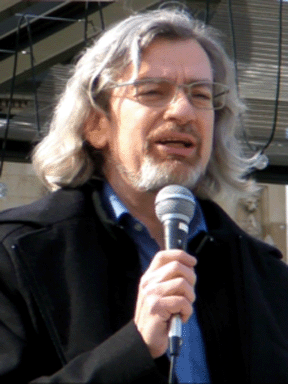 JOINT COMMITTEE ON THE FINDINGS OF THE NUCLEAR FUEL CYCLE ROYAL COMMISSION
If I could make a key point of guidance for the committee’s consideration and due deliberations and any recommendations that you would make, I draw your attention to the objects of the Nuclear Waste Storage Facility (Prohibition) Act 2000 which states:
…”to protect the health, safety and welfare of the people of South Australia and to protect the environment in which they live”…
The act then goes on to prohibit certain classes of nuclear waste storage and disposal facilities. I think that recommendation, those objects to protect the health, safety and welfare of the people of South Australia and the environment in which they live, should be the overriding guidance that this committee considers in how you address the findings of the nuclear royal commission and the business case as presented by the Jacobs Consultancy which is I think the primary matter that lies behind the nuclear commission’s findings and final report.
In my opinion, the nuclear commission, the findings and the final report, and the Jacobs Consultancy on which it is heavily reliant, present a number of assumptions which effectively mislead the public.
The project is projected to be at an inflated scale which has significant consequences both for the reality of the project but also for the claimed revenues. The revenues in this matter are a tonnage-based revenue multiplier. By Jacobs proposing that the world’s largest ever nuclear waste project in the world—the Yucca Mountain project in the USA, a project which failed and was cancelled by President Obama in 2009—could be doubled in scale has a significant question as to whether that is remotely reasonable, realistic, and whether that is a matter that effectively doubles the claimed revenues for the project. If this project had started with a proposal to equal the world’s largest ever proposed nuclear waste project, then the revenues would be half what they are presented in the report—half the numbers that are presented in the report—just on that step alone, that reality test of not exceeding what has ever been envisaged before in terms of scale of nuclear waste projects around the world. The project essentially also maximises aboveground storage, and I believe that compromises safety and it is an unnecessary step.
I believe that in a more realistic scenario, in more realistic time lines where this national matter—a matter that has no mandate to proceed—a matter that would not just realise bipartisan political support at state and federal level, it also needs to realise independent oversight and federal regulation. I believe it would have to be federal regulation and not state regulation. The state could be seen to have a significant conflict of interest in attempting to regulate this matter. Overseas players, whether it is the IAEA, client countries, and the public expectations in those countries, would reasonably expect as do the international conventions that such matters of highlevel nuclear waste be managed by a federal government and a federal authority, not by state.
I think that it is reasonable to project that that independent oversight would require a number of key steps and different time lines and different decision point assumptions than what are presented in the Jacobs report and the nuclear commission findings. The key one of those, I think, is that as an absolute minimum independent oversight would require that Australia not accept high-level nuclear waste prior to having an agreed licensed site for the potential geological disposal of that waste. That is a really key fundamental step that I believe public confidence, public consent, political support and independent oversight would rely on, not just in Australia but overseas through all the levels from consent of the state at a national and international level.
That one step alone—and I would consider that a four-year safety margin in the project that proposed imports could not be envisaged to be credible prior to what the project says is year 15 where they might first realise an agreed licensed site. That four-year safety margin actually realises a 40 per cent reduction in the claimed net present value of the project. A very small step, a very small initial step, in change of time line takes off 40 per cent of the claimed net present value the project is supposed to realise for South Australia………See: http://www.parliament.sa.gov.au/Committees/Pages/Committees.aspx?CTId=2&CId=333
Minerals Council of Australia spends up big to promote moribund uranium industry
 According to IBISWorld Australia’s uranium sector employs less than a thousand people and it generates around $700 million in sales. The uranium industry accounts for 0.01% (0.0084%) of jobs in Australia and in the 20131/14 financial year accounted for 0.19% of national export revenue. It is a sector that has promised much and delivered little.
But this hasn’t stopped the Minerals Council from pumping funds into poorly advised social and hard media campaigns of late to try to breathe life into the comatose uranium sector.
Australia’s nuclear-powered PR in meltdown, Independent Australia, 14 July 2016 With nuclear energy take-up shrinking post Fukushima, Australia continues to ignore the UN’s call for an independent cost-benefit analysis of our high risk-low return uranium trade. ACF’s Dave Sweeney examines the continuing spin by the MCA. “…… the changed status of Australia’s embattled uranium sector.
“Fukushima changed everything.” This might sound like a line from the anti-nuclear lobby but it is a direct quote from BHP, the world’s biggest miner. And they are right.
The Fukushima disaster was directly fuelled by Australian uranium and increasingly its impacts are being directly felt by the Australian uranium sector.
In the continuing shadow of Fukushima nuclear powers contribution to the global energy mix is shrinking and has been eclipsed by renewables, and with over 200 reactor shut-downs due by 2040, the industry will have to run hard just to stay put.
The related uranium market meltdown has been severe and seen prices, profits and employment numbers go south. Continue reading
Turnbull govt still backing Trans Pacific Partnership
Trans-Pacific Partnership: Trade Minister Steve Ciobo says he won’t give up on deal, Sydney Morning Herald, July 14 2016
The Turnbull government is refusing to give up on an ambitious 12-nation trade pact despite the prospect of a protectionist Senate and opposition in the US.
The Trans-Pacific Partnership: the dirtiest trade deal, you’ve never heard of
The upper house is shaping up to be difficult for the government’s free-trade agenda and its plans to ratify the Trans-Pacific Partnership. The Nick Xenophon Team, Pauline Hanson’s One Nation and Jacqui Lambie, considered either protectionist or anti-free trade, are readying to take their spots in the Senate.
Senator Xenophon said the government should throw in the towel on the TPP, which he believes will fail to deliver the promised benefits.
He fears the agreement will sacrifice tens of thousands of Australian jobs, accusing the government of failing to think through the real-life consequences.
But his most potent argument is that the deal could be dead in the water anyway given US presidential candidates Donald Trump and Hillary Clinton oppose it.
“Why are we jumping into this deal when whoever will be US president doesn’t want a bar of it?” Senator Xenophon told ABC radio on Thursday. However Trade Minister Steve Ciobo, who was in Washington this week to discuss the TPP, is not prepared to walk away.
But the minister was careful to pick up on the apparent rise of domestic scepticism on trade deals.
“I do appreciate that some Australians feel a little alienated by a globalised world, by a world in which currency flows, people flows, trade flows are happening at a faster rate than ever before,” Mr Ciobo told ABC TV.
“I don’t think you say it’s over till it’s over.”
He hopes the deal could at least be cleared at home with the help of the Labor Party. http://www.smh.com.au/federal-politics/political-news/transpacific-partnership-trade-minister-steve-ciobo-says-he-wont-give-up-on-deal-20160714-gq5ozu.html
Warning to Australia against being USA ‘deputy sheriff’ near China
Labor’s Bob Carr warns against ‘deputy sheriff’ military action in South China Sea, The Age, July 14 2016 Daniel Flitton Former Labor foreign minister Bob Carr has warned Australia risks looking like a US “deputy sheriff” should warships sail close to China’s artificial islands…….
“The plain fact is if Australia joined American patrols or ran patrols of its own that penetrated the 12-mile radius of Chinese-claimed territory, we would be the only American ally to do so,” Mr Carr told Fairfax Media.
China has denounced the ruling in the arbitration case brought by the Philippines as “null and void” and threatened to impose controls on aircraft over the disputed waters.
The territorial dispute has escalated in recent years after China seized control of coral atolls and tiny islands in waters claimed by the Philippines, dredging the sea floor to reclaim land and construct aircraft runways, which could serve as military bases.
Speaking from Beijing, Mr Carr said a diplomatic course was more likely to find a solution.
Asked about Senator Conroy’s comments, Mr Carr said Bill Shorten and shadow foreign affairs spokeswoman Tanya Plibersek had shown “realism” by supporting the diplomatic path.
“If our response to the arbitration were to immediately signal patrols that mimicked the American patrols, Australia would be one out among all American partners in the region. We’d look like the deputy sheriff,” he said…….http://www.theage.com.au/federal-politics/political-news/labors-bob-carr-warns-against-deputy-sheriff-military-action-in-south-china-sea-20160713-gq5arp.html
The People’s Solar at Melbourne’s Abbotsford Convent’s major crowd-funded solar energy project
 Australia’s Largest Solar Crowdfunding Campaign a Success, http://probonoaustralia.com.au/news/2016/07/australias-largest-solar-crowdfunding-campaign-success/ Pro Bono, Ellie Cooper, 14 July 16 For-purpose business, The People’s Solar has helped iconic Melbourne Not for Profit, the Abbotsford Convent raise $120,000 for its renewable energy project in the biggest crowdfunding project of its kind in Australia. The People’s Solar, part of Energy for the People, is a platform for delivering community-owned solar power to schools and Not for Profits.
Director and co-founder Tosh Szatow told Pro Bono Australia News this was the biggest solar crowdfunding project of its kind in Australia to date. It was also the largest project his business has been involved in.
“It’s really exciting. We’ve raised something like $250,000 now over two years, so the amount of money we’ve raised for projects has been doubling every six months, and that includes the project with the convent,” Szatow said. “We’ve now completed about 10 projects, it’s the biggest by some margin and it’s really confirmed for us that we can fund really big projects like this.
“And the other exciting thing is the organisations we’re working for would otherwise find it really hard to find the money to pay for solar power, and so it’s really great to know we’re able to help those organisations.”
The Abbotsford Convent, spread over 16.8 acres, has green space and historic buildings, which are said to house Australia’s largest multi-arts precincts. “It’s an iconic building in Melbourne… that’s really well loved by people in Melbourne, and the activities that are hosted at the convent are really important to the community,” Szatow said.
“As well as support for the creative arts and music, painting, sculpture and it’s a really valuable public asset. There’s a large green space which is a real oasis for people in that community. So there were a lot of reasons to get behind it.”
He said the $120,000 solar panel installation, half of which was crowdfunded through Pozible and the other half matched through a donor, would make a huge difference to the convent.
“It will save up to about $15,000 a year, and I believe that’s enough to fully fund the maintenance of their public open space so that’s all the gardening and upkeep on the gardens,” he said.
“So that’s a huge saving to their bottom line. And because it’s a Not for Profit organisation, it runs entirely on donations, saving that $15,000 every year is going to make a huge difference over the course of the panels lifetime.” The mission of Energy for the People is to help foster a “democratic” energy market where all Australians can access renewable energy. Szatow said The People’s Solar was started to focus on social impact and community benefit.
“[We were] talking with a lot of organisations that were struggling to find the money to go solar even though solar power has a pretty good financial payback. We were really looking for a solution to that,” he said.
“And I think more broadly there’s a really strong ethic in what we do with Energy for the People. We’re really keen to give back to the communities that we do work in, and solar is a really nice way of executing that and bringing together our skills and capability in clean energy with our interest and enthusiasm for the community side of things.”
USA’s and Russia’s provocative nuclear ‘war games’
 United States “playing nuclear chicken with Russia, http://www.b92.net/eng/news/world.php?yyyy=2016&mm=07&dd=12&nav_id=98588 “Helen Caldicott, the 1985 Nobel Peace Prize nominee, has warned about the danger related to the decisions made during a recent NATO summit. SOURCE: SPUTNIK TUESDAY, JULY 12, 2016 “The decisions reached at NATO are hardly believable considering current world politics and the state of play between Russia and the United States, both heavily armed nuclear nations… as they practice nuclear war exercises and ‘games’ adjacent to their respective borders,” she told Sputnik.
The two-day summit in Warsaw on Friday and Saturday approved the deployment of four battalions on Russian borders, made up of about 4,000 troops.
“Surely, the politicians and military personnel in Washington must realize that they are playing nuclear chicken with Russia,” said Caldicott, founding president of Physicians for Social Responsibility, and added:
“Large increases in NATO troops and equipment in countries once an integral part of the Soviet Union (and) anti-missile bases in Romania, Poland, Turkey and Spain, are extremely provocative to Russia which is clearly concerned for good reason.”
Sputnik noted in its report that Caldicott is the author of numerous books, including “The New Nuclear Danger: George W. Bush’s Military Industrial Complex,” and that the Smithsonian Institution named her “one of the most influential women of the 20th century.”
Indigenous opposition to the international waste dump plan
 Nuclear waste dump case unravels, World News Report, 13 July 16 , Green Left By Renfrey Clarke “……..Yankunytjatjara Native Title Aboriginal Corporation chairperson Karina Lester told a packed venue at a June 16 meeting: “The overwhelming majority of traditional owners … continue to speak out against establishing an international waste dump.”
Indigenous spokespeople have condemned the project since it was first mooted. In May last year, soon after the royal commission on South Australian involvement in the nuclear cycle began its work, representatives of 12 Aboriginal peoples met in Port Augusta.
 The gathering issued a statement that said: “South Australian Traditional Owners say NO! We oppose plans for uranium mining, nuclear reactors and nuclear waste dumps on our lands.
“We call on the Australian population to support us in our campaign to prevent dirty and dangerous nuclear projects being imposed on our lands and our lives and future generations.”
The prime site for the long-term waste repository is on the lands of the Kokatha people, near the towns of Woomera and Roxby Downs.
The Transcontinental Railway crosses the region and, as the Australian explained on June 27, the ancient rocks of the underlying Stuart Shelf are “considered by experts to have the best geological conditions for a nuclear dump”.
Early this year Dr Tim Johnson of the nuclear industry consulting firm Jacobs MCM told the royal commission his company envisaged a new port being built on the South Australian coastline to service the project. An interim storage facility nearby would hold newly-arrived wastes above ground for some decades, until they had cooled sufficiently to be transported by rail to the permanent dumpsite.
The only practical location for the port and above-ground repository would be on the western shore of Spencer Gulf, south of the city of Whyalla. Spencer Gulf is a shallow, confined inlet whose waters mix only slowly with those of the Southern Ocean. Any accident that released substantial quantities of radioactive material into the gulf would be catastrophic for the marine environment. Profitable fishing, fish-farming and oyster-growing industries would be wiped out, and the recreational fishing that is a favourite pastime of local residents would become impossible.
To connect the above-ground repository to the rail network, a new line would need to be built from the present railhead at Whyalla. Taking wastes north for permanent storage, trains would pass by the outskirts of Whyalla and Port Augusta.
Initially, the materials transported would be large quantities of low and intermediate-level waste, also planned for importation and burial. But after several decades, transport of high-level wastes would begin and would continue for another 70 years.
Awareness is growing in the Spencer Gulf region of the dangers posed by the nuclear industry. On June 24 in Port Augusta about 80 people took part in a protest against the federal plans to site a separate dump, for Australian-derived low-level radioactive wastes, near the Flinders Ranges’ tourist area………..https://world.einnews.com/article/334731841/OM4SBscz5Dp42697
South Australia Nuclear Energy Systems in talks with govt on a different nuclear waste import plan
 Mr Hundertmark said his firm’s plans were quite advanced and had already included talks with state and federal governments.
Push for high-level nuclear waste storage at Maralinga, former British atom bomb test site PAUL STARICK, CHIEF REPORTER, The Advertiser February 16, 2016 DUMPING imported high-level nuclear waste at Maralinga after shipping it through a deepwater port south of Whyalla is being pushed by a high-powered company.
In a multibillion-dollar plan similar to that recommended by the Nuclear Fuel Cycle Royal Commission, radioactive waste would be taken by rail to the former British atomic bomb test site.
SA Nuclear Energy Systems is proposing to bury the waste in giant pits, where soil and equipment contaminated during the British tests was stored in the 1990s, while the Royal Commission recommends underground storage.
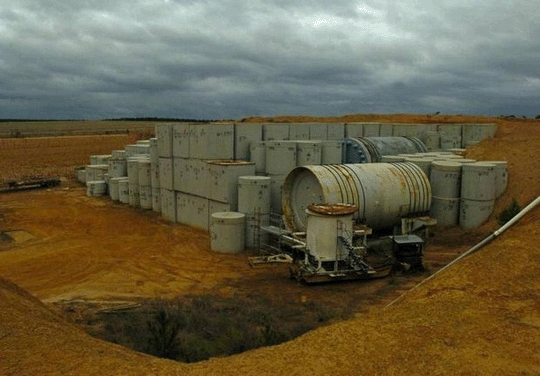
But the site criteria, such as its arid location free from seismic activity, is similar to that proposed by the Royal Commission, as is a dedicated port.
Where could a site go?
The company’s board includes former Premier’s Department chief Ian Kowalick, two Adelaide  University scientists and a former US nuclear industry executive. It is chaired by businessman Bruce Hundertmark……..In a submission to the Nuclear Fuel Cycle Royal Commission, Mr Hundertmark also highlights the fully operational air strip at Maralinga which is capable of receiving the heaviest transport aircraft……
Mr Hundertmark said his firm’s plans were quite advanced and had already included talks with state and federal governments, along with the area’s Aboriginal people, but would require state and federal legislative change.
He said his company’s plan could start far sooner than the late 2020s, because of the existing infrastructure, but did not specify a precise time frame…….http://www.couriermail.com.au/news/national/push-for-highlevel-nuclear-waste-storage-at-maralinga-former-british-atom-bomb-test-site/news-story/65d14a0d7c2f0daf90d7a5ef89da5e9f
Australia’s prominent role in USA’s web of climate denial

 US Senators detail a climate science “web of denial” but the impacts go well beyond their borders Australians have been both helpers and victims of the fossil fuelled web of climate science denial being detailed in the U.S Senate, Guardian, Graham Readfearn, 12 July 16, By the middle of this week, about 20 Democratic Senators in the US will have stood up before their congress to talk about the fossil fuelled machinery of climate science denial.
The Senators are naming the fossil fuel funders, describing the machinery and calling out the characters that make up a “web of denial”……
Australia has been a consumer, a contributor and a victim of the web of climate science denial.Australia has long provided personnel and contributors to the efforts of several of the key groups being named in the US Senate.
The late Dr Robert Carter, once of James Cook University, was an advisor and active contributor to several of the groups, including the Heartland Institute and the Science and Public Policy Institute (SPPI).
Malcolm Roberts (the wannabe One Nation Australian Senator) and bloggers JoNova and her husband David Evans have all written reports for the SPPI that claim human-caused climate change is some sort of elaborate hoax.
Retired Australian meteorologist William Kininmonth is also an SPPI science advisor.
Australian politicians have flown over to the United States to speak at conferences for climate science denialists hosted by the Heartland Institute – the group that once compared the acceptance of human-caused climate science to the values of terrorist and mass murderer Ted “Unabomber” Kaczynski.
Former Family First Senator Steve Fielding, current Liberal Senator Cory Bernardi and the current Nationals MP George Christensen have all spoken at Heartland’s conferences. The conferences themselves have been enthusiastically sponsored by several Australian groups over the years.
Australia’s role in the web of denial has been running since the 1990s, when groups like the CEI flew staff to Australia to firm up opposition to greenhouse gas regulations around the world.
Partnerships were formed with groups like the Melbourne-based Institute of Public Affairs, which has hosted and supported many visits from US-based climate science denialists.
Once here, those speakers will write columns for newspapers, do radio and television interviews and travel around the country to give talks.
In 2011 when the Gillard Government was trying to introduce laws to put a price on greenhouse gas emissions, the stopgillardscarbontax.com enlisted Pat Michaels, of the Cato Institute, as a science advisor. Cato is another member of the web of denial. Michaels once estimated that about 40 per cent of his funding came from the petroleum industry.
The impact of all this on the Australian public and the way the media covers climate science is clear.
There remains a split among Australians about the cause of climate change, despite multiple studies showing that more than 90 per cent of climate scientists are in agreement that it’s the burning of fossil fuels that’s driving up temperatures, fuelling weather extremes, raising sea levels, melting ice sheets and killing corals (and that’s just a few of the impacts).
The public becomes doubtful and the media, so often looking for controversy and conflict, has been a conduit for the fossil fuelled messages.
The fossil fuel companies, meanwhile, retain a grip on their so-called “social licence to operate.”
When Senator Whitehouse said the web of denial is “so big, because it has so much to protect” we might also think that we have so much to lose.
In failing to unravel the web of denial and by allowing our public discourse to be polluted by fossil fuelled PR outfits, ideologues and pseudo-science, who knows how much time we may have lost.
Twenty five years? https://www.theguardian.com/environment/planet-oz/2016/jul/12/us-senators-detail-a-climate-science-web-of-denial-but-the-impacts-go-well-beyond-their-borders
South Australian Labor’s push for nuclear waste importing is unravelling already
The case presented by the nuclear dumpsters is dissolving. Outspoken opposition from traditional owners is exposing, as a racist charade, the government’s attempts to manufacture “consent”.
The people of the upper Spencer Gulf cities will not be reconciled to having trainloads of lethal wastes rumbling past their doors for the next century. And the economic case for the dump scheme would merit an “F” in any respectable business course.
 Nuclear waste dump case unravels, World News Report, 13 July 16 , Green Left By Renfrey Clarke Armed with the findings of the Nuclear Fuel Cycle Royal Commission, South Australian Labor Premier Jay Weatherill is pressing ahead with plans to import as much as a third of the world’s high-level nuclear reactor waste and store it in the state’s outback.
There are compelling reasons to reject it. The project, it now emerges, could go ahead only over resistance from Indigenous traditional landowners, some of whom took part in the Lizard Bites Back convergence in early July.
There are serious environmental dangers in unloading the wastes, maintaining them above ground for decades while they cool and transporting them for final burial. Tens of thousands of people would be at risk.
Several devastating critiques have also shown that the economic case for the scheme is largely guesswork. Conceivably, the project would run at a loss — while burdening South Australians with the costs and dangers of tending to the world’s greatest single radiation hazard, effectively forever…….
Consultation?
Another element of the pro-nuclear “educational process” is to be the work of a “Nuclear Consultation and Response Agency” that will visit “all major regional centres, more than 50 remote towns and all Aboriginal communities” in a “dedicated program to ensure all South Australians can have their say about the state’s future involvement in the nuclear industry”.
There is no guarantee, however, that the massaging will work. For all the loot promised by the Advertiser, public opinion for and against the waste dump plan seems evenly split and active resistance is growing.
In mid-May Indigenous, health, union, faith and conservation groups joined in setting up a No Dump Alliance. On June 25, some 80 protestors heckled Weatherill as he arrived to address the opening session of his first “citizens’ jury”.
A 200-strong July protest at Roxby Downs, Lizard Bites Back, also condemned the government’s plan for a nuclear waste dump on Indigenous land. Spokesperson Nectaria Calan said the convergence was focused on the connections between uranium mining and nuclear waste. “A responsible approach to managing nuclear waste would begin with stopping its production”, she said.
The case presented by the nuclear dumpsters is dissolving. Outspoken opposition from traditional owners is exposing, as a racist charade, the government’s attempts to manufacture “consent”.
The people of the upper Spencer Gulf cities will not be reconciled to having trainloads of lethal wastes rumbling past their doors for the next century. And the economic case for the dump scheme would merit an “F” in any respectable business course. https://world.einnews.com/article/334731841/OM4SBscz5Dp42697
Uranium price slump further reduces ERA sales
 ERA uranium output slumps THE AUSTRALIAN JULY 13, 2016 Mill maintenance sharply reduced June quarter production by Ranger uranium miner Energy Resources of Australia.
Production for the period, characterised by a further fall in the already depressed spot price for uranium to $US26.40 a pound, slumped 18 per cent to 489 tonnes.
The 68 per cent-owned Rio Tinto subsidiary had been reduced to treating stockpiled material and was accumulating cash to cover the estimated rehabilitation cost of the mine, inside Kakadu, of more than $500 million.
Recently it reported it was holding cash of $433m, prompting Rio to offer a $100m credit facility to ensure rehabilitation costs were met…….
ERA had been planning to extend its mine life by developing the Ranger 3 Deeps deposit, but Rio and the traditional owners did not support the plan, meaning ERA’s existing Ranger authority to operate is set to end in 2021.
ERA has nevertheless preserved the option of an eventual development of Ranger 3 Deeps by committing to spending about $4m annually on care and maintenance of the exploration decline and related infrastructure.
The option was the key finding of the group’s strategic review, released in May, after it was clear the support of Rio and the traditional owners was not forthcoming.
Rio’s no-interest rehabilitation credit facility came with the condition that ERA did not seek to extend production at Ranger beyond 2020 by developing the Ranger 3 Deeps.
ERA previously said that while it expected to fully fund the rehabilitation, it might have to draw on the Rio funding in some situations…..http://www.theaustralian.com.au/business/companies/era-uranium-output-slumps/news-story/08e7df8b9a063dc6c8baa203d471f0ff
Indigenous rangers partner with scientists in researching coral bleaching
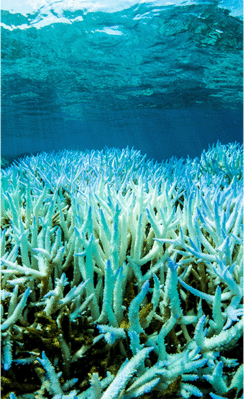 Indigenous rangers on the frontline of coral bleaching in remote Australia, ABC News By the National Reporting Team’s Kate Wild, 12 July 16 [Excellent pictures and video] In April this year Indigenous rangers from the Crocodile Islands received an alarming photograph of a coral reef off the coast of Arnhem Land. Leonard Bowaynu, who has fished the same reef since he was teenager, had seen small scattered patches of white coral before — but never anything this extensive.
“We used to go out, catch fish from the reefs. I never seen coral turning to white, like around the island or reef,” he said. Concerned by the image, rangers travelled to the area with a drone and GoPro camera to collect further evidence.
Michael Mungula said it was the first time Yolgnu people had seen the coral bleached white at that reef.
“At Murrangga [Island] we never seen white coral there before, during the 50s, 60s and 70s. But we seen it now, 2016.” “We need scientists to come here and do research in the Crocodile Islands,” Mr Mungula said. Meanwhile, 300 kilometres south-east, in waters around Groote Eylandt, Indigenous Rangers were watching giant clams turn white as well.
Anindilyakwa Rangers on Groote Eylandt began trialling the cultivation of giant blue-lipped clams (Tridacna squamosa) five years ago.
But in April the rangers noticed a number of the clams had turned white. Rick Taylor, the ranger manager, sent underwater footage of the clams to the ABC. He said it was first time he had seen the clams bleach since the trial was established in 2011.
With the two ranger groups’ permission, the ABC sent images of the Crocodile Islands coral and clams from Groote Eylandt to marine scientist Andrew Heyward at the Australian Institute of Marine Science.
Dr Heyward said the aerial photograph from the Crocodile Islands provided the first confirmation of a bleaching event in Arnhem Land. “It appears that in those areas checked it was severe,” he said. He said the photograph Crocodile Islands Rangers had received was confirmation of a massive bleaching event over the reef.
“The comments by the local rangers that they have never seen it [like this] before in their country is particularly telling that things are unprecedented, at least in human generational time frames,” Dr Heyward told the ABC……..
Skilled observers a precious commodity Dr Heyward said Indigenous rangers were able monitor environmental shifts in parts of the country most people cannot reach, and said he was keen for scientists and rangers to work together……Ranger groups have expressed enthusiasm for equal partnerships with scientists. http://www.abc.net.au/news/2016-07-11/indigenous-rangers-on-the-frontline-of-coral-bleaching/7557646
Enice Marsh at the Nuclear Citizens’ Jury – about the Federal nuclear waste dump
 “……..JUROR: Enice, you are representing all of the Adnyamathanha people.
Nuclear Waste Business Plan from Hell – South Australia

Blandy conveyed his objections to the royal commission — which substantially ignored them. Instead, the commission continued putting its trust in Jacobs MCM, which it had engaged to perform its financial modelling.
Jacobs, The Australia Institute notes, “consult extensively to the nuclear industry and have an interest in its expansion and continuation”
Nuclear waste dump case unravels, World News Report, 13 July 16 , Green Left By Renfrey Clarke “…….That the environmental and health risks posed by the international waste scheme are alarming and the economics could well be prohibitive are being ignored by the scheme’s supporters.
In its February “tentative findings” and in its May 9 final report, the state government’s royal commission set the hucksters drooling with its view that a high-level waste dump “could generate more than $100 billion income in excess of expenditure over the 120-year life of the project”.
Even this sum was too modest for the Murdoch-owned Adelaide Advertiser as it sought to herd public opinion behind the government’s plans. Working only from revenues and ignoring costs, the newspaper declared on February 17 that “a gigantic $445 billion would be pumped into the state’s finances over at least 70 years”.
The truth is that the economic case for the project rests on such wild assumptions that any competent entrepreneur would view it as a business plan from hell.
Hopes of a monster pay-out were savaged during March when The Australia Institute published a detailed analysis of the waste dump scheme.
Retired professor of economics Richard Blandy, the economic commentator for the Independent Daily, exploded the royal commission’s guesswork still more definitively on June 7.
The figure for net income of $100 billion, Blandy explained, was based on a completely fanciful estimate of the price that South Australia could expect to obtain for storing spent reactor fuel.
To obtain this estimate, of $1.75 million per tonne of heavy metal, the commission had assumed that the South Australian authorities of the future would have perfect knowledge of the maximum price that potential customers were willing to pay and that the state would face no competitors in the waste storage market-place.
The reality, as Blandy pointed out, is that India and China — to name just two countries — have extensive nuclear power industries and are highly likely to create their own waste repositories.
For these countries to add extra capacity to accommodate international customers would be relatively cheap — and much cheaper than could be managed by an Australian dump relying exclusively on imported waste.
The “$100 billion” figure also reflected an estimate that 37 countries that now have nuclear power industries — or that might someday set them up — would contract with South Australia to store 50% of their reactor waste.
But what if this estimate was grossly inflated?
If South Australia’s dump attracted only a quarter of the wastes targeted, Blandy calculated, and if the price received equalled the costs of building storage capacity in Sweden or Finland (costs, we must assume, that would be high compared to those in India or China) then the South Australian dump would lose money.
Blandy conveyed his objections to the royal commission — which substantially ignored them. Instead, the commission continued putting its trust in Jacobs MCM, which it had engaged to perform its financial modelling.
Jacobs, The Australia Institute notes, “consult extensively to the nuclear industry and have an interest in its expansion and continuation”…… plans.https://world.einnews.com/article/334731841/OM4SBscz5Dp42697
1 This month
17 October, Free Public Talk on Nuclear Issues in South Australia
David Noonan will speak on public interest concerns over the new Roxby Downs Indenture Act 2026 on BHP copper-uranium mining and ore processing in SA, and on how AUKUS may face SA with a High-Level nuclear waste agenda.
Dr Jim Green will discuss international developments in the field of nuclear power including ‘small modular reactors’ and Generation 4 ‘advanced’ nuclear reactor concepts.


Help Aunty Sue Protect Her Land and Sacred Sites From Destructive Rocket Testing.
.

Australians deserve the truth
about
AUKUS – https://aukuspublicinquiry.com/

PETITION – To: Prime Minister Anthony Albanese and the Australian Labor Government

of the week – Australians for War Powers Reform (AWPR)
To see nuclear-related stories in greater depth and intensity

