Queensland pioneers electric car chargers – free for public use
Queensland’s first solar-powered electric car chargers available and free for public use http://www.abc.net.au/news/2016-04-07/qld-first-solar-powered-electric-car-chargers-free-for-public/7307430 By Lexy Hamilton-Smith Queensland’s first solar-powered electric vehicle chargers have been installed on campuses of the University of Queensland at St Lucia and Gatton.

They charge 10 times faster than a home charger and will be free for public use. About 15 minutes of charging can provide a range of up to 70 kilometres.
UQ manager of Energy and Sustainability Andrew Wilson said it was a game changer.”The first inter city charger in Queensland enabling long distance electric vehicle travel outside of the city,” he said.”Hopefully this is the start of an electric vehicle highway throughout the state.”
Energy Minister Mark Bailey said sales of electric cars were currently slow, but said the Government would look into how it could develop the sector. “It is a bit like the chicken before the egg,” he said.
Electric cars start from around $50,000 but one sport version is selling for more than $400,000.
Tritium, which designed and built the Veefil charger in Brisbane, said the initiative would kick-start the electric vehicle revolution in Queensland. “It allows easy inter-city electric vehicle travel between Brisbane and Toowoomba,” chief executive David Finn said.
Mobile solar system – a boon to off-grid users
the combination of the financial and carbon benefits of solar with the flexibility and modularity of conventional diesel or gas power was “music to the ears” of off-grid electricity consumers. Systems can be provided on offtake agreements as short as five years
Mobile solar to take on diesel power http://www.smh.com.au/business/energy/mobile-solar-to-take-on-diesel-power-20160406-go0cbe.html April 8, 2016 Angela Macdonald-Smith Energy Reporter
Laing O’Rourke has successfully piloted a mobile solar-diesel project and is set to roll it out commercially under new subsidiary SunSHIFT, writes Angela Macdonald-Smith. Making solar power a realistic economic option for short-term projects that would otherwise wholly rely on polluting diesel energy is the mission of a new mobile solar system to be commercially rolled out by construction company Laing O’Rourke.
Outback mining sites, remote communities and disaster relief projects are all potential users of the system, which has been developed with the help of funding from the Australian Renewable Energy Agency.
The Australian arm of UK-based Laing O’Rourke has successfully piloted the moveable solar system, which it combined with diesel power back-up, and has set up a new clean energy business, SunSHIFT Pty, to commercialise it.
Plans for the launch of the system on the market are to be officially announced on Friday and Laing O’Rourke said it had already fielded inquiries for “multi-megawatt” systems, including some from  emerging overseas economies.
ARENA chief executive Ivor Frischknecht said the plant’s ability to be rapidly set up, relatively cheaply moved and easily scaled up made it suitable for many off-grid applications where power was needed for only a few years. Continue reading
Science for The Public Good: if not CSIRO – then who?
If the CSIRO won’t do research for the public good, who will?, The Age, April 7, 2016 Les Field
Australian society will be the biggest loser if the organisation is forced to abandon its blue-skies work. Scientists in Australia’s universities and research organisations are responsible for ground-breaking inventions such as the world’s first effective influenza drugs; smart mathematics that enabled superfast Wi-Fi and the bionic ear. These have also been resounding commercial successes, and show that local discoveries can be profitable.
Government policy emphasises the importance of commercially focused research and rightly encourages researchers to fully capitalise on their discoveries. But, in our focus on innovation geared towards commercialisation, have we overlooked the tremendous value to our community of research done in the public interest?
It is in this context that the emails sent between CSIRO executives revealed this week are worrisome. The email trail suggested that, in early stages of planning, there was a contemplation of removing all public-good climate research from CSIRO – that “public good” was not considered to be sufficient reason for CSIRO to be carrying on research. While it is important to realise that CSIRO’s priorities will rightly change from time to time to reflect the challenges facing Australia, this sentiment does raise some difficult questions about its role in Australia’s overall science and research effort.
Some of the most critical challenges our society faces – such as combating epidemics of chronic disease or finding ways to better predict natural disasters, or improving our ability to live the good life while caring for our environment – have almost no prospect of generating a commercial return. Yet every Australian would attest to their importance, and recognise that research in these areas contributes greatly to the welfare of the community………
The larger question that must be asked is that if CSIRO is no longer to consider public-good research as a valid endeavour, then who does? Australia’s science and research effort is made up of many players, who all have distinct roles. A substantial contribution to public interest research is made by our universities, who produce much of the fundamental knowledge that innovations are based upon. However, most university researchers work on relatively short projects, dictated by grant cycles……
It is also important to consider that, in the absence of co-ordinated public-interest research, who will investigate uniquely Australian problems? Without the knowledge and expertise of CSIRO’s animal health laboratories, would we today have the vaccine to the Hendra virus that can prevent its passage from bats to horses and then to humans? Who could provide us with a picture of the sustainable limits of water use in the Murray-Darling river system? Who can tell us about the likely impacts of long-term climate change on our coastal cities and our vital agricultural industries? http://www.theage.com.au/comment/if-the-csiro-wont-do-research-for-the-public-good-who-will-20160407-go0p4r.html#ixzz45GxrXlQX
BHP Billiton in the Panama corruption papers
BHP Billiton And Wilson Security Linked To Panama Papers 04/04/2016. BHP Billiton, Wilson Security and a major electricity company in Australia are now targets of the Australian Tax Office, after leaked documents linked all three companies to a law firm in Panama and the British Virgin Islands. http://www.huffingtonpost.com.au/2016/04/04/bhp-biliton-wilson-security-panama-papers_n_9607990.html
Panama Papers: Australian companies BHP, Wilson security caught up in tax probe April 5, 2016. More than 800 wealthy Australians are being investigated by the Australian Taxation Office over their dealings with a secretive Panama-based law firm used by the rich to hide money.
BHP Billiton and a security firm that guards major government buildings are among hundreds of Australian names linked to a Panama law firm that helps the rich hide money. …
Four Corners claimed that BHP used Mossack Fonseca offices in the British Virgin Islands to register five companies linked to its aluminium, diamonds, steel and finance arms. http://www.sbs.com.au/news/article/2016/04/04/panama-papers-australian-companies-bhp-wilson-security-caught-tax-probe
Panama Papers Update: Law Firm Mossack Fonseca Listed BHP Billiton’s Two British Virgin Islands Companies As ‘Mandatory High Risk’ April 4, 2016. Panama-based law firm Mossack Fonseca, which is at the center of a massive leak, assessed BHP Billiton Ltd.’s two companies in British Virgin Islands as “mandatory high risk” after the Anglo-Australian mining giant authorized the businesses to receive huge sums of money, the Guardian reported Monday. The exposé related to Mossack FonsecaSunday revealed widespread international corruption connected to offshore tax shelters. http://www.ibtimes.com/panama-papers-update-law-firm-mossack-fonseca-listed-bhp-billitons-two-british-virgin-2347746
The Panama Papers: BHP Billiton’s face-off with Mossack Fonseca April 4, 2016. A financial representative for BHP Billiton threatened to fire notorious Panamanian law firm Mossack Fonseca if it went ahead with a due diligence investigation. http://www.afr.com/news/policy/tax/the-panama-papers-bhp-billitons-faceoff-with-mossack-fonseca-20160329-gntasr
BHP-owned companies triggered ‘high risk’ alert at Panama law firm April 4, 2016. Mossack Fonseca flagged concerns about two of mining giant’s companies in British Virgin Islands because ‘authorised capital is higher than the norm’ http://www.theguardian.com/news/2016/apr/04/bhp-owned-companies-triggered-high-risk-alert-at-panama-law-firm
Panama Papers: ATO investigating more than 800 Australian clients of Mossack Fonseca April 4, 2016. The Australian Taxation Office is investigating more than 800 high net wealth Australian clients of the controversial Panama law firm Mossack Fonseca, which is the focus of an unprecedented leak of tax haven records released globally.
More than 11.5 million documents have been leaked from Mossack Fonseca’s files, revealing the secrets of hundreds of thousands of clients – including several thousand Australians – covering a period over almost 40 years, from 1977 until as recently as last December.
The release of the documents on Monday follows a 12-month investigation by media groups including The Australian Financial Review, led by the International Consortium of Investigative Journalists (ICIJ) in Washington. http://www.smh.com.au/business/banking-and-finance/panama-papers-ato-investigating-more-than-800-australian-clients-of-mossack-fonseca-20160403-gnxgu8.html
Australian companies, taxpayers exposed after Panama Papers leak April 5, 2016. Australian companies BHP Billiton and Wilson Security are among those named in the massive document leak, detailing tax dealings of companies and people from around the world.
The cases are part of a leak of 11.5 million documents from Panama-based firm Mossack Fonseca, which reveals how the rich, including political leaders such as Russian President Vladimir Putin, hide their money. https://au.news.yahoo.com/thewest/a/31269205/australian-companies-taxpayers-exposed-after-panama-papers-leak/
Australian companies BHP Bilton and Wilson Security among those named in Panama papers leak exposing the use of offshore tax havens
- Australian Tax Office is investigating dealings of 800 high net individuals
- It follows massive leak of Panama papers from law firm Mossack Fonseca
- Secret documents show how law firm allegedly helped clients evade tax
- Treasurer Scott Morrison says government is cracking on tax avoidance
The Australian Taxation Office is investigating more than 800 Australians after a massive leak of financial data revealed how 12 current or former world leaders, a host of celebrities and the global rich are using offshore tax havens to hide their wealth.
Australian-linked organisations and business leaders named in the huge leaks include BHP Billiton, Wilson Security, Gold Coast based company director Ian Taylor, and Hong Kong’s richest man and Australian energy market owner Li Ka-Shing, ABC’s Four Corners reports. http://www.dailymail.co.uk/news/article-3522798/Australian-companies-BHP-Bilton-Wilson-Security-named-Panama-papers-leak-exposing-use-offshore-tax-havens.html
6 April – 6 May : Assessing the Nuclear Fuel Chain Royal Commission before its results are released on 6 May
 It’s one month until the South Australian Nuclear Fuel Chain Royal Commission will announce its findings. And everyone knows what they will be – “nuclear waste importing will be a bonanza for South Australia”
This is the first of the significant posts that will appear on this site each day, ,until 6th May.
Kevin Scarce has dismissed opposition to the plan as largely “emotional”, not “factual” . I suspect that will be the way in which the Commission will deal with the opposing Submissions. Here’s today’s:
The Greens SA’s submission to the Nuclear Royal Commission’s Tentative Findings rejects the suggestion that an economic bonanza awaits our State if South Australians would only resign ourselves to becoming the world’s nuclear garbage bin.
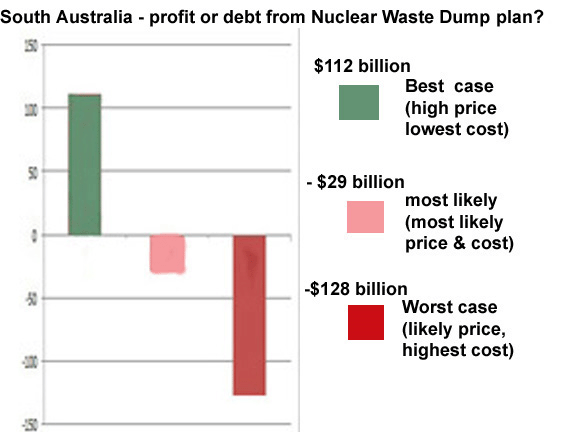
“The Royal Commission has been blinded by imaginary wealth and sucked into believing that a project that has never succeeded anywhere else in the World is South Australia’s for the taking”, said Greens SA Parliamentary Leader, Mark Parnell MLC.
“The most obvious question is being ignored: If this is such a great deal, how come no other country has grabbed it before now?
“The Greens are urging the Royal Commission to “get real” and critically examine the supposed economic benefits alongside the ongoing economic, social, environmental and reputational costs.
“Washing your hands of responsibility for a toxic legacy left to future generations is just immoral.
“The solution to South Australia’s current unemployment problems won’t be solved with mythical jobs that are decades into the future with the creation of toxic liabilities that last hundreds of thousands of year.
On releasing the “Tentative Findings” Report to the media on 15th February 2016, Commissioner Kevin Scarce stated, “The community needs to understand the risks and the benefits.” The Royal Commission’s “Tentative Findings” highlights many purported benefits but is scant on detail when it comes to the profound risks.
According to the Greens’ submission, the “Tentative Findings” suffer from:
1.Unrealistic expectations of the magnitude of the project;
2.Failure to appreciate 6 decades of international failure to solve the nuclear waste problem;
3.Missing costs, unfunded liabilities, missing contingencies and failure to recognise inevitable cost blow-outs
4.Heroic assumptions of other countries’ willingness to pay for SA to take their nuclear waste;
5.Lack of recognition of the potential for irrecoverable sunk costs and unlimited future liabilities;
6.Failure to address reputational damage and impact on other sectors of the economy; and
7.Naïve expectations that South Australia would get to keep all the profits from a nuclear waste dump in our State, without having to share them with other States.
“The Commission’s final report due on 6th May should recommend that the folly of South Australia’s increased involvement in the nuclear industry be abandoned.
“In relation to the other Terms of Reference, increased uranium mining, uranium processing or nuclear power were never really an option for SA and the Royal Commission was an expensive way to tell us what we already knew”, concluded Mark Parnell.
Kevin Scarce bemoans the “emotion” and “opinion” of opponents of nuclear waste dump
 Wealth beyond measure? Scarce commission backs SA nuke ‘dump’ Tom Richardson, INDaily, 11 Feb 2016 “…… “This commission is not driven by emotion or opinion,” Commissioner Kevin Scarce told reporters today. However, he conceded emotions and opinions would be divided by his findings on nuclear storage.
“The debate has been formed upon fear,” he said……..
Under questioning, however, he bristled at the use of the term “waste dump”, saying he “wished people would stop using” it.
“It’s a sophisticated engineering site… it has no bearing whatsoever on a dump,” he said. The case for nuclear waste storage was overwhelmingly the strongest of the four terms of reference considered, with Scarce finding nuclear electricity generation “would not be commercially viable in the foreseeable future… taking account of future demand and anticipated costs”……..
Greens MLC Mark Parnell insisted the economic case was flawed and “illusory”, because it only analysed the short-term benefits, rather than long-term environmental damage and reputational risk.
“If it looks too good to be true, it probably is,” he said, ignoring Scarce’s distaste for the terminology.
“A dump is a dump is a dump… if it looks like a dump and serves the purpose of a dump – it’s a dump.”…….
The commission has cost $5.5 million since it was established last year, but Scarce said that would be “value for money if the community has the opportunity to consider the facts”….
Dr Jim Green from Friends of the Earth denounced the commission’s “optimistic view of potential profits”. “Costs are likely to be astronomical, even over relatively short timeframes… just to build a repository would cost A$39 billion, according to the latest estimate in France, or A$43 billion according to an estimate from Japan,” Green said. ra ra http://indaily.com.au/news/2016/02/15/wealth-beyond-measure-scarce-commission-backs-sa-nuke-dump/
Carmichael coal project – the whitest of white elephants
 Adani’s Carmichael mine is just not going to happen, The Age, April 5, 2016 Michael West Business columnist Adani is not going to happen; the construction, that is, of the leviathan Carmichael mine, the world’s largest thermal coal mine in the hinterland of the Great Barrier Reef.
Much is the wailing and gnashing of teeth at the move by the Queensland government to approve the project but this approval is entirely political.
The evidence is compelling. Carmichael is the whitest of white elephants.It is all about the appearance of commitment to jobs, jobs that will never occur unless the coal price doubles, and it is about the government not getting bashed up by the opposition for being anti-jobs and abandoning its election commitments.
Even Adani is coy. No sooner had the Indian conglomerate been granted approval than it deferred the project for another year. Buried in the detail of its press release was this: “opportunity for final investment decision and construction in 2017”.
Reaching “final investment decision” would require willing financiers with a cool $10 billion just for Phase One. But Adani’s bankers have long since fled the scene.
There would be no taxpayer support nor “dredging [of the reef] at Abbot Point [port] until Adani demonstrates financial closure,” said Resources Minister Anthony Lynham.
The head of the world’s biggest power provider, chairman Liu Zhenya of China’s State Grid Corporation, recently told a US energy conference the ramp-up of renewable energy and ongoing integration of wind and solar power projects into the grid were gathering pace.
“A fundamental solution [to address power needs and climate change] is to accelerate clean energy,” Liu told his audience of energy executives. The eventual aim was “replacing coal and oil”.
The Panama Papers: The files reveal the darker side of the BHP Billiton merger
 The Panama Papers: The files reveal the darker side of the BHP Billiton merger
The Mossack Fonseca files raise questions about the 2001 merger between South African miner Billiton Plc and BHP Ltd— beginning with how dependent the British arm of the big miner has become on tax-free profits from its Singapore marketing hub to pay dividends. (subscribers only)
http://www.afr.com/news/policy/tax/the-panama-papers-what-the-files-reveal-about-the-billiton-merger-20160404-gny1fo#ixzz44tblBLDa
Roundup of news on the Panama global financial corruption scandal
 Panama Papers: Mossack Fonseca labels leak a ‘crime and attack’The revelation of the Panama Papers detailing the off-shore structures of many wealthy clients is a “crime” and an “attack” on Panama, the law firm at the heart of the scandal has said.http://www.abc.net.au/news/2016-04-04/mossack-foncesa-says-panama-papers-a-crime-and-attack/7296858
Panama Papers: FIFA officials, Lionel Messi, Michel Platini named in secret offshore files Disgraced FIFA officials, suspended UEFA chief Michel Platini and Barcelona superstar Lionel Messi were amongst the names found the Panama Papers — leaked documents which reveal offshore financial dealings of the world’s rich and famous.http://www.abc.net.au/news/2016-04-04/fifa-officials-and-lionel-messi-named-in-offshore-files/7296140
Panama Papers leak: Australian security company Wilson linked to Hong Kong corruption scandalLeaked documents have revealed that two brothers embroiled in a massive Hong Kong corruption scandal were ultimately in control of an Australian security company that earned roughly half a billion dollars in lucrative government contracts.http://www.abc.net.au/news/2016-04-04/australian-company-wilson-linked-to-hong-kong-corruption-scandal/7291178
Panama Papers: Tax office investigating 800 Australians identified in financial record leak The Australian Tax Office (ATO) is investigating 800 Australian residents named in a massive leak of tax and financial records known as the Panama Papers. http://www.abc.net.au/news/2016-04-04/tax-office-investigating-800-australians-in-panama-papers-leak/7296512
Panama Papers: Iceland PM Gunnlaugsson urged to resign amid Mossack Fonseca data leak By International Consortium of Investigative Journalists and ABC staffPressure is mounting for Iceland’s Prime Minister to resign after an unprecedented leak of data revealed accusations he used an offshore company to hide millions of dollars in investments in Iceland’s major banks.http://www.abc.net.au/news/2016-04-04/iceland-pm-urged-to-resign-amid-panama-papers-scandal/7295742
Panama Papers: Vladimir Putin associates, Jackie Chan identified in unprecedented leak of offshore financial records An unprecedented leak of more than 11 million documents has revealed the hidden financial dealings of some of the world’s wealthiest people, as well as 12 current and former world leaders and 128 more politicians and public officials around the world.http://www.abc.net.au/news/2016-04-04/unprecedented-leak-of-offshore-financial-records-exposes-secrets/7293524
The International Consortium of Investigative Journalists (ICIJ): The Panama Papers: Exposing the Rogue Offshore Finance Industry Leak of more than 11 million documents show heads of state, criminals and celebrities using secret hideaways in tax havens.https://panamapapers.icij.org/
Panama Papers: Greens call for Wilson Security to be stripped of contracts after corruption scandal links exposedThe Greens have called on the Federal Government to strip Wilson Security of its contracts for offshore immigration detention centres after revelations the company has links to a Hong Kong corruption scandal. http://www.abc.net.au/news/2016-04-05/greens-call-for-wilson-security-sacking/7299736
Panama Papers: Here’s who has been caught in the fallout of the Mossack Fonseca leak The unprecedented leak of more than 11 million documents from Panamanian law firm Mossack Fonseca has revealed some of the hidden financial dealings of the world’s rich and powerful.
Here’s a look at some of the more high-profile people feeling the heat after the scandal broke.http://www.abc.net.au/news/2016-04-05/who-has-been-caught-in-the-panama-papers-fallout/7299666
Panama Papers: Iceland PM Gunnlaugsson refuses to resign over tax leaks; protesters take to streets Iceland’s Prime Minister is refusing to resign after leaked tax documents known as the Panama Papers revealed accusations he and his wife used an offshore firm to allegedly hide million-dollar investments. http://www.abc.net.au/news/2016-04-05/icelandic-pm-refuses-to-resign-over-panama-papers-leak/7298944 (Actually I think that he has now resigned)
Panama Papers: Fraudsters, former tax officials among Australians identified in Mossack Fonseca leak Convicted fraudsters, directors banned by the corporate regulator and former Australian Tax Office (ATO) officials are among hundreds of Australians linked to companies incorporated by Panamanian law firm Mossack Fonseca. http://www.abc.net.au/news/2016-04-05/australians-identified-in-mossack-fonseca-panama-papers-leak/7297964
(Read more about this investigation by ICIJ journalists and more than a hundred other media partners at:https://panamapapers.icij.org/about.html – and check out the videos and reading list.)
Medical education now addressing radiation risk with medical imaging
 30376 – Radiation protection of the patient, RACGP March 16 Gplearning
Many medical imaging procedures involve exposure to ionising radiation. The immediate and long-term benefits of these procedures are widely understood. However, in clinical settings, both referring and radiological medical practitioners often have limited awareness of the actual doses of radiation and risks involved.
While risk associated with any single procedure is likely very small, the cumulative effect of frequent, often repeated and potentially inappropriate radiographic imaging presents a real public health concern for risks such as radiation-induced cancer.
This activity will cover the measurement of radiation associated with medical imaging; the effects of radiation exposure; the radiation associated with specific imaging procedures; and issues in clinical decision making, including evidence based medicine and risk communication.
The premise of justification is simple: the benefit of the test must outweigh the harm. In clinical practice, the process of justification is often less clear.
GPs are responsible for more imaging referrals than any other group. Most of these referrals are justified (the benefits far outweigh the risks) however, recent reviews suggest that between a significant number of medical radiation exposures may be unnecessary.
This activity will discuss the radiation associated with specific imaging procedures; and issues in clinical decision making, including evidence based medicine and risk communication. …….http://www.racgp.org.au/education/courses/activitylist/activity/?id=32177
Bureau of Meteorology might be able to take over CSIRO’s lost climate research
 Bureau of Meteorology plan to take over CSIRO climate change research, The Age, April 5, 2016 Adam Morton, Peter Hannam, The Bureau of Meteorology has offered to save climate research that CSIRO plans to axe under a plan that would see long-term programs and dozens of jobs transfer between the two national science agencies.
The proposal, discussed at a meeting convened by chief scientist Alan Finkel last month, is the most concrete of several ideas thrown up by the scientific community in a bid to retain internationally respected climate researchers and data collection.
Scientific agencies were taken by surprise when CSIRO chief Larry Marshall announced in February that the organisation would stop climate data collection as it re-positioned itself as an “innovation catalyst”, focusing on work that was financially attractive to government or private partners.
The recasting of the century-old Commonwealth Scientific and Industrial Research Organisation, initially linked to about 350 job cuts including up to 100 climate scientists, has drawn criticism from some research institutions in Australia and overseas.
It is understood the Bureau of Meteorology put forward two proposals that would see it hire either 40 or 50 CSIRO scientists as it took on more climate measurement and modelling – but was contingent on additional funding to pay for them. CSIRO is yet to respond in detail……….. Continue reading
Traditional Owners Wangan and Jagalingou condemn Queensland’s decision to approve Carmichael coal mine
 QLD Mines Minister Lynham’s Adani mine approval shows gutless and morally bankrupt approach of Government to Traditional Owners’ rights Wangan & Jagalingou Family Council 3 April 06:
“Minister prefers Adani’s misleading and inflated jobs figures to respect for the law and human rights, say Wangan and Jagalingou people
The Wangan and Jagalingou (W&J) people today responded to the announcement by QLD Mines Minister Anthony Lynham that he is issuing mining leases to Adani for the Carmichael coal mine. The coal mine is the biggest proposed in Australian history and if built will permanently destroy the W&J’s vast traditional homelands in the Galilee Basin.
W&J spokesperson and traditional owner Adrian Burragubba said, “This is a disgraceful new low in the exercise of Government power at the expense of Traditional Owners’ rights. Minister Lynham and Premier Palaszczuk should hang their heads in shame. History will condemn them.
This is the wrong mine, at the wrong time, on the wrong side of history. Their actions are reckless and dishonourable. “In October 2015 Minister Lynham confirmed in a letter to our legal counsel that he would await the outcome of our Federal Court action against the mine before considering issuing the leases. Late last year and again this year he said he would wait for the matters before the courts to be resolved so as not to run the risk of having his decision invalidated.”
Mr Burragubba’s legal representative and human rights lawyer,
Benedict Coyne of law firm Boe Williams Anderson, said…http://wanganjagalingou.com.au/gutless/
Political terms versus environmental time-lines – the South Australian nuclear waste folly
Saving the Environment or Centralized Control of a Monopoly in Power (Electricity)? Pan Chemistry, Gareth Lewis 03/03/15 “………Political terms versus environmental time-lines 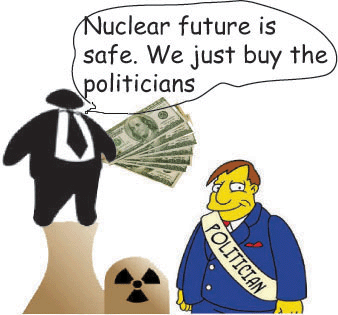 This section raises an important point with environmental issues or challenges: the short duration of political terms (often three to six years) limits the amount that can be done in the field of environmental protection. This means that global problems, such as air pollution and global warming that have no geographic boundaries and are likely to be long-term challenges may not be attempted. Even ‘smaller’ challenges like preserving the Great Barrier Reef and ensuring the viability of water supply and usage along the River Murray cannot be addressed in any one political term (nor have they been): there’s just insufficient time and funds to do so. Additionally, the political fallout from such ventures may not ensure the duration of the political term (a political paradox). A case could easily be argued that such issues should be written into Federal politics and once initiated they should go ahead regardless of the social and political climate.
The proposed nuclear industry and global radioactive nuclear waste dump in South Australia is similarly a complex issue and will affect many generations to come. However, given the comparatively simple challenge of managing water supply and usage along the Murray River how likely is it that a proposed nuclear industry would be managed efficiently? I am not being overly ‘emotive’ here, I’m simply saying this: any proposed nuclear industry will ‘outlive’ a Royal Commission, a State and Federal Government and all of us! So; very careful consideration is needed, not only for the current generation of Australians, but for future generations who will not have a say in the decision making process that will determine the cleanliness and viability of ‘their’ environment………
Is the notion of establishing a nuclear industry in South Australia really about centralized control in the creation and distribution of energy (electricity)?
A skeptic  could easily argue that the use of nuclear energy has nothing at all to do with ‘saving the environment:’ but that it’s really about centralized control in the production and sale of electricity in a monopoly system. After all, it’s easy to control a centralized supply and demand system, and it’s exactly what we have in place today in the world-wide production and sale of fossil fuels.
This notion of ‘centralized control’ is a whole topic in itself and is beyond the scope of the original question: ‘should a nuclear industry (uranium mining, sale of uranium and storage of global radioactive nuclear waste) be established in South Australia. My personal opinion (emphasis) and answer to this question at this time is no. I believe we have sufficient solar energy and land mass in Australia to develop and perfect the solar cell industry and such technology could then be licensed and sold overseas. Besides, the success of this approach has been clearly demonstrated in other countries, many of which have far less sunshine and land mass than Australia.
Additionally, the inherent risks of initiating what may be an untethered proliferation of nuclear (fission) power plants has also been demonstrated in the past at Chernobyl and Fukushima, with close calls in Long Island. However, what has not been demonstrated (thankfully) is what could happen to our environment (groundwater and surrounds) if global radioactive nuclear waste was compromised in transit or in storage by man-made or natural means. It remains to be seen whether the proposed Royal Commission will make the ‘right recommendation’ to the government in South Australia that will benefit and protect not only the current generation, but also of many future generations of Australians: so; fingers crossed :-\ 😉 http://www.gareth-panchem.com/347345675?pagenum=2
Queensland government takes an evil decision on Adani’s Carmichael coal mine
 Decision on coal mine ‘defies reason’ April 4, 2016 Tim Elliott Features and investigations journalist for The Sydney Morning Herald
The decision on Sunday to approve mining leases for Queensland’s Carmichael coal mine is akin to “evil”, according to one of the world’s foremost marine scientists.
“It defies reason,” said Dr Charlie Veron, former chief scientist at the Australian Institute of Marine Science. “I think there is no single action that could be as harmful to the Great Barrier Reef as the Carmichael coal mine.”
The $21.7 billion project, which involves mine, rail and port facilities, would allow Indian multinational Adani to extract 60 million tonnes of thermal coal a year from the Galilee Basin, in central Queensland. Adani claims the mine will generate 5000 jobs during construction and more than 4000 during operation, with construction to begin next year……..
conservationists say the mine is an environmental disaster waiting to happen, citing particular risks to the Great Barrier Reef.
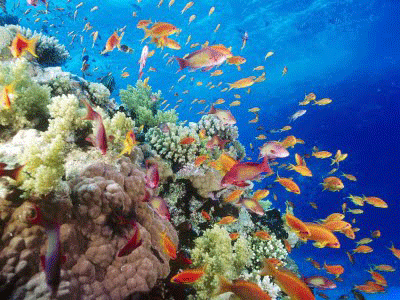 “It’s an extraordinary decision, especially coming at a time when the Great Barrier Reef is experiencing its worst ever coral bleaching event,” Australian Conservation Foundation chief executive Kelly O’Shanassy said. “We know the bleaching is because of global warming, and Carmichael will only make that worse.”
By Adani’s own figures, the mine and its coal will emit more than 4.6 billion tonnes of carbon dioxide over its lifetime. “The pollution from this mine is so big that it cancels the pollution cuts the Turnbull government committed to at the Paris Climate Summit,” Ms O’Shanassy said.
The impact of such emissions could be terminal to the reef, according to Dr Veron. “The reef is obviously in dire straights, irrespective of what anyone says, and that’s blindly obvious.
“There is extraordinary disconnect between science and the political action. Politicians think the mine is good because it’s good for economy, but we are selling out the next generation of Australians as fast as we can go.”
Dr Veron has devoted his life to studying coral reefs: he discovered more than 20 per cent of the world’s coral species, and has been likened by Sir David Attenborough to a modern day Charles Darwin.
“Roughly a third of marine species have parts of their life cycle in coral reefs,” Dr Veron said. “So if you take out coral reefs you have an ecological collapse of the oceans. It’s happened before, mass extinctions through ocean acidification, and the main driver of that is CO₂.”
Dr Veron recently travelled to Canberra to talk to government about the decline in the reef. “The politicians do listen to scientists, but that is the worst part of it,” he said. “If this was all done out of sheer ignorance, that is sort of understandable. It’s like child porn – you might say you don’t know it exists, but if you know it exists and you do everything to promote it, then that’s evil.”…….
Australian Institute of Marine Science principal research scientist Dr Frederieke Kroon has told the ABC that government policies designed to keep the reef on UNESCO’s World Heritage list are insufficient.
“Our review finds that current efforts are not sufficient to achieve the water quality targets set in the Reef 2050 Plan,” she said. http://www.smh.com.au/federal-politics/political-news/decision-on-coal-mine-defies-reason-20160403-gnxbc6.html#ixzz44p5A45Es
The global oil corruption scandal and Australia’s role in it
UNAOIL Why we Must Act , The Age, Nick McKenzie, 2 Apr 16 Australia is leagues behind the US when it comes to investigating corrupt multinational companies who bribe their way to success in third world countries.
This fact is even more concerning given that US prosecutors acknowledge that even they aren’t getting it right, and need to do more to send US corporate crooks to jail. If the US regime needs a jolt, Australia’s system needs a triple bypass.
Recently, when the CEO of the Australian Securities Exchange, Elmer Funke Kupper, stood down to deal with a police investigation over an alleged international bribery case, we even had the corporate cop saying what a “sad loss” it was.
Not a single Australian executive has been jailed for paying a bribe overseas, despite the introduction in 1999 of specific laws banning this practice…….
Unaoil is a Robin Hood in reverse. On steroids. It robs the poor of oil-rich nations such as Iraq, Libya, Angola and Iran. The citizens own the resources beneath their feet, but the money from exploiting them ends up lining the pockets of executives and crooked officials.
Among the Australian firms exposed in the leaked trove of documents is Leighton Offshore, the overseas arm of construction giant Leighton Holdings (since renamed CIMIC).
The emails show that Leighton Offshore promised to pay tens of millions of dollars in bribes in 2010 and 2011. These kickbacks were allocated by Unaoil to high-ranking Iraqi officials and politicians. In return, Leighton Offshore wanted these corrupt officials to help them win pipeline construction projects worth more than $1 billion.
This Australian-funded bribery is precisely the sort of illegal conduct the FBI’s McEachern says fuels inequality, anger and extremism…….
Both the US and UK have comprehensive anti-foreign bribery frameworks. Companies and whistle blowers have strong incentives to self-report corruption and co-operate with authorities – in the US, volunteering information can mean payments of millions of dollars to individual informers. High-quality inside knowledge makes it easier for authorities to hold the corrupt to account.
None of this applies in Australia. ra rahttp://www.theage.com.au/interactive/2016/the-bribe-factory/day-3/why-we-must-act.html
LET’S NOT LEAVE THE OIL INDUSTRY OUT OF OUR SCRUTINY
UNAOIL – The Company That Bribed The World The Age, HuffPost http://www.theage.com.au/interactive/2016/the-bribe-factory/day-1/the-company-that-bribed-the-world.html 31 Mar 16
 In the list of the world’s great companies, Unaoil is nowhere to be seen. But for the best part of the past two decades, the family business from Monaco has systematically corrupted the global oil industry, distributing many millions of dollars worth of bribes on behalf of corporate behemoths including Samsung, Rolls-Royce, Halliburton and Australia’s own Leighton Holdings.
Now a vast cache of leaked emails and documents has confirmed what many suspected about the oil industry, and has laid bare the activities of the world’s super-bagman as it has bought off officials and rigged contracts around the world.
A massive leak of confidential documents has for the first time exposed the true extent of corruption within the oil industry, implicating dozens of leading companies, bureaucrats and politicians in a sophisticated global web of bribery and graft.
After a six-month investigation across two continents, Fairfax Media andThe Huffington Post can reveal that billions of dollars of government contracts were awarded as the direct result of bribes paid on behalf of firms including British icon Rolls-Royce, US giant Halliburton, Australia’s Leighton Holdings and Korean heavyweights Samsung and Hyundai.
The investigation centres on a Monaco company called Unaoil, run by the jet-setting Ahsani clan. Following a coded ad in a French newspaper, a series of clandestine meetings and midnight phone calls led to our reporters obtaining hundreds of thousands of the Ahsanis’ leaked emails and documents.
The trove reveals how they rub shoulders with royalty, party in style, mock anti-corruption agencies and operate a secret network of fixers and middlemen throughout the world’s oil producing nations.
Corruption in oil production – one of the world’s richest industries and one that touches us all through our reliance on petrol – fuels inequality, robs people of their basic needs and causes social unrest in some of the world’s poorest countries. It was among the factors that prompted the Arab Spring.
Fairfax Media and The Huffington Post today reveal how Unaoil carved up portions of the Middle East oil industry for the benefit of Western companies between 2002 and 2012.
In part two we will turn to the impoverished former Russian states to reveal the extent of misbehaviour by multinational companiesincluding Halliburton. We will conclude the three-part investigation by showing how corrupt practices have extended deep into Asia and Africa……….
In continuing fallout from the joint Fairfax Media-Huffington Post investigation into corruption in the oil industry, the Monaco government revealed that it had raided the homes and offices of Unaoil’s principals, who ran the company exposed as the global bagman for the oil industry.
Advertisement
Unaoil executives “were also interviewed… in the presence of British officers in connection with a case of vast corruption with international ramifications that involves many foreign companies active in the petroleum sector,” the Monaco government’s statement said.
Fairfax Media revealed on Thursday that the British police had teamed up with the Australian Federal Police, the US Department of Justice and the FBI to investigate the vast cache of leaked Unaoil emails on which our stories have been based.
Unaoil was hired over almost two decades by large multinational firms, including the offshore arm of Australia’s Leighton Holdings, to pay bribes to top overseas officials in return for winning government funded contracts in oil-rich nations.
Police raids and more revelations: the fallout of the Unaoil scandal The Age, April 1, 2016 Nick McKenzie, Richard Baker, Michael Bachelard, Daniel Quinlan “……. In continuing fallout from the joint Fairfax Media-Huffington Post investigation into corruption in the oil industry, the Monaco government revealed that it had raided the homes and offices of Unaoil’s principals, who ran the company exposed as the global bagman for the oil industry.
Unaoil executives “were also interviewed… in the presence of British officers in connection with a case of vast corruption with international ramifications that involves many foreign companies active in the petroleum sector,” the Monaco government’s statement said.
Fairfax Media revealed on Thursday that the British police had teamed up with the Australian Federal Police, the US Department of Justice and the FBI to investigate the vast cache of leaked Unaoil emails on which our stories have been based.
Unaoil was hired over almost two decades by large multinational firms, including the offshore arm of Australia’s Leighton Holdings, to pay bribes to top overseas officials in return for winning government funded contracts in oil-rich nations……… http://www.theage.com.au/business/police-raids-and-more-revelations-the-fallout-of-the-unaoil-scandal-20160401-gnw9mx.html#ixzz44ZNjGbWg
Follow us: @theage on Twitter | theageAustralia on Facebook
We are becoming a dumping ground for dirty money
The Age, Nick McKenzie, 1 Apr 16
- Read the full day two expose here
- The dirty western executives
- Australia’s Leighton Offshore: dirty dealing in Iraq
- Big Oil’s bribe factory
Anti-corruption experts in the US and Europe have urged Australia to properly resource and empower its anti-bribery regime as Australia emerges as the “dumping ground” for dirty money from Asia.
Officials believe that under-resourcing, ineffective laws and competing priorities between the federal police and corporate watchdog ASIC are a factor in the failure to resolve many cases.
The call comes after Fairfax Media revealed Australian involvement in one of the biggest bribery scandals to ever hit – a scandal that has implicated a number of Australian firms and executives including the offshore arm of Leighton Holdings and WorleyParsons…….
The Coalition government has focused on fighting union corruption, but has been all but silent on the major gaps in Australia’s anti-corporate corruption regime.
1 This month
17 October, Free Public Talk on Nuclear Issues in South Australia
David Noonan will speak on public interest concerns over the new Roxby Downs Indenture Act 2026 on BHP copper-uranium mining and ore processing in SA, and on how AUKUS may face SA with a High-Level nuclear waste agenda.
Dr Jim Green will discuss international developments in the field of nuclear power including ‘small modular reactors’ and Generation 4 ‘advanced’ nuclear reactor concepts.


Help Aunty Sue Protect Her Land and Sacred Sites From Destructive Rocket Testing.
.

Australians deserve the truth
about
AUKUS – https://aukuspublicinquiry.com/

PETITION – To: Prime Minister Anthony Albanese and the Australian Labor Government

of the week – Australians for War Powers Reform (AWPR)
To see nuclear-related stories in greater depth and intensity

