Why take the risks of polluting South Australia with nuclear wastes?
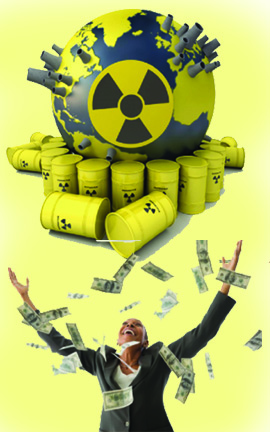 why take the risk(s)? Well, the short answer is that it would be worth taking the risk by the few and their families who would profit from the proposed venture in the short-term; but not the rest of us. Additionally, it will not be their families and their descendants that will suffer the consequences of a poor decision at this time since they will be able to afford to move elsewhere: the same may not be possible for future generations of Australians.
So, (hypothetically) what would Australia end up with should a nuclear industry go ahead in a self-promoting process? There would likely be many disused mining sites and disused nuclear reactors, the largest radioactive nuclear dump in the world, possibly a compromised water table and ecosystem and a few wealthy individuals (who may not be based in South Australia 😉
Saving the Environment or Centralized Control of a Monopoly in Power (Electricity)? Pan Chemistry, Gareth Lewis 03/03/15“……….Domestic and global transporting of nuclear waste is inherently risky and ocean, rail and road accidents do occur. Additionally, security in the transport of such waste would have to be assured to prevent the misuse of waste in our age of terrorism (would risks of nuclear weapons or dirty bombs increase in our attempt to curb global warming using nuclear energy?): such security would be complicated and expensive………
The Royal Commissioner commented that the notion of establishing a nuclear industry and waste dump in South Australia was ‘an emotive issue…’ Well, yes it is, and why shouldn’t it be based on the track records in Chernobyl, the Fukushimadisaster (with ongoing environmental pollution of the sea ecosystem) and a near miss in Long Island (there may be ‘other events’ that students could research).
What is also an issue is the destructive power of nuclear weapons and ‘dirty bombsthat can be manufactured from uranium and its radioactive waste products. Such devices could be made ‘anywhere’ in the world that may operate beyond the political term of any one local government that may initiate a nuclear industry in South Australia.
The Proposed South Australian Storage Depot
The grade and amount of waste will depend on the type of nuclear reactor. So, what then happens to radioactive waste? It would likely arrive in steel or
plastic drums and then be stored in geologically stable strata within
South Australia. The strata would have to be stable since radioactive nuclear waste takes thousands of years to reach safe levels (or levels that are unlikely to cause harm to
biota).
South Australia is well known for being one of the ‘driest places on the driest continent,’ but that’s not always been the case. We also get flooding events that may increase in intensity and severity as global weather pattern change, caused in part by our use of fossil fuels? Well, the vast majority of scientists seem to think so, and so do many politicians.
Let’s play ‘what if’ at this point, since it’s just a hypothesis or ‘one of those ideas.’ What if an extreme weather event caused massive flooding in the northern parts ofSouth Australia as often occurs in Queensland? That would mean that salts would be dissolved to create a hypersaline corrosive liquid. If this solution came into contact with the steel drums that contain radioactive waste they would begin to corrode. Alternatively, even plastic drums will deteriorate over time as their inner surfaces are bombarded by particles emitted from the
decaying radioactive waste. At that (hypothetical) stage, which may take thousands of years,
it would not be possible to move such a large mass of radioactive waste accumulated from throughout the world, it would simply be too risky. There is the argument that spent radioactive waste can be recycled and then reused, however the remaining residue (on reprocessing) will also provide another source of waste. Additionally, by that time other sources of energy (maybe even fusion) may provide economic benefits that far exceed the reclamation and reuse of fissionable material that has been accumulated over time and the original radioactive waste may simply remain where it was initially stored.
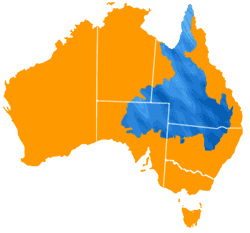 The northern parts of South Australia has a large Artesian Basin of fresh water deep beneath its surface which may then be put at risk from contamination by global radioactive nuclear waste that may have been stored over the millennia…….
why take the risk(s)? Well, the short answer is that it would be worth taking the risk by the few and their families who would profit from the proposed venture in the short-term; but not the rest of us. Additionally, it will not be their families and their descendants that will suffer the consequences of a poor decision at this time since they will be able to afford to move elsewhere: the same may not be possible for future generations of Australians.
So, (hypothetically) what would Australia end up with should a nuclear industry go ahead in a self-promoting process? There would likely be many disused mining sites and disused nuclear reactors, the largest radioactive nuclear dump in the world, possibly a compromised water table and ecosystem and a few wealthy individuals (who may not be based in South Australia ;-)……… http://www.gareth-panchem.com/347345675?pagenum=2
Australia had hottest March on record
 March temperatures sets record as hottest ever, Bureau of Meteorology says http://www.abc.net.au/news/2016-04-01/march-temperatures-sets-record-as-hottest-ever,-bom-says/7293500?section=environment By environment reporter Sara Phillips You could be forgiven for not noticing the end of summer — March was a hot one.
Information released by the Bureau of Meteorology (BoM) indicated it was the hottest March on record, reaching 1.7 degrees Celsius above the long-term average. This eclipsed the 1986 record of 1.67 degrees above the average, BoM said in its monthly climate report.
The unusual heat was particularly noticed in the Top End, where the failure of the monsoon allowed temperatures to creep up. This, coupled with a high pressure system off the east coast of Australia, caused a heatwave strong enough to prompt BoM to issue a special climate statement about the phenomenon.
March 2 became Australia’s hottest day on record.
Averaged across the country, it reached a top of 38 degrees Celsius. There was no relief overnight either with minimum overnight temperatures the warmest ever, smashing the 1983 record by 0.83 degrees.
The hot March came on the back of the hottest February globally, and the hottest year for 2015.
A strong El Nino weather pattern prevailed at the start of the year, which has traditionally been associated with hotter weather. Although the El Nino is weakening, the heat effects are expected to persist for a few more months.
Climate change is thought to be adding to the unusual heat. The scorching start to 2016 prompted Australia’s chief scientist Alan Finkel to warn that the world was “losing the battle” against climate change.
Impact of climate change on Victoria worse than previously thought
 Climate change fears worsen following University of Melbourne and CSIRO research April 1, 2016 CHRIS McLENNAN The Weekly Times THE impact of climate change on Victoria’s weather could be twice as bad as previously thought.
A team of University of Melbourne and CSIRO researchers believes popular computer predictions over-estimate the flow of rain run-off into rivers.
Victorian Government scientists believe the state faces a much warmer and drier future which could result in longer fire seasons, less rainfall in winter and spring south of the Great Dividing Range, and less rainfall in autumn, winter and spring in the north.
Scientists say climate change is already being felt across Victoria, with a rise in temperature and a drop in rainfall since 1950.
The university research found climate modelling failed to adequately cater for drought. Under prolonged dry conditions, modelling predicted twice as much run-off into rivers and catchments than was occurring,” Prof Andrew Western said……..http://www.weeklytimesnow.com.au/news/climate-change-fears-worsen-following-university-of-melbourne-and-csiro-research/news-story/cac037efb28f859f6f491d0fbc70ef46
Future Fund must not finance Adani’s Carmichael coal mine
Australia’s ‘future’ fund should not consider financing the energy projects of the past http://www.theguardian.com/commentisfree/2016/apr/01/australias-future-fund-should-not-consider-financing-the-energy-projects-of-the-past Stephen Bygrave
Australia can be a renewable energy superpower if it plays its investment cards right – we have to move on from our misguided fossilised past
 It was all over the news in India. The Indian finance minister Arun Jaitleywould be meeting Future Fund chairman Peter Costello to discuss using the Fund to help finance Adani’s Carmichael coal mine. There was no announcement of the meeting in Australia, but the questions must be asked: how should Australia’s sovereign wealth fund be used, and should it, a “future” fund, be considering the energy projects of the past?
The prospect of Costello dedicating sovereign funds to the massive coal mine in the Galilee Basin is so misguided. Future energy investment lies in renewables, not coal, and this trend is already playing out worldwide. The Australian economy already runs a real risk of becoming fossilised, caught in the past and missing out on the huge investment market in renewable energy as the world inevitably decarbonises and shifts to a zero emissions economy.
This global transition to renewables is an unavoidable condition for containing global warming below 2C. The future is renewables, the past is coal, and the economic benefits are easy to highlight.
In this transition, Australia stands to attract a major portion of the $2.3tn annual trade value from emissions-intensive trade-exposed industries, like cement, steel, and aluminium. In this era, countries with abundant, cheap, high quality renewable energy will attract these industries.
The Renewable Energy Superpower report to be released in Sydney on Monday 4 April shows that Australia is consistently in the global top three of countries with economic wind and solar energy resources, whether based on energy production potential per square kilometre, energy production potential from total land area, energy production potential from un-utilised land area, or energy production potential from rural land area.
Under various scenarios developed by the International Energy Agency for their WorldEnergy Outlook, investment in renewables and energy efficiency will make up around half of the future investment in energy in the next two decades, with investment in coal only making up 1-2%.
Whichever scenario the IEA looks at, renewables and energy efficiency attracts more investment in the next two decades than coal, oil and gas combined. Some $28tn is expected to be invested globally in renewable energy and energy efficiency by 2035.
Investment in renewables and energy efficiency globally is already large – around US$390bn isestimated to have been invested in 2013 alone, according to the International Energy Agency. In order to contain global warming to the 2C, the IEA estimates the annual investment in this market to more than double by 2020 to around US$750bn annually, and then to grow exponentially to US$2,300bn annually by 2035.
It also estimates that the renewables dominated power sector and energy efficiency markets will be 20-40 times the value of future coal sector development. The other important point that is relevant to Australia is that power sector and energy efficiency investment is skewed towards Australia’s neighbours in the Asia-Pacific region (40%) compared to global fossil energy investment (25%).
So how large is Australia’s renewable energy resource? While it is widely accepted that the total renewable energy resource across Australia is significant, the Superpower report conservatively models only the solar and wind resource that is available within 10kms of Australia’s existing electricity grid and able to generate power at a price competitive with other new power stations.
This is the resource that is immediately available to the existing electricity grid. The results are staggering even when only this small portion of Australia’s total renewable energy resource is captured – it is equivalent to 5000 exajoules, enough to power the world for 10 years.
Put another way, this solar and wind resource is greater than Australia’s coal, oil, gas and nuclear resources combined. Many proponents of fossil fuels argue that there are enough fossil fuels to power the world for hundreds of years, that coal is cheaper and isgood for humanity. These arguments ignore the reality that burning fossil fuels is incompatible with meeting the globally agreed goal of limiting warming to 2C, that new renewables are cheaper than new coal and new gas, and that many developing countries want solar.
In the decarbonised world in which we are heading, Australia will be a renewable energy superpower if it plays its investment cards right. If we are serious about our Future Fund funding the future for all Australians, it is renewables – not coal – where the investments must be made.
Guardian Australia and the author sought comment from Future Fund before publication. Future Fund responded after publication with the statement that “Finance Minister Jaitley has never raised Adani with the Future Fund.”
We assume that Julie Bishop will oppose radioactive trash import, as she fears nuclear terrorism
Nuclear terrorist threats ‘terrifying’, Yahoo News 7 AAP on April 2, 2016 There are “terrifying possibilities” that terrorists could get access to nuclear material to make dirty bombs, Foreign Minister Julie Bishop warns.
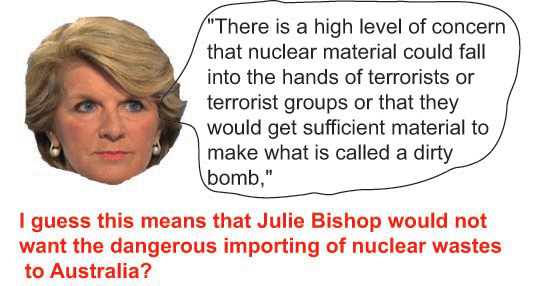
Speaking on the sidelines of a global nuclear summit in Washington on Saturday, Ms Bishop said Australia was committed to the global effort to secure nuclear material amid fears of the potential for a nuclear terrorist attack.
The summit is dealing with hypotheticals of what could occur and how to prevent it.
“There is a high level of concern that nuclear material could fall into the hands of terrorists or terrorist groups or that they would get sufficient material to make what is called a dirty bomb,” Ms Bishop told reporters……https://au.news.yahoo.com/a/31238577/nuclear-terrorist-threats-terrifying/
Australia wasting over $2.5 million investigating “wind turbine syndrome’ ?
 True cost to taxpayers of investigating wind farm complaints tops $2.5 million, The Age April 2, 2016 –Nicole Hasham Environment and immigration correspondent The price of the part-time wind farm commissioner created by the former Abbott government is three times more than first thought, costing taxpayers more than $2 million to monitor and investigate complaints against the wind industry.
It has also emerged that the Independent Scientific Committee on Wind Turbines, which advises the government on potential health and environmental effects of the industry, has held just two short teleconferences in five months and provided no advice, despite costing up to $174,000 a year.
The hefty bill has fuelled criticism over the commissioner and committee, which Environment Minister Greg Hunt agreed to establish as part of crossbench negotiations to pass the government’s revised Renewable Energy Target. Senators John Madigan and David Leyonhjelm were the key proponents of the policy.
Critics said the measures were a bid to thwart the roll-out of clean energy under Mr Abbott, who had called wind farms “visually awful”. Former treasurer Joe Hockey also decried them as “utterly offensive”.
As Fairfax Media reported last year, the part-time National Wind Farm Commissioner Andrew Dyer will be paid $205,000 annually over three years to monitor the wind industry and respond to community complaints about turbine noise and health effects.
However this sum is just a small proportion of the cost of establishing the role.
Official figures provided to a Senate committee show the wind farm commissioner’s office is expected to cost $2.03 million over four years, including $680,000 in 2017-18.
This cost includes travel, IT, office accommodation and four staff as well as Mr Dyer’s part-time salary, which is more than an average full-time federal backbencher……
The figures also show the independent scientific committee is expected to cost $507,000 over four years, comprising administered and departmental expenses.
Late in March the Department of the Environment told Fairfax Media the committee had held “two short meetings” in December and February and “has not provided any advice to government at this stage”.
The meetings were held by teleconference or videoconference, and the committee is expected to meet about every two months.
Announcing the committee last October, Mr Hunt said it would “build on the work of the National Health and Medical Research Council”.
Reviews by a number of state and federal government health bodies including the NHMRC have so far found no clear evidence of a link between wind farms and medical conditions. The Australian Medical Association last year released a statement saying the available evidence did not support the concept that wind farm noise harmed humans.
Labor’s environment spokesman Mark Butler said it did not support the commissioner’s appointment and “it is ridiculous that the Turnbull Liberal government will waste money on this commissioner, but is happy to rip money out of the renewable energy sector”. http://www.theage.com.au/federal-politics/political-news/true-cost-to-taxpayers-of-investigating-wind-farm-complaints-tops-25-million-20160401-gnvwoc.html#ixzz44bwvO1oa
Urgent need to shift to zero carbon power – as soon as 2018
“If the time for halting investments into new fossil fuel infrastructure is 2017 for the world, that time has been 10 years ago for Australia – the highest per-capita emitter in the developed world.”
renewable energy ventures are likely to meet any near-term need for additional large-scale capacity
 Shift to zero-carbon power must start by 2018 to avoid extra warming: study http://www.theage.com.au/environment/climate-change/shift-to-zerocarbon-power-must-start-by-2018-to-avoid-extra-warming-study-20160331-gnuy7x.html April 1, 2016 Peter Hannam Environment Editor, The Sydney Morning Herald The world must begin the shift to zero-carbon sources of electricity as soon as 2018 to avoid adding new fossil-fuel power plants that will lock in dangerous climate change, according to a team of Oxford University researchers.
Taking the average operating life of coal or gas-fired plants as 40 years, the world’s fleet of carbon-emitting power stations had already committed by 2014 a total of 87 per cent of the emissions required to ensure a 50-50 chance of reaching two degrees of warming compared with pre-industrial levels.
By 2017, the remaining stock of potential emissions will have been locked in, necessitating a transition to renewable or zero-emissions electricity from then on. Alternatively, radical technologies will be needed to sequester carbon dioxide or extract it from the atmosphere, the researchers including Australian Cameron Hepburn wrote in a paper published in Applied Energy journal.
“For policymakers who think of climate change as a long-term future issue, this should be a wake-up call,” the authors said in a statement. “Whether we succeed or fail in containing warming to 2 degrees is being determined by actions we are taking right now.”
The papers come in a week when environmental groups warned as many as 1500 coal-fired power plants are being planned or being built worldwide, scientists found coral bleaching in the Great Barrier Reef to be worse than first thought, and Antarctic ice sheets were declared to be melting faster than expected.
Electricity generation accounts for about one quarter of man-made greenhouse gas emissions and about one third of Australia’s total. The researchers assumed other emission sources, such as transport and agriculture, would track towards a 2-degree warming limit, an assumption “which may well be optimistic”, the paper notes.
Australia was one of almost 200 nations to sign up to limiting warming to a 1.5-2 degree range at the Paris climate summit late last year.
The lower end of that target has been well exceeded, the researchers argue: “Meeting a 1.5-degree target without [carbon capture and storage] or asset stranding would have required all additions to the electricity sector were zero carbon from 2006 onwards, at the latest”.
Malte Meinshausen, director of Melbourne University’s Climate & Energy College, said the research confirmed work by the International Energy Agency and others “that we now have enough fossil fuel infrastructure globally in place to emit a detrimental amount of carbon”.
“With the correct market signals in place – such as a price on carbon emissions – it will be more economical even for the utilities to abandon fossil fuel [plants] and switch to renewable investments instead,” Associate Professor Meinshausen said. “If the time for halting investments into new fossil fuel infrastructure is 2017 for the world, that time has been 10 years ago for Australia – the highest per-capita emitter in the developed world.”
As it happens, the combination of Australia’s flat or declining demand for grid-supplied electricity and the need to meet the mandated 2020 Renewable Energy Target (RET) means there is little likelihood of new coal or gas-fired power plants being built in this country for at least the next decade, said Dylan McConnell, a research fellow at Melbourne University’s Melbourne Energy Institute.
While there are several proposed gas projects and one black coal project in NSW at AGL’s Bayswater site, renewable energy ventures are likely to meet any near-term need for additional large-scale capacity, Mr McConnell said.
Some 14,000 megawatts (MW) of wind or solar plants are seeking approval, a tally that is “certainly much more than needed for the RET”, he said. “The cost curve for fossil fuel [plants] is going in the other direction.”
This week, Origin Energy signed up for its first power purchase agreement for large-scale solar, taking output from a 56 MW solar farm in Moree in northern NSW.
“Ten years ago, 15 years ago the prospectors were in Queensland looking for [coal seam gas] resources,” Grant King, Origin’s chief executive, said last year. “I would think the next great round of investment in Queensland will be utility scale solar.”
Origin is among the prospectors, applying to the Australian Renewable Energy Agency for funding to support a 106 MW solar farm of its own to be built on the Darling Downs next to its existing gas-fired plant.
China’s State Grid Eyes Australia
 China’s State Grid Eyes Australia (VIDEO) http://www.bloomberg.com/news/videos/2016-04-01/china-s-state-grid-eyes-australia April 1, 2016
It has more than one billion customers and sales bigger than Apple’s and Boeing’s combined. But not many people have heard about State Grid. It’s a Chinese-owned power company with ambitious plans to expand, especially in Australia. Bloomberg’s James Paton reports on “First Up.” (Source: Bloomberg)
Australian Capital Territory funding battery storage in homes
 battery storage in homes http://www.abc.net.au/news/2016-04-01/canberra-energy-auction-funds-battery-storage-in-homes/7290834 A new ACT Government renewable energy auction will help pay for battery storage in thousands of Canberra homes.
The auction for 109 megawatts of renewable energy feed-in tariff capacity begins today.
Minister for the Environment and Climate Change Simon Corbell said it would complete the Territory’s investment to meet its commitment of using renewable sources to supply 90 per cent of Canberra’s electricity needs by 2020.
He said successful bidders would provide the money needed to establish a photovoltaic battery storage program in the ACT.
“We expect up to $25 million to be available to support about 26MW of battery storage to be rolled out in more than 5,000 Canberra homes and businesses over the next four years,” Mr Corbell said.
“This will represent the largest deployment outside of Germany.”
Mr Corbell said photovoltaic battery storage would put renewable energy on demand when it was needed and reduce the need for network investment.
“It is exciting to see the 90 per cent renewable energy target on track to be completed on time and with minimal flow-on cost for the Canberra community,” he said.
Mr Corbell said the request for proposals would close in May.
Kevin Scarce buys expert pro nuclear opinions from Switzerland and Belgium
Swiss and Belgian experts to front nuclear commission as green light looms. by Simon Evans, Financial Review, 31 Mar 16 Experts from Switzerland and Belgium will give South Australia’s nuclear royal commission advice on whether nuclear waste can be safely stored underground in Australia.
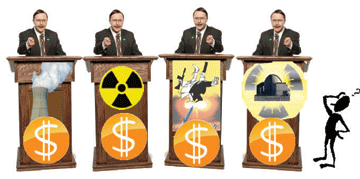
Royal commissioner Kevin Scarce has just visited both countries to scrutinise high-level waste disposal sites and their licensing regimes. All three places have similar soil, which means Swiss and Belgian experts should be able to give him detailed information about the danger of storing nuclear waste in the South Australian outback.
Mr Scarce said on Thursday his final report due on May 6 on whether the state should expand from just being a uranium miner and venture into nuclear waste storage was unlikely to differ greatly from his preliminary findings in mid-February.
He rejected suggestions that it was inevitable that South Australia would undertake some form of nuclear expansion……..
Mr Scarce said he had received 170 direct responses in the past few weeks to his tentative findings unveiled on February 15 in which he concluded that a nuclear waste storage facility housing spent nuclear fuel rods and other waste could deliver $5 billion in revenue annually over 30 years.
He said some of those submissions had accused him of exaggerating the economic benefits, but he said he was confident that his economic modelling had been robust and said he had taken a “conservative” approach.
Mr Scarce said he had visited Sweden and Finland earlier in his commission’s work but in the wake of the tentative findings had made a special visit to Belgium and Switzerland because they had similar sedimentary soil structures to South Australia………http://www.afr.com/news/policy/swiss-and-belgian-experts-to-front-nuclear-commission-as-green-light-looms-20160331-gnv15s
Anti-nuclear opinions don’t count for much with SA’s elitist Royal Commission
Comments today from Nuclear Royal Commissioner, Kevin Scarce, show that the elitist and dismissive  processes that dominated the Commission’s early days are still alive and well.
“Clearly the Commission doesn’t want to hear from ordinary South Australians. At the outset, they refused to accept submissions that weren’t sworn before a JP (including mine) and now they are devaluing submissions from concerned South Australians.”  said Greens SA Parliamentary Leader,
Mark Parnell MLC.
On radio today, Mr Scarce described 850 submissions to the Commission’s Tentative Findings as “computer-generated views” and “spam”. He also said “you can’t do anything with them because they’re expressing opinions as opposed to going with the tentative findings”.
“What the Commissioner conveniently ignores is that the ONLY rationale for an international nuclear waste dump in South Australia is its supposed economic advantages. The economic case for the dump is derived from the assumptions and opinions of consultants. However, if ordinary South Australians dare to present “opinions”, then the Royal Commission “can’t do anything with them”.
“Barely two weeks after the close of public submissions and six weeks before handing down its final report, the Royal Commissioner appears to have already locked himself into the waste dump idea saying, “I’m convinced it’s safe”.
“When it comes to economic criticism, the Commissioner appears to value the number of economists involved and the number of pages they write as key considerations. He promised to “take apart piece by piece” the economic analysis of The Australia Institute, whilst acknowledging that the Commission’s own economic analysis was based on assumptions because there is no equivalent operating facility to compare it with and after 50 – 60 years of nuclear waste, “no one has found a solution yet.”
“Commissioner Scarce has consistently emphasised the need for community support, yet seems oblivious to the elitist approach taken by the Commission which devalues those South Australians whose support is needed if any of the Commission’s ideas are to be taken seriously”, concluded Mark Parnell.
Scarce determined to recommend nuclear waste import and dump for South Australia
Scarce final report not for turning on nuclear dump, INDaily, Tom Richardson, 30 Mar 16 The former South Australian Governor and retired naval officer has flagged a conclusion largely in keeping with his tentative findings, which found a compelling business case for a high-level nuclear waste dump to be based in SA, arguing it would contribute billions of dollars annually to the state’s economy.
The assumptions underlying that conclusion were scoffed at in a response by left-wing think tank the Australia Institute last week, which believes the prognostications of wealth beyond measure are grossly exaggerated.
But Scarce says despite heated backlash since his initial report was published last month, “I don’t think I’ve changed my fundamental findings” in the subsequent community consultation……..
he insists: “I’m convinced that it’s safe.”
“I’ve been now to five countries, I’ve been to facilities, I’ve been to organisations that assure the communities of those countries that this is safe to do,” he said.
“What I always expected I had to do in the final report is explain how countries come to that conclusion that it’s safe to do over these long periods of time.”……
He denied the economic merits of his conclusions were predicated on providing “cheap, above-ground storage for nearly a century”.
“That’s not what the scenario is: we do put it in an interim storage site to collect the revenue to enable us to build the deep geological storage, but it’s not there for hundreds of years,” said Scarce.
He said he would “put more work [into] the financial analysis” for his final report, but added: “I don’t believe that will change the magnitude of the positive [impact] – you know, the revenue versus the cost.”……..http://indaily.com.au/news/local/2016/03/31/scarce-final-report-not-for-turning-on-nuclear-dump/
Australia’s home solar battery company launches new product
Australian company launches home solar storage battery to take on electronics giant Tesla With the number of depleted home solar batteries being thrown away tipped to rise over the coming years, one Australian company is taking on electronic giants such as Tesla and Panasonic with the launch of an easily recyclable power source.
http://www.abc.net.au/news/2016-03-30/recyclable-solar-storage-battaries-to-take-on-giants-tesla/7284518?section=environment
Australian designed ZCell home battery storage system to be available by midyear
AN Australian-designed battery system partly built in Adelaide will allow householders to use stored solar power during the night. But it will cost you.
http://www.adelaidenow.com.au/business/simon-hackettbacked-redflow-launches-zcell-home-battery-storage-system/news-story/c5cc9be96f517103b02c363adae6a6b5
It’s wrong to sell Australian uranium to critically unsafe Ukraine
The Zaporizhia nuclear facility is Europe’s largest and is only 200 kilometres from the conflict zone in eastern Ukraine. Some commentators have described nuclear plants in the region as pre-deployed nuclear targets and there have already been armed incursions during the recent conflict period.
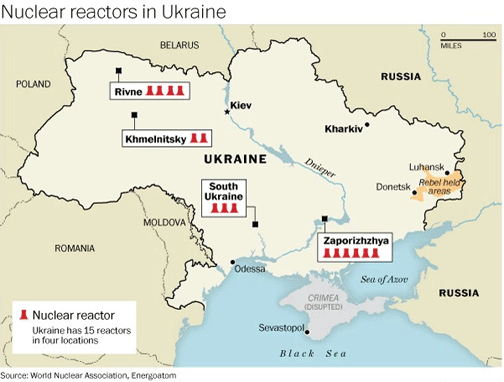
Australia shouldn’t sell its uranium to Ukraine http://www.smh.com.au/comment/australia-shouldnt-sell-its-uranium-to-ukraine-20160331-gnv0no.html, Dave Sweeney, 31 Mar 16 Foreign Affairs Minister Julie Bishop’s announcement this week to sell Australian uranium to Ukraine is an ill-advised and dangerous retreat from responsibility.
With timing and placement that a satirist could only dream of emulating – April Fool’s Day, the month of the 30th anniversary of the Chernobyl meltdown and while attending a nuclear security summit – Bishop is set to sign a uranium supply agreement this week with Ukrainian President Petro Poroshenko.
Australia, the country that directly fuelled Fukushima now plans to sell uranium to Ukraine, the country that gave the world Chernobyl – hardly a match made in heaven.
Thirty years ago the Chernobyl nuclear disaster spread fallout over large swathes of eastern and western Europe and five million people still live in contaminated areas in Belarus, Ukraine and Russia.
Serious containment and waste management issues remain at Chernobyl with a massive concrete shield now under construction in an attempt to enclose the stricken reactor complex and reduce the chances of further radioactive releases.
Against this backdrop there are deep concerns over those parts of the Ukrainian nuclear sector that are not yet infamous names, including very real security concerns about nuclear facilities being targeted in the current conflict with Russia. Continue reading
Sisters of St Joseph oppose nuclear waste import, defend sacred lands of Aboriginal people
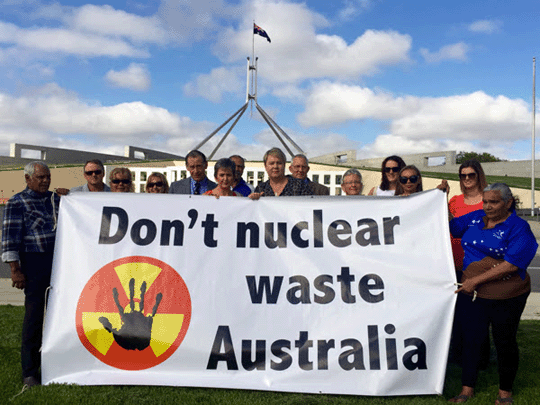 JOSEPHITES QUESTION NUCLEAR WASTE PROPOSAL, Josephite Justice Office, Sydney , 29 March 16 http://www.sosj.org.au/news-events/view_article.cfm?id=2772&loadref=594 Josephites around Australia have joined in questioning the proposal to import high-level nuclear waste into Australia. This is a move that challenges all of us who are committed to an increasingly fragile planet to look closely at the whole question of radioactive waste.
1 This month
17 October, Free Public Talk on Nuclear Issues in South Australia
David Noonan will speak on public interest concerns over the new Roxby Downs Indenture Act 2026 on BHP copper-uranium mining and ore processing in SA, and on how AUKUS may face SA with a High-Level nuclear waste agenda.
Dr Jim Green will discuss international developments in the field of nuclear power including ‘small modular reactors’ and Generation 4 ‘advanced’ nuclear reactor concepts.


Help Aunty Sue Protect Her Land and Sacred Sites From Destructive Rocket Testing.
.

Australians deserve the truth
about
AUKUS – https://aukuspublicinquiry.com/

PETITION – To: Prime Minister Anthony Albanese and the Australian Labor Government

of the week – Australians for War Powers Reform (AWPR)
To see nuclear-related stories in greater depth and intensity

