Desert Liberation Front to rally outside Olympic Dam
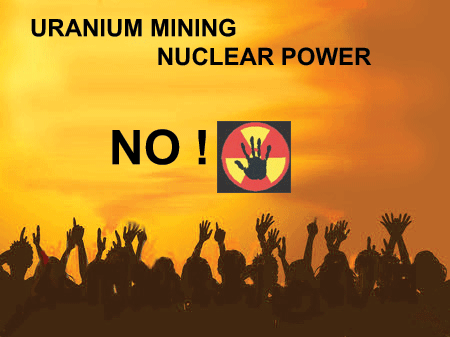 Anti-uranium protesters Desert Liberation Front to rally outside Olympic Dam again http://www.adelaidenow.com.au/news/south-australia/antiuranium-protesters-desert-liberation-front-to-rally-outside-olympic-dam-again/news-story/90234853dc42563677ee190b87da3841#load-story-comments March 28, 2016 ANTI-URANIUM protesters who want to shut down the Olympic Dam site are planning a “party at the gates of hell”, four years after a similar event forced police to send 500-plus officers to monitor the dangerous situation.
The Desert Liberation Front has issued an open invitation to artists, musicians, activists, community groups and media wanting to attend the protest festival to be held from July 1-3.
Under the banner “The Lizard Bites Back” the group is encouraging people to learn moves to a Zombie Lizard Flash Mob dance for its “party at the gates of hell” outside the BHP Billiton site.
Hundreds of police and protesters are expected to travel to Roxby Downs for the event, four years on from similar protests which police at the time estimated had cost the state $1 million.
During the 2012 protest more than 500 police — including STAR Group and mounted officers — worked around the clock for more than a week to monitor protesters.
Eighteen people were arrested for offences varying from loitering to resisting arrest.
South Australia’s changes to Aboriginal Heritage Act – a precursor to nuclear waste dumping?
 Minister rejects nuclear dump spectre in Aboriginal heritage overhaul , INDAILY 29 Mar 16 Tom Richardson The State Government insists changes to the Aboriginal Heritage Act pushed through parliament last week will have “absolutely no impact whatsoever” on the debate over a potential future nuclear waste dump, which indigenous communities fear could end up on traditional lands.
Aboriginal advocates and the Greens expressed concern at the haste with which the bill was passed, arguing there was inadequate consultation on its final draft.
Legislation to amend the Heritage Act passed parliament with Labor and Liberal support, despite opposition from the South Australian Native Title Services and the Aboriginal Legal Rights Movement, who argued the changes “have not been put before Parliament with the support of Aboriginal People”.
Sue Tilley, an indigenous social policy advocate, told InDaily: “One has to wonder about the rush to get this bill through parliament and the critical timing of this.” “South Australia is currently facing a number of contentious developments that may significantly impact on Aboriginal land and on the protection of heritage, such as the consideration of potential sites for a nuclear waste dump, and the development of the Northern Connector Road Project, amongst others,” she said in a written statement.
“Was the motivation driven by the need to have the seemingly constraining Aboriginal Heritage Act out of the way to enable these and other developments to proceed unhindered?”
But Aboriginal Affairs Minister Kyam Maher rejected the suggestion, insisting the changes safeguarded Aboriginal communities ……..
Advocates are unconvinced, particularly with the minister ceding his authority to delegate his decision-making powers to traditional owners of a site.
“This provision gave traditional owners a powerful tool to make decisions and enter into agreement-making about protecting their heritage,” Tilley said. “The amended legislation deletes this all-important provision.”
Andrew Beckworth, the principal legal officer with South Australian Native Title Services, provided advice to Greens MLC Tammy Franks that “this bill will come as a shock to many Aboriginal People in SA, as it has done for us”.
“This bill flies in the face of what previous governments or ministers have attempted and does so without any respect for the primacy of Aboriginal people’s voices and their rights and interests in managing and protecting Aboriginal Heritage,” the submission argues.
“This is against the United Nations Declaration on the Rights of Indigenous Peoples.”………http://indaily.com.au/news/local/2016/03/29/minister-rejects-nuclear-dump-spectre-in-aboriginal-heritage-overhaul/
Axe over controversial Shenhua coal mine in New England
China’s fossil fuel transformation places axe over controversial Shenhua coal mine in New England, The Age, March 29, 2016 Heath Aston Political reporter China Shenhua, which owns the contentious Shenhua-Watermark project on the NSW Liverpool Plains, has warned of plunging demand for fossil fuels and slashed its global budget for investing in new coal projects.
The company has surprised analysts with the depth of its pessimism on the coal market in its annual report released on Good Friday.
The proposed mine at Gunnedah is now almost certainly “commercially unviable”, according to Tim Buckley, Australasian director of the Institute of Energy Economics and Financial Analysis and it is only a question of whether the Chinese government proceeds to development in an attempt to “save face”, he said.
“I have no doubt the project doesn’t make any commercial sense unless the coal price doubles,” he said.
There is gathering speculation the Turnbull government is working on a political solution whereby the Baird Government would return Shenhua’s original $300 million exploration licence and allow the company to retreat with dignity……
NSW Greens’ mining and agriculture spokesperson Jeremy Buckingham said Mr Joyce should negotiate a “swift and fair exit” for Shenhua.
“Even the world’s biggest coal miner has recognised that there is no need for new coal and it’s up to Barnaby Joyce to create certainty for the farmers of the Liverpool Plains by negotiating an exit for Shenhua,” he said.
“It’s unacceptable for this coal mine proposal to hang over the Liverpool Plains, causing uncertainty and stress, and hindering investment in agriculture.” http://www.theage.com.au/federal-politics/political-news/chinas-fossil-fuel-transformation-places-axe-over-controversial-shenhua-coal-mine-in-new-england-20160329-gnt98y.html
The politically toxic proposed coal mine at the centre of the election battle between Deputy Prime Minister Barnaby Joyce and Tony Windsor appears doomed after its Chinese owner outlined an accelerated transformation plan away from mining into cleaner electricity generation.
At last Victoria might now get going, farming solar energy
 Has Victoria’s moment in the sun finally arrived? http://www.theage.com.au/victoria/has-victorias-moment-in-the-sun-finally-arrived-20160327-gnrs6l.html, The Age, Tom Arup March 27, 2016 Despite a decade of promises and plans from governments, policy uncertainty and project collapses has meant very little has materialised but now a handful of proposed Victorian projects are again on the table.
Phil Galloway stands in an open field between vast stretches of almond trees. The empty land is marginal and the sun above it bright.
One day soon he hopes to roll out 220,000 solar panels across the empty space on the Almas Almonds farm at Bannerton, generating enough electricity to power about 30,000 homes.
“The sun is really just another crop”, Mr Galloway, a former BHP executive, said during a meeting with the local council this week.
“And we’re utilising land that would have otherwise stood empty.”
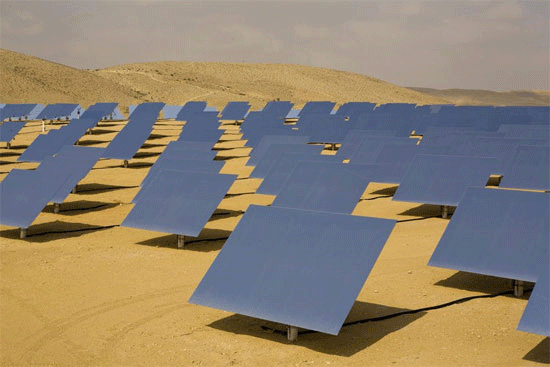
His company, Syncline Energy, is the latest in a long line of proponents that have sought to kick start a large-scale solar industry in Victoria’s sunny north west.
But despite a decade of promises and plans from governments, policy uncertainty and project collapses have meant that very little has materialised. And a celebrated concentrated solar project near Mildura was axed by its proponents in 2014, with the land and equipment later sold.
Now a handful of proposed Victorian projects are again on the table.
The latest bout of activity was sparked by $100 million in competitive grants on offer from the Australian Renewable Energy Agency (ARENA), which is looking to drive innovation in large-scale solar and drive down costs.
It is understood seven Victorian projects were among the 77 that registered initial interest with ARENA. Syncline Energy’s proposal, and another from Solar Choice located near Kerang, were the only two from Victoria to make a recently announced shortlist of 22. Continue reading
Nuclear news excluded or downplayed in Australian media
 The terrorists’ initial aim to blow up Belgium’s nuclear reactors was explained on SBS World News, last night, but did not get a mention on ABC news. It was reported on Sydney Morning Herald, but that story appears to have been withdrawn.( – Brussels bombers considered nuclear site, changed their minds: report Sydney Morning Herald–24 Mar. 2016. )
I doubt that it was reported on the Murdoch dominated commercial media
Could Australia’s media be experiencing pressure to avoid uncomfortable nuclear topics, – heading in the self censorship direction now prevalent in Japan?
FAULTS EXPOSED WITH MULGA ROCK URANIUM PROPOSAL
 http://www.ccwa.org.au/faults_exposed_with_mulga_rock_uranium_proposal
The confirmation raises serious environmental concerns over land clearing, water consumption, waste management and impacts on rare and endangered species.
The public comment period for the proposal closed today with over 1100 individual submissions calling on the EPA to reject the mine proposal.
Vimy Resources’ proposal for a uranium project at Mulga Rock is in the Yellow Sandplain Priority Ecological Community, 250km north east of Kalgoorlie and upstream from the Queen Victoria Springs A Class Nature Reserve.
“Vimy want to take 15 million litres of underground water every day for their uranium operation,” said CCWA nuclear free campaigner Mia Pepper. “This ancient water is sustaining life and supporting this fragile desert ecosystem. Vimy would be voraciously consuming this precious water resource in a bid to extract a product that is unsafe, unnecessary and uneconomic.”
“Vimy are seeking to fast-track approvals for this project before next year’s state election even though the uranium price has flat-lined in the wake of Fukushima”.
The environment groups detailed submission has also identified deficiencies in the plans for the long term containment and management of radioactive mine tailings, including the presence of under reported seismic fault-lines in the proposed tailing dams region. Continue reading
Facts on Western Australia uranium mining proposals
Fact File: http://www.ccwa.org.au/faults_exposed_with_mulga_rock_uranium_proposal
- Since the WA Government lifted the ban on uranium over seven years ago not one uranium proposal has attained final approval to begin mine construction.
- The recent SA Nuclear Fuel Cycle Royal Commission preliminary findings found that “significant barriers to the viability of new uranium mine developments in South Australia” including the “current low price of uranium and uncertainty about the timing of any price increases” – a finding with direct relevance for WA
- Australian uranium production has been in decline since 2009
- In 2014-2015 the Australian uranium industry employed just 987 people nationally
- The uranium spot price is currently $32.15
- Nuclear energy contributes just 4.4% of the global energy mix
- Renewable energy contributes 6% of the global energy mix with a growth rate of
12%
- There are 62 reactors under construction worldwide – of these 47 are experiencing construction and commissioning delays.
- Globally over 130 reactors have operated for over 30 years – nearing their lifespan. 54 of those reactors have operated beyond their designed life span of 40 years. These reactors are required to be decommissioned and the industry will struggle to maintain its shrinking market share.
- There is no state bi-partisan political support for uranium mining in WA
Uncertainty created by Australian govt’s new Clean Energy Fund
 Clean Energy Fund creates uncertainty for existing renewable proposals, SA Energy Minister says ABC News 24 Mar 16 Changes to the Federal Government’s energy agencies have created uncertainty in South Australia’s renewable energy industry, State Energy Minister Tom Koutsantonis says.
Key points:
- Changes ‘turn grants into loans’
- Business models to be affected, SA Energy Minister warns
- Union says clean energy fund is ‘too little, too late’
Prime Minister Malcolm Turnbull yesterday announced he would retain the Clean Energy Finance Corporation and the Australian Renewable Energy Agency, which former prime minister Tony Abbott tried to dismantle.
The agencies will manage a $1 billion Clean Energy Innovation Fund (CEIF) using money previously allocated to them.
But Mr Koutsantonis said the changes meant funds administrated as grants would now be considered loans.
He said this would affect business models for proposals such as solar, wind, tidal or hot rocks energy generation.
“That has to be changed now because the money has to be paid back, so they [the Federal Government] are creating a lot of uncertainty,” Mr Koutsantonis said.
Clean energy fund ‘too little, too late’
The Australian Services Union said the clean energy fund was “too little, too late” to help SA’s Alinta Energy workforce………http://www.abc.net.au/news/2016-03-24/clean-energy-fund-changes-creates-uncertainty-sa-energy-minister/7272472?section=environment
Turnbull’s new cleantech fund likely to sink without trace
 Turnbull Fiddles With Green Energy Policy While Carbon Continues To Burn https://newmatilda.com/2016/03/24/turnbull-fiddles-with-green-energy-policy-while-carbon-burns/ By Ben Eltham on March 24, 2016 With its renewable policy sinking without a trace and Arthur Sinodinos again in trouble, Turnbull’s extended election campaign has got off to a bad start, writes Ben Eltham.
If you accept – and it’s hard to deny – that Prime Minister Malcolm Turnbull’s decision to recall Parliament signals the start of a 14-week election campaign, then that campaign has not got off to a great start.
Policy is being announced. Yesterday, for instance, the government announced a new $1 billion Clean Energy Innovation Fund, “to support emerging technologies make the leap from demonstration to commercial deployment.”
Superficially, the fund looks like a good idea. Australia is well behind the rest of the developed world when it comes to clean tech industries. A fund to support capital investment in “emerging clean energy technologies” will no doubt be welcomed by a struggling sector.
Of course, a big reason for these struggles is the Coalition itself. The Rudd and Gillard governments put in place a comprehensive suite of policies designed to drive investment in the clean tech and renewables sectors. The Abbott government abolished nearly all of them. Amidst the smoking ruins of the Abbott government’s climate policies, investment and jobs in the renewables sector cratered. Meanwhile, our competitors in America, Europe and China forged ahead.
At least the Coalition has finally decided that it will keep the Clean Energy Finance Corporation, a government finance corporation for the clean tech sector. Once derided as “Bob Brown’s bank”, apparently someone has at last noticed that he CEFC actually makes money for the government by lending at commercial rates of interest.
That’s about as much as you could say for yesterday’s announcement, which has already been derided by experts and analysts as little more than a “shell game.” This is not a billion new dollars for clean tech: it is instead simply a repurposing of money already budgeted to the CEFC, which the government has bee trying to abolish for years now, but wasn’t able to as a result of opposition from the Senate crossbenchers. Continue reading
Turnbull cuts climate research money – spends it on ‘wind farm health effects’
 ‘Quite disgraceful’: NHMRC doles out $3.3m to study windfarm effects on health, The Age, March 23, 2016 Peter Hannam Environment Editor, The Sydney Morning Herald Australia’s top medical research body has given two researchers $3.3 million to study the effects of wind farms on human health despite its own year-long study finding no “consistent evidence” that a problem exists.
The National Health and Medical Research Council (NHMRC) awarded Guy Marks, a professor at the University of NSW $1.94m, to study the health impacts of infrasound – sound waves typically inaudible to humans – generated by wind turbines.
Peter Catcheside, an associate professor at Flinders University, secured $1.36m to investigate whether wind farms disturb sleep compared with traffic noise.
The outcomes of these studies, promoted by a so-called targeted call for research, will assist in developing policy and public health recommendations regarding wind turbine development and operations, the council said.
The research call was criticised last year, with even NSW and Victorian health officials calling for the NHMRC “to make it clear that the total available evidence (parallel and direct) suggest[s] little health risk,” according to emails from these health officials seen by Fairfax Media.
Senior members of the Abbott government, including then Prime Minister Tony Abbott, made public their opposition to wind farms. Then Treasurer Joe Hockey also dubbed wind turbines as “utterly offensive” and “a blight on the landscape”.
Simon Chapman, an emeritus professor of public health at the University of Sydney, said there had been at least 25 reviews internationally – including by the NHMRC – that showed “very little evidence of direct effects” from wind farms.
Effects that did exist could be put down to psycho-social factors, such as pre-existing antipathy to wind farms, resentment by locals who had received no benefit from turbines in their region, and anxiety of perceived health impacts, Professor Chapman said.
“It’s really quite disgraceful – it’s money literally poured down the drain,” he said. “There is no health or medical agency in the world that would give any rational priority to wind farms and health. “Potentially hundreds of researchers who had just missed on funding research would be angry as the money is being spent on wind farm research.”
Fairfax Media has sought additional comment from the NHMRC.
Senator Kim Carr, shadow science minister, said the funding came at a time when the Turnbull government was taking the axe to hundreds of scientists – including climate researchers – at the CSIRO.”The Liberals cannot plead innocence in cutting climate and manufacturing research in the CSIRO…while handing out money for contentious research into things like the supposed health effects of wind farms,” he said.
“The Abbott-Turnbull Government is hell-bent on politicising Australian research,” he said. http://www.theage.com.au/environment/quite-disgraceful-nhmrc-doles-out-33m-to-study-windfarm-effects-on-health-20160321-gnnzhe.html#ixzz43wzQSmqb
Wind farm commissioner – the cons and pros of the position
Wind farm commissioner insists he’s good value for taxpayers at $200,000 a year, SMH March 25, 2016 Tom Arup Environment editor, The Age Australia’s wind farm commissioner has insisted taxpayers are getting good value for money out of his $200,000 a year salary.
In an interview with Fairfax Media, Andrew Dyer, who was appointed to the wind energy watchdog post in October, said he believed there were genuine issues around wind farms to be solved and he was one of a handful of people with the skills to do it.
The national wind farm commissioner has been a highly contested position since it was first created by then Prime Minister Tony Abbott last year.
Critics say the position – established via a deal with anti-wind crossbench Senators – was another attempt to stymie the roll-out of clean energy under then Prime Minister Tony Abbott. There has also been a heavy focus from critics on Mr Dyer’s $205,000 a year remuneration and the job’s classification as part-time.
Mr Dyer said he could not claim to be full-time while holding other positions, including volunteer board spots, chairing a private company and involvement with Monash University’s sustainability unit, but added: “I can assure you it is a very big load.”……….
The most controversial element of the wind farm debate is claims infrasound (inaudible noise) from wind farms can make people sick. A long list of symptoms have been ascribed to so called “wind turbine syndrome”, including sleeplessness, headaches, nausea, memory loss and tinnitus.
But numerous health and government assessments – including by the National Health and Medical Research Council – have repeatedly found no link between wind farm infrasound and health problems.
Mr Dyer said this had also been his advice, though no health complaint, whatever the reason, should be ignored.
More research into the issue should be done, he said. This week $3.3 million in government research grants to study the health effects of wind farms were announced……..
Mr Dyer has worked in the energy industry for many years and in many roles. During that time he has been a notable champion of solar thermal technology.
He pointed to previous comment pieces he had written stressing a “balance of technologies” in the energy supply. He told Fairfax Media wind energy “will be a major part of that balance into the future.”
What impact might he have on the industry then?
Mr Dyer conceded he had no legal authority to order changes to projects, but he could personally work with complainants and companies to try reach workable solutions to disputes.
“Industry has been very supportive of my role and appointment because they know if complaints aren’t dealt with properly then it will continue to have a negative impact on them and raise the potential for further regulation,” Mr Dyer said. http://www.smh.com.au/environment/wind-farm-commissioner-insists-hes-good-value-for-taxpayers-at-200000-a-year-20160317-gnl6du.html#ixzz43wyFcFNc
Big financial benefits in locating solar and wind power together
 The study’s key findings:
– Co-location potential: The technical capacity of existing wind farms to accommodate co-located solar farms is estimated at over 1 GW. Growth in renewables driven by the Renewable Energy Target is expected to open up technical capacity for an additional 1.5 GW of solar PV to be co-located at new wind farms built by 2020. However, the relative financial competitiveness of these opportunities (combined with relevant policy) may limit the uptake of the full technical potential of co-location.
– Firming effect: Given the intermittent nature of renewable technologies, pairing resources in regions dominated by one particularly technology will likely have a “firming” effect. This reduction in the overall facility’s degree of intermittency results in an improved capacity factor at the connection point and can mitigate associated network constraints in regions dominated by a single generation type.
ARENA: Solar and wind co-location can deliver significant cost savings http://www.pv-magazine.com/news/details/beitrag/arena–solar-and-wind-co-location-can-deliver-significant-cost-savings-_100023809/#axzz43rWPStli 21. MARCH 2016 SOPHIE VORRATH
A total of at least 1GW of large-scale solar could be added to existing Australian wind farms, boosting renewable energy development, generation, and and smoothing its delivery to the grid, according to a new report from the Australian Renewable Energy Agency. Based on data from 10 existing wind farms around Australia, the report – released on Monday and previewed last Thursday at the Wind Wind Industry Forum in Melbourne – found that major savings could be achieved for developers using co-location, particularly in the grid connection infrastructure. Continue reading
Valdis Dunis – a caution on #NuclearCommissionSAust’s enthusiasm for nuclear waste importing
Valdis Dunis comments on important aspects of #NuclearCommissionSAust’s enthusiasm for importing nuclear wastes and storing them in South Australia – on soil behaviour, seismic risks, poor history of waste disposal world-wide, delays and cost overruns, and problems of financing and insurance.
“Limited Financing and Insurance Sources for Nuclear Projects: As nuclear programs in Europe, Japan, China and USA have shown, commercial banks usually decline funding nuclear programs due to the risk factors of repeated technical problems, delays and construction and maintenance cost rises seen in many projects involving nuclear fuel. Funding thus falls to government, government-linked banks and the companies building the projects themselves (such as EDF in China and Europe). This limits who funds can be sourced from.
Similarly, commercial insurance companies do not insure nuclear installations, with the risk falling on governments”
Valdis Dunis’ Response on NFCRC’s Tentative Findings, 17 Mar 16 “………My comments below apply to the one area where your initial findings found that our state has a chance to have a significant profitable business, namely storage of high-level nuclear waste from other countries. Continue reading
South Australian voters will not be taken in by nuclear lobby spin
if South Australia will commit to taking international nuclear waste, it will be easier to sell new nuclear programs to investors, and easier to renegotiate the debts of existing nuclear companies. The nuclear industry will make more sales and pay lower interest rates up front, if South Australia is willing to spend $145 billion and have nuclear waste stored in ‘temporary’ storage for the next hundred years
SA’s media and political elite think it’s a great idea. Fortunately, South Australia’s voters are not quite so easy to spin.
 A Hundred Years Of Ineptitude And A Century Of Nuclear Spin https://newmatilda.com/2016/03/24/a-hundred-years-of-ineptitude-and-a-century-of-nuclear-spin/ By Rod Campbell on March 24, 2016 The numbers around a nuclear waste economy don’t add up, writes Roderick Campbell. And then there’s the history….
The idea of a nuclear waste dump in South Australia is sold as a saviour for South Australia’s economy. SA’s former governor and Royal Commissioner Kevin Scarce has joined the chorus:
Financial assessments suggest that [a nuclear waste facility in SA]could generate total revenue of more than $257 billion, with total costs of $145 billion.
Wow, that means we’ll make over $100 billion! Break out the Banrock Station! Have a holiday in Hahndorf! Take trams to Mt Gambier!
But what if this was just a little too good to be true? What if the benefits of this proposal go not to ordinary South Australians, but to the big companies involved in the nuclear industry?
The Royal Commissioner’s numbers are based on a study by Jacobs MCM, a company:
With more than fifty years of experience across the complete nuclear asset lifecycle, we support client delivery and the associated infrastructure requirements at every stage of a project.
The SA Royal Commission unquestioningly repeating the findings of a consultant with a deep interest in the nuclear industry is just the latest in South Australia’s rich tradition of nuclear propaganda.
Guess what year this was written in the Adelaide Advertiser:
It must be seen by any moderate thinking person that the radium mining field of Olary [South Australia] must eventually become the greatest and richest mining centre of the globe, and the sooner  the Commonwealth Government awake to this fact the sooner will the positive prominence of Australia, be recognised by the nations of the world.
That was written in 1913. A century later, the ‘tizer is still glowing on about nukes:
BILLIONS of dollars from the nuclear industry could deliver free power to all South Australians and the abolition of state taxes, [SA Liberal Senator Sean Edwards] says.
Hardly anyone actually reads economic reports like the one Jacobs wrote, even commentators and ‘experts’ and probably not the Royal Commission. These reports are hundreds of pages long, full of impressive graphs, jargon and econobabble – they’re meant to be hard to read.
But if you can wade through the mud, you find gems/radioactive waste like this: Continue reading
France, (and everybody else) touting sales of nuclear submarines to Australia
France pitches nuclear submarine option Sky News, , Thursday, 24 March 2016 “………As part of its sales pitch, DCNS is touting a nuclear growth path.

‘If, in 2050, Australia wants a nuclear submarine, they can design a nuclear submarine,’ DCNS chief executive Herve Guillou told AAP this week in Cherbourg. The DCNS bid offers Australia the eventual capability to come up with our own submarine whether nuclear or conventionally powered. Deputy chief executive Marie-Pierre De Bailliencourt says the Shortfin Barracuda was conceived from a vessel designed to nuclear standards, especially safety. That’s all way down the track.
In the meantime DCNS has to convince the Australian competitive evaluation process panel its proposal is better than those of Germany or Japan. German firm TKMS is proposing its 4000-tonne Type 216, a new design based on its widely exported Type 214. The Japanese government is offering its 4200-tonne Soryu-class boat, manufactured by Mitsubishi Heavy Industries and Kawasaki Shipbuilding Corporation.
Of the three designs, only the Soryu actually exists and is in service with Japanese navy. However, it would still need substantial modifications to meet Australian requirements for range and endurance……….
This will be Australia’s biggest-ever defence procurement by a large distance, costing as much as $50 billion for acquisition and perhaps $150 billion through their life. Continue reading
1 This month
17 October, Free Public Talk on Nuclear Issues in South Australia
David Noonan will speak on public interest concerns over the new Roxby Downs Indenture Act 2026 on BHP copper-uranium mining and ore processing in SA, and on how AUKUS may face SA with a High-Level nuclear waste agenda.
Dr Jim Green will discuss international developments in the field of nuclear power including ‘small modular reactors’ and Generation 4 ‘advanced’ nuclear reactor concepts.


Help Aunty Sue Protect Her Land and Sacred Sites From Destructive Rocket Testing.
.

Australians deserve the truth
about
AUKUS – https://aukuspublicinquiry.com/

PETITION – To: Prime Minister Anthony Albanese and the Australian Labor Government

of the week – Australians for War Powers Reform (AWPR)
To see nuclear-related stories in greater depth and intensity

