Turnbull govt “clean energy” plan designed to stall renewable energy projects?
 Green power projects to falter under Turnbull government plan, critics say http://www.theage.com.au/federal-politics/political-news/green-power-projects-to-falter-under-turnbull-government-plan-critics-say-20160322-gnooqi.html March 22, 2016 –Nicole Hasham Environment and immigration correspondent The Turnbull government would be taking a “risky gamble” with the renewable energy sector by merging two key climate action bodies and forcing vulnerable new ventures to borrow funds rather than receive grants, green power advocates say.
Guardian Australia has reported that the government intends to combine the Clean Energy Finance Corporation and the Australian Renewable Energy Agency – two bodies that provide financial support to emerging renewable technologies.
The CEFC issues loans that must be paid back while ARENA provides grants, including a focus on projects in the research and development phase that would otherwise struggle to attract investment.
There is speculation that the merger model will mean grants would be scrapped and only loans would be available – raising questions over whether projects in their very early stages would be funded at all.
Solar Citizens national director Claire O’Rourke said the plan was a “risky gamble on the future of renewables in Australia” and would harm both research and development and reduce investment in demonstration projects.
“The kinds of projects that ARENA funds won’t necessarily get support from the CEFC because the investment conditions are different,” she said.
Ms O’Rourke said Australia’s clean energy future would be jeopardised by “gambling on secure, long-term funding for major proven programs that support innovation and investment in renewables”.
ARENA has committed more than $1 billion in grants to more than 230 projects, studies, scholarships and fellowships since mid-2012.
The former Abbott government sought to abolish both ARENA and the CEFC, and a merger would ensure their survival under Prime Minister Malcolm Turnbull, who has so far refused to guarantee their future.
However Clean Energy Council Chief executive Kane Thornton said reports that the bodies could be “funded by future borrowings are of particular concern for the sector”.
“While we recognise there are opportunities for more co-ordination and a closer working relationship between ARENA and the CEFC, it is important that the government continues future support through funding for projects, innovative finance and … high-level research and capability,” he said.
The office of Environment Minister Greg Hunt did not comment.
Dispute in South Australia, as Labor govt wants to scrap law against expenditure towards nuclear waste dumping
 State Parliament has backed removing a law against investigating nuclear dumping, with dispute over when it should take effect, The Advertiser, March 22, 2016 Daniel Wills State Political Editor The Royal Commission’s tentative findings were that a nuclear dump could be constructed safely in SA STATE Parliament has taken its first step toward supporting nuclear waste storage, with bipartisan support to repeal laws that ban spending money on investigating its establishment.
However, a dispute has emerged over State Government plans to make the changes effective as of several weeks ago amid Opposition questions about if the law has already been broken.
Premier Jay Weatherill a fortnight ago announced plans to change laws enacted under the former Liberal government which stop public money being spent on encouraging a dump.
He said the move did not signal support for a dump in SA, but the laws could prevent robust debate and investigations once the final Nuclear Fuel Cycle Royal Commission report is released.
The existing law states: “no public money may be appropriated, expended or advanced to any person for the purpose of encouraging or financing any activity associated with the construction or operation of a nuclear waste storage facility in this state”.
Mr Weatherill said legal advice found the Commission did not break existing law……..
Greens MP Mark Parnell has previously told Parliament he believes the law may have been broken by commissioning telephone interviews with citizens seeking their views on storage.
Conservation SA today released a report from left-leaning think-tank The Australia Institute which cast doubts on the economic benefits of nuclear storage in SA.
Conservation SA chief executive Craig Wilkins said it “confirms what many South Australians suspect”, in that “the dump proposal being pushed seems way too good to be true”.
“Because there is no international market for high level nuclear waste, any prices, or costs underpinning any possible return for our state are pure guesswork based on assumptions and modelling,” Mr Wilkins said. “The consultants have made some extraordinarily optimistic assumptions about the price other countries will be willing to pay.
“They assume South Australia will be able to do something that even experienced nuclear countries have never managed to do, at a cheaper price.
“They also ignore the very real possibility that SA could take a cut in its GST revenue if this project did manage to make money.
“A project with this level of risk to future South Australians needs to stack up on economic grounds as well as safety and ethical ones. Our concern is that this fails on all three.” http://www.adelaidenow.com.au/news/south-australia/state-parliament-has-backed-removing-a-law-against-investigating-nuclear-dumping-with-dispute-over-when-it-should-take-effect/news-story/a9bb5ee604fc4f7e850e4a9116cbdd0d
Turnbull suggests Port Augusta solar thermal plant for federal clean energy plan
 Port Augusta solar thermal plant likely to be funded by $1 billion federal clean energy fund March 23, 2016 PETER JEAN POLITICAL REPORTER The Advertiser A LARGE solar thermal plant at Port Augusta is likely to be one of the first projects supported by a $1 billion Clean Energy Innovation Fund, to be announced by the Federal Government today.
Prime Minister Malcolm Turnbull and Environment Minister Greg Hunt will today reveal plans for the fund, which will invest up to $100 million per year in emerging technologies.
The announcement comes after the federal and state government were urged to back the development of a solar plan at Port Augusta, where hundreds of jobs will be lost when two coal-fired power stations close in May.
It is likely to cause tension with conservative elements in the Coalition, particularly those who have aligned themselves with former prime minister Tony Abbott.
“We are promoting innovation and new economic opportunities, enhancing our productivity, protecting our environment and reducing emissions to tackle climate change,’’ Mr Turnbull said last night.
“An example of a project could be a large scale solar facility with storage in Port Augusta.
“By offering innovative equity and debt products, the Clean Energy Innovation Fund can accelerate the availability of new technologies to transform the energy market, and deliver better value for taxpayers.”
American company SolarReserve had been seeking support for the development of a large solar thermal plant at Port Augusta.
Similar projects in the United States have created about 1000 construction jobs, 50 ongoing roles and 4000 indirect jobs.
A delegation of federal MPs visited a large solar power station built by SolarReserve in the American state of Nevada last year…….http://www.adelaidenow.com.au/news/south-australia/port-augusta-solar-thermal-plant-likely-to-be-funded-by-1-billion-federal-clean-energy-fund/news-story/7be66ebf70e864e8a1a9cb9a95bd83bc#load-story-comments
Nuclear waste import idea – economic optimism is unjustified
Nuclear waste storage plan based on optimistic assumptions, Australia Institute warns ABC News, 891 ABC Adelaide 22 Mar 16 A South Australian proposal to build a storage facility for nuclear waste is being based on very optimistic assumptions, an economic think-tank has warned.
Key points:
- Australia Institute warned any benefits to taxpayers were speculative
- It questioned stockpiling waste for years if the business ran into future financial issues
- Business SA said royal commission’s role was not to analyse the economics in detail
The Australia Institute, backed by funding from Conservation SA, analysed the waste storage proposal raised in the early findings of SA’s Nuclear Fuel Cycle Royal Commission.
“If you get into the waste disposal business in the way proposed at the moment, what you’re going to get is a big loss to taxpayers in the short term and the potential, but not certain, benefits in the future,” the institute’s chief economist Richard Denniss told 891 ABC Adelaide.
“They’re based on very optimistic prices that the world will be willing to pay for nuclear waste.”Dr Denniss urged South Australians to think carefully about where future taxpayer dollars were spent.
“What I’m anti is people who need to exaggerate the economic benefits of mines in order to convince taxpayers to fund them,” he said.”I’m not anti-mining, I’m anti-propaganda being pushed as economic fact.
“If you spend billions of dollars on this project then that’s billions of dollars you won’t put into schools, roads, hospitals, transport — it’s up to you as residents of SA how you want to invest your money.”
Stored waste might create future worries The economist questioned what might happen if a waste storage project ran into future economic problems. “The question is what happens to SA if, after stockpiling high-level nuclear waste above ground for 20 years, what happens if the project falls over after you’ve imported all the waste?” he said.
Dr Denniss also said the storage of nuclear waste might only create a few hundred local jobs……..http://www.abc.net.au/news/2016-03-22/australia-institute-questions-nuclear-waste-storage-plan/7265744
Lithium: design and recycling- a potential new industry for Australia
 Lithium: Australia needs to recycle and lease to be part of the boom, The Conversation, Damien Giurco Professor of Resource Futures, University of Technology SydneyBen McLellan Honorary Senior Research Fellow, The University of Queensland March 22, 2016 “….Australia has an opportunity to capitalise on the increasing global demand for lithium batteries by developing recycling systems and creating models for leasing the resource.
Lithium is the third element in the periodic table and the lightest classified as a metal. This makes it a good choice in battery applications needing lightweight energy storage. Lithium-ion batteries are now increasingly common in smartphones, electric vehicles and indeed Tesla powerwalls, the first of which was recently installed in Australia.
Because of this rising demand, Lithium is considered to be a “critical” mineral by many countries. Currently, global demand is over 32 thousand tonnes per year. This is predicted to rise to between 80 to 280 thousand tonnes by 2030……
In order to meet future demand, recycling of lithium will also need to rise significantly. Continue reading
Mixed reaction to Turnbull’s Clean Energy Innovation Fund
Kane Thornton, chief executive of the Clean Energy Council, was this morning not totally convinced about the new fund. He told ABC radio the proposal was “really giving with one hand while taking from the other”. (The new fund will be financed by $10 million from ARENA over 10 years. )
“This proposal obviously keeps the Clean Energy Finance Corporation, and that’s a welcome development.
“But essentially it is removing funding from the Australian Renewable Energy Agency and really I guess constraining it in terms of its ability to provide capital grants to the sector into the future.”
- See the full transcript of this interview here
- Read more media articles here, in The Guardian
- Fairfax Media
And see how the extreme right wing sees the news here (It calls the destruction of the Liberal Party by Turnbull)
As we draw near to a possible election on 2 July, we’ll be watching closely. The whole world will be.
Turnbull announced $1 billion Clean Energy Innovation Fund http://www.thefifthestate.com.au/politics/turnbull-announced-1-billion-clean-energy-innovation-fund/81166 Tina Perinotto | 23 March 2016
Malcolm Turnbull has finally caved to his supporters instead of the Abbott camp by announcing early today a decisive and dramatic signal move to support climate action. He’s announced not only a $1 billion Clean Energy Innovation Fund but a commitment to retain the Clean Energy Finance Corporation AND the Australian Renewable Energy Agency.
Media today was awash with news of the fund designed to create innovation and jobs with smart grids, alternative energy such as bio fuels and large-scale solar projects.
It’s the most-vote winning confidence-boosting thing he’s done since winning office and making his statement on innovation, essentially declaring Australia was back in the land of the living, instead of the walking dead. It’s a powerful wake-up call to Labor to get back on the most important and competitive bandwagon going, the fight to save our planet AND create a innovation clean, green and lean economy. Continue reading
Further revelations on the scope of cuts to CSIRO climate research
 New CSIRO document reveals scale of planned cuts to climate programs, The Age March 23, 2016 Peter Hannam Environment Editor, The Sydney Morning Herald One of CSIRO’s main climate science units planned to slash four out of five researchers, all but eliminating its monitoring and climate modelling research, a new document reveals.
The cuts are contained in an analysis for the Oceans & Atmosphere division, dated January 25, 2016. CSIRO handed over the document to the Senate committee investigating plans to slash 350 staff overall, and it has been made public on the Senate’s website.
Doubts over the rationale and planning of the cuts flared on Tuesday in another CSIRO section facing deep job losses, with many Land & Water staff walking out of a meeting with chief executive Larry Marshall.
Scientists, though, have told the Senate committee investigating the CSIRO that adaptation work would be much harder to do unless Australia is able to predict the rate of change and where its impacts will hit the hardest.
The document shows the net reduction in full-time staff in the O&A division would save just $6.5 million a year. That calculation was based on $8.8 million in salaries and $2.7 million in lower operating costs, with the gains set against $5 million in lost revenue.
“It’s a pretty bad deal – you cut about 110 staff all together and you recover almost nothing,” one senior scientist told Fairfax Media. “You also ruin the reputation [of CSIRO] and the lives” of the staff let go.
Dr Marshall is expected to be grilled on the document when he fronts the Senate committee, now planned for April 7. http://www.theage.com.au/environment/new-csiro-document-reveals-scale-of-planned-cuts-to-climate-programs-20160322-gnodtg.html
Alternative media: WGAR: Working Group for Aboriginal Rights (Australia)
 About WGAR News: http://groups.google.com/group/wgar-news
Subscription to ‘WGAR News’ e-newsletters is free.
The best way of subscribing to WGAR News e-newsletters is to
go to the ‘WGAR News Public Google Group’ link, sign in, and click on ‘Join Group’:
http://groups.google.com/group/wgar-news
This best way of subscribing means you will receive e-newsletters automatically and it is reliable.
Otherwise, to subscribe, email wgar.news@gmail.com and
include the words “subscribe WGAR News” in the message header.
‘WGAR News’ monitors the media, including alternative media, focusing on:
* The Freedom Summit’s National Freedom Movement;
* the Australian Federal government intervention into Northern Territory (NT) Aboriginal communities;
* Plans to close Aboriginal homelands / remote communities in Western Australia (WA), South Australia (SA), [and Northern Territory (NT)?];
* Treaties with Aboriginal Sovereign Nations of Australia;
* the Aboriginal sovereignty movement and the Aboriginal tent embassies;
* Justice Reinvestment, Aboriginal imprisonment and Aboriginal Deaths in Custody;
* Aboriginal land rights and mining;
* Suicide and self-harm in Aboriginal & Torres Strait Islander communities;
* Removal of Aboriginal children and the continuing Stolen Generation;
* Aboriginal peoples and the impact of the Australian Federal Budget;
* Aboriginal & Torres Strait Islander health and wellbeing;
* other Aboriginal rights issues; and
* upcoming Aboriginal rights events around Australia.
‘WGAR News’ gives priority to grassroots Aboriginal voices
and grassroots voices in solidarity with Aboriginal peoples’ rights.
The role of ‘WGAR News’ is to facilitate the voices of others,
and as such, ‘WGAR News’ rarely writes its own articles.
Omigawd! Australia’s peak medical body is funding research into ‘wind turbine sickness’
 Medical body pledges $3.3m for research into ‘wind turbine sickness’ ABC News By environment reporter Sara Phillips 22 Mar 16 Australia’s leading medical funding body, the National Heath and Medical Research Council (NHMRC), has awarded $3.3 million to two researchers to look into whether proximity to wind turbines causes illness.
Key points:
- One researcher to investigate wind turbine noise and sleep, mood and cardiovascular health
- Another to look into impacts of wind turbine noise on sleep
- Total of the two grants is $3.3m – much higher than average
- Some have questioned why the turbine research received funding ahead of other projects
More research was recommended by a year-long study into wind turbine sickness by the NHMRC that found “no direct evidence that exposure to wind farm noise affects physical or mental health”.
It recommended $2.5 million over five years to fund researchers to undertake further study…….
Questions raised over research funding
Clean Energy Council policy manager Alicia Webb said multiple studies, both in Australia and overseas, had already concluded there is no evidence that wind farms cause adverse health effects in humans.
“This finding has been backed up by statements from leading national organisations such as the Australian Medical Association and the Australian Association of Acoustical Consultants, which have said there is not enough infrasound produced by wind farms to have a negative effect on humans living near wind farms,” she said.
John Iser from Doctors for the Environment questioned why the wind turbine sickness research received funding ahead of other projects.
“While we always welcome good quality research, the proposed studies are far removed from a real-life setting,” Dr Iser said.
“We live in a world with many pressing health concerns, it’s worrying that research on these issues will go begging while studies on wind farms receive millions of dollars.
“Only about 15 per cent of all grant applications receive NHMRC funding.” http://www.abc.net.au/news/2016-03-22/3.3m-pledged-for-research-into-wind-turbine-sickness/7267946
To thwart Tony Abbott, Malcolm Turnbull is even trying to look green
Malcolm Turnbull’s green shift another blow to Tony Abbott, The Age, March 23, 2016 –Mark Kenny Chief political correspondent Malcolm Turnbull has added to the growing differences between his administration and the previous Abbott government by reversing Coalition hostility to forward-leaning climate change policy through the creation of a new $1 billion clean energy innovation fund.
And he has bolstered that move with a formal commitment to keep the Clean Energy Finance Corporation, and the Australian Renewable Energy Agency, both of which had been set for abolition under Mr Abbott’s leadership. Continue reading
Unlike Britain,Australia is, at present, easily able to avoid a very bad nuclear deal
Secret deals: Australia’s nuclear waste plan and the UK’s Hinkley project, Independent Australia 21 March 2016, The South Australian Government scheme to import international nuclear waste has a major flaw in common with the UK’s Hinkley Point C project — secret contracts with foreign organisations, writes Noel Wauchope.
THESE TWO PLANS have something in common. Both the UK’s Hinkley Point C plan and South Australia’s nuclear waste plan are grandiose and very expensive to set up.
But, more than that, they both require the involvement of foreign governments and companies, in secret arrangements.
 The South Australian Nuclear Royal Commission‘s plan for importing international wastes already involves confidential communications from foreign companies. Put into operation, the plan will mean secret contracts — South Australia being beholden to the provisions of foreign laws regarding disclosure, shipping and transport security, insurance and other matters relating to a client nation’s high level nuclear wastes (HLNW).
Plans have been suggested for foreign companies paying up front towards the setting up of the waste facility, in exchange for “ironclad contracts”to later set up “Generation IV” nuclear reactors. With foreign governments and companies involved, South Australia is very likely to become locked in to a deal from which it cannot escape. A later decision to pull out of the scheme would certainly entail heavy compensation payments to foreign companies.
 Britain’s Hinkley Point C nuclear project is thoroughly embroiled in complicated negotiations with the government-owned companies of China and France. The major backer, Electricite De France(EDF) is in grave financial trouble and its financial director Thomas Piquemal has resigned, over this Hinkley project. EDF is being bailed out by the French government, so that the £18bn plan can go ahead. UK has had to agree to a contract with EDF, amounting to about £40bn in real terms, and providing State guarantees on insurance, among other matters. The plan locks the UK in, with compensation costs in the event of it being shut down, as shown in an unpublicised departmental “minute“:…….
Professor Catherine Mitchell, an energy policy expert at the University of Exeter, comments in The Guardian:
The £22bn “poison pill” effectively reduces the risk to zero for EDF and its backers, which is great for them. But from an outside perspective, it smacks of desperation.
There could be so many reasons over 35 years that you would want to close the plant, including rising costs, changes to the UK’s energy system or loss of public confidence……..
However, in two important ways, the Australian situation is very different from that of the UK.
Firstly, although the UK Hinkley project is big, the South Australian nuclear waste plan is ginormous. Potentially sourcing high level nuclear wastes (HLNW) from around the world – USA, Canada, Europe, Asia – would be a massive operation, many decades in the setting up, many thousands of years in carrying it out. The money involved would be not dozens of billions of dollars in costs but hundreds of billions.
Secondly, for all the millions in dollars now being spent on the Royal Commission project – the trips abroad, forums, research, public relations and so on – the plan is nowhere near the point of agreement, whereas the UK plan is well advanced…….
It is vitally important for Australia to pay attention to the Royal Commission plan and to the scrutiny of South Australian radiation expert Paul Langley. and others. Unlike Britain, Australia has the opportunity to prevent this plan, while it’s still only a gleam in the eyes of Royal Commissioner Kevin Scarce and the nuclear lobby. https://independentaustralia.net/politics/politics-display/secret-deals-australias-nuclear-waste-plan-and-the-uks-hinkley-project,8797

Record heat: renewable energy key to slowing climate changge
 Record-breaking autumn temperatures points to a hotter future, environmentalists warn http://www.abc.net.au/news/2016-03-20/hot-autumn-weather-across-australia-may-have-consequences/7261312?section=environmentRecord-breaking hot weather across Australia in autumn could have long-ranging consequences, the Climate Council says, with warmer conditions set to continue.
Key points:
- March temperatures in south-eastern Australia up by 12C, report says
- Perth recently had more 40-degree days than ever before
- Environmentalists say high temperatures point to human-driven climate change
In the first week of March, temperatures in parts of south-eastern Australia were 12 degrees Celsius warmer than average, the report titled The Heat Marches On said.
The Climate Council’s Tim Flannery said El Nino weather patterns had caused Australia to heat up, and that hotter conditions were expected in future.
“As long as El Nino persists, we will see these very hot conditions,” he said.
“Once El Nino fades, we will go back to less extreme conditions.
“But the next El Nino will bring a higher spike again, because the background level of greenhouse gases that is capturing ever more heat just continues to grow.”
Mr Flannery said the heat was having consequences around the world.
“The fact that we have seen record high temperatures over the Arctic ocean through this winter … means that we are looking towards a summer with potentially very low ice volumes,” he said.
“That will have a global impact. These warm conditions throughout the earth now are really having an impact on humanity in so many ways.
“Droughts, enhanced fire conditions, changed rainfall patterns, shrinking glaciers. We are now living in a new climate.”
Renewable energy is key: environmentalists
The Climate Council report said Perth had suffered through more 40-degree days in 2015-2016 than ever before, and Sydney recorded 39 consecutive days over 26C this year.
The first nine days of March in Victoria were about 10C above average, the report said, and Echuca sweated through eight days in a row above 38C. Climate Council chief executive Amanda McKenzie said extreme heat had a big impact.”As it gets hotter, fire risk is exacerbated. We saw that in Tasmania with the extreme fire in the World Heritage Area,” she said.
The report said the unusually high temperatures pointed to human-driven climate change.
Ms McKenzie said extreme conditions would continue unless Australia moved away from fossil fuels and towards more renewable energy.
“We have moved from a period of climate change concern where scientists have been warning us about the consequences of climate change, to now an era of climate change consequences,” Ms McKenzie said.
“We are seeing extreme heat, hot days; heatwaves are longer, they are hotter, they are happening more often. We will see that accelerate if we don’t do anything more.”
On the sidelines of last year’s climate talks in Paris where leaders struck a deal to slow the pace of global warming to well below 2C, Foreign Minister Julie Bishop said fossil fuels still had a future in Australia.
Ms Bishop said long-term change would come through new energy technologies.
NO TO NUCLEAR WASTE DUMP – say women and Labor voters
Women and Labor voters opposed to international nuclear waste dump in South Australia, poll finds Adelaide Now, March 21, 2016 PREMIER Jay Weatherill will need to win the support of women and his own Labor voters if the State Government decides to back the construction of an international nuclear waste storage facility in South Australia.
The results of a new opinion poll show almost 60 per cent of women and most Labor voters are opposed to a global nuclear waste facility being located in the state.
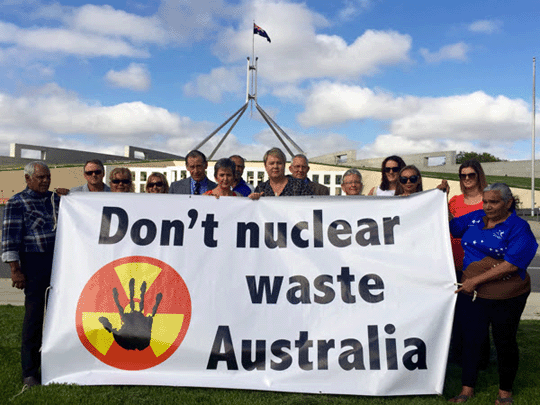
The ReachTEL Poll of 1077 SA residents conducted on March 10 found that 37 per cent of voters supported of voters supported an international nuclear waste dump, 48.5 per cent were opposed and 14 per cent were undecided.
The poll was commissioned by left-wing think tank The Australia Institute, which will tomorrow release a report critical of the international nuclear waste proposal.
Australia Institute executive director Ben Oquist said South Australians were increasingly aware of the risks posed by the project, including the damage it could do to the state’s reputation.
“I think people are increasingly wise to the projects that are jobs-rich, versus those that are expensive, likely to involve a large upfront government subsidy and won’t produce long-term jobs,’’ Mr Oquist said.
Those industries that are jobs-intensive are potentially put at risk by South Australia’s brand being threatened by a global nuclear waste dump.’’
Almost 49 per cent of Liberal, 28 per cent of Labor, 12 per cent of Greens voters backed the proposal.
But 52 per cent of Labor, 38 per cent of Liberal and 71 per cent of Greens were opposed……http://www.adelaidenow.com.au/news/south-australia/women-and-labor-voters-opposed-to-international-nuclear-waste-dump-in-south-australia-poll-finds/news-story/35d4ad38cadbaae4798ca89e91c74f5f
Movement for a treaty with Australia’s First Nations gathers momentum
 Tony McAvoy, The Point with Stan Grant, NITV:
Tony McAvoy: The time to push for a treaty is right now
‘Australia’s first Indigenous Senior Counsel, Tony McAvoy is a strong advocate
for treaty over recognition.
He addressed the ‘Need for Treaty’ forum in Sydney on Tuesday night.’
http://www.sbs.com.au/nitv/the-point-with-stan-grant/article/2016/03/15/tony-mcavoy-time-push-treaty-right-now
15 Mar 16:
“KEY POINTS
* A treaty is achievable
* There must be an acknowledgment that Australia was not settled
* The assertions of sovereignty by the British Colonies, and now by
the Commonwealth of Australia, are flawed
* We need an Assembly of First Nations
* There must be land reform
* There must be changes to the land tenure arrangements
* There must be reparations, compensation and equitable benefit sharing
* Structural reform needs to take place at many levels
* There needs to be guaranteed representation in Parliament … ”
Redfern forum: ‘Treaty framework achievable within next few years’
15 Mar 16:
“Over one-hundred people attend a landmark meeting to discuss a way forward for treaty in the next few years. In front of a packed crowd in Sydney’s Redfern Community Centre, Wirra man and Australia’s first Indigenous Senior Counsel Tony McAvoy opened the night with a decisive plan for treaty. “It is achievable that within the next few years, that we will have set a
framework for treaties to be entered into by First Nations,” says Mr McAvoy. “I think the time is now and I don’t think we should defer it,” he said to applause front the audience. … “
The ethics of burdening future South Australians with nuclear wastes?
A high-level nuclear waste dump for SA What is our moral obligation?

The argument goes: surely SA has a moral obligation to import nuclear waste…
…because we mine uranium?
…because we are more geologically and politically stable than other places?
…because we benefit from x-rays?
If we want this decision to include moral considerations (as it should), we might ask ourselves about the ethics of burdening thousands of generations of future South Australians with the cost and risk of managing highly radioactive waste, when any economic benefits are long gone.
1 This month
17 October, Free Public Talk on Nuclear Issues in South Australia
David Noonan will speak on public interest concerns over the new Roxby Downs Indenture Act 2026 on BHP copper-uranium mining and ore processing in SA, and on how AUKUS may face SA with a High-Level nuclear waste agenda.
Dr Jim Green will discuss international developments in the field of nuclear power including ‘small modular reactors’ and Generation 4 ‘advanced’ nuclear reactor concepts.


Help Aunty Sue Protect Her Land and Sacred Sites From Destructive Rocket Testing.
.

Australians deserve the truth
about
AUKUS – https://aukuspublicinquiry.com/

PETITION – To: Prime Minister Anthony Albanese and the Australian Labor Government

of the week – Australians for War Powers Reform (AWPR)
To see nuclear-related stories in greater depth and intensity

