Australian govt now recognising no true threat from ‘vigilante’ green groups?
No evidence of ‘vigilante’ green groups as government crackdown falls silent, The Age, Nicole Hasham, March 3, 2016 Environment Minister Greg Hunt has failed to justify his government’s claim that “vigilante” green groups are unfairly disrupting major developments in court, a parliamentary committee says, as speculation mounts that another Abbott-era attack on the environment has been quietly abandoned.
It has been almost seven months since the government proposed new laws that would strip conservation groups of the right to launch a legal challenge to environmental approval for large infrastructure and mining projects. It followed a Federal Court bid by a grassroots community group that threw a spanner in the works of Australia’s largest coal project, Adani’s proposed Carmichael mine in central Queensland – a move former prime minister Tony Abbott described as “sabotage”.
Under the proposed changes, the right to mount a court challenge would be limited to people directly affected by a development, such as a landholder.
The move drew public outrage and stalled in the Senate after failing to win support from Labor, the Greens and some crossbenchers.
In an attempt to justify the legislation to a joint parliamentary committee on human rights, Mr Hunt claimed there was “an emerging risk of the [current laws] being used to deliberately disrupt and delay key projects”.
However, a report by the committee, which is evenly split between government and other members, said no evidence was provided about the extent and nature of this threat in cases where there was “no legitimate environmental concern”.
Mr Hunt’s office insisted the proposal “remains government policy”. However the bill is unlikely to pass without changes and Labor says the government has not sought to negotiate amendments.
Mr Butler said it appeared the bill had been “tucked away in the bottom draw in the hope that the Australian public will forget the ridiculous attacks this government has made on the environment in the past two-and-a-half years”.
It follows reports that the Turnbull government has shelved plans to abolish the Clean Energy Finance Corporation, representing another departure from Mr Abbott’s environment policies………http://www.theage.com.au/federal-politics/political-news/no-evidence-of-vigilante-green-groups-as-government-crackdown-falls-silent-20160303-gn9e7c.html
Australia needs to ‘get very serious’ about dealing with heatwaves
Australia underprepared to deal with ‘killer heat’, Climate Council report says Australia is underprepared to deal with the escalating problem of extreme “killer” heatwaves and a “whole of society approach” is needed to deal with the problem, a Climate Council report says. ABC News, 3 Mar 16

- The 2009 heatwave killed over 370 people
- Heatwaves have killed more people than fires, cyclones, floods
- Cardiac arrests triple during heatwaves
- Whole of society approach needed to make changes
There were more than 370 deaths during the heatwave of 2009 and climate forecasts indicate there will be longer, hotter and more intense heatwaves in future, according to The Silent Killer: Climate change and the impact of extreme heat.
The number of record hot days in Australia has doubled in the past 50 years.
Heatwaves have killed more Australians than any other natural hazard and have caused more deaths since 1890 than bushfires, cyclones, earthquakes, floods and severe storms combined, the report said.
The heat places “a dramatic demand” on public facilities such as hospitals and the system is so stretched there is no capacity to increase services.
In the 2009 heatwave, emergency callouts jumped by 46 per cent and there was a tripling of cardiac arrests.
“Our argument is no-one should die from heat in Australia,” said Dr Liz Hanna, the report’s author. We know it’s hot, we know when it’s coming, we know quite a lot about what’s needed. “What we need to do is just make this happen.”
Australia needs to ‘get very serious’ about dealing with heatwaves Dr Hanna said there needs to be greater flexibility in how hospitals operate, and extra capacity in the emergency services.”It’s not only boosting capacity to respond to what we’ve had, we need to plan to boost our capacity for what’s yet to come because the worst hasn’t really happened yet,” she said………http://www.abc.net.au/news/2016-03-02/australia-underprepared-to-deal-with-killer-heat-report-says/7212408
Larissa Waters explains Australia’s revolving door of polluters and politicians
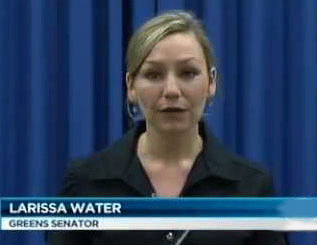 Larissa Waters: Ban donations from mining companies and stop ministers working for them, Larissa Waters, Guardian, 1 Mar 16 The fossil fuel industry’s influence on politics is disproportionate to the contribution the sector makes to employment, writes Senator Larissa Waters In Australian politics, there is a revolving door that swings round and round, fuelled by money and self-interest.
Into it go former politicians and their staffers and out pop even more highly paid mining company executives and fossil fuel lobbyists.
The list of former politicians and staffers who’ve scored cushy positions in the fossil fuel sector is depressingly long – I’ve listed just some of them that I’m aware of below.
The revolving door in part explains why there has never been a coal mine or gas project refused under our federal laws.
The massive political donations, made by this desperate industry trying to cling on through taxpayer subsidies, make up another reason for the tick-and-flick approach.
A very generous $3.7m was tipped into the pockets of the federal Liberal, National and Labor parties in the last three years – and much more when you include donations made at branch and state levels.
Such large amounts of money buys influence, and buys favourable policy settings for this dying industry. For every dollar of their $3.7m contribution to the election warchests of the big parties, they get more than $2,000 back from the taxpayer purse………..
The influence of these pervasive fossil fuel donations on our political system has left the job-rich clean energy industry to deal with the investment uncertainty created by a government ruled by climate dinosaurs.
And despite the change of prime minister and the talk of agility and innovation, the revenue-positive Clean Energy Finance Corporation and the Australian Renewable Energy Agency, which supports cutting-edge, genuinely innovative technology, are both on the Turnbull government’s chopping block.
Now is the time to be increasing public investment in job-rich clean energy to take advantage of the global transition that is already happening, while Australia is missing out.
The revolving door between politicians and the mining lobby needs to be slammed shut and political donations from fossil fuel companies must come to an end.
The Greens have legislation before the Senate to ban donations from fossil fuel companies,………http://www.theguardian.com/commentisfree/2016/mar/01/larissa-waters-ban-donations-from-mining-companies-and-stop-ministers-working-for-them
Australian Conservation Foundation monitors Australia’s biggest polluters
 Australia’s 10 biggest climate polluters 2016 http://apo.org.au/resource/australias-10-biggest-climate-polluters-2016 Australian Conservation Foundation 29 February 2016 Australia’s 10 biggest polluters – all energy and mining companies – continue to rely on last century’s fuels to generate energy and conduct their businesses.
Foreword
In the 12 months since the Australian Conservation Foundation’s first report on Australia’s 10 biggest climate polluting companies, energy giant AGL has gone from #3 to #1 and miner Glencore has entered the list for the first time.
Despite what the federal government tells Australians, the amount of climate pollution Australia pumps into the sky is rising.
And Australia’s 10 biggest polluters – all energy and mining companies – continue to rely on last century’s fuels to generate energy and conduct their businesses.
This report, based on the very latest available data, describes each company, explains how the company creates climate pollution and summarises what each says on the public record about climate change.
These 10 companies are responsible for the equivalent of nearly a third of Australia’s climate pollution. Together, they are responsible for pouring more climate pollution into the atmosphere than Switzerland, Ireland, and Denmark combined.
And government policies encourage them to keep doing what they’ve been doing for decades. Meanwhile, the world is changing.
In Paris in December last year, 195 countries agreed to keep “the increase in the global average temperature to well below 2°C above pre-industrial levels and to pursue efforts to limit the temperature increase to 1.5°C above pre-industrial levels.”
To achieve this goal all countries have to work hard to cut climate pollution.
But in 2014-15 Australia’s climate pollution increased by 1.3 per cent. That’s more than seven million additional tonnes of planet-warming pollution pumped into our skies in just one year.
Why? In axing the carbon price, the government removed the one policy Australia had to reduce climate pollution from the energy sector, leaving electricity generators – and the rest of us – largely reliant on coal for our power.
The truth is the energy sector is crying out for government leadership to help the industry make the transition to a zero-pollution future.
At an energy forum hosted by ACF last year representatives of energy companies, superannuation funds, financial services companies and investors agreed the early closure of coal-fired power stations was inevitable and the federal government needed to manage this transition.
AGL’s chief executive Andrew Vesey has called on the federal government to develop a “clear and equitable policy” to close the least efficient power stations. “It is important that older, less efficient and reliable power stations are removed from Australia’s energy mix,” Mr Vesey said. “Decarbonisation and modernisation of Australia’s electricity system are important goals requiring effective policy.”
The calls are there – from the energy companies, investors, environmentalists and infrastructure experts. Now, the government must take the lead.
ACF urges the federal government to commit to a phased closure of Australia’s coal-fired power stations. This means starting with the dirtiest and least efficient stations, helping affected workers and communities with the transition and drawing up comprehensive plans to clean up and rehabilitate old mine sites and power stations.
The big polluters identified in this report own some of the world’s dirtiest coal-fired power stations. Every day these dirty power stations are spewing out pollution. Every day they are making climate change worse.
Australians already live with the impacts of climate change. Last year was the world’s hottest recorded year, the 39th consecutive year of above average temperatures. This has fuelled droughts, bushfires, heatwaves and other extreme weather events across the country. This summer ancient parts of Tasmania’s alpine World Heritage wilderness were burnt by bushfires for the first time in a thousand years. These big polluting companies are making this situation worse every day.
It’s time for Australia to get out of last century’s energy sources and leap into a brighter future powered by clean energy.
Solar thermal power push to keep jobs in Port Augusta
 THE “dominoes” are lined up for Port Augusta to switch from coal-fired to solar thermal power generation and advocates are urging governments to summon the “political will” to secure the project….(subscribers only)
http://www.adelaidenow.com.au/news/south-australia/solar-thermal-power-push-to-keep-jobs-in-port-augusta/news-story/dd0e42df6d28e5e0bb5959966ac676be
Oman Ama community group to Canberra to reject nuclear waste dump plan
 Qld group rejects nuclear dump plan Brisbane [AAP], EchoNet 1 Mar 16 Representatives from a tiny Queensland town have travelled to Canberra to voice concerns about being on a shortlist for nuclear waste dump sites.
Oman Ama, west of Warwick, was in November named as one of six potential dump sites identified by the federal government, which began a four-month consultation period…….
Members of the group Friends of Oman Ama will meet with two of Mr Frydenberg’s advisors on Tuesday, believing their questions about the process have not been adequately answered. ‘There’s some real damage happening – in family, friends, there’s division in the community’, spokesman Mark Russell told AAP.
‘The degree of harm and hurt is only going to be exacerbated as this process goes on.’ Mr Russell said the government was yet to clarify how it would measure “community acceptance”.‘We have no way of identifying where the goalposts are,’ he said.
‘It’s a very murky area, but it’s a key part of the process – because (the minister) is pinning his approach on this to the consultation factor.’
Oman Ama is a potential site because one land holder expressed an interest to an offer of “four times” the retail value of his property, Mr Russell said. He said residents were not concerned about the owner’s decision, but the way in which the government had begun the process based on one landowner’s interest.
Other property owners were worried about the financial impact and had spoken to bank managers, real estate agents and insurance brokers, Mr Russell added.
‘They have been told if you get a radioactive waste management facility in your area, your land values are most likely to depreciate’, he said……http://www.echo.net.au/2016/03/qld-group-rejects-nuclear-dump-plan/
Resources Minister Josh Frydenberg would not meet Communities from outback sites designated for nuclear waste dump
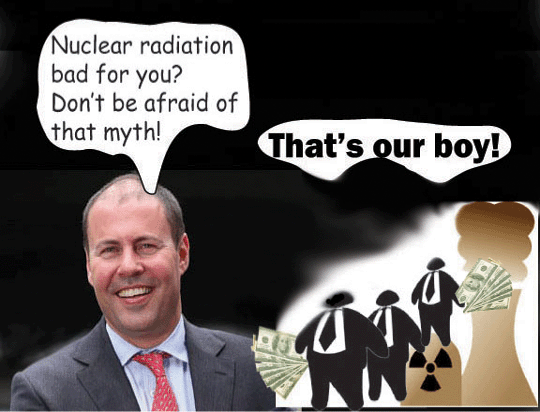 Residents ‘disappointed’ Minister Josh Frydenberg failed to meet them over nuclear waste dump concerns, ABC News, By Leah MacLennan and Natalie Whiting, 1 Mar 16 South Australian residents campaigning against a nuclear waste dump being set up in their communities have taken their fight to Canberra.
The Federal Government has a shortlist of six sites for the facility, which would house medium- and low-level waste, much of it from nuclear medicine. Representatives from all six communities have travelled to Canberra, where they have met with government advisers, but have not been able to meet Resources and Energy Minister Josh Frydenberg.
Three of the proposed sites are in South Australia,with two near the Eyre Peninsula town of Kimba.
Kimba farmer Peter Woolford travelled for two days to get to Canberra and said he was disappointed the Minister did not make time to meet with the group. “I think it’s certainly a lack of respect that’s been shown to a lot of us at the moment,” Mr Woolford said………
The group is concerned about the impact a dump could have on the environment, agriculture and land values. Andyamathanya woman from the Flinders Ranges, Regina MacKenzie, said one of the proposed sites has archaeological and spiritual significance for her people. “What little we have left, let us preserve it. Let us take it for the future,” Ms MacKenzie said.
“We’re fighting for our survival, not only our survival but our spiritual survival as well as Aboriginal people.”
Community consultation on the proposed sites will end on March 11….http://www.abc.net.au/news/2016-03-01/resident-disappointed-josh-frydenberg-failed-meet-nuclear-waste/7211416
Communities fight Turnbull government nuclear waste dump plan
Aboriginal woman Regina Mackenzie said the proposed Barndioota site in the Flinders Ranges threatened important cultural heritage sites. “There was no consultation whatsoever … we just feel it’s an attack on our belief system,” she said.
Greens nuclear spokesman senator Scott Ludlam said communities were told the dump would not be built if locals largely objected. “There’s strong opposition in all six communities [and] the government needs to abandon this idea,” he said.
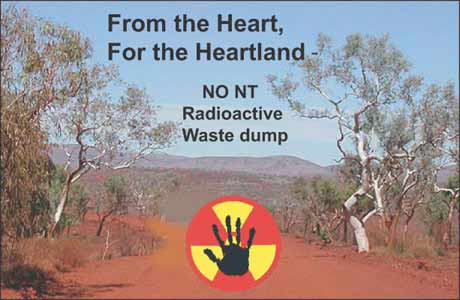 Nuclear waste dump: Sleepless nights, tears and stress as communities fight Turnbull government plan, SMH March 1, 2016 – Nicole Hasham Environment and immigration correspondent When Peter Woolford’s son died in a motorbike accident 12 years ago, the rural community of Kimba united to help the farmer and his wife through their personal cataclysm.
But that was then. Now, old friends in the community no longer speak, and people on the streets of the South Australian town are afraid to talk about the issue that has driven a wedge between neighbours: a proposed nuclear waste dump.
Cortlinye, near Kimba, is one of six sites across Australia the federal government has shortlisted to host the nation’s first permanent nuclear dump for low-level and intermediate waste.
The others are at Sallys Flat near Hill End in NSW, Hale in the Northern Territory, Pinkawillinie and Barndioota in South Australia and Oman Ama in Queensland.
If sites are approved, landowners who volunteered their property would receive up to four times the value of their land, and the community would receive about $10 million for infrastructure or services.
But this fight is “not about money”, said Mr Woolford, who was in Canberra on Tuesday with waste dump opponents from the other five communities to voice their concern. They say Resources Minister Josh Frydenberg refused to meet them, however they met other senior officials. Continue reading
Solar energy to the grid: New South Wales’ Moree solar farm in operation
 Moree solar farm starts feeding energy into grid http://www.abc.net.au/news/2016-02-29/moree-solar-farm-starts-feeding-the-grid/7207942 ABC New England By Kelly Fuller The largest single-axis tracking solar farm in the country is now feeding energy back into the grid from Moree in New South Wales.

The solar farm is led by Fotowatio Renewable Ventures (FRV) and has been funded with assistance of a $102 million grant from Australian Renewable Energy Agency and $47 million in debt financing from the Clean Energy Finance Corporation.
At full capacity the project is expected to generate 140,000 megawatt hours per annum, or the equivalent energy to supply the needs of 15,000 homes.
The company’s country manager Cameron Gamsworthy said feeding energy back into the grid was a significant step in the project’s development.
“It’s absolutely a major milestone. We’re now generating clean, renewable energy for the country,” he said. “[We are] looking forward to getting the project fully commissioned over the course of the next month.”
The farm’s 222,000 panels are expected to have a life of 30 years, and the company hopes the project will be at full capacity in a month’s time.
Mr Gamsworthy said FRV was considering other projects in the region.
Farm solar is the future
While the Moree project is unique, a University of New England academic said there was a growing demand for solar energy, particularly among rural communities.
“Farmers are getting more and more hungry for mobile technology that can be distributed around the farm,” said Professor David Lamb, from the university’s Smart Farm. “It could be a little water bore pump or some sort of gate alarm system or a trough monitor,” he said. “All of these technologies are going to need solar themselves because we obviously don’t want powerlines running around farms.
“I wouldn’t be surprised if there are literally thousands of little solar panels balancing on the back seat of old tractors that are used to keep the battery alive while it is left out in the weather for the next start.”At the end of the day the solar panel is becoming the set of pliers on a farm — you see them everywhere you look.”
Professor Lamb said the university was putting up ‘smart trees’ around the Smart Farm. “We literally have little sensors in the trees showing the amount of water these guys suck out of the ground, and each and every one of these trees has their own solar panel,” he said.
“[It] is quite ironic when you consider that trees are one of the most efficient harvesters of solar energy that we know.”
Tasmania’s great opportunities in renewable energy
King Island is emblematic of the challenges and opportunities facing the state. It is blessed with natural resources, but punished by its relative remoteness and lack of economies of scale. It has been a perfect testing ground for renewable technology, and has led to the Hydro exporting novel approaches to overseas markets. The project has already avoided the use of 18 million litres of diesel, and saved more than $24 million.
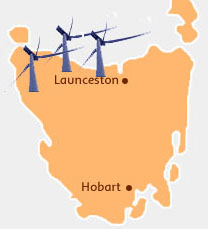 Tassie must look to future in renewables, February 29, 2016, ROSALIE WOODRUFF, Mercury “……… The Paris climate agreement sends a clear message to governments and investors that the age of fossil fuels is finished. There is a momentum around renewable energy generation, pushed by an urgency to respond to global warming and an explosion of new technology.
From crisis comes opportunity. The Greens are focused on the long-term task of transitioning Australia away from dependence on fossil fuels. The future is clearly in renewable energy generation, for pragmatism and prosperity.
We have released the Greens Energy Strategy, a blueprint for how the state can get started immediately on setting the business conditions we need to attract medium to large-scale renewable projects.
Our target is for Tasmania to be self-sufficient in clean electricity generation by 2022, and to be net exporters to the mainland. This is achievable. Continue reading
Could renewable power be Port Augusta’s saviour?

THE “dominoes” are lined up for Port Augusta to switch from coal-fired to solar thermal power generation and advocates are urging governments to summon the “political will” to secure the project….(subscribers only)
http://www.adelaidenow.com.au/news/south-australia/solar-thermal-power-push-to-keep-jobs-in-port-augusta/news-story/dd0e42df6d28e5e0bb5959966ac676be
Port Augusta community keenly concerned about renewable energy versus nuclear industry developments
Key points:
- Regional job losses and nuclear royal commission findings have some locals worried
- Government minister Geoff Brock says no nuclear decisions have been taken
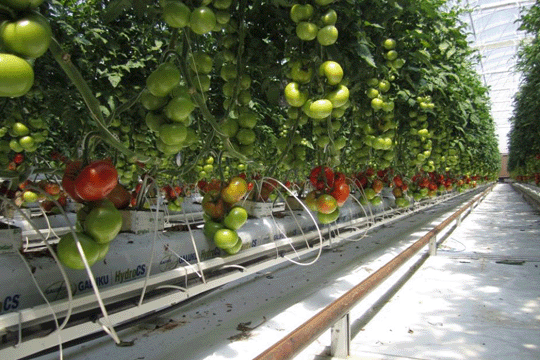
- Tomato greenhouses using desalinated water are praised for creating local jobs
Hundreds of residents are expected at Port Augusta’s Central Oval complex to quiz visiting Government ministers on a range of issues including jobs.
The regional city is gearing for an imminent closure of Alinta’s Port Augusta power stations.
 Mayor Sam Johnson expressed hope a range of options including hydroponic farming and renewable energy projects would create a secure future for the Port Augusta region.
“There is an area around Port Augusta which is clearly one of the world’s best sites when it comes to wind … also [ideal for] solar virtually from just south of Port Augusta right up to Roxby Downs,” he said.”As you go over towards Whyalla and Cowell, [that area] has been identified for anyone that wants to invest in wave technology.”
Government ministers are expected to tour Sundrop Farms’ vast tomato greenhouses at Port Augusta, which use desalinated sea water for crop production in the arid region. State Regional Development Minister Geoff Brock praised such ventures at a time of job losses elsewhere. “They will have around 200 people working there full-time and the good thing about this [is] Sundrop have just won an innovative award in Germany on an international scale,” he said.
“They’re going to have the research and development [functions] located at Port Augusta, so this is state of the art.”
Radioactive nuclear waste worries for northern SA residents Nuclear concerns will also be high on the agenda for the public forum and for Cabinet as it meets in the far north region. The Port Augusta Mayor said there was significant local concern about the future prospect of radioactive waste being transported through the northern region.
Mr Johnson said talk of a possible nuclear waste facility for the state’s north was a hot topic among residents. He said if any high-level waste was ever shipped in via Whyalla or Port Pirie, it would also be likely to be transported through Port Augusta.
 “The only way to go … is through Port Augusta, which has a two-lane bridge which has been in need of a little bit of work,” he said.
“There’s effectively no alternative detour access route and should there be an incident that occurs on that bridge then that has significant impacts not just for Port Augusta but also potentially the eco or marine environment.”…….http://www.abc.net.au/news/2016-02-28/jobs-nuclear-waste-port-augusta-forum-country-cabinet/7205842
Australia’s Labor and Liberal Parties unite in dismissing community concerns on nuclear waste dumping
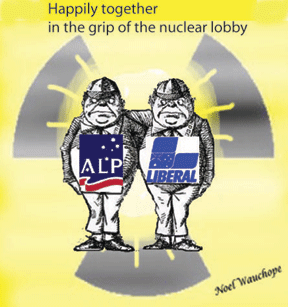 Liberal and Labor vote to ignore waste dump community concerns 22 Feb 2016 | Scott Ludlam The Labor and Libberal parties have voted together against a senate motion acknowledging the community opposition to each of the six locations shortlisted as a site for a nuclear waste dump.
“It’s not as though this motion asked a lot of the government, but for the opposition to cower from it is disappointing and weak,” Australian Greens Deputy Leader and Nuclear Issues Spokesperson Senator Scott Ludlam said today.
“The government is shirking their own process. After months of assurances that they would heed community concerns, they’re desperately trying to downplay those concerns or ignore them altogether.
“We should be investigating all avenues to minimise waste, we should have a genuinely independent inquiry to investigate long-term stewardship options for spent fuel, reprocessing wastes, and other categories of radioactive waste. And we certainly should categorically rule out the importation of international nuclear waste,” Senator Ludlam concluded.
The senate motion opposed by Labor and the Coalition can be viewed here: http://scott-ludlam.greensmps.org.au/content/motions/strong-local-opposition-all-6-proposed-nuclear-waste-dump-sites
Will the Australian govt impose a Lucas Heights nuclear waste dump on a South Australian community?
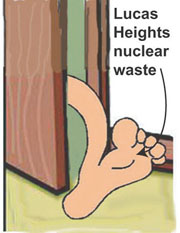 We will soon see how much in a rush the government is with the issue. Will it try to find a site by any means, even if this implies imposing it on a community or will it take its commitment not to do so seriously and maybe take the steps necessary to find a long-lived solution to a long-lived problem?
| By Anica Niepraschk , 29 February 2016 The federal government – once again – is looking for a place to dump its nuclear waste. All attempts over the last twenty years have failed – and so might this one, at least if the government is sticking to the promises it made in its new approach.The process is to be voluntary and no dump is to be located anywhere without community consent. These are the words at least. 28 sites across Australia had been nominated by landowners last year and were reduced to a shortlist of six by the Department for Resources.
The six sites are in Hale (NT), not far from Alice Springs, Hill End in NSW, Oman Ama in Queensland and three sites in South Australia: two in the Kimba region (Cortlinye and Pinkawillinie) and Wallerbidina/ Barndioota, outside Hawker. The South Australian shortlisted sites also get increasingly entangled in a debate as to whether the state might offer itself up as the world’s nuclear waste dump, accepting high-level nuclear waste from power reactors around the world. This was the key prospect outlined in the tentative findings of the Royal Commission into the Nuclear Fuel Cycle, released last week. All six sites are so far highly contested by the local communities, Continue reading |
South Australia a great State not a Waste State – communities visit Federal Parliament
 Flinders Ranges and Kimba residents voicing nuclear concerns to Federal Parliament http://www.transcontinental.com.au/story/3753842/local-voice-on-nuclear-goes-national/?cs=1538 28 Feb 16
FLINDERS Ranges and Kimba representatives will travel to Parliament House in Canberra next week, with delegates from three other sites across Australia targeted for a national radioactive waste dump joining them.
South Australia has three nominated sites – two at Kimba and one just north of Hawker in the Flinders Ranges. The visit comes a week before the closure of public comment on the National Radioactive Waste Management Project on March 11.
Meetings have been requested with the key decision maker federal Resources Minister Josh Frydenberg and other ministers to discuss community concerns ahead of the submission deadline.
Toni Scott and her family neighbour in Kimba a part of a group of locals within affected areas.She has been in regular contact and feels taking their message directly to Canberra will be an important way to step up campaigning efforts to ensure community concerns are recognised and reflected. “We are going to Canberra because our concerns must be heard,” Ms Scott said.
“Communities deserve to be treated better than what this process has delivered thus far and we want to get our message across face to face.”
Regina McKenzie has regularly spoken against the planned proposal near Hawker.“Its important that we get the message through to the government – no means no,” Ms McKenzie said.”We don’t want to live next to a radioactive waste dump. “SA is a great state not a waste state.”
1 This month
17 October, Free Public Talk on Nuclear Issues in South Australia
David Noonan will speak on public interest concerns over the new Roxby Downs Indenture Act 2026 on BHP copper-uranium mining and ore processing in SA, and on how AUKUS may face SA with a High-Level nuclear waste agenda.
Dr Jim Green will discuss international developments in the field of nuclear power including ‘small modular reactors’ and Generation 4 ‘advanced’ nuclear reactor concepts.


Help Aunty Sue Protect Her Land and Sacred Sites From Destructive Rocket Testing.
.

Australians deserve the truth
about
AUKUS – https://aukuspublicinquiry.com/

PETITION – To: Prime Minister Anthony Albanese and the Australian Labor Government

of the week – Australians for War Powers Reform (AWPR)
To see nuclear-related stories in greater depth and intensity

