AGL proceeding with Silverton wind farm project in far west NSW
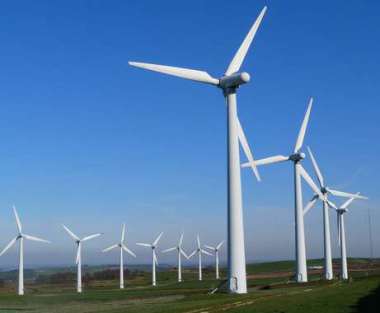 AGL vows to go ahead with Silverton wind farm project in far west NSW ABC Broken Hill
By Declan Gooch 27 Feb 16 Energy company AGL has reaffirmed its commitment to the Silverton wind farm project in far west New South Wales, and says studies of the site will get under way within weeks.
The proposed site along the Barrier Ranges just outside the Silverton township was first proposed in 2007 by Epuron, but stalled after AGL took over in 2012. AGL blamed uncertainty about the federal government’s Renewable Energy Target for the pause, with development approval set to run out in May.
The company announced at a community meeting on Thursday night it applied that day to have another five years added to the approval, and announced a new project manager, Adam Mackett.”We’re already doing work through the hydrogeological study where we’re committed to this project, so we’re showing that,” Mr Mackett said. “It is a half-a-billion-dollar project so before we then fully commit to constructing it we need to do a bit of work.”
Mr Mackett is no stranger to the state’s far west, having managed the construction of the Broken Hill solar farm around 25 minutes away. He also oversaw the construction of South Australia’s Hallett wind farm.
“We’re confident of having [the Silverton project] extended, we think the Silverton wind farm is a fantastic opportunity.”
AGL hopes the wind farm will generate enough power to supply around 120,000 average homes.
Funding will be contributed from AGL’s newly-announced Powering Australian Renewables Fund, which will be seeded partly by the Broken Hill solar farm……… AGL said it hopes its Powering Australian Renewables fund will be set up by the middle of the year, and that the extension to the project’s approval will be signed off in the next three months. http://www.abc.net.au/news/2016-02-26/agl-vows-to-go-ahead-with-silverton-wind-farm-project/7202338
Australia at risk of missing its 2020 renewable energy target
Some continue to blame the sluggish investment on the uncertainty created by then Prime Minister Tony Abbott’s ferocious push across 2014 and 2015 to cut the renewable energy target. Last year the government and Labor struck a deal to lower the target.
In recent times there have been some positive signs of movement.. This month energy giant AGL launched an investment fund aimed at delivering 1000 megawatts worth of renewable energy, while Origin Energy head Grant King was quoted saying his company was preparing to back new projects………
 Australia risks missing clean power goals, with households to pick up the bill, SMH, February 28, 2016 Tom Arup Environment editor, The Age Australia risks not hitting its 2020 renewable energy target with analysts now forecasting that interim goals will be missed – a situation that will trigger penalties that households will have to pay.
Many in the energy industry agree that this year will be “make or break” for achieving the end-of-decade target, which aims to deliver about 23 per cent of Australia’s electricity from clean technologies such as wind and solar.
“This year is critical” said Kane Thornton, who heads the Clean Energy Council……….. Continue reading
Gas company APA joins throng to spend on renewable energy projects
APA aims to ramp up renewable energy spending, The Age February 28, 2016 Brian Robins APA wants a seat at the table in the multibillion-dollar investment boom in renewable energy sources over the next few years amid national moves to meet the mandated renewable energy target.
This month, AGL said it might launch a $3 billion fund to build renewable energy projects such as wind and solar farms.
Rival Origin Energy said it might invest in similar projects but would most likely buy the output under long-term contracts.
Under federal government policy, one-fifth of electricity must be sourced from renewable energy by 2020. The move is expected to hasten the closure of heavily polluting coal-fired power stations…….
APA is considering several projects, including a potential solar farm in Western Australia, if it wins support from Australian Renewable Energy Agency funding and signs a power sales agreement. It is also bidding on an estimated 90MW of wind turbine capacity in the Northern Territory………http://www.theage.com.au/business/apa-aims-to-ramp-up-renewable-energy-spending-20160224-gn2a1g.html
Exposing the vested interests of pro nuclear publicists like Oscar Archer
 Dennis Matthews, 26 Feb 16 The Advertiser newspaper has been printing lots of Letters to the Editor on the nuclear issue.
Two pro-nuclear letters caught my attention.
One was by a writer (Oscar Archer) who is regular contributor to a pro-nuclear website, and who prides himself on having a PhD in Chemistry. The PhD, however, is in an area of chemistry not evenly faintly related to nuclear issues and is no basis for claiming any special insight. What is highly relevant however is that the supervisor of his thesis was Stephen Lincoln who, as a member of the board of SA Nuclear Energy Systems, has a vested interest in promoting the nuclear industry.
Another letter was written by a geologist (Sean Kennedy) who was one of the people acknowledged by Senator Edwards as contributing to his submission calling for an integrated nuclear industry in SA.
Noel Wauchope – Oscar Archer is a star publicist for the nuclear lobby. And – he really gave the game away in a talk on ABC Radio National “Ockham’s Razor” – in which he elaborated the plan of USA nuclear industry “new nukes” – their idea to set up a suite of experimental SMRs -Small Modular Reactors in Australia at their own expense. All Australia has to do to get these is to invite in the world’s radioactive trash. They don’t mention that SMRs need plutonium or enriched uranium to start the reaction – so Australia would have to import those, to get these reactors working.
Interesting that they just call them “SMRs” – leaving out that unpopular word “Nuclear”. As USA govt has difficult safety regulations for setting up new nuclear reactors, why not have Australia be the guinea pig?
Adelaide Advertiser poll – nearly all supporters of nuclear waste import had vested interests!
 Dennis Matthews, It was heartening to see that in a survey stacked with vested interests (The Advertiser, 23/2/16), of those who had no apparent vested financial or professional interest only two people supported the importation of high-level nuclear waste into South Australia and one of those had imprecise information about Finland.
Stacking inquiries and surveys is a trade mark of the nuclear lobby.
I look forward to the day when we can trust the business community, media and politicians to be honest with the people of South Australia and to stop treating us as like idiots.
Naively, I thought this would have happened after the State Bank fiasco in 1991. Consecutive South Australian Premiers have clearly demonstrated that they have learnt nothing from past indiscretions.
It is now up to ordinary South Australians to keep South Australia free from exploitation by vested interests and incompetent politicians.
China criticises Australia’s ‘Cold War mentality’,in its planned $150 billion military spendup
Defence white paper shows Australia’s ‘Cold War mentality’, says China, February 26,2016 Philip Wen China correspondent for Fairfax Media
Shanghai: China has accused Australia of maintaining a “Cold War mentality” with its alliance with the United States, following the release of the Turnbull government’s defence white paper which criticised China’s role in rising tensions in the South China Sea.
At a regular press briefing in Beijing, Defence Ministry spokesman Colonel Wu Qian said China was “seriously concerned” about the contents in the white paper, and that it was “firmly opposed to the accusations against China’s construction activities on the islands and reefs in the South China Sea”.
“We urge the Australian side to cherish the hard-won good momentum of development in bilateral relations, and don’t take part in or conduct any activities that may compromise the stability in the region,” Colonel Wu said at Thursday’s briefing, alluding to pressure on Australia to join the United States in sailing warships within 12 nautical miles of China’s artificial islands in the sea in so-called freedom of navigation operations…….. http://www.smh.com.au/world/defence-white-paper-shows-australias-cold-war-mentality-says-china-20160226-gn4d6j.html#ixzz41PmdN1zf
Australia’s $150 billion Defence white elephant spending
Sub-standard plan for Defence, SMH, February 27, 2016 Michael West Business columnist After a welter of strategic press leaks, targeted with the precision of a laser-guided missile, the 2016 Defence white paper was finally unveiled this week.
Defence spending has the added allure of political expedience. Who can argue with a government bent on safeguarding its citizens from future unspecified invaders? Certainly not the opposition……
It may cost taxpayers $150 billion.
 Although the cost to design and build each of the 12 submarines is mooted at $4 billion – just shy of a Medibank float – the cost of running them is far greater. They describe the submarine spend as the “largest defence procurement program in Australia’s history”.
Chance of attack is small
The white paper concedes there is but a remote chance of a military attack on Australian territory by a hostile foreign power. Further, it says Australia cannot afford to equip, train and prepare its military forces solely for the remote prospect of such a major attack.
This would leave the defence forces less capable of addressing the wide range of more likely threats Australia faced to 2035.
So the policy is therefore to devote unprecedented billions of dollars, the biggest defence outlay ever, to build submarines on the implausible chance of a foreign military attack.
China is not discussed much, though it is deemed by Defence to be the biggest threat. There are a few brief references in the paper though there is no discussion of what sort of force we would need if China were to attack.
And you don’t have to be a defence guru to work out that Australia would stand little chance of withstanding a Chinese military with its 70 submarines, 2.3 million frontline personnel and $US155 billion defence budget.
The white paper’s submarine analysis is flimsy. The first subs only become operational in the 2030s, at the end of the strategic environment which the paper addresses.
It fails moreover to establish why this weapon system is superior to far more agile, responsive and modern air and surface weapon systems for meeting the faint threat of invasion, or how the huge outlay is justified……
The public deserves better than for this critical issue of defence spending to be treated as such a sacred cow that there is no debate about it in Parliament and no more than feeble inquiry in the mainstream media.
You could select the tiniest thing on the share market and bet it would boast superior disclosures to Defence white paper 2016.
Rather than having cash thrown at them willy-nilly, the armed forces should undergo the same blow-torch as other institutions. You can bet there is a lot more fat in defence than the ABC (whose white paper coverage has also been lame).: http://www.smh.com.au/business/comment-and-analysis/substandard-plan-for-defence-20160226-gn4cx3.html#ixzz41PkqKAgL
#NuclearCommissionSAust ‘s plan – not necessarily an Eldorado for South Australia
 SA’s Nuclear Waste Boom: A Hot Story Requires Cool Heads http://adelaidereview.com.au/opinion/business-finance-opinion/nuclear-waste-boom-a-hot-story-requires-cool-heads/ John Spoehr Director of the Australian Industrial Transformation Institute at Flinders University February 26, 2016
As the alluring prospect of a nuclear waste storage boom fades a little in our minds, attention needs to turn to the risks associated with large–scale radioactive waste storage…….
I think the Commission’s estimates might prove to be over-optimistic. If the proposition is as attractive as the modeling provided by the Commission suggests, then you would expect a range of players to enter the market at the same time as Australia does……
We cannot rely on a radioactive storage facility to deliver short-term benefit. ‑The lead times on a project like this are long and will be complicated by the need for very thorough and accurate geological, environmental, social and economic impact assessment. Community attitudes will be shaped by this as it unfolds.
In the meantime, we must guard against seeing the Commission’s findings as the foundation for some kind of nuclear Eldorado. The prospect of great riches and jobs flowing from being a storehouse for radioactive material is seductive at a time when job losses in the automotive, mining and steel industries loom large. We must be convinced rather than seduced by the case for a storage facility in South Australia. Future generations will not forgive us if we get this one wrong.
Australian Senate passes motion calling on Western Australia to drop Anti-Protest Law
Federal Senate Urges WA Parliament To Drop Anti-Protest Law, New Matilda, By Thom  Mitchell on February 24, 2016 The Federal Senate has passed a motion calling on the West Australian government to abandon “divisive and unnecessary” anti-protest laws which have been strongly condemned by the United Nations.
The motion, introduced by Greens Senator Rachel Siewert and passed on the voices, adds to a long list of institutions and individuals who are concerned about what Colin Barnett’s government is proposing.
Last week three separate United Nations Special Rapporteurs issued a joint statement condemning the anti-protest laws, saying it would have the “chilling affect of silencing dissenters”.
“It would go against Australia’s international obligations under international human rights law, including the rights to freedom of opinion and expression as well as peaceful assembly and association,” the three Special Rapporteurs said.
Hundreds of people protested against the bill at the West Australian Parliament yesterday, and a coalition of more than 80 community organisations, legal centres, and unions have signed an open letter opposing the bill. The Federal Senate this afternoon noted “the important role public protest and free speech have played, and continue to play in a healthy democratic society”. However that role may be dramatically curtailed by the time West Australia’s Parliament adjourns tonight.
The bill is being progressed in the lower house of the state Parliament this afternoon, having moved through the upper house last week.
The legislation will inevitably pass, because the Barnett Government controls both houses, but it faced nearly a year of staunch opposition from Labor and the Greens.
The anti-protest law creates two new criminal offences. Under the first, it will become illegal to physically and intentionally prevent a lawful activity being carried out. And under the second, it will become illegal to possess with the intent of using, or to use a “thing” to prevent a lawful activity.
On top of this extremely broad drafting, there is concern that the onus of proof is reversed for both new offences. The President of the West Australian Law Society, Mathew Keogh has previously said that the bill “may erode fundamental aspects of our criminal justice system”.
“The legislation is so broad that it is almost impossible to say how they may be applied down the track,” he said……..
Senator Siewart takes a different view, arguing “were it not for peaceful protest, awful projects such as James Price Point would have gone ahead”.
“The anti-protest laws that Colin Barnett is pushing through State Parliament attacks free speech, public protest and a healthy democratic society,” Siewart said.
“I urge Colin Barnett to consider the calls of the Senate, as well as the United Nations, and abandon these divisive and unnecessary laws,” she said. https://newmatilda.com/2016/02/24/federal-senate-urges-abandonment-of-anti-protest-law-as-wa-parliament-prepares-to-pass-it/
Australian govt’s new fossil fuel “growth centre” !
Coalition digs deeper into fossil fuels with new “growth centre” http://reneweconomy.com.au/2016/coalition-digs-deeper-into-fossil-fuels-with-new-growth-centre-82395 By Sophie Vorrath on 25 February 2016
 Part of the government’s $248 million Industry Growth Centres Initiative, the Oil, Gas and Energy Resources Growth Centre was unveiled on Wednesday by federal energy minister Josh Frydenberg and minister for innovation and industry, Christopher Pyne. The ministers said they hoped the facility – in which the Turnbull government is investing $15.4 million over four years – would help position Australia’s energy and resources sector for the next wave of investment.
It will be chaired by long-time oil and gas industry executive, Ken Fitzpatrick, with a board and management team drawn from across the oil, gas, coal seam gas, coal and uranium industries.
According to the website, the growth centre’s mission is to reduce industry costs, direct research to industry needs, improve work skills, facilitate partnerships and reduce regulatory burdens.
It will also have a particular focus on improving knowledge and techniques needed to unlock Australia’s marginal gas resources like coal-seam gas – a controversial and high-cost field of exploration and production that AGL Energy recently ruled out of its repertoire to focus, instead, on the “evolution” of the energy industry.
Pyne says the new growth centre – which will be known as National Energy Resources Australia, or NERA – will work closely with researchers from universities and the newly streamlined CSIRO, the irony of which was not lost on critics of the scheme.
“Pouring millions of dollars into research for the fossil fuel industry adds insult to injury for the CSIRO climate scientists who are set to lose their jobs under Malcolm Turnbull and his government’s watch,” said Greens energy spokesman Adam Bandt on Thursday.
“Not only is the Liberal government allowing the CSIRO to cut climate science, it’s making the scientists who don’t lose their job try to breathe life into the dying fossil fuel industries.
“(It) is pouring millions of dollars into a big hole in the ground, which is directly at odds with what the science tells us we must do,” Bandt said.
The Australian Conservation Foundation said the establishment of NERA amounted to another multi-million dollar subsidy to big polluting energy companies. “This money would be better spent extending the funding of the Australian Climate Change Science Program which is due to expire in June this year,” said ACF climate program manager Victoria McKenzie-McHarg.
“The world has changed since the Paris agreement. This budget the government should focus on supporting the science, technology and clean energy innovation of the future, not keep subsidising pollution.”
“Australia’s energy and resources sectors make a vital contribution to the Australian economy,” said Frydenberg in a statement on Thursday. “During this challenging time, the Growth Centre will drive collaboration and innovation, and direct research to industry needs, ultimately improving productivity to ensure Australia remains globally competitive.”
#NuclearCommissionSAust willing to pass huge costs on to future generations
we are bequeathing a stream of costs to our successor generations. They will be poorer as a result, and will have reason to curse their forebears for selfishly making themselves better off at their expense.
Nuclear waste dump confounds cost-benefit analysis, In Daily, 23 Feb 16 The proposal for a South Australian high level nuclear waste dump places too much risk on future generations, argues economist Richard Blandy.
The Nuclear Fuel Cycle Royal Commission delivered its tentative findings on 15 February. It is seeking responses to these findings up until 18 March. I intend to submit this article to the commission for its consideration.
The only aspect of the nuclear fuel cycle that received the Royal Commission’s support in its tentative findings was the storage and disposal of used nuclear fuel, entirely from overseas, obviously. The Royal Commission described such an integrated storage and disposal facility as “likely to deliver substantial economic benefits to the South Australian community”.
I believe that the Royal Commission has got this wrong and that South Australia should not use part of its land mass as a dump for highly radioactive used fuel from overseas nuclear reactors (called “high level waste”) which, in the Royal Commission’s own words, “requires isolation from the environment for many hundreds of thousands of years”.
The reason why South Australia should not allow a nuclear dump within its borders goes to the heart of cost-benefit analysis involving many generations of people, literally tens of thousands of generations, in this case. Cost-benefit analysis works well when the costs are up front and the benefits accrue into the future. But it falls apart when the benefits are up front and the costs accrue into the future.
This is the case with the proposed high level nuclear waste dump. We are promised an up-front bonanza, after 30 years of construction of the facility, with a net present value of “more than $51 billion (at the intergenerational discount rate of 4 per cent)”. Continue reading
Aboriginal landowners shocked at plan for nuclear waste dump close to sacred site
 Traditional owners in the Flinders Ranges say nuclear waste dump threatens cultural heritage ABC NORTH AND WEST MICHAEL DULANEY Traditional owners in the Flinders Ranges say a Federal Government nuclear waste dump could destroy significant cultural heritage and countless sacred sites around a permanent spring. The lush vegetation and birdlife along Hookina Creek, 30 kilometres north of Hawker in South Australia, stands out even among the imposing space and scale of the central Flinders Ranges. Its permanent waters are fed by aquifers that bubble up to feed ‘an oasis’ of reeds and large eucalypts bursting from the dry heat and dust of the pastoral landscape.
It is an area integral to the lives of the Adnyamathanha people for generations and whose presence has left a rich cultural and archaeological record along the creek.
These waters are also just a few kilometres from Wallerberdina, a cattle station near Barndioota partly-owned by former Liberal senator Grant Chapman.
It is also one of six sites nominated to host Australia’s first nuclear waste dump.The Adnyamathanha people, who manage the Yappala Indigenous Protected Area which shares a boundary with Barndioota, said they were “shocked” by the prospect of storing Australia’s low and intermediate level nuclear waste so close to a significant cultural site.
Traditional owner Regina McKenzie said the facility would jeopardise their links to a place important for the present — a place where her children have learnt to swim and the family comes to camp — as well as the past, as seen in the tools, paintings and storylines that mark the area.
“The emotional stress we’re feeling is off the charts,” Ms McKenzie said. “We’re still the custodians here; we’ve always looked at it that way.”
The Adnyamathanha people are also worried about the risk from large floods known to hit the area, and elder Enice Marsh pointed out damage around the creek caused by the last flood a decade ago.
Ms Marsh said she feared the loss of her people’s heritage in the region if rising flood waters mixed with radioactive waste. “If we’re going to have that poison stuff here, even if it’s a low-level situation, it’s just absolute madness to put something like this near somewhere that’s so special,” she said.
“It’s everything; it’s a type of importance that you would never be able to describe. “The connection to this land for Adnyamathanha people is their culture, their customs; it’s their identity.”…….
With a final decision from the Government due by the end of the year, Ms McKenzie said the Adnyamathanha people would continue to oppose the expansion of the nuclear industry into their traditional lands.
“We’re feeling as though we’re being forced to do something we don’t want to do,” she said. http://www.abc.net.au/news/2016-02-24/traditional-owners-flinders-ranges-fears-on-nuclear-waste-dump/7195030
Aboriginal cultural heritage threatened by plan for nuclear waste dump in Flinders Ranges
Flinders Ranges communities divided over whether to host Australia’s planned nuclear waste dump , ABC News, By Nicola Gage 23 Feb 16 Communities in South Australia’s Flinders Ranges remain deeply divided over whether the nation’s nuclear waste should be stored locally.
Wallerberdina Station, north-west of Hawker, is one of six locations being considered by the Federal Government to house low-level waste…… Meetings have been held in the region recently and Flinders Ranges Council Mayor Peter Slattery said there were mixed feelings in the community…….
Traditional owners vow to fight against waste dump For the Adnyamathanya people of the Flinders Ranges, their land is filled with songlines and sacred sites.
Traditional owner Regina McKenzie said she wanted to send a strong message to the Federal Government that her people did not want a dump built locally. “We’re just hoping that it’s not going to be here,” she said. “The amount of archaeology and the amount of heritage that’s in this area is way, way too high. “It’s actually the site of our first storyline that runs 70 kilometres from Hawker right down to Lake Torrens, so it’s a very significant place for us.”
Adnyamathanya man Tony Clark helped successfully fight against a nuclear dump being built at Woomera a decade ago.
He said he would fight with the same vigour against any proposal to store nuclear waste in the Flinders Ranges.
“This is a pristine area and represents a dreaming story that we want to preserve,” Mr Clark said.“The white man preserves ancient things in museums, this part of our land is our museum.“So our great-grandchildren can come along with their great-grandchildren and show people.”
The Federal Government is expected to make a final decision on a site by the end of the year. http://www.abc.net.au/news/2016-02-24/flinders-ranges-communities-divided-over-nuclear-waste-dump/7194592
Senate motion today on nuclear waste dumping and community opposition
 22 Feb 16 NOTICE OF MOTION
I give notice that on the next day of sitting I shall move that –
The Senate –
- Notes that
- the Australian Government has initiated a voluntary site selection process for a
national radioactive waste facility; - consecutive Ministers have confirmed that a such a facility would not proceed against the wishes of host communities;
- six sites have been selected for further assessment for shortlisting, including Hill End in New South Wales, Omanama in Queensland, Hale in the Northern Territory, Cortlinye, Pinkawillinie and Barndioota in South Australia;
- strong local opposition clearly exists at all six sites currently under consideration, and;
- Calls on the Government to:
- Acknowledge the opposition and lack of community support at all six sites
- Respect previous commitments on non-imposition and the importance of community consent and remove all six sites from further consideration
- Initiate a genuinely independent inquiry to investigate long-term stewardship options for spent fuel, reprocessing wastes, and other categories of radioactive waste, including drawing on international examples and experience;
- Investigate options for active waste minimisation, including increased use of non-reactor based methods for radioisotope production, and;
- Clearly reaffirm policy and legislative prohibitions on the importation and disposal of international radioactive waste.
SENATOR SCOTT LUDLAM
Australian govt lies about medicine and nuclear waste
Government information on nuclear waste is misleading and omits important facts. Failure of informed consent? Medical Association for Prevention of War – health professionals promoting peace 22 February 2016 – MELBOURNE:
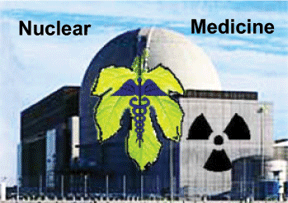 Nuclear medicine has been highlighted as a key reason to have a nuclear waste repository. MAPW President, Dr Margaret Beavis observes that ‘The Commonwealth government fact sheet: Information for communities- Key questions answered’ is a gross misrepresentation and reads more like a puff-piece for the nuclear industry. The recently released brochure states “One in two Australians – everyone who has ever had a broken bone, heart scan or cancer diagnosis – will need nuclear medicine at some point in their lifetime.”
“This is very clearly misleading in all three areas” said Dr Beavis . “X Rays for a broken bone rarely require nuclear medicine, the vast majority of heart scans are done by ultrasound, and most cancers are treated by surgery, chemotherapy or radiotherapy, none of which use radioisotopes. Even the assertion the half the population needs nuclear medicine is not credible.”
In addition ANSTO continues to insist that using reactors to produce radioisotopes is the only option. In January 2015 Canada – the world leader in radioisotope commerce – had a successful pilot project for commercial cyclotron production. Current regulatory testing and expansion will likely make Canada self-sufficient through cyclotron generation in 3-5 years. “Cyclotrons are a more reliable, safer and cheaper source of radioisotopes than nuclear reactors, and produce no long term waste, but ANSTO has not mentioned this” said Dr Beavis
Nor is mention made of ANSTO’s plans to increase reactor production (from previously 1%) to supply 25-30% of world markets, vastly increasing Australia’s waste from the generation of medical radioisotopes for international sales. “We already have more waste than we know what to do with” said Dr Beavis “We need community debate before massively increasing radioactive waste production.”
Earlier this month it was reported that ANSTO would stop making radioisotopes next year if a waste repository site was not found. Subsequently in Senate Estimates hearings it emerged this was sourced from a previous document and was not the case. These alarming claims have yet to be widely rebuffed by ANSTO, despite requests to do so.
Finally, the telephone information hotline for communities has been very poor. “Comments such as suggesting televisions and microwaves are radioactive when used are clearly wrong.” said Dr Beavis.
If the government is sincere about informed consent it needs to do much better than this.
1 This month
17 October, Free Public Talk on Nuclear Issues in South Australia
David Noonan will speak on public interest concerns over the new Roxby Downs Indenture Act 2026 on BHP copper-uranium mining and ore processing in SA, and on how AUKUS may face SA with a High-Level nuclear waste agenda.
Dr Jim Green will discuss international developments in the field of nuclear power including ‘small modular reactors’ and Generation 4 ‘advanced’ nuclear reactor concepts.


Help Aunty Sue Protect Her Land and Sacred Sites From Destructive Rocket Testing.
.

Australians deserve the truth
about
AUKUS – https://aukuspublicinquiry.com/

PETITION – To: Prime Minister Anthony Albanese and the Australian Labor Government

of the week – Australians for War Powers Reform (AWPR)
To see nuclear-related stories in greater depth and intensity

