Voters in key Liberal Coalition electorates strongly support renewable energy
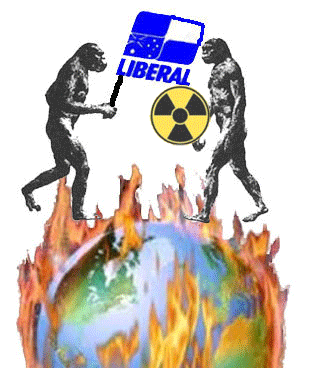 Strong Renewable Energy Support In Key LNP
  Electorates http://www.energymatters.com.au/renewable-news/renewables-australia-lnp-em5288/
January 12, 2016 The passion for renewables in Australia isn’t waning, but support for coal appears to be – particularly when it comes to new mines. This is a continuing trend among voters of all political leanings.
72-77% of voters recently polled in conservative electorates support Australia becoming a 100% renewable energy powered nation by 2030.
A ReachTEL-conducted survey of thousands of residents across the federal electorates of New England, Page, Warringah and Dickson in December revealed just 14% to 18% opposed a renewables powered Australia.
The polling of these voters also indicated a global moratorium on new coal mines had strong support; at 50 – 57%.
It will come as no surprise that Labor and Greens voters indicated even stronger support.
“Renewable energy is popular across the political spectrum. Part of Tony Abbott’s undoing was that he placed himself at odds with the electorate on this issue,” said Ben Oquist, Executive Director of The Australia Institute said.“These results show politicians of any hue who undermine support for a 100% renewable future risk an electoral backlash.”
Mr. Oquist also stated construction of new mines in a struggling market is “a recipe for economic disaster.”
“China recently announced a 3 year moratorium on new coal mines. Malcolm Turnbull can and should show the same commitment to deliver on commitments made at the Paris climate meeting in December,” he said.
The chances of a moratorium? Late last year, Federal Energy Minister Josh Frydenberg claimed there was a “strong moral case” for coal. Also in October, the Federal Government granted Adani re-approval to build the massive and very controversial Carmichael coal mine
Back in 2014, the Institute for Energy Economics and Financial Analysis (IEEFA) issued a wake-up call to investors, stating the global coal industry’s economic models were flawed. IEEFA said major coal projects with a reliance on export markets such as India constituted a huge financial risk.
The Australia Institute is actively campaigning against new coal mines in Australia and says a local moratorium will send the strongest political signal that the reign of coal is over.
NSW Farmers launch a renewable energy calculator for rural businesses
 Renewable energy calculator launched for farmers http://www.northernstar.com.au/news/renewable-energy-calculator-launched-for-farmers/2896307/ 12th Jan 2016 NSW Farmers has developed and launched an online calculator to help households and small farm businesses to test the financial viability of investing in solar PV and batteries.
The online calculator was launched to coincide with Tesla’s announcement that Australia would be the first market to receive its PowerWall battery which, along with other battery products, is expected to significantly accelerate the penetration of renewable energy across Australia.
NSW Farmers energy expert Gerry Flores cautioned households and small to medium farm businesses to adopt a conservative approach to this new technology.
“It’s important for farm business owners to consider whether energy storage is right for them before they make any substantial investments,” he said.
Mr Flores, a photovoltaics engineer who developed the calculator, said it could estimate potential savings and the financial case for several scenarios in NSW.
To help households and farm businesses better understand and utilise the calculator, NSW Farmers will hold a webinar on Friday January 22 at 10:30am.
For further information or to register click here.
For more information about the calculator click here.
South Australian launch for Aboriginal owned solar energy storage system
The products are being launched at Tandanya Aboriginal Cultural centre in Adelaide on Wednesday 2 September. Ms Oberon said Adelaide was chosen for the launch because of the council’s Sustainable City Incentive Scheme, which provides up to $5000 towards the cost in installing solar PV storage across the residential, business, education and community sectors. Funding for the program also has financial support from the South Australian government.
“We felt it was important to acknowledge the South Australian government and the City of Adelaide for such a forward-looking and innovative scheme,” Ms Oberon said.
The company is also hoping other state governments and councils will be encouraged to take up the idea of supporting the uptake of renewable energy storage.
The company’s core mission is based on the fundamental Aboriginal approach of stewardship of the earth and its resources. This means needing to shift out of high-emissions fossil-fuel derived energy.
Aboriginal-owned energy company one-upping Tesla By Willow Aliento, The Fifth Estate Friday 8 January 2016 The renewable energy storage game is about to be disrupted, with Australian Aboriginal-owned company AllGrid Energy announcing the launch of WattGrid, a new 10kWh solar energy storage system it says is around 30 per cent cheaper than the Tesla Powerwall.
Customers also don’t have to wait until 2016. Spokeswoman for AllGrid, Deborah Oberon, said the company expected to be making its first deliveries in the next two to three months.

The $11,999 WattGrid unit comprises an aluminium cabinet containing tubular lead acid gel batteries, and a hybrid 5kW solar inverter with battery management system that has load share capability with the grid and uninterrupted power supply capability.
The unit is also accompanied by a software app, WattsHappening, that allows users to view real-time information and interface with the system.
Beta testing has shown the unit can help solar owners maintain an energy supply profile that can be matched to the demand profile, potentially rendering drawing grid power unnecessary.
The Queensland-based company is also releasing another product it has developed, the PortaGrid. This is an independent unit comprising solar panels, storage, UPS, inverter and outlets that is suitable for remote and off-grid locations, as well as emergency situations.
The units can be supplied with an inbuilt weather station that will automatically close up the panels in the event of a severe weather hazard such as a cyclone. Continue reading
Popularity of Western Australia’s rooftop solar makes privatisation of electricity assets unlikley
 WA’s rooftop solar so popular power privatisation not an option, says expert, Guardian, Calla Wahlquist, 6 Jan 16 Prof Philip Jennings, a renewable energy expert, says investors would be unlikely to be interested in unprofitable power networks Western Australia would not be able to privatise its electricity assets “even if they gave it to them for nothing” because the popularity of rooftop solar panels has made state-owned power stations unprofitable, a renewable energy expert has said. Continue reading
Leeton, New South Wales: plan for multimillion dollar solar farm
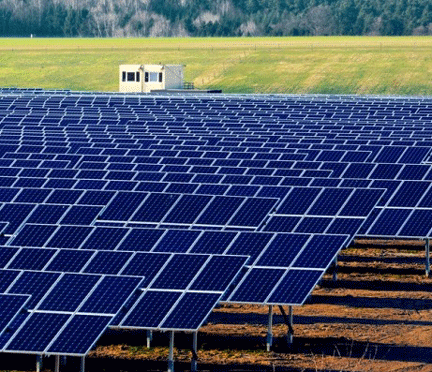 proposed for Wumbulgul http://www.abc.net.au/news/2016-01-07/wumbulgul-solar/7072604 A $90m solar farm is proposed near Leeton in the New South Wales Riverina, to help power a new rail freight hub in the region. Photon Energy has been in discussions with Leeton Shire Council since 2012 about a solar development.
It’s now asked the state government to consider a proposal for a 100 megawatt plant, with the ability to double that output, next to the recently opened Western Riverina Intermodal Freight Terminal at Wumbulgul.
Documentation lodged with the Planning Department states the solar farm would be on a 140 hectare site on the Griffith Road and would take around a year to build.
Photon estimates the farm would have a life of around 30 years, after which infrastructure could be updated or the site rehabilitated.
The application says feedback from initial discussions in August is positive and a community consultation plan will be developed.
The Department is now preparing its requirements for the solar project.
Australia’s role in the big nuclear issues for 2016
 Five big nuclear issues for 2016 — and Australia’s role in them, Independent Australia Noel Wauchope 5 January 2016, Nuclear issues got next to no discussion in Australia in 2015. That is sure to change in 2016 from five explosive factors, writesNoel Wauchope.
#1: Nuclear weapons “……….. In the event of nuclear war, Pine Gap makes Australia both a participant and a target.
What the experts call a “limited nuclear war” between India and Pakistan is always on the cards as both nations ramp up their nuclear weaponry. What does Australia do about this? The Turnbull Government, ignoring the advice of the Joint Standing Committee on Treaties (JSCOT) and pro nuclear power expert Dr John Carlson, goes ahead with insecure uranium sales to India, thus contributing to that India-Pakistan arms race.
All these considerations will matter to Australia in a number of ways in 2016. An obvious example is in the diplomatic tightrope that our Government must walk in its relations with China — Australia’s largest export market.
#2: Indigenous rights……. For 2016, governments must have learned that Indigenous Australians are a force to be reckoned with and that non-Indigenous might join in that anti nuclear struggle. State governments, particularly Western Australia, have sought to strengthen the resources industries’ power to fight Aboriginal land rights. This has to be an issue for uranium mining in 2016 — whether mining developments can continue to ride roughshod over traditional Indigenous traditional land.
#3: Energy technologies Renewable energy is here to stay. ….. Australia leads the world in rooftop solar, with the highest portion of residential buildings with rooftop photovoltaic power. Despite government policy uncertainty, important solar research continues, community solar projects are developing, large scale solar projects are taking off, for example, in New South Wales. Wind power is now also taking off and has long shown its success in South Australia.…….. The nuclear lobby would have everyone believe that nuclear energy is the answer. But even they know that this is not a practical choice for Australia. In February, the South Australia Nuclear Fuel Cycle Royal Commission will be announcing its recommendations. Its chief, Kevin Scarce, has already indicated that it is not likely to recommend nuclear power.
In 2016, Australia still has the opportunity to become a leader in truly clean renewable energy technologies, as energy storage systems become a reality…….With 2016 as an election year and with the ALP’s policy of a 50 per cent renewable energy target by 2030, renewable energy developments form a challenging issue.
#4: Australia as the world’s nuclear waste dump….. the South Australian Nuclear Fuel Cycle Royal Commission and all that will ensue from its recommendations. Commission head, Kevin Scarce, will no doubt cover his back with worthy statements about proceeding only if there is a social licence, but we can be pretty sure that this expensive year-long Royal Commission is not going to turn its back on its central idea — importing nuclear wastes. Meanwhile, in 2016, the ALP will have to face the push within its ranks to change its existing anti nuclear policy.
#5: The propaganda war….. there will be pressure on Australia’s academic and health authorities, as well, of course, on the mainstream media……. https://independentaustralia.net/environment/environment-display/five-nuclear-issues-for-2016–and-australias-role-in-them,8544
Only a small fraction of Lucas Heights radioactive waste is of medical origin
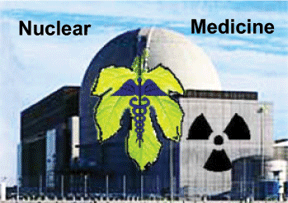 The incessant references to nuclear medicine to ‘sell’ the proposed radioactive waste repository/store amount to nothing more than emotive propaganda
10-20% of the current stockpile would be the plausible range for medical waste − closer to 10% if measuring by radioactivity (because spent reactor fuel is such a large contributor to total radioactivity) and closer to 20% if measuring by volume.
Nuclear medicine and the proposed national radioactive waste dump http://www.foe.org.au/anti-nuclear/issues/oz/nontdump/med Jim Green National nuclear campaigner – Friends of the Earth, Australia December 2015
To download a 2-page paper addressing these issues right-click here.
“As health organisations, we are appalled that access to nuclear medical procedures is being used to justify the proposed nuclear waste dump. Most waste from these procedures break down quickly and can be safely disposed of either on site or locally.”
− Dr Bill Williams, Medical Association for the Prevention of War
“Linking the need for a centralized radioactive waste storage facility with the production of isotopes for nuclear medicine is misleading. The production of radioactive isotopes for nuclear medicine comprises a small percentage of the output of research reactors. The majority of the waste that is produced in these facilities occurs regardless of the nuclear medicine isotope production.”
− Nuclear Radiologist Dr Peter Karamoskos
Summary
Proponents of a national radioactive waste facility (a repository for lower-level wastes and a co-located store for higher-level wastes) claim or imply that nuclear medicine would be jeopardised if the facility does not proceed. There is no basis to such claims – they amount to dishonest scare-mongering.
Proponents claim that most or all of the waste that the federal government wants to dispose of or store at a national repository/store arises from medicine, specifically the production and use of medical radioisotopes. However, measured by radioactivity, the true figure is just 10-20%. Measured by volume, the figure may be within that range or it may be higher than 20% − but it takes some creative accounting to justify the claim that most or even all of the waste is medical in origin.
In any case, the fact that some waste is of medical origin doesn’t mean that a national repository/store is the best way to manage the waste.
If the plan for a national repository/store does not proceed, medical waste will continue to be stored at the Lucas Heights reactor site operated by the Australian Nuclear Science and Technology Organisation (ANSTO) and, in much smaller volumes, at hospitals. Some waste is used in hospitals and then sent back to ANSTO (e.g. molybdenum ‘cows’ that have been ‘milked’ of the daughter radionuclide, technetium-99m − by far the most commonly used medical radioisotope). That is no problem since ANSTO and hospitals continue to produce radioactive waste and thus they have an ongoing need for on-site waste stores and waste management expertise regardless of the options for periodic off-site disposal.
Nuclear medicine is not being adversely affected by the absence of a national radioactive waste repository/store. Nuclear medicine will not benefit from the creation of a national radioactive waste repository/store. Continue reading
MP Bruce Scott now has “deep reservations” for Oman Ama as nuclear waste site
 MP reveals “deep reservations” for nuclear waste site http://www.warwickdailynews.com.au/news/scotts-oman-ama-vow/2890770/ Jayden Brown | 6th Jan 2016 MARANOA MP Bruce Scott has weighed in on the proposed nuclear waste facility at Oman Ama, admitting he has “deep reservations” about the issue.
The outgoing Federal MP has been neutral on the issue since the small community, west of Warwick, was announced as one of six sites shortlisted for a nuclear waste dump.
Mr Scott has vowed to make sure the Oman Ama site does not go ahead if that is the wish of the community. “I believe a decision of this magnitude needs to be made by the local community, giving consideration to the impacts the proposed facility may have on the region’s farming potential,” he said.
“The proposed nuclear waste facility is dependent on broad community support. “If local residents and concerned neighbours do not support the proposed location, I will work with my ministerial colleagues to ensure the Oman Ama site does not go ahead.”
The comments come as Senate candidate Belinda Marriage called on both Mr Scott and Southern Downs MP Lawrence Springborg to represent the views of the community.
A vocal opponent of the facility, Ms Marriage said she had attempted to contact Mr Scott several times to express the feelings of the community, to no avail.
Ms Marriage, who runs a free-range pork property at Karara, said it was clear the people of Oman Ama had spoken.
“Mr Springborg, the Queensland state representative, needs to represent this community,” she said.”The overwhelming majority of the community are saying no to the dump. “How much clearer do they have to make it?”
Mr Springborg was unavailable for comment yesterday, however, in the past he has declared he had an “open mind” on the issue.
For those opposed to the facility though, the case is already closed. Ms Marriage said it was time to bury the Oman Ama proposal. “With the strong support against having a nuclear dump in our agricultural region, I urge the ministers to listen to our wishes and desist in trying to bully us into having a dump built in our rich agricultural history,” she said.
“The community wants to go back to doing what they do best, raising families and growing clean food, crops and fibres for the people of Australia.”
Mr Scott is encouraging concerned community members to have their say before the consultation period ends on Friday, March 11, at 5pm. Visit http://www.radioactivewaste. gov.au/proposed-sites#3.
Australian Ethical Superannuation finds the nuclear industry to be an unacceptable risk

Australian Ethical Super Dr Stuart Palmer, Head of Ethics Research at Australian Ethical. 6 Jan 16
We agree that the nuclear energy is a complex issue given the need to transition globally to low-emissions power. However, Australian Ethical has a strong negative screen on nuclear power for a range of reasons including:
· frequent association with nuclear weapons manufacture;
· radioactive pollution from uranium mines;
· the intractability of radioactive waste;
· the potential for catastrophic failure of nuclear power stations;
· security risks associated with the operation of nuclear power stations, and with the transport and storage of nuclear waste.
In our view these concerns outweigh the potential climate change benefits of nuclear power. Even with new generation nuclear plants we still consider the level of risk to be unacceptable, particularly given rapid advancements in renewable energy and storage technology.
I hope this information is helpful in explaining our approach.
–tinyurl.com/Nuclear-Uranium
Solar Australia: 1.5 Million+ Solar Power Systems Installed
1.5 Million+ Solar Power Systems Installed In Australia http://www.energymatters.com.au/renewable-news/solar-pv-australia-em5278/ January 5, 2016Energy Matters More than 23.2 million solar panels are now installed in Australia – a module for every man, woman and child in the nation.
According to solar consultancy firm SunWiz, Australia registered its 1,500,000th solar power system on December 22, 2015. More than 4.65 gigawatts of sub-100kW capacity systems are generating clean electricity across the country and saving their owners a bundle on power rates.
SunWiz states Australia boasts the highest number of installations per capita in the world and the equivalent of 18% of Australian households own a PV system.

“Australia ranked 8th in the world for capacity installed in 2014, and is likely to be a top-10 country for installed capacity in 2015,” says SunWiz.
State-wise, while Queensland has the most solar power systems in the country ( 450,000+), South Australia has the highest proportion of households with PV installed (30%).
Solar PV is now contributing more than 2.5% of Australia’s electricity requirements. While that may not sound like a huge amount, it’s very valuable electricity as solar panels typically produce the most power during periods coincide with high demand. This reduces the need for added mains grid infrastructure and the incidence of higher cost generation from peaking power stations; the cost of which can exceed $13,000 per megawatt-hour ($13 a kilowatt hour).
For 2016, SunWiz predicts the residential solar market will slightly contract, the small and mediumcommercial solar sector will grow 10-20% and the large-scale commercial segment will also experience significant growth as companies become increasingly aware of how much can be saved on energy costs by going solar.
SunWiz doesn’t expect much in the way of utility scale projects being brought online in Australia this year.
“… the focus will be upon earlier stages of project development, with utility-scale project deployment starting in earnest in 2017 and growing from there.”
The utility scale sector went into limbo during the drawn-out battle over Australia’s Renewable Energy Target; instigated by now ex-Prime Minister, Tony Abbott. After dragging on for eighteen months, the issue was finally settled in June 2015; ensuring sunnier days ahead for the sector.
Rooftop solar power in Western Australia produces more electricity than the State’s biggest power turbine
 Rooftop solar producing more energy than WA’s biggest turbine, ABC Radio AM 5 Jan 16 By Anthony Stewart Rooftop solar panels in the South-West Interconnected System (SWIS) in Western Australia are now producing as much energy as the state’s largest power turbine, according to research from Curtin University.

SWIS stretches from Kalbarri north of Perth to Ravensthorpe in the state’s south, taking in the Perth metropolitan area. Curtin University sustainability professor Peter Newman said 20 per cent of homes across the grid have rooftop solar panels installed.
“We are in the extraordinary position of saying that Perth [SWIS] now has rooftop solar as the largest supplier of electricity, it’s the biggest power station in WA,” he said.
“It’s nearly 500 megawatts and it’s growing rapidly, by 2020 we could have half of Perth’s [SWIS] households with rooftop solar.”……
Professor Newman said the state’s electricity utilities needed to rapidly adapt to the growth in solar.
“They didn’t predict it, they have all these contracts for coal and gas that go 20 or 30 years and they have even got an old power station out of mothballs, fixed it up, but never turned it on,” he said.
“Despite the boom times we actually reduced our power consumption during this period because people are just not needing it if you’ve got the PV’s [photovoltaic] on the roof.”
Energy utility Synergy has been contacted for comment.
Batteries to drive solar boom….. http://www.abc.net.au/news/2016-01-04/rooftop-solar-panels-bigger-than-biggest-turbine-wa/7066240
Enova – Australia’s first community-owned renewable energy retailer
“what we do is we buy from the national energy market and sell to you; it comes through the grid. “In order for you to have renewable energy, we enter into agreements to purchase green power from accredited renewable energy providers, so that whenever we are selling you energy we are offsetting that with green energy certificates.”
Ms Crook said Enova also hoped to increasingly buy from local renewable energy generators.
“What we hope to be doing is facilitating the development of community-scale renewable generation,”
 Australia’s first community-owned renewable energy retailer Enova to open its doors in Byron Bay http://www.abc.net.au/news/2016-01-05/australia-first-community-owned-energy-retailer-enova/7068420 ABC North Coast, 5 Jan 16 By Samantha Turnbull Australia’s first community-owned renewable energy retailer, Enova, is about to open its doors in northern New South Wales after raising $3.8 million from 1,090 investors.
Seventy-five per cent of the voting shares are held on the NSW north coast, but chair Alison Crook said the company had attracted investors from every state and territory in Australia. Continue reading
Wester Australia finally bans solarium tanning beds
Total eclipse for tanning beds, The West Australian, Cathy O’Leary December 31, 2015, Hundreds of young WA women are likely to avoid disfiguring and potentially deadly skin cancers because of a ban on tanning beds that starts tomorrow.
Regulations to ban commercial sun beds make WA the last State to outlaw the machines.
Cancer Council WA director of education and research Terry Slevin said the ban came 12 months after laws took effect in the rest of the country.
He said that before regulations started in Australia it was estimated that sun beds caused almost 3000 skin cancers a year, including 281 melanomas, and were responsible for 43 melanoma-related deaths.
A recent study predicted one in six melanomas in Australians aged 18 to 29 could be prevented if solarium operators were shut down.
Mr Slevin said the machines were mostly used by people under the age of 24, often young women.
They exposed skin to ultra-violet radiation five to six times more intense than the midday summer sun……https://au.news.yahoo.com/thewest/wa/a/30464028/total-eclipse-for-tanning-beds/
Queensland’s Oman Ama residents reject nuclear waste dump
 Oman Ama residents reject proposal for nuclear waste disposal site http://www.brisbanetimes.com.au/queensland/oman-ama-residents-reject-proposal-for-nuclear-waste-disposal-site-20160103-glyji8.html January 4, 2016 – Drew Creighton A group of residents of the tiny Darling Downs hamlet of Oman Ama has banded together in a bid to prevent Australia’s first permanent nuclear waste disposal facility from being built near their town.
Oman Ama was one of six sites shortlisted by the Federal Government and announced in November as a possible location for the facility.
The group has written to federal Resources Minister Josh Frydenberg ’emphatically’ rejecting the proposed nuclear waste dump.
The proposed site is roughly 90 kilometres from Warwick on Bennets Gully.
Friends of Oman Ama member and local doctor Dr Colin Owen said in a statement he was not convinced the proposal was risk free.”Mishaps have occurred in such facilities around the world, including at Lucas Heights in Sydney,” Dr Owen said.
The facility he referred to is the Lucas Heights reactor that produces nuclear medicine. Dr Owen is convinced there have been mishaps in the past 10 years at the reactor.
In 2010 a whistleblower alleged there had been a series of safety breaches at Lucas Heights.
Dr Owen said the proposed site was just a few kilometres north of Murray-Darling tributaries such as the Condamine. “The big concern is that if it leaks into there, the whole murray darling water way will be compromised,” he said.
Safety is not the only concern the residents have. Mental health nurse Susan Campbell had a list of worries including devaluation of land, risk to tourism initiatives and anxiety levels in locals.
Not all locals are against the proposal and one resident has offered their property as a potential site for the facility.
Another medical practitioner from Oman Ama, Dr Bob Morrish, is concerned with what has been called ‘obfuscation’ by the government. “The Government people have not been clear about the difference between storage and disposal, particularly in relation to the so called ‘interim’ storage of intermediate level radioactive waste,” Dr Morrish said. “They have refused to define ‘interim’ but suggested it could be as long as 30 years.”
The group is also pressuring the landholder to withdraw his application for the proposed site of the nuclear facility.
The other five sites on the shortlist are Sallys Flat in NSW, Hale in the Northern Territory and Cortlinye, Pinkawillinie and Barndioota in South Australia.
The government’s consultation process is expected to take until March, with a final shortlist of three sites announced later this year. A final determination of the site will not be announced until after this year’s federal election.
New Directive to Clean Energy Finance Corporation (CEFC) supports renewable energy investment
 New clean energy investment mandate a shift from policy proposed by Abbott
Directive to CEFC to focus on innovative and emerging technologies will enhance support for windfarms and small-scale solar projects, Guardian, Shalailah Medhora, 24 Dec 15. The Clean Energy Finance Corporation (CEFC) has been directed to focus on innovative and emerging technologies, reversing a mandate by the former prime minister Tony Abbott that would have specifically blocked funding for windfarms and small-scale solar projects.
The mandate came into effect on Thursday, with a new clause outlining the shift in focus.
“As part of its investment activities in clean energy technologies, the corporation must include a focus on supporting emerging and innovative renewable technologies and energy efficiency, such as large-scale solar, storage associated with large- and small-scale solar, offshore wind technologies, and energy efficiency technologies for cities and the built environment,” the clause said. “ This will in turn increase the uptake of emerging technologies such as large-scale solar and energy efficiency.”
The investment mandate is not exclusive, meaning that established technologies can still be funded, and not retrospective, so projects that have already been funded will not be affected.
“The CEFC will therefore continue to pursue a diverse range of investment activities that are within the scope of the CEFC Act and this new investment mandate,” a statement by the body said.
“Together, the new investment mandate and the accompanying explanatory statement provide guidance on how the CEFC should approach investment in mature and established technologies, such as conventional onshore wind and conventional hydro,” it said. “It is the government’s expectation that, in many circumstances, projects involving mature technologies should be able to secure finance from commercial financing sources.”
The mandate is a shift from what Abbott proposed in July, when he said the body should no longer fund small-scale solar projects such as rooftop panels and wind technology…….
The CEFC chairwoman, Jillian Broadbent, wrote to the environment minister, Greg Hunt, and the finance minister, Mathias Cormann, welcoming the new mandate. She said it was an “appropriate approach that allows the CEFC to support the Australian government policy priorities while still allowing a measure of investment flexibility”. …….http://www.theguardian.com/environment/2015/dec/24/new-clean-energy-investment-mandate-a-shift-from-policy-proposed-by-abbott
1 This month
17 October, Free Public Talk on Nuclear Issues in South Australia
David Noonan will speak on public interest concerns over the new Roxby Downs Indenture Act 2026 on BHP copper-uranium mining and ore processing in SA, and on how AUKUS may face SA with a High-Level nuclear waste agenda.
Dr Jim Green will discuss international developments in the field of nuclear power including ‘small modular reactors’ and Generation 4 ‘advanced’ nuclear reactor concepts.


Help Aunty Sue Protect Her Land and Sacred Sites From Destructive Rocket Testing.
.

Australians deserve the truth
about
AUKUS – https://aukuspublicinquiry.com/

PETITION – To: Prime Minister Anthony Albanese and the Australian Labor Government

of the week – Australians for War Powers Reform (AWPR)
To see nuclear-related stories in greater depth and intensity

