#NuclearCommissionSAust’s plan to bring radioactive trash to Australia – by Leasing
 Next Thursday’s (Oct 15) Adelaide public hearing at the Nuclear Fuel Chain Royal Commission (NFCRC) could be an interesting one.
It will be about the concept of leasing uranium – the idea that Australia continues to “own” uranium , so contracts to take back all radioactive trash.
It’s not a new idea – pushed for decades by Dr John White

and by the former Global Nuclear Energy Partnership (GNEP) and the current International Framework for Nuclear Energy Cooperation (IFNEC)

Topics to be addressed at this public session: Concept of nuclear fuel leasing and potential demand for those services. The international and commercial arrangements necessary to establish a fuel leasing operation
Dr Caldicott’s submission concerning radiation #NuclearCommissionSAust
 Dr Helen Caldicott Submission to the Nuclear Fuel Chain Royal Commission http://www.helencaldicott.com/submission-to-the-nuclear-fuel-cycle-royal-commission/
Excerpt – Types of ionizing radiation
- X-rays are electromagnetic, and cause mutations the instant they pass through the body.
- Similarly, gamma radiation is also electromagnetic, being emitted by radioactive materials generated in nuclear reactors and from some naturally occurring radioactive elements in the soil.
- Alpha radiation is particulate and is composed of two protons and two neutrons emitted from uranium atoms and other dangerous elements generated in reactors (such as plutonium, americium, curium, einsteinium, etc – all which are known as alpha emitters and have an atomic weight greater than uranium). Alpha particles travel a very short distance in the human body. They cannot penetrate the layers of dead skin in the epidermis to damage living skin cells. But when these radioactive elements enter the lung, liver, bone or other organs, they transfer a large dose of radiation over a long period of time to a very small volume of cells. Most of these cells are killed; however, some on the edge of the radiation field remain viable to be mutated, and cancer may later develop. Alpha emitters are among the most carcinogenic materials known.
- Beta radiation, like alpha radiation, is also particulate. It is a charged electron emitted from radioactive elements such as strontium 90, cesium 137 and iodine 131. The beta particle is light in mass, travels further than an alpha particle and is also mutagenic.
- Neutron radiation is released during the fission process in a reactor or a bomb. Reactor 1 at Fukushima has been periodically emitting neutron radiation as sections of the molten core become intermittently critical. Neutrons are large radioactive particles that travel many kilometers, and they pass through everything including concrete and steel. There is no way to hide from them and they are extremely mutagenic.
So, let’s describe just five of the radioactive elements that are continually being released into the air and water at Fukushima. Remember, though, there are over 200 such elements each with its own half-life, biological characteristic and pathway in the food chain and the human body. Most have never had their biological pathways examined. They are invisible, tasteless and odourless. When the cancer manifests it is impossible to determine its aetiology, but there is a large body of literature proving that radiation causes cancer, including the data from Hiroshima and Nagasaki. Continue reading
Australia’s doctors campaign for action on climate change
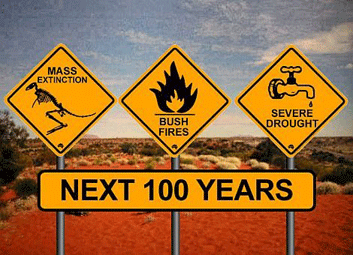 Doctors urge climate action http://www.sbs.com.au/news/article/2015/10/11/doctors-urge-climate-action One of Australia’s peak medical bodies says political leaders must act on climate change to reduce serious health impacts. AAP
 The Royal Australasian College of Physicians will hold a Global Day of Climate Action to put pressure on leaders at the coming United Nations climate talks in Paris in December.
Infectious diseases physician and senior lecturer at the Australian National University medical school, Dr Ashwin Swaminathan, said doctors are trying to raise awareness of serious health impacts caused by climate change. “Doctors want the community and our government representatives to know that health is at stake with climate change,” Dr Swaminathan said.
“The college recognises that climate change poses a risk to the health of all Australians across all regions.”
Health professionals have seen a spike in ambulance call-outs, hospital admissions and deaths during heatwaves, which are projected to increase further without checks on global emissions.
Dr Swaminathan said there will also be increases in water-borne and mosquito-borne diseases, with Australian disease specialists worried in particular about diarrhoea-causing bacteria and disease-carrying mosquitoes. Higher temperatures expand the areas in which these disease carriers can thrive.
Dr Swaminathan said the species of mosquitoes that can carry dengue fever, Ross River fever and Barmah Forest virus will be able to move further south in Australia under changed climate conditions.
Disease and climate change is attracting more attention from doctors. “It’s something that is becoming more discussed at infectious diseases forums,” Dr Swaminathan said.
The Royal Australasian College of Physicians has begun a Doctors for Climate Action campaign which, with the support of 50 medical organisations, is calling on world leaders to commit to meaningful targets for emissions reduction at the United Nations COP 21 Climate Change Conference in Paris.
Solar cars for Australia
R** Solar cars tested in tough NT conditions ahead of World Solar Challenge 2015
On a remote road an hour out of Darwin, dozens of solar-powered cars have been pushed to the limits for the past two weeks.
http://www.abc.net.au/news/2015-10-11/solar-cars-tested-in-nt-conditions/6842916
R** Solar car on track to become Australia’s first road-legal solar vehicle.
3 October 2015. This group of students are the latest in a long line of undergraduates from the University of New South Wales that have been working on solar cars.
http://www.abc.net.au/radionational/programs/offtrack/sunswift-solar-car/6810376
Australian Capital Territory inviting Tesla Motors to research renewable energy
Canberra asks Tesla Motors to host research presence in ACT , ABC News 10 Oct 15 The ACT Government is pitching to one of the world’s leading renewable energy companies, asking it to consider establishing a research hub in Canberra. Chief Minister Andrew Barr last week sat down with executives at US giant Tesla Motors at the company’s headquarters in California.
Tesla are already selling electric cars in Australia – as well as developing new storage technology for renewable energy. Mr Barr wants the company to set up a research and development presence in Canberra, highlighting the city’s investment in renewables.
A spokesman for Mr Barr said it was a “productive meeting”, and a formal letter had been sent to the company. In the letter to Tesla management, Mr Barr said Canberra offered a “unique location advantage” for the renewable energy industry.
“The ACT has the most aggressive renewable energy and emissions reductions targets in the nation, by a significant margin, and amongst the most aggressive in the world,” he said. “Our region also includes a world-class expertise in renewable energy and energy storage technology research and development, across both public and private organisations.
“Employment in the ACT renewable energy sector grew over 400 per cent during the last five years.”
From next year, Tesla’s wall-mounted Powerwall batteries will be available in Australian homes.
The company will be utilising software from Canberra start up firm Reposit Power when Powerwall is launched, allowing solar panel owners to sell power back to the grid. Mr Barr used the Canberra-based company’s success was an example as to why Tesla should make further ties with the capital.
“I understand Reposit Power’s technology is unique and is an example of the innovative environment in Canberra,” he said……http://www.abc.net.au/news/2015-10-10/canberra-launches-bid-to-tesla-motors-to-host-research-hub/6843812
#NuclearCommissionSAust hearing – is the Small Modular Reactor (SMR) a lemon?
Plough your way through the transcript of the October 7th hearing of the South Australia Nuclear Fuel Chain Royal Commission, and amidst all the technical hype, you will find some sobering points.
The speaker was Mr Thomas Marcille, of Holtec International, developer of the SMR-160, who enthused about that SMRs future, and explained its safety features etc.
Yet there were bits that would make even a greedy Australian nuke enthusiast pause:
“COMMISSIONER: Would it be fair to say that you’re expecting SMR or the 30 application of them outside the US more than inside?
MR MARCILLE: No question ……As a data point, I think that would suggest that the vast market is outside of the United States………, it’s possible for a national regulator outside the United States to first licence the SMR-160.”
He goes on to explain that the USA’s now more rigourous licensing process “part 52 or design certificate” is “far too arduous in terms of time and cost and risk.”
[translation – nobody in USA wants to buy the SMR, and it can’t get licensing there]
“our concept is to develop a preliminary design specification and a preliminary safety analysis report and to then achieve an opportunity with a commercial client to submit that preliminary safety analysis report under the review of a competent regulator for consideration of granting a construction permit. At such time the design will matriculate through the engineering specifications, the procurement specifications and the construction drawings. It’s unlikely that Holtec will continue to develop towards final safety analysis and final design unless a client steps forth.”
[translation – we’re not going ahead with licensing until after we’ve signed up an overseas buyer, such as Australia] [Holtec will] “continue the investment in the business and the technology if and as the marketplace develops”
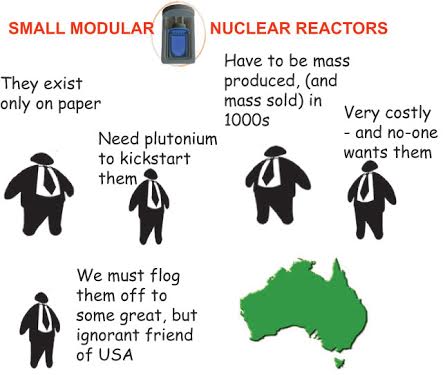
The Commissioner asked Mr Marcille about “ comparison to larger plants the cost economies and the advantages of small modular reactors.” and about “the extent to which companies expect to have an order book of plants to manufacture and the extent to which they can enjoy economies of scale 25 because they’re manufacturing multiple versions of the same item “.
MR MARCILLE: Let me help by saying that – let me liken a large light-water reactor to a large apple and suggest that a lot of people think of small modular reactors as little apples. I would ask you to think of a small modular reactor like the SMR160 not as a little apple but a little orange. So now I’m comparing a big apple to a little orange and they’re entirely different. The apple is sweet, 40 the orange is sour. You get the picture…….
Mr Marcille continued with a lengthy and complex answer to this question, which included stressing the large costs of large reactors. I did not find it convincing .
Govt to investigate ERA’s Ranger uranium mine burnoff and subsequent Kakadu fire
 Kakadu bushfire: Dept of Environment to investigate Ranger mine burn-off that spread to national park, ABC News, 9 Oct 15 The federal Environment Department says it will investigate a fire started by Energy Resources Australia (ERA) that spread into Kakadu National Park, threatening important cultural sites.
The fire started at ERA’s Ranger uranium mine a week ago and spread into the World Heritage-listed park, threatening several culturally sensitive Indigenous sites. In a statement to the ABC, a spokesman for Federal Environment Minister Greg Hunt described the fire as a “very serious matter”.”Minister Hunt has asked the Department and Parks Australia to conduct a full and thorough investigation into the cause of the fire,” the statement said.
“No permission was sought and no approval was received for the lighting of the fire by ERA.
“We will not hesitate to seek reimbursement for the costs of firefighting if negligence or wrongdoing are in any way shown.
“Additionally, a breach of the Environment Protection Biodiversity Conservation (EPBC) Act can result in fines of up to $8.5 million.”
The ABC understands the NT Department of Mines and Energy will also be investigating the fire………
Aboriginal groups angry over fire
Justin O’Brien from the Gunjeihmi Corporation, which represents the area’s traditional owners, said ERA needed “to be taught about the sensitive environment” they operate in. “There’s an argument to say they should be prosecuted for what they’ve done, this is the second year in a row that they’ve done this, It’s almost a replica of last year,” he said.
“They are not learning so they need to be taught about the sensitive environment which they’re operating in.”
The Northern Land Council (NLC) said it was not confident a federal investigation would find anyone accountable for the fire.
Joe Morrison, CEO of the NLC, said he wanted to see traditional fire management practices reinstated.
“There’s been lots of fires and lots of investigations in relation to Kakadu and surrounds for a long time, we wouldn’t want to hold our breath,” Mr Morrison said.
Mr Morrison said he wanted to see Aboriginal people “take control of that agenda and reinstate their traditional fire management practices”. http://www.abc.net.au/news/2015-10-09/dept-of-environment-to-investigate-era-kakadu-fire/6842436
Unable to sell them at home, Westinghouse trying to flog uneconomic nuclear reactors to Australia
 Westinghouse eyes Australian nuclear potential, links with local suppliers, SMH October 8, 15, Angela Macdonald-Smith and Jenny Wiggins Nuclear technology giant Westinghouse sees the retirement of old coal-fired power plants in Australia as an opportunity for nuclear power and is positioning itself early to inform the political and public debate.
In Sydney to announce a tie-up with three local suppliers, Westinghouse chief executive Danny Roderick said the Japanese-owned company “wants to make sure that the facts are out there” on the safety of new-generation nuclear reactors.
He said that convincing the 8 per cent of the Australian public that is undecided about nuclear power would create “an overwhelming majority of people in Australia that would support a nuclear new-build”.
The company, part of Toshiba Corporation, already has strong links with uranium suppliers in Australia, and sees the latest step as “a very logical fit” to build on those and explore local manufacturing capacity for a new reactor……….
Public perception still an issue
Nuclear power made “a lot of sense” for Australia, Mr Chilcote added. “Look at what brown coal and the associated emissions are doing on the environment. There’s a lot less waste out of nuclear, the hardest part is overcoming the public perception.”
The option of nuclear power for Australia is being examined within a South Australian royal commission, with findings due next year. Meanwhile, the federal government’s greenhouse gas reduction targets, of 26 to 28 per cent cuts from 2005 levels by 2030, and the anticipated retirement of ageing coal-fired generators have also set the scene for discussion.
“In the next decade you have several very large coal plants that are going to need to be retired, and you’re going to have to choose to build something to replace those,” Mr Roderick said.
“If you’re going to talk about carbon reduction and greenhouse gas reductions you’re going to have to bring nuclear into the mix.”
Mr Roderick’s discussions this week included federal Environment Minister Greg Hunt, Port Adelaide member Mark Butler and senior officials from the offices of the Prime Minister and Cabinet, and Resources Minister Josh Frydenberg.
He has been pointing out that Westinghouse’s AP1000 nuclear plant uses “passive” technology that doesn’t require electricity to be able to safely shut itself down, averting a Fukushima-like situation. This type of plant is under construction in the US and is set to be used in the UK, China and India……….. http://www.smh.com.au/business/energy/westinghouse-eyes-australian-nuclear-potential-links-with-local-suppliers-20151008-gk427h.html#ixzz3o0cN6nkW
AUSTRALIA’S SHAME: getting UN climate draft to drop action to help climate refugees
 UN drops plan to help move climate-change affected people, Guardian, Oliver Milman, 7 Oct 15 Australia opposed the plan for a group to assist migration, and it has been left off the draft agreement for UN climate talks in Paris Australia’s opposition to the creation of a body to help people escaping the ravages of climate change appears to have paid off, with the idea dropped from the draft agreement for the crucial UN climate talks in Paris.
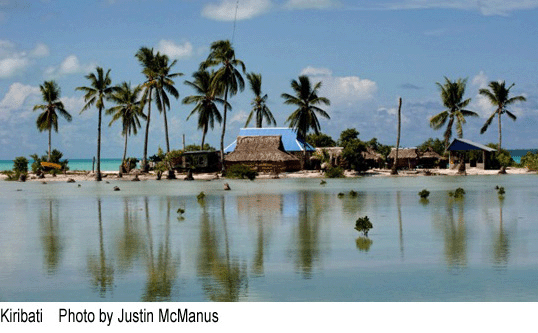
A previous draft of the deal to be thrashed out by nations included a “climate change displacement coordination facility” that would provide “organised migration and planned relocation”, as well as compensation, to people fleeing rising sea levels, extreme weather and ruined agriculture.
However, this reference has been removed in a revised text ahead of the December climate conference negotiations. Australia opposed the facility, although Guardian Australia understands the prime minister, Malcolm Turnbull, has shown interest in the issue of displacement.
“Australia does not see the creation of the climate change displacement coordination facility as the most effective or efficient way to progress meaningful international action to address the impacts of climate change,” a Department of Foreign Affairs and Trade spokesman said. “Australia is already working closely with our Pacific partners on these important issues.”
Australia had spent more than $50m in climate resilience projects in the Pacific and contributed another $200m to the Green Climate Fund.
Opposition to the coordination facility is not shared by Australia’s traditional allies, with representatives from the US, British and French governments indicating they were open to the idea……..
The impact of climate change is anticipated to displace up to 250 million people worldwide by 2050, including many in low-lying Pacific islands such as Tuvalu, the Solomon Islands and Kiribati.
In areas of the Pacific, sea level is rising by 1.2cm a year, four times faster than the global average. For coral-based islands two to three metres above sea level this has resulted in communities being relocated, and drinking water and crops are threatened by salt water inundation. Recent research suggests islands will not be submerged but will change shape and height, posing difficulties for fixed infrastructure.
“Why on earth would Australia not support a coordination facility?” said Phil Glendenning, president of the Refugee Council. “We are talking about the most vulnerable people on the planet who are facing threats to their food security, seeing their water supplies diminish and their entire cultures at risk.
“The world is going to have to deal with this displacement. We need to get on the front foot. Australia can’t say we are doing enough. People in Kiribati and Tuvalu are the canaries in the coalmine and they are looking to Australia.”
Last year the Kiribati government bought 20 sq km of land on Vanua Levu, one of the Fiji islands, in case its people cannot be moved internally. It has a policy called “migration with dignity” if its cluster of 33 coral atolls becomes inhabitable…….
Relocation of people is occurring across the Pacific region. Dozens of villages in Fiji will be moved, and 2,000 people from the Carteret atoll of Papua New Guinea will be transferred to mainland Bougainville, a three-hour trip on a wooden boat, because of salt intrusion and destructive tides. http://www.theguardian.com/environment/2015/oct/07/un-drops-plan-to-create-group-to-relocate-climate-change-affected-people
Trans Pacific Partnership’s Investor-State Dispute Settlement [ISDS] provisions bad for environment
 Trans-Pacific Partnership bad for the environment, green groups say October 7, 2015 Peter Hannam Environment Editor, The Sydney Morning Herald “……Greens Senator Peter Whish-Wilson said the Investor-State Dispute Settlement [ISDS] provisions of the pact will allow large corporations to challenge any efforts to tighten environmental regulation.
“This is a watershed moment for the Liberals and the mining industry in their continuing assault against environmental protections in Australia,” Senator Whish-Wilson said. “ISDS will provide a massive chilling effect against improvements in environmental law at a local, state and federal level.”
Kelly O’Shanassy, chair of the Australian Conservation Foundation, said it was “a very silly idea to lock in restrictions to future policy in this country”.
Corporations could now have a look at a proposed policy change and if it threatened their ability to make profit, they would go to the courts as they did to oppose the Gillard government’s plain packaging laws to curb tobacco marketing.
“It could be the plain packaging fiasco for climate change,” Ms O’Shanassy said.
With the Paris climate summit now looking increasingly likely to fall short on locking in sufficient cuts to greenhouse gas emissions to limit global warming to 2 degrees, governments will need to make regular revisions of their targets beyond this year’s summit.
The TPP is likely to limit nations’ ability to take those necessary additional steps, she said: “It means governments won’t be bold and ambitious as they should be.”http://www.theage.com.au/environment/transpacific-partnership-bad-for-the-environment-green-groups-say-20151006-gk2bga.html#ixzz3o10RNuqa
Perth home entirely powered by solar energy shows the way
 Perth gets first home powered almost totally by solar http://www.abc.net.au/news/2015-10-08/first-perth-home-almost-totally-solar-powered/6835726 By Kathryn Diss A Hilton home has become the first in Perth to use the Sun to meet almost all of its power needs by storing the energy in batteries while still remaining
  connected to the power grid. (diagram at left not realistic!)
The home uses solar for 97 per cent of its power needs and also offloads excess supply onto the grid, in what could become a mainstream feature in the future.
Environmental scientist Josh Byrne built the home in Perth’s southern suburbs two years ago with a 10-star energy rating.
But despite having an energy efficient home solar panels on his roof, Mr Byrne was still paying power bills.
So, Curtin University’s Jemma Green proposed a battery storage trial at the home to try to further reduce his power bills. She had spent the past year researching and getting approvals for the project while seeking funding to pay for the batteries and her research. Continue reading
Displacement Solutions NGO for climate refugees targets Australia as worst climate offender
 UN drops plan to help move climate-change affected people, Guardian, Oliver Milman, 7 Oct 15 “………Advocates for displaced people argue that a new international framework needs to be created to help them, given that the UN refugee convention does not cover them because they are not fleeing persecution.
“I’d hope the UN would put a new apparatus in place. At the moment this is being dabbled in – there’s nothing systemic,” said academic Scott Leckie, founder of Displacement Solutions, an NGO that facilitates moving people displaced by climate change within their countries.
Leckie’s organisation focuses its work in five countries – Bangladesh, Colombia, Fiji, Panama and the Solomon Islands – but said climate displacement was a global problem, even in wealthy nations such as the US where people in Alaskahave had to move and Boston faces a future of being a “city of canals” because of sea level rises.
“Successful relocation is very complicated and there’s a real gap in how governments do this internally,” he said. “It may seem simple to move 30,000 people within Panama, for example, but when you get into it there is a variety of land and ethnic tensions.
“The question for people on small islands is whether to stay or go, which is almost impossible to answer because the stakes are so high. Once you have people leave, you get a brain drain, investment dries up and you get into a vicious cycle of despair and poverty.
“This is solvable with political will and resources. There needs to be a coordinated human rights approach. Just as Australia takes in 12,000 Syrian refugees, there’s nothing stopping a further 1,000 places earmarked for people who have nowhere else to go in the Pacific islands.
“I think every country in the world responsible for CO2 emissions have some measure of responsibility for the predicament they’ve caused. Top of that list is Australia, given it is the worst per capita emitter in the world.” http://www.theguardian.com/environment/2015/oct/07/un-drops-plan-to-create-group-to-relocate-climate-change-affected-people
Australia’s Great Artesian Basin – what will its future be?
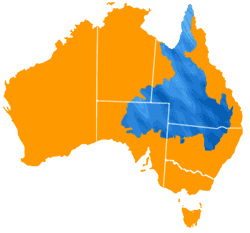 Great Artesian Basin future up for discussion at outback forum in Alpha http://www.abc.net.au/news/2015-10-07/alpha-forum-to-discuss-future-of-great-artesian-basin/6832964 By Ash Moore The future of the Great Artesian Basin will be up for public discussion over the next five weeks.
The Department of Mines and Natural Resources is holding 25 public meetings around the state, starting in Alpha in the central west today.
It will create a new draft 10-year plan for the basin when the current plan expires next year.
The department’s Mark Foreman said anyone who wanted to could have their say.
“It’s something that is vital when you’re developing a plan, talking to the community, finding out what people think,” he said.
“We’ll have different views, conflicting views and the only way we can develop a plan that works and that reflects the needs of the community as well as government policy is by having these sorts of conversations.
“The challenge is to actually work out something that actually meets the needs of both sides of the community – those who are keen for additional development, while also protecting the incredibly diverse and amazing natural ecosystems of the area – as well as those existing water users who rely on the Great Artesian Basin, as you’d appreciate, during this drought time.”
Secrecy on nuclear waste plans, as Fed govt delays announcing site for radioactive trash dump
 Federal Government delays announcement of Australian waste dump site after silence from NT October 5, 2015 NT News http://www.dailytelegraph.com.au/news/federal-government-delays-announcement-of-australian-waste-dump-site-after-silence-from-nt/story-fnk1w5xx-1227557268139
Uranium mine fire in Kakadu National Park
NT uranium mine fire: Traditional owners call on mine operator to take responsibility for blaze http://www.abc.net.au/news/2015-10-07/kakadu-uranium-mine-fire/6832666Traditional owners are calling on the operator of the Ranger Uranium Mine to take responsibility for a fire that is threatening important cultural sites in Kakadu National Park.
They are also warning if the out-of-control fire spreads into Kakadu’s escarpment country, it will be too difficult to contain. Parks Australia said the blaze started when the mine’s operator, Energy Resources of Australia (ERA), began weed management burning which then spread into Kakadu.
Justin O’Brien from the Gunjeihmi Corporation, which represents the area’s traditional owners, said ERA should fund efforts to put out the fire. “I mean there’s an argument to say they should be prosecuted for what they’ve done, this is the second year in a row that they’ve done this, It’s almost a replica of last year,” he said. “They are not learning so they need to be taught about the sensitive environment which they’re operating in.”
Mr O’Brien said the fire was close to escarpment country, where it would be very difficult to put out. “If this fire gets into the escarpment, there’s no water in there,” he said “You can’t do suppression from the air, you cannot get boots on the ground in that country, it’s too rugged. “All you can do is wait for it to put itself out, that’s not acceptable.”
Mr O’Brien said hundreds of rock art galleries, plants and animals in Radon Springs are threatened by the fire. One of Kakadu National Park’s most significant cultural sites, Nourlangie Rock, featuring Indigenous rock art showing early contact with Europeans, as well as other art up to 50,000 years old, has been closed to tourists.
1 This month
17 October, Free Public Talk on Nuclear Issues in South Australia
David Noonan will speak on public interest concerns over the new Roxby Downs Indenture Act 2026 on BHP copper-uranium mining and ore processing in SA, and on how AUKUS may face SA with a High-Level nuclear waste agenda.
Dr Jim Green will discuss international developments in the field of nuclear power including ‘small modular reactors’ and Generation 4 ‘advanced’ nuclear reactor concepts.


Help Aunty Sue Protect Her Land and Sacred Sites From Destructive Rocket Testing.
.

Australians deserve the truth
about
AUKUS – https://aukuspublicinquiry.com/

PETITION – To: Prime Minister Anthony Albanese and the Australian Labor Government

of the week – Australians for War Powers Reform (AWPR)
To see nuclear-related stories in greater depth and intensity

