Climate draft for Paris leaves Australia further behind in its lack of climate plan
 “The Turnbull government’s Paris targets are so bad that they not only isolate
  Australia from the trade and job opportunities of the clean energy future but they could have a wrecking effect on global ambition at these pivotal talks,”
The climate summit is scheduled to run from November 30 to December 11, although France’s climate ambassador Laurence Tubiana last week told reporters a special pre-summit may be arranged for 8 to 10 November so leaders can agree on the key details of the deal ahead of the main gathering.
Paris 2015: Draft flags five-year climate reviews, leaves Australia ‘flat-footed’, SMH, October 6, 2015 Peter Hannam Environment Editor, The Sydney Morning Herald Countries should agree to review their carbon emission reduction policies every five years to ensure dangerous global warming can be avoided, according to a draft United Nations agreement being circulated before the Paris summit due to start late next month.
The provision for regular revisions in the draft accord – which has been slashed from 80 to 20 pages – is a sign UN organisers are increasingly resigned to the fact any pledges in Paris will not be enough to keep temperature rises to less than 2 degrees of pre-industrial levels.
Even so, the first “comprehensive draft” by the event’s co-chairmen for some 200 nations demonstrates “the inevitable trend to stronger action” that will be strengthened over time, said Erwin Jackson, the deputy chief executive of the Climate Institute……. Continue reading
Australia’s climate policy does not measure up to the UN draft Paris climate pact
“The inevitable trend to stronger action is embedded in the draft agreement with countries needing to progressively strengthen action through time.
“Core details still need to be resolved, but this again just highlights that Australia’s lack of stable, scalable and credible domestic policy to moderise our economy is leaving us flat footed in a world turning to clean energy,”
UN draft Paris climate pact released – Australian policy under pressure http://reneweconomy.com.au/2015/un-draft-paris-climate-pact-released-australian-policy-under-pressure-12427 By Sophie Vorrath on 6 October 2015 A new draft of the global climate change pact due to be signed in Paris this December has been released by the UN, calling on all nations to commit to mitigation policies that reflect their highest possible ambition, and to toughen these commitments every five years.
The 20-page draft, released by the co-chairs of the UN climate negations in Bonn on Monday, increases the pressure on countries like Australia, whose low-ball emissions reduction target has been roundly criticised for lacking ambition and not having a sufficient policy framework. Continue reading
New South Wales town Uralla shows the way to q100% renewable energy
 NSW town provides blueprint for 100% renewable energy communities, One Step Off The Grid By Giles Parkinson on October 6, 2015 (interesting diagrams),
 The NSW town of Uralla has outlined plans to go 100 per cent renewable energy, in a government-sponsored blueprint that could become the model of many other towns in NSW and other states to follow suite.
The Zero Net Energy Town – the Uralla Case study – was released today and describes a two-stage process that the town could adopt to go 100 per cent renewable, or “zero net energy”. It is a blueprint that others can follow, and two dozen towns in the state have already expressed interest.
The good news is that Uralla – population 6,034 and in the heart of Barnaby Joyce’s New England electorate – can get most of the way to their council’s objective of becoming “zero net energy” just by using measures that are proven and that will save them money.
These include things such as LED lighting and home insulation, and producing energy on site, particularly with solar PV. These measures will save the town around $2.2 million a year in energy costs, the study finds. Continue reading
Study finds that storage for solar energy can replace gas in our electricity networks
Storage can replace gas in our electricity networks and boost renewables http://reneweconomy.com.au/2015/storage-can-replace-gas-in-our-electricity-networks-and-boost-renewables-21141 By Dylan McConnell on 6 October 2015 (Good graphs on original)
Energy storage is often considered the holy grail of the electricity sector. Tesla’s Powerwall home battery system, for instance, allows households to store energy from solar panels, to be used when the sun isn’t shining. It is seen as a vital piece of the puzzle in a future with more renewable energy.
Storage is great for households, but could also be as important in the wider electricity network. Here’s how it could work. Continue reading
New low-cost, high efficiency solar panel launched in Australia
 SunEdison Launches World First P-Series Solar Panel in Australia October 6, 2015 Energy Matters Global solar leader SunEdison, Inc. (NYSE:SUNE) has today launched its low-cost, high efficiency SE-P265NPB solar panel; available exclusively in Australia.
This 265W panel is set to play a significant role in the nation’s solar power revolution and is the first SunEdison panel available in the Australian market.
“This module boasts all the hallmarks of quality Australian installers have come to expect; including a very low temperature coefficient, 35mm silver frame and MC4 connectors,” said SunEdison Australia Managing Director, Jeremy Rich.
SunEdison’s first foray into the Australian market with the SE-P265NPB polycrystalline solar panel offers an outstanding model efficiency of 16.2% and a better return on investment for Australian consumers based on the higher volume of watts per module. Multi-MPPT transformerless inverter compatible, the SE-P265NPB features a positive power tolerance and is Potential Induced Degradation (PID) free.
As a vertically integrated Tier-1 manufacturer, SunEdison has an impressive track record in the development and operation of solar power stations, with 50 years experience in the production of silicon and solar technology…….
ADDITIONAL INFORMATION:
- The SunEdison SE-P265NPB solar panel is a 60-cell module with four bus bars per cell, helping maximise its energy harvesting capabilities.
- This panel is considered a “greener” module in terms of embodied energy as cells are fired in furnaces at triple the density of other systems.
- The bus bar printing technology enables printing of both cell fingers and bus bars in two separate steps, meaning great precision and allowing the print pattern for fingers and bus bars to be independently optimised.
- Sealed process bars are used to avoid contamination of the cells.
- Cells that do not pass rigorous testing processes are on-sold to other manufacturers for use in lower-spec panels.
- The SE-P265NPB comes with a 10 year limited warranty on materials and workmanship, and a 25 year linear power warranty.
BROCHURE AND DATASHEET:
Today’s Royal Commission Hearings – on financial viability of nuclear operations
 Today’s royal commission hearings are about the financial viability of enrichment, electricity and a waste dump.
South Australia as radioactive trash dump our best nuclear bet – Kevin Scarce
 Nuclear power option years away: royal commissioner Kevin Scarce http://www.theaustralian.com.au/national-affairs/state-politics/nuclear-power-option-years-away-royal-commissioner-kevin-scarce/story-e6frgczx-1227556819827?sv=631d9f761d476c7a142e1be7add844b1
OCTOBER 5, 2015 Michael Owen SA Bureau Chief Adelaide There is a decade of regulatory and legislative change required before any real work can begin on establishing a nuclear energy industry in Australia, royal commissioner Kevin Scarce says.
Those changes would require federal and state bipartisanship, meaning tangible economic benefits of expanding nuclear activity would not be apparent until at least 2030. We need to be realistic about what the opportunities will be,” Mr Scarce, a former South Australia governor, told The Australian. “If we do decide to participate (in the nuclear cycle), you’d want to grow some jobs, some expertise, and grow the technical know-how to go into other elements of nuclear — it has to have some economic benefits, and part of this royal commission is to look 10-15 years into the future and see what else is being developed to see if there is a need for nuclear in our power-generation mix.”
The Nuclear Fuel Cycle Royal Commission was established by Labor Premier Jay Weatherill to look at South Australia’s involvement in the mining, enrichment, energy and storage phases in the life cycle of nuclear fuel, given the state has one of the world’s biggest uranium deposits and has been involved in uranium production for more than 25 years.
Mr Weatherill’s government is grappling with the worst unemployment rate of any state amid the decline of manufacturing. The Premier is keen to explore the economic benefits of a deeper involvement in the nuclear sector.
Mr Scarce said it might be that, given Australia’s energy demand was decreasing, coupled with an abundance of renewables, nuclear generators were not necessary. This would leave a nuclear waste dump as the most likely source of economic benefit.
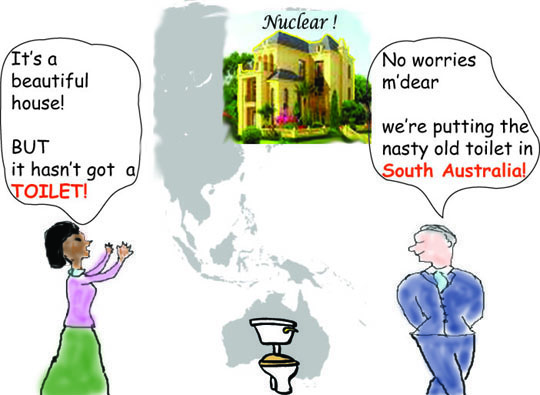
Mr Scarce said it was “absolutely” the case that there was a decade of bipartisan legislative and regulatory change that had to occur before any nuclear industry could be up and running. “One should not think that if we turn the switch on at the end of this royal commission after the government has had a look at it that benefits will be delivered within the decade — they won’t be,” he said.
“In order to provide the investment certainty that would be required, because of the length and cost of this industry, if you don’t have bipartisan support at both the state and federal level, an industry will not go anywhere.”
Mr Scarce said the state opposition had been very supportive, as had the government, which established the inquiry. However, there could be major hurdles under any future federal Labor government. A decision to change the ALP national platform opposing a nuclear industry has been delayed until after the release of the commission’s report, due on May 6.
Former prime minister Tony Abbott has said there was no need for Australia to pursue nuclear energy because of the nation’s large coal and gas reserves, although he said nuclear energy would help cut carbon pollution.
Mr Scarce, who has visited several countries on fact-finding missions this year, will begin 30 days of public hearings until December.
#NuclearCommissionSAust – An Aboriginal group slams its processes
monetary compensation via Native Title is not the solution – don’t insult us by simply hying to buy our consent and silence our concerns
SUBMISSION TO THE NUCLEAR FUEL CYCLE ROYAL COMMISSION.
FROM: ANGGUMATHANHA CAMP LAW MOB
Extract Why we are not satisfied with the way this Royal Commission has been conducted: Yaiinidlha Udnyu ngawarla wanggaanggu, wanhanga Yura Ngawarla wanggaanggu?
always in English, where’s the Yura Ngawarla (our first language)?
The issues of engagement are many. To date we have found the process of engagement used by
the Royal Conuuission to be very off putting as it’s been run in a real Udnyu (whitefella) way.
The lack of an intelpreter service means we are forced to try and engage using English (or rely on the goodwill of caring community members), and often this means we cannot be part of the engagement process. Even a Plain English summary of the four papers would have been helpful, and more opportunity for people to give oral submissions in their first language with a translator to interpret. We say that govemment and industry have a moral and ethical obligation to include us as citizens of Australia, and as Traditional Owners of our Country. We suspect that many other Australians would have benefited from a Plain English version of the papers and this was suggested by many people who went to the first lot of community meetings held by Kevin Scarce and his team. Not everyone has good English literacy.
Requiring a JP’s signature is a barrier to participation and suggests that ordinary people cannot
be trusted; not everyone has easy access to a JP, and the timeline puts pressure on people to do
this. We feel this is likely to intimidate people and discourage many from participating.We strongly recommend that the Royal Commission do more work on the following issues:
- Provide the public with better understanding of the health, cultural, and social impacts in other
countries of an expanding nuclear industry (including public anxiety, contaminated areas, effects 0n public health); - Provide adequate resources to enable all Australians to be part of an informed process – put
people before profit; - The lack of advertising, and very short notice on several occasions suggests that government and
industry and not serious about wanting to engage with public opinion and don’t value our input. - Many people think this suggests the proposal is ‘a done deal’ and that it will go ahead anyway.
- Timelines are short, information is hard to access, there is no interpreter service available, and
the meetings have been very poorly advertised. - Engagement opportunities need to be fair and equitable (readily available to all people) and the Native Title interest is no more important than the wider community.
- A closed and secretive approach makes engagement difficult for the average person on the street, and near impossible for Aboriginal people to participate.
- Government continue to use an assimilatory process; they ignore us by refusing to translate
information into our first language, and they make no effort to understand our views in our
languages as the First Australians. The lack of a well-thought out engagement strategy tells us that our views are not important, that government and industry will do what they want regardless of public wishes. - Develop a compensation package for the likely economic impacts from the negative associations of nuclear industry on local and regional economy – ego Loss of prices in crops, housing, land, as a result of contamination threats, accidents and breaches of EPA regulations;
- Develop actual measures to counter threats from terrorist organisations re: protection to avoid nuclear site attacks, and local capacity to deal with emergency situations;
- Tell the public what risk management plans need to be developed for communities impacted by transportation along the travel routes – for example, who will respond to a truck accident and are they equipped to deal with it; Informed awareness among communities that live along the designated travel routes so they can make decisions about their future.
- The nuclear industry must find ways to show respect for the rights of Traditional Owners who are concerned about or opposed to the nuclear industry – monetary compensation via Native Title is not the solution – don’t insult us by simply hying to buy our consent and silence our concerns;
 Provide means for ongoing and independent monitoring of dangerous levels of airbome and water-based contaminants in groundwater, along transportation routes, after accidents, and among food sources used by Aboriginal people ego Nguri, urdlu and warratyi varlu, awi. We have a right to measure and monitor levels of radiation like other people do in countries such as the USA. We know from the Kakadu mine in NT that there is a major problem there with water management that is yet to be resolved.

Coming refugee crisis as sea levels rise on Pacific Islands
 Fiji PM Warns Of Syria-Style Refugee Crisis If Rich Nations Don’t Do More On Climate, Thom Mitchell, New Matilda, 2 Oct 15 Frank Bainimarama has taken aim at advanced nations for ignoring the plight of Pacific Islanders in pursuit of short-term economic growth. Thom Mitchell reports.
The Fijian Prime Minister Frank Bainimarama has hit out at developing nations for their “unacceptable” progress in reducing carbon emissions as part of a speech to the United Nations General Assembly, in which he warned of a humanitarian refugee crisis on the scale of the current migration out of Syria if more is not done.
The talks come as Foreign Minister Julie Bishop seeks a place for Australia on the UN Security and Human Rights Councils, but Bainimarama warned that developed nations like Australia are not listening to the voice of Pacific Island nations, whose human rights are threatened by rising seas and hostile weather patterns.
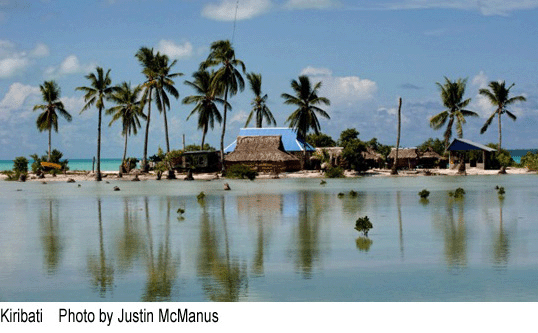
“It is simply not acceptable for advanced economies to build a high standard of living on the degradation of the earth and the seas,” Bainimarama said.
The choices we face may be politically difficult in the short run, but the consequences we are already seeing – environmental degradation, unbearable heat, drought, powerful tropical storms and unpredictable weather patterns – are simply unacceptable,” he said.
“[Fiji] plans to move some 45 villages to higher ground, and we have already started.
“We have committed to resettle people from other low-lying, South Pacific Island States that face the prospect of being swallowed up by the rising ocean and falling inexorably to oblivion.
“Should that happen, the people of those Island States would be refugees as desperate and lost as the hundreds of thousands fleeing conflict in Syria and Iraq,” he said.
As New Matilda reported in June, experts in migration law, like those at the University of New South Wales’Kaldor Centre for International Refugee Law, are already warning that the “disasters on steroids” climate change will bring is likely to create a need for special refugee visas.
It is clear by now that international pledges nations have made through the United Nations climate change process will not be enough to keep the global rise in temperature to less than two degrees, which is the level accepted as ‘safe’ by Australia and around 200 other nations: https://newmatilda.com/2015/10/01/fiji-pm-warns-syria-style-refugee-crisis-if-rich-nations-dont-do-more-climate#sthash.hk0kghO3.dpuf
Dr Arjun Makhijani explains why Small Modular Nuclear Reactors (SMRs) are doomed to fail
PUBLIC HEARING, SA NUCLEAR FUEL CYCLE ROYAL COMMISSION DR ARJUN MAKHIJANI, Institute for Energy and Environmental Research ADELAIDE , THURSDAY, 1 OCTOBER 2015
Excerpt “…….the core idea of an SMR is that you have smaller reactors. Of course you lose the economies of scale, reactors are big because cost of materials goes according to surface area, and power production goes according to volume, and the larger the reactor the smaller the material needed per kilowatt.
That is the theory and that is why there were small reactors in the fifties, they were proposed and we went to bigger reactors because they were cheaper, all other things being equal. So you go back to smaller reactors, the underlying technology will tell you that the costs per kilowatt, in terms of materials and labour, the number of wells you need per kilowatt, the amount of steel you need per kilowatt will all go up.
The proposal is that all of these costs would be offset by assembly line manufacturing. So you won’t have to set it up on site. And in theory it is a fair idea to evaluate and you ask what is the size of the assembly line you need? And who is going to create this assembly line and the required supply chain, the vessels and the pumps and valves and all of it? So if you look at what the Department of Energy has said, what the industry itself has said is that you can’t – so you are really displacing the heavy capital cost upstream from the reactor sites……
so now instead of having a 10 billion dollar problem, you have got a 50 or a 100 million dollar problem because to .SA Nuclear 01.10.15 P-431 Spark and Cannon set up a supply chain for say 100 or 150 reactors a year, you need that scale of investment……
you need a supply chain investment that is about the same order of kind of an assembly line for airbuses or (indistinct) So it’s very, very huge. So who is 5 going to make all of these orders that will cause some private party to make that investment in the assembly line? With airbuses we know they get advance orders of hundreds of aircraft and they set up their assembly lines. The answer to that question is, no one other than governments…….
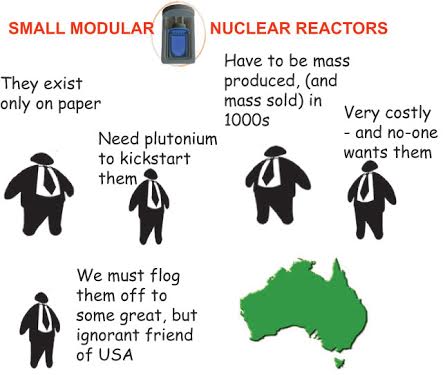
How you would handle such a system from a regulatory point of view is 15 mysterious to me because when you have assembly lines, as I note in my paper, you have recalls. Today we have got an 11 million car recall, one of the most reputable companies from perhaps the most technologically reputable country in the world, Germany. What are we going to do if we have 2,000 assembly line reactors that are found to have a fault through design? By design I mean 20 as not properly conceived, or through some cover up, like what happened with Volkswagen. How are we going to deal with it? Are we going to shut them down? Are we going to send them to the manufacturer? Are we going to – it’s unclear…..
the fine 25 print of small module reactors is much, much more complicated economically and in terms of the risks and investments, than their performance have led you to believe. That’s why they’re not – I mean I think – at least two of the four companies that are embarked on it, are already not pursuing it in the United States. Fallen apart before anything was built…. ” http://nuclearrc.sa.gov.au/app/uploads/mp/files/videos/files/151001-topic-4-day-2-transcript-full.v2.pdf
The pro nuclear front group Breakthrough Institute joins push for nuclear power in South Australia
The Breakthrough Institute (BI) was notorious for its attacks on Al Gore and climate scientists.It has a long history of trying to discredit renewable energy, in particular, attacking Germany’s Energiewende. More recently, BI has discovered climate change, as that is a useful tactic in their long-running promotion of new nuclear technology
the promoters of new nuclear reactors for South Australia certainly include idealistic and altruistic people, some of whom have bought the BI’s message.
Who wants to be a nuclear billionaire? Independent Australia, 1 Oct 15 Noel Wauchope navigates the complex web of ambiguity behind submissions to South Australia’s Nuclear Fuel Chain Royal Commission.. Some promoters of nuclear industry expansion have very altruistic motivations.
Just who are the people who want South Australia to be a nuclear industry hub? The submissions to the Royal Commission give some indications, though it is not easy to work this out……
The pro nuclear submissions on the whole, come from interested parties, where a commercial or career motive can be discerned: that is often clearly shown, but sometimes is not apparent. There are also some pro nuclear submissions that are quite cautious about promoting development, and a few who are inclined towards sitting on the fence.
Of the 94 pro nuclear submissions published, 46 come from companies or organisations connected with the nuclear industry. But who knows how many nuclear companies really did send in submissions, as theirs were allowed to not be published, due to ‘commercial in confidence’?
….most favoured topic, as with the organisations, was Issues Paper 3, “ELECTRICITY GENERATION”…
Their backgrounds? 20 of the [pro nuclear] 48 individuals are now, or were formerly, employed in a nuclear or nuclear-related company, government or university department.(1) In some cases they state this clearly, in other cases it is not apparent…..
Then there are the 2 career politicians, Sen Sean Edwards and MP Tom Kenyon, who have hitched their political future to the nuclear star.
Then there are nuclear publicists, who are not necessarily engineers or involved in the nuclear industry, but who have become well known for their pro nuclear articles or lobbying. There are only 4 listed names that could be described as pro nuclear publicists (2)
….the majority of the pro nuclear submissions enthuse about new nuclear reactors – “Generation IV” Small Modular Reactors” “Liquid Fluoride Thorium Reactors”.
When you add those individual submissions to the 46 from nuclear-related organisations, it looks as if the overwhelming support for new nuclear reactors comes from interested parties – nuclear related companies, or individuals connected to the industry, who seek profit or career advancement. Continue reading
Australia’s uranium industry looks to Paris Climate Conference to save it
 Read between the lines, as BHP makes some of the right noises about climate change, in its oh so worthy portfolio analysis of climate change. BHP warns about the need for action and supports carbon pricing. It says it supports renewable energy, and does indeed support carbon capture and storage.
BHP says little about uranium – but I suspect that this is the main game.
However, it is interesting that BHP makes a quite revolutionary statement, for a nuclear company, in for the first time, publicly acknowledging that the next nuclear disaster might be a damaging blow to the industry.
Perth Now reported, Oct 1 :
“Mining giant BHP Billiton said this week it expected uranium would be the biggest winner in its portfolio, as the world comes under pressure to cut carbon emissions and limit global warming to two degrees celsius.
Australia holds the largest share of uranium resources globally. The ongoing South Australian royal commission into the nuclear fuel cycle is an important opportunity for Australia to review its contribution towards development of nuclear power, Dr Guthrie told mining industry executives in Sydney.”
- Governmental support of nuclear programs
- Successful implementation of small scale reactors
- Renewables capacity additions for power generation
- Less public acceptance following another nuclear power accident ” http://www.bhpbilliton.com/~/media/bhp/documents/investors/reports/2015/bhpbillitonclimatechangeporfolioanalysis2015.pdf
Western Australian Wiluna uranium project in the doldrums for the forseeable future
 WA’s first uranium mine likely to be delayed as Toro Energy puts Wiluna on hold WESTERN Australia’s first new uranium mine is likely to be delayed due to the ongoing downturn in demand and prices, Perth Now, 1 Oct 15
Toro Energy has put its Wiluna uranium project on hold as it waits for market conditions to improve. The company began drilling at the project in 2014 and had expected to start operations in 2017.
“We will get to build Wiluna when we get the price that makes Wiluna economic. We are not seeing that price today,” managing director Vanessa Guthrie told AAP.
Wiluna, 960 kilometres northeast of Perth, is the first new uranium mine in WA to receive federal 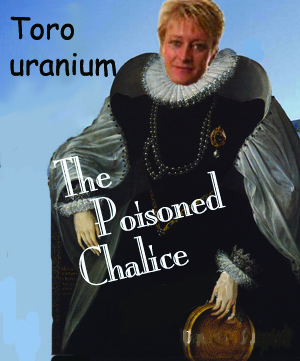 government approval since the lifting of a ban on uranium mining in 2008.
The project will require prices between $60 and $70 a pound to make money, Dr Guthrie said.
Long term uranium prices currently hover around $45 per pound, almost half the levels of five years ago. Prices are expected to dip further because of large stockpiles……..
Global uranium production has stalled in the past two years as depressed uranium prices have curtailed exploration activities and the opening of new mines……http://www.perthnow.com.au/business/was-first-uranium-mine-likely-to-be-delayed-as-toro-energy-puts-wiluna-on-hold/story-fnhocr4x-1227552733503
Report shows opportunity for clean energy jobs worth $370 bn
Australian clean energy jobs could be worth $370 bn in 10 years http://reneweconomy.com.au/2015/australian-clean-energy-jobs-could-be-worth-370bn-in-10-years-39526 By Sophie Vorrath on 29 September 2015 Australia’s renewable energy industry could generate $370 billion worth of jobs over the next 10 years using current technology, a new report has found. The report, released on Tuesday by Beyond Zero Emissions, aims to illustrate how Australia can transition from coal-fired power to renewables, shifting the economy along with it.
“Our research with Melbourne University into energy generation in Australia shows that we can create $370 billion of green energy jobs with current technology, instead of using coal-fired power stations,” said Beyond Zero Emissions CEO Stephen Bygrave.

When you add to this smart homes and buildings, as well as low-carbon land use, high speed rail and electric vehicle options, the green jobs climb towards $1 trillion dollars in value, Dr Bygrave says.
The report’s findings coincide with a new policy proposal from the Greens that calls for a levy to be imposed on coal mining companies to help pay for the transition away from fossil fuels, including for the rehabilitation of retired mines and retraining workers for clean energy jobs.
BZE is also set to launch a new book on October 2, at the Smart Future Cities Conference showing how easily existing Australian homes can be retrofitted to eliminate electricity and gas bills – a follow-up to its Zero Carbon Australia Buildings Plan, that was researched over 3 years.
“The Buildings Plan showed that all residential and commercial buildings in Australia could be converted to generate as much energy as they consumed, creating $270 billion of green jobs in the construction industry,” Bygrave said.
“The new book, The Energy Freedom Home, shows how every home can produce more energy than it consumes. And with rising electricity and gas prices and falling rooftop solar prices, Australian households can affordably revolutionise the way they power their homes.
“Our research shows that millions of ordinary Australian homes can be transformed to be high performing, comfortable and cheaper to run. The transformation is easy since 1.4 million homes already have rooftop solar.”
To illustrate their theory, BZE along with the University of Newcastle have retrofitted a brick veneer family home in North Lambton, Newcastle, that was originally built in 2000.
The retrofits, which began in 2009 and are based on the guidelines provided by the Energy Freedom Home program now save the household $1,200 a year on power bills, with credits during the year. By 2013 the house was transformed into a comfortable, passive solar house, generating more energy from the PV system in the year than it uses.
“We removed the gas systems for health, safety and cost reasons, and have found we use less energy now than when we had both electricity and gas,” said the house’s owner, who monitors it for energy, water, temperature and humidity.
As part of the Smart Future Cities conference, the home in North Lambton will be open on 10am and at 10:30am on Saturday 3rd October for free limited tours.
Australian govt to promote battery storage, through ARENA and CEFC
Coalition to accelerate battery storage in Australian households. http://reneweconomy.com.au/2015/coalition-to-accelerate-battery-storage-in-australian-households-75760 By Giles Parkinson on 1 October 2015
Environment minister Greg Hunt says he wants the two institutions that have been brought within his department – the Clean Energy Finance Corporation (CEFC) and the Australian Renewable Energy Agency (ARENA) – to bring forward the widespread deployment of battery storage. “Australia has the highest rate of household solar in the world,” Hunt said in emailed comments toRenewEconomy. “This makes Australia an ideal place to develop storage and battery technology.”
Indeed, the battery storage market in Australia is widely tipped to take off in the next year. One of the triggers will be the arrival of the first Tesla Powerwall products in Australia in the next two months, although other international manufacturers such as Panasonic, LG, and Kokam already have products in the market.
Next week, Enphase will launch its “plug and play” battery storage product into Australia. Like Tesla, Enphase is targeting Australia because of the unique nature of its markets – high electricity prices driven by soaring grid costs, particularly to meet “peak” demand, the world’s biggest penetration of rooftop solar, and lots of sun. Continue reading
1 This month
17 October, Free Public Talk on Nuclear Issues in South Australia
David Noonan will speak on public interest concerns over the new Roxby Downs Indenture Act 2026 on BHP copper-uranium mining and ore processing in SA, and on how AUKUS may face SA with a High-Level nuclear waste agenda.
Dr Jim Green will discuss international developments in the field of nuclear power including ‘small modular reactors’ and Generation 4 ‘advanced’ nuclear reactor concepts.


Help Aunty Sue Protect Her Land and Sacred Sites From Destructive Rocket Testing.
.

Australians deserve the truth
about
AUKUS – https://aukuspublicinquiry.com/

PETITION – To: Prime Minister Anthony Albanese and the Australian Labor Government

of the week – Australians for War Powers Reform (AWPR)
To see nuclear-related stories in greater depth and intensity

