#NuclearCommissionSAust paying lip service only to renewable energy as “low carbon’ option
 South Australia’s Nuclear Fuel Cycle Royal Commission seems to be focused on electricity generation from low carbon sources, but is paying lip service only to renewable energy, Noel Wauchope 30 Sept 15
 - Climate Change and Energy Policy
- National Electricity Market
- Geology and Hydrogeology of South Australia,
- Low Carbon Energy Generation Options,
- Estimating Costs and benefits of Nuclear Activities
- Environmental Impact: Lessons Learnt from Past SA Practices
- EXPLORATION EXTRACTION AND MILLING
- FURTHER PROCESSING AND MANUFACTURE
- ELECTRICITY GENERATION
- MANAGEMENT STORAGE AND DISPOSAL OF WASTES.
- Mr Donald Hoffman, President and CEO of EXCEL Services Corporation, which provides specialist advice and support services to nuclear facilities in the US and internationally. Mr Hoffman served as President of the American Nuclear Society from 2013-2014. He currently provides presentations on the benefits of nuclear science and technology to the US Congress and is chairing a committee to support all the US Governors on implementing the US Clean Energy Act and addressing the Climate Control Acts.
- Mr Andrew Stock, director of energy companies Horizon Oil Limited and Alinta Holdings, and past director of Silex Systems, Geodynamics, Transform Solar and Australia Pacific LNG
- Mr Arjun Makhijani, Institute for Energy and Environmental Research, President of the IEER and holds a Ph.D. in Engineering, specialising in nuclear fusion
- Dr Keung Koo Kim and Dr Kyun S. Zee, Korea Atomic Energy Research Institute . The Institute (KAERI) has a history of over 50 years of research and development in nuclear energy. . Dr Kim is the Director of Advanced Reactor Development.
- Mr Thomas Marcille, of Holtec (US) Holtec International is an energy technology company with a focus on carbon-free power generation, specifically commercial nuclear and solar energy. Mr Marcille is Vice President and Chief Nuclear Officer at Holtec International and is involved in the development of Holtec’s small modular reactor, the SMR-160. He has provided nearly three decades of service in senior engineering positions in the nuclear industry in the US.
 A while back, nuclear power was being touted as “renewable”. That was patently untrue, and the phrase went out of fashion as far as nuclear power was concerned. It seems that it has been replaced now by “low carbon”. The nuclear lobby still quite often condemns renewable energy as inadequate, as “not a base load source”, as too expensive, etc. However, nuclear promotion today is more sophisticated, and will include renewable energy, along with nuclear, as “part of the energy mix”. So “low carbon” is the preferred term for nuclear promotion, and it looks to me as if this is the way in which the Royal Commission is using that term, and paying only lip service to renewable energy. .
Nuclear lobby aiming to overturn an Environment Protection and Biodiversity Conservation Act ban
The first target of the lobbying push is to overturn an Environment Protection and Biodiversity Conservation Act ban on the nuclear development process.
Jim Green, an anti-nuclear campaigner at Friends of the Earth, said it was unlikely that nuclear would ever be feasible in Australia. “We don’t need a bridge from fossil fuels to renewables, we just need renewables. It’s viable and affordable. There is a lot of rhetoric around a nuclear renaissance, but not much else.”
 Nuclear industry to push for Australia to adopt ‘clean, affordable power’
Australian Nuclear Association plans to lobby Turnbull government to embrace the technology ‘to create jobs and economic opportunity’ Oliver Milman , Guardian, 29 Sept 15 The nuclear industry will lobby for nuclear energy in Australia, saying the prime minister, Malcolm Turnbull, should embrace the technology as a way to slash greenhouse gas emissions.
The Australian Nuclear Association (ANA) will accompany Danny Roderick, chief executive of the leading US nuclear technology firm Westinghouse, to talk to government ministers and business leaders in Canberra and Sydney next week.
Roderick said nuclear power could help produce “clean, reliable, affordable electricity for more people”.
“We’d like to help Australia explore ways to create jobs and economic opportunity that are also good for the environment,” he said. South Australia’s nuclear inquiry is ‘a gale of commonsense’, Tony Abbott says
The ANA is optimistic that the change in Australia’s prime ministership will mean nuclear will be looked at “on its merits”.
The move is the latest attempt to overturn legal obstacles to nuclear energy generation in Australia.
Federal environmental law bans building nuclear reactors, and an attempt by the Family First senator, Bob Day, to scrap a separate law that blocks building reactors and uranium enrichment plants was halted in August by the Tony Abbott government……..
The ANA says nuclear is a better option to cut emissions from electricity than renewable sources such as solar and wind…….
Parker denied that nuclear was prohibitively expensive, estimating that Australia could build 29 reactors for $160bn with companies such as Westinghouse “lining up” to invest.
He also claimed “strong community support” for nuclear despite the Fukishima disaster in Japan…… Continue reading
At least Turnbull is getting rid of Maurice Newman as govt adviser
Climate sceptic Maurice Newman not reappointed as government adviser, Guardian
Newman, whose term as chairman of PM’s business advisory council has expired, repeatedly questioned climate science in columns for the Australian Lenore Taylor 29 Sept 15 Outspoken climate sceptic Maurice Newman’s term as chairman of the prime minister’s business advisory council expired last week and he has not been reappointed, a spokesman for prime minister Malcolm Turnbull has confirmed.
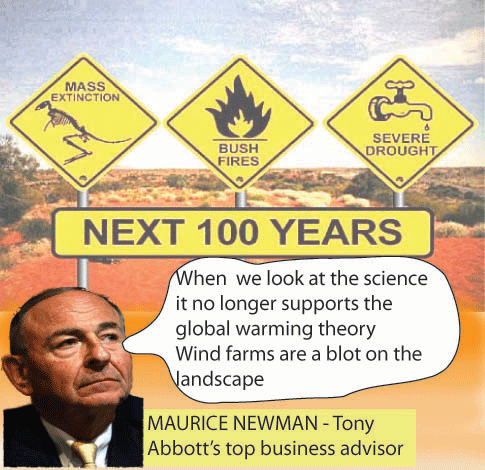
Former prime minister Tony Abbott appointed Newman as one of his first acts after winning government in 2013.
Newman has used a weekly column in the Australian to expound private views on climate change, including that the world was ill-prepared for a period of global cooling and that the United Nations was using debunked climate science to impose a new world order under its own control.
He also called for a government-funded review of the Bureau of Meteorology (BoM) to “dispel suspicions of a warming bias” in its temperature record-keeping, something freedom of information documents have recently revealed was under consideration by the prime minister’s department.
Turnbull’s spokesman said the new prime minister, who has strong personal links to the business community, was still considering whether he needed a formal business advisory council. He said Newman had not been reappointed.
The two-year terms of the other 11 members of the council expire in December because they were appointed by Abbott after he had named the chairman…….http://www.theguardian.com/australia-news/2015/sep/28/climate-sceptic-maurice-newman-not-reappointed-government-adviser
Australia’s Resources Minister Josh Frydenberg will help Adani’s coal mine with tax-payer money
 Frydenberg signals $5 billion taxpayer frolic with Adani’s unwanted fossil flop https://independentaustralia.net/environment/environment-display/frydenberg-signals-5-billion-taxpayer-frolic-with-adanis-unwanted-fossil-flop-,8193
IF AUSTRALIA’s new Prime Minister and refreshed front bench are showing signs of being more progressive about renewable energy investment and R&D, it looks like they are also going to be far more candid about coal, and their plans to invest heavily there, too.
In an interview with Fairfax media on Wednesday, the newly sworn in energy and resources minister Josh Frydenberg was crystal clear on the government’s intent to use taxpayer money from its $5 billion Northern Infrastructure Fund to help get the Adani-owned Carmichael coal mining project off the ground.
And he was equally clear that the Turnbull Government’s attitude to developing new coal projects – despite the smart money being on all untapped fossil fuel resources staying in the ground, and despite the fact that most banks and institutional investors won’t touch the Galilee Basin project with a 10 foot barge pole – remains the same as the Abbott Government’s. Frydenberg told the AFR, repeating the mantra of his former boss:
[Carmichael coal mine is] a very important project, which will see significant investment in Australia and provide electricity to millions of people in the developing world,”
Anti-development activism can create major delays in projects and send investment offshore, and you have to be very conscious of that when there are such large time frames involved and we are competing internationally for investment in this country.
AUDIO: Australia world top in household solar panel installations
 AUDIO: Australia leads world in household solar panel installations, ABC RadioThe World Today By Samantha Donovan Australia has the highest rate of household solar panel installation in the world, according to a new report from the Energy Supply Association of Australia.
“We’re clearly leading the world in rooftop solar,” said the association’s chief executive, Matthew  Warren.
“There’s literally daylight [coming in] second.”
The report found about 15 per cent of Australian homes had solar panels………Installation rates are highest in South Australia and Queensland, and in some Brisbane and Adelaide suburbs more than half of all homes have solar panels.
Mr Warren attributed that to more generous schemes in those states.
“South Australia has 25 per cent of dwellings, which is the highest in the world, and Brisbane’s not far behind with 23 per cent, and then Perth and WA at 18 per cent.”
Media player: “Space” to play, “M” to mute, “left” and “right” to seek.
But the report found lower rates of solar panel installation in affluent suburbs. “It’s very popular with retirees,” Mr Warren said. “It’s more popular with mortgage-belt consumers who are probably more price conscious. “It hasn’t been in the trendy inner-city suburbs. There’s not much roof space and there are more renters, but it just hasn’t appealed to that demographic.”
Australia lags with large-scale solar projects
While Australians are taking to small-scale solar projects enthusiastically, the report found large-scale solar projects are less common than in other countries……..http://www.abc.net.au/news/2015-09-29/australia-leads-world-in-installation-of-household-solar-panels/6813532
New nuclear energy is an expensive fantasy – Dr Mark Diesendorf
 The fantasy of cheap, safe nuclear energy http://indaily.com.au/opinion/2015/09/28/the-fantasy-of-cheap-safe-nuclear-energy/ Back in the 1970s and 80s, solar and wind energy were expensive and their supporters were criticised by the nuclear industry for dreaming of a renewable energy future.
Nowadays the situation is reversed. Several countries are well on their way to their targets of 80-100 per cent renewable electricity while global nuclear energy generation ceased growing nine years ago.
In northern Europe and the USA wind energy is about half the price of nuclear. In South America contracts to deliver electricity from big solar photovoltaic (PV) power stations are being signed at 8 US cents per kilowatt-hour, already less expensive than nuclear, and the price of solar PV is still declining. In many places, including mainland Australia, rooftop solar is much less expensive than retail electricity from the grid.
The current fantasy is that nuclear energy is cheap, safe, CO2-free and necessary, and that South Australia could make a profit storing the world’s nuclear wastes. All of these claims by enthusiasts for the nuclear fuel cycle, made in submissions to the current Nuclear Fuel Cycle Royal Commission, are poorly based.
In theory, the geologically stable regions of South Australia could provide a location for storing high-level nuclear wastes. But as yet there are no permanent repositories operating anywhere in the world. It would be crazy for Australia to attempt build one when the USA has failed.
Apparently recognising this, South Australian Liberal Senator Sean Edwards has proposed an even greater fantasy: that South Australia could earn huge revenue from storing the world’s high-level wastes temporarily in dry casks. He claims that the revenue would be sufficient to fund a nuclear power station.
Unfortunately, this scheme fails under basic economics. Why would a nuclear power country pay the additional costs of shipping and storing high-level waste in Australia when it can store its own wastes temporarily in dry casks? Indeed, several nuclear power countries are already doing this.
Senator Edwards’ fantasy is that Australia could convert the long-lived component of the nuclear wastes into nuclear fuel in an Integral Fast Reactor. However, this technology is not commercially available. It has only ever existed as a pilot plant in the USA. Proposing that SA buy unproven technology at huge expense is a poor prescription for the economy.
Australia could not convert the contents of the dry casks to nuclear fuel. We would be stuck with managing them while they corrode and release their deadly contents. It’s far better to leave the source countries to handle the huge costs and risks of managing their nuclear wastes for 100,000 years or more.
Turning to nuclear power stations, both the Australian Energy Market Operator and our own research group at UNSW have shown independently that the National Electricity Market, which includes South Australia, could be operated reliably and affordably on 100 per cent renewable energy. The UNSW research uses only scaled-up commercially available renewable energy technologies. The results of the computer simulations, now spanning eight years of hourly data, are supported by practical experience in South Australia where at times renewable energy provides up to three-quarters of electricity.
Nuclear power is very inflexible in operation, unable to follow the variations in wind and solar PV output. It would be an inadequate partner for a SA electricity supply system that will soon be predominantly renewable. Instead, flexible peak-load plants are required: biofuelled gas turbines, concentrated solar power with thermal storage, and, in appropriate locations, pumped hydro.
Furthermore, under current market rules, wind and solar, with their tiny operating costs, would have priority in supplying base-load demand. Nuclear power would be displaced from operating as base-load power, just as coal is currently being displaced in SA. Then, nuclear energy would have even greater difficulties in repaying its already exorbitant capital costs.
Dr Mark Diesendorf is Associate Professor in Interdisciplinary Environmental Studies at UNSW. He gave evidence to a hearing of the Nuclear Fuel Cycle Royal Commission on 14 September.
Australia’s PM Turnbull under firm control of right wing on climate change
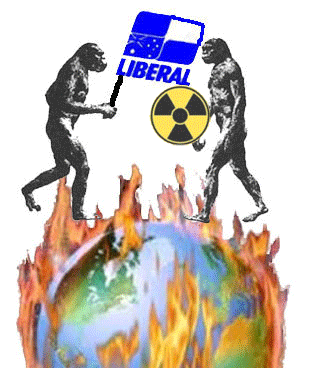 Liberal right wing’s climate warning to Malcolm Turnbull: don’t touch Direct Action, The Age, September 25, 2015 Mark Kenny and Philip Wen Malcolm Turnbull has been warned by his party’s right wing not to attempt changes to beef up the Abbott government’s Direct Action program in response to China’s introduction of an economy-wide emissions trading scheme by 2017.
West Australian Liberal Dennis Jensen welcomed the assurances  of Environment Minister Greg Hunt, who said Australia would not be altering its climate change abatement measures in response to the Chinese development.
“It’s one of the conditions of the leadership change that we are sticking with the policy we had,” he told Fairfax Media………
While Mr Turnbull declined to comment, Mr Hunt was sent out to reassure nervous Liberals that the development out of Beijing would not lead to a similar move from Canberra. http://www.theage.com.au/federal-politics/political-news/liberal-right-wings-climate-warning-to-malcolm-turnbull-dont-touch-direct-action-20150925-gjv73s.html#ixzz3mnbYTxSM
Canberra school Amaroo to get benefits from ACT’s largest rooftop solar system
 Amaroo School to gleam under ACT’s largest rooftop solar system, Canberra Times, September 25, 2015 Emma Kelly Canberra Times reporter Amaroo School will gleam beneath the territory’s largest rooftop solar system when school returns next term. Almost 2000 large solar panels will be installed across the school’s buildings, producing 600kW of power to be fed into the ACT electricity grid.
The school is leasing its roof space to solar energy company Solar Choice and will power the equivalent of about 175 Canberra houses each year. The 20-year lease will also generate $30,000 a year in school funding.
Solar Choice managing director Angus Gemmell said a team of 30 contractors would install the panels over the next fortnight while students were on school holidays, before solar inverters were installed the week after.
Mr Gemmell, who will soon oversee construction of the Majura Valley solar farm, said the school’s utility-scale panels would be about 25 per cent bigger than the panels installed on regular houses.
“We have large skillion, north-facing roofs that are much like a ski slope to the north. The panels can be perfectly flush-mounted, they won’t need tilt fronts,” he said………
the installation was part of a broader rollout of solar technology in the territory, which had seen rooftop solar capacity jump from less than one megawatt in early 2009 to about 45 megawatts today.
“As we head to a 90 per cent renewable energy target, rooftop solar is going to play an increasingly important role,” he said.”Medium and large-scale rooftop solar is the growth market now for PV [solar power] in Australia and I’m very excited to see Amaroo sharing in those benefits.”
Amaroo School principal Julie Cooper said the school, which is also home to a wind turbine, would make the most of the money injected into the school via the roof space lease. http://www.canberratimes.com.au/act-news/amaroo-school-to-gleam-under-acts-largest-rooftop-solar-system-20150924-gjujsf.html#ixzz3mnO1OZCy
Western Australia’s govt slow to re-register Aboriginal sacred sites
 WA Government ‘dragging feet’ over sacred site registration: Indigenous group, ABC News 25 Sep 15 By Kathryn Diss An Aboriginal heritage group has accused the State Government of dragging its feet on reinstating several sacred sites it deregistered over the past year.
Several culturally significant sites around WA have had their protection withdrawn on the basis they no longer fit the definition of a sacred site.
Guidelines issued by the Department of Aboriginal Affairs stated that to be a recognised sacred site, a place needed to have been devoted to religious use rather than simply mythological stories, songs or beliefs.
But in a test case in April challenging the Aboriginal Cultural Materials Committee’s (ACMC) deregistration of a site in Port Hedland, the Supreme Court quashed the decision to remove it from the protected list.
Dr Stephen Bennetts from the Aboriginal Heritage Action Alliance said it had been months since the ruling was handed down and the government had not yet reinstated the other sites.
Dr Bennetts said he is concerned the sites could be damaged if they were not adequately protected. “It is quite possible some of those may have already been damaged,” he said.
Dr Bennetts said it was a scandal none of the custodians of the deregistered sites had been notified of the court’s decision.
“Because we know the reasoning the ACMC deregistered them in the first place was to make it easier for developers to get their approvals that was the exact reason,” he said………..http://www.abc.net.au/news/2015-09-25/call-for-indigenous-heritage-sites-to-be-re-registered/6804082
Professor John Quiggin dismisses the CANDU nuclear reactor at the #NuclearCommissionSAust
 SA NUCLEAR FUEL CYCLE ROYAL COMMISSION PROCEEDINGS, WEDNESDAY, 23 SEPTEMBER 2015, Excerpts from the transcript
Prof Quiggan: “……..I think we’ll go back to carbon pricing and we’ll go down essentially a renewable (indistinct) perhaps already well-established industry. With popular acceptance – there’s obviously a little bit of objection to wind but broad 40 popular acceptance and essentially all we need is the price signal and some policy certainty and that’s the path we’ll take……..
Coober Pedy gets another visit from #NuclearCommissionSAust
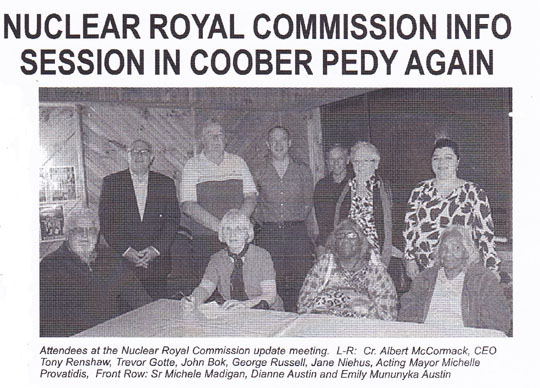
https://cooberpedyregionaltimes.files.wordpress.com/2014/05/coober-pedy-regional-times-24-09-2015.pdf , Noel WauchopeThe South Australian Nuclear Fuel Chain Royal Commission went to Coober Pedy again, on September 18th. John Bok, Regional Engagement Manager for the Commission was there to make a presentation about the Royal Commission. Bok stressed that he was there only to provide information about the Commission’s processes, and also that the Commission’s findings would be evidence based..
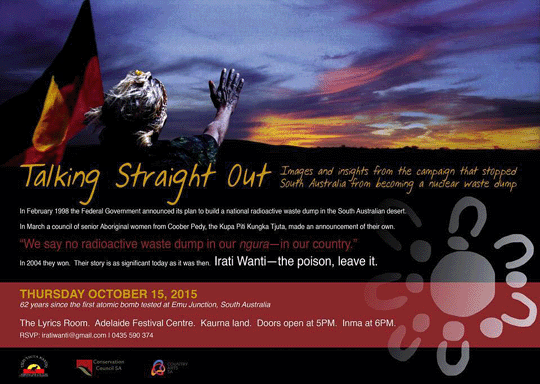
We are the Aboriginal Women. Yankunytjatjara, Antikarinya and Kokatha. We know the country. The poison the Government is talking about will poison the land. We say, “No radioactive dump in our ngura – in our country. It’s strictly poison, we don’t want it.”
We do not want nuclear anything on our Land – Anangu Pitjantjatjara Yankunytjatjara Law and Culture
APY LAW & CULTURE – CONCERNS FOR NUCLEAR WASTE, Coober Pedy Regional Times, 24 Sept 15, Anangu Pitjantjatjara Yankunytjatjara Law and Culture is declaring its intention to move away from the APY Administration. For a long time our committee has been worried about the direction the APY Administration is taking.
On several occasions we have been told Law and Culture is a side committee, that it is second to the APY.
Law and Culture comes first. It always has. The administration needs to understand this. All Anangu know that our Law and Culture comes first, our Law and Culture must be at the heart of decision making. We have decided to stand alone. Our Law and Culture will come first. Our lives depend on it. We will source alternate funding.
One of our big concerns is the Royal Commission into Nuclear Energy. Law and Culture says no to APY Lands being used to mine uranium or dump the waste.
Tony Abbott’s legacy – it’s not pretty
Tony Abbott’s department discussed investigation into Bureau of Meteorology over global warming exaggeration claims, FOI documents reveal
Former prime minister Tony Abbott’s own department discussed setting up an investigation into the Bureau of Meteorology amid media claims it was exaggerating estimates of global warming, Freedom of Information documents have revealed.
In August and September 2014, The Australian newspaper published reports questioning the Bureau of Meteorology’s (BoM) methodology for analysing temperatures, reporting claims BoM was “wilfully ignoring evidence that contradicts its own propaganda”.
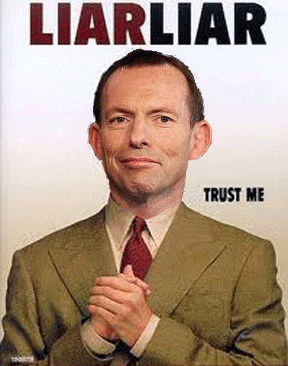 Fact check scorecard: How does Tony Abbott’s record of claims and promises stack up?
ABC Fact Check was established shortly before the 2013 election, and has been checking Tony Abbott’s claims ever since.
Before the election, Mr Abbott repeatedly set a high standard for integrity, promising to lead a government that “says what it means, and does what it says”.
Mr Abbott made many claims during his tenure on a diverse range of topics, including the economy, environment, immigration and employment.
So now that his time as leader is over, how does his record of claims and promises stack up?
http://www.abc.net.au/news/2015-09-24/tony-abbott-fact-check-record/6792016
Poll shows most Australians support charity status for environmental groups
Voters have overwhelmingly rebuffed the government’s so-called “vendetta” on green groups, with new polling showing 70 per cent oppose any move to deny charity status to environment groups.
Voters have overwhelmingly rebuffed the government’s so-called “vendetta” on green groups, with new polling showing 70 per cent oppose any move to deny charity status to environment groups.
Removing such groups’ charity status, first proposed by key Tony Abbott backer Andrew Nikolic, could cost them hundreds of millions of dollars in tax-deductible income, and severely restrict their capacity to campaign on environmental issues.
Pressure has been building on the government to abandon the proposed changes, with Labor and the Greens flagging they will oppose any moves it makes on the matter.
Environment groups believe the proposal is designed to strip them of their ability to campaign against mining projects.
But new polling conducted by the Australia Institute shows 68 per cent of people support the right of green groups to conduct environmental campaigns and advocate policy changes, while also claiming charity status…… http://www.smh.com.au/federal-politics/political-news/most-oppose-denying-environmental-groups-charity-status-says-poll-20150924-gjtz4t.html#ixzz3mhlVxCnW
Renewable Energy way ahead of nuclear – Rebecca Keane’s Submission to #NuclearCommissionSAust
 http://nuclearrc.sa.gov.au/app/uploads/2015/09/Rebecca-Keane-23-07-2015.pdf I am astonished that South Australia is even being considered as a site for nuclear power plants and/or radioactive waste dumps. Australia’s rapid and widespread progress in the harnessing of our virtually unlimited solar energy resource is evident in the fact that currently 1.4 million households have rooftop solar installations!. The huge potential for expansion in this field negates any need for the pursuit of such a highly dangerous enterprise as nuclear power generation.
Solar thermal energy supply, where solar energy is stored as heat is also highly efficient and offers
tremendous opportunities in this country. Moreover, our nation’s geographical conditions are extremely favourable to the massive development of other renewable sources such as wind, hydro and wave power. Wind energy is emerging as a highly cost-effective resource and vertical axis wind turbines are particularly effective and create no noise issues.
The West Australian coast is subject to the world’s strongest wind system (The Roaring Forties) with the energy released each year from the pounding of the waves influenced by this system, equating to five times Australia’s annual total energy usage2. Over 85% of Australians live in close proximity to the
coast.
A combination of the utilisation ofrenewable intermittent sources such as solar, wind
and wave energy with back-up hydro and gas-driven turbines is recognized by experts throughout the world as being highly comparable in terms of both adequacy and reliability of supply, to existing coal-driven technology. Over 24,000 people are employed in Australia’s renewable energy industries compared to 10,000 in coalmining for the domestic market 3 Continue reading
1 This month
17 October, Free Public Talk on Nuclear Issues in South Australia
David Noonan will speak on public interest concerns over the new Roxby Downs Indenture Act 2026 on BHP copper-uranium mining and ore processing in SA, and on how AUKUS may face SA with a High-Level nuclear waste agenda.
Dr Jim Green will discuss international developments in the field of nuclear power including ‘small modular reactors’ and Generation 4 ‘advanced’ nuclear reactor concepts.


Help Aunty Sue Protect Her Land and Sacred Sites From Destructive Rocket Testing.
.

Australians deserve the truth
about
AUKUS – https://aukuspublicinquiry.com/

PETITION – To: Prime Minister Anthony Albanese and the Australian Labor Government

of the week – Australians for War Powers Reform (AWPR)
To see nuclear-related stories in greater depth and intensity

