Australia’s new Resources Minister Frydenberg is a nuclear power enthusiast
 Turnbull appoints a nuclear fan to head energy policy REneweconomy, By Giles Parkinson on 21 September 2015 Prime Minister Malcolm Turnbull has appointed a strong advocate of nuclear energy in the key resources and energy portfolio as part of sweeping changes to his cabinet and ministry.
Josh Frydenberg, an ally of Tony Abbott who was previously assistant Treasurer, has been named as minister for resources, energy and northern Australia, as part of a reshuffle that sees the portfolio split from industry, innovation and science, which goes to former eduation minister Chris Pyne.
Greg Hunt retains his spot as environment minister, to continue his bluster around Direct Action as a result of Turnbull’s pact with the Liberal Party’s far right wing, and Turnbull has also appointed Jamie Briggs to be Minister for Cities and the Built Environment, in an appointment welcomed by the Green Building Council and others…………..
Frydenberg also has strong views on energy, and in particularly nuclear energy. He made it one of his three major issues when he made his maiden speech to parliament in October, 2010, and then made a series of speeches and articles pushing the technology.
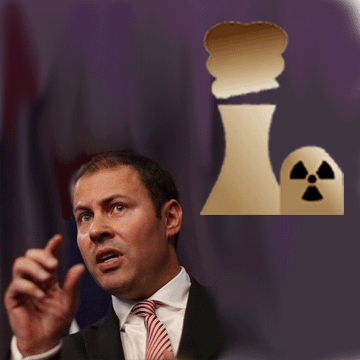
In The Australian newspaper in early 2011, Frydenberg said nuclear was safe and cheap, and expected that sometime soon nuclear plants could likely be constructed within 2 ½ years. He also quoted nuclear advocate Ziggy Switkowski as saying that Australia could be 90 per cent powered by nuclear energy by 2050. Continue reading
#SOSBLAKAUSTRALIA: Stop the Forced Closure of Aboriginal Communities in Australia
 #SOSBLAKAUSTRALIA 5th Global Call to action announced:
Stop the Forced Closure of Aboriginal Communities in Australia
https://www.facebook.com/sosblakaustralia/photos/a.1042299689120174.1073741828.1042255972457879/1158023780881097/?type=1&theater
16 Sep 15: “With the recent change of leadership in the current LNP government and last week’s announcement of eight Indigenous individuals confirmed to determine the fate of 274 Aboriginal Communities in Western Australia alongside what the Government claims to be a ‘consultative process’, a new date has been set for the 5th Global Call to Action – Friday 27th November 2015.
… #SOSBLAKAUSTRALIA grew out of necessity in the response to the threatened forced closure of Aboriginal communities. Our extended reach is in excess of 12 million people and our direct reach is close to 75,000. Our goal goes well beyond any ‘consultation’. Regardless of who is prime minister, we
are committed to keeping our communities on their homelands and we have been consulting among our own people to develop sustainable and viable models for communities, outstations and seasonal campsites.
To support this work, we are steadily galvanising support from NGOs, unions, the legal fraternity and public figures and have built a skills database with submissions from thousands of everyday people worldwide, who care as much as we do about our Aboriginal culture and human rights.
#SOSBLAKAUSTRALIA itself will be scaled up to increase its capacity, whilst supporting a cultural revolution, political platform and fundraising campaign.
South Australian govt removes regulatory hurdle on renewable energy
If South Australia were a nation, it would be second only to Denmark in regard to wind energy. It’s no slouch on solar power either. While it may not host the largest number of solar panel systems in Australia; it leads the nation based on the percentage of households with home solar installed.
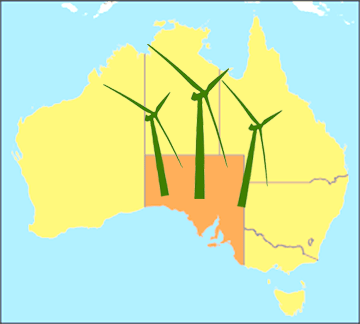 More Of South Australia Opened Up To Renewable Energy Projects http://www.energymatters.com.au/renewable-news/south-australia-renewables-em5081/ September 22, 2015 Energy Matters The South Australian Government has reduced regulatory burdens on renewable energy projects on state Crown lands; a move it says will provide greater certainty to investors and make South Australia even more competitive.
The proclamation of the Pastoral Land Management and Conservation (Renewable Energy) Amendment Act 2014 means wind farm developer can now apply for 25-year licences on Crown land; subject to pastoral lease tenure. Developers will also be given the option to renew for another 25 years.
“Securing investor confidence is key to the long-term future of the renewable energy industry, and this Act serves to cement South Australia’s position as the preferred destination for renewable energy development,” said Climate Change Minister Ian Hunter.
Additionally, the Act will expedite access for the development of solar farms and also ensure local communities reap the benefits of renewables investments; with 95 per cent of licence payments flowing through to pastoral lessees and native title holders. Continue reading
New Resources Minister, Josh Frydenberg, gives cautious support to renewable energy
Wind farms, solar to be ‘key part’ of Federal Government’s energy strategy, Minister says, ABC News, By Loretta Florance, 21 Sept 15 Renewable energy will be a “key part” of the Federal Government’s energy platform, the newly elevated Minister for Resources, Energy and Northern Australia Josh Frydenberg says.
Key points:
- Josh Frydenberg says renewables will be “key part” of energy policy
- Renewable energy sector says comments are “extremely encouraging”
- The industry has lost 88 pc of investment in past year
Former prime minister Tony Abbott was vocal in his opposition to the sector, describing wind farms as “visually awful” and saying he wished the Renewable Energy Target (RET) had never been introduced by the Howard government.
The industry, which lost 88 per cent of investment over the past year, amid uncertainty over the RET,had been hopeful the Government’s attitude would change under new Prime Minister Malcolm Turnbull.
However Mr Turnbull, who lost the party leadership in 2009 over his support for the Rudd government’s proposed Emission Trading Scheme, said he was in favour of retaining the Government’s current climate change policies.
“The climate policy is one that I think has been very well designed that was a very, very good piece of work,” he said after he took the leadership last week.
But today, Mr Frydenberg told 774 ABC Melbourne that “clearly renewable energy is a key part of our energy platform”.”I think wind farms, I think solar, I think they all have a role to play,” he said.
Mr Frydenberg was asked by host Jon Faine if describing renewable energy as a “key platform” represented a u-turn for the Government.
“Don’t play it up to be bigger than it is Jon, what I’m saying is that we as a Coalition Government have entered into a bipartisan agreement with the Labor Party, on a 23.5 per cent renewable energy target by 2020, this will see a doubling of large scale renewable energy,” he said……http://www.abc.net.au/news/2015-09-21/renewable-energy-to-be-key-part-of-federal-government-strategy/6791136
Queensland poised – could take off as renewable energy leader
 QLD could become renewable energy leader, http://www.sunshinecoastdaily.com.au/news/qlds-future-really-is-the-sunshine-state/2782321/ Bill Hoffman | 22nd Sep 2015 QUEENSLAND can become a leader in developing cleaner electricity, according to a new forum that has just launched a renewable energy transition document to explain how it’s possible.
The approach aims to create new jobs in regional and rural communities across the state and seeks to tap into global investment in renewable energy which rose 17% last year to more than $270 billion. Sustainable Queensland Forum patron, Marcoola’s Professor Ian Lowe, said we should be at the forefront of the shift from fossil fuels because of our abundance of solar and wind resources.
“Queensland can get on board and move away from its present reliance on coal to develop a pathway for a clean energy transition and play a major role in this growth sector,” Prof Lowe said. “We have long been known as the Sunshine State. “It’s time to earn that title.”
Despite one of the highest uptakes for household solar, with about half a million homes using solar energy, Queensland lags behind every state except WA in total renewable generation.
Report lead author Trevor Berrill said renewable energy schemes created jobs through the construction and operation and offered farmers and graziers the chance to supplement their income by hosting solar and wind installations. Members of the Sustainable Queensland Forum received a positive response to the report at a recent meeting with Queensland Energy Minister Mark Bailey and his Director-General.
Key recommendations of the report Queensland Transitioning to a Clean and Efficient Energy System also include the establishment of an area within the State Government to drive Labor’s target of 50% renewable energy by 2030 and no further fossil fuel generation as coal-fired stations reach the end of their productive life.
Improving energy efficiency delivers savings for users and creates jobs and training for more energy auditors. The Australian Solar Council, Queensland Conservation Council, Australian PV Institute, Alternative Technology Association and Environmental Defenders Office endorsed the findings.
Will Environment Minister Greg Hunt now come good on renewable energy?
Turnbull government to ditch former PM Abbott’s attempt to abolish renewable energy agencies http://www.ibtimes.com.au/turnbull-government-ditch-former-pm-abbotts-attempt-abolish-renewable-energy-agencies-1468516 By Darwin Malicdem on September 22 2015 The Turnbull government is waiving to abandon former Prime Minister Tony Abbott’s previous attempt to abolish renewable energy agencies for a new approach to attain the carbon reduction target of Australia. Environment Minister Greg Hunt is about to add the Clean Energy Finance Corporation, or CEFC, which Abbott previously aimed to ban from investing in commercial-based wind or small-scale solar energy projects, to his new portfolio.

There has been a negotiation between the government and the CEFC about the company’s investment instructions after a legal advice for the investment bank suggested that the Abbott government order could deny the CEFC its legislated duties. The Guardian reported that an agreement would be announced at any day.
Hunt believes that the CEFC may provide flexible proposals as it may return to finance government projects. In addition, the Australian Renewable Energy Agency, or Arena, set up by the former Labor government to handle the use of renewable energy, was reported on Monday to be transferred from the Industry Department to the Department of the Environment.
“Obviously under Malcolm Turnbull there is a history of a deep long support for renewable energy,” Hunt told Sky News on Monday. Continue reading
Tesla’s new Powerwall solar-energy batteries available in Australia this year
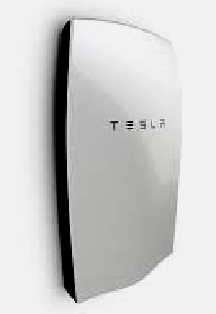 Australia among first countries to use Tesla’s new Powerwall solar-energy batteries, IBT, By Darwin Malicdem on September 21 2015 US firm Tesla has announced Australia would be one of the first countries in the world that it would provide with its new Powerwall solar energy batteries. The new 7kWH home energy storage units will be available in late 2015 coming ahead of the previous reports indicating its release date in 2016.
The Powerwall, launched in May, is designed for the interior wall of the house that can store energy from solar panels placed on the rooftop. The storage units work with lithium-ion battery to generate electricity created by the solar panels.
Tesla has already partnered with the Canberra-based firm, Reposit Power, to launch the Powerwall. The firm is working with different residents to directly buy and sell their stored electricity.
The Business Insider reported that there is a growing list of major utility and solar supply companies aiming to partner with Tesla to launch the Powerwall storage units in the country. The sustainable energy expert at the University of Sydney, Professor Anthony Vassallo, describes Tesla’s arrival significant for the renewable energy industry because of its high-profile products.
“The Tesla product isn’t unique by any stretch, but it’s the Apple brand of the battery storage industry, they have the sex appeal that others don’t,” he said. Australians already has a great solar resource, which “makes a lot of sense” of the availability of the Powerwall batteries to store the energy created by the solar panels, Vassallo added.
More than 1.3 million households in Australia already have solar panels on their rooftop, and the number is currently increasing rapidly because of the falling PV systems price. However, the Powerwall technology still needs improvement, Vassallo said…..
Vassallo said that the country could reach the 50 percent target if it will require “well-designed policies and markets that allow a transition from centralised, large-scale fossil fuels to efficient but variable renewables.” Storage is a key part to make the goal successful, he added.
Once the officials have managed the capital cost of the renewable energy, Vassallo said, there would be no fuel cost. The availability of renewables would aid energy security where people “don’t get with fossil fuels.” http://www.ibtimes.com.au/australia-among-first-countries-use-teslas-new-powerwall-solar-energy-batteries-1468188
Electrical trades Union of Australia dispels the hype about Generation IV Nuclear Reactors
 Electrical Trades Union, Graham Glover Submission to South Australian Government Nuclear Fuel Cycle Royal Commission http://nuclearrc.sa.gov.au/app/uploads/2015/09/Electrical-Trades-Union-03-08-2015.pdf

Malcolm Turnbull disappoints on Climate Change Policy
 Malcolm Turnbull’s Faustian pact on climate change is heartbreaking, Guardian,
Mark Butler, 19 Sep 15 Many Australians hoped the new PM would drag the Coalition back to the sensible centre on climate change – but he has swallowed Abbott’s Direct Action hook, line and sinker…………..Many Australians held out very high hopes that Mr Turnbull’s return to the leadership of the Liberal party would see him drag the party back to the sensible centre on climate change — that there would be the hope of Australia again regaining a bipartisan consensus that would allow us to move forward in the way that so many of our sister nations around the world are doing……
The old Malcolm Turnbull was clear in his advocacy of an emissions trading scheme as the cheapest and most effective means of reducing carbon pollution. We have heard him say, so many times, particularly in that critical period of debate in 2009 and 2010, that a policy like Tony Abbott’s emissions reduction fund would be “a recipe for fiscal recklessness on a grand scale”.
Well, apparently it’s all different now. Tony Abbott’s Direct Action policy is apparently now a “very, very good piece of work”. In parliament, the new prime minister praised the emissions reduction fund’s first auction, which spent about $650 m of taxpayer funds. Forty seven million tonnes of carbon pollution reductions were purchased under this first auction. What the prime minister has not said is that of those 47 m tonnes, three quarters, or 34 m tonnes, were from projects that already existed and in some cases had existed for more than 10 years, including with big companies like AGL — the largest polluter in Australia. Taxpayers are paying for things that those companies were already doing.
The second element of Tony Abbott’s Direct Action policy, the safeguards mechanism, was released earlier this month, and it exceeded everyone’s worst expectations. RepuTex, the leading modelling agency in this area, has provided very clear advice that, under this safeguards policy, the biggest 20 polluters in Australia will not be touched whatsoever. And the biggest 150 polluters in this country will increase their emissions by 20% over the next 15 years. The Grattan Institute said in response to the release of the safeguards policy: “It is called a safeguard, but it is not an environmental safeguard. Greg Hunt is not actually constraining emissions; if it is going to work it is going to have to have teeth, but all we have got is gums.”
It’s not surprising then that we’ve seen emissions starting to rise again. Under Direct Action, 2020 levels of carbon pollution will be substantially higher than they are today, and substantially higher than they were in 2000 or in 2005.
The government’s own projections suggest that, in 2020, carbon pollution levels in Australia will be 655 m tonnes against 559 m tonnes in 2000 — so, not 5% below 2000 levels, 17% above 2000 levels. RepuTex was more generous to the government than the government’s own modelling. It said only last month that, in 2020, carbon emissions will be 613 m tonnes against 559 m tonnes — so 10% above 2000 levels………..http://www.theguardian.com/australia-news/commentisfree/2015/sep/18/malcolm-turnbulls-faustian-pact-on-climate-change-is-heartbreaking
Tesla’s Powerwall battery for solar storage about to disrupt Australia’s energy market
Tesla’s Powerwall will give its first taste of disruption to Australia’s energy market, Guardian, 19 Sep 15 Giles Parkinson With plenty of sunshine for solar panels and unprepared network operators, fast-tracking Powerwall into Australia’s energy market is a savvy move.
The arrival of the Powerwall Tesla battery storage unit in Australia will herald the biggest challenge to Australia’s electricity industry for decades.
Tesla announced on Thursday that it is fast-tracking the roll-out of its battery storage product. Australia will be its first market for the 7kWh household units. The first deliveries had not been expected until well into 2017.
The Tesla Powerwall is not the first or even the cheapest battery storage maker to enter the Australian market but it is the most ubiquitous brand.
It threatens to do to incumbent business models what Uber is doing to the taxi industry, and Facebook, Twitter and Amazon did to traditional publishing.
Tesla is targeting the Australian market first because it is ripe for change. It has high electricity prices, excellent sun, lots of rooftop solar (more than 4,400MW on more than 1.4m homes). Its tariff structure should make it attractive for households and businesses to store their solar output in a box for use in the evening, rather than giving it away for next to nothing to the grid.
There are a range of predictions on how quickly battery storage will be adopted in Australia. Some suggest that the combination of a solar array and battery storage is already cheaper than grid power in some areas, others suggest it will be another five years before the combination is cheap enough to become a mass market.
But the promised benefits to consumers could be undermined because of a major turf war between the incumbent utilities whose business models are being threatened by the new technology, and because regulators are so slow to act. Continue reading
Tax-payers likely to be hit with big costs of mines rehabilitation
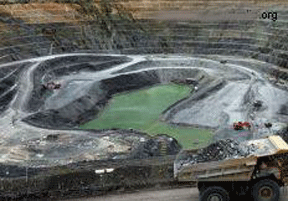
State governments calculate the required rehabilitation bonds using a standard formula but Dr Erskine said the mining companies work off their own, and often very different numbers.
“The rehabilitation costs held independently by the mining companies are often much larger than the rehabilitation bonds paid to state governments,”
An environmental scientist who works with the mining industry has broken ranks to warn that Australian taxpayers will be left with a bill running into tens of billions of dollars unless government and industry start taking mine rehabilitation seriously.
Key points
- More than 50,000 abandoned mines in Australia
- Scientist says mines must be rehabilitated
- Report says rehabilitation bonds ‘insufficient’
- Concerns over Peabody Energy’s plummeting share price prompts rehabilitation bonds questions
Dr Peter Erskine from the University of Queensland’s Sustainable Minerals Institute said although state governments hold financial securities for mine rehabilitation, they are nowhere near enough.
Across Australia there are more than 50,000 abandoned mines — a legacy of the early mining days when resource companies simply walked away when the profits dried up.
To avoid repeating its past, Dr Erskine said Australia must ensure that operating mines are properly and progressively rehabilitated while they are turning a profit.
What is in the rehabilitation kitty? Continue reading
Adelaide Hills site suitable for nuclear reactor – #NuclearCommissionSAust
 Nuclear Fuel Cycle Royal Commission hears Adelaide Hills site earmarked as suitable for nuclear reactor http://www.adelaidenow.com.au/news/south-australia/nuclear-fuel-cycle-royal-commission-hears-adelaide-hills-site-earmarked-as-suitable-for-nuclear-reactor/story-fni6uo1m-1227533674218 September 18, 2015 CHIEF REPORTER Paul Starick The Advertiser SITES in the Adelaide Hills and Port Augusta have been earmarked as suitable for a nuclear power plant should one be built in South Australia, a royal commission has heard.
The operator of the state’s high-voltage electricity network said the existing power station site at Port Augusta, which is slated for closure, would be suitable for a nuclear reactor.
ElectraNet executive manager asset management Rainer Korte also said this was among four suitable sites in the network – the others in Adelaide and the Hills. Those in Adelaide were unlikely to be used for a nuclear power plant, he said.
Mr Korte was responding to a question by Chad Jacobi, counsel assisting the Nuclear Fuel Cycle Royal Commission, about where a 1000-megawatt nuclear power plant could be connected to the SA electricity network. He said: “One of them is at Davenport, which is near Port Augusta, which is where essentially the current northern power station is connected.
“The other two are in Adelaide, in the Adelaide metropolitan area where you arenot likely to see any major development of a power station for environmental reasons and others.
The royal commission, headed by former governor Kevin Scarce, is conducting public sessions to inform a final report due by May next year. It is investigating the potential for SA to be involved in nuclear power, waste storage, enrichment and further exploration and milling.
An Adelaide Hills site described as in the Mt Lofty Ranges or just east was previously identified as a possible place for a nuclear reactor in a 1997 federal Cabinet submission, leaked in 2006. Sites at Woomera and Olympic Dam also were among 14 places across Australia detailed in the submission, prepared for then science minister Peter McGauran.
In other royal commission evidence on Friday afternoon, SA Power Networks senior manager Mark Vincent said forecasts predicted solar energy would be used by two-thirds of SA households in about 20 years. In the same period, it was predicted about 100,000 electric cars would be using SA roads – for which Premier Jay Weatherill is planning new road laws.
Walkatjurra Walkabout completes 5th walk against uranium mining in West Australia
http://walkingforcountry.com/2015/09/17/41888/ 16 Sep 15: “The Walkatjurra Walkabout, which started in 2011, finished its 5th walk in the North Eastern Goldfields town of Leonora on Tuesday. The walk, a collaboration of Aboriginal and non-indigenous people, is a moving community protest against the proposed uranium mines in the region.

The month long walk, lead by local Traditional Owners, covered almost 450 km’s from Wiluna to Leonora, passing Toro Energy’s Wiluna uranium mine proposal at Lake Way and Cameco’s proposed uranium mine at Yeelirrie Station. Walk participants included local Traditional Owners, people
from Australia, Japan, Taiwan, England, Sweden, Aotearoa (New Zealand), America and France.
The walks continue to attract people interested in learning about Aboriginal culture, caring for country and to share a united vision for a nuclear free world.
 The walk was also joined at Yeelirrie for two days by Federal Greens senators Rachel Siewert and Co-Deputy Greens leader Scott Ludlam along with state Greens MLC Robin Chapple.
The visit included a tour of Toro Energy’s uranium project at Lake Way near Wiluna with walkers and Toro Energy. Many of the participants have first hand experience of the
dangers of the nuclear industry, especially those from Japan and Taiwan, whose nuclear industry are fuelled by Australian uranium. … “
Exposing Michels Warren and Nuclear Waste Dumping in South Australia
Nuclear Fuel Chain Royal Commission WEEK 11 – MANAGEMENT,  STORAGE AND DISPOSAL OF NUCLEAR AND RADIOACTIVE WASTE, Jim3 17 Sept 11115
Michels Warren is a PR company working for the Nuclear Fuel Cycle Royal Commission. The company was involved in the Howard government’s failed 6-year attempt to impose a national nuclear waste dump in South Australia. A great deal of information is available about the role of Michels Warren in this controversy thanks to documents released under Freedom of Information (FoI) legislation.
A September 27, 2000 email written by Stephen Middleton from Michels Warren talked about the need  to “soften up the community” and “sell” the repository: “We will lose ground once again unless we can soften up the community on the need for the repository and the reasons why SA has been identified as the best location. The prospect of the Minister announcing the preferred site before we can get to the community with something that explains what it all means makes my head spin. The wider research into issues such as Lucas Heights, uranium mining, the nuclear fuel cycle etc etc can be tackled as a separate issue. It should not hold up anything we are doing in terms of selling the repository to South Australians. The rest of the country probably doesn’t care less about the repository, but it is a big issue in SA. Further delays could be potentially disastrous.”
Why was a South Australian company willingly involving itself in the federal government’s nuclear dump plans? After all, Michels Warren itself acknowledges that the dump is an unwanted imposition on SA.
A 2003 Michels Warren document released under FoI legislation stated: “The National Repository could never be sold as “good news” to South Australians. There are few, if any, tangible benefits such as jobs, investment or improved infrastructure. Its merits to South Australians, at the most, are intangible and the range and complexity of issues make them difficult to communicate.”
So why was Michels Warren dumping on its home state? Money, of course. In total, Michels Warren was paid at least $487,000 to dump on SA … and possibly much more. Michels Warren staff were paid at rates up to $192.50 per hour for their work on the nuclear dump campaign.

An August 16, 2000 “high priority” email reveals that Caroline Perkins, a senior official in the  Department of Industry, Science and Resources – at that time under the direction of Senator Nick Minchin – was asked to compile information on protesters. “[T[he minister wants a short biography of our main opponents in the Ivy campaign by about 11am our time (pre-rally)”, the email said. The rest of the email is blacked out under FoI provisions. The email refers to a Michels Warren employee – no doubt Michels Warren helped compile the biographies. Continue reading
Transport and storage of nuclear spent fuel is just too dangerous
Nuclear Fuel Chain Royal Commission WEEK 11 – MANAGEMENT,
STORAGE AND DISPOSAL OF NUCLEAR AND RADIOACTIVE WASTE, dan 17 Sept 11115 Any risk assessment for the management of spent nuclear fuel should firstly consider the current management practice internationally. In considering the possible establishment of a new facility, it should firstly be accepted that transportation of spent nuclear fuel to any centralized facility presents risk which could be avoided entirely if waste is managed at or near its present locations.
In some cases, spent nuclear fuel is currently stored in closer proximity to human populations than desirable, so I can understand some host nations’ desire to export their spent nuclear fuel liability to a distant receiving country like Australia. I also acknowledge the position presented by Barry Brook and Ben Heard that future reprocessing technology may be able to separate uranium and plutonium from the spent fuel and produce electricity as a by-product of this process. The risk associated with this vision of the future is that such technology currently expressed in theory may never eventuate, and the spent nuclear fuel may thus prove to be an extremely long-lived management liability.
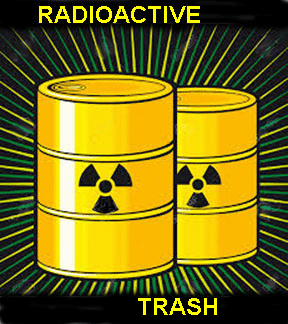 Risks which Australia should consider if considering the prospect of importing spent nuclear fuel include the possible appropriation of shipments by terrorist groups either in transit or after receipt. Similarly, a transport vessel may be attacked and join the number of sunken nuclear-fuelled submarines slowly corroding on the seabed around the world, destined to have unknown ecological impacts. As this Commission is no doubt aware, spent nuclear fuel can be reprocessed to obtain plutonium and uranium, both of which can be then repurposed as weapons material. This has serious implications for nuclear weapons proliferation risk.
Following receipt of spent nuclear fuel, the responsibility for protecting this material would presumably become Australia’s and would remain so for centuries (pending some technological breakthough in speculative technology). Should Australia enter war during the course of the life of the radioactivity contained in the stored spent fuel, or otherwise become a future terrorist target, any centralized repository of spent nuclear fuel represents a potential air-strike or bomb target.
If such an attack were to occur, storage vessels may be ruptured and release radioactive material to the atmosphere, essentially functioning as a ‘dirty bomb’. Wherever spent nuclear fuel is stored, it is my opinion that every measure should be made to protect it from air-strike or terrorist attack. The fallout from such an event would lead to the establishment of a new sacrifice zone, akin to those surrounding stricken Chernobyl and Fukushima nuclear power plants. Consequences for human health would take years to manifest and be demonstrably linked to such an event- meanwhile displaced persons would suffer anguish and may, as in the case of Fukushima, lead to people taking their own lives. Should such a facility be located in the South Australian outback, those most directly affected would likely be indigenous Australians, who would mourn the event as a colossal, cultural loss as their connection to country is severely damaged.
Obviously wartime or terror attack-proofing of spent fuel storage is not achieved in many locations where spent nuclear fuel is currently stored. I would assume that the quantity of these stores would be smaller than any proposed new facility, dedicated exclusively to the storage of spent nuclear fuel. Perhaps there is a case for improving management of spent nuclear fuel at or near existing storage.
Should a new facility be constructed, it should (in my opinion) be secure and underground, in a position where water infiltration is extremely unlikely. Examples of corrosion and water infiltration proving problematic for nuclear waste storage facilities include Orchid Island (Taiwan) and Yucca Mountain (USA).
When all is thoroughly considered, it might be concluded that the improvement and standardisation of current storage practise at or near locations where spent fuel is currently held provides an alternative pathway to proceed down if the objective of this exercise is risk minimisation.
1 This month
17 October, Free Public Talk on Nuclear Issues in South Australia
David Noonan will speak on public interest concerns over the new Roxby Downs Indenture Act 2026 on BHP copper-uranium mining and ore processing in SA, and on how AUKUS may face SA with a High-Level nuclear waste agenda.
Dr Jim Green will discuss international developments in the field of nuclear power including ‘small modular reactors’ and Generation 4 ‘advanced’ nuclear reactor concepts.


Help Aunty Sue Protect Her Land and Sacred Sites From Destructive Rocket Testing.
.

Australians deserve the truth
about
AUKUS – https://aukuspublicinquiry.com/

PETITION – To: Prime Minister Anthony Albanese and the Australian Labor Government

of the week – Australians for War Powers Reform (AWPR)
To see nuclear-related stories in greater depth and intensity

