Telstra Business Award goes to Family-owned business Country Solar NT
 Family-owned business Country Solar NT named 2015 Telstra Northern Territory Business of the Year CRAIG DUNLOP NT NEWS JULY 04, 2015
A FAMILY-owned business has taken out the Territory’s most prestigious business prize just five short years after opening its doors.
Country Solar NT, which is owned by husband and wife team Jeremy and Pam Hunt, was named 2015 Telstra Northern Territory Business of the Year at a gala ceremony at the Darwin Convention Centre last night.
The company, which began with the couple selling solar panels from the back of their ute, now has clients all across the Top End, including schools, supermarkets and remote communities.
Mr Hunt said the business was committed to providing a high quality local service.
“We’re local and we want to ensure that locals are getting the best renewable energy products available at the best prices to meet their energy needs,” he said.

“Amid the ever-changing rules about solar PV and the past performance of fly-in fly-out solar contractors, we have provided a stable alternative for the home, business and government markets.”
Mr Hunt said the business was committed to the local community and providing sustainable energy………http://www.ntnews.com.au/business/family-owned-business-country-solar-nt-named-2015-telstra-northern-territory-business-of-the-year/story-fnk2tq5v-1227428467238
The writing is on the wall for coal-fired power in Australia
 Say goodbye to coal power in Australia, The Age July 5, 2015 Mark Diesendorf The writing is on the wall for coal-fired power in Australia. Despite federal government attempts to stop the growth of renewable energy, all they can do is delay the inevitable transition.
Tasmania already has almost 100 per cent renewable electricity, based on hydro supplemented by wind. The ACT is on track to reach its target of 90 per cent net renewable electricity by 2020, based on solar and wind.
 South Australia, with no freshwater hydro-electric potential, is the leading mainland state in the transition to renewable energy. Last year 33 per cent of its annual electricity consumption was generated by the wind and 6 per cent from rooftop solar. Furthermore, its electricity system has already operated reliably and stably for hours when the contribution of variable renewable energy reached two-thirds of demand. Recently wind power and gas coped admirably when the coal-fired Northern power station went unexpectedly offline.
Coal power will soon disappear from SA and eventually from the whole country. Because wind has no fuel cost, it can bid the lowest price into the electricity market and so is ranked higher in operating order than coal. The result: coal is displaced from operating as base-load (24/7) power, coal’s economics become worse and incidentally the wholesale price of electricity decreases.
This is the real reason our Prime Minister is trying to stop the growth in wind power. It has nothing to do with aesthetics or the sham ‘wind turbine syndrome’, but everything to do with Mr Abbott’s misguided commitment to coal. Continue reading
Radioactive Exposure Tour visits Sydney’s Lucas Heights Nuclear Reactor
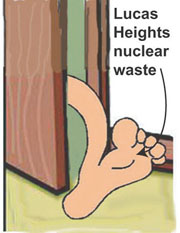
Interestingly, the visit to Lucas Heights revealed another nuclear waste issue that apparently has been forgotten. None of the numerous employees and scientists present at the discussion knew what happened to the radioactive waste water – heavy water – from the HIFAR reactor. Is it still on site, has it been treated or even discharged? The risks in the latter would be enormous and the fact that no one had any information on it therefore both shocking and scary.
This is a strong reminder of the importance of independent monitoring of nuclear activities and the accountability civil society helps to enforce on operators. For Friends of the Earth, this is just the beginning of a tour that will release many more valuable lessons and incredible stories.
ANSTO’s radioactive waste management, Online opinion, By Anica Niepraschk , 3 July 2015 ANSTO, the Australian Nuclear Science and Technology Organisation, through its nuclear science, industry and medical operations at Lucas Heights in southern Sydney is the largest producer of radioactive waste in Australia.
Since 1959 Lucas Heights is producing ever growing amounts of low and intermediate level waste which it stores on site in designated facilities. The most recent addition to ANSTO’s waste facilities is an newly built hangar for reprocessed fuel, which has to return from France until the end of the year.
Although the construction of a reprocessing plant is currently discussed by the South Australian Royal Commission into the Nuclear Fuel Cycle Australia so far has no capacity to reprocess the highly radioactive contents of ANSTO’s nuclear fuel rods. They are therefore sent overseas for reprocessing. Agreements with France and the UK provide for the resulting intermediate level waste to be returned to Australia, with the French shipping due to arrive in Australia until the end of the year…………..
The so called Radtour has been taking a great number of interested people and anti-nuclear activists to key nuclear sites in Australia for over 25 years, providing an opportunity to learn about the country and affected communities in a way that is rarely part of public narratives. It has thereby created strong bonds with Aboriginal and other communities throughout the country. Continue reading
Uranium investing – some stocks bad, others worse
 ERA also has a $290m cash stockpile but faces almost double that to close Ranger. Unlike Amy Winehouse, that’s one rehab to which ERA must go-go-go.
As for Paladin Energy (PDN, 25.5c), being the world’s only listed pure-play uranium miner with two operating mines (albeit on care and maintenance) hasn’t made for unfettered joy either……..
We rate ERA a sell and Alliance and Paladin as specbuys
Uranium stocks a mixed bad for investors THE AUSTRALIAN JULY 03, 2015 Tim Boreham Over the years the uranium caper has been much more fun for investors in the exploration chase, rather than the drudgery of actually mining the toxic substance. Continue reading
Aboriginal landowners reject coal giant Adani
Adani shown the door by traditional owners, SMH July 4, 201Michael West Business columnist The Wangan and Jagalingou people gathered two weeks ago at a convention centre in Carseldine north of Brisbane.
They were there to vote on a proposal to make sure those responsible for their native title claim were truly representative of the Wangan and Jagalingou people. These are the traditional owners of the land in the Galilee Basin, precisely where Indian company Adani aims to build Australia’s biggest coal mine, the controversial $16 billion Carmichael project.
Twice in three years, the Wangan and Jagalingou (W&J) had rejected Adani’s advances to sign a land deal for the mine, and twice Adani had dragged them off to the Native Title Tribunal and sought approval for the state to override their opposition to the mine.
It was just after 9am on Saturday, June 20, when two charter buses turned up at the Tavernetta Function Centre in Carseldine. Adani had bussed in 150 people in a sly bid to force consideration of a new memorandum of understanding they claimed to have with W&J, despite the previous ‘no vote’ from W&J. It was an Adani ambush, and it must have cost a fortune: three days of food, accommodation and transport for 150 people.
“We saw the buses turn up and we were wondering what was going on,” says traditional owner and W&J lead spokesman Adrian Burragubba.
“They tried to organise their own meeting after ours in order to get the people to agree to their MoU – a kind of tricked ILUA [Indigenous Land Use Agreement] when they knew they didn’t have one. Right now we’re in the Federal Court precisely because we refused an ILUA and they have tried to override us.”
But Adani’s cunning stunt backfired. They hadn’t counted on their 150 voters changing their minds after impassioned speeches from the likes of Burragubba. W&J tribal elders are deeply concerned about the effect of the mine on their cultural heritage and the risks it poses to water and wildlife.
By the end of the day, Adani’s reps had been asked to leave the meeting. Of the W&J’s 12 “new applicants”, or claim representatives, at least seven were against Adani, despite all the money flying about to skew the vote, and three were in favour. The views of the other two appear in the balance.
Burragubba says Adani has been engaging in tactical skulduggery for years, excluding him from meetings as he represented families which were not in favour of Carmichael.
“They claimed I was disruptive,” he told Fairfax Media.
“But they need all applicants in a meeting to do a deal. So there cannot possibly be a legally binding agreement.
“Adani has been conniving with these other two people [other Indigenous applicants] to try to get an agreement and undermine the Native Title process and our right to free prior informed consent.”
Before the showdown at the Carseldine convention centre, Adani had co-opted two of the W&J applicants, also directors of the trustee for the W&J’s Cato Galilee Trust……….http://www.smh.com.au/business/comment-and-analysis/adani-shown-the-door-by-traditional-owners-20150703-gi3y2h.html
Tasmania’s Energy Minister hails wind farms, disagrees with Tony Abbott
 State Energy Minister Matthew Groom hails wind farms in departure from PM HELEN KEMPTON MERCURY JULY 03, 2015 UNLIKE the Prime Minister, Tasmania’s Energy Minister Matthew Groom is a fan of wind farms and says more infrastructure needs to be built to capitalise on the state’s renewable energy headstart.
“I support the renewable energy broadly,” Mr Groom said after speaking at yesterday’s Tasmanian Minerals and Energy conference at Queenstown. “We have extraordinary resources in Tasmania and some of the best sites on the face of the planet on which to build them
Mr Groom said he was pleased the passing of Australia Renewable Energy Target legislation had given certainty to the wind industry and he looked forward to seeing progress on a new wind farm at Granville Harbour, near Zeehan.
Mr Groom said building a second interconnector cable across Bass Strait to export power was a key part of making the most of our renewable energy advantages. 
He said Japanese investors who recently visited Tasmania were gobsmacked by the state’s energy mix, and we needed to harness that competitive advantage………http://www.themercury.com.au/news/
New wave power technology set to boost economy in Port Fairy, Victoria
Hope for $21m Port Fairy prototype wave power unit to boost local jobs http://www.abc.net.au/news/2015-07-02/hope-for-prototype-wave-power-unit-to-boost-port/6588930, 2 July 15
Moyne Shire Council says the construction of the state’s first prototype wave power unit off the Port Fairy coast, in south-west Victoria, is set to boost the local economy.

The $21 million project, which will be installed in November, is expected to feed 250 kilowatts of renewable energy into the national grid.Mayor Colin Ryan said it was a significant event for the renewable wave energy industry and Victoria.He is hoping it will create new jobs in the region.
“I’m very happy to hear the news, I think it’s a great opportunity for Port Fairy with potential work opportunities for our locals, be it employment directly involved with the project or service industries and businesses in the town supporting the workers that come for the project,” he said.
“It being the first type of its power generation is a significant event and being the first one in Victoria … to do with currents and it was the desired locality for the operation, which is good news.”
@Rottoturbine hits back at Abbott
“My European wind turbine friends are laughing at me. The government’s own review showed that more renewable energy would actually decrease costs for consumers.”

 Rotto Wind Turbine uses Twitter to hit back at PM’s ‘ugly’ insults, WA Today, July 1, 2015 Emma Young Rottnest Wind Turbine is using Twitter to carry out a spirited self-defence against the insults of Prime Minister Tony Abbott.
@Rottoturbine now has more than 700 people following its tweets, which vary from wind energy-related links and information, banter about Mr Abbott’s “visually awful” description of turbines and pictures of generators against stunning rural backdrops, hashtagged #notvisuallyawful.
@Rottoturbine consented to share some of its views with Fairfax Media though an email interview, facilitated by its “human helper”, a Perth man in his thirties who the turbine says shares its concerns about renewable energy.
“I had been aware of negative views being expressed by some government Ministers about wind farms in general and this was concerning, but personal attacks against me were the last straw. Continue reading
Victoria, unlike USA, may slash solar tariff, rather than promote home solar

For intense, apart from avoided, line losses, there is no credit for network benefits, or environmental benefits. The contrast with some US states, where pricing regulators put the “fair” solar tariff at close to the retail price, is striking.
Regulator wants to slash Victoria solar tariff by 20 per cent http://reneweconomy.com.au/2015/regulator-wants-to-slash-victoria-solar-tariff-by-20-per-cent-67417 By Giles Parkinson on 2 July 2015 Victorian energy regulator the Essential Services Commission has recommended that the minimum feed-in-tariff paid for surplus rooftop solar output fed back into the grid be cut to 5c/kWh from the current level of 6.2c/kWh in 2016.
The recommendation, included in a report released this week, suggest that the falling cost of wholesale electricity prices – coincidentally the result of reduced demand and increased renewable energy – justifies the cut. [good graph here on original] Continue reading
Taxpayers likely to cop the costs of Ranger uranium clean-up. if ERA goes bankrupt
 as Ranger was authorised by the Commonwealth Government under 1953 Atomic Energy Act which primarily allowed the uranium to be used for military purposes, the Commonwealth and, ultimately the taxpayers, could be liable for the clean up if ERA was bankrupted.
ERA faces closure after uranium miner’s expansion plans shelved by Rio Tinto, ABC News, 30 June 15 By business reporter Stephen Letts Sorry history, uncertain environmental legacy Apart from the discharge of a million litres of radioactive slurry in 2013, Ranger has a sorry history of accidents with more than 200 environmental incidents being reported to government agencies since 1979.
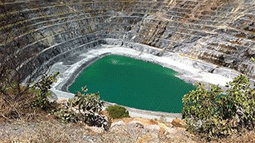 Just how much Ranger’s clean-up will cost is open to question. Under existing legislation, once the lease expires early in 2021, ERA has five years to complete the rehabilitation program.
Gavin Mudd, a senior lecturer in environmental engineering at Monash University with a long standing interest in Ranger, argues there are problems calculating the final cost as it depends on a number of choices, including how long is an adequate period of monitoring radioactivity levels.
The level of radioactivity around the site is unlikely to be safe any time soon given the half-life of uranium-238 is 4.5 billion years. The half-lives of other principal radioactive components of mill tailings, thorium-230 and radium-226, are shorter at about 75,000 years and 1,600 years respectively, but it’s a rather academic distinction.
Currently there is not a stipulated period for monitoring levels of radiation at the site once the rehabilitation is completed. However, Dr Mudd said a monitoring program should be run over decades rather than years.
“Fifty years would be a good start,” he said. Continue reading
Local community funds Repower Shoalhaven renewable energy investment scheme
Repower Shoalhaven renewable energy investment scheme funded by locals, SMH, June 29, 2015 Kieran Gair First, it was the local bowling club. Then the churches. In the Shoalhaven, community solar power is on the rise.
Renewable energy is expected to supply almost 60 per cent of Australian electricity by 2040, according to research by Bloomberg New Energy Finance, which found the fall in renewable energy prices would drive a shift from fossil fuels to renewable energy.
One community in NSW has already reaped the benefits of an early move to community-owned renewable energy. Non-profit Repower Shoalhaven installed Australia’s first investor-owned community solar project on the roof of the Shoalhaven Heads Bowling Club last year.

Repower raised $145,000 for the project in just two weeks, with 80 per cent of the cost coming from “mum and dad” investors.
The company has just completed its second community solar investment project in the Illawarra region on Figtree Anglican Church and Nowra City Church.
Head of Repower Shoalhaven Chris Cooper said demand for renewable energy is growing as it becomes cheaper. “People want clean energy and they want secure investments and previously there was no real opportunity to do that so we created a system where the community pays for the solar power system and the business repays community investors via a power purchase agreement.
The Repower solar financing model allows local businesses to purchase community-owned renewable energy at a cheaper rate than grid power.
Figtree Anglican Church member and University of Wollongong Sustainable Building Research Centre masters student Daniel Jones said community owned solar had significantly reduced the overall electricity costs associated with running the church…….http://www.smh.com.au/environment/repower-shoalhaven-renewable-energy-investment-scheme-funded-by-locals-20150629-ghwmmk.html
The end of the line for uranium company Energy Resources of Australia
 ERA faces closure after uranium miner’s expansion plans shelved by Rio Tinto, ABC News, 30 June 15 By business reporter Stephen Letts ERA was once one of the world biggest uranium producers, supplying about 10 per cent of the global market for ‘yellowcake’ and powering electricity utilities in Japan, Europe and North America.
It’s now pretty well friendless as its last three independent directors resigned, leaving the company in the hands of its majority shareholder Rio Tinto.
Rio for its part said there is no future for ERA’s only productive asset, the Ranger Mine, which operates in the middle of the World Heritage listed Kakadu National Park.
With its existing open mine resources exhausted, ERA has been labouring on, processing stockpiled ore since late 2012.
Ranger’s last hope lay in an ambitious and expensive underground mine – the Ranger 3 Deeps project – which could have extended the mine’s life by another decade. That hope was extinguished earlier this month when Rio, with its 68 per cent stake in ERA, said enough was enough. The market was blindsided by Rio’s decision, with ERA’s share price tumbling more than 70 per cent in the aftermath.
In hindsight it was probably inevitable.
ERA’s losses mount to $700 million since 2011 Continue reading
Landcare group reports high radioactive gas levels at Iluka mine
Radioactive gas levels at Wimmera mining site near Horsham too high says Landcare group, ABC News, 30 June 15
A Wimmera Landcare group in south-western Victoria says monitoring it has done shows levels of radioactive gas at a mine near Horsham far exceed the maximum for public exposure.
The Kanagulk Landcare Group placed four radon gas monitors at properties surrounding Iluka Resources’ mining operations at Douglas over a three-month period.
It said analysis of the monitors’ data by Australia’s nuclear industry regulator, the Australian Radiation Protection and Nuclear Safety Agency, reveals levels of the gas were four times the limit.
The group’s Albert Miller said the State Government needed to step in…….http://www.abc.net.au/news/2015-06-29/fears-aired-over-radioactive-gas-levels-at-wimmera/6579670
Central Sydney blocked as marchers protest Aboriginal community closures
 Australia: Sydney streets blocked by protest against Aboriginal community closures Warrior Publications by Calla Wahlquist, The Guardian, June 28, 2015
A protest against the closure of remote Aboriginal communities blocked streets in central Sydney on Sunday, as about 600 people marched against the Western Australian government’s plans to wind back support for communities it deems aren’t viable.
The protest began at Town Hall at 1pm on Sunday and moved toward The Block in Redfern, closing George, Lee, Regent and Lawson Streets on the way. t’s the third national call to action and the sixth time protests have shut down an Australian capital city in protest against the plan to overhaul funding to the state’s 247 remote Aboriginal communities, which the premier, Colin Barnett, has said will result in “significantly fewer” homelands communities remaining open……
At the same time, WA has developed its own “major reforms” for service delivery in remote Aboriginal communities, which is expected to lead to the closure, through withholding services from some communities, of a number of less populated communities over the next few years.
Details are scarce and the full model is yet to be worked out. Nominations for Aboriginal leaders to join the regional working groups intended to steer the reforms closed this month.
Protest organisers, rallied around the #SOSBLAKAUSTRALIA hashtag on social media, have been ramping up activities since Friday ahead of July 1 – the day federal funding to WA’s remote communities formally switches over to the state…….http://www.theguardian.com/australia-news/2015/jun/28/sydney-streets-blocked-by-protest-against-wa-remote-community-closures https://warriorpublications.wordpress.com/2015/06/30/australia-sydney-streets-blocked-by-protest-against-aboriginal-community-closures/
Waste from logging native forests is NOT renewable energy
Abbott government’s RET returns Australia to dark ages of energy production https://www.greenleft.org.au/node/59312, June 26, 2015
The Australian Forests and Climate Alliance released this statement on June 23.
The Australian Forests and Climate Alliance (AFCA) has condemned today’s decision to make burning native forests eligible for Renewable Energy Certificates under the Renewable Energy Target.
“We are going back to using dirty medieval technology that pretends to be sustainable and clean”, said Jill Redwood of AFCA.
“In reality it will undermine real renewables like solar and wind. It will produce more emissions than burning coal and cause immense loss of ecosystems, wildlife and our greatest carbon stores. It’s hard to imagine a worse scenario.
“This is not about ‘waste’ from the forest floor, but is a deliberate waste of our forests. It is about financing the logging of forests as fuel for furnaces.
“The government has been doing grubby back room deals”, said Lorraine Bower from AFCA. “They have promised a Wind Farm Commissioner and tighter controls on wind power in return for the support of key cross bench senators for the wood ‘waste’ regulation.
“Perversely there is proven evidence that living near a biomass plant has major health risks, but none whatsoever have been found from living near a wind farm.”
“This regulation will simply prop up the dying and destructive native forest logging industry now that woodchips are out of favour with customers and the logging industry is 80% plantation based. To date electricity companies have undertaken not to sell ‘Dead Koala Power’. We will now do all we can to make sure people understand that they should steer clear of companies that sell it.”
“Government and UN agencies overseas are coming to the conclusion that this is not renewable energy’, said Redwood. “Investors and consumers are quickly consigning these polluting industries from the Dark Ages to the dustbin of history.”
1 This month
17 October, Free Public Talk on Nuclear Issues in South Australia
David Noonan will speak on public interest concerns over the new Roxby Downs Indenture Act 2026 on BHP copper-uranium mining and ore processing in SA, and on how AUKUS may face SA with a High-Level nuclear waste agenda.
Dr Jim Green will discuss international developments in the field of nuclear power including ‘small modular reactors’ and Generation 4 ‘advanced’ nuclear reactor concepts.


Help Aunty Sue Protect Her Land and Sacred Sites From Destructive Rocket Testing.
.

Australians deserve the truth
about
AUKUS – https://aukuspublicinquiry.com/

PETITION – To: Prime Minister Anthony Albanese and the Australian Labor Government

of the week – Australians for War Powers Reform (AWPR)
To see nuclear-related stories in greater depth and intensity

