Australian Technologies Competition (ATC) dominated by renewable energy solutions
Smart grid, renewable energy solutions dominate Australian tech comp shortlist, REneweconomy, By Sophie Vorrath on 15 June 2015 A pre-fab, portable solar power solution; peak energy load predicting software; and inverter/charger grid balancing technology for network operators. These are just three of a range of home-grown, new clean technologies to make the shortlist for this year’s Australian Technologies Competition (ATC), announced on Monday………
This year’s Semi Finalists includes NSW-based 5B Australia, for its prefabricated, portable, modular solar PV power system for use where energy needs are changeable, short-term or over multiple sites; Queensland’s Renewable Energy Solutions Australia (RESA) for its VoltLogic inverter/charger technology that can be used for power factor correction and phase balancing in grid networks, where renewables capacity is being added; and a retrofittable hybrid heating, ventilating, and air conditioning unit that delivers an average a 30-40 per cent energy reduction on costs compared to conventional HVAC units, from Victorian company Independent Products.
There is also “CloudCAM”, by NSW company Fulcrum3D – an advanced, ground-based sky imaging system that identifies, categorizes, tracks
and predictscloud movement and shadow for solar power stations; and a product that reduces network, customer and generation peaks to
provide energy optimisation and demand management, by Victoria-based company, GreenSync…………http://reneweconomy.com.au/2015/smart-grid-renewable-energy-solutions-dominate-australian-tech-comp-shortlist-19161
Adelaide’s Advertiser continues to spout pro nuclear advertising articles
 Dennis Matthews, It is indeed pathetic that the pro-nuke lobby keeps repeating the same old one-sided arguments to support their out-dated, dangerous and dirty industry (The Advertiser, 15/6/15). This should be recognised for what it is, the standard tool of the propaganda merchant.
It is equally pathetic that others keep repeating the neurotic claim that opposition to the nuclear industry is some sort of conspiracy to prevent “rational debate” (The Advertiser, 15/6/15), a claim that flies in the face of countless inquiries run by manifestly pro-nuclear governments.
But the most pathetic thing of all is that a reputable newspaper keeps publishing these sorts of unproductive and boring contributions to what is claimed to be an important issue.
Let’s have not only a rational debate but also a debate that encourages the flow of new information not repetitive, mindless, propaganda that appears to be designed to brainwash rather than inform.
Rockefeller Brothers Fund warns Australia on diseconomics of investing in coal
Australian Government ‘stuck in the past’ defending fossil fuels, descendant of John D Rockefeller says, ABC News Four Corners By Geoff Thompson 15 June 15 A descendant of America’s first billionaire John D Rockefeller, whose fortune was built on oil, has accused the Australian Government of being “stuck in the past” for continuing to defend fossil fuels like coal.
Valerie Rockefeller Wayne is the chair of the $1.1 billion Rockefeller Brothers Fund, a charity committed to social change. The fund last year joined a growing “divestment” movement by abandoning its investments in coal companies.
“The value of coal stock in the United States has gone down 60 to 90 per cent,” Ms Rockefeller told the ABC’s Four Corners program. “This is a global phenomenon and we want to get out of those because we see the fossil fuel investments as risky.”
Ms Rockefeller said the numbers for coal no longer added up in Australia either.
“If you look just at the financial data in Australia … over the past five years, the SNP500 has gone up by 76 per cent,” she said. “The value of coal stocks has gone down by 71 per cent, so you’ve lost a lot of money if you’ve been in coal.”…………..
“In my mind Australia’s an extremely progressive country that has been an international player on so many issues. “It is baffling to me why the current Australian Government is stuck in the past rather than looking towards the future and becoming part of the solution.”
Ten days ago Norway decided one of the world’s richest government pension funds, the $1.1 trillion Norwegian Sovereign Wealth fund, would divest from companies that derive more than 30 per cent of their income from coal.
Last week the G7 group of industrial nations agreed to give up fossil fuels by the end of the century. http://www.abc.net.au/news/2015-06-15/government-stuck-in-the-past-defending-fossil-fuels-rockefeller/6544200
South Australia’s Nuclear Royal Commission unfortunately linked with failed nuclear company AREVA
I would like to think that Kevin Scarce’s Royal Commission was fully investigating nuclear industry issues — not just the geewhiz technology that they would be shown in France by AREVA, which is all too cosy with South Australian pro-nuclear politicians and businessmen.
SA’s Nuclear Royal Commission: All too cosy with failed French nuclear giant AREVA? Just how independent is the SA nuclear review and are opponents being side-lined? Independent Australia 12 June 15, Noel Wauchope looks at just who the Royal Commission met on its recent visit to France.
AT ITS South Australian community forums, South Australia’s Nuclear Fuel Cycle Royal Commission head, Kevin Scarce, made a point of the Commission’s independence. He stressed that the Commission would be meeting overseas proponents, and also opponents, of the nuclear industry.
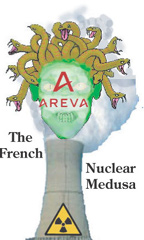 On the Commission’s website, they list the destinations for the Commission’s overseas tour, now about to wind up. I was struck by the amount of time allocated to conferring with the French nuclear energy corporation, AREVA. I had to wonder — in their discussions with AREVA, it would hardly be necessary to talk with nuclear opponents. I wondered how much AREVA would be going to come clean about what really is going on, in France’s nuclear industry.
The AREVA connection with Australia is important. AREVA has an office in Wayville, in Adelaide, and has hosted South Australian parliamentary tours of their nuclear industrial facilities in France. AREVA acquired the Northern Territory Koongarra uranium deposit in 1995, but subsequently, in a David and Goliath battle with Aboriginal traditional owner, Jeffrey Lee, lost this opportunity, as Lee donated his land to Kakadu National Park.
AREVA is in a joint venture with Toro Energy, in uranium exploration in the Northern Territory. The corporation had been exploring for uranium in Queensland’s Karumba and Carpentaria basins since about 2012, but recently pulled out altogether. AREVA will probably be making a submission to the Royal Commission. However, the Commission, in publishing submissions, will not be publishing ones that are deemed “commercially sensitive“.
Without doubt, AREVA has a keen commercial interest in Australia. France’s nuclear industry is somewhat embattled, as its fleet of reactors near the end of their shelf life, and the government is pledged to cut down on nuclear power, and develop renewables. The French nuclear industry (like USA’s) depends for its survival, on selling nuclear technology overseas.
But what of the fortunes of AREVA itself? As the Royal Commission seeks to learn about the commercial viability of the nuclear industry, AREVA is hardly the most reliable authority on that question.
For a start, AREVA now barely exists. Continue reading
Rio Tinto will have to step in to fund rehabilitation of Kakadu’s uranium mining area
 ERA cans Ranger uranium mine in Kakadu by: BARRY FITZGERALD , Resources Editor The Australian June 12, 2015 The crash in uranium prices in the wake of the 2011 Fukushima nuclear disaster in Japan has claimed the controversial Ranger mine inside the world heritage-listed Kakadu National Park in the Northern Territory as its latest victim.
Operated by the Rio Tinto-controlled Energy Resources of Australia (ERA), Ranger’s long-term future was to be secured by the development of an underground uranium resource known as Ranger 3 Deeps.
But ERA has canned the development, citing the “current operating environment”. The decision leaves ERA to process stockpiles from the previous open-cut operation which was dogged in recent years by water handling issues and process plant spills.
Shares in ERA plummeted after the announcement. At 2:10pm the shares were down 61c, or 47 per cent, to 69c each in trading on the Australian Securities Exchange.
Rio (RIO) owns 62 per cent of the ASX-listed ERA and said last night that it would likely take a $US300 million impairment charge on the investment — an acknowledgment that in the current environment, its investment is near worthless.
Rio could also be compelled to step in to ensure that in the event that Ranger’s life is not extended beyond the current treatment of stockpiles, ERA will be able to meet its rehabilitation costs of more than $600m…….
Despite seeming to baulk at having to help ERA at its annual meeting in April, Rio said last night that it recognised the “importance of ongoing rehabilitation work at the Ranger mine site”.
It said it was “engaged with ERA on a conditional credit facility to assist ERA to fund its rehabilitation program, should additional funding be required beyond ERA’s existing cash reserves and the future earnings from processing ore stockpiles”…. http://www.theaustralian.com.au/business/mining-energy/era-cans-ranger-uranium-mine-in-kakadu/story-e6frg9df-1227394169459
World will be watching how Australia manages Kakadu, now that uranium mining there has ended
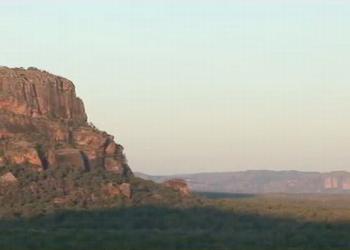 WWF welcomes cancellation of Kakadu uranium mine http://www.theadvocate.org.au/wwf-welcomes-cancellation-of-kakadu-uranium-mine/
WWF has welcomed the cancellation of a planned controversial underground uranium mine in Kakadu National Park.
Energy Resources of Australia, whose parent company is Rio Tinto, cancelled the Ranger 3 Deeps project in a statement to the Stock Exchange last night.
The proposed mine was in an area that had previously been excised from the Kakadu National Park and World Heritage Area.
WWF said the move was not only a victory for Australia’s environment, but also important for further economic empowerment of Indigenous communities.
WWF-Australia CEO Dermot O’Gorman backed calls by the Mirarr Traditional Owners to ensuring the permanent protection of the natural and cultural values for which Kakadu is inscribed World Heritage.
“Kakadu is one of Australia’s environmental treasures and this development presents an ideal opportunity for the area to be rehabilitated and incorporated into the Kakadu World Heritage Area,” said WWF-Australia CEO Dermot O’Gorman.
“Now that the mine will not go ahead, WWF looks forward to ERA and Rio Tinto accelerating the rehabilitation program, ensuring that it results in the full reinstatement of the internationally recognised outstanding natural and cultural values of this important site.
“With a World Heritage Committee meeting now less than a month away, the eyes of the world will be watching how the Australian Government and Rio Tinto manage the rehabilitation of Ranger.”
Victorian government moves to speed up wind farm projects
 Streamlined Victorian wind farm planning laws promise more regional renewable energy investment ABC News, 12 June 15, The Victorian Government says changes to wind farm planning laws will drive renewable energy investment in the state.
New changes mean the Planning Minister will assess wind farm applications and their infrastructure together.
Previously, developers had to submit multiple applications to local and state governments.
Planning Minister Richard Wynne said it made the application process easier for investors.
“What we are saying is that the doors are open, we are unambiguously in the space of wind farms, we are encouraging investment and the decisions that we reach today around the planning considerations give a streamlined outcome for anyone who wants to invest in wind farms in Victoria,” he said.
He said the move would create jobs in country Victoria.
“Investment in wind farms just makes tremendous sense in terms of employment outcomes for regional communities, it makes tremendous sense in terms of climate change and it’s a great win for regional economies right across regional Victoria,” he said.
Meanwhile, the Australian Wind Alliance said it has concerns for south-west Victoria’s renewables sector, in the wake of comments made by the Prime Minister……http://www.abc.net.au/news/2015-06-12/victorian-wind-farm-planning-laws-streamlined/6540634
Uranium glut, Ranger shutdown, leave Rio Tinto with $300M writedown
 Rio Tinto mulls $300M writedown as uranium mine expansion cancelled, Mining.com Cecilia Jamasmie | June 12, 2015 Mining giant Rio Tinto (LON, ASX:RIO) is contemplating to take a writedown of about $300 million after its subsidiary Energy Resources of Australia (ASX:ERA) decided to cancel plans to expand a uranium mine.
ERA, in which Rio has a 68.4% stake, said on Thursday that it would not proceed with the final feasibility study of its Ranger 3 Deeps uranium project in Australia’s Northern Territory, citing weak market conditions.
The decision underscores the ongoing strains in the nuclear industry following the Fukushima meltdown in 2011, which prompted Japan to mothball its 43 operable reactors, causing uranium prices to drop as a result of a worldwide supply glut……..http://www.mining.com/rio-tinto-mulls-300m-writedown-as-uranium-mine-expansion-cancelled/
South Australia’s great opportunity to transition from coal to 100% renewable energy
Bye bye baseload Our calculations show that SA does not need any baseload power stations, such as coal or nuclear. Indeed, the lack of operational flexibility of coal and nuclear makes them poor partners for high penetrations of variable renewable energy. The SA system has already operated reliably for long periods without its coal-fired stations, as last weekend’s incident demonstrated. Moving fully to renewable energy will deliver environmental, social and economic benefits. The transition would reduce SA’s greenhouse gas emissions, air pollution and associated respiratory diseases. It would cap electricity prices.
SA could create a wide range of new jobs in manufacturing, installation, grid connection, technical support and sales, which could help to compensate for the forthcoming job losses in its coal industry.
As for the nuclear question, the multinational financial analyst Lazard estimates the average costs of subsidized new nuclear energy in the United States in 2017 to be 12.4–13.2 US cents per kilowatt hour (kWh), compared with unsubsidized costs of 3.7–8.1 c/kWh for onshore wind, and 7.2–8.6 c/kWh for large-scale solar PV
 Coal closures give South Australia the chance to go 100% renewable https://theconversation.com/coal-closures-give-south-australia-the-chance-to-go-100-renewable-43182 June 12, 2015 Mark Diesendorf Associate Professor and Deputy Director, Institute of Environmental Studies, UNSW at UNSW Australia South Australia is facing the closure of its Northern and Playford B power stations and Leigh Creek coal mine, after Alinta Energy yesterday announced plans to shut them ahead of schedule. It will cost 438 jobs in the coal-mining and coal-fired electricity industries. But this threat to employment could be transformed into an opportunity for creating many new jobs in renewable energy.
The South Australian electricity system could be operated entirely on scaled-up, commercially available, renewable energy sources. This is the conclusion of my forthcoming report (to be published next week) to the Conservation Council of South Australia. Continue reading
How wind and solar power provided South Australia’s electricity when coal power stopped
the chief qualities of the energy system of the future will not be baseload, but flexibility. This will likely be delivered by the quick-start gas generators that already exist in the system to back up fossil fuels, but also the grid and household-based storage that will be installed in coming years.
 How South Australia coped without any baseload power http://reneweconomy.com.au/2015/how-south-australia-coped-without-any-baseload-power-65138 By Giles Parkinson on 9 June 2015 South Australia’s electricity system was put the test over the long weekend when the state’s only baseload power contributor, the brown coal Northern power station near Augusta, suddenly tripped and stopped providing power.
The incident was caused by a fire that caused several injuries, including one serious injury to a worker still in hospital. This is not the first time that South Australia has been without baseload coal power, of course. Northern was mothballed for nearly a year because of the declining economics of the coal generator. The difference with this event is that it came unannounced.
While declines and increases in the output of wind and solar are quite predictable, sudden outages in baseload fossil fuels are not, which is why the energy system needs a large amount of redundancy to support large centralised generation.
So how did the South Australian energy market cope? Quite well, as it turns out. There was a lot of wind blowing at the time, so it was a while before the Torrens gas plant was needed. Most of the gas came from the Osborne plant.
There was so much wind – more than 1GW through most of the day – that electricity prices dived into negative territory on several occasions during the day, which means that the gas generators were not making any money.
Indeed, for most of the day South Australia had the cheapest wholesale electricity prices in the country. Continue reading
Mirarr Traditional Owners of the Ranger Uranium Mine area oppose any further uranium mining
 Gundjeihmi Aboriginal Corporation, 12 June 15 The Mirarr Traditional Owners of the Ranger Uranium Mine area and the site of the proposed Jabiluka uranium mine release this statement following yesterday’s announcements by Energy Resources of Australia and Rio Tinto that ERA will not at this time proceed with the final feasibility study of the proposed Ranger 3 Deeps underground mine.
The Mirarr and the GAC welcome the clarity that yesterday’s announcements provide in terms of the present viability of the Ranger Three Deeps project. We are also pleased that both companies now publicly recognise the importance of adequately financing the rehabilitation of the Ranger site.
First and foremost in our minds is ensuring the permanent protection of the natural and cultural values for which Kakadu is inscribed World Heritage. We need to see a concrete and comprehensive commitment and plan for the clean-up of Kakadu; that commitment and planning needs to start today.
Mirarr have maintained ongoing dialogue with ERA and governments throughout this process and notwithstanding today’s announcement will continue to talk through all relevant issues as necessary. However, as things stand today we will not support any extended term of mining at Ranger beyond 2021.
We take this position because of our experience of 30 years of environmental and cultural impacts at Ranger and because in our talks with Rio Tinto and the Australian government we have been given no guarantee that Ranger will be the last uranium mine in Kakadu. The Mirarr remain fundamentally opposed to Jabiluka’s development – that opposition is intergenerational. We are concerned about the lack of adequate planning for Jabiluka’s final rehabilitation and its incorporation into Kakadu National Park. ____________________________________________________________________________________ For further information contact 08 8979 2200 / 0427 008 765
Ranger 3 Deeps cancellation should spell end of an ERA for uranium mining in Kakadu
Northern Territory and national environment groups have welcomed the announcement that a planned underground uranium mine in Kakadu – Energy Resources of Australia’s Ranger 3 Deeps project – has been cancelled.
“ERA’s move to abandon plans for an underground expansion at Ranger is an overdue acknowledgement that the underground mine plan lacked economic and environmental sense. It is also a significant step towards the end of uranium mining in Kakadu,” said Nuclear-Free campaigner Lauren Mellor.
Local and national environment groups have for long called for ERA and parent company Rio Tinto to commit to the rehabilitation of the Ranger site and have welcomed that ERA’s ASX announcement has now accepted it needs to secure adequate rehabilitation funding.
“We welcome the fact that ERA has sought an assurance from its parent company Rio Tinto that the required clean-up costs will come at the expense of the company and not the public,” said ACF spokesperson Dave Sweeney.
“ERA has lost around $1 billion on the under-performing Ranger project and has left its run too late in developing the Ranger 3 Deeps proposal – with the continuing low post-Fukushima commodity price the window for uranium mining at Ranger is closing and the operation has moved from dig up to clean up.”
The groups have called for all project applications and approvals to be withdrawn and for ERA to detail its closure and clean-up plan and costings.
*ERA ASX announcement available here: http://www.energyres.com.au/documents/Media_release_Ranger_3_Deeps_project_update.pdf
For further context and comment contact:
Lauren Mellor, Environment Centre NT on 0413 534 125
Dave Sweeney, Australian Conservation Foundation on 0408 317 812
Energy Resources of Australia(ERA) announces it is not proceeding with Ranger uranium min eexpansion
 Uranium miner Energy Resources Australia pulls plug on 3 Deeps expansion, ABC News 11 June 15 Uranium miner Energy Resources of Australia (ERA) will not proceed with its proposed 3 Deeps expansion project at the present time, the company has announced to the stock exchange.
In a statement, the company said the uranium market has not improved like ERA had previously expected and there is uncertainty as to what prices would do in the future.
The company also said the mine only had the authority to operate until 2021, and the economics of the project required certainty beyond that point. Those conditions meant ERA would not proceed to a final feasibility study at this time, the statement said. ERA will continue to “process stockpiles and meet obligations to its customers”, the statement said.
The 3 Deeps expansion would have seen the Ranger Uranium Mine commence underground operations for the first time. Its current operations are open-cut.
ERA said it had engaged its major shareholder, Rio Tinto, about funding to rehabilitate the mine site, which is completely ensconced by Kakadu National Park.
The company previously said rehabilitation was funded under its current business plan, but if the 3 Deeps expansion did not go ahead it would require another source of funding to pay for all of the rehabilitation works…… http://www.abc.net.au/news/2015-06-11/energy-resources-australia-pulls-plug-on-3-deeps-expansion/6540046
BHP CEO hypes up Olympic Dam uranium mine – but also hedges his bets with a plug for renewables
 BHP says Olympic Dam expansion is ‘game on’ THE AUSTRALIAN Scott Murdoch JUNE 12, 2015 BHP Billiton chief executive Andrew Mackenzie has declared the Olympic Dam expansion is “game on” but admits there are technical and manufacturing hurdles that must be worked out before final approval is given to the giant project…….
The upgraded production targets at Olympic Dam would make it the second-largest copper mine in the world after giving the uranium and gold output an equivalent copper value, and it would be the world’s largest producer of uranium……..
BHP exports uranium to China and Japan for power generation but it would not reveal the value or volume of its annual sales. The miner is expected to make a submission shortly to the Nuclear Fuel Cycle Royal Commission in South Australia on uranium mining……
[But I note that CEO Andrew Mackenzie hedges his bets a bit: -]
“A move to renewable energy (in China) is good for our copper business. Copper is a material that will do well in a world that puts a greater accent on renewable energy. The quicker you can get thermal energy into the form of electrical energy the better in terms of efficiency and the best relatively affordable conductor is copper,” Mr Mackenzie said. “Part of the strength of our portfolio is that we are reasonably flexible as to what path China and other nations choose towards decarbonising their energy…” http://www.theaustralian.com.au/business/mining-energy/bhp-says-olympic-dam-expansion-is-game-on/story-e6frg9df-1227393713719
Australia’s Prime Minister Tony Abbott boasts of his plan to restrict renewable energy
Mr Abbott had exposed the government’s true intentions on the renewable energy target.
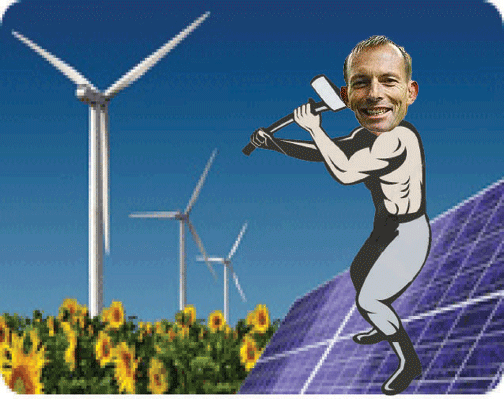 ‘Noisy compared to what?’: Tony Abbott’s claim wind farms awful and noisy dismissed, The Age June 11, 2015 Lisa Cox National political reporter Prime Minister Tony Abbott has described wind farms as “visually awful” and boasted slashing the Renewable Energy Target will restrict growth in the industry.
Mr Abbott also said the Howard government would never have introduced the clean energy policy if it had its time over again.
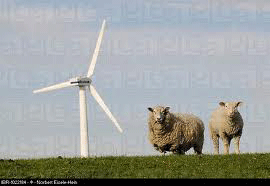 Victorian cattle farmer Hamish Officer lives a good deal closer to wind turbines than most people.”You don’t need to lift your voice to have a conversation under a wind turbine nearly as much as you would in a city street,” Mr Officer said.
“For someone like the Prime Minister to stand there and say they’re noisy – it’s a very blanket statement. Noisy compared to what?”
1 This month
17 October, Free Public Talk on Nuclear Issues in South Australia
David Noonan will speak on public interest concerns over the new Roxby Downs Indenture Act 2026 on BHP copper-uranium mining and ore processing in SA, and on how AUKUS may face SA with a High-Level nuclear waste agenda.
Dr Jim Green will discuss international developments in the field of nuclear power including ‘small modular reactors’ and Generation 4 ‘advanced’ nuclear reactor concepts.


Help Aunty Sue Protect Her Land and Sacred Sites From Destructive Rocket Testing.
.

Australians deserve the truth
about
AUKUS – https://aukuspublicinquiry.com/

PETITION – To: Prime Minister Anthony Albanese and the Australian Labor Government

of the week – Australians for War Powers Reform (AWPR)
To see nuclear-related stories in greater depth and intensity

