Western Australian Liberal Senator Chris Back rejects medical expertise on wind farms
A Sydney University review of 25 studies into the possible health effects of wind turbines found none had produced evidence they were detrimental to human health and in 2014 the Australian Medical Association issued a statement saying the available evidence did not support the idea that windfarm noise harmed human health
 Liberal senator wants windfarm inquiry to recognise ‘adverse health effects‘, Guardian, Lenore Taylor Political Editor, 12 June 15
Coalition figures want inquiry to acknowledge alleged health impacts and support more checks by the regulator A new federal inquiry could call for commonwealth oversight of windfarm regulations and demand recognition of the alleged health impacts of turbines on people living near them, according to Coalition senators.
The prime minister, Tony Abbott, dismayed the wind industry on Thursday when he told Sydney radio announcer Alan Jones that he wished the government had been able to reduce the number of new windfarms more than was possible in a recent renewable energy deal with Labor, and agreed windfarms had “potential health impacts”. Continue reading
Julie Bishop (happy to export radioactive materials), but warns about ISIS getting radioactive materials.
 ISIS may have collected radioactive materials for nuclear ‘dirty’ bomb, says Australian Foreign Minister, First Post, Jun 11, 2015 Melbourne: The Islamic State is believed to have collected radioactive material from hospitals and research establishments in cities it has captured in Iraq and Syria which it could use to build a large “dirty” bomb, Australian Foreign Minister Julie Bishop has warned.
ISIS had declared its ambition to develop weapons of mass destruction in the most recent edition of its propaganda magazine Dabiq, stating that there is an “infinitely” greater chance of the cash-rich group smuggling its first nuclear weapon from Pakistan to attack the US within a year.
Bishop told The Australian that NATO was deeply concerned about the theft of radioactive material.
“The insurgents did not just clear out the cash from local banks,” she was quoted as saying.
In a speech in Perth last week, Bishop warned that the Islamic State may be developing poison-gas weapons.
Julie later told the daily that her speech was based on reports from the Defence Department and the Department of Foreign Affairs and Trade………http://www.firstpost.com/world/isis-may-have-collected-radioactive-materials-for-nuclear-dirty-bomb-says-australian-foreign-minister-2291388.html
Australian anti nuclear activist barred from entry to India
 India barred activist from entry: Greenpeace , Arab News 9 June 15 NEW DELHI: Greenpeace said Monday an Australian staff member had been barred from entering India despite holding a valid visa, in what it said was the latest crackdown against the group.
Aaron Gray-Block was on his way to meetings in India when immigration officials stopped him at Bangalore airport on Saturday night and put him on a flight to Kuala Lumpur without explanation, the campaign group said.
His passport was seized and only returned to him once he had landed in the Malaysian capital, the environmental group said in a statement.
“Our colleague has a valid business visa, and yet he was prevented from entering India with no reason given,” Divya Raghunandan, program director of Greenpeace India, said.
“We are forced to wonder if all international staff of Greenpeace will now be prevented from entering the country?“
Local media reports cited unnamed home ministry sources saying Gray-Block was denied entry because his name figured in an official ‘black list’.
But the activist said he had “not received any communication” from the government of being placed on such a list, demanding “an explanation to this.”
“I arrived at Bangalore Airport with a valid business visa issued by the Indian embassy in Australia… Any suggestion of wrongdoing is a farce and a smear,” Gray-Block said in a statement late Monday.
“There is no reason for me to be included in any blacklist,” he added……
A court last month ordered authorities to unfreeze some of Greenpeace’s accounts, handing the group a lifeline after it faced closure of its local operations.
Greenpeace has accused the government of waging a “malicious campaign” against it. Authorities prevented one of its campaigners in January from leaving Delhi after she was placed on a suspicious persons list. According to Indian media, a secret report by the main intelligence agency recently warned that delays to key development projects being sought by Greenpeace and other activist groups could knock up to three percentage points off India’s annual growth rate.
Greenpeace has been at loggerheads with the government over claims of environmental damage caused by India’s heavy reliance on coal and the impact of deforestation and nuclear projects. http://www.arabnews.com/news/758971
Maitland-Newcastle Catholic diocese holds forum “Transitioning to Renewable Energy”
Maitland-Newcastle diocese takes up Pope Francis’ support of environmental issues http://www.maitlandmercury.com.au/story/3135438/catholic-church-forum-on-renewable-energy/ June 9, 2015, The Hunter’s involvement on the transition to renewable energy will come into focus during a public environmental forum preceding a letter from Pope Francis on environmental issues. The Social Justice Council of the Diocese of Maitland-Newcastle will host the public forum “Transitioning to Renewable Energy” at St Pius X High School on Wednesday night.
A group of Maitland students, teachers and residents will attend.
The forum follows Pope Francis’ announcement that his highly anticipated encyclical letter on environmental issues to be released on June 18. Continue reading
Australia’s big miners in tandem pushing coal and uranium industries
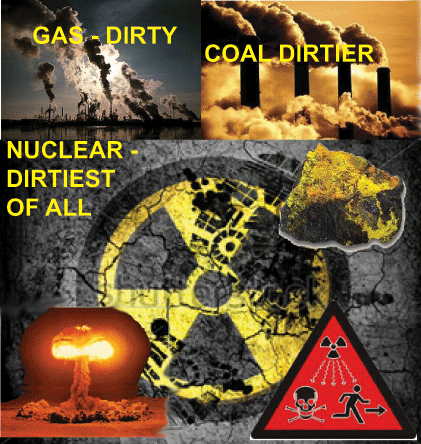 Big miners say they can survive push to end fossil fuels, SMH, June 9, 2015 Tom Arup and Lisa Cox Australia’s big miners have declared they have a future despite a push to stamp out fossil fuel emissions from the global economy backed by G7 world leaders, pinning their pitch on clean coal technology and uranium……….
Overnight on Monday G7 leaders, which include United States President Barrack Obama and German Chancellor Angela Merkel, released a statement throwing their weight behind ending fossil-fuel emissions from the use of coal, gas and oil by the end of the century.
The declaration, which followed a G7 leaders’ summit in Germany, also backed emissions cuts of near 70 per cent by 2050 from 2010 levels, the upper end of recent recommendations from the Intergovernmental Panel on Climate Change (IPCC)…..
Greens Leader Richard Di Natale said the G7 statement presented “big challenges” for Australia’s economy as half the country’s coal exports went to G7 countries and they were saying they did not want it anymore. http://www.smh.com.au/federal-politics/political-news/big-miners-say-they-can-survive-push-to-end-fossil-fuels-20150609-ghk5bh.html
Australia must adapt to changes in global energy sector, or fail economically
Changes in the global energy sector as well as in the global climate are underway, whether Australian policymakers like it or not, and Australia must adapt.
Opportunities beyond the Australian Energy White Paper, Nautilus Institute by Samantha Mella and Geoff James 8 June 2015
I. INTRODUCTION
Samantha Mella and Geoff James write “The (Australian Energy) White Paper’s framework of competition, productivity and investment provides a good platform for discussion, but a number of important issues are not addressed. These include the development of Australia’s abundant renewable energy resources, the consideration of carbon constraints, the growth in renewable energy investment overseas compared to a decline in Australia, and the potential impacts of the fossil fuel divestment movement.”
“Australia’s future prosperity is [best] served by the development of a vital, healthy renewable energy sector that competes alongside fossil fuels in a fair and open energy market.”
POLICY FORUM BY SAMANTHA MELLA AND GEOFF JAMES
Opportunities beyond the Australian Energy White Paper
Australia’s Energy White Paper released in April focused on the development of fossil fuels in Australia’s domestic and export energy markets. The paper has been well received by the mineral and resources sector and some industry groups, while others have expressed dismay in its treatment of Australia’s energy and environmental future.[1] [2] Continue reading
Mount Alexander Shire, Victoria, launches MASH (Mount Alexander Solar Homes)
Further information on MASH 2 can be viewed here.
 SunEdison Australia Powering MASH 2 Solar Initiative http://www.energymatters.com.au/renewable-news/sunedison-mash-solar-em4862/ June 9, 2015Castlemaine-based non profit group Hub Foundation has sparked a second solar revolution in Mount Alexander Shire in Victoria, Australia; in partnership with SunEdison.
Hub Foundation’s largest project so far has been MASH (Mount Alexander Solar Homes). The community solar bulk-buy program has already achieved 225 new solar PV rooftops in the area – half of all solar power systems installed in Mount Alexander Shire last year.
During the first stage of MASH, 3,000 panels were installed in total. 24% of homes in the Shire are now saving on power costs with a solar rooftop; making it equal second among Victoria’s shires. But perhaps the Shire may boost its ranking very soon, while helping even more residents to save on energy bills and reduce their CO2 emissions.
For those who missed out on the first stage of MASH, MASH 2 was launched on the 4th of June by Mayor of Mount Alexander Shire, Cr Christine Henderson. Continue reading
Power from sunshine and seawater – applicable to Australia
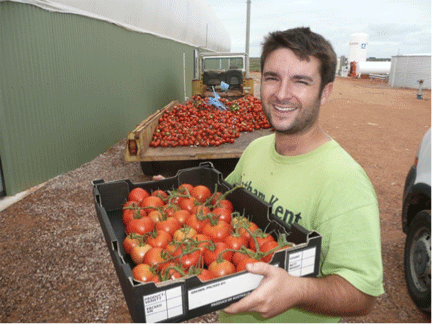 The Sundrop Farms project is moving ahead, and has won substantial financial support from the global venture capital firm KKR in addition to its earlier support from the Clean Energy Finance Corporation, as well as a contract to supply fresh produce to supermarket chain Coles over the next ten years.
The Abu Dhabi project is even more ambitious and is called “seawater farming”.
Could Australia do the same? Australia is a country with vast arid areas, copious quantities of seawater and sunshine – all the ingredients needed for a similar solar biofuel and food project.
It has a national air carrier in Qantas that has already experimented with various kinds of aviation biofuels. It has a national R&D organization in CSIRO that could organize such a project.
Desert farms could power flight with sunshine and seawater, The Conversation, John Mathews Professor of Strategic Management, Macquarie Graduate School of Management at Macquarie University, 9 June 15 “…….what if you could grow biofuels on land nobody wants, using just seawater and sunlight, and produce food at the same time?
That’s just what a new project in Abu Dhabi is seeking to do. TheIntegrated Seawater Energy and Agriculture System, or ISEAS, will grow sustainable food and aviation fuel in the desert, using seawater and sunshine, in a way that is eminently transferable to similar arid regions around the world.
The project was announced in January 2015 and is now under construction……..
Energy, water and food problems frequently compound each other, each making the others more difficult to resolve.
Examples abound: think of wasteful irrigation coming up against water limits and threatening reductions in food production. But there are some projects that turn the issue around and bring water, energy and food issues into positive relations, each strengthening the others. Continue reading
Cut price loans by NAB for solar and energy efficiency program s
 NAB to offer discounted energy efficiency, solar loans, Climate Spectator JOHN CONROY 9 JUN, The National Australia Bank will offer cut-price equipment loans to small and medium-sized businesses investing in energy efficiency and renewable power equipment as part of a $120m funding program backed by the Clean Energy Finance Corporation.
The agreement to fund energy-saving equipment or renewables generation will see NAB offer a rate 70 basis points below its standard equipment finance rate.
Finance will be offered through NAB, and will be across a diverse range of pre-approved assets including cars, irrigation systems, solar PV, building upgrades, lighting upgrades, processing line improvements and refrigeration……..http://www.businessspectator.com.au/news/2015/6/9/policy-politics/nab-offer-discounted-energy-efficiency-solar-loans
Bundaberg – Queensland’s solar capital.
 Solar power: Queensland city Bundaberg has more solar energy systems installed than any other place DARYL PASSMORE THE SUNDAY MAIL (QLD) JUNE 07, 2015
Bundaberg now has a new claim to fame — as Queensland’s solar capital. The subtropical city has more rooftop photovoltaic solar energy systems installed than any other city or town in the state.
Data from the Clean Energy Regulator reveals that 9400 houses with the postcode 4670 — which includes Bundaberg and Bargara — now have solar systems with a combined output capacity of more than 28 megawatts. “There’s huge demand,’’ Bundaberg Solar managing director Ashley Clark said.
More than 330 days of sunshine a year makes the central Queensland city a perfect place for solar power. “I would put it down to the fact that this is an area with a lot more retirees who are a bit more cautious about where their money goes,’’ Mr Clark said.
It is a trait Bundaberg shares with Hervey Bay and Caloundra, which fill the second and third spots on the list. Mr Clark said demand was now so strong that residents were having trouble getting approval from Ergon to connect to the electricity network….
- The regional feed-in tariff is now 6.5¢ , while householders in the Energex area have to negotiate a rate with power companies. The Palaszczuk Government says a new Queensland Productivity Commission will set a fair feed-in rate……
Australian Greens Senator for Queensland Larissa Waters said the state’s residents were collectively saving $214 million on electricity bills a year by embracing solar.
Queensland leads the country with 433,770 of the 1,393,526 solar installations nationwide. A quarter of houses in the state now have rooftop solar panels. Queensland Energy Minister Mark Bailey says the state has a target of one million homes having rooftop solar panels by 2020. http://www.couriermail.com.au/news/queensland/solar-power-queensland-city-bundaberg-has-more-solar-energy-systems-installed-than-any-other-place/story-fnn8dlfs-1227386107531
Australia trashes its international reputation, in its adoration of coal
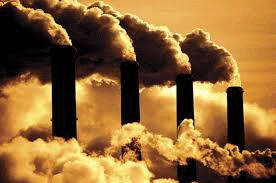 Australia stands out as a major recipient of overseas public finance for coal and coal seam gas projects, grabbing some $3.96 billion of public financing from overseas governments.
Through Australia’s own Export Finance and Investment Corporation, the country financed some $1.39billion between 2009 and 2014 for coal industry projects.
But as Paris draws nearer, is Australia willing to sacrifice its international reputation and the future state of its own climate on the alter of coal?
Will Australia continue to sacrifice its international reputation on the altar of coal?, Guardian 7 June 15 Graham Readfearn Arguments that coal is the answer to poverty are based on “implausible economics with unsubstantiated evidence” says report led by Kofi Annan. We’re now well passed the halfway point on the long road to Paris and a new global climate agreement to cut greenhouse gas emissions.
Australia took its turn to defend its domestic policies and targets during United Nations talks in Germany yesterday,
You can hear the whole exchange on the UN website but in short, Australian representatives insisted that it had the policies in place to meet its “not credible” target to cut emissions by five per cent by 2020 from 2000 levels.
Just to be clear, the Australian delegation didn’t describe the target as “not credible” – that came from the government’s own Climate Change Authority back in 2013.
Australia also talked-up its Direct Action climate policy – a measure that asks taxpapers to pay for emissions reductions and leaves fossil fuel companies unaffected.
Australia’s real self-interest Continue reading
A French Farce indeed – South Australia’s Nuclear Royal Commission in Paris – talking to AREVA
 It would be funny if it were not so serious. Australians hear little about this secretive Royal Commission. But France’s failed nuclear giant AREVA was invited to put in a submission to the Commission.
The SA Royal Commissioner and some support staff will be in Paris this weekend – at the end of a week that saw the French government confirm that they will take apart the nuclear ‘global leader’ AREVA and give some failed pieces to EDF, which subsequently fell by over 6% on the stock market – let’s hope they read the papers.
Northern Territory Mines Departments Credibility and ERA’s Contaminants both down the Creek
ENVIRONMENT CENTRE NT – AUSTRALIAN CONSERVATION FOUNDATION 5 JUNE 2015 On World Environment Day NT and national environment organisations have called on the NT Department of Mines to explain why Energy Resources of Australia, operator of the embattled Ranger uranium mine, should not be prosecuted over a major radioactive spill inside the boundaries of Kakadu National Park.

“Today – World Environment Day – marks twelve months since Energy Resources of Australia gained approval to restart processing at Ranger following a major radioactive spill from a collapsed leach tank in December 2013,” said Lauren Mellor from the Environment Centre NT.
“That a spill of over 1.3 million litres of radioactive slurry happened inside a World Heritage listed National Park is unacceptable: that we still don’t know why twelve months after operations have been resumed is derelict”.
Environment groups are concerned that a subsequent string of regulatory failures indicates that the NT Mines Department is ill-equipped to meet its responsibilities to protect the environment, workers and communities.
In the 12 months since the Ranger restart was approved DME has:
- Failed to release its report into the 2013 radioactive spill accident, even to other Investigative Taskforce member agencies or Traditional Owners.
- Failed to prosecute ERA for clear operational breaches under the Mines Management Act to improve safety and environmental protection at Ranger.
- Been unable to oversight ERA’s water monitoring due to staff shortages and deficient testing, meaning at some sites with contamination trends there was no independent oversight.
- Not implemented a key recommendation of the Independent Expert’s incident report into the leach tank failure and radioactive spill calling for a complete regulatory overhaul at Ranger.
- Failed to address contamination trends in Gulungul Creek, part of Kakadu National Park downstream from the mines leaking tailings dam. DME must apply statutory requirements to its deficient monitoring program as recommended by a 2003 Senate Inquiry into Ranger Uranium Mine. This is despite significant spikes of electrical conductivity indicating impacts from the mine are now being seen in Kakadu waters.
“The NT Mines Minister’s inaction on this major incident appears to be a case of prioritising the operations of Energy Resources of Australia above the protection of Kakadu National Park,” said ACF campaigner Dave Sweeney.
World Environment Day is a perfect time to send a clear message that poor mining practises are neither acceptable, nor above the law. Kakadu deserves better than complacency,” concluded Mr Sweeney.
Contact: Lauren Mellor, Environment Centre NT, 0413 534 125 Dave Sweeney, Australian Conservation Foundation, 0408 317 812
Australia is obligated to take back Lucas Heights nuclear waste from France
 the Australian Conservation Foundation doesn’t think the outback is the ideal location.
Spokesman Dave Sweeney believes the bulk of the waste should remain at the ANSTO facility in Sydney and at the CSIRO facility in Woomera, SA, where the country’s, if not the world’s top minds, are located.
He says there wasn’t an urgent need to move the waste and argued there were still risks associated with transporting and storing radioactive material in the middle of nowhere.
“We are not aware of all the sites that have nominated, but we are aware of some of them and there are problems,” Mr Sweeney said.
The sites the ACF are aware of all rest in outback WA
 At present, a Royal Commission is being held in South Australia to examine the feasibility of developing a nuclear storage facility which would house not only our waste but international waste.
Time is ticking for Australia’s first nuclear waste dump, news.com.au JUNE 05, 2015“…..[THE AUSTRALIAN GOVERNMENT] put out a call for any land owner, council or company to nominate their land for the facility. Submissions closed last month. And the Department of Industry and Science plans to release the short list in mid-July. Industry and Science Minister, Ian McFarlane, has said he wants to settle on a site by mid-2016.
Why the hurry?
Well, at the end of next month around 28 steel canisters of reprocessed nuclear waste is set to return home from France and the government needs to find somewhere to put it. Continue reading
Northern Territory Government fails to act on radioactive spill by Energy resources of Australia
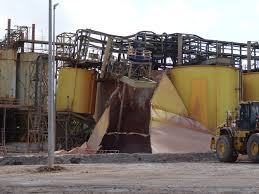 NT govt must end delay on Ranger action http://www.sbs.com.au/news/article/2015/06/05/nt-govt-must-end-delay-ranger-action It is “completely unacceptable” Ranger uranium mine operators have not been prosecuted over a slurry spill within Kakadu, traditional owners say.
The Northern Territory government is taking too long to punish those responsible for a radioactive spill on Aboriginal land in Kakadu, traditional owners say.
They have set their sights on the Department of Mines and Energy, which has investigated the 2013 spill of up to 1.5 million litres of acidic slurry from a collapsing leach tank at the Energy Resources of Australia operated Ranger uranium mine.
But the department is yet to share its report with stakeholders, despite a request six months ago from the Office of the Supervising Scientist.
The Gundjeihmi Aboriginal Corporation, which acts for the Mirarr traditional owners, says the delay is “completely unacceptable” especially given ERA was able to restart operations at Ranger a year ago.
“Members of the investigative taskforce as well as the general public are still waiting for the regulator to release its report, let alone prosecute the mining company,” corporation CEO Justin O’Brien said.
The traditional owners want the government to impose a fine, or declare an operational breach for the spill.
The Environment Centre NT claims ERA breached its operating conditions, and in particular a section of the Mine Management Act which requires “no unauthorised release of waste or contaminant”.
A department spokeswoman said the incident was still being investigated. Comment is being sought from ERA.
1 This month
17 October, Free Public Talk on Nuclear Issues in South Australia
David Noonan will speak on public interest concerns over the new Roxby Downs Indenture Act 2026 on BHP copper-uranium mining and ore processing in SA, and on how AUKUS may face SA with a High-Level nuclear waste agenda.
Dr Jim Green will discuss international developments in the field of nuclear power including ‘small modular reactors’ and Generation 4 ‘advanced’ nuclear reactor concepts.


Help Aunty Sue Protect Her Land and Sacred Sites From Destructive Rocket Testing.
.

Australians deserve the truth
about
AUKUS – https://aukuspublicinquiry.com/

PETITION – To: Prime Minister Anthony Albanese and the Australian Labor Government

of the week – Australians for War Powers Reform (AWPR)
To see nuclear-related stories in greater depth and intensity

