An international Treaty that has saved lives – the Montreal Protocol
 Ozone treaty ‘prevented skin cancer deaths’ http://www.abc.net.au/science/articles/2015/05/27/4242804.htm Anna Salleh
The ozone hole over the Antarctic would have been 40 per cent bigger in 2013 if the Montreal Protocol hadn’t curbed the production of CFCs, according to a new study.
In this scenario, Australia and New Zealand would have experienced greater UV radiation, which in turn would have increased the rate of skin cancer, say the authors of a new paper today in Nature Communications.
The paper also shows that, by 2011, ozone depletion would have become a northern hemisphere problem too.
“There would have been an Antarctic-like ozone hole in the Arctic over populated regions,” says co-author Dr Richard McKenzie, an atmospheric physicist at the National Institute of Water and Atmospheric Research in New Zealand.
In the mid-1980s scientists discovered a hole in the ozone layer above Antarctica, and in 1987 the world agreed to the Montreal Protocol, which limited the production of chlorofluorocarbons (CFCs).
Despite this, the concentration of CFCs continued to rise until 1993, and even today the ozone hole reappears each spring, and this contributes to an increase in cancer-causing UV radiation in Australia and New Zealand.
But without the Montreal Protocol it could have been so much worse, say the researchers. Continue reading
Tour of French art – Aboriginal life before colonisation
Rare French paintings of Tasmanian Aboriginal life before colonisation to tour Australia, ABC News, By Sam Ikin 19 May 2015, A collection of 19th century French illustrations depicting Indigenous life in Tasmania and around mainland Australia before British colonisation will go on show in the state for the first time next year.
The drawings and sketches were done in early 1802 during Nicholas Baudin’s exploration of Australia.
The French explorer’s artists, Charles-Alexandre Lesueur and Nicholas-Martin Petit, meticulously documented their meetings with local Aboriginal people when they landed in Tasmania.
The pictures are owned by France’s Museum of Natural History in La Havre and will tour the Tasmanian Museum and Art Gallery (TMAG), Launceston’s Queen Victoria Museum and Art Gallery, the National Museum of Australia in Canberra and several other Australian galleries next year and in 2017………The French museum’s director Cedric Cremiere said he was proud to be able to show the works in Australia.
“It is wonderful that after that first French encounter with Australia more than 200 years ago, we can share these discoveries and sense of wonder with Australian audiences.” he said.
Tasmanian Arts Minister Vanessa Goodwin said the artworks were of huge importance to Tasmania.
“This partnership will allow audiences across Tasmania to see depictions of early Tasmanian life which are of enormous significance to the Tasmanian Aboriginal people and the Tasmanian community in general,” she said.http://www.abc.net.au/news/2015-05-19/paintings-of-tasmanian-aboriginal-life-before-colonisation/6479650
Call to allow clear participation for Royal Commission submissions – Australian Council of Trade Unions (ACTU) Congress
 The motion below was passed at Australian Council of Trade Unions (ACTU) Congress yesterday. It was moved by the CEPU (Communications, Electrical and Plumbing Union) and seconded by Unions SA.
Nuclear Fuel Cell Cycle With regards to the Royal Commission into the Nuclear Fuel Cell Cycle currently underway in South Australia, Congress notes with alarm the Commission has decided to require that all public submissions to be typed and sworn under oath in front of a Justice of the Peace before they will be accepted.
Requiring members of the public to take the time and resources to type and swear an oath before they can lodge a submission is an unnecessary and surprising restriction that will serve as a huge barrier to participating in what is supposed to be an open, public, inclusive and democratic process.
To be required to type a submission then swear an oath just to have your say is simply not necessary, and will have a disproportionately large effect on regional and remote communities, a majority of which are Indigenous. Additionally, in many remote communities English is not a first language, so along with the typed and sworn oath requirements means that many Indigenous voices will not be heard in the Royal Commission
The requirements means that if you live in a community that does not have a Justice of the Peace or other authorised witness, you would need to drive (assuming access to car or transport) up to an hour or more to the nearest community that does.
This runs contrary to the spirit of having an open public inquiry and is particularly unacceptable given that it is indigenous communities that will be most impacted should the Commission make recommendations for the establishment of a nuclear waste facility because they will have the facility placed on their land.
Congress calls on the Royal Commission to:
1- Restore and encourage the broadest possible public participation by removing the requirement for public submissions to be sworn under oath.
2- Accept oral and written submissions from members of the public.
3- Ensure that any activities in regional and remote indigenous communities are done in a culturally appropriate manner, including the provision of interpretation services at public meetings and ensuring that written materials are available in local languages.
America’s long term push to make Australia accept nuclear waste
 US pressed Canberra to play ball on nuclear waste by: PAUL CLEARY http://www.theaustralian.com.au/in-depth/wikileaks/us-pressed-canberra-to-play-ball-on-nuclear-waste/story-fn775xjq-1227373417008 May 29, 2015
 US government cables from 1978 reveal Washington had a long-term strategy to make Australia acknowledge its “responsibility” to accept nuclear waste.
This pressure coincided with parliament’s approval on June 8 that year of a six-part regime to facilitate the mining, milling and exporting of uranium oxide.
Senior US officials began raising the waste issue in June when the two countries began high-level talks over a nuclear co-operation agreement, cables posted on the WikiLeaks website reveal.
A US embassy cable reported that Australia shared the US government’s views about uranium enrichment but “was unreceptive to questions about waste disposal in the Australia-Pacific area”.
When in September that year the Mirror editorialised against Australia’s accepting nuclear waste, US embassy officials told the Department of Foreign Affairs Australia should expect the US to “nudge” it about this issue.
The editorial was brought to the attention of the US embassy by Ron Walker, who headed the defence and nuclear division in the department. US officials bluntly told him Australia was essentially ignoring the problem of nuclear waste. “We replied by telling Walker he and other GOA (government of Australia) officials should assume that during the course of the next several decades there will inevitably be speculation about potential sites for nuclear waste storage,” the US officials wrote in the cable.
“We added that while we read GOA views ‘loud and clear’, the GOA should assume there will be continuing discussion about storage sites for nuclear wastes and in fact we would probably from time to time even go as far as to nudge the GOA about its responsibility in helping to find appropriate, safe and secure storage areas.”
The following week, two officials from the Australian embassy in Washington, described as “Starr and Knight”, asked the US State Department for guidance on talking points to respond to media reports. State Department officials said Australia should mention the US government’s policy of encouraging international co-operation in storage and processing of spent fuel.
One week later, an embassy official asked the State Department if the Australian government could use a form of words at the next Pacific Forum that said it was “highly unlikely” the US government would ask Pacific countries to accept spent nuclear fuel.
The US officials said Australia should not use this language.
The nuclear agreement referred to was signed by the Fraser government in 1979, but the Hawke government ended the plan to develop nuclear enrichment technology when it dismantled Australia’s laboratory-scale centrifuge enrichment plant.
Australia’s nuclear lobby keen to “educate” schoolchildren
Forget the nuclear family we are soon going to have nuclear classrooms if ANSTO has its way BRUCE MCDOUGALL THE DAILY TELEGRAPH MAY 28, 2015
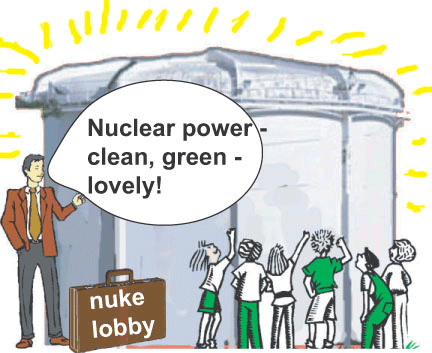
AUSTRALIA’S nuclear facility at Lucas Heights is spearheading a major push to encourage schoolchildren to become scientists.
Thousands of secondary students have been invited to tour the country’s only operational nuclear reactor, meet its scientists and study their research programs.
As Federal Education Minister Christopher Pyne launched a plan to make maths and science compulsory in the final year of school, 250 students arrived at Lucas Heights yesterday to work on special projects.
The Year 9 and Year 10 students from seven schools took part in a series of competitive challenges at the Australian Nuclear Science and Technology Organisation (ANSTO)……http://www.dailytelegraph.com.au/news/nsw/forget-the-nuclear-family-we-are-soon-going-to-have-nuclear-classrooms-if-ansto-has-its-way/story-fni0cx12-1227372012172
Examining the nuclear lobby’s hype about “planned construction of reactors
If we had a list of renewable projects that were planned and under construction, it would look like the renewable sector was 1000 per cent of what it actually is. That’s because there are a lot of planned wind farms and even more solar farms.
In fact in interviews of Australian households beyond the 10 per cent who already have solar on their roof (25 per cent in South Australia), more than 75 per cent have a plan to get solar on their roof at some point in time. A similar number believe or are “planning” to get batteries to deliver their solar power as a cheaper alternative to the grid at night.
 So if we put all the planned nuclear reactors that never get built against all the planned solar installs and wind installs around Australia and the rest of the world, the nuclear proposals would be so dwarfed to be completely irrelevant.
 If you’re hearing another one of these countless stories such as those being hawked at the pro-nuclear “Nuclear Fuel Cycle Royal Commission” being held in South Australia, just remember there are people who want their uranium penny stocks to take them from rags to riches or riches to even more riches that are creating most of the hype.
In the west, a second generation nuclear reactor is unacceptable and no third generation reactors have ever successfully been built.
What if we all adopted the nuclear industry’s interpretation of a ‘planned’ project?MATTHEW WRIGHT , HTTP://WWW.BUSINESSSPECTATOR.COM.AU/ARTICLE/2015/5/27/RENEWABLE-ENERGY/WHAT-IF-WE-ALL-ADOPTED-NUCLEAR-INDUSTRYS-INTERPRETATION-PLANNEDIf you search the definitive list of reactors on Wikipedia, you’ll find that reactors are being decommissioned globally at a rate of knots, and many more are set to be decommissioned in the not too distant future. This includes the entire fleet in Germany and a significant portion but unspecified number of reactors in Japan.
If you looked further, you’d find that you could count the total number of reactors built in 2014 and 2015 on just one hand. In that period there was activity predominately in China — with its centralised state control avoiding the scrutiny the technology gets everywhere, outside a lone reactor in Argentina being the exception — but you could hardly get excited as that project was started when first of the Generation Ys were still in nappies in 1981.
So you’ve got a few plants getting built at a much slower pace than planned in China, and a bunch of plants ‘planned’ all over the place. But as is the case with almost all nuclear plans in the last 25 years, they’ve gone nowhere. They are plans (if a dream is a plan), but are not likely to be plants.
So why do we hear about these so called plans over and over? Continue reading
Australia’s public sector now losing its climate change experts

Canberra’s climate change brain drain becoming critical, The Mandarin 28 May 15 by David DonaldsonClimate change expertise is being lost from the public sector as the government fails to fill board vacancies and departments stop commissioning climate policy modelling from ABARES. Continue reading
Federal and Western Australian govts systematic attack on environmental critics
Funding withdrawal from Environmental Defender’s Office criticised as ‘systematic attack’ on community groups, ABC News, By Stephanie Dalzell, 28 May 15, The Conservation Council of Western Australia has accused the State and Federal Governments of launching a “systematic attack” on community groups which scrutinise policy decisions.
The criticism comes after WA’s Environmental Defender’s Office (EDO) had its funding completely withdrawn by the State Government, effective from the end of this financial year.
The decision follows similar action by the Federal Government in 2013.
The EDO, which also relies on grants and donations, said the combined cut in state and federal funding would leave it with a gap of $250,000 in annual operating expenses. Conservation Council director Piers Verstegen said the cut appeared to be a direct response to the EDO’s advocacy for groups which challenged policy or development decisions.
“The EDO is an extremely important organisation in our community and it brings scrutiny to environmental issues often where government make bad decisions or go wrong in relation to environmental management,” he said. “I think the Government’s keen to remove that scrutiny.
“I think this is part of a systematic attack on community groups around the country that engage in advocacy on environmental issues and stand up for clean water, healthy land, and healthy ecosystems.
“And when that doesn’t align with government policy or the industries that government [is] supporting, that’s when government [feels] uncomfortable with that advocacy and [starts] to cut funding.”……..http://www.abc.net.au/news/2015-05-27/conservation-council-criticises-funding-withdrawal/6499492
BHP funded Grattan Institute unfairly critical of solar energy

Solar Industry Hits Back At Report Critical Of Roof-Top Solar, New Matilda, By Thom Mitchell, 27 May 15 A report by a respected think-tank is being slammed by key players in the solar energy industry. Thom MItchell reports.
A report published by the Grattan Institute on Monday has been dismissed by the solar industry, which argues its critique of generous state and federal government subsidy schemes misrepresents their true value and ignores important flow-on benefits. Continue reading
Assessment of Kevin Scarce’s Royal Commission forums
My impression is that the Nuclear Fuel Chain Royal Commission community forums are pretty formulaic. Kevin Scarce has got it all down pat , and does not stray from his agenda of the 4 Issues in the Terms of Reference. A bit of lip service is paid to Renewable Energy, but it is clear that this will not feature in the serious examination of energy technologies. There is complete avoidance of legal issues.
The thing that gets me about Kevin Scarce and the Royal Commission, and the media coverage – is the pretense that this is all just a South Australian affair – despite the fact that these nuclear developments are illegal under national law. Of course this whole idea of making South Australia the world’s nuclear hub and waste dump concerns all of Australia.
The meeting at Coober Pedy (14/5/15) was quite a lively one, and the audience showed a degree of knowledge and sophistication that The Royal Commissioners might not have expected to find, in such a remote location. Concerns aired in questions included the problems of nuclear wastes – problems handed over to future generations, environmental concerns, and support for renewable energy rather than nuclear .
At University of South Australia – Mawson Lakes, (19/5/15) about 50 people attended. I have no report on this, other than that at least one University lecturer was worried that harmful affects of tourism and agriculture and food would not be properly addressed, and small businesses would not put in submissions about the potential harm to their business.
At Adelaide University(22/5/15) around 250 people attended, and pro nuclear people were slightly in the majority – as evidenced by a show of hands when asked for this. David Noonan of Wilderness Society didn’t get to ask his question – that the proposed activities the RC is investigating are currently illegal in Australia!
At Flinders University (20/5/15) – (see report on this page) there was some pretty lively questioning. Kevin Scarce was able to deflect very deftly any difficult questions. His two best techniques – to point out that matters are “not in the Terms of Reference” and to urge the questioner to seek the answer and “put in a submission”.
A concern that showed up in Adelaide meetings was that of bias – questioners wanted to know about the agendas, the interests of the staff and expert advisers on the Commission. They also wanted to know about the companies involved, and their submissions to the Commission – will the Commission be transparent about this?
Report on Royal Commission meeting at Flinders University 20 May 2015
Presentation of Royal Commission to meeting at Flinders University/Tonsley Campus, 20 May 2015
Kevin Scarce outlined purpose of the Royal Commission to examine the 4 issues set out in the Terms of Reference for the Royal Commission.- to look at the opportunities and costs of expanding the nuclear fuel chain in South Australia – for the community, environment and economy.
He discussed each of the 4 Issues :
1 Exploration, Extraction and Milling – should this be expanded? Australia has about 30% known U deposits; SA has about 80% of that.
thorium – will consider sources, possible use of this, too.
- processing/manufacturing
- conversion – uranium oxide to uranium hexafluoride
- enrichment –to concentration suitable for reactors
- enriched conversion to nuclear fuel/rods
- medical/scientific isotopes – ANSTO produces these at reactor in Sydney. 10-15% from cyclotrons – one in SA.
3 nuclear reactors/power generation
- storage/disposal of nuclear wastes
- low/intermediate level waste – radioactive materials (clothing, instruments etc) associated with energy generation – can be treated to assist storage e.g. vitrification; synroc/ceramics;
- to storage – encased steel & concrete
- high level – heat produced so stored in wet storage pool to cool – encased in steel & concrete – intended to go to deep geological storage – Finland –developing only one at present 400m underground – operate from 2022 onwards
- reprocessing of spent fuel rods can recover fuel –large infrastructure & complexity of process
He outlined the process of the Royal Commission. For Any questions needing detailed answer, people can consult the Issues Papers.
There is a Royal Commission team of 15, who will be seeking national & international expertise. At present – framing ways to examine costs & opportunities. The Commission will be getting balance in talking to experts.
- The Commission will examine the issues papers , questions raised on complex processes, and the Submissions in response to the Issues Papers by – early August response date. The Submissions will be made public later in the year.
- not clear here – I think there’s to be release of & consultation about responses to issues papers– Adelaide & regionally to December
- Commission will then develop findings – take back to community Feb
- Final report to SA government – early May 2016
Questions from audience; Commissioner response Continue reading
Australia’s Aboriginals again threatened by nuclear radiation
 Nuclear-hit Aborigines again in radiation danger https://linksunten.indymedia.org/de/node/144304 Verfasst von: Diet Simon, sourcing from beyond nuclear news roundup (Account: Nuclear Worrier). Verfasst am: 25.05.2015
Darren Farmer, a burly middle-aged Martu tribal man, told VICE online magazine that “the Martu people do not want this uranium mine. Everybody has said no.” But that hasn’t stopped the federal environment minister Greg Hunt from givingKintyre the green light.
The VICE article explains how poverty prompts some Martu to agree to mining on their country and how Darren Farmer and others are physically assaulted for opposing it.
Meanwhile four decades after test explosions of atom bombs in the Maralinga desert area of South Australia, which killed and maimed Aboriginal people, Indigenous people face barriers as they try to contribute to a parliamentary inquiry whether the state should start a nuclear fuel cycle industry.
A requirement for all submissions to be sworn in front of a justice of the peace makes it particularly difficult for Aboriginal people, people from remote areas and those with language issues to present their views.
The former Governor [Queen Elizabeth’s representative] of South Australia, Kevin Scarce, who heads the inquiry, is to inspect the Fukushima region of Japan,ravaged by nuclear reactor explosions.
One of the things the inquiry will consider is the storage of nuclear waste from other countries. The federal government is currently looking for a site to dump six cubic metres of nuclear waste that must return to Australia from France for processing this year.
The federal government had previously targeted Aboriginal-owned sites in the Northern Territory, including Muckaty Station, where agreements with Aboriginal governance fell through or stalled. Aboriginal women’s resistance also stopped a 2003 plan by the federal government to dump nuclear waste in South Australia.
The French state-owned nuclear giant Areva is offering to sell its ‘world leading’ nuclear technology to South Australia. “The offer is being reported in the South Australian media without a hint of irony,” comments leading anti-nuclear Australian activist, Jim Green. “A reality check is in order.”
Two former Australian prime ministers, one each from the Liberal [in name only, actually right-of-centre conservative] and Labor [only nominally left] parties have said it would be a good idea for Australia to take in all the world’s nuclear waste. Guess on whose lands.
Small scale solar power from Australian company transforms slum life in India
 Australian solar company Pollinate Energy brings light to slums of India ABC Foreign Correspondent By South Asia correspondent Stephanie March 26 May 15 With indoor air pollution from kerosene lamps and stoves the second largest cause of death in India, one company, founded by Australians, has come up with a solution to the problem.
Every night in the sprawling shanty towns of the country of 1.2 billion people, the air fills with dense, black smoke.
“We used to get oil from the market and pour it into the lamp and light it; the house used to get full of soot and dirt,” said Abdul, a slum-dweller in Bangalore who lives in a hut made of wooden board and tarpaulin.
That was until Abdul bought a portable solar light from a company called Pollinate Energy, founded by five young Australians.
“After we got this solar lamp a lot of things improved,” Abdul said. “Now we don’t worry that there will be a fire.” Continue reading
Australians overwhelmingly prefer solar energy – survey results
Survey Says Australians Prefer Solar Power Sputnik News 25 May 15 Australians strongly support the use of renewable energy, according to Ipsos research company’s survey. Some 87 percent of respondents were strongly in favor of solar panels on homes and 78 percent supported large-scale solar energy facilities.MOSCOW (Sputnik) — Solar power is considered the most efficient source of energy by an overwhelming majority of Australians, Ipsos research company stated Monday.
Earlier in May, following months of negotiations, Australia’s current government and the primary opposition party reached an agreement to scale back its Renewable Energy Target (RET) by almost 20 percent by 2020, due to declining power demand.
A recent Ipsos report based on a poll of nearly 1200 people funded by Australian Renewable Energy Agency (ARENA) revealed that Australians responding to the poll strongly support the use of renewable energy. Some 87 percent of respondents were strongly in favor of solar panels on homes and 78 percent supported large-scale solar energy facilities.
An overall 72 percent of respondents from across Australia said they supported wind farms and hydro energy, while tidal and geothermal energy was favored by 52 and 45 percent respectively……..
Since coming to power in 2013, Prime Minister Tony Abbott has repealed a tax on carbon emissions and eliminated the post of science minister……… http://sputniknews.com/environment/20150525/1022530489.html#ixzz3bHKV5Rpu
Iodine pills for South Australians- is that in the Nuclear Royal Commission’s planning?
Will South Australian communities and nuclear workers get iodine pills, once the State launches into its role as the international nuclear hub?
Canada’s communities near nuclear facilities ware getting them. Kevin Scarce’s Nuclear Fuel Chain Royal Commission will be getting Submissions from Canadian nuclear companies. Perhaps the 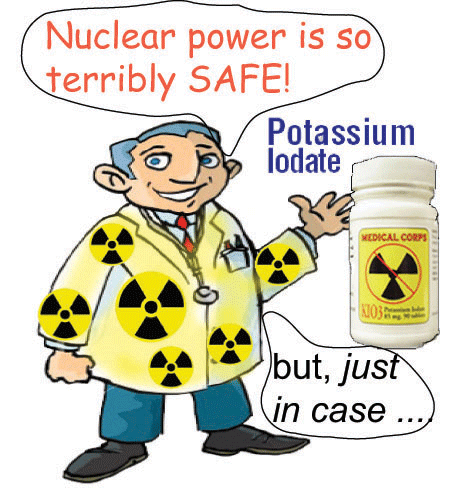 Commission will be visiting Canada, as part of its international junket.
Presumably the South Australian Nuclear Fuel Chain Commission will be keen to keep up with all the safety requirements that Canada has.
1 This month
17 October, Free Public Talk on Nuclear Issues in South Australia
David Noonan will speak on public interest concerns over the new Roxby Downs Indenture Act 2026 on BHP copper-uranium mining and ore processing in SA, and on how AUKUS may face SA with a High-Level nuclear waste agenda.
Dr Jim Green will discuss international developments in the field of nuclear power including ‘small modular reactors’ and Generation 4 ‘advanced’ nuclear reactor concepts.


Help Aunty Sue Protect Her Land and Sacred Sites From Destructive Rocket Testing.
.

Australians deserve the truth
about
AUKUS – https://aukuspublicinquiry.com/

PETITION – To: Prime Minister Anthony Albanese and the Australian Labor Government

of the week – Australians for War Powers Reform (AWPR)
To see nuclear-related stories in greater depth and intensity

