Canberra battery storage trial likely to kill the myth of “no baseload renewables power”
Canberra-based renewable energy consulting company IT Power will analyse the performance of six major lithium-ion battery brands, comparing them to “old school” and advanced lead-acid batteries for use in large and small electricity grids.
 A testing centre will be established at the Canberra Institute of Technology for the trials to be partially funded by $450,000 from the Australian Renewable Energy Agency.
T Power’s managing Director Simon Troman said storage was the next step needed to help integrate renewable energy, especially solar, into electricity grids.
 “It kills the argument put out there by the anti-renewable mob that they’re intermittent and you can’t rely on them… and it turns intermittent renewables like solar and wind into a direct competitor for base-load power.
Rather than research new options for storage, Mr Troman said the trail will purchase batteries for
testing that are already commercially available making the impact more immediate and maintaining the independence of the data.
Electric car maker Tesla’s first foray into lithium-ion batteries for homes the Powerwall, announced last week featuring technology developed by Canberra start-up Reposit Power, could be part of the trials when it goes on the market. Continue reading
Abbott advisor Maurice Newman has embarrassed even our climate sceptic government
the leader of the Australian Greens, Senator Richard di Natale, suggests Mr Newman’s views have  been influential.
MARK BUTLER: I’ve never been particularly clear why Maurice Newman holds the position he does hold, given how central climate change is to the future economic prosperity of Australia.
SIMON LAUDER: Mr Newman says the UN (United Nations) is not working alone, that it’s enlisted compliant academics and gullible media, including the ABC, using fear and appeals to morality to push its agenda.
 AUDIO: Little support for PM’s top business adviser over UN climate conspiracy theory ABC Radio PM 8 May 15 MARK COLVIN: The Prime Minister’s top business adviser says the United Nations is trying to use the fear of climate change to orchestrate an anti-freedom, anti-capitalist new world order.
Maurice Newman chairs the Prime Minister’s Business Advisory Council.
In today’s edition of The Australian he urges Tony Abbott not to listen to the UN and resist attempts to get Australia to sign a climate treaty. Continue reading
UN top climate official Christiana Figueres sees the funny side of Abbott’s top advisor Maurice Newman
Maurice Newman’s climate conspiracy a joke: top UN climate official, The Age May 8, 2015 – Lisa Cox, Mark Kenny, Tom McIlroy Christiana Figueres who is visiting Australia to discuss progress toward a global deal said Mr Newman’s claim that climate change was an UN “hoax” designed to lead to world domination, was a joke.
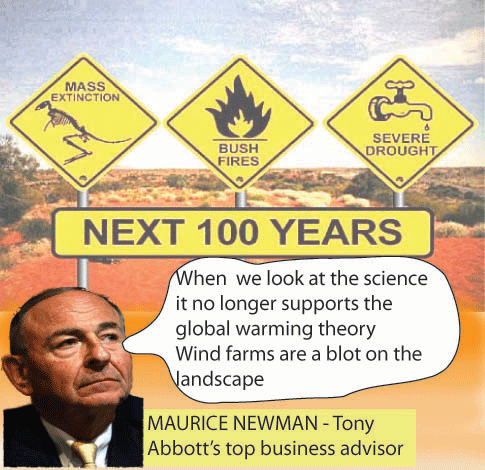 Mr Newman, the chair of the Prime Minister’s business advisory council, used an opinion piece in The Australian on Friday to argue scientific modelling linking human activity and climate change is wrong and the UN’s real agenda was to impose authoritarian rule.
Speaking in Canberra, Ms Figueres said the comments must have been an attempt at humour.
“I really don’t take it very seriously because it doesn’t respond to the reality or to facts,” she said.
Her comments were mirrored by senior political figures on both sides of politics with government ministers privately expressing withering contempt for Mr Newman’s views and suggesting he had become a liability.
Ms Figueres even described the Newman comments as “really good fun”.
“We live in a world of free press and free opinion and, you know, if that’s the humour in Australia then that’s the humour in Australia ………….
the Academy of Science, the Bureau of Meteorology and the Intergovernmental Panel on Climate Change say greenhouse gas emissions from human activity are affecting the climate……http://www.theage.com.au/federal-politics/political-news/maurice-newmans-climate-conspiracy-a-joke-top-un-climate-official-20150508-ggxlga.html
Australia’s Education Minister Pyne seeks new home for Bjørn Lomborg climate sceptic centre
 Christopher Pyne vows to find new home for Bjørn Lomborg centre, Guardian, Lenore Taylor Calla Wahlquist 8 May 15 Education minister and Lomborg say ‘Australia consensus centre’ will go ahead in a new home after WA university handed back $4m in funding Australia’s education minister, Christopher Pyne, has vowed to find another university to host the Bjorn Lomborg “consensus centre” and is seeking legal advice about a decision by the University of Western Australia (UWA) to hand back $4m in federal government funding awarded for it.
UWA handed back the funding and dropped its connection with Lomborg, saying that lack of support among its academics made the centre untenable….
Pyne accused the UWA academics of “shouting down” views with which they disagreed…………..
UWA academics have been vocal in their opposition to the centre anddemanded that the university sever its contract with the federal government or risk jeopardising its international reputation.
Rachel Siewert, Greens senator for WA and a UWA alumnus, told Guardian Australia that she was relieved the university had responded to pressure from its academics.
“I can now be proud of my university again,” she said…………..http://www.theguardian.com/australia-news/2015/may/08/climate-contrarian-bjrn-lomborgs-centre-dropped-by-wa-university
Public and academic outcry force Uni of Western Australia to ditch Bjorn Lomborg centre
 University of Western Australia pulls out of Bjorn Lomborg centre, The Age May 8, 2015 -Kate Aubusson The University of Western Australia has pulled out of its deal to create a “consensus centre” run by climate contrarian Bjorn Lomborg and partly funded by the federal government.
The decision is a blow to Prime Minister Tony Abbott, whose office drove the push to fund the centre.
UWA appears to have bowed to pressure from staff and the public following news the think tank would receive $4 million in government funding.
“I have today spoken to the federal government and Bjorn Lomborg, advising them of the barriers that currently exist to the creation of the centre and the university’s decision to cancel the contract and return the money to the government,” UWA vice-chancellor Paul Johnson said.
“The scale of the strong and passionate emotional reaction was one that the university did not predict,” Professor Johnson said on Friday evening. Continue reading
Cutback and inclusion of native wood burning – wrecking the Renewable Energy Target
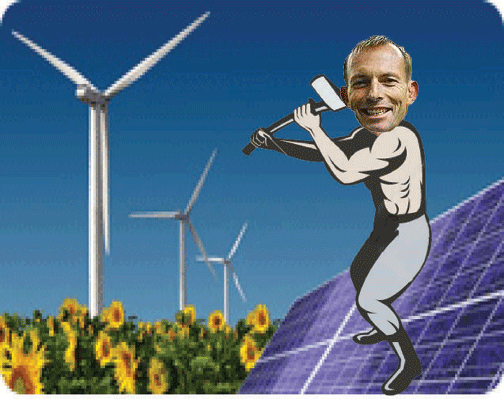 Leigh Ewbank, Friends of the Earth’s renewable energy spokesman, said: “Today, the Abbott government has agreed to cut the renewable energy target by 20%. This means less clean energy, less jobs, and less investment for Australia. This cut to the RET means 3,680 less jobs by 2020.”
[Industry Ministe MacFarlane] – we would expect that the cross-bench will support us on wood waste.”
Australia’s renewable energy target deal hits last-minute snag over wood burning, Guardian, Oliver Milman, 8 May 15
Labor accuses Coalition of trying to include burning of wood waste as a renewable energy source after both sides agree to 33,000GWh target A deal to end the lengthy stand-off over Australia’s renewable energy target has hit a dramatic late hitch after Labor accused the Coalition of trying to include the burning of wood waste as a renewable energy source.
The federal government and the opposition have held on-off talks for several months over a deal to cut the renewable energy target (RET), which mandates that 41,000 gigawatt hours of Australia’s energy must come from renewable sources such as solar and wind by 2020.
Talks between Greg Hunt, the environment minister, Ian Macfarlane, the industry minister, and Mark Butler, Labor’s environment spokesman, in Melbourne on Friday agreed that the RET be cut to 33,000GWh, with exemptions for energy-intensive industries such as aluminium.
However, Labor has objected to part of the deal after claiming that the government introduced a last-minute amendment that the burning of wood waste be included in Australia’s renewables target. Continue reading
Abbott govt cutback to Renewable Energy Target will cost 1000s of jobs
 RET cut a step backwards, says Solar Citizens http://www.dailyexaminer.com.au/news/ret-cut-a-step-backwards-says-solar-citizens/2632812/ 8 May 15 THE announcement today of an in-principle agreement to drastically cut the Renewable Energy Target to 33,000 gigawatt hours will cost thousands of jobs, millions in investment and lock in more expensive power for all Australian consumers, according to Solar Citizens.The decision to slash the Target will take Australia backwards and increase pressure on already stretched family budgets, said National Director Claire O’Rourke.”This massive scale back of the RET could mean up to a $45 billion revenue windfall to the big power companies over the next 15 years and now it looks likely that households will continue to pay more,” she said.
“The vested interests of the power companies have received special treatment from the Abbott Government at the expense of ordinary Australians who want more solar and renewable energy, not less.
“Recent polling from The Australia Institute shows 75% of Australians support an increase in the Renewable Energy Target, not a decrease. The cut to the RET will cost 8,000 jobs and be particularly devastating for solar companies looking at installing big solar projects.
“The Coalition’s proposal to include burning wood waste in the Target, which is the remaining sticking point for the deal, would be yet another horrendous step backwards.
“Renewable energy is recognised globally for the jobs, opportunities and savings on power bills that it can deliver. More than 1.3 million households – that’s at least 2 million voters – have already installed rooftop solar power and are now benefiting from lower power bills.”Yet the decision today will take Australian renewable energy generation backwards.
“They have pledged to support a national goal of at least 50% solar and renewable electricity generation by 2030, an end to unfair fees for solar owners and to help all Australians with the rising cost of electricity bills,” Ms O’Rourke said.
Abbott govt’s new Renewable Energy Target deal freezes investment
Renewable Energy Target: Clean energy sector angry yearly reviews remain following deal http://www.abc.net.au/news/2015-05-08/clean-energy-sector-angry-at-government-change-on-ret/6457070 By political reporter Dan Conifer The clean energy sector is opposing a key part of the Renewable Energy Target (RET) deal struck between the major parties.
The Federal Government and Labor have agreed in-principle to a 33,000 gigawatt hour target for clean energy production by 2020.
But the Government has backflipped at the last minute on a promise to ditch two yearly reviews.
While pleased a deal appears close, companies say the reviews by the climate change authority freeze investment.
“This is an issue we thought had been resolved now by both parties for the last 18 months,” Andrew Richards from wind farm operator Pacific Hydro said.
“We thought they had understood that constant reviews is not good for investor confidence. “We’d like to see it removed. We hope that saner people prevail eventually and they will remove it and will allow us to go on and invest with some level of confidence.”
Wind tower manufacturer Keppel Prince said while it was glad a 33,000 GWh deal has been reached, the reviews needed to stop.
“It just has that air of uncertainty and the industry just locks up any sort of spending for probably a good six to eight months beforehand,” Mr Garner said.
“Every two years we seem to run out of work because the investment just stops.”
The next review is scheduled for 2016 and would follow two reviews last year, including the specially-commissioned Warburton Review that recommended slashing the target.
In a joint statement last month, the environment and industry ministers said: “We will also remove the requirement for regular two-yearly reviews of the RET to give the industry the certainty it needs to move ahead.”
Industry minister Ian Macfarlane now says Cabinet insisted the reviews remain, and Labor did not oppose the plan in talks on Friday.
But Labor’s environment spokesman Mark Butler said the ALP was unlikely to support continued reviews.
“I want to have discussions with the industry about the two year reviews, but our position has been clear on that for almost two years now: we think we need to move away from regular reviews,” Mr Butler said.
CHRISTIANA FIGUERES answers Maurice Newman’s attack on United Nations
CHRISTIANA FIGUERES:...” he is certainly not in the majority, not only the majority of scientists, but the majority of citizens around the world, the majority of leaders around the world, are quite clear about the effects that we are actually playing with here and the risks that we have to manage ahead of us.”
UN climate chief responds to tirade from PM’s adviser Australian Broadcasting Corporation, Lateline Broadcast: 08/05/2015 Reporter: Emma Alberici
UN climate negotiator Christiana Figueres says she is willing to meet business leader Maurice Newman in the wake of his extraordinary attack against on UN climate policy – and warns that it would be dangerous for Australia not to act on climate change.
Transcript……………
Christiana Figueres joins us now from our studio in Canberra……………
South Australia Nuclear Royal Commission Issues Paper 4 – misleading and serious omissions
the issues paper appears to be talking about a so-called public-private-partnership (PPT).
There is no mention of “user pays” or “polluter pays” principles. Nor is there any discussion of the role of Government economic regulation of such a venture.
Dennis Matthews, 8 May 15 NUCLEAR FUEL CYCLE (sic) ROYAL COMMISSION
ISSUES PAPER FOUR
MANAGEMENT, STORAGE, AND DISPOSAL OF NUCLEAR AND RADIOACTIVE WASTE
Once again, the word “ionising” has been omitted from “ionising radiation”. It is hard to believe that this is an oversight and appears to be a deliberate move by the nuclear industry to play down the fact that radiation from radioactive substances is very different in its effect on living tissue from other forms of radiation such as visible light and radio waves.
In addition a new ploy has emerged, not only has nuclear waste been differentiated from radioactive waste but in the majority of cases it is simply referred to as “waste” and we end up with terms like “waste disposal facility”.
I anticipate that in the near future the nuclear industry, its fellow travellers, and the unsuspecting public will be using these sterilised and misleading terms. For example, it would be a simple matter to quote sections of the issues papers out of context in such a way that terms like “radiation”, “waste” and “waste disposal facility” can be bandied about until they become the standard.
As previously, there is widespread use of terms like “proposed”, “under development”, “being developed”, “would involve”, and research is “ongoing”. Such terms have no place in a document that is being used to determine government policy, especially on such a contentious issue as expansion of the nuclear industry.
This issues paper is in three sections: Nuclear and Radioactive Waste, Facilities and Techniques for the Management, Storage and Disposal of (nuclear and radioactive) Waste, and Risks and Opportunities.
- NUCLEAR AND RADIOACTIVE WASTES
Climate change defines Christine Milne’s fine legacy in Parliament
 Given our climate politics, who can blame Christine Milne for retiring?, Guardian 7 May 15 Tim Hollo
After 25 years of campaigning, Milne’s retirement from parliament is an indictment of how little progress Australia has made on climate change. egardless of the surprise of the press gallery, anyone paying attention realised Christine Milne would have been thinking deeply about her future. With her first grandchild on the way, the planet’s future would also have been brought into a stark new light.
Milne can be confident that she steered the Greens through a hugely difficult period, bringing a new strategic focus to campaigning and beautifully mentoring a new crop of advocates. But it is climate change which keeps her awake at night, and she has had to consider where she could most effectively focus her efforts in the critical years ahead.
Who can blame her for concluding that Australian parliamentary politics is a poor place right now from which to work for radical climate change action?
Milne’s deep knowledge of (and passion for) climate science and policy is legendary in and around parliament. Less well known is her record on climate change over the last quarter century.
In 1990, while a member of the Tasmanian Parliament, she was appointed alongside Joan Kirner and Rupert Hamer to Australia’s first Greenhouse Council. She moved to the international arena in 1998 and was elected to the Global Council of the International Union for the Conservation of Nature in 2000. She was elected its vice president in 2004, the same year she was elected to the Senate.
From all of these positions, Milne worked to build awareness and acknowledgement of climate change. More deeply, she challenged us to grapple with its deep ramifications for our economies, our politics and our lives.
From all of these positions, Milne worked to build awareness and acknowledgement of climate change. More deeply, she challenged us to grapple with its deep ramifications for our economies, our politics and our lives……………..
Milne’s role in bringing depth to the climate change debate through that period was vital to the tremendous election result for the Greens in 2010. She capitalised on that by proposing the Multi Party Climate Change Committee as a condition of supporting the Gillard government, insisting on experts sitting on the committee, and shepherding through it the best possible result that could have been achieved. She also used the process to increase the understanding of climate change in the community.
While we have, of course, lost the carbon price, the Climate Change Authority and the Clean Energy Finance Corporation remain – and both are Milne’s hard-won achievements. More importantly, the idea that we cannot be serious about climate change without phasing out coal remains and is growing ever stronger. No future government will be able to get away with what Tony Abbott has done, and that is in no small part thanks to Milne’s efforts…….http://www.theguardian.com/commentisfree/2015/may/07/given-our-climate-politics-who-can-blame-christine-milne-for-retiring
Dennis Matthews exposes South Australia Royal Commission “Issues Paper 2” spin
In relation to the dangers of ionising radiation the issues paper refers simply to “radiation” thereby lumping it together with electromagnetic radiation including such innocuous things as visible light and radio waves.

Dennis Matthews, 8 May 15 NUCLEAR FUEL CYCLE (sic) ROYAL COMMISSION
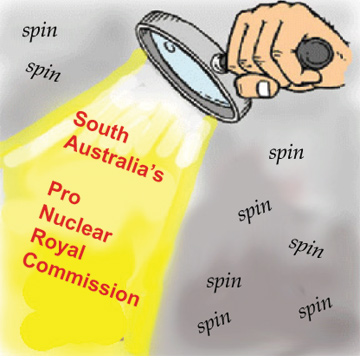 ISSUES PAPER TWO
FURTHER PROCESSING OF (uranium and thorium) MINERALS AND MANUFACTURE OF MATERIALS CONTAINING RADIOACTIVE AND NUCLEAR SUBSTANCES
Two things stand out in this the second Issues Paper for the Scarce Nuclear Industry Commission.
One is the consistent use of pro-nuclear jargon/spin, the other is the frequency with which statements are accompanied by provisos.
The pro-nuclear jargon/spin started right from the beginning of this whole process with the name of the Commission. Instead of using the neutral, straight forward term “nuclear industry”, the value –laden, scientifically incorrect, misleading phrase “nuclear fuel cycle” was chosen. This was accompanied by similarly misleading, nuclear industry, feel-good phrases such as “value adding” and “enrichment”.
The most obvious nuclear industry ploy used in this discussion paper is to refer to “radiation” rather than “ionising radiation”. This is unscientific, misleading and potentially confusing to many readers who are familiar with the fact that “radiation” includes microwaves, radiowaves, visible light, and infrared radiation, none of which is ionising.
This issues paper makes frequent use of vague terms such as “may allow”, “ongoing”, “possible”, “currently being developed”, “may be”, “could be influenced”, “being developed”, and “emerging technologies”. These are hardly encouraging or appropriate terms for producing serious policy, especially on such a contentious issue as expanding the nuclear industry in SA.
This issues paper is in four sections: Further Processing, Manufacture, Viability, and Risks and Opportunities. Continue reading
Australia’s disarmament double-speak at the nuclear Non-Proliferation Treaty Review Conference 2015
Australia’s claimed reliance on the US’ nuclear arsenal hijacks any meaningful contribution to disarmament. Most endorsers of the Australian-led humanitarian statement are similarly thwarted by their commitment to the nuclear weapons of their allies. Meanwhile, many other countries are refusing to accept and enable indefinite inaction.
While Australia remains tolerant of nuclear weapons, thankfully Austria and the majority of states are seeking new methods and action, now. This process is bound to go ahead with or without the nuclear weapons states.
The Australian Government should respond to the 84% of the Australian public who want their government to support a nuclear weapons ban (2014 Nielsen poll) and stop encouraging the reckless behaviour of the nuclear minority.
 Gem Romuld, 6 May 15 Despite being close in name, the gap between Australia and Austria on the issue of nuclear disarmament is stark. Austria is at the forefront of a global push to stigmatize, ban and eliminate nuclear weapons, whereas Australia is leading efforts to undermine this push.
During the first week of the nuclear Non-Proliferation Treaty Review Conference, currently underway in New York, the Australian Ambassador to the United Nations, Ms Gillian Bird, delivered a statement expressing concern that 45 years since the NPT entered into force, “some 16,000 nuclear warheads still exist”. But she dismissed the “call for a treaty banning nuclear weapons”, and stated Australia’s support for “practical, realistic measures to achieve actual nuclear disarmament”. Elaboration on these unambitious measures was saved for the 26-nation Statement on the Humanitarian Consequences of Nuclear Weapons, not to be confused with the much stronger Austrian-led 159-nation Joint Statement on the Humanitarian Consequences ofNuclear Weapons.
Both ‘humanitarian statements’ acknowledged the renewed focus on the humanitarian impacts of nuclear weapons, catalysed by the three conferences that have been held on the subject since February 2013 by the Norwegian, Mexican and Austrian Governments. The Austrian-led statement said that the “humanitarian focus is now well established on the global agenda” and affirmed that “the only way to guarantee that nuclear weapons will never be used again is through their total elimination”. The Australian-led statement claims there are “no short cuts”, implying that the slow, and thus far ineffective, steps to disarmament are the only way to reach a world without nuclear weapons. Continue reading
Prosperity for Victorian farmers hosting wind farms
There are jobs and prosperity blowin’ in the wind http://www.weeklytimesnow.com.au/news/opinion/there-are-jobs-and-prosperity-blowin-in-the-wind/story-fnkerdb0-1227337252668 MAY 06, 2015
“THE single biggest investment in rural Victoria.” That’s how Municipal Association of Victoria president Bill McArthur described the $5 billion worth of new wind farms waiting to be built in Victoria.
This recognition of the sheer scale of the opportunity the wind farms present to regional Victoria is a welcome turn in the debate. In much of the discussion around wind farms, the interests of regional Victoria are too often overlooked. How to keep farming businesses viable. How to keep tenants in the shops along the main street. How to provide the jobs that will draw the next generation of families back to small towns and farms.
These are questions country Australia has constantly had to address.
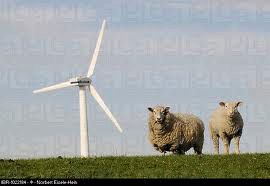 Wind farms fit with farming. Wind towers use only a fraction of a farmer’s land and add valuable access tracks, improving farm viability.
Wind farm lease payments bring a 25-year income stream on to farms and that money returns to the local economy through things such as farm upgrades, the hire of local labour and purchases from local businesses.
A full-time work force can make a huge difference to a small town and guaranteed rates income has already become vital for shires like Moyne, Pyrenees and Southern Grampians.
Crucially, wind farms don’t use a drop of water. As southeast Australia becomes drier, a large-scale energy source that makes no call on our precious water supplies will become all the more important.
But there’s no such thing as a free lunch. As The Weekly Times editorial recognised last month, more wind farms will bring a “long-term change to our beloved landscape”. Visually, wind farms are a big deal, but whether people like the look of them or not can’t be the main driver.
An end to the Federal Government’s attack on the renewable energy target will bring a once-in-a-generation investment boom to regional Victoria. Our choice is to embrace this and make it work, or just hope that another opportunity like it might one day turn up.
Andrew Bray is Australian Wind Alliance national co-ordinator
South Australia gets world class floating solar system – by an Australian company
Australian company creates world-first floating solar system NEWS.COM.AU MAY 02, 2015 AN AUSTRALIAN company is leading the way for renewable energy after creating a world-first floating solar system.
Infratech Industries selected the Northern Areas Council Waste Water Treatment Plant in South Australia as the first location to implement the new system.
Director Felicia Whiting said it is expected the innovative technology will generate an estimated 57 per cent more power than fixed land-based systems.
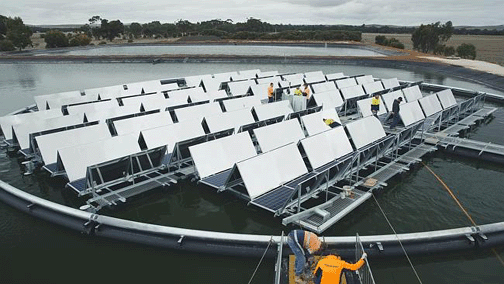
“The proprietary tracking, cooling and concentrating technology uses water to counteract the gradual loss of output caused by overheating solar panels to create a better performing and more efficient system,” she said.
“The Northern Areas Council will reap additional economic benefits with a cost saving of approximately 15 per cent on their current energy expenditure, plus an additional one per cent margin on the excess energy provided to the local community.”
- Ms Whiting said the biggest challenge in implementing the technology was changing the mindset of government officials and bureaucrats who questioned the need for renewable energy.
“Just how strong Australia’s post-2020 emissions reduction targets remain unknown, however we do know solar innovation is a milestone towards Australian councils, communities and businesses making a difference,” she said.
“As Australians evangelise this type of technology, it is our hope that renewable energy becomes the mainstream rather than niche solution.
“Change is not beyond us and this is definitely a strong step forward.”………http://www.news.com.au/technology/innovation/australian-company-creates-world-first-floating-solar-system/story-fnjwucti-1227331868879
1 This month
17 October, Free Public Talk on Nuclear Issues in South Australia
David Noonan will speak on public interest concerns over the new Roxby Downs Indenture Act 2026 on BHP copper-uranium mining and ore processing in SA, and on how AUKUS may face SA with a High-Level nuclear waste agenda.
Dr Jim Green will discuss international developments in the field of nuclear power including ‘small modular reactors’ and Generation 4 ‘advanced’ nuclear reactor concepts.


Help Aunty Sue Protect Her Land and Sacred Sites From Destructive Rocket Testing.
.

Australians deserve the truth
about
AUKUS – https://aukuspublicinquiry.com/

PETITION – To: Prime Minister Anthony Albanese and the Australian Labor Government

of the week – Australians for War Powers Reform (AWPR)
To see nuclear-related stories in greater depth and intensity

