Australian Capital Territory a winner for renewable energy jobs
ACT renewable energy jobs soar in past five years April 14, 2015 Henry Belot Canberra Times Reporter The number of jobs in the ACT renewable energy industry has increased by more than 400 percent over the past five years, the largest increase in Australia.
According to Australian Bureau of Statistics data released earlier this week, 630 people were employed by the renewable energy industry last year with 480 employed by the government or non-profit institutions and 150 in solar power.

But while the ABS figures indicated a growth in ACT employment they revealed more than 2000 jobs had been lost in the industry nationwide over the past two years.
Some 12,590 people were employed full-time in the wind, solar and other renewable energy industries last year down from almost 15,000 two years earlier…….
In late 2013, the ACT government legislated a 90 percent renewable energy target for the territory by 2020 drawing praise from the Climate Council as a welcome contrast to federal uncertainty. …………
Mr Antflick Elementus Energy manager director Ashleigh Antflick,said he expected the solar farm, which will be relocated from a proposed site near the Uriarra village to beside the Monaro Highway at Williamsdale, to be a long-term stable employer of skilled labour in the ACT.
“We are looking at working with a number of tertiary education institutions in the territory to be part of their skills programs for undergraduate and technical training programs,” he said.
Mr Antflick said the ACT government and broader community were supportive or major solar power investments despite a concerted public relations campaign from Uriarra villagers to relocate the solar farm.
“There is a pretty clear understanding by territorians of the broader climatic benefits of solar energy and I think broad support for doing something to make a positive contribution to climate change,” he said. http://www.canberratimes.com.au/act-news/act-renewable-energy-jobs-soar-in-past-five-years-20150414-1mku8a.html
Queensland’s Newman government gutted the renewable energy industry
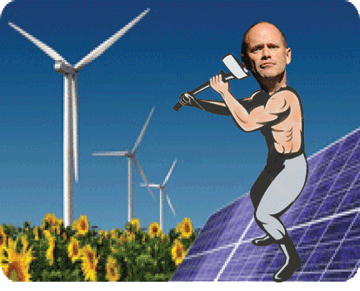 Campbell Newman’s LNP government ‘gutted’ renewable energy industry RENEWABLE energy jobs in Queensland fell by over a third under the Liberal National Party government, Energy Minister Mark Bailey says., Courier Mail, 15 Apr 15
Mr Bailey said new Australian Bureau of Statistics data showed a third of jobs in the sector vanished under the previous state government.
He said actions such as the former government’s cuts to the renewable energy target had caused the loss of 1300 jobs.
“No wonder jobs were vanishing under the LNP when they were removing any incentive for businesses to look at industries of the future like renewables,” Mr Bailey said………
Mr Bailey said the current Labor Government’s commitment to the solar sector, a renewable energy target and a renewable energy auction would grow jobs for the sector.
But the deputy opposition leader said he was yet to see any detailed government plan to create jobs.http://www.couriermail.com.au/news/queensland/campbell-newmans-lnp-government-gutted-renewable-energy-industry/story-fnihsrf2-1227303819258
The Parkinson Report: renewable investment near zero, but rooftop solar grows
 Australian renewable investment plunges to near zero, but rooftop solar grows http://reneweconomy.com.au/2015/australian-renewable-investment-plunges-to-near-zero-but-rooftop-solar-grows-93815 By Giles Parkinson on 14 April 2015 The crisis affecting investment in large-scale renewable energy projects in Australia has deepened, with new analysis by Bloomberg New Energy Finance pointing to a 90 per cent drop in the 12 months to March 31, thanks to policy uncertainty under the Abbott government.
The BNEF data shows new investment Australian large-scale renewable energy projects tumbled in the 12 months to March 31 was just $206.9 million – a fall of 90 per cent – and only one large scale renewable energy project (worth $6.6 million) was financed in the first quarter.
But the data hides an even worse story. Of that $206.9 million, $160 million came from government agencies – such as the Australian Renewable Energy Agency and the Clean Energy Finance Corporation – that the Coalition government is trying to scrap. Without that support, investment would have been virtually zero. The one project to get financed in the latest quarter was for a unique floating solar pilot project in South Australia.
BNEF says the dramatic drop is almost entirely due to the policy uncertainty brought about by the election of the Abbott Coalition government, and attempts by key members to firstly scrap, and now severely cut the previously bipartisan target of 41,000GWh by 2020.
The Clean Energy Council, supported by Labor and key industry groups, has proposed a compromise of 33,500GWh, but so far the Abbott government has refused to budge from its position of 32,000GWh. Industry minister Ian Macfarlane has indicated that even that figure is too high for many in Cabinet.
The BNEF data shows new investment Australian large-scale renewable energy projects tumbled in the 12 months to March 31 was just $206.9 million – a fall of 90 per cent – and only one large scale renewable energy project (worth $6.6 million) was financed in the first quarter.
This followed zero investment in large scale projects in the previous quarter. BNEF noted the exit of Banco Santander, the world’s third largest clean energy lender, from the Australian market, as reported by RenewEconomy here.
In contrast, the uptake of rooftop PV by households and businesses has been largely unaffected, with about 195MW of rooftop PV capacity in the sub-100kW category installed in the first quarter, a 7 per cent increase on the same quarter a year ago.
The data came as new figures from the Australian Bureau of Statistics on Monday showed the number of renewable energy jobs in Australia had fallen by 2,300 or 15 per cent up to June 30, 2014 – not including the latest downturn.
The Abbott government is hoping to strike an agreement with cross-bench Senators, many of whom are actively anti-wind and involved in a Senate-sponsored wind inquiry. However, Ricky Muir, from the Motorists Party, said he wanted a bipartisan agreement between the two parties.
He suggested Labor could even drop to the 32,000GWh limit demanded by the Coalition, with the idea of lifting the target if elected at the next election. That, Muir said, would at least provide a floor for investment.
Federal funding for South Australia’s remote Aboriginal communities
Future of remote Aboriginal communities secured by deal between SA and federal governments ABC Radio The World Today By Natalie Whiting, 13 Apr 15 Nicola Gage & staff The future of remote Aboriginal communities in South Australia has been secured by a deal between the state and federal governments.
There were concerns communities could close because of Federal funding cuts to essential services, including rubbish collection, sewerage, power and water.
However, a compromise announced this morning will see the Federal Government continue to pay for services in the APY Lands, for the time being. Continue reading
Abbott govt’s Energy White Paper is highly political, as is its stand on Renewable Energy Target
Energy white paper has some huge black holes, SMH 12 Apr 15 Was it an accident or wilful blindness? The federal government’s 74-page energy white paper, released last week, contained just a single reference to climate change. Given the Abbott government’s self-imposed blindness on this issue, we have to suspect it was the latter. The omission renders the document deeply flawed.
The white paper’s approach is that of the classic free-marketeer: governments should not intervene to modify energy consumers’ behaviour (by, say, subsidising renewables or reserving gas supplies for domestic use at a lower cost to consumers). Applied to other industries that analysis may still sketch the outlines of a workable policy, but it is no longer adequate in a supposedly comprehensive review of energy production and use. The burning of fossil fuels is the world’s single most important contributor to greenhouse gases and therefore to climate change. Yet the white paper virtually ignores this link which is central to its subject…….
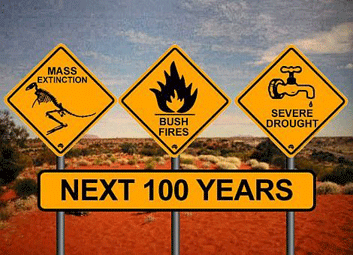 Despite its dispassionate pretence, Australia’s white paper is a highly political document. Economics rules Australia’s politics, and hence our political response to climate change has also been achingly slow. Cocooned by the country’s income from hydrocarbons in a world of comfortable fantasy, many in this country deeply still resent any disturbance from scientists or others who try to point out the stark evidence of record average temperatures, changed farming environments, warmer oceans, longer and harsher bushfire seasons……..
There is no risk now that Australia will lead the world in acting against climate change, since most developed nations are already ahead of us, and our recent steps have all been retrograde. But Australia should not be cutting off any options to act when at last it makes up its mind to do so. Unfortunately the white paper, and the row over the RET, look to have precisely that effect. http://www.smh.com.au/comment/smh-editorial/energy-white-paper-has-some-huge-black-holes-20150412-1mjflr.html
New South Wales Premier Mike Baird firmly on the side of the coal lobby
 Thom Mitchell: Backing Big Coal – Mike Baird Promises To Up The Ante For Acting On Your Conscience
Miners get rewarded for destroying our environment, while protestors cop massive fines. And it’s about to get worse. Welcome to Mike Baird’s new New South Wales……..
“So-called plans to phase out mining in NSW have no place in this parliament,” Baird announced, “and I’ll be very clear on this, no place”.
In fact, Baird said, he would halve the time it takes to get big mines approved………
New Matilda understands Baird’s Liberal government will seek to change Workplace Health and Safety laws and other relevant legislation in the new parliament to reverse the liability, but protestors are unlikely to be deterred by his promise of harsher penalties……https://newmatilda.com/2015/04/12/backing-big-coal-mike-baird-promises-ante-acting-your-conscience
Senator Sean Edwards spruiks for the South Australian nuclear lobby
 Yesterday, I wrote about the media publicity given to Senator Sean Edwards, a former estate agent, who is going very public in support of South Australia getting the entire nuclear fuel chain (around its necks). Meanwhile, Dr Helen Caldicott, a world authority, was denied publicity to put the counter case.
Today, I learn that Sen Edwards has now set up a website to promote this theme. It’s a corker.
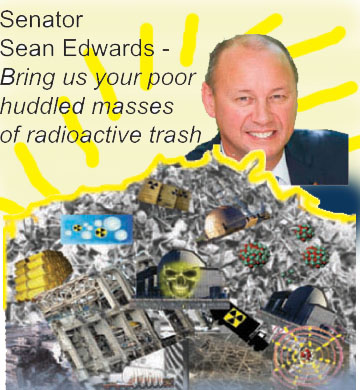
He starts with an attack on the Greens – they should be “morally and philosophically compelled to support advanced nuclear energy”
Moves quickly on to the argument for nuclear power as “free energy” and the $billions of revenue for South Australia, in importing the world’ radioactive trash.
“Polling proves South Australians want this and they want it yesterday” – says Edwards. Actually – no! Polling shows that South Australians voters reject expansion of the nuclear industry.
He asserts that “nuclear reactors produce no emissions that contribute to global warming”. (That’s untrue, but especially untrue if you ignore the entire nuclear fuel chain)
They “deliver abundant energy without any mining”. Hey – he doesn’t count the mining required for the conventional reactors to produce the wastes to put into the reprocessing reactors that he is touting! Edwards must be a bit confused. One of the main arguments for the South Australian expansion, as put by nuclear proponent Oscar Archer, is that it will give a strong boost to Australia’s uranium mining and uranium export industry.
Edwards tells us how very safe the nuclear industry – except for 3 what he calls “incidents” (Three Mile Island, Chernobyl, and Fukushima).
And without any evidence at all, he asserts that – for the new non existent untested reprocessing nuclear reactors – “The science is sound, the business case has been made and the public is behind us”
Australian government’s Energy White Paper ‘wilfully deluded’ on climate change
 Energy white paper ‘wilfully deluded’ on climate change, SMH April 9, 2015 Lisa Cox National political reporter The Abbott government’s energy white paper is “wilfully deluded” for failing to put climate change at the centre of Australia’s future energy policy, say climate groups.
The government released the paper on Wednesday with recommendations including the privatisation of remaining state-owned electricity assets and the rejection of a proposal for a domestic gas reserve, despite rising gas prices.
But it is the suggestion that future energy policy should be “technology neutral” that has raised concerns among the Greens and environment groups, which want policy that focuses on ceasing fossil fuel use.
Similar to last month’s intergenerational report, which devoted just three and a half pages to global warming, the energy white paper mentions climate change just once………
The Climate Institute described the energy white paper on Wednesday as a “fantasy of climate ignorance” but acknowledged the report did recognise the risk Australia’s fossil fuel industries posed in “an emissions constrained future”.
“But the white paper doesn’t think through the challenges and opportunities of a world seeking to remove carbon pollution,” chief executive John Connor said. “There’s no recognition that helping achieve the internationally agreed goal of keeping global warming to 2°C requires a plan for an energy sector with net zero pollution by mid-century,” chief executive John Connor said………
 Greens leader Christine Milne said the paper should be “binned along with the Warburton review into the RET [renewable energy target]”.
“All we’re getting from this report is a commitment to business as usual for the big old polluters, and a promise to cut the renewable energy target, abolish the Australian Renewable Energy Agency and close down the revenue-raising Clean Energy Finance Corporation,” Senator Milne said. http://www.smh.com.au/federal-politics/political-news/energy-white-paper-wilfully-deluded-on-climate-change-20150408-1mgrnu.html
Melbourne city at standstill as thousands marched to support remote Aboriginal communities
Thousands rally in Melbourne in support of remote Aboriginal communities ABC News, 11 Apr 15 Thousands of people have staged a rally in Melbourne against the forced closure of remote Aboriginal communities, bringing parts of the CBD to a standstill.
There were major delays to public transport on Friday as Flinders Street and St Kilda Road closed to traffic. Yarra Trams tweeted at 7:10pm to say Swanston Street trams running between the Arts Precinct and Melbourne Central Station were able to resume service.
Earlier, Metro Trains advised passengers to access Flinders Street Station via Elizabeth Street to avoid the crowds………
Last month, Tony Abbot backed the West Australian Government’s plans to close nearly half of the state’s 247 remote communities and said it was not unreasonable if the cost of providing services such as schools, outweighed the benefits.
“What we can’t do is endlessly subsidise lifestyle choices, if those lifestyle choices are not conducive to the kind of full participation in Australian society that everyone should have,” he said.
The Prime Minister’s comments received criticism from Aboriginal leaders, as well as both sides of politics.
“I think it’s a very disappointing and hopeless statement by the Prime Minister, quite frankly,” Indigenous leader Noel Pearson told The World Today in March……http://www.abc.net.au/news/2015-04-10/rally-in-melbourne-in-support-of-remote-aboriginal-communities/6384826
Australian government’s plans to shut down remote Aboriginal communities
Entire Aboriginal Communities May Be “Closed” in Australia http://www.slate.com/blogs/the_slatest/2015/04/10/aboriginal_communities_closing_in_australia.html
By Ben Mathis-Lilley Thousands of people rallied in Melbourne on Friday to protest the potential closure of up to 150 Australian aboriginal communities, according to reports. The government of Western Australia has said it cannot continue to provide services to all of the 274 “remote communities” under its supervision and that many of them are affected by social ills including sexual abuse. (Public figures who oppose the plan suggest that the abuse issue is being used manipulatively as cover for a financial decision.) Australia’s notoriously insensitive/gaffe-prone prime minister, Tony Abbott, has described native peoples’ decision to live in the communities as a “lifestyle choice.”
The previous shuttering of a Western Australian community called Oombulgurri illustrates what might happen on a large scale if the government goes forward with closures, which wouldn’t begin until 2016:
… many of the people living in Oombulgurri didn’t want to leave, says Amnesty International’s Australian Indigenous Peoples’ Rights Manager, Tammy Solonec.
As the government gradually closed vital facilities such as the health clinic, school and police station, and eventually shut off the town’s power and water, people were left with no choice but to move out, says Ms Solonec.
An estimated 69,665 “Aboriginal and Torres Strait Islander peoples” live in Western Australia.
Queensland Senator Matthew Canavan wants no tax deductability for environment groups
 Government MP steps up campaign against eco-charity tax concessions, ABC News, 10 Apr 15 By Conor Duffy More than 100 environment groups face being struck off a register that gives them tax deductibility status enjoyed by charities and research organisations.
A parliamentary inquiry into the Register of Environmental Organisations has begun taking submissions, with some Government MPs agitating for a cull of the 600-strong register.
Queensland LNP senator Matthew Canavan said a preliminary audit showed eco-charities were getting tax deductibility status to engage in political rather than environmental activity……….
Cam Walker from Friends of the Earth believes that protesting and lobbying is important environmental work.
“I think the Australian people are very sharp, they realise that protecting the environment isn’t just a case of planting some trees,” Mr Walker said.
“They realise that in the current context it’s political activity that brings about change.”
Government accused of being driven by ideology
Friends of the Earth has already come under Government scrutiny.
In the run-up to the last election it received a $130,000 donation which was spent on market research and used in conjunction with GetUp! for political campaigning.
It is currently being audited by the Australian Tax Office, but has been cleared in a separate Environment Department investigation………
Inquiry ‘more about politics than facts’
Environment NGOs said funding had already been cut for environmental campaigns and lawyers, and the latest move was part of a campaign against the sector.
“The current House of Representatives inquiry is an attempt to silence the environment movement. We have no doubt that this is more about politics than about facts,” Mr Walker said……..
Other groups like the Institute of Public Affairs (IPA), which campaigns on behalf of big business to remove environmental protections, also have tax deductibility status.
NGO academic and vice-president of Environment Victoria, Joan Staples, said that was hypocritical.
“The department that scrutinises them, which is not the Environment Department but the Industry Department, should be scrutinising them much more closely and look at whether they really are producing what that tax deductibility status requires of them,” she said……….http://www.abc.net.au/news/2015-04-10/environment-groups-could-lose-tax-concession-status/6384554
Big investment banks walk away from Queensland’s Galilee Basin coal projects
 Big Banks Closing The Vault On Big Coal, Adding To Adani’s Woes, New Matilda, By Thom Mitchell 11 Apr 15 Plans to build one of the world’s largest coal mines in Queensland have hit yet another roadblock, with international investment banks refusing to back the project. Thom Mitchell reports.
Big investment banks continue to walk away from the massive new coal field proposed for the Galilee Basin in Queensland, with three French Banks – Société Générale, Crédit Agricole and BNP Paribas – yesterday joining nine others in not banking on the project’s success.
It is “due to the number and magnitude of issues linked to the planned coal development projects in the Galilee Basin,” that Credit Agricole SA, one of the three French banks, advised company Market Forces it “does not intend to finance these projects or their associated facilities”. Continue reading
CSIRO’s Climate Analogues tool shows climate change for 400 Australian towns
 By 2030, Australian annual average temperature is projected to increase by 0.6-1.3C above the climate of 1986-2005 with little difference between emissions scenarios.
A new website shows how global arming could change your town The Conversation, 7 Apr 15 Leanne Webb Visiting scientist at CSIRO Penny Whetton Honorary Research Fellow at CSIRO
What will Australia look like in 2050? Even if we significantly reduce our greenhouse gas emissions as under an intermediate scenario, Melbourne’s annual average climate could look more like that of Adelaide’s, and Adelaide’s climate could be more like that of Griffith in New South Wales.These changes are captured in a new Climate Analogues tool released by CSIRO today. It’s not just capital cities – you can find climate analogues for more than 400 towns around Australia, under various climate scenarios.
Eastern Australian coastal sites could see a climate shift to those currently typical of locations hundreds of kilometres north along the coast. Sydney’s climate could resemble that of Port Macquarie, and Coffs Harbour’s climate resembling that of the Gold Coast (by 2050; intermediate emissions).
Towns in major inland agricultural areas could have climates typical of inland areas further north, such as Griffith’s climate shifting to that of Cobar, a town around 300 km north (by 2050; intermediate emissions).
The change in climate is much greater by 2090 and under a high emissions scenario. In this case Melbourne’s climate could then be more like that of Dubbo, Griffith’s more like that of Bourke (600 km away), Sydney’s more like Brisbane, and Coffs Harbour’s could be like Mackay.
Australia’s climate future Continue reading
“THE AUSTRALIAN’ newspaper’s pro nuclear bias continues.
 Isn’t it interesting that when a Liberal politician, with a background in auctioneering and estate agency, produces his particular pro nuclear argument, it gets coverage from THE AUSTRALIAN? But when Dr Helen Caldicott, an internationally regarded expert on matters nuclear offers an informed insight into the South Australian nuclear proposals – then there’s no room for that, in the same newspaper.
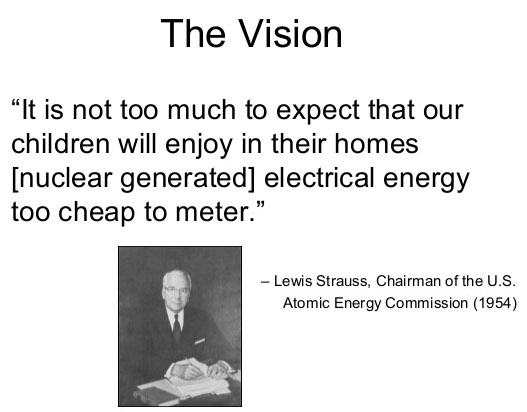
Liberal Senator Sean Edwards is repeating a story that sounds remarkably familiar: “We could end up with zero or low-cost power” … “The more you reprocess, the more electricity you have to get rid of.”
Senator Edwards is “briefing” Industry Minister Ian Macfarlane and Trade Minister Andrew Robb on the (non existent) Integral Fast Reactor
Abbott government to help South Australia remove restrictions on the nuclear industry
Federal Gov White Paper on Energy prepares way to cut red tape on nuclear industry http://www.adelaidenow.com.au/business/federal-government-white-paper-on-energy-prepares-way-to-cut-red-tape-on-nuclear-industry/story-fni6uma6-1227296081932
by: CHRISTOPHER RUSSELL BUSINESS EDITOR From: The Advertiser, 8 Apr 15
 THE Federal Government is positioning itself to cut red tape blocking development of a nuclear industry in South Australia.
The Federal Government’s White Paper on Energy, launched on Wednesday by Industry Minister Ian Macfarlane, says the Commonwealth will consider the findings of SA’s royal commission into the nuclear fuel cycle.
“The royal commission will allow for a considered and informed community discussion on nuclear industries and energy, examining the opportunities and the risks,” the White Paper says.
It adds the government wants to work with states by “responding to technical developments and the streamlining and removal of any unnecessary regulation”.
Mr Macfarlane has said the Federal Government will not lead a push for nuclear energy. His spokeswoman said yesterday this remained the case but the Federal Government wanted to ensure it had the expertise to deal with any change advocated by SA.
SA Mineral Resources and Energy Minister Tom Koutsantonis welcomed federal co-operation. “A lot of the imports and exports of this industry are regulated by the Commonwealth,” he said. “Having Canberra on side with our royal commission is a great boost.
“It’s important to understand exactly what impediments there are to the importation of spent fuel rods.
“It’s important to understand the impediments to exporting uranium through all of our ports around the country; understanding exactly what grade of uranium can be exported and imported.
“So the red tape reduction is all about making sure that whatever industry we want to build in this state can be accomplished.
1 This month
17 October, Free Public Talk on Nuclear Issues in South Australia
David Noonan will speak on public interest concerns over the new Roxby Downs Indenture Act 2026 on BHP copper-uranium mining and ore processing in SA, and on how AUKUS may face SA with a High-Level nuclear waste agenda.
Dr Jim Green will discuss international developments in the field of nuclear power including ‘small modular reactors’ and Generation 4 ‘advanced’ nuclear reactor concepts.


Help Aunty Sue Protect Her Land and Sacred Sites From Destructive Rocket Testing.
.

Australians deserve the truth
about
AUKUS – https://aukuspublicinquiry.com/

PETITION – To: Prime Minister Anthony Albanese and the Australian Labor Government

of the week – Australians for War Powers Reform (AWPR)
To see nuclear-related stories in greater depth and intensity

