Australia’s lost credibility in international climate talks, thanks to Tony Abbott
Ultimately, Australia’s diminished influence could have an impact on its economy, in ways that the Australian public, and the Australian media, did not understand. (Indeed, RenewEconomy has been the only Australian media at the last three climate talks, Doha, Warsaw and Lima).
 Abbott throwing away Australian influence at climate talks, report says, REneweconomy, By Giles Parkinson on 25 March 2015
The Lowy Institute report – written by Howard Bamsey, Australia’s former special envoy on climate change, and Kath Rowley, the general manager of reviews at the Climate Change Authority – says climate change negotiations should be at the top of Australia’s priorities. If not, Australia risks losing the ability to influence the shape of a new global climate treaty that could have major consequences for its own economy. Continue reading
Abbott govt’s Direct Action policy to give privileges to heavy-polluting electricity industry
Greens Leader Christine Milne said the policy would not raise revenue because the baselines were  being set so high that no company would breach them.
“It’s just a joke of a policy which will do nothing to reduce emissions and nothing to drive energy efficiency or more innovative practices,” she said.
 Power sector to get special treatment under Direct Action, The Age March 27, 2015 Peter Hannam and Lisa Cox The Abbott government has proposed a major concession to the heavy-polluting electricity industry in its direct action climate change policy by exempting individual companies from caps on emissions. Continue reading
Labor and Liberal happy to get donations from coal seam gas companies
 Lee Rhiannon: Future mortgaged to the mining past, Online opinion 26 Mar 15 Last week, Federal Labor voted with the Liberals and Nationals to block a Senate motion calling for a ban on political donations from mining and coal seam gas companies.
It seems that Labor is not prepared to back up Luke Foley’s recent comments about a post-coal future by ending its own reliance on mining donations.
Data recently released by the Australian Electoral Commission shows that political donations in the lead up to the 2013 election quadrupled. Mining companies are big donors, contributing hundreds of thousands to the Liberal, National and Labor parties.
Santos, Woodside Energy and Hancock Coal were some of the companies that donated more than $1.1 million to the major parties. The implications for democracy are deeply concerning.
http://www.onlineopinion.com.au/view.asp?article=17199
Abbott government leads resistance to Obama’s efforts to combat climate change
 Abbott government resists US moves against coal power, The Age March 26, 2015 – Lisa Cox, Mark Kenny The Abbott government has again put itself on a collision course with US President Barack Obama, this time over government funding for coal-fired power plants.
The revelations call into question Canberra’s readiness to cooperate with other major economies in the lead-up to global climate talks in Paris in December.
Environment groups believe Australia is running interference in order to protect its own coal export markets in Asia……..the Australian government is arguing that limiting financial assistance to non-coal based power plants would send the wrong message to developing economies………
>Doug Norlen, a senior economic policy manager with Friends of the Earth, US, said the Abbott government was putting itself at odds with President Obama, who was using international forums to push other world leaders to reduce fossil fuel use in the lead-up to the Paris talks.
“This is interesting in several contexts, including in the recent context of the G20 where President Obama gave a very strong speech on the need to protect the Great Barrier Reef from damage from fossil fuel exportation,” he said.
“As we go forward, the Paris meetings become an important place where countries need to stand up and declare their seriousness about climate change or shirk their responsibility.”……..http://www.theage.com.au/federal-politics/political-news/abbott-government-resists-us-moves-against-coal-power-20150326-1m7mxr.html
Nuclear lobby influence – Australian Industry Group Defence Council wants nuclear submarines
 Nuclear submarine option pushed by industry Financial Review by John Kerin, 24 Mar 15, Australia’s peak defence industry group has urged Prime Minister Tony Abbott to reconsider buying or leasing a nuclear submarine fleet to replace the ageing Collins class, saying the absence of a supporting domestic nuclear power industry no longer presents a hurdle.
Australian Industry Group Defence Council chairman Chris Jenkins, who is also the Australian chief of French industry giant Thales, said today’s submarine nuclear power plants were so efficient and required so little maintenance that an onshore nuclear power industry was hardly a requirement.
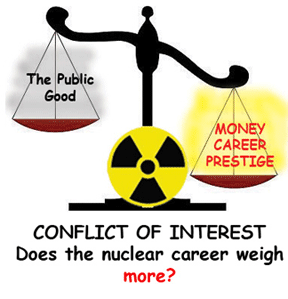
He said nuclear submarine powerplant technology was constantly improving and you would need a trained workforce but not necessarily a power industry to support it.
The defence council is the peak body representing the’s $8 billion 24,000 strong defence sector. “That’s been said [you need a nuclear power industry] but I think nuclear energy these days is much more modularised than people think….like anything else [the submarine] powerplant is manageable,” Mr Jenkins said.
“The idea of a nuclear industry as a fundamental necessity, I am not convinced, but I did think it was quite a good thing that there was a call for a really deep review from South Australia in to nuclear energy,” Mr Jenkins said.
Mr Jenkins was referring to a royal commission called by South Australian Premier Jay Weatherill into the development of nuclear power.
Defence Minister Kevin Andrews will deliver the opening address at a major two-day summit on Australia’s Future Submarine, where experts are expected to fiercely debate the competitive evaluation process given ongoing concerns over the future of Adelaide based ASC and jobs in Adelaide……..
the French firm DCNS has offered a diesel powered version of its 5000 tonne Barracuda submarine.The nuclear version of the Barracuda will be in service with the French Navy from 2017.
But its understood DCNS could offer the nuclear version of the Barracuda from around 2030 if Canberra wished to go down that route……..
Mr Jenkins said. “Given the concern over jobs, South Australia should be as keen to know the answer as anyone because it would undoubtedly be the centre of Australia’s nuclear industry,” he said. http://www.afr.com/news/politics/nuclear-submarine-option-pushed-by-industry-20150324-1m5cpx
Beyond Nuclear Initiative monitors Australia’s Radioactive Waste Management
 The Beyond Nuclear Initiative considers this timeframe to be unnecessarily compressed and constrained, especially given that the first shipment of long-lived intermediate level waste returning to Australia from overseas reprocessing in December 2015 will be returning to a purpose built storage facility at the Lucas Heights nuclear reactor complex just south of Sydney.
The Beyond Nuclear Initiative will continue to monitor progress of the NRWMP and inform stakeholders and interested parties of key developments and opportunities for input into the process. That this process is happening at all is a tribute to the tenacity of the Muckaty Traditional Owners who took such sustained action to protect their country and culture. It is also a tribute to all who supported them. Now we need to maintain our vigilance and efforts to advance radioactive waste management in Australia in a more socially and environmentally responsible way.
Radioactive Waste Update- March 2015 http://beyondnuclearinitiative.com/radioactive-waste-update-march-2015/ Natalie Wasley Beyond Nuclear Initiative coordinator.In June 2014 the Australian federal government abandoned plans to build the first national nuclear waste facility on Aboriginal land at Muckaty in the Northern Territory. The decision came half way through a federal court case challenging the nomination of the site and is a testament to the determined eight year campaign by Traditional Owners and their supporters around the country and world.
Australian non-government and civil society organisations, including environment groups, public health organisations and trade unions, have consistently requested the Minister halt the search for a single remote site in favour of a process based on an audit of all radioactive waste materials in parallel with an independent Inquiry that considered the full range of waste management options.
However, in November 2014 federal Industry Minister Ian Macfarlane instead announced intention to open a nationwide site nomination and selection process for locating a national radioactive waste facility. The National Radioactive Waste Management Project (NRWMP) was officially launched on Monday March 2 and aims to shortlist nominations, assess preferred sites and declare a final location by the middle of 2016.
The Beyond Nuclear Initiative considers this timeframe to be unnecessarily compressed and constrained, especially given that the first shipment of long-lived intermediate level waste returning to Australia from overseas reprocessing in December 2015 will be returning to a purpose built storage facility at the Lucas Heights nuclear reactor complex just south of Sydney. Continue reading
Abbott government intransigent on its plan to weaken Renewable Energy Target
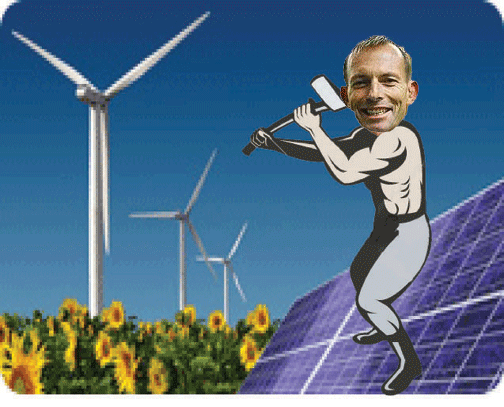 ‘Take it or leave it’, government tells renewable energy industry in latest RET talks, SMH March 24, 2015 Lisa Cox National political reporter Industry Minister Ian Macfarlane has told the clean energy industry that the government’s latest offer on the renewable energy target is a “take it or leave it” position.
In a fresh round of talks with unions and representatives for the clean energy and aluminium industries on Monday, Mr Macfarlane said the government would not budge from a figure of 32,000 gigawatt hours of renewable energy production by 2020.
The number represents a substantial reduction from the existing large scale target of 41,000 gigawatt hours and both Labor and the clean energy industry have said it is unacceptable…….
Australian Solar Council chief executive John Grimes said “we are now at the end point”.
Mr Grimes said his organisation was shut out of Monday’s talks.
“This is not a process and the end point is perpetual uncertainty,” he said. http://www.smh.com.au/federal-politics/political-news/take-it-or-leave-it-government-tells-renewable-energy-industry-in-latest-ret-talks-20150324-1m5ql8.html
Issues ignored in Radioactive Waste Management in Australia
 Radioactive Waste Management in Australia: The federal government’s revised search for a national facility ACF Briefing paper compiled by Anica Niepraschk, March 2015
“…………Related issues/ wider impact
As the current process focuses on the selection of a site, it leaves some issues untouched that are of high importance when establishing a National Radioactive Waste Facility:
- The safety of workers at the facility as well as in the wider nuclear waste industry (such as in the transport and securing of waste) needs to be ensured.
- Not only the community in near proximity of the site will be affected but also the communities along the transport routes between the facilities producing or currently storing nuclear waste and the newly established facility. A clear plan on how to engage with these communities and ensure their safety should be developed. At the current stage, there is no indication any such engagement will take place and once again, resistance among the transport routes can indirectly interfere with the proposed concept of ‘volunteerism’.
- Communities are organic mechanisms and so are characterised by change. Engaging with the affected community at the selected site only during the selection process does not live up to the requirements of such a high-safety issue. Continuous engagement, including consultations and sensitisations as well as transparent access to information, is required beyond the selection process, encompassing the establishment and day-to-day operations of the facility for its whole lifespan.
For questions, comments or additional information please contact:
Dave Sweeney – Nuclear Free Campaigner, ACF: d.sweeney@acfonline.org.au
Anica Niepraschk – Nuclear Free Campaign Intern, ACF: a.niepraschk@acfonline.org.au
Natalie Wasley – Beyond Nuclear Initiative (BNI): beyondnuclearinitiative@gmail.com
Mildura’s solar farm – successful without a cent of government money
what makes the Mildura plant so special is that it was built without a cent of government grants being tipped in.
helps illustrate how solar’s smaller, highly modular scale and fast construction time could allow it to play a far greater role in ensuring the target for the large-scale RET is met
Belectric have a developed a standardised 3MW solar power installation system they call the 3.0 MegaWattBlock (pictured below) which they roll-out across the globe.
Australia’s biggest solar farm powers-up but solar’s potential shines elsewhere, Business Spectator, TRISTAN EDIS 23 MAR
Australia’s largest ever solar power plant, AGL’s 102 megawatt Nyngan – has begun feeding power into the grid. But there’s a far more interesting solar power plant no one is talking about in Mildura.
The Nyngan plant in Western NSW now has its first 25MW of capacity, involving 350,000 solar modules made by First Solar, generating power that is exporting power to the grid. Further generation will progressively be brought online over the next three months as the remaining three sections of the plant are individually commissioned.
It’s unambiguously good news, yet I’m far more excited about the solar power plant in Mildura even though it’s substantially smaller – 3MW of capacity versus Nyngan’s 102MW. In fact it’s quite astounding that the completion of the Mildura plant has received no press whatsoever, because when it started feeding power to the grid in April last year it was the second largest operational solar power plant in the country at the time, and remains comfortably the largest in Victoria. Continue reading
The importance of connection to country – the danger of Terra Vacua

Do we want Australia to become Terra Vacua, a site of vast quarries visited only by a fly in and fly out workforce?
Without connection to country, Australia is a shallow nation. That’s what Abbott doesn’t understand Guardian Chris Sarra 25 Mar 15 The best way to unite all Australians is to encourage the ancient Indigenous connection to the land, not destroy it or label it a “lifestyle choice” any official functions throughout Australia are opened with an acknowledgement to the traditional custodians of the land. Unfortunately, it is not unusual to observe some people rolling their eyes at this. If only they knew and understood the value of such a gesture. An acknowledgment of country may not seem like much, but its value is enhanced if one can understand that this very gesture has been occurring on this land withIndigenous Australians for many thousands of years. It is an ancient and serious gesture, which was traditionally executed to enable passage on another person’s country, as well as to signal good manners.
Today Indigenous Australians offer a gift to non-Indigenous Australians by enabling them to participate in this ancient gesture. As we execute this ritual together, our history becomes shared and non-Indigenous Australians can become more in tune with the rhythm of this land we both now live on. When we understand the depth of this gesture, we are better able respect and stand alongside each other.
Last week on his visit to Kalgoorlie, Tony Abbott – who likes to be seen as one who walks alongside Aboriginal Australians – set himself apart from us when he described many of those in remote communities as making “lifestyle choices”. Even his hand-picked Aboriginal advisers denounced him.
It is clear that Abbott wants to be regarded a prominent leader in this space but such comments signal he has a long way to go. It is also clear that neither he, nor any other politician, can develop the level of understanding required and respect that comes with it, from a few carefully choreographed appearances at remote Indigenous communities. On these visits, everything is done to ensure the VIPs hear what they want to, rather than what they need to.
It is worth understanding that Aboriginal people in many remote communities are there by anything but a process of “choice”. They are there because historically their people were rounded up and detained in such places under apartheid-like policies. Nonetheless, such communities have evolved over time. It is also clear that as a nation we have left them to dwindle at the end of the societal vine rather than enabled them to evolve into communities of quality and substance that can nurture a sense of hope and strength……. Continue reading
Greens call to reinstate Municipal and Essential Services funding for remote Aboriginal communities
Consultation to begin with Aboriginal communities slated for closure in WA, Guardian Calla Wahlquist 17 Mar 15 “………Greens senator Rachel Siewert was due to move a motion on Tuesday calling for the prime minister to apologise for the “insensitive” remark.
Abbott has so far refused to apologise for the comments or concede it was a poor choice of words.
The motion will also call on the federal government to reinstate the Municipal and Essential Services funding, which will run out next year under a deal that gave states responsibility for providing for remote communities, and urge the WA government to abandon plans to close Aboriginal communities.
“Many organisations, including the National Aboriginal Community Controlled Health Organisation, have noted that these remote communities are important to cultural, emotional and social wellbeing and should not be shut down for the sake of short-sighted budgetary measures,” Siewert said.
“We need to be working with communities to deliver essential services and support, not closing and abandoning them.”…..
Dodson, known as “the father of reconciliation”, said on Sunday the avenue for dialogue between Indigenous people and the federal government had closed and urged Abbott to reconsider his approach.
“Does Australia want to have a relationship with Aboriginal people, or does it not?” Dodson said. “Or does it simply want to improve the management and control systems over the lives of Aboriginal people? That’s the seminal issue.”……http://www.theguardian.com/australia-news/2015/mar/17/consultation-to-begin-with-aboriginal-communities-slated-for-closure-in-wa
ACT solar farm project will go ahead – in a different location
ACT solar farm project moved from controversial Uriarra site to Williamsdale
666 ABC Canberra 24 Mar 15 A controversial project to build a solar farm next to the rural village of Uriarra has been dumped by the ACT Government after fierce opposition from local residents.
Plans by Elementus Energy to build a 26,000-panel solar farm that could power more than 1,400 homes will now be moved to Williamsdale in the Territory’s south.
Environment Minister Simon Corbell told 666 ABC Canberra the Government would now license parts of blocks 1470 and 1471 in the district of Tuggeranong (Williamsdale) for the OneSun Capital solar project.
But an approval process would still be necessary for the new location.
“The ACT Government is proposing to enter into a rental arrangement with the developer for a new site on land the Government now owns at Williamsdale, on the Monaro Highway,” Mr Corbell said.
“And it will occur without any change to the tariff feed-in price that the developer bid in the reverse auction for the solar farm project.
“What this means is a clearer path. We can get on and hopefully see that project built and it also addresses the concerns raised by Uriarra residents.”……http://www.abc.net.au/news/2015-03-24/act-solar-farm-project-to-move-from-controversial-uriarra-site/6342900
Australian government downplays climate change, invites sceptic to talk on foreign aid
 Critics concerned as government invites climate ‘policy sceptic’ Bjorn Lomborg to address aid staff, The Age March 23, 201 Markus Mannheim One of the world’s most prominent climate contrarians will address Australian diplomats and aid staff on Monday – an invitation that has rankled the opposition and environmental activists……Dr Lomborg is best known for his books
“climate-change alarmists” of focusing on worst-case scenarios and ignoring more positive data……Labor’s foreign affairs spokeswoman, Tanya Plibersek, questioned Dr Lomborg’s involvement.
“It’s up to Julie Bishop to explain why she made this choice,” she said.
“In particular, what kind of message does it send to our Pacific Island neighbours, who say dealing with the effects of climate change are some of the biggest challenges they face?”…….
Climate Council chief executive Amanda McKenzie also opposed the government’s decision to invite Dr Lomborg, saying he had “a history of downplaying the consequences of climate change and also of cherry-picking data”. http://www.theage.com.au/federal-politics/political-news/critics-concerned-as-government-invites-climate-policy-sceptic-bjorn-lomborg-to-address-aid-staff-20150322-1m4tor.html
Climate change, extreme heat and bushfires in WA
 The heat is on: climate change, extreme heat and bushfires in WA http://apo.org.au/research/heat-climate-change-extreme-heat-and-bushfires-wa
- Western Australia is experiencing a long-term increase in average temperatures and in 2014 the state recorded its highest ever annual average maximum temperature.
- The number of heatwave days in Perth has increased by 50% since 1950.
- Nine of Western Australia’s hottest Januarys on record have occurred in the last 10 years.
- The number of days per year
with severe fire danger weather is projected to almost double in south west Western Australia by 2090 if global carbon emissions are not drastically reduced.
Recent fires in Western Australia have been influenced by record hot dry conditions.
- The long-term trend to hotter weather in Western Australia has worsened fire weather and contributed to an increase in the frequency and severity of bushfires.
- The concept of a normal bushfire season is rapidly changing as bushfires increase in number, burn for longer and affect larger areas of land.
- By 2030, the number of professional firefighters in WA will need to more than double to meet the increasing risk of bushfires.
3. The economic, social and environmental costs of increased extreme heat and bushfire activity is likely to be immense.
- In Perth, from 1994-2006, there were over 20 heat attributable deaths per year. If average maximum temperatures were 2°C warmer, this number would almost double to 40 deaths.
- Some of Western Australia’s most fire-prone regions may become unlivable as the risks to lives and property caused by bushfires continue to increase.
- Without effective action on climate change, there will be 20 times the number of dangerous days for outdoor workers by 2070, reducing productivity.
4. Tackling climate change is critical to protecting Western Australia’s prosperity.
- As a nation we must join the global effort to substantially reduce emissions and rapidly move away from fossil fuels to renewable energy if we are to limit the severity of extreme heat and bushfires both in Western Australia and nationally.
Victorian Labor government makes regulations easier for wind farms
 Australian state of Victoria open for wind energy business http://www.renewableenergymagazine.com/article/australian-state-of-victoria-open-for-wind-20150320 Robin Whitlock Friday, 20 March 2015 The Victorian State Government in Australia has made some regulatory changes in order to make the state more attractive to wind farm developers.The changes will help to unlock billions of dollars in investment, providing a bipartisan deal can be reached on Australia’s Renewable Energy Target (RET). The director of the Clean Energy Council (CEC), Russell Marsh, said that under restrictive rules introduced by the previous government, a coal mine could be built closer to homes in the state than a wind turbine.
“It is important to get the balance right between attracting renewable energy investment to Victoria and ensuring that the voice of communities is heard when building a wind farm” Mr Marsh said. “But the restrictions introduced by the previous government simply drove wind farm companies to other states and robbed Victoria of investment and job opportunities in regional communities. New wind farm applications virtually dried up after these new measures were introduced.”
Mr Marsh added that it is fantastic to see the Andrews Government recognising the need for change and acting to address some of the most draconian parts of the former governmental legislation, which is clearly a step in the right direction.
The changes will mean that the 2 kilometre setback distance between houses and wind turbines will be reduced to 1 kilometre. The Planning Minister will decide on wind farm applications and local councils will be responsible for regulating new and existing wind farms. The ongoing review of the national RET by the Federal Government has led to an 88 percent reduction in investment in large renewable energy projects such as wind farms across the country over the course of last year. The RET remains the industry’s highest priority and bipartisan support for a strong RET needs to be secured in order to return investment and stability to the renewable energy industry. According to Mr Marsh, once this happens, the industry can look forward to working with the Victorian Government to build renewable energy infrastructure and pass the many benefits of that onto rural and regional parts of the state.
In turn, this will provide direct employment and will also provide flow-on benefits to local contractors, suppliers, shops, restaurants, accommodation providers and much more while wind farms are being constructed.
For additional information: Clean Energy Council Victorian Government
1 This month
17 October, Free Public Talk on Nuclear Issues in South Australia
David Noonan will speak on public interest concerns over the new Roxby Downs Indenture Act 2026 on BHP copper-uranium mining and ore processing in SA, and on how AUKUS may face SA with a High-Level nuclear waste agenda.
Dr Jim Green will discuss international developments in the field of nuclear power including ‘small modular reactors’ and Generation 4 ‘advanced’ nuclear reactor concepts.


Help Aunty Sue Protect Her Land and Sacred Sites From Destructive Rocket Testing.
.

Australians deserve the truth
about
AUKUS – https://aukuspublicinquiry.com/

PETITION – To: Prime Minister Anthony Albanese and the Australian Labor Government

of the week – Australians for War Powers Reform (AWPR)
To see nuclear-related stories in greater depth and intensity

