Jacinda Ardern says New Zealand’s no-nuclear line on AUKUS subs met with ‘understanding and appreciation’ in Australia

ABC NEWS, 7 July 22, New Zealand Prime Minister Jacinda Ardern has reaffirmed her country’s long-standing policy of not allowing nuclear-powered vessels in its waters, saying the rule was well understood in Australia.
Key points:
- Jacinda Ardern says New Zealand will continue to take a “strong, principled position” on its nuclear-free zone
- New Zealand banned ships with nuclear weapons and nuclear-powered vessels in its waters in 1987
- Ms Ardern says New Zealand’s defence policy would remain focused on the Pacific
Asked by 7.30 host Sarah Ferguson if there were “any circumstances” in which an Australian nuclear-propelled submarine might dock in a New Zealand port in the future, Ms Ardern said the policy was set.
“But, actually, you know, I’ve only ever encountered understanding and appreciation of that position,” she said.
“We’ve taken a strong, principled position and we’ll continue to do so. That doesn’t change the relationship we have with Australia or their understanding of our position.”
Ms Ardern has been in Australia this week for her second meeting with Prime Minister Anthony Albanese as well as meetings with state premiers………………………………….
A question of neutrality
Ms Ardern was also asked about a recent security pact struck between Solomon Islands and China, which some analysts warn could provide a pretext for the basing of Chinese troops or vessels in the Pacific Island nation.
The Solomon Islands government has repeatedly ruled out a military base.
…….. “We believe that escalation in our region and a militarisation in our region is not necessary, not called for, and not wanted. So we’re very clear on that.”
Asked if New Zealand would join Australia in increasing its defence capability in response to China’s military expansion, Ms Ardern said it was up to Australia to explain its own rationale for its defence strategy.
New Zealand’s defence policy would remain “Pacific-focused”, she said………………..
“It is not for New Zealand, or Australia, to dictate the relationships that Pacific Island neighbours have with others.”
She said China pursuing closer ties with Pacific Island nations was not a new phenomenon and that Solomon Islands had been on a “trajectory” of closer links with Beijing over a “number of years”. https://www.abc.net.au/news/2022-07-07/jacinda-ardern-new-zealand-nuclear-policy-met-with-understanding/101216094
Liberal National Party, led by Dutton and Littleproud vote on support for Queensland nuclear plants

LNP vote on support for Qld nuclear plants, Marty Silk July 8, 2022,
Liberal National Party members are set to vote on whether to make it easier for nuclear power plants to be built in Queensland.
The party will use its annual convention in Brisbane this weekend to decide on motions that could come to define its climate change and energy policies at the next state and federal elections.
They include a call to commit to net zero emissions by 2050 ahead of the 2024 state election and to repeal any law preventing the construction of a nuclear power plant in Queensland.
“So that it authorises the construction or operation of the following nuclear installations: a nuclear fuel fabrication plant; a nuclear power plant; an enrichment plant; and a reprocessing facility,” the motion put forward by three LNP branches says.
Other motions call for an end of government subsidies for renewable energy and for domestic coal, oil, gas and uranium reserves.
The LNP motions could be decisive in determining the federal coalition’s energy policies as both the Liberal and National leaders – Peter Dutton and David Littleproud – are members.
Mr Littleproud last month wrote to Prime Minister Anthony Albanese urging him to consider small-scale nuclear plants to reduce emissions and improve reliability.
Formed in a merger of the two parties 14 years ago, the LNP currently holds more seats in Queensland than the coalition does in any other state.
The Queensland party’s three-day annual convention starts in Brisbane on Friday will begin charting a course for its return to power.
Opposition Leader David Crisafulli is hoping to lead the LNP to victory in two years’ time against what will then be a nine-year-old Labor government.
Federal Opposition Leader Mr Dutton is on leave and will miss the convention, but his deputy Mr Littleproud will speak on Saturday………………………………
There are also motions to water down land clearing laws and to oppose any increase of national park areas in Queensland…………………………
Albanese’s extreme language against China is out of place now, and against Labor tradition
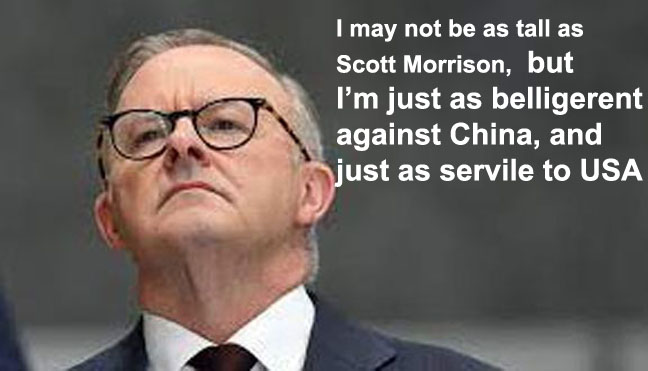
Even the hawkish former defence Minister Peter Dutton told National Press Club that he did not believe China wanted to occupy Australia. Why then do both sides of politics go out of their way to make an enemy of China. It is a recklessly provocative policy that could cause many Australians to die unnecessarily.
Albanese blasted China for not condemning Russia’s invasion of Ukraine but exempted India which did the same.
China has not been in major war since 1950. Nor has it killed anyone in the South China Sea or near Taiwan, where it is accused of behaving more aggressively. All major countries accept Taiwan is part of China.
What is Anthony Albanese up to! https://johnmenadue.com/what-is-anthony-albanese-up-to/ By Brian Toohey. Jul 6, 2022
Anthony Albanese has shown during his recent trip to Europe that he is a prime minister addicted to hyperbole and oblivious to how countries can change in unexpected ways.
He told NATO leaders China aimed to become the most powerful nation in the world and its strengthening relations with Moscow “posed a risk to all democratic nations”. It’s most unlikely all democratic countries will be at risk. For a start, Russia will be in no condition to go to war with any other country after its abhorrent decision to invade Ukraine. It could be bogged down for years in a guerrilla war. China faces a growing number of countries, including those in NATO, which are committed to containing its military and economic growth.
Albanese said in Europe that China is trying to “build up alliances to undermine what has historically been the Western Alliance in places like the Indo Pacific”. Historically, however, most Asian countries, including India and China, have been there a lot longer than the Western intruders are likely to last. The US may be the exceptional state. It annexed Hawaii in 1898 and made it an American state in 1959. But there is a plausible chance America will not remain a democracy in coming years. While nothing is certain, China may become a democracy sometime after a discredited President Xi is deposed or dies. If so, it is entirely feasible the public may elect a majority Communist government led by a moderate reformist. No one knows. Alternatively, the US may become an autocratic state with a feral Supreme Court while China remains an autocratic state with an unpopular and futile determination to achieve “Zero Covid”.
The story of other members of the Western alliance is one of momentous change. Britain took Hong Kong by force in 1842 as a base for peddling opium produced in India by the British East India Company. India won its independence from Britain in 1947 and Hong Kong was handed back to China in 1977. France had a cumulative 100 years as the colonial power in Indochina until booted out by the Viet Minh in 1953. However, it retained its colonial possessions in the Pacific Islands. Albanese told President Macron in Paris that France was an Indo Pacific power which could help contain China’s “growing ambitions” in the region.
Albanese told President Macron in Paris that France was an Indo Pacific power which could help contain China’s “growing ambitions” in the region.
Albanese blasted China for not condemning Russia’s invasion of Ukraine but exempted India which did the same. Labor’s Defence Minister Richard Marles earlier warmly praised India and said it is “central to Australia’s worldview and defence planning”. It also has a Hindu supremacist government that actively discriminates against Islamic members of the population.
While in Europe, Albanese falsely claimed that Australia always obeys the international rules. If it had, it would not have helped the US and the UK invade Iraq. The invasion killed or seriously injured large numbers of people and rendered even more homeless. It also allowed terrorist groups to operate in Iraq when none were present under Saddam Hussein. Albanese’s misleading assertion dishonours Labor’s leader at the time, Simon Crean, who opposed the invasion as a breach of the rules forbidding the use of military aggression in international relations.
Albanese caught the attention of his European audience when he complained that China had “economically coerced” Australia. A fuller picture would have acknowledged Australia officially took more than 100 anti-dumping complaints against China, despite usually frowning on such measures as potentially harming free trade. China eventually retaliated with tariffs and anti-dumping measures on some Australian exports to China. Albanese gives no sign that he understands China is not the only one who should back off.
China has not been in major war since 1950. Nor has it killed anyone in the South China Sea or near Taiwan, where it is accused of behaving more aggressively. All major countries accept Taiwan is part of China. Some of China’s opponents, including senior US Republican politicians, seem intent on goading it into using military force against Taiwan. Fortunately, Taiwanese leaders seem to understand that the island will not be attacked unless they declare independence. China could make this less likely by granting Taiwan a genuine status as autonomous region. One reason China won’t grant independence is this would make the island a convenient base to stage attacks against the mainland. Nevertheless, an experienced observer Geoff Raby says China won’t attack the island as this would involve the killing fellow ethnic Han Chinese which would be highly unpopular.
China makes claims to territorial waters in the South China Sea that other littoral countries also claim. The Pentagon acknowledges China withdrew six land claims to settle borders disputes. If it wants to be more accommodating, China could settle some of the extreme territorial sea claims that were originally made by the Communist Party’s political opponent, the Nationalist Party, before 1949. Taiwan also makes these claims. Ideally, China Sea could follow the Antarctic example and offer to turn South China Sea into a demilitarised zone beyond the 12 nautical mile offshore line.
There is no dispute that China is building up its armed forces. But its spending is no match for the US which is spends as much as the next nine countries together, including China. China has good reason to respond to a US military build up. In 2009, the US announced it had developed an Air/Sea Battle Plan for a war with China, to destroy much of its air and naval forces and blockade all its ports and maritime routes. The details have changed, but in 2011 the US also adopted a “pivot” to the Pacific with goal of deploying 60 per cent of its forces there. It is also actively engaged in building new bases on Pacific islands within striking distance of China while the Albanese government loudly opposes any hint that China might try to build naval base in the Pacific, or even in nearby Cambodia. US and Australian forces also constantly undertake surveillance missions close to China.
In these circumstances, it is vital to try to ease tensions on all sides to avoid what would be a terrible war. In the past, Labor would be among those urging support for new arms control agreements and expanding all channels for the potential combatants to talk. Ben Chifley, Bert Evatt, Gough Whitlam, Bill Hayden, Gareth Evans and Paul Keating all made significant efforts to actively promote peace. Anthony Albanese is supporting a large arms buildup, which is not the same thing.
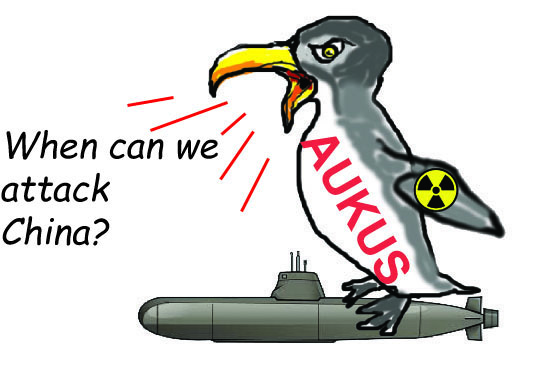
Well before Albanese’s European trip, he stressed the Labor government would support the Coalition’s new security pact between Australia, the UK and the US (AUKUS). No one has given a convincing explanation for why we need AUKUS on top of the Australian New Zealand US (ANZUS) security treaty signed back in 1951.
The UK adds nothing of value. In 1968 the then Labour Prime Minister Harold Wilson announced that Britain would withdraw its military bases from “East of Aden”. This was a good policy reflecting the fact that Britain no longer ruled the waves. Wilson also refused to send British troops to the Vietnam war, partly because the country couldn’t afford it. Yet Britain retained its “special relationship” with the US. A subsequent government restored a military base in the Middle East, but now Boris Johnson, a disastrous prime minister, has given British military forces a role in confronting China in the Asia-Pacific.
Although the text of AUKUS has not been released, it states the US and UK are prepared to sell nuclear submarines to Australia. They would’ve done that without AUKUS. They would also have done so for other countries such as Japan, South Korea, Vietnam and Singapore, but they see more advantages in writing operating modern conventionally powered ones. NATO members without nuclear subs could buy them, but don’t because it doesn’t make military or financial sense. Yet Labor still wants buy eight nuclear subs, almost certainly from the US, so it can fire cruise missiles from nuclear submarines operating far from Australia into China. This is an extremely bad idea on both strategic and cost grounds. It will only provoke China which çan fire more missiles into Australia than Australia can fire into it. We could do more to defend Australia from closer to home with a mix of weapons at a much lower cost. Moreover when our nuclear submarine fires the first missile into China it will be detected and almost certainly sunk.
Plausible estimates put the cost of eight US nuclear submarines at $171 billion. (This is from a government that says it can’t afford to increase the miserable level of the New Start Allowance.) The risks of buying nuclear are on the upside, particularly as Australia wants to build them here.
The first submarine, probably a version of the US Virginia class attack ones, will not be operationally available until the early 2040s and the last by 2060. A leading US defence analyst Winslow Wheeler cautions that the Virginia class has maintenance problems and is not available for much of the time. He says that over 33 years they have only performed 15 six monthly deployments.
The former Senator Rex Patrick, an ex-submariner, says that conventionally powered submarines are now commonly equipped with air independent propulsion (AIP), which makes them quieter than nuclear submarines which have to keep their reactor cooling pumps going and use noisy big meshing gears between the steam turbines and propellers. Others point out that nuclear subs can be detected by their constant release of hot water; by leaving wakes on the surface when run at high speeds and by blue green lasers that will penetrate water by 2040.
Patrick says that figures given to the parliament show Australia could buy 20 modern off-the-shelf conventional submarines for $30 billion – not $171 billion for nuclear submarines that don’t meet our requirements.
Another downside of buying nuclear subs is that we would have to meet our obligations to declare any fissile material under our control to the International Atomic Energy Agency which acts on behalf of the Nuclear non-Proliferation Treaty (NPT). However, the US will refuse to give us the required information about the highly enriched, weapons grade uranium in the reactors.
A further problem is that several Pacific Island leaders don’t want Australia to buy nuclear submarines. Nor, as Foreign Minister Penny Wong discovered on her recent visit to Malaysia, do its leaders.
Australian public opinion does not unambiguously support Labor’s strategy. The latest Lowy Institute’s annual poll shows over 51 per cent believe Australia should remain neutral in a military conflict between China and the US.
Even the hawkish former defence Minister Peter Dutton told National Press Club that he did not believe China wanted to occupy Australia. Why then do both sides of politics go out of their way to make an enemy of China. It is a recklessly provocative policy that could cause many Australians to die unnecessarily.
Scientist sheds doubt on the viability of Australia’s planned Kimba nuclear waste dump.
Peter Remta 7 July 22, This is the comment by the scientific expert who has been responsible for Australia’s only two nuclear waste management facilities and is often asked by ARPANSA for advice .
There was an oblique reference to aerodynamic surveys in the characterisation reports by AECOM.
I have no idea why they would be doing this now.
This is the kind of survey that would be undertaken prior to selecting a site to identify prospective geology and avoid areas of commercial mineralisation that would be sterilised by siting a radioactive repository. It smacks to me of someone with a bottomless budget to spend or be lost.
As a consultant advising a client on site evaluations on a regular basis, I do my best to minimise the extent of work done to only that which is required and will provide important supporting information, as such survey work is costly.
A good comparison is Deep Isolation from California which apparently has raised USD$35 million but most overseas experts regard its technology as old hat and not really workable and above all not safe
+
AUKUS submarines: Beasts of nuclear proliferation
The AUKUS security partnership, announced last September by Australia, the United States and Britain, has muddied the pool of non-proliferation.
The precedent of permitting Australia to be the only non-nuclear weapons state with HEU-propelled technology is also seismic on another level.
For one thing, Article III of the NPT exempts naval reactors from nuclear safeguards, which threatens a pillar of the non-proliferation regime — limiting the production and use of highly enriched uranium (HEU) which can be used, in turn, to make nuclear weapons.
There will be nothing stopping China and Russia doing what the United States and Britain promise to do: proliferate naval reactor technology and long-range missiles with a nuclear capability.
https://www.greenleft.org.au/content/aukus-submarines-beasts-nuclear-proliferation Binoy Kampamrk, July 6, 2022, Issue 1352,
When faced with the option of acquiring nuclear technology, states have rarely refused. Since the splitting of the atom and the deployment of atomic weapons in war, the acquisition of a nuclear capacity has been a dream. Those who did acquire it, in turn, tried to restrict others from joining what has become, over the years, an exclusive club.
Members of this club engage in elaborate ceremonial claims that their nuclear weapons inventory will eventually be emptied. Non-nuclear weapons states allied to such powers go along with appearances, taking comfort that nuclear weapons states will offer them an umbrella of security.
This hypocrisy underlines such arrangements as the Treaty on the Non-Proliferation of Nuclear Weapons (NPT).
Central to the document is the discouragement of non-nuclear weapons states from weaponising nuclear technology, as long as members of the nuclear club pursue “good-faith” disarmament negotiations. While it is true to say that the NPT probably prevented a speedier, less infectious spread of the nuclear virus, it remains a constipated regime of imperfections that has only delayed proliferation.
Most tellingly of all, most non-nuclear weapon states have complied with their undertakings whereas nuclear weapons states have not: they have disregarded serious multilateral nuclear disarmament. Nor do they have an incentive to alter current arrangements, given that any changes to the NPT can only take place with the unanimous support of the three treaty depositories: Russia, Britain and the United States.
The NPT supporters pour scorn on alternative approaches to nuclear weapons, such as the Treaty on the Prohibition of Nuclear Weapons (TPNW), which held its first meeting of state parties in Vienna from June 21—23.
While the Anthony Albanese government sent Susan Templeman MP to the meeting as an observer, Canberra has remained consistently opposed to the TPNW as a threat to the accepted disarmament and NPT framework. Dated and spurious concepts, such as extended nuclear deterrence and the interoperability of Australian and US military systems, tend to be common justifications.
The AUKUS security partnership, announced last September by Australia, the United States and Britain, has muddied the pool of non-proliferation.
A central component of the agreement is a promise to share nuclear propulsion technology with Australia, thereby enabling it to acquire eight nuclear submarines, to supposedly be built in Adelaide.
While much of this is wishful thinking — Australia has no expertise in the field and will have to rely on expertise from the other two — the glaring problem with AUKUS is what it does to non-proliferation arrangements.
While former Prime Minister Scott Morrison said the agreement would comply with Australia’s own non-proliferation commitments, such confidence is misplaced.
For one thing, Article III of the NPT exempts naval reactors from nuclear safeguards, which threatens a pillar of the non-proliferation regime — limiting the production and use of highly enriched uranium (HEU) which can be used, in turn, to make nuclear weapons.
Non-proliferation experts have not been enthusiastic with the promised new Royal Australian Navy submarines. Daryl G Kimball, director of the Arms Control Association, noted the salient difference between deepening defence cooperation with allies on the one hand and proliferating “sensitive HEU nuclear propulsion tech in contravention of US and global nonpro principles”.
Hans Kristensen, director of the Nuclear Information Project at the Federation of American Scientists, greeted AUKUS with gloom when it was announced. Its provisions on nuclear technology would “further intensify the arms race in the region and the dynamics that fuel military competition”.
The International Atomic Energy Agency’s (IAEA) Director General Rafael Mariano Grossi is visiting Australia to discuss safeguards of nuclear material used for naval propulsion.
This is nothing short of problematic, given that IAEA inspectors are unable to inspect such material for extended periods of time when the vessel is at sea. Grossi described this process as “quite complex”, although he wants Australia to commit to non-proliferation alongside the acquisition of nuclear technology.
“There is a period of 18 months which was given by the three partners — the United States, United Kingdom and Australia — to define how the project is going to be implemented but, already we have started this interaction, this joint work of technical levels so that we can reconcile both things.”
Prior to Grossi’s visit, Foreign Minister Penny Wong reiterated Australia’s “longstanding” support of the “IAEA’s mission to harness the peaceful use of nuclear technology in areas like medicine, industrial processes and environmental monitoring, as well as upholding the international nuclear non-proliferation regime”.
The world Wong described is distinctly pre-AUKUS. Despite promises of “open and transparent engagement with the IAEA on nuclear safeguards”, the whinnying horse of proliferation has bolted from the stable. Assurances to avoid the future development of nuclear weapons capability in Australia or a national nuclear fuel cycle also ring hollow.
The precedent of permitting Australia to be the only non-nuclear weapons state with HEU-propelled technology is also seismic on another level.
There will be nothing stopping China and Russia doing what the United States and Britain promise to do: proliferate naval reactor technology and long-range missiles with a nuclear capability. [Dr Binoy Kampmark lectures at RMIT University.]
Kimba nuclear waste dump – phase 3 in progress, but the Australian Radioactive Waste Agency (ARWA) has not completed phase 2 !
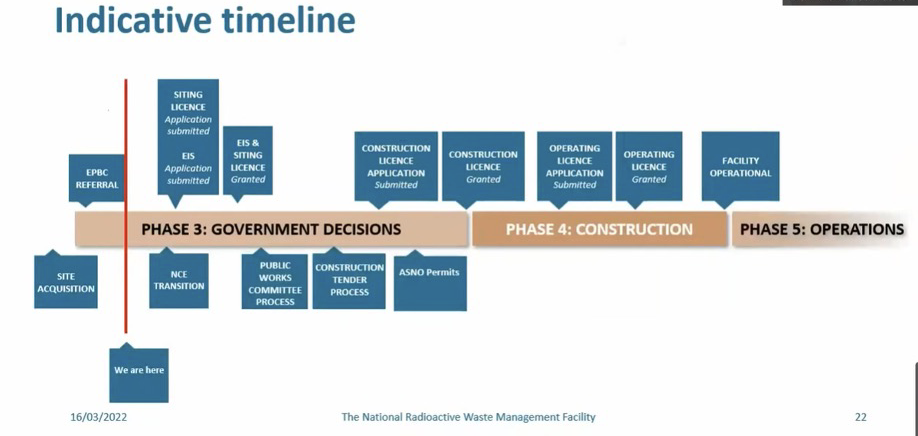
Peter Remta. Timeline for development of Kimba facility 6 July 22.
Out of interest this is the timeline produced by the Australian Radioactive Waste Agency (ARWA) showing where the progress of the Kimba nuclear waste facility development was as at 16 March 2022.
From this timeline it appears that the government is already into phase 3 of the Kimba development but this is completely false as it has still not completed phase 2 in accordance with the prescriptions of its official nomination guidelines issued in November 2016 and titled Radioactive Waste Management Land Nomination Guidelines.
Time to speak up: water apartheid is Australia’s dirty secret
Canberra Times By Erin O’Donnell, Kirsty Howey, July 4 2022
Imagine, in Australia, having to buy bottled water just so you can have clean water to drink. Imagine in 2022, in Australia, Aboriginal communities still have to do that, because they don’t have access to safe drinking water supplies.
While the 2022 NAIDOC week theme is get up, stand up, and show up, that’s an instruction for all of us.
All Australians need to get up, stand up, show up and speak up about this national shame.
In the Northern Territory, drinking water in remote communities regularly breaches guidelines for uranium, and heavy metals. It makes people sick. In Western Australia, the Auditor-General found 24 communities still require the government to truck in bottled water, as local supplies contain harmful contaminants, including uranium. In Queensland, remote, largely Indigenous, townships have faced ongoing water quality issues. Further south, NSW communities also struggled with water quality during the recent drought, and a 2022 study found towns and communities with higher Aboriginal populations and lower income levels were less likely to have access to free sources of filtered water within the community.
In the NT, predominantly white towns such as Darwin, Alice Springs and Katherine have a regulated and safe drinking water supply, but in Indigenous communities drinking water supply is unregulated, with many residents needing to resort to buying bottled water. And far from being an unavoidable consequence of life in remote communities, this is the result of ongoing failure by successive NT governments to plug gaps in water regulation.
………………………………………… The new Labor government’s commitment to restoring a National Water Commission must end water apartheid in Australia. The commission cannot come too soon for northern Australia, where this disaster is unfolding. https://www.canberratimes.com.au/story/7804335/time-to-speak-up-water-apartheid-is-australias-dirty-secret/
Julian Assange’s 51st birthday.
 | |||
|
Alan William Preston 2 July 22, 1174 days in solitary confinement in London’s Belmarsh prison for having published evidence of the American military’s deliberate breaching of the Geneva Conventions during their illegal occupation of Iraq during which their personnel recorded 61,000 civilian deaths caused by their activities.
This is only a small corner of the truth he was shining the light on.
No further investigations or prosecutions for these war crimes have ever been pursued. Now the U.K. government is scrambling to disconnect itself from the European Court of Human Rights.
The U.N. had deemed that Julian Asssange had the right to publish this material and that his imprisonment is arbitrary and that the conditions equate to psychologicial torture and is ‘intimidation and reprisal’ being inflicted by the states that stand implicated by the evidence received and published.
We need to set the terms of reference for a Royal Commission of Inquiry into the dysfunction in all the checks and balances that have allowed this travesty of injustice to occur.
Julian Assange files new appeal fighting extradition to US.
Washington Examiner. by Ryan King, Breaking News Reporter, July 01, 2022
WikiLeaks founder Julian Assange is appealing the United Kingdom’s order to extradite him to the United States.
Two appeals were filed in the High Court of Justice in London to challenge the extradition, and the court will decide whether to evaluate the case, Assange’s attorney Gareth Peirce announced, according to the Wall Street Journal……………………………………
Friday was the deadline for Assange to appeal the extradition order, according to the BBC. He is being held at Belmarsh prison in London.
His lawyers claimed that he could face up to 175 years behind bars if he stands trial in the U.S., but the U.S. argued he will likely face between four and six years.
A myriad of groups championing freedom of the press urged the U.K. not to extradite Assange, arguing that doing so could set a bad precedent and hamper press freedoms in the future. For example, the International Federation of Journalists has expressed concerns the move could pose a “chilling effect” on journalists worldwide.
“The US pursuit of Assange against the public’s right to know poses a grave threat to the Fundamental tenets of democracy, which are becoming increasingly fragile worldwide,” the group said. “Irrespective of personal views on Assange, his extradition will have a chilling effect, with all journalists and media workers at risk.”
“The case sets a dangerous precedent that members of the media, in any country, can now be targeted by governments, anywhere in the world, to answer for publishing information in the public interest,” the group added.https://www.washingtonexaminer.com/policy/courts/julian-assange-files-appeal-fighting-extradition
Mr Albanese goes to Madrid: Australia on the alliance path to Global Nato

Albanese’s trip to the leaders’ summit of a US-dominated alliance centred on the other side of the world will prepare the way for deeper Australian integration into a broadened Nato.
Above all, in one respect Mr Albanese’s rush to Madrid is not so different from his predecessor’s cajoling of Washington and London to help out a mate with the anachronistic PR nonsense of AUKUS and the gift horse of a ‘privileged’ offer to allow Australia to buy massively expensive American or conceivably British nuclear-powered submarines.
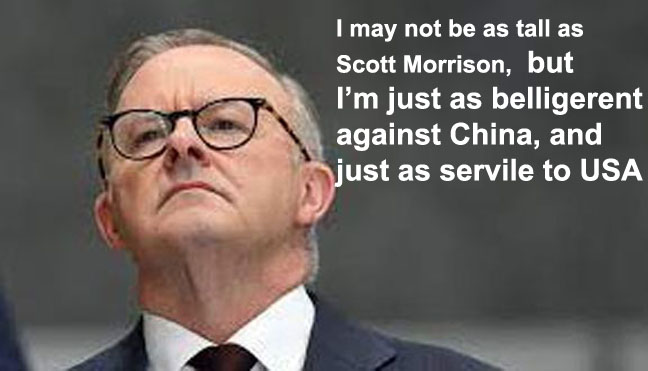
https://johnmenadue.com/mr-albanese-goes-to-madrid-australia-on-the-alliance-path-to-global-nato/ By Richard TanterJun 30, 2022, While most eyes rest on the remains of Scott Morrison’s failed attempt at a khaki election through last September’s announcement of a backward-looking AUKUS alliance, prime minister Anthony Albanese’s trip to Madrid for the North Atlantic Treaty Organisation summit points to a much more significant shift in Australia’s alliance with the United States – ‘a global alliance of democracies’, aka Global NATO.
Scott Morrison’s AUKUS centring on agreement with the US and UK to provide Australia with submarine nuclear propulsion evoked derision about its back to the 1950s strategic vision and despair about what promises to be the worst and most consequential of Australia’s numerous recent politically-driven defence procurement choices.
The submarines debacle apart, AUKUS for the most part remains a matter of two or three lines of unpromising promises in media releases, largely dealing with matters already the subject of bilateral agreements or dimly-seen possible futures like quantum computing for defence purposes.
The most recent, if somewhat limp, nudge to keep the Albanese government on the nuclear submarine track came at the National Press Club when the Lowy Institute’s Michael Fullilove mocked an informed questioner concerned about the deal’s implications for the tattered nuclear Non-Proliferation Treaty. This widely-held worry – if first Australia, then serious nuclear weapon-wannabes Brazil and South Korea – was in fact unimportant Fullilove replied, since experts such as former Foreign Minister Gareth Evans have assured us are under control.
At the same time the US has just added its confidence booster to this process with a bill before Congress for an Australia-U.S. Submarine Officer Pipeline Act that would allow two RAN submariners a year to attend a seven-week nuclear reactor training, take the US Navy’s Submarine Officer Basic Course, and then deploy aboard a US nuclear-powered submarine.
This only leaves the imponderables of deciding the strategic rationale of the mission to which the submarines are to be solution, the actual technical requirements that would be entailed by that mission, the design of the submarine, the choice of country and lead contractors for the build, the development of a full-scale naval nuclear-engineering safety and maintenance regime, and a brief discussion of the lifetime costs likely to be more than a couple of multiples of the $100 billion estimate for the French submarines.
What could possibly go wrong?
And that’s before any discussion of opportunity costs – even for alternative contenders for defence spending, let alone meeting non-military requirements for a secure Australia – of the lifetime costs of a commitment to nuclear submarines that are likely to move towards the half trillion dollar mark.
But Albanese’s trip to the leaders’ summit of a US-dominated alliance centred on the other side of the world will prepare the way for deeper Australian integration into a broadened Nato.
For over a decade US and Nato officials and Australian defence advisors have been calling for ‘a global alliance of democracies’. The Australian prime minister, together with the leaders of Nato’s other ‘Asia-Pacific partners’ from Japan, New Zealand and South Korea, will participate in the launch of the first formal iteration of Global Nato with Nato’s Strategic Concept 2022.
Two decades of high tempo deployment of Australian military under Nato auspices in the disastrous wars in Afghanistan and the Middle East have conditioned the Australian Defence Force to close operational coordination and interoperability with US-led Nato ground, air, and naval forces.
Defence planners have gradually integrated Nato into high-level Australian strategic planning, first as an ‘Asian partner’ Nato along with Japan, South Korea and New Zealand, and recently as an ‘Enhanced Strategic Partner’.
Nato’s centrality to the hyper-multinational International Security Assistance Force in Afghanistan provided the first and possibly most important Australian escalator into Nato.
While replete with consequences as lethal for the people of Afghanistan as they were dysfunctional for all of the alliance militaries involved, ISAF, together with the parallel US-orchestrated Combined Maritime Forces in the western Indian Ocean from 2002, provided deep operational experience and ‘learnings’ for a Nato-centred US-led coalition on a scale approaching a multilateral ‘global’ presence.
Nato’s Strategic Concept 2022 is to be formalised at the Madrid Summit, representing a maturation of US post-Cold War planning for a major step towards an integrated global defence alliance after seventy years of US-dominated Nato in Europe and the limitations of bilateral hub-and-spokes alliances in Asia.
Most importantly, apart from integrating its Asian partners more closely, the new Strategic Concept is to prepare Nato ‘against all threats, from all directions’.
Full membership of Nato for any of these Asian partners will be a long way off, not least because the governing institutions of a now 30 member country nuclear alliance will need adjustment, even assuming there is no uncomfortable internal opposition as Turkey has mounted against the admission of Sweden.
For the present, Australia, Japan and Korea – and possibly New Zealand – will be drawn into Nato’s seemingly endless rounds of political, diplomatic, military and civil society consultations (though the last is in practice a most attenuated and selective grouping of actual national and international civil society).
US-led military interoperability drives will be coupled with injunctions for closer political and strategic planning coordination between Canberra and Brussels (aka Washington).
But there can be little doubt of the ultimate goal for Washington in the construction of ‘an alliance of democracies’ with global reach.
The follies of AUKUS distract attention from the scale of the quiet achievement of the United States in rescuing Nato from post-Cold War obsolescence, latterly assisted greatly by the Russian war against Ukraine.
Drawing the line from Kyiv to Taipei, ‘we know’, the Prime Minister said, ‘that there is an alliance that has been reached as well between Russia and China. There are implications for our region, given the strategic competition that is in our region, which is why this Nato summit comes at such a critical time’.
As Mr Albanese rightly put it Russia’s ‘brutal invasion is against the rule of law’, and carries implications for ‘all of those who cherish democracy, who cherish the rule of law, and who cherish the rights of nations to be sovereign’.
Yet Australia needs to tread carefully.
The warm glow of rhetorical solidarity with Ukraine facing World War 2-scale Russian attack tends to veil the fact that multiple US-auspiced Nato interventions in the Middle East, North Africa and Afghanistan have led, via great destruction, to evident defeat or specious ‘mission accomplished’.
Moreover the list of Nato members and partners does not provide an unsullied list of countries honoured for their respect for democracy, rule of law, or sovereignty.
Mr Albanese might like to chat about the rule of law with Victor Orbán from Hungary or Recep Tayyip Erdoğan from Turkey, or indeed with Boris Johnson – or mull over the battered state of American democracy with Joe Biden.
Perhaps a stopover by his RAAF plane in Diego Garcia might prompt some thoughts about British respect for the rule of law – in certain respects, such as the forced dispossession of the indigenous Chagos Islanders to make way for a giant US military base often used by Australia, more egregious than China’s violations of international law somewhat further east.
Above all, in one respect Mr Albanese’s rush to Madrid is not so different from his predecessor’s cajoling of Washington and London to help out a mate with the anachronistic PR nonsense of AUKUS and the gift horse of a ‘privileged’ offer to allow Australia to buy massively expensive American or conceivably British nuclear-powered submarines.
By all means, let us make common cause with governments we find congenial – when our interests do in fact genuinely align. Defence coordination and cooperation with democratic states in our principal areas of strategic interest is a must for Australia. The problem is that Europe is not such an area, and neither was the Middle East, Afghanistan, nor Nato’s latest fronts in North Africa and the Sahel.
Thinking about an alliance of democracies is not inherently foolish. The problem comes when the form of periodic elections is confused with the substance of democracy. It may seem carping to point to the Orbans and Erdoğans of Nato, but with Marine Le Pen possibly just one more election away from the Elysée, the authoritarian threat in Europe is palpably real.
Remarking on a British prime minister’s announced willingness to trash international agreements for political gain at the risk of re-starting a war in Northern Ireland may seem unoriginal, it is scarcely beside the point with talk of new alliances built on rule of law.
Most seriously of all, we should be talking about the risk of a precipitous decline, or even collapse, of democracy in the United States extremely seriously. Appalling as it is, the Supreme Court decision abolishing US women’s rights to control their bodies is but the latest blow to the unexamined claim for the United States to still be called a global model of democracy.
The view in Canberra seems to be that the US alliance has survived the threat of Trump, so it’s back to business as usual, and onward to ever closer union – with the path leading now through Brussels. Yet the dangers to Australia from unconsidered reliance on a country with both systemic dysfunction and deep anti-democratic impulses at its heart should not be ignored.
The common element between the swooning Australian interest in Global Nato and the Morrison fiasco with AUKUS and the manifold problems of its submarine element is that in both cases a considered assessment of whether Australian national interests align with those of the United States – in this case in the guise of Nato – is absent.
The new Australian foreign minister has started a commendable reset of Australian regional relations in an effort to recover, at least as a start, from the wreckage of a decade of coalition policy.
In a series of important statements on foreign policy in recent years Penny Wong eloquently has made the case for understanding that a proper consideration of our national interest cannot be separated from the long and sometimes difficult process of working out who we are.
Interests very largely flow from identity, especially when it comes to reading a map of threats and opportunities. Why then would the first foreign policy ventures of a new prime minister be tied to an alliance with the other side of the world – for Australia, the old world?
AUKUS nuclear submarine plan to be revealed by March 2023
ABC By defence correspondent Andrew Greene 29 June 22,
Key points:
- The Morrison government previously indicated a decision could be made this year
- The Labor government is also hoping to know soon if an interim submarine solution is needed
- Numerous defence figures have warned Australia is facing a capability gap because of ageing submarines…………………… https://www.abc.net.au/news/2022-06-29/richard-marles-defence-projects-submarines-aukus/101190876
Spinbusting the propaganda of SMR Nuclear Technology’s Tony Irwin as he spruiks for Small Nuclear Reactors for Australia

First to nuclear power, which, we should remember, has been effectively banned in Australia since the late 1990s.
On page three of the Sunday Telegraph in Sydney, columnist Piers Akerman wrote an “exclusive” news
story showing “nuclear energy is cheaper” than coal, gas, solar or wind. Such a claim would overturn pretty much all serious analysis of electricity costs around the globe. So where did it come from? The
International Energy Agency maybe, or perhaps the CSIRO?
No. Akerman quoted “new data” from Tony Irwin, who is a nuclear industry veteran and a technical director at a consultancy company with “specialist industry knowledge on the procurement and development of nuclear technologies” with a focus on small modular reactors (SMR).
But one problem with using Irwin’s numbers is they are based on an estimate of the cost of one
particular SMR design which has not yet been built and won’t produce power until at least 2029.
Guardian 30th June 2022
Oh, for a Prime Minister honest about Australia’s security!
https://johnmenadue.com/oh-for-a-prime-minister-honest-about-australias-security/1 By Mike Gilligan, Jun 29, 2022,
How did it come to this? Australia’s defence policy has been baldly sacrificed to US interests via AUKUS with little public discourse.
Mostly, those that present as security experts have mumbled support as the US entangles Australia in its planning for war with China. Not a word from the serried rows of professors, publicly funded, who otherwise jostle for public exposure.
For five decades Australia’s security policy has centred on defending our territory independently. Self-reliance has been the prudent and rational posture for Australian governments with ANZUS deliberately avoiding a commitment to armed response by the US in the event of attack on Australia.
Implementing that strategy has been a big task – intellectually, financially and managerially, requiring all our defence spending to be directed to that objective. Whenever we have chosen to join the US in its global wars we did so with modest contributions drawn from forces created for our own priorities, measured to signal political support but not detract from our own objective. Now that policy has been abruptly buried with AUKUS requiring our taxes to heavily fund US strategic denial of China – building nuclear submarines of little value for our own needs to fit with US planning for military conflict with China.
How could Australia’s security policy move largely unremarked from an earnest and internationally respected self-defence policy to mounting aggressive deployments into China’s adjacent waters, at mind numbing cost? Former Prime Minister Paul Keating was an early and insightful critic of AUKUS. Just a few weeks after it was announced, Keating addressed the National Press Club, in November last year. He began by inferring that it was because mainstream media coverage of security is so weak in Australia he felt compelled to share his perspective. Keating’s reservation was reinforced by the level of questions from the floor at the end. Keating made the then striking claim that Australia was to build nuclear submarines specifically to attack China in its waters. He observed that this had been admitted effectively by Australia’s ambassador to Washington, Arthur Sinodinos. The submarines would be designed to attack China’s nuclear missile submarines which are China’s second-strike deterrent to US nuclear attack on China.
So, Australia is being set up as a key factor in the nuclear war equation of the US and China. Broadly, Keating argued that China deserves respect. It now has a bigger economy than the US by 25% and can be expected to expand that gap in coming decades. China has shown it wants to participate in global structures and be part of reform. China has a lot to offer and is not contriving to run the world. Its security concern is to push US sea and air military forces away from its borders, noting US and other forces (including Australian) exercise in the South China Sea. The more senior of the serried professors, Paul Dibb, quickly took up the pen disparagingly against Keating, observing that Keating “gave the strong impression of being a sleepwalker”. Dibb is thereby suggesting it has long been common knowledge that Australia is preparing for war against China. If so, that is news to most Australians, including those who have a more-than-cursory interest in our security affairs.
On Thursday last week, Dibb was delivered by ABC TV into the living rooms of Australians via the 7:30 Report, unannounced and without context, just prior to Leigh Sales’ interview with Prime Minister Albanese. His hectoring message was that Defence should have first priority from the Government, to ensure that it counters an “aggressive and expansionist” China. Urgency was implied as China could exploit a “window of opportunity” with the US distracted by the Ukraine. I suspect most viewers thought that this was just more of the banality we enjoy on Thursday nights from Sammy J. But it was shabby, ABC.
Dibb’s professional pedigree lies in Cold War intelligence. It has been claimed that he enjoyed unusual access to sensitive classified material for years. In this regard Dibb should now be obsolete. These days he writes for an online ASPI platform where his paragraphs settle comfortably alongside trademarks of weapons systems purveyors. The tone is invariably unsettling and receptive to greater defence spending. Yet big media conduits such as the Press Club and ABC television, which provide him a national platform at prime time, offer no declaration of interests.
Another professor, Rory Medcalf, head of the “National Security College “ at the ANU with staff of about sixty, writes and comments regularly. His recent book “Contest for the Indo-Pacific” is engaging but the substance is a worry. In discussing Australia, Medcalf shows poor comprehension of the realities of Australia’s defence policy post ANZUS: “ Australia relies acutely on … in the ultimate crisis, the expectation under the ANZUS Treaty that overwhelming (US) force would come to its aid “. In fact Australia’s policy has been quite the reverse – to have no such expectation of US force intervening on our behalf under ANZUS . Even security hobbyists know Medcalf Is at odds with decades of Australian defence policy centred on self-reliance, deriving from the ANZUS negotiation by Spender, its ratification by Congress and subsequent affirmations. This failure is not of some slippery nuance. Ignorance of a key risk factor in our security is more than disappointing at his level. Only by getting ANZUS right can we address our security risk.
In public commentary Medcalf seems as anchored ideologically as the daily media, lining up with China as a threat to be constrained. How can Australians understand security without credible public thought leaders? Recognising the deficiency is a start. Balanced analytical commentary should aim for Australians to be confident that their governments comprehend and are dealing with the risks in ANZUS. At present few realise that any Australian government joining with the US in applying military force against China on the assumption that the US will be with us “all the way”, is foolhardy.
What an achievement it would be for a serving prime minister to inform Australians honestly of our ultimate security risk under ANZUS. Prime Minister Albanese might ponder that as he sits amongst NATO leaders in Madrid, none of whom carry similar risk to him because they share a real security treaty with the US. And perhaps the Prime Minister might realise that Australia, in being treated differently, can learn from Ukraine’s experience as a qualified friend of the US.
Dr Mike Gilligan worked for 20 years in defence policy and evaluating military proposals for development, including time in the Pentagon on military balances in Asia.
Harsher anti-protest laws targeting environmentalists are putting greed before green

Guardian, Bob Brown 27 June 22,
Penalties for peaceful action are now the same as for aggravated assault.
Last Friday dozens of armed New South Wales police officers raided a camp near Sydney and arrested two environmentalists. One was Aunty Caroline Kirk, an Aboriginal elder. She was charged with “wilfully obstructing and intimidating police”.
“I can’t run, I can’t climb,” she said. “All I can do … is teach my culture. Why are they doing this?”
The answer lies in the showdown of our age between greed and green.
At the heart of this is greenophobia, the fear of things green, including environmentalists. It involves the blighted idea that people should be stopped from taking action to defend the environment, especially if it gets in the way of making money.

It has infected the world of natural resource extractors and they have found the established political parties around the world extra helpful. So, in this year’s Queen’s speech, Boris Johnson announced a bill to jail peaceful UK protesters for up to 10 years. The proposal of those measures was one of the triggers that brought 400 alarmed scientists out to support environmental activists last year.
Brazil’s president, Jair Bolsonaro, is a greenophobe who is letting the Amazon rainforest and its Indigenous cultures be destroyed. His nation has descended into environmental lawlessness in which two rainforest defenders, British journalist Dom Phillips and Brazilian Indigenous advocate Bruno Pereira, were murdered this month. Globally, 220 environmentalists were murdered last year and thousands more were injured, terrorised or imprisoned. Most of the perpetrators have not been arrested or charged.
MMG’s lobbying helped influence the Tasmanian parliament to vote last week for harsher penalties for the defenders of the Tarkine and its giant masked owls. A clear majority of Tasmanian MPs want MMG to get its toxic waste dump in the Tarkine and Tasmania’s defenders of nature to get a cell in Risdon prison.
Tasmania’s laws match those of NSW, with penalties of up to $11,000 for peaceful environmental protest and double that, or two and a half years in jail, for a second offence. Had these laws been in place in other jurisdictions at other times, the Franklin River would be dammed, the Daintree rainforest razed and much of Kakadu national park mined.
Victoria has also introduced legislation, one aim of which is to deter scientists who have previously gone into the highlands and found forests with protected species – such as the greater glider and the state’s critically endangered faunal emblem, the Leadbeater’s possum – being logged. That’s illegal. While the loggers faced no charges, the intention of the new laws is to stop or arrest those scientists next time.
In Newcastle last year a young man was sentenced to a year in jail for delaying a coal train. The court did not hear the assessment of the former chief scientist at Nasa who told the US Congress that, in this world of dangerous global heating, transporting coal is a criminal activity.
Greenophobia is percolating down. On the Monday before Aunty Caroline’s arrest, 100 or so officers raided Blockade Australia’s camp for peaceful protest at Colo near Sydney after four undercover officers who failed to identify themselves “feared for their lives” – though the police had the guns and the people in the camp, including the children, had none……………………………..
Corporate PR machines, with the rightwing media ready to go, are developing greenophobia to divert attention to their business wellbeing and away from the graver threat of the collapse of Earth’s biosphere, including through global heating and species extinctions. As the NSW attorney general, Mark Speakman, put it: “What we are stopping, or criminalising even further, are protests that shut down major economic activity.” It’s money before the planet.22
The new federal environment minister, Tanya Plibersek, is now Australia’s most powerful environmentalist. She will decide if MMG should treat its toxic wastes inside or outside the Tarkine rainforest. In doing so she will also decide if Tasmania’s environmentalists will face the new draconian sentences there. Those penalties, for peaceful environmental action, are now the same as for aggravated assault or for threatening neighbours with a shotgun.
Such laws may be tested in the high court as earlier laws were, after I was among those arrested in Tasmania’s Lapoinya rainforest in 2017. The court found those laws unconstitutional because they took away the right to peaceful protest. Meanwhile the Lapoinya forest was flattened and burnt, along with its rare wildlife. No one was arrested for that… The court found those laws unconstitutional because they took away the right to peaceful protest. Meanwhile the Lapoinya forest was flattened and burnt, along with its rare wildlife. No one was arrested for that.
If MMG’s needless waste dump is given the go-ahead I, for one, will help defend that vital forest, its owls, kingfishers and Tasmanian devils. They can take us out of nature but they can’t take nature out of us.
As for the “terrifying” Aunty Caroline, I would like to meet her and thank her. She may not be able to run or climb but she is an inspiration. https://www.theguardian.com/commentisfree/2022/jun/27/harsher-anti-protest-laws-targeting-environmentalists-are-putting-greed-before-green-bob-brown
- Bob Brown is a former senator and leader of the Australian Greens and is patron of the Bob Brown Foundation……
Assange’s wife sounds alarm over his treatment
Assange’s wife sounds alarm over his treatment, https://www.rt.com/news/557738-assange-wife-treatment-extradition-us/ 27 June 22.WikiLeaks founder was subjected to ‘especially cruel’ treatment after extradition to US was approved in UK, Stella Moris has said.
Julian Assange was strip-searched and moved to a bare cell on the very day the UK Home Secretary Priti Patel approved his extradition to the US, the WikiLeaks founder’s wife, Stella Moris, told journalists on Thursday. The 50-year-old remained there for a weekend as prison guards searched his own cell, she added.
“Prison is a constant humiliation but what happened on Friday felt especially cruel,” Moris, who married Assange in March, has said, adding that the guards had told their inmate that it had all been done “for his own protection.”
According to Moris, the guards were looking for any things that could be used by a person to take their own life. In the bare cell where Assange was placed, the guards checked his status every hour until he was allowed to return to his cell on Tuesday.
The WikiLeaks founder currently remains in the maximum security Belmarsh Prison in south-eastern London, having been placed there in April 2019 as the UK was deciding on his extradition to the US. On June 17, Patel approved his transfer to US custody.
A British court had initially refused the extradition request on the grounds that Assange may otherwise kill himself, or that he’d be subjected to inhumane treatment in US detention. But Washington successfully appealed the ruling, offering the UK assurances that the Australian’s rights would be observed.
“The fact he is imprisoned while this outrageous extradition proceeds is a grave injustice in itself. He needs to deal with all that, while preparing for a complex appeal to the High Court,” Moris said. Assange still has a right to appeal the decision within 14 days of June 17.
“This kind of thing never becomes more tolerable. Any person would find it degrading. The mental strain on Julian is enormous as it is, having to process what is essentially a death sentence,” Moris said, adding that extradition to the US would “drive him to take his own life.”
It is not some “regular discussion about mental health,” she has insisted, adding that “we are talking about driving a person to take their own life.”
Moris, who has two children with Assange, has vowed to “use every available avenue” and “every waking hour fighting for Julian until he is free.” John Rees, a leading member of the campaign aimed at making the authorities free Assange has also branded Patel’s ruling “illegal” and said the WikiLeaks founder’s supporters “need to redouble our efforts to stop the extradition.”
The UK Home Office said last week that the British courts “have not found that it would be oppressive, unjust or an abuse of process to extradite Mr. Assange,” adding that they also believed his rights would be observed.
Assange has been a target for the US since 2010, when WikiLeaks published a trove of State Department cables and Pentagon documents that depicted alleged war crimes committed by US forces in Afghanistan and Iraq. He has since been accused of attempting to hack Pentagon computers and is charged under America’s Espionage Act, over WikiLeaks’ publication of classified materials. If extradited to the US, he might face up to 175 years behind bars.
1 This month
7 April – WEBINAR – Australia and the Doomsday Clock – Preventing nuclear war through NoFirstUse and other policies
Online | Tuesday April 7, 4:00-5:30pm, Australian Eastern Time / 8:00-9:30am Central Europe Time
– Access the registration link
15 April – Zoom –Nuclear Power is Not the Solution
Apr 15, 2026 01:00 AM in Canberra, Melbourne, Sydney

Join the International Physicians for the Prevention of Nuclear War (IPPNW) on Tuesday, April 14th for a timely webinar exploring the risks associated with nuclear power and challenging the myth that it offers a simple, safe, carbon-free solution to the climate crisis

21 April Webinar: No Nuclear Weapons in Australia
Start: 2026-04-21 18:00:00 UTC Canberra, Melbourne, Sydney (GMT+10:00)
End: 2026-04-21 19:30:00 UTC Canberra, Melbourne, Sydney (GMT+10:00)
Event Type: Virtual
A virtual link will be communicated before the event.
Host Contact Info: australia@icanw.org

of the week – Australians for War Powers Reform (AWPR)
To see nuclear-related stories in greater depth and intensity
 Antinuclear