Dissecting Vice Admiral Jonathon Mead’s Nuclear submarine zealotry
Australia considering next-generation US and UK designs for nuclear submarines, The Strategist, 10 May 2022, Brendan Nicholson, Brendan Nicholson is executive editor of The Strategist. Australia is involved in complex negotiations to ensure that its plan to acquire eight nuclear-powered submarines doesn’t weaken the international non-proliferation regime.

Of course it will weaken the international nuclear non-proliferation regime. The fuel required for these submarines’ nuclear reactor is highly enriched uranium – at risk of being acquired by other countries. Of course others will want these types of nuclear submarines, once Australia is getting them
The chief of the Royal Australian Navy’s nuclear-powered submarine taskforce, Vice Admiral Jonathan Mead, tells The Strategist talks are underway with the International Atomic Energy Agency to ensure the project embraces such high safety standards that it sets a rigorous new benchmark under the Treaty on the Non-Proliferation Nuclear Weapons, or NPT.
The submarines are to be built in Australia under the AUKUS arrangement with the United States and United Kingdom.

Oh yeah.where does he get that from? Most bexperts are saying that they’ll be built in UK or USA
Australia is yet to choose a US or UK submarine, but reactors on both use highly enriched, or ‘weapons grade’, nuclear fuel that does not need to be replaced for the boat’s 30-year life. There’s concern that the use of this fuel could wreck the global non-proliferation machinery by opening the way for other nations to obtain it as a step towards manufacturing nuclear weapons………
To complete a defence project on this massive scale, says Mead, Australia must build ‘a nuclear mindset’……….
What is he talking about? Australians are not so stupid. So there’ll be a massive propaganda campaign? How’s he going to do iy?
Mead is aiming for the RAN to have its first submarine by the end of the next decade, but says he’s ‘seized by the strategic need to drag that date left as much as is safely possible’……..
He notes that an interim submarine capability is likely to include Australians co-crewing with American and British submariners, and other more advanced options.
Those options will not include another conventional submarine.
However, The Strategist understands that the navy may be offered a nuclear-powered boat to use through the 2030s—once Australia’s nuclear stewardship has been certified.
Mead says it’s too soon to say whether Australia will end up with US Virginia-class or British Astute-class vessels, but he concedes that new versions, the American SSNX and the British SSNR, will be in the mix.
‘We are doing deep-level analysis of all these options—maturity of the design, when are they going to start building it, what’s its affordability, how we’d do it—to present by the first quarter of 2023 an optimal path to the three governments. We then begin to deliver the submarine.’
‘To train personnel’, Mead says, ‘we could embed sailors and officers in a US or UK boat to the point where we may have a 50% UK or US crew and a 50% Australian crew.’ When the first submarine is launched in South Australia, the goal is to have the crew trained, the industrial base ready to maintain it and the regulatory system set up. ‘We have exchange officers on board our submarines and ships all the time.’……….
‘So we need to set up a system supported by the US and UK to provide our people with reactor training. If you’re the engineer, you may be a nuclear physicist. If you’re working at the front end of the boat, you require some knowledge of the reactor in case there’s an emergency, but not to the same level.
‘The commanding officer will require a very deep level. We are mapping out every person on the submarine and what type of nuclear training they require and how we deliver that.’
Succeeding in the submarine enterprise will take a major national effort, says Mead.
The decline in the number of science, technology, engineering and mathematics, or STEM, students in schools and universities will have to be arrested. The Australian Defence Force needs to attract individuals who see nuclear-propelled submarines as state of the art, as exciting, as something they want to work in for many years.
STEM education is a very good idea – Science Technology, Maths, Engineering – and should be encoursaged. But, at the same time, these nuclear zealots are down-grading biology history, social studies, ecology, the arts – all the humanities – equally, perhaps more than equally, necessary
……… ‘That will be the key to success. We need to harness Australia’s youth now so that they see a very clear and satisfying career path in the submarine program. I want to develop my own sovereign and independent system where I have someone at school right now. She could be 15 and wondering what to do. I tell her I want her to command submarine number one in 15 years. “You’ll need to do some STEM subjects and you’ll join our program and I’ll send you overseas. I’m going to send you to MIT, potentially, and then on a UK boat, then bring you back to Australia.” Or, “I want to prepare you to be a manager in the shipyard, an engineer or a naval architect looking after the reactor—or part of the regulatory system.”’
Mead needs thousands of specially trained people in the industrial base, navy workforce, broader ADF and crew from the sharp end of the submarine and the reactor through to safety regulation and monitoring and environmental protection and, ‘if we have a defect, an Australian company that’s nuclear certified and able to provide parts’.
He’s talking to universities that are developing courses ranging from doctoral and research degrees in nuclear physics down to graduate certificates or introductory courses on reactors.
His taskforce already numbers 226 specialists in areas ranging from engineering to international law and nuclear proliferation. Many have already been on global research trips. ‘I have people embedded from the Attorney-General’s Department and legal experts from the Solicitor-General, legal people from the navy and from the Department of Foreign Affairs and Trade, and we bring in other experts when needed.’
………………………………. To assess whether Australia could build these submarines without a civil nuclear industry, Defence sought advice from the US and UK. Because the reactors don’t need to be refuelled and come as a sealed unit, the strong advice was that a civil industry was not required to build and operate the submarines. Mead has sought advice from nuclear physicists and technicians at the Lucas Heights reactor near Sydney. ‘They’ve been dealing with nuclear waste for many years, so we talk to them as we look at our own solutions for nuclear waste”………………………………..

So, Vice Admiral Mead and co are going to solve the nuclear waste problem. Australia can do it? When highly qualified scientists across the world have not been able to?
Mead will take a big team to UK shipyards soon to map out a pathway to Australia’s new submarines.
Who’ll be on this team? Anyone with any common sense? Or just another pack of nuclear zealots?
I wake up every morning thinking I’ve got to find that optimal pathway, not just to the submarine itself, but what is the optimal workforce?’ says Mead. ‘What’s the best way to train these people over 20 years? How do we set Australian industry up for success?
The plan for that whole system must be provided to the three governments early next year so that the decision on the choice of submarine can be made. Then the process to build begins.
In the US and UK, Mead says he’s sensed an unwavering commitment from everyone he’s talked to, civil and military.
‘They see great strategic benefit in what we’re doing……. How we will develop a sovereign capability.’
What’s he talking about – ”a sovereign capability”? So Australia is to be a great world military power? This guy has delusions of grandeur
……………. He says the boats must be built in Australia to ensure Australia has a sovereign capability. That will make it much easier to sustain them …………… Could Australia then become a sustainment hub for US and UK submarines? Absolutely, says Mead. A US nuclear submarine visited Western Australia recently and a British Astute-class boat came last year. https://www.aspistrategist.org.au/australia-considering-next-generation-us-and-uk-designs-for-nuclear-submarines/
Far from having a leftwing bias, the ABC has been tamed by cuts and incessant attacks

So what is to be done? One recommendation I have made to the parliament is to enshrine in legislation the ABC’s funding so that it cannot be stood over by future conservative governments. Such legislation would set a minimum level of ABC funding, indexed for the future, which the government could not fall short of without passing legislation through the Senate.
Second, the independent selection panels for the ABC must be strengthened. When Labor designed the panels, we did not imagine that a future government would be so brazen in ignoring their recommendations. This could include legally limiting the proportion of directors who could be appointed outside the panel process.
Finally, the ABC’s leaders need to toughen up and actually show some leadership in defence of their own institution. They are under attack every single day – whether by the Liberal party, the National party, the Institute of Public Affairs, the Murdoch media, or myriad other arms of the rightwing establishment – and should learn to fight back.
The alternative is to continue seeking to appease the far right. And that only ends badly.
Kevin Rudd, https://www.theguardian.com/commentisfree/2022/may/10/far-from-having-a-leftwing-bias-the-abc-has-been-tamed-by-cuts-and-incessant-attacks?CMP=share_btn_tw 10 May 22, Under the Coalition, the national broadcaster has been domesticated to the point of overcorrecting for perceived partisanship.
When your opponent is determined for war, history teaches us appeasement does not work. Indeed, unilateral concessions are often counterproductive: they weaken your position and embolden your adversary.
Sadly, these are lessons that the Australian Broadcasting Corporation, by and large, has failed to learn. Over the past decade of conservative rule, the national broadcaster has been gradually tamed by an unrelenting campaign of bullying, intimidation and delegitimisation.
The clearest example is the ABC’s budget. Despite a crystal-clear election promise in 2013 of “no cuts to the ABC”, the national broadcaster is facing $1.2bn of cumulative cuts over a decade. These cuts have felled two television programs that were crucial to government accountability, Lateline and the state-based 7.30 program (once known as Stateline), among many others.
Most government ministers, no matter their level of ability, can navigate a short daily press conference or a local radio interview. But you can’t fake your way through a 15-minute grilling on live television where premiers and prime ministers have their mastery of the issues put to the test. Also gone are statewide radio bulletins, digital transcripts and programs like the Media Report, which examined the rapid changes to how information flows in our democracy.
The cuts have not stopped at our water’s edge. Our national security has been undermined by the axing of the ABC’s Australia Network, which broadcast high-quality television throughout the Pacific while adding to the ABC’s overall pool of foreign correspondents. Radio Australia’s shortwave radio service – an essential lifeline that amplified our national interests and democratic values to remote Pacific Island countries – has also been axed. And while Australia has retreated, China has spent billions to expand its global media presence with Xi Jinping vowing to “tell Chinese stories well” and “make the voice of China heard”.
The Coalition government also exerts control by quietly stacking the ABC’s board with directors hand-picked by the minister, directly ignoring the recommendations of independent merit-based selection processes established under legislation by my government. This includes Ita Buttrose, a former Murdoch editor and Liberal party fundraiser, as its chair. At one stage, five of the eight government-appointed board members were not recommended on merit.
These appointments risk affecting decision-making at the highest levels. One apparent example was when Buttrose’s predecessor, Justin Milne, responded to government complaints by demanding journalist Emma Alberici’s head. “They hate her,” Milne reportedly wrote in an email to then managing director Michelle Guthrie. “We are tarred with her brush. I think it’s simple. Get rid of her. We need to save the ABC – not Emma. There is no guarantee they will lose the next election.” Alberici was eventually forced out. Milne denied there had been any interference by the government in the ABC and said the “interests of the ABC have always been utmost in my mind”
But the most insidious way the government domesticates the ABC isn’t through budget cuts or board appointments; it is through incessant attacks on the national broadcaster over alleged systemic leftwing bias in its news and current affairs.
These attacks have always been fanciful. There have always been prominent conservatives at the ABC. Consider two of the ABC’s recent chief political correspondents: Mark Simkin later became Tony Abbott’s press secretary; Chris Uhlmann was a protege of deeply conservative MP Paul Osborne. Other presenters include Tom Switzer, who sought preselection for the Liberal party and runs the Centre for Independent Studies. Some ABC staff, like Phillip Adams, have been involved in left-of-centre causes over the years.
Nonetheless, the Liberal party attacks persist because they serve multiple purposes. First, they delegitimise the ABC, fuelling the idea that reporting that exposes the government’s failures cannot be believed. The ABC’s critics often claim to detest cancel culture, but they would love nothing more than to cancel the ABC.
Second, by doing so, the Liberals curry favour with Rupert Murdoch, who has a direct financial stake in undermining public broadcasters, be they the ABC in Australia, PBS and NPR in the United States, or the BBC in the United Kingdom. Murdoch hates any media he can’t control, and he wants the ABC privatised.
Third, they normalise the idea that Murdoch’s national stranglehold on print media is OK because it’s merely a rightwing counterbalance to the leftwing ABC. This is ludicrous; the ABC has robust standards, rigorous complaints processes, and is accountable to parliament. News Corporation is functionally unregulated, its political bias is way off the Richter scale, and it acts like a petulant child at the very suggestion that it be compelled to answer questions at a commission of inquiry about their monstrous levels of monopoly.
The Murdochs insist they have nothing to hide, while claiming the ABC is compromised. If they actually believed this, they would have welcomed a wide-ranging media royal commission years ago.
Fourth, and most importantly, the Liberals use these tactics because they subtly condition the ABC’s staff to be hyperconscious about confirming the stereotype. You can see it in the eyes of television reporters who, having caught themselves in the act of saying something that could be construed as vaguely leftwing, will rush to invoke a Coalition talking point (even if they know it is false) or engage in facile “both sides” arguments that draw a false equivalence between the two parties.
Continue readingThe ‘climate election’ we need to have
https://www.foe.org.au/the_climate_election_we_need_to_have 9 May 22, As pre polling opens for the 2022 federal election, climate change and the environment have been largely missing from the mainstream debate.
Yet what happens at this election will impact climate and environment, in a time where science makes it abundantly clear that we don’t have time to waste if we want to avoid catastrophic climate change.
Context
Why does climate and environment matter when there are so many pressing immediate issues, like the cost of living, health and employment?
- Global monthly average carbon dioxide (CO2) levels have reached above 420 parts per million (ppm) for the first time on record.
- Global temperatures have risen about 1C since 1900, overwhelmingly due to greenhouse gas emissions. In Australia, the average increase has been 1.4C. It has been linked to unprecedented bushfires, rainfall events that have caused catastrophic flooding and four mass coral bleaching on the Great Barrier Reef since 2016.
- There is scientific consensus about the risk of irreversible climate impacts if 1.5C of warming is passed for even a short period of time.
- Since colonisation, more than 100 native species have been made extinct and more than 1,900 Australian animals, plants and ecological communities are at risk of extinction.
- According to the Vote Compass surveys, climate change is the top issue for voters.
How do the parties rate on climate?
A key issue to look for in judging how seriously political parties take climate change is to look for their promised emission reduction targets.
The emission cuts the four major parties promise for 2030 are:
- Greens: 75%
- Labor: 43%
- Coalition (Liberal/ National): 26-28%
Recent research by Climate Analytics found neither major party had emissions reduction goals that lived up to the commitment that was made in the landmark 2015 Paris agreement, and strengthened in last year’s Glasgow climate pact, to aim to limit heating to as close as possible to 1.5C.
For reference, the Climate Analytics analysis found that Australia should cut its emissions by 57% by 2030 to be compatible with a 1.5C heating goal.
LIBERAL NATIONAL COALITION
According to analysis by Climate Analytics, the Morrison government’s climate change commitments are consistent with more than 3C of global heating, bordering on 4C, a level that would lead to catastrophic damage across the planet.
The Liberal’s environment and energy policies can be found here.
The Nationals don’t have a specific policy covering climate change. Climate change is not one of the Nationals top five priorities. You can find their policies here.
THE AUSTRALIAN LABOR PARTY
The ALP has reaffirmed its plans to cut Australia’s greenhouse gas emissions by 45% on 2005 levels by 2030, and ensure 50% of the nation’s electricity comes from renewable sources by 2030. Additionally, it has announced a long term target of net zero greenhouse gas pollution by 2050.
Labor’s climate target was found to be consistent with about 2C of heating above pre-industrial levels. Both would be expected to lead to the loss of tropical coral reefs, including the Great Barrier Reef, and a significant rise in the number of extreme heat events in Australia, assuming other countries took equivalent action.
The ALP’s climate platform can be found here.
The ALP’s environment policies can be found here.
THE AUSTRALIAN GREENS
The Greens say Australia should be cutting by 75% by 2030.
The Greens climate platform is available here.
THE CLIMATE INDEPENDENTS
The ‘teal’ independents largely support a climate bill proposed by Zali Steggall that includes a 60% target.
There are more than 22 candidates covered under the Climate 200 umbrella. They are self described as being ‘pro-climate, pro-integrity and pro-gender-equity Independent candidates’.
You can details on them, and their individual policies, here.
THE MICRO PARTIES
Be aware that many of the micro parties are deeply anti environment and opposed to government taking meaningful action on climate change. These include
Pauline Hanson’s One Nation (PHON is a climate change denialist party)- Clive Palmer’s United Australia Party
- The Liberal Democrats (who advocate for the deployment of nuclear power)
- Far right independents like those associated with ‘Australia One’ who have been focusing on harvesting anti-vaccine-mandate and anti-lockdown sentiment. The Australian Federation Party is conservative, anti-public health, and has no formal climate, energy, environment policies. There are many candidates running on a ‘Freedom platform’ against public health orders and vaccination mandates. Most of them have no climate or environment policies. This is a good (Melbourne focused) assessment of the policies of many micro parties.
Most of these groups hold climate denier/ anti environment positions. If you are considering voting for them, we urge you to check their policies on climate, energy and environment.
Scorecards
Friends of the Earth has not produced a scorecard for this election. Here are some links to other groups assessments.
Vote Climate. Available here.
Climate and Health Alliance. Available here.
Australian Religious Response to Climate Change. Available here.
This black smoke rolling through the mulga’: almost 70 years on, it’s time to remember the atomic tests at Emu Field
The Convesation, Liz Tynan, Associate professor and co-ordinator of professional development GRS, James Cook University: May 4, 2022
The name Emu Field does not have the same resonance as Maralinga in Australian history. It is usually a footnote to the much larger atomic test site in South Australia. However, the weapons testing that took place in October 1953 at Emu Field, part of SA’s Woomera Prohibited Area, was at least as damaging as what came three years later at Maralinga.
The Emu Field tests, known as Operation Totem, were an uncontrolled experiment on human populations unleashing a particularly mysterious and dangerous phenomenon – known as “black mist” – which is still being debated.
Operation Totem involved two “mushroom cloud” tests, held 12 days apart, which sought to compare the differences in performance between varying proportions of isotopes of plutonium. The tests were not safe, despite assurances given at the time.
Between 1952 and 1957, Britain used three Australian sites to test 12 “mushroom cloud” bombs: the uninhabited Monte Bello Islands off the Western Australian coast and the two South Australian sites. (An associated program of tests of various weapons components and safety measures continued at Maralinga until 1963.)
The British government, with loyal but uncomprehending support from Australia under Liberal prime minister Robert Menzies, proceeded despite incomplete knowledge of atomic weapons effects or the sites’ meteorological and geographical conditions.
The British government, with loyal but uncomprehending support from Australia under Liberal prime minister Robert Menzies, proceeded despite incomplete knowledge of atomic weapons effects or the sites’ meteorological and geographical conditions.
The first British atomic test, Operation Hurricane, held in 1952, was a maritime test of a 25 kiloton atomic device detonated below the waterline in a ship anchored off part of the Monte Bello Islands.
Operation Totem was designed to test two much smaller devices – 9.1 and 7.1 kilotons respectively – by detonating them on steel towers in the desert.
At the time, Britain was in the process of commissioning a new reactor at Calder Hall in Cumbria (designed to make plutonium for both military and civilian uses) that would produce nuclear fuel containing more plutonium-240 than a previous reactor.
Totem was intended to test “austerity” weapons made from nuclear fuel eked out of this reactor. (Plutonium-240 can potentially make nuclear weapons unstable, in contrast to the fuel of choice for fission weapons, plutonium-239, which is more controllable.)
Totem was a “comparative” test. Its innermost technicalities are still kept secret by the British government.
A greasy black mist
The two tests at Emu Field were fired at 7am, on 15 October and 27 October.
The first test, Totem I, produced a mysterious, greasy “black mist” that rolled over Aboriginal communities around Wallatinna and Mintabie, 170 kilometres to the northeast of Emu Field. The black mist directly harmed Aṉangu people. Because no data was collected at the time, it is impossible to quantify precisely, however, the anecdotal evidence suggests death and sickness occured.
The British meteorologist, Ray Acaster, gave an account of the phenomenon, and its possible causes, in 2002:
The Black Mist was a process of mist or fog formation at or near the ground at various distances from the explosion point … Radioactive particles from the unusually high concentration in the explosion cloud falling into the mist or fog contributed to the condensation process … The radioactive particles in the mist or fog became moist and deposited as a black, sticky, and radioactive dust, particularly dangerous if taken into the body by ingestion or breathing.
The black mist was an horrific experience for all in its path. Survivors gathered at Wallatinna and Marla Bore in 1985 testified to the Royal Commission into the British Atomic Tests in Australia on its effect on individuals and communities.
Among those who testified was Lallie Lennon, who lived at Mintabie with her husband and children in 1953. After breakfast on 15 October they heard a deep rumble, followed by weird smoke that smelt of gunpowder and stuck to the trees. Lallie, her children and the others with her all got sick with diarrhoea, flu-like symptoms, rashes and sore eyes. Lallie’s skin problems were so severe, it looked like she had rolled in fire.
Another witness, the later tireless advocate for the survivors of the British atomic tests, Yami Lester, was a child at the time of Totem and lost his vision after the tests.
He recalled his experiences in testimony to the royal commission, and elsewhere. Interviewed by two London Observer journalists in a story republished in the Bulletin under the title “Forgotten victims of the ‘rolling black mist’”, he said:
I looked up south and saw this black smoke rolling through the mulga. It just came at us through the trees like a big, black mist. The old people started shouting ‘It’s a mamu’ (an evil spirit) … they dug holes in the sand dune and said ‘Get in here, you kids’. We got in and it rolled over and around us and went away.
Contaminated planes
The second test, Totem II, took place on October 27 in completely different meteorological conditions and did not produce a black mist. Its cloud rose quickly into the atmosphere and broke up soon after. However, radioactivity from both Totem I and Totem II travelled east across the continent, crossing the coast near Townsville.
Air force crews from both Britain and Australia flew into the atomic clouds. A British Canberra aircraft with three crew aboard entered the Totem I cloud just six minutes after detonation, far earlier than any of the other cloud sampling aircraft.
For a brief period the radioactivity to which they were exposed was off the scale. The aircraft was flown back to the UK, where it was found to carry extensive residual radioactive dust despite having been cleaned in Australia.
While air crew were exposed to contamination in flight, RAAF ground crew were worse affected, since they were largely unprotected and worked for hours on the contaminated planes. The risk to both air and ground crew was extensively examined by the Royal Commission.
One account by Group Captain David Colquhoun, head of RAAF operations at Emu Field, mentioned a gathering of crew in a hangar at Woomera, where a doctor ran a Geiger counter over those present.
As it reached the hip of one man, “the Geiger gave a very strong number of counts”. The young man then said he had a rag in his hip pocket he had used to wipe grease “off the union between the wing and the fuselage”. This rag was heavily contaminated.
Abrogating responsibility
After America’s McMahon Act of 1946 made it illegal for the US to work with other countries on atomic weaponry, a secret British Cabinet committee made the decision to conduct tests of a British bomb – but not on its own territory.
Britain explicitly abrogated all responsibility for those who lived near the Emu Fields site. Britain maintained through to the royal commission – and in years beyond – that it was not responsible for Aboriginal welfare in the face of atomic weapons tests.
The extent of the huge British atomic weapons testing program here is still largely unknown by Australians. The Australian government forced the British government to contribute to the cost of remediation of Maralinga in the mid-1990s, although Monte Bello and Emu Field were largely left untouched.
The story of Emu Field has been forgotten for nearly 70 years. Bringing it back into our national consciousness reminds us the costs of harmful political decisions are often not borne by the decision-makers but by the most powerless.

The author would like to thank Maralinga Tjarutja Council for allowing access to the Maralinga lands, including Emu Field.
The Secret of Emu Field: Britain’s forgotten atomic tests in Australia, by Elizabeth Tynan, has just been published by NewSouth
A Secret Australia Revealed by the WikiLeaks Exposés
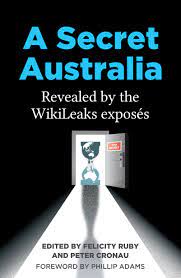
https://publishing.monash.edu/product/a-secret-australia/?fbclid=IwAR3n6_ljrq7LHcdyeKwyeex78AJrDfKE0llSnjEvPEt0HfZFa_rnXdAK-TI Edited by Felicity Ruby and Peter Cronau Also available as an ebook from your favourite retailer.
In A Secret Australia, eighteen prominent Australians discuss what Australia has learnt about itself from the WikiLeaks revelations – revelations about a secret Australia of hidden rules and loyalty to hidden agendas. However Australians may perceive their nation’s place in the world – as battling sports stars, dependable ally or good international citizen – WikiLeaks has shown us a startlingly different story.
This is an Australia that officials do not want us to see, where the Australian Defence Force’s ‘information operations’ are deployed to maintain public support for our foreign war contributions, where media-wide super injunctions are issued by the government to keep politicians’ and major corporations’ corruption scandals secret, where the US Embassy prepares profiles of Australian politicians to fine-tune its lobbying and ensure support for the ‘right’ policies.
The revelations flowing from the releases of millions of secret and confidential official documents by WikiLeaks have helped Australians to better understand why the world is not at peace, why corruption continues to flourish, and why democracy is faltering. This greatest ever leaking of hidden government documents in world history yields knowledge that is essential if Australia, and the rest of the world, is to grapple with the consequences of covert, unaccountable and unfettered power.
The contributors include author Scott Ludlam, former defence secretary Paul Barratt, lawyers Julian Burnside and Jennifer Robinson, academics Richard Tanter, Benedetta Brevini, John Keane, Suelette Dreyfus, Gerard Goggin and Clinton Fernandes, as well as writers and journalists Andrew Fowler, Quentin Dempster, Antony Loewenstein, Guy Rundle, George Gittoes, and Helen Razer, and psychologist Lissa Johnsson.
Sydney University fined for carelessness with a radioactive device
The fallout of the University’s radiation case, by Bella Gerardi, May 2, 2022,
Last week, the University of Sydney was fined $61,000 for failing to properly dispose of a radioactive source belonging to a decommissioned medical imaging machine. For an institution that claims to have a strong commitment to the environment, conviction of a criminal environmental offence appears at odds with its sustainability strategy.
The source, which contained a sealed radioactive isotope, was found when a truck delivering scrap metals to a recycling yard set off alarms during a routine radiation check.
Identified as belonging to a PET scanner owned by the University, the Environmental Protection Agency (EPA) charged the University with four individual breaches of the Radiation Control Act. The case didn’t go to court as the University pled guilty, and in exchange the EPA dropped two of the four charges.
So, how did this happen?
By accident, the court ruled.
…………… the court noted that if the source had not been detected before entry to the second metal recycling yard, environmental contamination would have been “very likely”. In this scenario, the source would have gone on to be reprocessed, a procedure that would involve breaking the seal of the source and dispersing the material into usable metal. It would have ultimately ended up in consumer material, which the court noted has occurred overseas.
………… It is disappointing, but not surprising, that it took a criminal conviction to reach the safeguards imposed today. Unfortunately, the University’s prior lack of clear procedure is indicative of the broader attitude institutions and corporations hold toward environmental crimes. Environmental crimes are often entangled with accidents, negligence, or oversight, and are often not viewed as holding the same gravity as other offences.
Corporations and institutions are responsible for the majority of environmental harm, yet complex corporate hierarchies make it uncommon for individuals to face repercussions for offences, which in turn promotes a lax attitude toward environmental damage. ………………………………….. more https://honisoit.com/2022/05/the-fallout-of-the-universitys-radiation-case/
Unions NSW opposes nuclear powered submarines and the AUKUS treaty.
Paul Keating ,Branch Secretary, Maritime Union of Australia, Sydney Branch, 26 Apr 22,
Unions NSW declares its total opposition to the reckless announcement by Scott Morrison that Australia would be developing nuclear-powered submarines as part of a military alliance with the US and UK.
At a time when Morrison should have been pursuing vaccination supplies and providing maximum support to our health system and millions of people in lockdown, he has been pursuing secret military deals. The deal will continue to escalate unnecessary conflict with China. Workers have already been impacted with seafarers stranded on coal ships and some trades shut down.
Extraordinary sums of money have been wasted with the previous submarine contract scrapped only five years after it was signed. That contract was worth $90 billion – nuclear submarines will cost much more.
Only six countries in the world have nuclear submarines, and they all have nuclear power stations. Advocates for nuclear power and nuclear weapons have been emboldened. The submarines will use highly enriched uranium ideal for nuclear weapons.
The Australian government has repeatedly tried to set up nuclear waste dumps on First Nations land. This will intensify that pressure.
The billions wasted on submarines should be spent on:
Building an Australian strategic shipping fleet in Adelaide that could operate in cabotage and international trades;
· Building renewable energy and offshore wind turbines to ensure we prevent global heating from exceeding 1.5°C;
· Raising Jobseeker payments to well above poverty levels;
· Pay increases for health workers and investments in our health systems;
· Pay increases for teachers and investments in public schools to make them covid-safe;
· Investing in firefighting capacity and ensuring we are ready for the next bushfire season.
Workers have no interest in war with China or any other country. Every effort should be made to pursue peaceful relations.
Unions NSW stands in solidarity with workers in all countries in opposing war and wasteful environmentally harmful military spending.
We pledge our opposition to oppose the development of nuclear submarines in Australia, and the development of any other nuclear industry.
Various groups oppose plan for nuclear submarine base – ”a military target” at Port Kembla, New South Wales
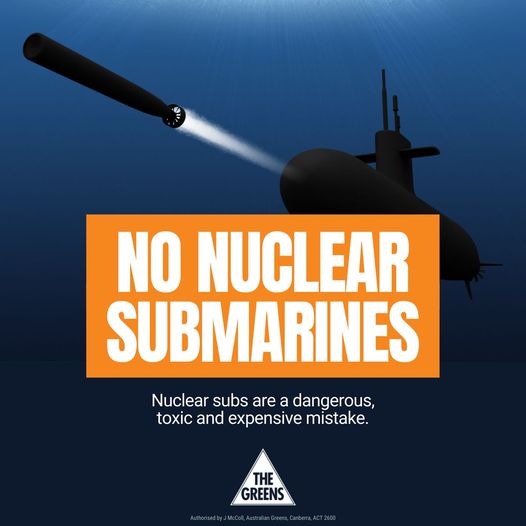
Planes, trains, automobiles … and nuclear subs: the local issues at play in the federal election
Guardian Stephanie Tran and Khaled Al Khawaldeh, Mon 2 May 2022
………….Submarine base in Port Kembla
Max, 26, works for a non-profit and lives in the electorate of Cunningham, held by retiring Labor MP Sharon Bird. He is worried about the prospect of a base being built in Port Kembla to house the future nuclear-powered submarines to be built under the Aukus agreement.
“This announcement was made with no consultation with the community, no proposal for consultation moving forward and a potential for my home to have a giant target on its back,” he said.
The Wollongong suburb, 100km south of Sydney, was flagged by the Coalition as the potential home of its new nuclear-powered submarine base. However, experts have raised concerns that the base could endanger the community by making it a military target, and some in the community are wary over the safety of the submarines’ nuclear reactors.
Alison Byrnes, the Labor candidate for Cunningham, said that if elected she would ensure that the community was consulted on the decision.
“I will make it a priority to seek a detailed briefing from the minister for defence on this plan, as well as Defence’s proposed assessment process,” she said.
The Liberal party emphasised the economic benefits of the project, but did not address the community concerns……..
Greens candidate Dylan Green said he did not want to see his community “getting caught up in a nuclear arms race”.
“Our government should be strengthening diplomatic ties with neighbouring states, not inviting conflict by investing in warships with primarily offensive capabilities,” he said.
Alexis Garnaut-Miller, from the Australian Citizens party, was “absolutely and resolutely opposed to this nonsensical proposal of building nuclear submarines or any development of nuclear submarine presence in Port Kembla”…… https://www.theguardian.com/australia-news/2022/may/02/planes-trains-automobiles-and-nuclear-subs-the-local-issues-at-play-in-the-federal-election
Australia is No1 on Transparency’s list of countries with developing public sector corruption

9 COUNTRIES TO WATCH ON THE 2021 CORRUPTION PERCEPTIONS INDEX , Transparency International 1 May 22
Troubling signs and key opportunities that can make – or break – the fight against corruption
What is a ‘country to watch’ on the CPI?
In this annual watch-list published alongside the CPI, Transparency International flags countries that need closer monitoring and attention in the coming year………
1 AUSTRALIA
Australia (CPI score: 73) is one of the world’s most significant decliners, having dropped 12 points since 2012 to hit a record low this year. Its deteriorating score indicates systemic failings in tackling public sector corruption. Despite public calls and previous promises, last year Australia missed a landmark opportunity to establish a national anti-corruption agency with broad powers to investigate corruption………………………………… https://www.transparency.org/en/blog/cpi-2021-corruption-watch-list-australia-austria-el-salvador-kazakhstan
Call to dump nuclear, go hydrogen for submarines
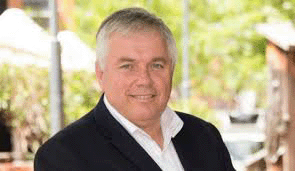
Australia cannot afford to allow Scott Morrison’s nuclear submarine plans to proceed, according to federal parliament’s only ex-submariner. 7 News, Marion Rae, 27 Apr 22,
Scott Morrison’s nuclear option for future Australian submarines is another budget disaster in the making, according to federal parliament’s only former submariner.
“We can’t afford to allow this bathtub admiral’s nuclear fantasy to go any further,” Independent senator Rex Patrick said on Tuesday.
The South Australian senator wants hydrogen fuel-cell submarines to be considered instead of the program he says will ruin Australia’s sovereign capability and deal a huge blow to his state’s defence industrial base.
New technology has allowed hydrogen fuel-cell powered submarines to become a viable non-nuclear option for endurance and silence, with some navies already operating or building with the new propulsion systems.
The senator said Australia needs a new submarine capability in the water in 2026, not 2040, and it should be built in Adelaide not contracted to foreign shipyards.
“I get that nuclear submarines are very capable. As a former submariner and having spent time at sea on the nuclear USS Santa Fe, I get it more than any other member of the federal parliament,” he said.
“But I also understand the capabilities of modern hydrogen fuel-cell submarines.”
He recommends a $20 billion spend on 20 highly capable submarines, rather than an estimated $171 billion on eight nuclear-powered vessels.
The previous $90 billion deal with a French company was scrapped last year in favour of nuclear-powered submarines as part of the AUKUS security pact, with a termination payment that could exceed $5.5 billion.
The Morrison government has already committed to building a new nuclear submarine base on Australia’s east coast, with the location to be announced after the election…………..
Senator Patrick said it was wrong to claim conventional submarines would not survive the modern operational environment, pointing to the fleets of Germany, Spain, Turkey, Greece, Sweden, Japan, South Korea, and Singapore.
“It doesn’t matter how good the pros of a nuclear submarine are – if it arrives too late, costs too much and undermines sovereign capability then it’s the wrong solution,” he said.
https://7news.com.au/business/call-to-dump-nuclear-go-hydrogen-for-subs-c-6580633?fbclid=IwAR2rf7smDYvCgEnSKGxjYp0rNFExJe0Vv8zd7tt8S9aN1Jkdk3_t9WW0rqY
Anzac Day and the conflict-loving neocons
https://independentaustralia.net/politics/politics-display/anzac-day-and-the-conflict-loving-neocons,16300, By David Donovan | 27 April 2022
This year’s Anzac Day has been politicised into a call-to-arms against China by our Coalition leaders. Founder and publisher Dave Donovan calls for war profiteers to be condemned.
ACCORDING TO one report, Defence Minister Peter Dutton’s opponent in Dickson, Labor candidate Ali France, is increasingly confident of deposing him from his marginal north Brisbane seat.
“It will be better than last time around,” she told Roman Mackinnon. “[I’m] definitely feeling hopeful we can kick him out.”
We can hope, but not too much. Because Dutton is the sort of former cop who looks as if he might have enjoyed a bit of kicking in his time ─ on the boot end, not as the ball.
On the day before Anzac Day, Dutton – out of what seems more a skull than a living head − honoured the grim sacrifice of generations of Australian military personnel, by preparing us all for more war. We need to “prepare for war” with China, said Peter Dutton,
It’s the oldest trick in the book: the khaki election. Beloved by conservatives like Dutton, whose reptile brains are ever ready for fight and flight. And it just might work for them again. Because Australia is a war-loving nation, with a people ever ready to send the cream of their youth to kill and be slaughtered in any scrap going down, anytime, anywhere, for any reason.
We love war so much, Remembrance Day in November is not enough for us, we need to relive the action again each year in April for what has truly become our national day. On 25 April, we take the day off for marches and parades, for drinking and gambling, all to recall our futile role in an ill-planned invasion of a distant land for a European empire. One that ended in disaster and defeat, but which has become some sort of macabre national death cult and celebration – yes, celebration, because that is what it is − of militarism and folly.
Of course, it’s not our fault, we Australians. It is how we have been taught. The death cult has been inculcated into us almost from the teat. It is an intrinsic part of our culture. I don’t need to tell you, knowledgeable reader, about the military-industrial complex or that war is a racket. Our National War Memorial in Canberra is sponsored by Lockheed Martin and Boeing.
You know that, like you know that it is good for business. And Australia is deeply invested in the war business. After Tony Abbott and Joe Hockey shooed the car industry from our shores in 2014, the Coalition’s only plan to maintain a heavy manufacturing base in this country is through the production of war materials: guns, rockets, tanks, troop carriers, shells and other such armaments.
They also, through normalising war, ensure there is always enough new meat to send to the slaughterhouse each time. A country that profits from war, surely, has a vested interest in perpetuating it.
Isn’t that something we should consider on Anzac Day each year, as we mourn our dead? That our Government does not really care about the tragedy and sacrifice of war, or the deaths of our children, but instead wants to make a buck out of it?
Scott Morrison cares so little for those he considers his lesser – the ones he would send to fight China – that he was seen on Monday, during the Dawn Service, texting on his phone. War is just a potential vote winner for him, as it is for the ghoulish Dutton.
Celebrate Anzac Day, certainly. Take to the streets and honour the dead. But do it with a sense of outrage. That we needlessly sacrificed so many of our brave sons and daughters. For nothing but the conquest of empire and the dreams of mortal power of our cold and psychopathic leaders.
Take to the street to condemn those who feel no pangs about sending our children off to die. Take to the streets on Anzac Day to condemn the warmongers and profiteers. Because there is no glory in war: just blood, and tears, and shit and death.
Nuclear submarines in an Adelaide shipyard – sitting ducks for a disastrous terrorist attack: conventional submarines – cheaper, safer
Impact of a missile strike on the SSN at Osborne, APRIL 26, 2022 BY AUSTRALIAN DEMOCRATS WHAT HAPPENS IF A LARGE ADVERSARY DECIDES TO BLOW UP THE PROPOSED NUCLEAR SUBMARINES (SSN) PRIOR TO LAUNCH BUT AFTER THE REACTOR IS INSTALLED?
Once launched nuclear submarines are a very powerful weapons with an indefinite range. They are very hard to find and destroy in open water and pose a major direct threat to an adversaries home territory.
In the unlikely event they were destroyed in the water the reactor should shut down and sink with the boat to the abyssal depths of the ocean. While the reactor may leak to some extent the pressure and cold water contain the problem.
However, prior to launch the submarine is a sitting duck, vulnerable to a wide range of submarine and land-launched precision missiles. The logical time to strike would be when the boats are almost complete but not launched.
Questions for the government
- What is the likely impact of a missile strike on a nuclear submarine in the shipyard?
- What modelling does the government have regarding the spread of radioactive material from the reactor if it was hit by a precision missile?
- How many years would Adelaide need to be evacuated for after a disaster?
- Given the government’s rhetoric, why would a large adversary not destroy our SSN before launch given the threat they pose?
- Having spent $20 billion on each boat over ten years, will the government be upset if the SSN are destroyed on the day of the launch?
Our Plan: 20 advanced conventional submarines
The Democrats advocate avoiding this problem by building advanced conventional submarines.
This would save about $80 billion, ten years, and Adelaide…… https://www.democrats.org.au/impact-of-a-strike-on-the-ssn-at-osborne/
Hysteria over the Solomon Islands-China security pact
Independent Australia, By Binoy Kampmark | 28 April 2022, Visits to Honiara are part plea, part threat. Delegations are equipped with a note of harassment.
That was the initial Australian effort to convince the Solomon Islands that the decision to make a security pact with Beijing was simply not appropriate in the lotus land of Washington’s “Pacific empire”. ………………
Having not convinced Honiara to change course, a range of reactions are being registered. David Llewellyn-Smith, former owner of the Asia Pacific foreign affairs journal The Diplomat, took leave of his senses by suggesting that a Chinese naval base in the Solomons would see ‘the effective end of our sovereignty and democracy’.
In a spray of hysteria, he suggested that this was ‘Australia’s Cuban missile crisis’.
The Labor Opposition, desperate to win office on 21 May, are calling this one of the greatest intelligence failures since World War II, which perhaps shows their somewhat tenuous command of history. Their leader, Anthony Albanese, seeking some safe mooring in a campaign that has lacked lustre, was particularly strident.
It was a chance to show that Labor was not shaky or wobbly on national security.
…………..This belligerent, simple note might have been stronger were it not for the fact that his deputy, Richard Marles, had previously made the unpopular suggestion that the Pacific islands were somehow sovereign entities who needed to be treated as such while China, in providing development assistance to them, should be “welcome” in offering it. …………………….
With Australia failing to change minds, the paladins of the U.S. imperium prepared to badger and bore Honiara. On the list: President Joe Biden’s National Security Advisor Jake Sullivan; Assistant Secretary of State for East Asian and Pacific Affairs Daniel Kritenbrink; and National Security Affairs Indo-Pacific chief Kurt Campbell. It seemed like an absurd gathering of heft for a small Pacific Island state.
The theme was unmistakable. A bullying tone was struck in a message from National Security Council spokesperson Adrienne Watson, who seemed to forget the Solomons was not some ramshackle protectorate of the Five Eyes.
Officials from the US, Japan, New Zealand and Australia had ‘shared concerns about [the] proposed security framework between the Solomon Islands and the People’s Republic of China (PRC) and its serious risks to a free and open Indo-Pacific’.…………………………….
As for the Solomon Islands itself, divided, fragmented and vulnerable to internal dissent and disagreement, Sogavare is unrepentant:
He has already told his country’s Parliament that there is no intention “to ask China to build a military base in Solomon Islands”. He felt “insulted” by such suggestions and felt that there was only one side to pick: “our national security interest”………………… https://independentaustralia.net/politics/politics-display/hysteria-over-the-solomon-islands-china-security-pact,16302
Today. About Julian Assange: Australian government, snivelling cringing sycophantic to USA. And the Labor Opposition is just as bad
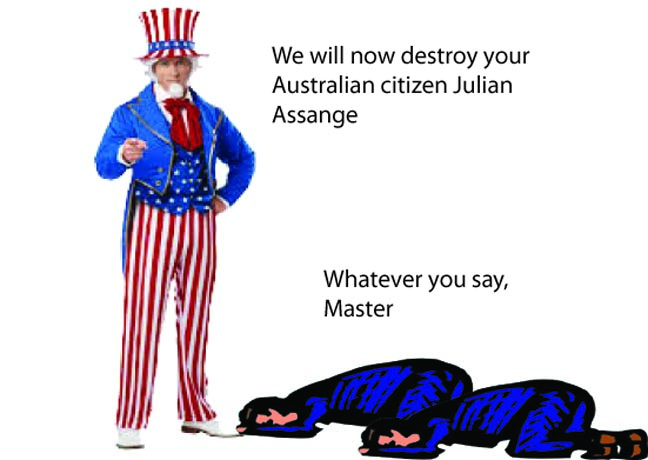
Will Australia ever get any integrity in it’s leaders?
In the clearest denialof justice in British history, the UK kow-tows to American militarism in its court now agreeing to send Juian Assange to be ”disappeared” in the USA’s penal system. And, worse than the UK, Australia’s leaders stand by, and pretty much applaud this evil event.
Liberal Morrison mouthpiece Simon Birmingham – ” we have confidence in the process”
And Labor’s Penny Wong carefully keeping her nose clean as she sucks up to the UK-USA ”legal” fakery – ”We also expect the government to keep seeking assurances from both the UK and US that he’s treated fairly and humanely.” What does she mean? – ” ïf they don’t treat Assange fairly, well, that’s not our problem”
I actually think that the Liberals are better – they don’t even pretend to care!
Paradoxically – we all love to hate Barnaby Joyce, but he stuck up for Julian Assange – and good on him!
And the Greens – a voice of intelligence and reason, in Australian political mental desert – the Greens spelled out the reasons for their opposition to this terrible injustice to Assange and to journalism.
1 This month
17 October, Free Public Talk on Nuclear Issues in South Australia
David Noonan will speak on public interest concerns over the new Roxby Downs Indenture Act 2026 on BHP copper-uranium mining and ore processing in SA, and on how AUKUS may face SA with a High-Level nuclear waste agenda.
Dr Jim Green will discuss international developments in the field of nuclear power including ‘small modular reactors’ and Generation 4 ‘advanced’ nuclear reactor concepts.


Help Aunty Sue Protect Her Land and Sacred Sites From Destructive Rocket Testing.
.

Australians deserve the truth
about
AUKUS – https://aukuspublicinquiry.com/

PETITION – To: Prime Minister Anthony Albanese and the Australian Labor Government

of the week – Australians for War Powers Reform (AWPR)
To see nuclear-related stories in greater depth and intensity

