Clean Technology Investment Program funds Bendigo solar system
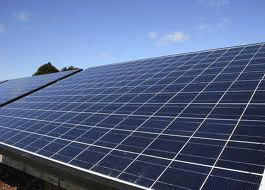 Australian Vaccine Manufacturer Going Solar http://www.energymatters.com.au/index.php?main_page=news_article&article_id=3720, 3 May 13 Veterinary vaccine manufacturer, MSD Animal Health, has been awarded funding under the Clean Technology Investment Program to install a 250kW solar panel system at its manufacturing facility in Bendigo East, Victoria.
The solar array will slash carbon emissions intensity from the facility by 22 per cent and result in savings of around $44,000 on electricity bills each year. The government’s contribution of $335,660 will be matched by the company. Continue reading
Australia’s Labor and Liberal Energy Ministers wage war against renewable energy
Are renewables doomed to failure in Australia?, REneweconomy By Giles Parkinson 3 May 2013“…….The appointment of Nahan [as Minister fotr Energy, W.A. ]– along with Queensland’s Mark McArdle, NSW’s Chris Hartcher, and Victoria’s Michael O’Brien – and the impending return of the federal Coalition’s Ian Macfarlane, has doomed the industry to another period of uncertainty and inaction. All, it would seem, in the name of ideology. Look-alike energy ministers in Canberra
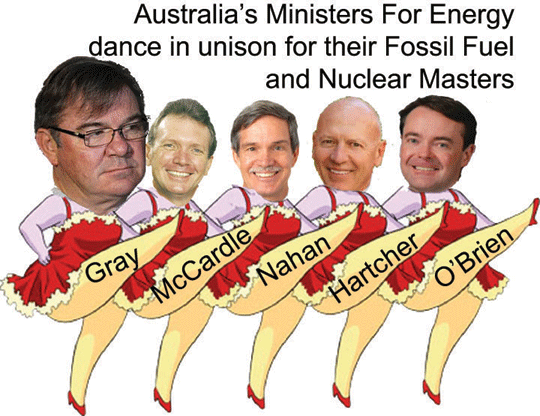
On the subject of federal energy ministers, it was fascinating to hear the newly appointed Federal Minister for Resources and Energy Gary Gray speak about the issue at a conference in South Australia this week.
As RenewEconomy pointed out after the resignation of former minister Martin Ferguson last month, he and his ultimate successor, the Liberal energy spokesman and former minister Ian Macfarlane, were like two peas in a pod – sharing like-minded, highly conservative views on Australia’s energy policies and how its energy system should evolve.
Gray – who says he is no longer a climate skeptic – is probably only keeping the seat warm for a return of Macfarlane come the September election, but he wants it known that he is of the same ilk as Ferguson, whom he labelled as a sometimes grumpy but “hardworking visionary,” and his Coalition counterpart.
“In many ways it really doesn’t matter from a Federal perspective if you look back at any (Federal Energy Minister), Ian Macfarlane or you look at Martin Ferguson, hopefully myself, you effectively see the same person,” Gray told a resources conference in Whyalla. “You see a Canberra political system that places the resource industry and the resource sector above politics, that cares deeply for the success of this sector and enjoys its success in the most obvious way.”
In the case of all three, it’s a matter of stepping on the gas. Gray is convinced the shale gas boom will deliver lower gas prices to Australia, notwithstanding that everyone else, including the gas operators themselves and market analysts, point out that gas prices will match export prices – and that means they are going up………. http://reneweconomy.com.au/2013/are-renewables-doomed-to-failure-in-australia-47501
Mike Nahan from Institute of Public Affairs – Western Australia’s Minister Against Renewables
 Are renewables doomed to failure in Australia?, REneweconomy By Giles Parkinson 3 May 2013 “………Mike Nahan (Western Australia) is an interesting choice as energy minister. For supporters of renewable energy, he’s actually quite a frightening one.
The American-born Nahan is a former executive director of the conservative, pro-market, anti-renewable think tank,  the Institute of Public Affairs, which is so intertwined with conservative policy making that many Coalition politicians refer journalists to the IPA for comment on issues such as energy and climate.
A collection of Nahan’s thoughts on climate and energy can be found on the IPA website as, like his contemporaries and successors, he was a prolific contributor to (mostly Murdoch-owned) newspapers. They give an interesting insight into his views on all things climate, energy and environment.
In 2005, he questioned the science of climate change. “Not only is the fact of global warming unclear, but a fully honoured Kyoto Agreement would have had only a trivial effect on temperatures,” he wrote in theHerald Sun.
In 2006, in the same paper, he hallelujahed the creation of the pro-nuclear and pro-business Australian Environmental Foundation, which has strong links to anti-wind farm groups. He also praised the expansion of the massive Hazelwood brown coal-fired power station, describing one of the country’s most polluting power plants as “efficient, profitable and clean.”
And, of course, he doesn’t like the Greens, accusing them of being “Watermelons” – former socialists who were red on the inside and green on the outer. He even decried the focus of Environment Day, saying such events should be a celebration of achievements – such as the fact that there were, he wrote in 2004– enough whales to support large whaling fleets.
Elsewhere, Nahan mocks the idea that the planet is depleting its resources, praises Conservative pin-up boy Bjorn Lomborg, and suggests that the global environment is actually improving rather than degrading. He also scoffed at suggestions that the Murray Darling Basin had water or salinity issues – both here and here.
Elsewhere, he dismissed the concept of “negawatts” – the idea promoted by the likes of the International Energy Agency that energy efficiency can play a critical role in decarbonising the world’s energy system, and to save money – as “activist jargon for subsidised energy conservation.” His preferred term was ‘megawatts’ – code for building more coal, gas and nuclear plants and burn as much fuel as possible.
Just in case you thought he might have evolved since being elected to state parliament in 2008, his views of wind and solar remain staunchly conservative, old school and just plain wrong. In a recent parliamentary debate, Nahan insisted wind energy required “one-for-one” backup by fossil fuel generators and did not reduce greenhouse gases, said solar cells were “hugely more costly” than polluting alternatives, and the only “low-cost, baseload, greenhouse-low energy” that existed was nuclear power.
He said Western Australia should consider nuclear power, but conceded they “do not fit the grid, because they are too big; they are too lumpy … our system is too peaky and nuclear would not fit. And then he goes on to suggest that the government should “consider nuclear power for the Pilbara,” which is an even smaller grid…………http://reneweconomy.com.au/2013/are-renewables-doomed-to-failure-in-australia-47501
Investors have been burned, as governments and “analysts” hype Australia’s failing uranium industry

Last year the Olympic Dam expansion was cancelled, BHP disbanded its uranium division and sold the Yeelirrie uranium lease in Western Australia for about 11 per cent of the nominal value of the resource.
Also indicative of the state of the industry was Cameco’s announcement in February of a $162.5 million write-down on the Kintyre project in Western Australia. Just months after first production at the Honeymoon mine in north-east SA in September 2011, project partner Mitsui announced its decision to withdraw as it “could not foresee sufficient economic return from the project”.
In addition to industry propaganda, governments routinely inflate the significance and potential of the uranium industry, as do industry “analysts” (some of them market traders), some business journalists and some academics. There are real-world consequences to uranium mania — many “mum and dad” retail investors have been burned, especially during the speculative price bubble in the mid-2000s.
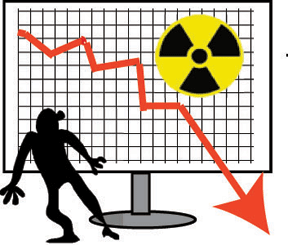
Uranium Industry Dreams Of Paydirt http://newmatilda.com/2013/05/02/uranium-industry-dreams-paydirt By Jim Green, 2 May 13, A new report released by the Australian Conservation Foundation: Yellowcake Fever: Exposing the Uranium Industry’s Economic Myths, shows that uranium accounted for just 0.29 per cent of Australia’s export revenue in the 10 years from 2002−2011. In the last financial year, uranium revenue of $607 million was 103 times lower than the biggest earner, iron ore. Milk and cream generate twice as much export revenue as uranium — and can’t be turned into Weapons of Mass Destruction.
Uranium export revenue is still more underwhelming given that the four companies mining uranium in Australia are all either majority foreign owned or 100 per cent foreign owned; in other words, a sizeable proportion of that export revenue never leaves the Northern Hemisphere and never comes anywhere near Australia. Continue reading
Time to stop the exploitation of poverty-stricken Niger by rapacious foreign uranium companies
the grievances expressed by representatives of local populations in the mining zones and pastoral peoples as well as government representatives. Concerns relate to radioactive pollution, water resource depletion, work-related diseases for mine workers, and the appropriation of land and water resources, including legally enshrined common property regimes and pastoral territories, without required compensation.
It is widely acknowledged among government staff that the Nigerien government is not able to properly implement its environmental legislation and monitor the uranium mining industry.
Niger: Development Cooperation Must Support the Environmental Governance of Uranium Mining THE ISN BLOG, Rasmus K Larsen 2 May 2013 Niger’s new development strategy, the Economic and Social Development Plan, is also intended to guide international development cooperation. Environmental governance of uranium mining, the country’s by far largest single economic activity, appears hitherto to have constituted a ‘blind spot’ for environmentally oriented development cooperation. It is now time to remove the blinkers and include support to strengthen environmental governance of the mining sector in new programmes to assist Niger in meeting its development challenges
Niger is well known in international media as one of the world’s poorest countries, struggling with chronic structural hunger and malnutrition. UNDP ranks Niger 186 out of 187 countries in the Human Development Index, and in 2011, five million people (33% of Niger’s population) were at ‘high risk’ to food insecurity.
What is less well known is that Niger also hosts the fourth largest uranium production in the world. Export values totalled over EUR 348 million in 2010, representing more than twice the total development assistance finance received during the same year. However, the state retains less than one fifth of the value of the uranium ore that is exported. The exploitation of the mineral wealth by international investors is expanding, with granted and requested mining concessions comprising close to 10% of the national territory…….
Attention to environmental impacts or risks associated with the mining sector goes seemingly without mention in the guiding documents of the principal development partners, including the EU, the World Bank, the UNDP, and the African Development Bank.
Severe environmental governance issues Continue reading
A warning to Aboriginal people about Indigenous Land Use Agreements (ILUA)
Don’t sign your sovereign rights away with ILUAs, Aboriginal leader warns, 2 May 13A prominent Aboriginal leader warns Aboriginal and Torres Strait people against signing Indigenous Land Use Agreements (ILUA), saying they cede their sovereignty for a few crumbs if they do.
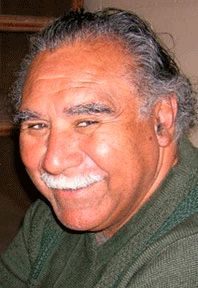 Michael Ghillar Anderson writes in a media release from Germany that state and Territory governments are trying to coerce Aboriginal peoples into signing ILUAs.
“This is an act of bastardry on the governments’ part as they are NOT informing our peoples of their deceitful intent.
“The ILUAs are designed in such a way that the state, Territory and federal governments can say to the world and the local courts, ‘The Aborigines recognise us as the sovereign state because they signed an ILUA under our law, therefore, they recognise our sovereignty and authority over them, together with sovereignty over the lands, airspace and waters therein.’”
Mr Anderson is the last survivor of the four men who set up the Aboriginal Embassy in Canberra in 1972 and spokesman for the First Nations Interim National Unity Government, which campaigns for sovereignty. He is the leader of the Euahlayi nation in northwest NSW and southwest Queensland.
“In Australia we have reached a very important time in our history. We must come together as distinct sovereign nations to jointly locate a national perspective on our sovereign rights,” he writes.
“We know that the Uncle Toms and Aunt Marys will all tell you that this is all a pie in the sky pipe dream. That is fine because they have always been the people who have betrayed our legal rights and interests. Continue reading
CSIRO ‘s UltraBattery could be a key component of Australia’s Smart Grid
How UltraBattery could help our grid http://ecogeneration.com.au/news/how_ultrabattery_could_help_our_grid/081278/ MELANIE RYAN May/June 2013 Low-cost, durable and fast with a long life-cycle – and it ‘smooths’ intermittent electricity from renewable sources. The CSIRO-developed UltraBattery could be the key component of an Australian smart grid of the future.
Dr Lan Lam, the primary inventor of CSIRO’s UltraBattery, retired in February 2013 after he and his team turned battery technology into a storage unit that simultaneously brings down the cost of hybrid electric vehicles and makes it easier to integrate more renewable energy into a grid.
Dr Lam leaves quite a legacy behind him: this year, the first UltraBattery will be released in the automotive market, powering hybrid electric vehicles in Japan, the United States, South America, Europe and Asia. In October 2013, the battery is also due to be installed at Tasmania’s King Island Renewable Energy Integration Project, becoming the largest clean energy storage system in Australia.
The UltraBattery combines a traditional lead acid battery and a super capacitor into one; normally they are separate components.
“It sounds simple, but we have now created a new technology that is 70 per cent cheaper than current batteries used in hybrid electric cars, and they can also be made in existing manufacturing facilities,” Dr Lam explains. UltraBattery technology has now been successfully installed in a large-scale solar power plant in New Mexico, United States; its storage capacity allows for intermittent renewable energy to be smoothly supplied to an electricity grid.
The CSIRO says that in comparison to alternate renewable energy battery options, the UltraBattery is more low-cost, durable, has faster discharge/charge rates, and has a life-cycle that is two to three times longer than a regular lead acid battery. When intermittent electricity from renewables is fed into the grid through UltraBattery’s smoothing process, power quality and stability are improved. UltraBattery can also store energy for use during peak demand times, assisting the grid to balance supply and demand and avoid local stress.
CSIRO UltraBattery team member Dr Peter Coppin says that a number of large-scale demonstration projects both completed and in-planning have shown the battery’s applications in power system support and smoothing. These projects include wind smoothing at Hampton Wind Farm in New South Wales and grid support at the PJM in Pennsylvania, United States.
“These real-world, at-scale applications are very important, as they clearly demonstrate the commercial viability of the UltraBattery,” Dr Coppin notes. “It’s exciting, as the interest in the UltraBattery projects is building rapidly, as managing intermittency from renewable sources becomes more of an issue for grid integration.”
CSIRO’s energy storage team says that it will continue Dr Lam’s legacy by researching and developing the UltraBattery, aiming to make it lighter and more efficient. CSIRO is considering next-generation development with new materials and higher-energy-density technologies, such as lithium.
May 1st’s antidote to Australia’s uranium lobby lies about: The Uranium Market
 AUSTRALIA’S URANIUM EXPORT REVENUE IN PERSPECTIVE YELLOWCAKE FEVER Exposing the Uranium Industry’s Economic Myths , Australian Conservation Foundation A serious constraint is the modest size of the global market for uranium. Even if all secondary supply is bundled into the primary market, and lower spot prices are ignored, the figure still falls short of $10 billion p.a:
 (Beverley) 100%, and Uranium One (Honeymoon)
Australia has yet another Minister For Promoting Nuclear Energy, Gary Gray
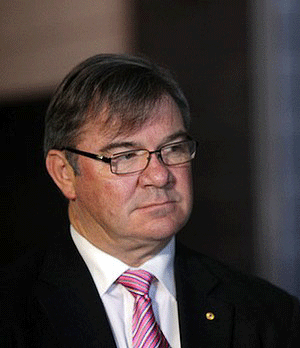

we thought we would have a Minister for ALL Resources and Energy – such as for Renewable Energy. But we thought wrong!
New Federal Resources and Energy Minister Gary Gray says he supports nuclear energy industry, Adelaide Now, by Valerina Changarathil, 1 May 13, FEDERAL Resources and Energy Minister Gary Gray has thrown his support behind developing a nuclear energy industry in Australia but says it will happen in a “timely fashion”.
Minister Gray’s comments came in response to a question at the South Australian Resources and Energy Investment Conference specifically about considering changes to current legislation that prohibits nuclear power generation in Australia given the power requirements of the resources industry.
“Yes. I am a real optimist for the future of the uranium mining industry,” Mr Gray said. He said he was pleased to see approval for the latest uranium project by SA company Toro Energy in WA had passed “through the system”.
“We can’t discount the importance of what is happening in the global uranium markets,” he said.
The global uranium industry is currently reviewing its processes after the Fukushima nuclear plant disaster in Japan triggered by the earthquake in 2011.
“I am optimistic that we will get (power) generation issues attended to and that it will be done in a timely fashion.”
Labor is opposed to nuclear power generation……
At the uranium conference on Monday, SA Mineral Resources and Energy Minister Tom Koutsantonis said there was no business case for nuclear enrichment facilities here and that it was not commercially viable.
“I don’t see a case for it in the near future,” he said, although he has expressed support for it in the past.
“We’ve got to value-add here in SA. Down the track, I would like to see some form of enrichment, some sort of value-add. We have to go out and passionately support the uranium industry,” he said at a conference in 2011……
Mr Gray has been in the role for a month and replaced Martin Ferguson who was sacked. http://www.adelaidenow.com.au/business/sa-business-journal/new-federal-resources-and-energy-minister-gary-gray-says-he-supports-nuclear-energy-industry/story-e6fredel-1226633083969
Australia’s million-plus solar households have collectively become a massive power station
 Solar Slashing Wholesale Electricity Costs In Australia http://www.energymatters.com.au/index.php?main_page=news_article&article_id=3714 29 April 13, That solar is reducing the cost of wholesale electricity is not new news in itself – but now a figure has been put on the savings. Solar PV ranks highly in the Merit Order of electricity generation in some peak conditions; being cheaper than coal and gas.
At times when wholesale electricity costs from ‘traditional’ sources can eclipse $10,000 per megawatt-hour; surplus solar electricity is being exported to the mains grid for as little as $80 per megawatt hour.
Centre of Policy Development’s sustainable economy research director Laura Eadie says Australia’s rooftop solar power systems are saving between $300 million and $670 million each year in wholesale electricity costs; which could be reducing household power bills if electricity retailers pass the savings on to consumers. According to an article on NewsMail, Ms Eadie’s report also states solar households were more energy-aware; which not only reduces their own electricity costs, but also helps to further lighten the load on the mains grid network.
Australia’s million-plus solar households have collectively become a massive power station; with total capacity of 2,461,696 kW of solar panels on the nation’s rooftops as at early this month. According to figures from solar provider Energy Matters, Australia’s small-scale solar power systems could generate over $900 million worth of electricity over the next 12 months; based on an average 25c/kWh retail electricity cost.
While solar has been demonised in the past courtesy of myths perpetuated from certain corners, it’s becoming increasingly clear the scapegoating has been misdirected and solar’s net effect on Australia’s electricity infrastructure is a boon; not a blight.
Assuming satisfactory conditions and policies; residential and commercial-scalesolar energy will continue its ascent in Australia and help to not only slash the power bills of millions more, but also play a greater role in reducing the nation’s carbon emissions and support thousands of Australian families through employment in the sector.
Mining companies the largest leasholder of Western Australian pastoral land
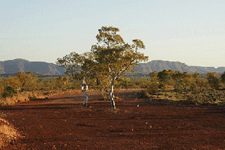 WA land owned increasingly by conservation and mining Science Network Western Australia, 29 April 2013 “The research focused on pastoral country from the edge of the Wheatbelt up to and including the Pilbara, which historically has been held under pastoral leases owned by families and used for grazing such as sheep and cattle stations”—Dr van Etten. Image: Stefan Jurgensen RESEARCHERS say an increasing amount of land in Western Australia is being managed for environmental conservation, however mining companies are the single largest lease holder of what was previously pastoral land. Continue reading
Australian Uranium Association’s Paydirt Conference shortened to one day, in gloomy economic prospects
 PAYDIRT URANIUM CONFERENCE IN ADELAIDE THIS MONDAY Uranium industry boosters will gather this Monday April 29 at the Adelaide Hilton for the annual Paydirt Uranium Conference. This year’s conference has been downgraded to a one-day event, reflecting industry stagnation in the wake of the Fukushima disaster.
Friends of the Earth national nuclear campaigner Dr Jim Green, co-author of a new report exposing the economic myths of the uranium industry, said: “The Australian Uranium Association’s Executive Director Michael Angwin claims that Australia “has enough reserves to be to uranium what Saudi Arabia is to oil”. However Australia’s uranium export revenue in 2011 was 466 times lower than Saudi oil revenue in the same year. Others to draw asinine comparisons between Australian uranium and Saudi oil include former SA politicians Mike Rann and Kevin Foley, and Adelaide-based academics Ian Plimer and Haydon Manning.”
“For decades the uranium industry has promised great economic benefits but it never delivers. Uranium accounted for just 0.29 per cent of Australia’s export revenue in the 10 years from 2002−2011. In the last financial year, uranium revenue was four times lower than Australia’s 20th biggest export earner, eight times lower than Australia’s 10th biggest export earner and 103 times lower than the biggest earner, iron ore. Even milk and cream generate nearly twice as much export revenue as uranium − and can’t be turned into Weapons of Mass Destruction. Uranium mining and exploration accounts for just 0.015% of all jobs in Australia.”
“Last year, BHP Billiton cancelled its planned expansion of Olympic Dam, disbanded its Uranium Division, and sold the Yeelirrie uranium lease in Western Australia for about 11% of the nominal value of the resource. Just months after first production at the Honeymoon mine in north-east SA in September 2011, project partner Mitsui announced its decision to withdraw as it ‘could not foresee sufficient economic return from the project.'”
“An independent inquiry is long overdue to objectively weigh the uranium industry’s economic benefits against its effects on environmental and public health, safety and security, particularly in the shadow of the unfolding Fukushima tragedy − a tragedy directly fuelled by Australian uranium,” Dr Green concluded.
‘Yellowcake Fever: Exposing the Uranium Industry’s Economic Myths’, a report released by the Australian Conservation Foundation last Friday, is posted at:
Now Tony Abbott is over- hyping Olympic Dam uranium mine expansion
 Tony Abbott vows the Coalition would give Olympic Dam a chance to succeed BRAD CROUCH :adelaidenow April 27, 2013 FEDERAL Opposition Leader Tony Abbott today vowed to create economic conditions to help the stalled Olympic Dam mine proceed after blaming the State and Federal governments for it being put it on hold by BHP Billiton.
However, Mineral Resources Minister Tom Koutsantonis accused Mr Abbott of “over-spruiking” by suggesting the Coalition could get Olympic Dam expanded, saying Mr Abbott would have to change international conditions.
Mr Abbott said he could not guarantee the project would proceed under the Coalition but said: “I can promise there will be no obstacles from government that will impede its progress.”
“I want to give the Olympic Dam expansion a chance,” Mr Abbott said. “It is not on hold because of the quality of the ore body, lack of dynamism in South Australia or a lack of work ethic, it is on hold essentially because State and Commonwealth Labor governments have not created a climate in which this kind of investment can go ahead.”He also repeated promises to dump the carbon and mining taxes, put the budget “back in the black” and restore border security in a speech heavy on hope but light on specifics, such as how to fund the changes.
Mr Koutsantonis responded, saying: “He needs to change business conditions internationally, not just in Australia – what will get Olympic Dam over the line is not conditions in Australia or South Australia, it is the price of copper and uranium and the development of new technology to reach one of the most difficult ore bodies in the world.
“Who is over-spruiking now?”…… http://www.theaustralian.com.au/news/tony-abbott-vows-the-coalition-would-give-olympic-dam-a-chance-to-succeed/story-e6frg6n6-1226630615659
Sutherland Council doesn’t want Lucas Heights nuclear wastes – “The local community would not support that”
the only sensible thing to do is to shut down the Lucas Heights nuclear reactor. Nuclear medicine is just a sideshow there anyway. All nuclear medicine’s pharmacueticals can be made in other ways, by non nuclera cyclotrons.
Lucas Heights real purpose is to keep a foot in the door for the nuclear fuel cycle in Australia
 A Sydney council’s nuclear waste warning, BYVIKKI CAMPION The Daily Telegraph April 29, 2013 A SYDNEY council has warned it does not want to be the dumping ground for Australia’s nuclear waste.
It comes as a massive expansion of the nuclear medicine operations at Lucas Heights triples the amount of nuclear waste generated.
The Australian Nuclear Science and Technology Organisation plans to build a state of the art nuclear waste treatment facility – to safely store it – but could end up keeping it there for up to 10 years.
Sutherland mayor Kent Johns said the council’s biggest concern was making sure Lucas Heights did not become the permanent home of nuclear waste storage……..
A spokesman for ANSTO said it supported setting up a long term storage facility for nuclear waste, but not at Lucas Heights……. “By law ANSTO cannot be used as a national waste repository. The local community would not support that….. ( just like the Muckaty Aboriginal community C.M)
Senator Ludlam calls on Australian government to press Britain to compensate Maralinga veterans
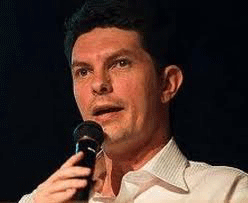 British Government fails test on Australian nuclear victims, but fight continues 29 April 2013. Efforts to secure Act Of Grace payments for the victims of British nuclear testing will be stepped up after the British Government’s disappointing response, Senator Scott Ludlam said today.
“I call on Foreign Minister Bob Carr to raise this proposal directly with his UK counterparts.
“Because of difficulties victims of the British nuclear testing were facing in the courts, I wrote to British Foreign Secretary William Hague twice making the case for ex gratia payments to Australians exposed to British nuclear testing in the 1950s and ‘60s.
“The British Minister for Defence Personnel Welfare and Veterans Mark Francois has now responded by washing his hands of the deadly legacy his government left in Australia, paradoxically arguing that because the victims of nuclear testing could not prove in court their higher rate of radiation-related illness was caused by the nuclear testing, they would not receive Act Of Grace payments.
“The point of Act of Grace payments would be to circumvent the inappropriate burden of proof of causation being imposed on the victims – yet Minister Francois applies the same utterly unreasonable standard that has hampered attempts to secure justice through the courts.
“Australian nuclear veterans are pursuing the matter through the Human Rights Commission and strongly support this action, but they should not have expend this ongoing time and effort to get what is rightfully theirs.
“The Australian Government must bring diplomatic pressure to bear on the British Government to do their duty and compensate the people exposed to radiation; to make amends and to ensure they and their families can afford medical care.”
1 This month
17 October, Free Public Talk on Nuclear Issues in South Australia
David Noonan will speak on public interest concerns over the new Roxby Downs Indenture Act 2026 on BHP copper-uranium mining and ore processing in SA, and on how AUKUS may face SA with a High-Level nuclear waste agenda.
Dr Jim Green will discuss international developments in the field of nuclear power including ‘small modular reactors’ and Generation 4 ‘advanced’ nuclear reactor concepts.


Help Aunty Sue Protect Her Land and Sacred Sites From Destructive Rocket Testing.
.

Australians deserve the truth
about
AUKUS – https://aukuspublicinquiry.com/

PETITION – To: Prime Minister Anthony Albanese and the Australian Labor Government

of the week – Australians for War Powers Reform (AWPR)
To see nuclear-related stories in greater depth and intensity

