Despite their high cancer rates, Australia’s Maralinga veterans get rejection from British govt
 No compensation for Maralinga radiation victims, SMH, April 29, 2013 Bianca Hall The British government has ruled out paying ”act of grace” compensation to Australian soldiers deliberately exposed to nuclear bomb testing at Maralinga in South Australia 61 years ago.
Greens senator Scott Ludlam wrote to Foreign Secretary William Hague in January seeking an undertaking that Britain would pay compensation to victims of its nuclear testing program.
”Of the British and Australian veterans who were involved in the testing, and the Aboriginal people in the area at the time of the blasts, only 29 Aboriginal people have ever received compensation from the Australian government and veterans continue to struggle to obtain the medical support they need,” Senator Ludlam said.
A 2006 report commissioned by the Australian government showed the Australians at the Maralinga and Emu Field sites were 23 per cent more likely than the general population to develop cancer, and 18 per cent more likely to die from cancer. But it found it was impossible to conclude whether that was due to radiation…….http://www.smh.com.au/opinion/political-news/no-compensation-for-maralinga-radiation-victims-20130428-2imrw.html#ixzz2RteYnZ00
Letter from UK Ministry of Defense http://xa.yimg.com/kq/groups/18059953/1363946993/name/maralinga.pdf
The dirt on Australia’s uranium industry, as it holds its “Paydirt” conference
 Yellowcake Fever. Exposing the Uranium Industry’s Economic Myths Report in full at: http://www.acfonline.org.au/sites/default/files/resources/ACF_uranium_economics_Yellowcake_Fever.pdf by Dr Jim Green (FoEA) & Dave Sweeney (ACF), Australian Conservation Foundation, April 2013 (33 page PDF) Executive Summary: The Australian uranium industry involves serious and unresolved domestic and international security, environmental and inter-generational concerns and remains a contested and controversial sector that lacks a secure social license. This report examines the sectors small economic and employment contribution in relation to its significant risks and legacies and seeks to build the case for an independent cost-benefit analysis and a comprehensive and transparent assessment of the impacts and implications of Australia’s uranium trade.
Uranium is a small contributor to Australian export revenue and employment. From 2002 to 2011, uranium sales averaged $627 million annually and accounted for only 0.29% of all national export revenue. In the 2011/12 financial year, uranium revenue of $607 million was 4.4 times lower than Australia’s 20th biggest export earner, 8.7 times lower than Australia’s 10th biggest export earner and 103 times lower than the biggest earner, iron ore. Small industrial sectors can play an important economic role but the unique properties and risks of uranium mining relative to any benefits means its role requires particular scrutiny.
The industry’s contribution to employment is also underwhelming. The World Nuclear Association estimates 1,760 jobs in Australia’s uranium industry. That is the highest of all estimates yet it represents just 0.015% of all jobs in Australia. The industry’s primary promotional body, the Australian Uranium Association (AUA), claims its members are “significant employers of First Australians”
however the sector only provides around one job for every three thousand Indigenous Australians.
In the mid-2000s, there was a speculative uranium price bubble. Since this bubble burst the uranium industry has been battered by a falling commodity price, rising production costs, the Global Financial Crisis (and associated credit crisis), the failure of the global nuclear power ‘renaissance’ to materialise, the failure to develop new mines and serious production shortfalls……. Continue reading
Journalists should scrutinise Australia’s politicians on their ignorance on climate change science

many Australian politicians – and the Australian media. Very rarely have politicians who reject climate science in Australia been asked to explain their justifications on scientific grounds.
According to the Political Leaders and Climate Change Index (PLCCI) published in 2010 by the Global Change Institute at the University of Queensland, the number of politicians in the parliament who either don’t or won’t accept the science of climate change in Australia is significant.
The likelihood of a Coalition government winning in 2013 makes the public statement of personal opinions on human induced climate change an issue of national and global importance.
Your MP doesn’t ‘believe’ in climate change? Ask the tough questions, The Conversation, Brad Farrant, Fiona Armstrong, Karen Kiang, Mark G Edwards , 27 April 13 As we head into an election, you’d be justified in asking what your local member is basing their climate change decisions on.
If your MP says “I don’t support policies to prevent dangerous climate change” because “I don’t believe climate change is occurring” or “I’m not sure climate change is human caused” is this position justifiable simply because it’s his or her personal opinion?
While everyone may be entitled to their own opinion, are our elected leaders being ethically responsible when they justify inaction on climate change based on personal opinions? Sustainability ethicist Donald A. Brown, from Widener University School of Law, emphatically argues, “no” – they are not.
In a recent widely republished blog post on ethicsandclimate.org, Brown argues government officials have an ethical responsibility to understand the state of climate change science. Politicians hold crucial leadership positions where they can enact policies that can prevent or minimise great harm. These policies, to put it bluntly, affect millions, if not billions, of people around the world.
Governments and elected officials cannot ethically choose to rely on their own uninformed opinion or ideology instead of the scientific consensus. Continue reading
Liberal Party’s Shadow Minister for Education wants to sanitise Australian history
Have we forgotten how often, and easily history can be distorted by those seeking to make history simply a celebration, or quest for freedom?….
History isn’t a party, it’s an honest pursuit of an accurate telling of the past – the whole past, not just bits we like.
 Don’t dismiss nation’s blemishes , SMH April 27, 2013 Julia Baird Historians across Australia buried their faces in their palms again this week when, without warning, retro talk of ”history wars” was revived. It was like being drawn back into 2001, when John Howard was prime minister, George Bush was US president and Vanilla Ice was in jail.
On Monday, the jaunty opposition spokesman for education, Christopher Pyne (at left) criticised the new national school curriculum for putting Aboriginal and multicultural commemoration days in the same league as Anzac Day.
This seemed to come partly from a preference for the festive over the sombre.
Pyne said a Coalition government would review the curriculum because it should promote a more cheerful version of the past: Continue reading
These are the questions that journalists should be asking of politicians
 Your MP doesn’t ‘believe’ in climate change? Ask the tough questions, The Conversation, Brad Farrant, Fiona Armstrong,
  Karen Kiang, Mark G Edwards , 27 April 13, “….
we propose a series of questions that journalists (and the public) should be asking politicians on global warming, and how governments should respond to it.
- Are you aware that over 97% of climate scientists globally, the CSIRO, the Australian Academy of Science and every major national science academy in the industrialised world (whose membership includes climate scientists) agree that the planet is warming, that the observed climate change is mostly human caused, and that if we continue with business as usual, harsh impacts and irreversible changes to the climate system will occur?
- Do you accept that the human population is making a substantial contribution to climate change via our greenhouse gas emissions? If not, what specific scientific sources and references do you rely on to justify going against the scientific consensus?
- Is it your position that Australia and the rest of the world need to urgently adopt policies to reduce our greenhouse gas emissions in line with scientific recommendations? If not, what specific scientific sources and references do you rely on to justify rejecting the scientific consensus?
- Are you aware that the impacts of climate change in terms of increased risks to human health and climate change related deaths is already being measured by medical and public health professionals worldwide?
- Do you accept that anyone who argues that we continue with business as usual and emit greenhouse gases beyond levels that the consensus of climate scientists says is dangerous for humanity (and the ecological system on which humans depend) should bear the burden of proof to show that this is safe?
- Do you accept that, in light of the overwhelming weight of scientific evidence and the long-standing consensus of climate scientists, politicians have a responsibility to immediately implement strategies to prevent dangerous climate change?
- Given that climate scientists have been advising the urgent reduction of greenhouse gases for decades, do you accept that politicians who fail to implement policies to prevent dangerous climate change should be held responsible for harm that results from this inaction?
- Do you accept that climate change is occurring? If not, what specific scientific sources and references do you rely on to justify rejecting the scientific consensus? http://theconversation.com/your-mp-doesnt-believe-in-climate-change-ask-the-tough-questions-13432?utm_medium=email&utm_campaign=The+Weekend+Conversation&utm_content=The+Weekend+Conversation+CID_746b0f21860e09252d87a376993410ea&utm_source=campaign_monitor&utm_term=Your%20MP%20doesnt%20believe%20in%20climate%20change%20Ask%20the%20tough%20questions
- We might ask politicians a few of these ourselves. Have a go yourself – and let us know how you get on. We’d be pleased to write about it.
High risk, low return: Australia’s uranium industry’s poor record demands inquiry
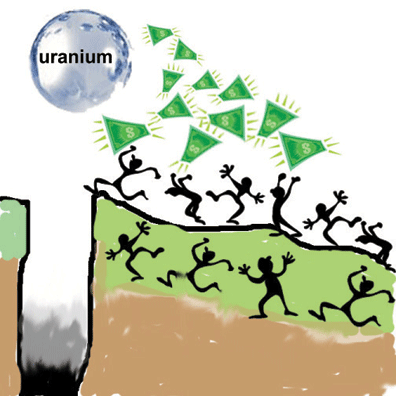 Dave Sweeney, 26 April 13 Australia’s uranium industry is a minor contributor to employment and the economy, a major source of domestic and international risks and is overdue for an independent inquiry into its effects on the environment, health, safety and security, according to a report released today on the anniversary of the 1986 Chernobyl nuclear disaster.
The report, Yellowcake Fever: exposing the uranium industry’s economic myths, released by the Australian Conservation Foundation, shows uranium accounted for only 0.29 per cent of national export revenue and less than 0.015 per cent of Australian jobs in the decade to 2011.
In the last financial year, revenue from uranium was four times lower than Australia’s 20th biggest export earner, eight times lower than Australia’s 10th biggest export earner and 103 times lower than the biggest earner, iron ore. “While Australia’s uranium sector remains an economic minnow, it is a leviathan when it comes to the damage it does to communities and the environment and the risks it spreads,” said the Australian Conservation Foundation’s Dave Sweeney.
“It is time for an independent and credible cost-benefit analysis of this sector and for decisions to be based on evidence, not self-interested industry enthusiasm.”
The most recent independent assessment of the Australian uranium industry – a Senate Inquiry in October 2003 – found the sector characterised by underperformance and non-compliance, an absence of reliable data to measure contamination or its impact on the environment and an operational culture focussed on short term considerations.
“In the decade since that Senate Inquiry, leaks, incidents and accidents have continued to dog uranium mines, Australia has sold uranium to more nuclear weapon states and Australian uranium has fuelled the continuing Fukushima tragedy,” said Dave Sweeney.
“The Australian Uranium Association’s push to reduce independent scrutiny of uranium projects shows why this sector does not enjoy community confidence or a social license.
“We call on the federal government to establish an evidence-based inquiry into the operations and impacts of this industry, particularly in the shadow of Fukushima.” Contact: Dave Sweeney, 0408 317 812
Australia’s Opposition climate change spokesman Greg Hunt talks nonsense on CEFC
CEFC may write financing contracts before July, REneweconomy By Giles Parkinson 26 April 2013 “…..Hunt’s big dodgy number games
 Last Sunday, Opposition climate change spokesman Greg Hunt appeared on the Bolt Report, the program hosted by noted climate skeptic and News Ltd journalist Andrew Bolt, complaining about the government’s“dodgy numbers” on its climate policy.
Hunt knows something about dodgy numbers. That’s how most experts describe his Direct Action policy, but on ABC Radio on Wednesday he came up with a new one when he said (unchallenged) that the CEFC would spend up to $240 million a day between July 1 until the writs for the election are issued in early August. Hunt was so satisfied with his statement that he tweeted it too.
Of course, it’s utter nonsense, as Hunt well knows. He arrives at that figure by dividing the $10 billion in funds the CEFC will have at its disposal over 5 years, by the number of days between July 1 and the election writs. But these funds are only allocated in $2 billion batches over 5 yeas, so even if the CEFC spent its entire 2013/14 budget is the first six weeks, it would be well short of Hunt’s number. But, the bigger the number, the bigger the scare.
And the CEFC is not likely to rush its entire funds out the door in one fell swoop. The CEFC can only be disbanded by an act of government, which makes it as easy, or as difficult, to unravel as the carbon price. Unless the Coalition gets a majority in the Senate, or the Labor rump rolls over, then the CEFC could continue for a while longer.http://reneweconomy.com.au/2013/cefc-may-write-financing-contracts-before-july-28670
Australia’s Clean Energy Finance Corporation can write contracts before July
 CEFC may write financing contracts before July, REneweconomy By Giles Parkinson 26 April 2013 The newly created Clean Energy Finance Corporation is likely to enter contracts for financing deals even before July 1, when the first of its $10 billion in funding becomes available, according to CEO Oliver Yates.
In an interview with RenewEconomy, Yates said the CEFC was capable of entering contracts in coming months, even if the $2 billion that can be spent by the organization in 2013/14 is not available until July 1.
The CEFC has become a subject of controversy because of the Coalition’s pledge to disband it, among other clean energy and climate change institutions, should it be elected in September, and because of the Coalition’s demand that it not make any investments pending the result of the election.
The CEFC became fully operational at the start of this month, and now boasts 50 staff, including those incorporated from Low Carbon Australia (LCA). As we reported on Wednesday, the government has released its final investment mandate, which defines its targeted returns and manner of operations.
Yates said the work of the LCA, particularly in the areas of energy efficiency, would continue, and would likely be upscaled. This would allow larger clients such as municipalities, hospitals and universities to get financing assistance for these sorts of projects.
“These organizations have got budget cycles, so they find it hard to fund such investments up front,” Yates said. ”We can help with that.”
Yates also identified solar leasing as an area of interest for the CEFC. Solar leasing, which allows home-owners and commercial companies to install solar PV on their rooftops for no deposit, removing the problems of upfront capital cost, has taken off in the US, where it accounts for around three-quarters of new installations. The financing is now well supported by mainstream banks such as Goldman Sachs and US Bancorp.
In Australia, however, solar leasing is relatively new and has struggled to gain finance from banks at interesting rates because they have no experience of the technology or the financing, and have so far resorted mostly to the private wealth market.
Yates said it was typical of the sort of investments where the CEFC could play some sort of trail-blazing role that would encourage the commercial market to follow…….http://reneweconomy.com.au/2013/cefc-may-write-financing-contracts-before-july-28670
44 Indigenous Carbon Funding projects approved – ready to go
Successful Indigenous Carbon Farming Fund projects announced http://www.investinaustralia.com/news/successful-indigenous-carbon-farming-fund-projects-announced-12c3 24 April 13 Environment Minister Tony Burke and Parliamentary Secretary for Climate Change, Industry and Innovation Yvette D’Ath today announced the 44 successful applications under the Australian Government’s Indigenous Carbon Farming Fund Capacity Building and Business Support stream.
Mr Burke said through this program, the Australian Government is helping Indigenous Australians access carbon farming specialists, business development expertise and legal advice for their carbon farming projects. “These projects are spread across Australia and range from undertaking feasibility assessments to developing carbon farming project ideas and existing carbon farming businesses,” Mr Burke said.
“This program will not only provide benefits for our environment but also provide employment opportunities in indigenous communities.”
Other successful proposals include feasibility assessment of carbon projects, community education, and the development of businesses to provide services or undertake carbon abatement and sequestration activities under the Carbon Farming Initiative (CFI).
Mrs D’Ath said the projects have received funding to assist Indigenous communities to benefit from the Carbon Farming Initiative.
“The Research and Development stream of this initiative provides funding to underpin CFI methodologies and the development of tools for estimating and reporting on emissions,” Mrs D’Ath said. “Up on Cape York Peninsula, where the project area covers an area of up to 2,300,000 ha in Aurukun, one group aims to avoid emissions of approximately 30,000 tonnes CO2 per year.”
The Fund will provide $22.3m over five years to assist Aboriginal and Torres Strait Islander people to participate in the CFI. The CFI enables Indigenous landholders and land managers to earn carbon credits by undertaking projects to reduce emissions or store carbon. Types of projects include early season savannah burning and environmental plantings.
For more information, including a list of successful projects, go tohttp://www.environment.gov.au/cleanenergyfuture/icff/index.html.
Uranium mining company Paladin – seen as The Ugly Australian, in Malawi
 Of the profits made, Paladin, for instance rakes in about 80% and has a paltry 1.5% for the Malawi nation
Paladin says in one breath it paid over U$5.6 million in taxes to the Malawi government, and in its other breath through its published annual report, indicates it paid about U$9.3 million in taxes.
the British silently stole our uranium and left when their projections did not add up to their whims, and now we have the Aussies who are refusing to deal fairly.
Killing Malawians through the rotten extractives deals: The case of Paladin’s uranium mining http://www.nyasatimes.com/2013/04/24/killing-malawians-through-the-rotten-extractives-deals-the-case-of-paladins-uranium-mining/ Patricia Masinga, April 24, 2013 Malawi has in the few weeks been engaged by a plethora of stakeholders discussing strategies to revive, or more on the ground, reclaim the benefits that Malawians are been milked of by the so-called extractive industry multi-national corporations.
They call themselves investors, and government believes that the Malawi Development Goals (MDGs – who cares if it’s the second phase) will be boosted, particularly that mining alone through Kayerekera of Paladin Energy Limited group of companies (trading as Paladin (Africa) Ltd in Malawi?) could provide a large economic base.
But that is all a fat lie. Paladin and many other foreign multinational mining countries are least interested to contributing to the Malawi economic growth. They are here to milk the country – exploiting all that it has rich in minerals and dump us when the time is right even poorer.
Imagine, to screw Malawians of their rightful economic gains, the company, incorporated in Australia first listed on the Australian Stock Exchange (ASX) on March 29, 1994 under code ‘PDN’, and quickly changed its name from Paladin Resources NL to Paladin Resources Ltd in 2000 and listed under the Toronto Stock Exchnage (TSX) in Canada April 29, 2005, and again changed its name to Paladin Energy Ltd in November 2007 and listed on the Namibian Stock Exchnage on February 2008.
By such trends, one is compeled to question the motive, Continue reading
South Australian Premier admits mistake in over promoting uranium and rare earths projects
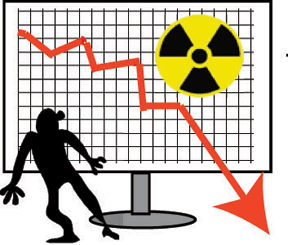
 VIDEO Mining promises too bold, concedes SA Premier http://www.abc.net.au/news/2013-04-23/mining-promises-too-bold-concedes-sa-premier/4645662 Apr 23, 2013 South Australian Premier Jay Weatherill has conceded the Government needs to be more cautious about spruiking mining opportunities in the state. Rare earths company Arafura Resources is to scrap a minerals processing plant planned for Whyalla and keep more of its operations close to the mine site north of Alice Springs.
Mr Weatherill said he agreed with the Opposition the Government had a track record of overselling mining projects but underdelivering.
“I think this was a bit over-spruiked. It was always a speculative project but at the time it was always one that was a realistic project,” he said.”We did no more or less than back up what the company was saying about what they proposed to do, but I think we should be a little more cautious about that and obviously cases like this indicate that.”
Mr Weatherill said with both the shelved BHP Billiton Olympic Dam mine expansion and now Arafura’s project, the Government only backed up what the companies had told it.
“We did the thing we could do which was to provide speedy approvals, now to the extent to which we jump up and down and say this is going to happen is something we can control and we have to take a bit of care about that,” he said.
“It’s difficult to underestimate the significance of these projects, because they are significant.”
Dave Sweeney from the Australian Conservation Foundation said the loss of hundreds of potential jobs was a disappointment for Whyalla, but the decision against shipping material south for processing was a win for the environment.
“There are real concerns with this sort of processing and rare earth processing – you’re dealing with radioactive materials including uranium,” he said.”You would have radioactive exposures and elevated radiation levels in the area, you’d be left with a waste stream that would include a range of radioactive materials that pose a long-term human and environmental problem.”
Tony Shepherd’s attack on Renewable Energy Target does not make sense, for Business Council of Australia
by using the BCA’s own criteria, the RET is sensible energy policy.
The RET has been a very effective piece of legislation enjoying bipartisan support for good reason. South Australia now sources over 25 per cent of its electricity from renewable energy sources resulting in lower emissions, substantial regional investments and jobs, and perhaps most importantly, lower wholesale electricity prices in that state.
We need policy settings to remain predictable and thereby provide investor confidence. Investment in large-scale renewable energy generation in Australia will deliver economic prosperity to regional Australia and more broadly improve Australia’s competitiveness.
Waging war on sensible energy policy : http://www.businessspectator.com.au/article/2013/4/22/renewable-energy/waging-war-sensible-energy-policy#ixzz2RWoPG4SL Miles George22 April 13, In an address to the National Press Club on Thursday, Business Council of Australia president Tony Shepherd AO asserted without any basis in fact that Australia needed “to wind up the Renewable Energy Target”.
Mr Shepherd said that the BCA was “consulting widely and broadly” and welcomed the “contest of ideas”, and yet clearly the BCA did not refer to the findings of the recent independent Climate Change Authority review of the Renewable Energy Target.
Following broad and wide consultation and a very strong contest of ideas, modelling undertaken on behalf of the CCA found that:
— The cost of the RET is an immaterial component of retail electricity bills before taking into account the benefits it brings in reducing wholesale electricity prices.
— Reducing the large-scale RET would result in higher wholesale and retail electricity prices. Continue reading
South Australia may cut its a Solar Feed In Tariff
South Australia Solar Feed In Tariff Threatened, by Energy Matters, 23 April 13, Households and businesses in South Australia considering going solar may want to do so soon. The Essential Services Commission of South Australia (ESCoSA) has proposed that from 1 July 2014, the amount paid to South Australian owners of solar panel systems for surplus electricity exported to the mains grid should be slashed from 25.8 cents down to 9.8 cents.
Under current arrangements and according to information from solar systems provider Energy Matters, a 5kW solar panel system installed in Adelaide can provide a financial benefit exceeding $2,000 a year.
The CEC says ESCoSA has “used the narrowest definition of a feed-in tariff, based on the financial benefit that a solar PV owner provides to his or her electricity retailer.”….
ESCoSA has invited public submissions to its draft determination and a copy of CEC’s submission can be viewed here (PDF). http://www.energymatters.com.au/index.php?main_page=news_article&article_id=3703
Jim Green exposes Geoff Russell, Australia’s newest nuclear conspiracy spinner

Russell and science are at odds on the question of the cancer risks associated with low-level radiation exposure. The 2006 report of the Committee on the Biological Effects of Ionising Radiation (BEIR) of the US National Academy of Sciences states that “the risk of cancer proceeds in a linear fashion at lower doses without a threshold and … the smallest dose has the potential to cause a small increase in risk to humans.”
What nuclear conspiracy theories? Climate Spectator Jim Green 23 April 13
Conspiracy theories conjured up by nuclear advocates are mostly harmless fun. But not when they involve trivialising the suffering of victims of the Fukushima nuclear disaster.
Political demagogue Lyndon LaRouche is the most colourful of the conspiracy theorists. Here’s his take on the anti-nuclear movement:
“This utterly depraved, dionysian cult-formation found its echoed, more violent expression in late 1980s Germany, where the anti-nuclear, fascist rioting reached near to the level of outright civil war …”
Australia’s Leslie Kemeny (think Lord Monckton) agrees: “Radical green activism and global terrorism can form dangerous, even deadly, alliances. The ‘coercive utopianism’ of radical greens, their avid desire for media publicity and their hidden socio-political agendas can produce societal outcomes that are sometimes violent and ugly.”
Kemeny believes the anti-nuclear movement is “supported by immense funds from affluent right-wing interests” and is also tied to the “political left”. Go figure. With such a grab-bag of extreme − and extremely contradictory − views, Kemeny might be considered a good candidate for Bob Katter’s political party … but he’s already joined Fred Nile’s.
A recent convert to nuclear conspiracy theories is Adelaide-based nuclear advocate Geoff Russell.
Russell has no time for the euphemisms of ‘dionysian cult-formation’ or ‘coercive utopianism’. He gets straight to the point: nuclear critics are responsible for all of the death and suffering resulting from the Fukushima nuclear disaster and much else besides. Ouch.
How does he arrive at those conclusions?…….. Continue reading
Don’t let Australia’s uranium lobby remove safeguards – say doctors
It is essential that appropriate environmental and human safeguards remain, and that uranium mining and milling remains within the definition of “nuclear actions” for the purposes of the EPBC Act. There is a clear need for federal oversight to ensure clear and consistent implementation of these measures
Medical Assocation for the Prevention of War (MAPW) SUBMISSION ON FEDERAL REGULATION OF URANIUM MINING, by Dr Margaret Beavis April 2013 The uranium mining industry is attempting to remove federal overview of uranium mining. MAPW Vice-President Dr Margaret Beavis has prepared this submission to the Productivity Commission arguing that federal oversight should remain, and noting that as risks to health and the environment become more apparent, radiation regulation is increasing internationally.:
 It is concerning that the uranium industry has used the expression “mild radiation” to describe its radiological environmental impacts, when there is no regulatory basis or definition to use this term, potentially giving the impression that the levels of radiation in the uranium mining industry are without risk to the environment. The evidence is clear and unassailable that this is not correct. Furthermore, it is appropriate that uranium mining continue to be considered a ‘nuclear action’ as specified by the EPBC Act as the radioactivity derives specifically from nuclear decay processes. Tailings from uranium mining are radioactive for millennia, resulting in unique environmental considerations for every uranium mine.
The International Commission on Radiological Protection has determined that the dose coefficient for radon gas, one of the sources of radioactivity from uranium mining, needs to be doubled, indicating that it is actually thought to be double the previously estimated carcinogenic hazard.1. ARPANSA is currently in the process of revising dose estimates to workers. It follows that risks to others is doubled and makes it even more essential appropriate mitigation strategies are introduced. It also follows that the environmental risk is also increased. Continue reading
1 This month
17 October, Free Public Talk on Nuclear Issues in South Australia
David Noonan will speak on public interest concerns over the new Roxby Downs Indenture Act 2026 on BHP copper-uranium mining and ore processing in SA, and on how AUKUS may face SA with a High-Level nuclear waste agenda.
Dr Jim Green will discuss international developments in the field of nuclear power including ‘small modular reactors’ and Generation 4 ‘advanced’ nuclear reactor concepts.


Help Aunty Sue Protect Her Land and Sacred Sites From Destructive Rocket Testing.
.

Australians deserve the truth
about
AUKUS – https://aukuspublicinquiry.com/

PETITION – To: Prime Minister Anthony Albanese and the Australian Labor Government

of the week – Australians for War Powers Reform (AWPR)
To see nuclear-related stories in greater depth and intensity

