Remembering Australia’s wars – what about the one against the Aborigines?
 on the 97.8 per cent of human affairs conducted in this place before colonisation, on the 2000 generations who made their lives where Hyde Park now stands, on what happened in our obtaining of it, and on what became of the ‘dispossessed’, not a word or stone is spent.
It’s time we started talking about how Anzac Day can embrace difficult realities of war and nation, and still do the other things it needs to
The Australian wars that Anzac Day neglects, EUREKA STREET, DEAN ASHENDEN APRIL 21, 2013 For more than 30 years the Australian War Memorial in the nation’s capital has refused to consider any recognition of the long and often violent conflict between black and white.
The proposal that the memorial might commemorate the ‘frontier wars’ first came in 1979 from Geoffrey Blainey. It has since been repeated by commentators and scholars including the then-principal historian at the memorial, Dr Peter Stanley, and a former army chief of staff, Lieut-General John Coates. To no avail.
The memorial is not alone in its silence. Sydney’s Hyde Park, just a few hundred metres from where it all began, has almost as many monuments, memorial gardens and commemorative fountains as trees, most to do with our loss, sacrifice and valour in war, the struggles of our explorers and pioneers, or the sagacity of our civic leaders. Continue reading
Doctors make powerful statement on protection of animals from uranium mining radiation
 Medical Assocation for the Prevention of War (MAPW) SUBMISSION ON FEDERAL REGULATION OF URANIUM MINING, by Dr Margaret Beavis April 2013 “…..With regard to non-human species, the 2010 ARPANSA Technical Report No. 154 entitled
Height of waves is increasing due to climate change
 VIDEO Climate change increasing wave height ABC News http://www.abc.net.au/news/2013-04-18/climate-
 change-predicted-to-increase-wave-height/4637624 By Fiona Blackwood Apr 19, 2013 Scientists are beginning to predict how climate change will influence the height of waves.
The impact on wave height has been a neglected area of research until now.
CSIRO research scientist Mark Hemer says buoys and satellites around the world have been modelling how changes in atmospheric circulation will influence sea swells. “We see an increase in wave heights in the Southern Ocean and we see decreases in a lot of the rest of the global oceans,” he said.
Waves in the Southern Ocean could increase by half a metre over the next century.
Dr John Hunter, from the Antarctic Climate and Ecosystems CRC, says wave height will have a similar impact on coastal areas as sea level rise.”So changing waves and sea level can cause recession probably of order in some places say 100 metres this century,” he said.
“That’s quite likely a lot of houses are within 100 metres of the shoreline.” For the first time wave height will be included in a new report by the International Panel on Climate Change.
Muckaty was never selected scientifically as a nuclear waste dump site
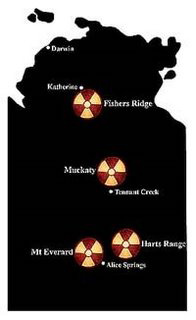 15 July 2005 The Minister for Education, Science and Training, the Hon Dr Brendan Nelson MP, announces three potential locations to be investigated for the Commonwealth Radioactive Waste Management Facility. The three locations are properties located near Katherine and Alice Springs in the Northern Territory: Fishers Ridge, Department of Defence property, southeast of RAAF Base Tindal; Mt Everard, Department of Defence property, northwest of Alice Springs; and Harts Range, Department of Defence property, northeast of Alice Springs. The new facility will co-locate low-level and intermediate-level radioactive wastes.
http://www.aph.gov.au/About_Parliament/Parliamentary_Departments/Parliamentary_Library/Publications_Archive/online/RadioactiveWaste#radio
Christina Macpherson 19 April 13. It’s hard to discover exactly what sites were recommended by Bureau of Resource Sciences in the 1990’s, but Muckaty wasn’t one of them.
NRIC, A Radioactive Waste Repository for Australia: Methods for Choosing the Right Site, DPIE, Canberra, 1992.The Commonwealth releases its report National Radioactive Waste Repository Site Selection Study, Phase 1 for public comment by December 1992. The Phase 1 report is prepared by the National Resource Information Centre (NRIC), a science unit within the Department of Primary Industries and Energy (DPIE). The report:
describes the nature of radioactive wastes
briefly describes the criteria for assessing the suitability of sites for hosting a waste repository
outlines a Geographic Information Systembased system for applying the criteria, and
describes the way a repository would be constructed.
Of the eight regions identified by this study, five were selected entirely by using ASSESS. These were the
Tanami, Bloods Range, Everard, Billa Kalina and Olary regions. Continue reading
Nuclear waste dump: other sites more suitable than Muckaty
Proposed new nuclear waste dump site nomination, Natalie Wasley 19 April 13 How Australia should responsibly manage its nuclear waste
 A RESPONSIBLE APPROACH TO RADIOACTIVE WASTE MANAGEMENT, Jim Green, Feb 2011, – 1. Waste minimisation – 2. All options for radioactive waste management should be considered -3. Site selection processes must be fair and transparent.
 1. Waste minimisation
Nuclear waste dump: where do New NT Chief Minister Giles and Federal Resources Minister Gray, stand?
New NT Chief Minister and Federal Resources Minister , by Natalie Wasley, 19 April 13 approached to meet with Traditional Owners opposed to the waste dump and we hope this meeting will be advanced soon to allow grassroots voices of opposition to be heard and represented.
No to uranium mining in Queensland: ALP reaffirms their stand
 Qld State ALP reaffirms support for uranium ban http://workersbushtelegraph.com.au/2013/04/17/qld-state-alp-reaffirms-support-for-uranium-ban/ “Environmentalists welcome the State ALP’s reaffirmation of their policy of opposition to uranium mining in Queensland” said Friends of the Earth spokesperson, Ms Robin Taubenfeld.
Yesterday Jackie Trad, State ALP member for South Brisbane tabled a report, published by environmental groups and trade unions, in State Parliament.
The report, “High Risk – Low Return: The case against uranium mining in Queensland” exposes the State Government’s claims about jobs and royalties as being without substance.
Jackie Trad MP argued that the uranium industry was only likely to create 155 long-term jobs, according to a Deloitte Access Economics report from 2008. Jackie Trad MP argued that the risk to agricultural and tourism jobs far outweighed claims made by the Premier, claiming “The risks to both the reputation and sustainability of our agricultural industry and food security from uranium mining are real.”
Ms Trad has said that “Queenslanders need to ask themselves this very important question – is the small economic return on uranium mining worth the risk it poses to established industries, our precious environment and the health and safety of workers?”
Robin Taubenfeld said “State investment in renewable energy would create more jobs. The uranium industry has a terrible accident history and this poses a significant threat to the environment and our way of life in Queensland.”
The “High Risk – Low Return” report can be downloaded from http://www.qnfa.org.
Solar panels a winner for millions of Australian homes
 In the words of Mahatma Gandhi; “First they ignore you, then they laugh at you, then they fight you, then you win,” – and the ultimate winners are the 1 million solar households across the nation who are not only striking a blow in the carbon emissions battle, but also slashing their power bills while helping support the thousands of Australians employed in the local renewable energy sector and their families.
Australian Home Solar Generating $2 Million+ In Electricity Daily http://www.energymatters.com.au/index.php?main_page=news_article&article_id=3692 17 April 13, It’s little wonder Australia’s electricity sector is becoming increasingly cagey about the home solar revolution – rooftop systems in the nation will generate many hundreds of millions of dollars worth of electricity at retail value over the next 12 months says Energy Matters.
According to figures Energy Matters sourced from the Clean Energy Regulator, 1,000,643 small solar power systems were installed in Australia as at April 5; with a collective total capacity of 2,461,696 kW.
Most of these systems would have been installed in the last few years and on average, each system works out to be around 2.4kW.
Given an average over a year of 4.5 sun hours a day, each of these systems would produce in the region of 10kWh of electricity daily.
This translates to an estimated 10,006,430 kWh a day generated by all small Australian solar power systems. Over a year, the figure would be 3,652,346,950 kWh.
Based on an average 25c/kWh retail electricity cost (day rates); these home solar power systems could generate as much as $913,086,737 worth of electricity over the next 12 months. Continue reading
Australia’s electricity carbon emissions down, due to less demand, energy efficiency, and renewables
 Australian Electricity Generation Emissions Drop By 14 Million Tonnes http://www.energymatters.com.au/index.php?main_page=news_article&article_id=3689 16 April 13, National Greenhouse Accounts released on Monday show Australia’s carbon pollution from electricity generation fell by 14 million tonnes during 2012.
The Accounts state Australia’s total greenhouse gas emissions declined by 0.2 per cent for the year to December 2012. Annual emissions for the year to December 2012 were estimated to be 551.9 million tonnes of carbon dioxide equivalent.
The decrease in overall annual emissions for the year was largely due to a decline in emissions from electricity reflecting lower electricity demand and changes in the energy generation mix.
Over the first six months of 2012-13, electricity emissions were at their lowest level since 2001-02 states the Quarterly Update of Australia’s National Greenhouse Gas Inventory (PDF).
Over the full year, generation in the National Electricity Market from black coal reduced by 5.3% and brown coal generation emissions dropped 7.0%; with both fossil fuels seeing their lowest generation levels in more than a decade. Continue reading
Nuclear weapons were the real goal in Australia’s uranium industry, and Lucas Heights reactor
 Australia and the Bomb http://workersbushtelegraph.com.au/2013/04/14/australia-and-the-bomb/ Ian CurrAfter WW II both Liberal and Labor parties in Australia supported the development of a nuclear bomb – that is why the nuclear reactor at Lucas Heights in Sydney was developed. They also supported uranium mining and export and nuclear power. So the major parties were not merely allowing the British to test their bomb at Maralinga they supported Australia getting a nuclear bomb. Australia did not acquire a nuclear weapon because it needed American support to get the technology to make a bomb. The US refused that support to both Australia and Canada but supported the British acquisition and testing on the bomb on Aboriginal land in South Australia.If anyone in the Labor party disagrees with my take on the history, lets hear what you have to say about it.
There was a ban the bomb movement in Australia and members of the ALP and trade unions participated in that movement, but ALP policy was to join the nuclear race. So it is little wonder that when Hawke came to power in 1983 he made sure the ALP government mined and exported Uranium.
Both Liberals & Nationals supported Australian involvement in the nuclear club throughout this period.
“Plains of Maralinga” describes the British atomic bomb tests at Maralinga and their deadly side-effects on the Pitjantjatjara people. Song performed when Alistair was on tour with David Rovics in Australia in 2008.
Nuclear war risk heightened by USA ”Air Sea Battle” concept in the Pacific
 Why Australia Fears the United States The Disaffected Lib, 14 April 2013 Since coming into existence in 1776, the United States has enjoyed just 21 “war free” years. The last four of those were under president Jimmy Carter who didn’t see much point in blowing other people, their kids and all their stuff into smithereens just to make a point. No wonder he was so reviled.
Since Bush/Cheney rode into Washington, the United States has become our world’s only true Warfare State. Obama, despite his claims to the contrary, has kept the tradition alive and well.
When Canadians consider our country’s relationships with America, we too readily forget that it is a true, warfare state. That affects the way it works, the way it deals with other countries like our own, and the decisions it takes for the future. If you have any doubt about this, read Andrew Bacevich’s The New American Militarism reviewed here and here and here.
USA’s military strategy in the Pacific could lead Australia into a nuclear war
|
|
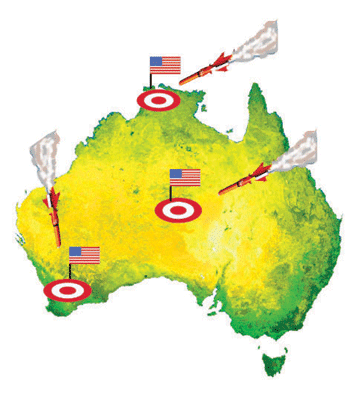 US strategy could result in nuclear war,
The concept risks making the Chinese military an enemy.
The paper, written by the institute’s senior analyst for defence strategy, Benjamin Schreer, urges the Australian government to keep a cautious distance from the plan for now. Australia would likely play a role in the strategy, particularly with US Marines stationed in Darwin. The plan assumes any conflict between the US and China – most likely over Taiwan or Chinese skirmishing with Japan – would remain below the level of nuclear strikes.
But Dr Schreer writes that “such an outcome is far from certain”. Part of any US plan to strike at China would involve “blinding” the People’s Liberation Army by hitting its surveillance, intelligence and command systems.
This could provoke panic on the Chinese side and “consequently increase the chances of Chinese nuclear pre-emption”, he writes.
“AirSea Battle thus raises the spectre of a series of miscalculations on both sides if Beijing perceives conventional attacks on its homeland as an attempt to disarm its nuclear strike capability.”
The paper coincides with rising tensions between China and Japan over territorial disputes in the East China Sea, and between China and Vietnam in the South China Sea.
US military planners are developing the AirSea Battle plan in response to the shift in the strategic balance as China’s growing military might threatens to end more than half a century of US dominance on the western Pacific rim.
China’s long-range missiles, submarines and stealth bomber squadrons could soon threaten US bases and aircraft carrier groups in the region, potentially deterring the US from coming to the aid of Taiwan or Japan in the event of a conflict.
The plan sees US forces withstanding the first round of Chinese attacks, then carry out their “blinding” campaign. US carrier battle groups would then hit Chinese missile launchers. Meanwhile, US submarines and long-range missiles would strike at the Chinese airforce. The US could also blockade oil supplies and other resources – likely with Australian help.
While Australia would inevitably be drawn into any such conflict, the institute urges the government not to publicly endorse the plan for now, but rather demand a clearer explanation of how Washington would enact the plan, and its political goals. “[It] risks making the Chinese military an enemy” when the US, Australian and allied grand strategy is ”aimed at integrating Beijing in a co-operative Asian security order”.
Australian uranium company Paladin will now have to renegotiate its deal with Malawi
 Malawi to renogotiate with Paladin on the Kayerekera uranium deal http://www.malawitoday.com/news/128733-malawi-renogotiate-paladin-kayerekera-uranium-deal 14 April 2013, ZODIAK RADIO Malawi has finally succumbed to pressure from activists to start re-negotiating with Paladin Africa Limited on the Kayerekera Uranium deal in a last ditch attempt to create a win-win situation.
First on the proposal is to remove the confidentiality clause on the agreement such that it be made public before rectifying other strings within the deal.
Minister of Mines Mr John Bande confirmed that discussions are underway with Paladin Africa Limited on the matter.
“We are working out on modalities to discuss in public the agreement between Kayerekera and the Malawi Government,” said Bande.
Bande blamed the previous regime for putting a confidentiality clause on the license. “Now government is working to remove that clause so that the deal can be discussed in public,” said Bande.
Critics have continuously called on government to re-negotiate the license, saying Malawi is getting a raw deal from it.
Issued in 2009 the Kayerekera uranium mine license is for a period of 15 years and is subject to renewal.
The license among others also allowed the miner to open an off-shore account.According to the deal, Malawi was meant to be collecting a meager US$ 100 million in taxes annually from the deal.
Southern hemisphere’s biggest wind farm opened in Victoria
 Australia’s biggest wind farm – the vital statisticshttp://reneweconomy.com.au/2013/australias-biggest-wind-farm-the-vital-statistics-35976 By Giles Parkinson 12 April 2013 Macarthur wind farm – the largest in Australia and the southern hemisphere – was officially opened in south western Victoria on Friday by the local member and state premier Denis Napthine. The 420MW wind farm, built at a cost of $1 billion by AGL Energy and New Zealand company Meridian, is the biggest single investment in renewable energy in the country since the Snowy Mountain hydro project was completed in the 1970s, the companies say. Continue reading
1 This month
17 October, Free Public Talk on Nuclear Issues in South Australia
David Noonan will speak on public interest concerns over the new Roxby Downs Indenture Act 2026 on BHP copper-uranium mining and ore processing in SA, and on how AUKUS may face SA with a High-Level nuclear waste agenda.
Dr Jim Green will discuss international developments in the field of nuclear power including ‘small modular reactors’ and Generation 4 ‘advanced’ nuclear reactor concepts.


Help Aunty Sue Protect Her Land and Sacred Sites From Destructive Rocket Testing.
.

Australians deserve the truth
about
AUKUS – https://aukuspublicinquiry.com/

PETITION – To: Prime Minister Anthony Albanese and the Australian Labor Government

of the week – Australians for War Powers Reform (AWPR)
To see nuclear-related stories in greater depth and intensity

