The murky story of how anti-wind energy bullies hijacked a town’s name
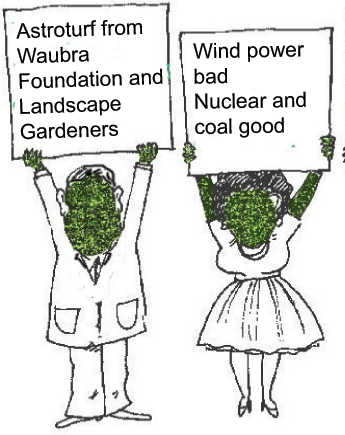
The New South Wales and South Australian governments are currently reviewing guidelines for wind farms. Neither government is likely to ignore a recent poll that 77 per cent of Australians support wind farms.
Waubra Fights The Anti-Wind Bullies. New Matilda , 26 Sept 12, By Sandi Keane The town of Waubra has had its name hijacked by anti-wind astroturfers. Locals say they’re happy with wind-farming – and it’s not making them sick. So who are the scare campaigners? Sandi Keane reports
It’s spring in the quiet sheep-farming hamlet of Waubra, an hour’s drive northwest of Ballarat in Victoria. With the shearing done and the crops in, local farmers have turned to a bit of springtime mending. Not fences, but the town’s image. After three years saddled with the negative legacy of the “foundation” that stole their name, local farmer, Karen Molloy, says the community is fighting back with a bumper festival.
Back in 2009, Waubra hit the news when powerful forces linked to mining interests, and Australia’s climate sceptic factory, the Institute of Public Affairs, used what was then the largest wind farm in the southern hemisphere as an easy target for their anti-wind scare campaign. The establishment of the Waubra Foundation followed.
“For three years, we’ve lived here quite happily. We love the wind towers and love Waubra. But it is so much more than wind so we’ve dropped the word “Wind” from the Waubra Community Festival”, Molloy said.
The festival, which takes place on Saturday 6 October, will showcase the positives of renewable energy as well as the fresh produce grown in its red volcanic soil. There’ll be a “Waubra Gift” running race, free rides, entertainment for the whole family, a free bus from Ballarat and a tour of the wind farm. Continue reading
BHP’s shares down as it dallies again with the expensive Olympic Dam dream
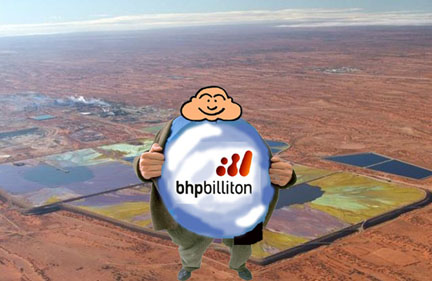 BHP seeks more time on Olympic Dam Kristie Batten , 27 September 2012 THE South Australian government says it will carefully consider a request by BHP Billiton for an extension to the December deadline for its shelved $A28 billion Olympic Dam expansion
The government received a letter requesting the four-year extension beyond December 15 ahead of a meeting between the miner and Minister for Mineral Resources and Energy Tom Koutsantonis in Adelaide yesterday.
“Very careful consideration will now be given to the company’s request and the reasons given for seeking an extension,” Koutsantonis said in a statement…….
this will require a lot more work at the pit, a lot more work here in Adelaide and the scale and the scope of that work will be in the hundreds of millions of dollars.”
However, SA Greens politician Mark Parnell told ABC Adelaide the government should reject the request and renegotiate.
“Extending a bad deal for four more years doesn’t improve it one iota,” he said.
“This is really a chance for South Australia to renegotiate with the world’s richest resource company a deal that looks after the environment, is better for the economy, guarantees local jobs and makes sure that all South Australians benefit from the resources that we own.”
BHP has said it did not expect to approve any major projects in the current financial year. Shares in BHP last traded 27c down to $32.54.
Australia in danger, as part of USA’s military machine
 Is it time to downgrade US defence? Business Spectator, Jackson Hewett , 26 Sep 2012 Malcolm Fraser says it is time we end our “dangerous and foolish” complicity with US military policy in the Asian region and renegotiate the ANZUS treaty.
He calls Defence Minister Stephen Smith’s assertion that joint US Australian military operations are not bases as “political spin of the worst kind”, something that Professor Richard Tanter, the Director of the Nautilus Institute for security studies agrees with.
Fraser says that the 2500 marines on permanent rotation in the Northern Territory, proposed US surveillance bases in the Cocos Islands and expanded roles of Pine Gap linked to US bomber command in Hawaii, send a clear message that Australia is becoming the “the southern bastion of America’s re-arming in the Western Pacific and Southeast Asia” – something that “spells danger for the entire region”. If citizens fully understood the level of US control over
military operations here, there would be “rage across Australia”.
Fraser is calling for a complete review of the ANZUS treaty and says that we have failed to work within the treaty’s stated aim of “consultation” on defence, and instead we have become “supplicants” who uncritically take part in American wars.
It is time, Fraser says, to show “the guts, the grit and the gumption” to communicate to the region that we are independent of America. Under current American policy, Fraser believes, our unwavering alliance with the US puts us in more danger than not….. http://www.businessspectator.com.au/bs.nsf/Article/us-alliance-america-australia-china-foreign-policy-pd20120926-YH2Q9?OpenDocument&src=sph%20&src=rot
Solar energy going backwards in Queensland, with its anti-renewable energy government
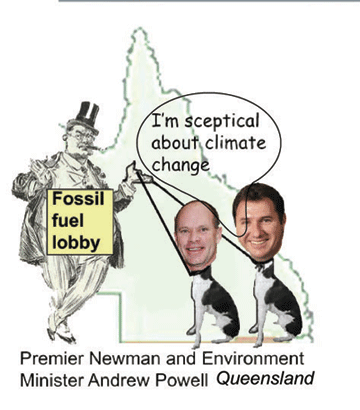 Queensland a leader in solar? Not on Campbell Newman’s watch By Charis Palmer 27 September 2012 The Conversation Around the clock solar power could be a reality for Australians in the foreseeable future, but experts say a hostile state government stands in the way of Queensland becoming the solar power leader suggested by the Climate Commission.
The latest instalment from the Climate Commission on the impacts and opportunities of climate change is “wilfully blind to reality”, with no mention of the massive coal and coal seam gas industries in Queensland, said Chris McGrath, senior lecturer in environmental regulation at the University of Queensland. The report says Queensland’s solar resources are among the best in the world, and the state should take more advantage of the opportunity.
But in the absence of positive deployment policies from the state government, it will take some time to see large solar power stations serving retail customers, said Mark Diesendorf, deputy director of the Institute of Environmental Studies at University of New South Wales. The Climate Commission’s report cites the Kogan Creek Solar Boost Project, which will provide a solar thermal addition to the neighbouring coal-fired power station, expected to be the largest solar integration project in the world.
But in July, Queensland Premier Campbell Newman withdrew $75 million in funding from the proposed stand-alone 250 megawatt Solar Dawn project near Chinchilla.
Dr Diesendorf said concentrated solar thermal could be vital to solar power generation in the longer term. “It’s not very expensive to store the heat on concentrated solar thermal and therefore have 24 hour solar power.”
But with several coal-fired power stations running at less than capacity in Queensland, organisations investing in new solar infrastructure will find it difficult to compete, Dr McGrath said. He added that the government’s focus remained on coal and coal seam gas, with renewables seen as a small component only.
“They’re talking about Queensland as a leader for solar, but Queensland’s going backwards in terms of participating in any funding for addressing climate change, and unwinding programs.” Dr McGrath said the picture painted by the Climate Commission in its report is the same one that’s been painted for ten years with no action taken.
He said a blunter approach was needed from the Commission and agreed that while it may not be an advocacy group, it was up to scientists to point out the consequences of policy choices. “It’s not advocating if you say the 5 per cent by 2020 goal will lead to three degrees warming and we won’t have a Great Barrier Reef at this point. That’s just joining the dots for people to see.”
BHP prolongs the indecision on Olympic Dam uranium mine
BHP Billiton’s request for an indenture extension keeps the Olympic Dam project alive, says Greg Kelton. Adelaide Now 27 Sept 12 GET ready for another four years of “will they or won’t they”. South Australians will have to play the pol-itical guessing game of what will happen to the much-vaunted Olympic Dam mine expansion, albeit on a much smaller scale.
The state has already gone through one major economic disappointment with BHP Billiton shelving the planned $30 billion expansion last month, claiming it was due to world economic conditions.
The proposed expansion had been sold to the public by Government, economic commentators and many in the mining industry as the state’s economic saviour, the major project which would put SA up with the mining giant states of WA and Queensland.
BHP Billiton’s decision to ask for an extension of the indenture which was due to expire at the end of this year, keeps the project, in some form at least, alive….. Both parties now realise the project cannot be seen as the be-all and end-all for the state’s economy. Both have stated the need for more diversification of the state’s economic base. However, whatever they think, both parties will be keen for some form of Olympic Dam expansion to proceed. Their political futures might well depend on it. http://www.adelaidenow.com.au/news/opinion/bhp-billiton-guessing-game-set-to-continue-in-south-australia/story-e6frealc-1226482133887
Western Australian Aborigines fear radiation pollution from Wiluna and Yeelirrie uranium mining projects
 Radiation exposure looming for Wiluna http://indymedia.org.au/2012/09/22/radiation-exposure-looming-for-wiluna 22 Sep 2012 By Gerry Georgatos Perth Western Australia Gerry Georgatos – courtesy National Indigenous Times – nit.com.au “They are going to kill our people, some will die quickly, some by a thousand cuts,” said Wiluna Elder Glen Cooke.
“We don’t want Maralinga all over again where our people will be hurt and die sick and young, and for decades the truth hidden.” “If they bring uranium out of the ground at Wiluna and radiation to our people many of our young children today will be tomorrow’s Yami Lesters.”
Toro Energy’s Wiluna uranium project’s final environmental approval looks near certain from the Environmental Protection Authority (EPA) and the uranium mine will become the front runner for more uranium mining throughout Western Australia and predominately on Aboriginal lands where communities continue to thrive – for now.
The many years-long ban on uranium mining in WA has been lifted.
Angst has ripped through Aboriginal communities State-wide and especially at Wiluna and Yeeliree.
“The Government has not said that they cannot guarantee against radiation poisoning of our people,” said Mr Cooke. EPA chairman Paul Vogel said radiation exposure for people living near Wiluna would be “very low”.
Yeeliree Traditional Owners and chairperson of Western Australians Nuclear-Free Alliance (WANFA), Kado Muir said all the Elders from across WA who make up WANFA cannot believe the “high risk” claim by Dr Vogel of “very low” radiation exposure risks to communities nearby the proposed Wiluna mine. “There are no genuinely safe levels with radiation – radiation exposure at any level is bigger than exploding dynamite. Chernobyl and Fukishima didn’t get it safe, so what makes us think Australia will? This is our peoples lives they are putting at real risk, not theirs.”
“How many Western Australian communities have suffered lead and aluminium poisoning from leaks along freight routes and from refineries, and it was said risks would be contained but they weren’t? They skyrocketed past base levels and with uranium a thousand times more dangerous, what are they saying? Are they mad? Uranium belongs in the ground, not above it.”
“Don’t our peoples, our communities, our Country matter to these Boards?”
The EPA claim to have tightened conditions around the uranium project after an independent appeals committee made 21 new recommendations after appeals were made by independent groups, the Conservation Council of WA and WANFA and its Elders to the EPA decision to approve Toro Energy’s Wiluna uranium project.
Canadian company CAMECO is also seeking approvals to mine uranium on Mr Muir’s Tradtional Country – Yeeliree.
WA environment minister Bill Marmion said nine appeals had been lodged against the EPA decision in May. The EPA has three uranium proposals before it. “I am satisfied the appeals committee has carefully considered all the matter raised in the appeals and have accepted their recommendations,” Mr Marmion said in a statement. He said he would consult the Radiological Council and the Ministers for Indigenous Affairs and Health
Spread of nuclear weapons now likely,if SILEX laser uranium enrichment goes ahead
U.S. Nuclear Agency OKs License for Laser Enrichment, Despite Worries NTI Sept. 25, 2012
By Elaine M. Grossman Global Security Newswire WASHINGTON — Nuclear Regulatory Commission staff on Tuesday issued the first U.S. commercial license ever for a process in which uranium is enriched by laser, opening what many issue experts have warned could be a new chapter in the global proliferation of sensitive atomic materials.
“This is going to further validate a new enrichment technology when we’re trying to get countries to restrict the old enrichment technologies, because they’re dangerous enough,” said one House aide, describing a concern held by several members of Congress. “How is this a positive for nonproliferation?”
Under the new permit, nuclear energy giant GE-Hitachi can construct and operate what it calls a “Global Laser Enrichment” facility in Wilmington, N.C., that would produce atomic fuel for reactors worldwide. The commercial consortium has said initial tests of the technology have been successful, potentially laying the groundwork for a more cost-effective method of enrichment than today’s centrifuge approach.
Smaller facility space and less energy consumption make lasers an appealing tool for commercial uranium enrichment, but might also prove attractive to a handful of nations around the globe interested in the illicit production of weapon-grade uranium, according to nonproliferation specialists.
Critics have said any U.S. action to approve laser enrichment domestically would be likely to spur new research on the technology abroad — both for commercial and clandestine use.
Based on such concerns, the American Physical Society in 2010 petitioned the Nuclear Regulatory Commission to begin requiring proliferation assessments as part of its licensing process for any new uranium enrichment or plutonium reprocessing technologies.
Experts subsequently asked the five NRC commissioners to postpone the agency’s decision on the GE-Hitachi laser enrichment license until they could decide the matter of whether such permit requests should undergo appraisals for their potential proliferation ramifications.
However, an NRC decision on mandating such analyses is not expected until November at the earliest.
“The petition review package is due to the Office of the Secretary by Oct. 31,” NRC spokesman David McIntyre said on Tuesday. “It should reach the commission a few days after that.”
By regulation, the NRC staff had 10 days to issue the laser enrichment operating permit following Atomic Safety and Licensing Board approval on Sept. 19.
Led by Chairwoman Allison Macfarlane, the NRC commissioners have not actually voted on whether to approve the GE-Hitachi license, according to McIntyre. Rather, the NRC spokesman said, “the commission was notified verbally that staff was prepared to issue the license, and since the commission did not direct otherwise, the staff proceeded.”
Now that staff has approved the permit, the commissioners have 120 days to revisit the licensing board’s findings and potentially put the brakes on the laser enrichment effort, if they see fit. Such NRC reviews are “rare but not unheard of,” McIntyre said…….
there could still be enough time to revisit the laser enrichment license approval even after the NRC commissioners’ anticipated consideration this fall of the American Physical Society petition on proliferation assessments……. The pending American Physical Society petition “offers the commission a second opportunity to take a stance on proliferation matters, for which I am optimistic,” said Kemp, now an assistant professor of nuclear science and engineering at the Massachusetts Institute of Technology. “However, whether the commission will have the high-mindedness and public spirit to revisit the [laser enrichment] decision at that time remains an open question.”http://www.nti.org/gsn/article/us-nuclear-agency-oks-license-laser-enrichment-despite-worries/
Solar power in Australia being taken up by the less well off
 ‘Solar Is For The Rich’ Myth Well And Truly Busted http://www.energymatters.com.au/index.php?main_page=news_article&article_id=3392 by Energy Matters, 24 Sept 12 The anti-solar brigade is running out of ammunition after yet another popular myth – that rich city dwellers represent the majority of solar installs – has again been shown to be completely and utterly false.
In a submission prepared by the Rec Agents Association (RAA) to the Climate Change Authority in relation to Australia’s Renewable Energy Target review, an analysis of postcode locations of solar electric and solar hot water system installations found most systems (53%) were installed in regional and rural communities with only 43% installed in the major capital cities.
Solar power uptake amounted to 13% in the major capital cities of Australia and 21% outside of the major capital cities.
Furthermore, the suburbs with the highest income levels did not correspond to those with highest penetration – in fact, the opposite was more likely.
“A broad range of communities have accessed solar under the RET scheme and the above figures explode the myth that the RET is supporting metropolitan middle class welfare and is evidence of the RET’s equitable effectiveness,” states the submission.
Echoing sentiments expressed by others, RAA also believes the RET review should be extended from 2 to a minimum of 4 years as the current 2 year review increases investment uncertainty for the renewable energy industry.
RAA’s response to the Climate Change Authority’s Statutory Renewable Energy Target Review can be viewed here (PDF).
The REC Agents Association (RAA) was established in late 2011 and represents agents registered with the Clean Energy Regulator (CER) that createsRenewable Energy Certificates (RECs) and other environmental certificates.
Australia: Renewable Energy Market Research Report
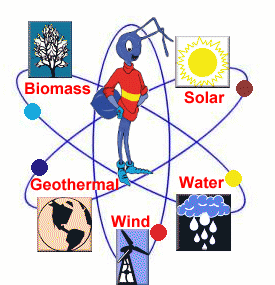 Renewable Energy in Australia Industry Market Research Report Now Updated by IBISWorld http://www.redorbit.com/news/science/1112699124/renewable-energy-in-australia-industry-market-research-report-now-updated/ September 22, 2012 Melbourne, Australia (PRWEB) September 23, 2012
The energy world faces unprecedented uncertainty. Increased awareness surrounding the impact of climate change and dependence on fossil fuels has prompted policy makers and scientists to rethink their strategies. The Renewable Energy industry has been both a benefactor and victim of these changing tides, as increased investment and support has been offset by delayed implementation and political populism.
The Federal Government’s mandatory Renewable Energy Target (RET), which aims to have 20% of the country’s electricity generated from renewable sources by 2020, is a good indicator of its commitment to a clean energy future. However, the economics of coal-fuelled electricity considerably outweigh that of renewables. The introduction of the carbon tax on 1 July 2012 will see the industry benefit from significant assistance in the form of grants and concessions, but still remains at the mercy of its infancy and expensive cost structure. According to IBISWorld industry analyst, Naren Sivasailam, “in the five years leading up to 2012-13, industry revenue is estimated to grow at an annualised 5.6% to total $5.24 billion”. Revenue in 2012-13 is expected to post an increase of 35.2% from the previous year.
Hydropower continues to be the largest source of renewable energy, but has been affected by poor rainfall and drought conditions. “Wind and solar power have exhibited dramatic growth over the decade, but their contribution to overall output remains small”, adds Sivasailam. The Renewable Energy industry has a medium level of market concentration, although there are significant segmental differences. For example, the hydropower segment is highly concentrated, with the two major players, while the wind power segment is more fragmented, with a number of players operating wind farms with medium capacities. The major players in the industry are Snowy Hydro Limited and Hydro-Electric Corporation.
The future prospects of the Renewable Energy industry are inextricably tied to the level of government support and the willingness of end users to wear higher costs. Initiatives such as interest free Green Loans and the Renewable Energy Development Fund aid investment in technology that will eventually make clean energy affordable. However, support from consumers and industry is equally important in setting a precedent for change. The next five years will be critical in determining whether Australia’s abundant natural resources can indeed be harnessed and set a world example for a decarbonised future.
For more information, visit IBISWorld’s Renewable Energy report in Australia industry page.
Australia is slow to cop on to the collapse of the uranium market
 Australia’s nuclear/uranium lobby appears to live in a parallel universe. quite distinct from the real one.
Of course, the nuclear lobby world-wide is continuing to desperately hype the future of its now declining industry. And, of course, Australia’s greedy little nuclear entrepreneurs, like John White, Ron Walker and Robert Champion de Crespigny, and their politically minded hangers on , Martin Ferguson, Alexander Downer – all salivate at the thought of Australia becoming the world’s nuke waste dump.
 Still, I expected more self interest from Australia’s uranium lobby, and States politicians. Don’t they notice what is happening to the uranium market?. BHP Billiton and Cameco noticed, and acted to stop wasting shareholders’ money in developing new uranium mines.
But every day in Australia, the media is bombarded with the joy of new uranium mining – joy in Queensland, in NSW – today it’s Broken Hill looking to the golden future. – Christina Macpherson 22 Sept 12
No foreseeable future for new uranium mines
 End of last month, the price had fallen to US$49.25 and for most of September, it hovered at the US$48 mark. This is almost 60% below the entry level target as calculated by Bannerman. The impact on the development of new mines, is obvious.
I believe the commodities boom is over, or at least on hold for another five years. In the meantime, no new mines.
Our Anticipated Uranium Projects Will Not Go Ahead, Except One [analysis] Equities.com Daniel Steinmann All Africa Global Media 22 Sept12, Bannerman Resources, the Australian company driving one of four new uranium projects in Namibia, recently said at a mining conference, the price for uranium U308 needs to be between US$75 and US$90 per pound (0.454kg) to drive any new investment in greenfields uranium mines.
Hidden in this seemingly neutral observation and analysis, are many serious consequences for the further development of the uranium sector Continue reading
Tor Energy may face legal action against its Wiluna uranium mine plan
 Uranium plans may spark legal stoush http://www.abc.net.au/news/2012-09-21/uranium-mine-plans-may-spark-legal-stoush/4274134 Sep 21, 2012 The Conservation Council of Western Australia says it will consider legal action to prevent Toro Energy’s proposed Wiluna uranium mine going ahead.
The group says the State Government has not responded adequately to appeals lodged against the project, which is set to become WA’s first uranium mine. The council’s Mia Pepper says the group will pursue a range of avenues to ensure its safety and environmental concerns are addressed. Continue reading
Australia’s unrecognised radiation victims of Montebello atomic bomb tests
Pat Coverley, now 83, saw most of his shipmates die young, “of various cancers suspected to be linked to radiation”
The [Royal Commission] findings delivered a scathing indictment of the manner with which these tests were conducted
Despite the findings, Drewe says the British and Australian governments have ever since fobbed off allegations that servicemen were exposed to high levels of radiation, making it almost impossible to mount a successful compensation claim.
One man’s island SMH, September 22, 2012 “……..Drewe’s arrival by dinghy to the still-contaminated island
(visit limit: one hour) was the eerie culmination of a lifelong obsession with the Montebello Islands. “It amazes me how few
Australians know about these nuclear tests Britain arrogantly conducted in our backyard,” he declares. Continue reading
Australia’s big opportunity to export renewable energy expertise to Indonesia
The AusTrade report has identified several areas of opportunities for Australian clean energy companies, including:
- Education – training, research and development for renewable energy development and deployment, particularly in hydropower and solar photovoltaic,…
 Indonesia: Clean Energy Opportunities for Australian Companies Engineering Source, by Justin McGar, 21 Sept 12 The Australian Trade Commission (ATC) has identified Indonesia as a key target market for home-grown companies involved in clean energy products, expertise and services who want to grow and develop their businesses.
That news comes according to a recent study the ATC carried out with key executives with inside knowledge into the workings of the country and Indonesia’s future renewable energy direction.
Australia already exports $4.5 billion worth of products and services to Indonesia which, with a population of over 234 million, is the fourth most populous nation in the world and one of the world’s highest performing emerging markets.
To ensure sustainable growth in Indonesia, its government has set a target that would see 25 per cent of total energy consumption filled by clean energy sources by 2025. Continue reading
Call for Victorian government to allow small scale community wind farms
 Call to ease regulations for small wind farms http://www.abc.net.au/news/2012-09-20/call-to-ease-regulations-for-small-wind-farms/4271052 Sep 20, 2012 The Hepburn council will lobby the Victorian Government to exempt community-based wind farms from strict regulations. A planning amendment introduced by the State Government last year prohibits new wind farms in certain areas and within two kilometres of houses.
The council adopted a motion at this week’s meeting to express its ongoing support for renewable energy developments.
Mayor Sebastian Klein says small wind farms should not be treated the same as large-scale wind farms. “It basically asks for the State Government to make different considerations for community owned wind farms than I guess large-scale, corporate wind farms,” he said.
“So I guess small-scale community owned wind farms that provide back to the community have a community dividend and also have a much smaller footprint and a much smaller impact on the landscape and on people’s amenity.”
1 This month


Help Aunty Sue Protect Her Land and Sacred Sites From Destructive Rocket Testing.
.

Australians deserve the truth
about
AUKUS – https://aukuspublicinquiry.com/

PETITION – To: Prime Minister Anthony Albanese and the Australian Labor Government

of the week – Australians for War Powers Reform (AWPR)
To see nuclear-related stories in greater depth and intensity
 Antinuclear