Julian Assange trial is political hypocrisy
WikiLeaks founder Julian Assange attended the conference. Assange has become one of the main targets. Many of the themes discussed at the conference are what Assange has come to represent.
Freedom of information rather than freedom from information. The prosecution of wrongdoers, not the prosecution of whistleblowers. An open society, not a closed society.
“Freedom to think as you will and speak as you think are indispensable to the discovery and spread of political truth; the greatest menace to freedom is an inert people.”
The Australian Government must speak up for Julian Assange.
Julian Assange trial is political hypocrisy, Independent Australia, By Kim Sawyer | 13 December 2021 Given that governments in the past have encouraged whistleblowing, the punishment of Julian Assange is a great hypocrisy, writes Dr Kim Sawyer.
Continue readingNuclear submarine wastes and Napandee – a backdoor way of starting Australian nuclear waste importing?

A frightening prospect!. Not only are these planned nuclear submarines completely unsuitable for the defence of Australia’s coastline, but now it looks as if they are a back-door way of achieving that old nightmare – of Australia taking in international radioactive trash.
Preparing for spent nuclear fuel disposal. MARITIME AND UNDERSEA WARFARE, Defence Connect, 06 DECEMBER 2021, By: Christopher Skinner, ”……………….We must therefore consider the requirement for the submarine spent reactor fuel at end-of-service life to be a responsibility for Australia and to plan accordingly.
The current work on the Australian Intermediate Level Radioactive Waste Storage Facility near Kimba, on; upper Eyre Peninsula in South Australia, has reached a decision point as reported by the ABC (Napandee chosen as nuclear waste storage site after ‘six years of consultation’), “Napandee, a 211-hectare property near the town of Kimba, has been acquired by the government and will be used to store low and medium-level nuclear waste. The property was already selected by the government but it had to allow an additional 60 days of consultation before it could formally declare the site.”
The implication of this decision for the nuclear submarine program is to show that concern for the full extent of the nuclear fuel cycle is relevant even if the development of the Australian NRWMF was not predicated on either the advent of nuclear propulsion with spent fuel to be managed, nor of the need to provide a permanent disposal facility for high level waste such as unprocessed spent fuel…..” https://www.defenceconnect.com.au/maritime-antisub/9204-preparing-for-spent-nuclear-fuel-disposal?fbclid=IwAR385TPCTWA4ALXk9r7bzJ5uhyD78zpolFNvWb2Q9aEj3UvXLjAuOnhAS8A—
Australia has been warned, even from the militaristic Australian Strategic Policy Institute, on the problems and astronomic costs of the nuclear submarines
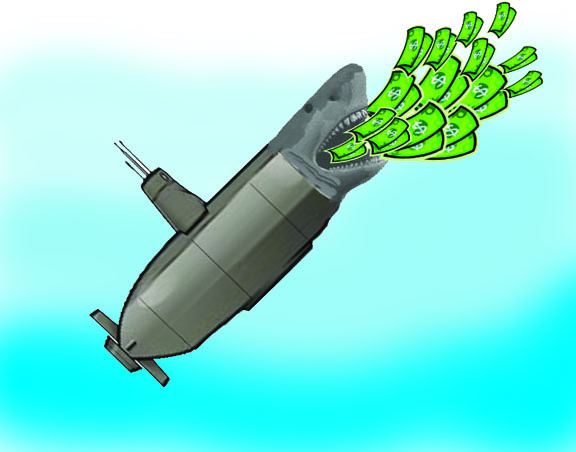
The price tag will be eyewatering, with an eight-boat programme costing Aus$116 billion (US$83 billion) “at an absolute minimum”, almost a tenth of annual gross domestic product.
“It’s likely to be at least two decades and tens of billions of dollars in sunk costs before Australia has a useful nuclear-powered military capability.”
Australia warned bid for nuclear subs carries ‘enormous’ risks https://www.france24.com/en/live-news/20211213-australia-warned-bid-for-nuclear-subs-carries-enormous-risks 13/12/2021 Australia’s bid to develop a fleet of nuclear-powered submarines will cost more than US$80 billion and take decades in the “most complex” project the country has ever embarked on, a study released Monday warned.
The report from the Australian Strategic Policy Institute — an influential Canberra-based think tank — said ownership of the high-tech subs built with US or British know-how would offer a major advantage in deterring aggression from China or elsewhere. [Really?]
But it will also be a fiendishly difficult task requiring a step-change in Australia’s military and industrial capabilities.
It is “probably the largest and most complex endeavour Australia has embarked upon. The challenges, costs and risks will be enormous,” the think tank warned.
“It’s likely to be at least two decades and tens of billions of dollars in sunk costs before Australia has a useful nuclear-powered military capability.”
The project, announced last month, will make Australia the only non-nuclear weapons power to own nuclear-run submarines, which are capable of travelling quickly over long distances carrying long-range missiles and state-of-the-art underwater drones.
Canberra plans to equip them with conventional rather than nuclear weapons. It has yet to decide whether it will buy US or British technology, what class, size and capabilities the subs will have, where they will be built or how radioactive material will be handled.
Even under an optimistic schedule, the first submarines are unlikely to be operational before 2040, according to the report’s authors, who include former Australian defence department officials and an expert on nuclear physics.
The price tag will be eyewatering, with an eight-boat programme costing Aus$116 billion (US$83 billion) “at an absolute minimum”, almost a tenth of annual gross domestic product.
Among a litany of tasks ahead, the navy will have to triple the number of submariners it recruits, refurbish docks, and develop extensive nuclear safeguards.
On the diplomatic front, Australia will need to reassure neighbours and the International Atomic Energy Agency that the subs do not present a nuclear proliferation risk.
“Regardless of the Australian government’s declared intentions,” the report said, “once Australia possesses (weapons-grade enriched uranium), the breakout time to develop and construct nuclear weapons would be less than a year if a simple nuclear-weapon design were pursued.”
The submarine plan has already caused diplomatic headaches for Canberra, with nearest neighbour Indonesia expressing concern, and the decision to ditch a contract to buy French non-nuclear submarines causing fury in Paris.
Independent MP Andrew Wilkie implores the Prime Minister to pick up the phone to the US president and UK prime minister to end the prosecution of Julian Assange.
MP urges PM to pick up phone over Assange, https://www.mandurahmail.com.au/story/7548246/mp-urges-pm-to-pick-up-phone-over-assange/?cs=9397Dominic Giannini
MP urges PM to pick up phone over Assange, https://www.mandurahmail.com.au/story/7548246/mp-urges-pm-to-pick-up-phone-over-assange/?cs=9397
- Dominic Giannini 12 Dec 21
Independent MP Andrew Wilkie has implored the prime minister to pick up the phone to the US president and UK prime minister to end the prosecution of Julian Assange.
The former intelligence analyst said the prosecution of Mr Assange has always been political which meant it could be solved politically by Prime Minister Scott Morrison.
“The reality is this has always been an intensively political matter and it can be solved politically by Scott Morrison picking up the phone to Joe Biden and Boris Johnson,” Mr Wilkie told the ABC.
It comes after reports the 50-year-old WikiLeaks founder suffered a stroke in prison in October.
“Jail is killing Julian Assange,” Mr Wilkie said.
“There is no way he will survive continued incarceration in the UK.”
Mr Assange has just suffered a legal blow after the UK High Court ruled he could be extradited to face charges in the US.
Mr Assange’s lawyers say they intend to appeal the decision in the UK’s highest court.
Protesters say ‘No’ to AUKUS, nuclear submarines and war with China
Protesters say ‘No’ to AUKUS, nuclear submarines and war with China https://www.greenleft.org.au/content/protesters-say-no-aukus-nuclear-submarines-and-war-china Kerry Smith December 12, 2021Issue 1329Australia A national weekend of action against AUKUS was organised over December 10-12 with protests in Canberra, Perth, Sydney, Wollongong, Hobart, Brisbane and Adelaide.
Around 40 people attended an action by the newly-founded campaign group Stop AUKUS – WA action in Boorloo/Perth on December 10 as part of a national weekend of action. The group’s three objectives are: No nuclear subs; No US bases; and No war with China. Greens Senator Jordon Steele-John called for a reduction in defence spending, more funds to international aid and proper care for veterans.
Other speakers included: Christopher Crouch from the Independent and Peaceful Australia Network; anti-nuclear campaigner Jo Vallentine; Socialist Alliance WA convenor Sam Wainwright; Elizabeth Hulm from the Communist Party of Australia; Peter Shannon from the Medical Association for Prevention of War and Steve McCartney from the Australian Manufacturing Workers Union.
Around 200 people protested in Sydney on December 11. Speakers included Wongkangurru man Raymond Finn, an anti-nuclear campaigner, who acknowledged country; Greens Senator Mehreen Faruqi; a speaker from School Strike 4 Climate; Lachlan Good from Young Labor Left and Warren Smith, Assistant National Secretary of the Maritime Union of Australia.
The lively protest, which marched through the CBD to Belmore Park, was endorsed by the Retail and Fast Food Workers Union, Maritime Union of Australia – MUA, United Workers Union, NTEU-NSW, as well as many anti-war and peace organisations and environment groups.
Australian government urged to push UK and US to free Julian Assange.
Australian government urged to push UK and US to free Julian Assange, SBS , 12 Dec 21,
Australia’s Department of Foreign Affairs and Trade says officials have raised issues of due legal process and access to proper medical care for Julian Assange with officials in the UK and the US. By Alexander Britton
The Australian government has been urged to weigh in on the case of WikiLeaks founder Julian Assange as supporters vowed to continue to fight against his extradition……………..
Senator Rex Patrick told SBS News the Australian government has not placed enough pressure on the US and UK governments about the case but was hopeful “common sense will prevail”.
He said: “We have a Deputy Prime Minister (Barnaby Joyce) who spoke in support of Julian Assange while on the backbench who is in Washington in quarantine.
“He could be using his time pushing his views, speaking to the (US) Secretary of State.
“The Deputy Prime Minister was very clear as to what the Government should be doing, but has remained quiet since he rejoined the cabinet.”
‘Dangerous and misguided’
In a statement, Mr Joyce said: “My position remains the same….In regards to the current UK proceedings, I note he was not in the US at the time of the action he is accused nor was he a US citizen at the time so should not be bound to US laws.”
The US said the release of the classified information put lives in danger, but Mr Assange’s backers say the case is retaliation for his exposing of wrongdoing in overseas conflicts.
His fiancee, Stella Moris, said his legal team would appeal against the decision and said Friday’s verdict at the Royal Courts of Justice in London was “dangerous and misguided”.
“This goes to the fundamentals of press freedom and of democracy. We will fight,” she said outside the court.
“Every generation has an epic fight to fight, and this is ours because Julian represents the fundamentals of what it means to live in a free society, of what it means to have press freedom.”
The ruling has been the subject of criticism from a range of campaign groups, as well as a number of politicians in Australia.
Labor MP Julian Hill said the Australian government “must stand up to the US and the UK and stop this extradition”.
In a series of tweets, he said: “Julian Assange, an Australian citizen is fighting for his life in London, as the USA seeks his extradition to face an effective death sentence.
“This Australian, who exposed US war crimes, is treated worse than a war criminal. He’s NOT receiving a fair trial.
“There will never be a legal solution to Julian Assange’s case. It is an inherently political witch-hunt.
“The Australian Government must stand up to the US and the UK and stop this extradition.”
Federal Independent MP Andrew Wilkie urged Prime Minister Scott Morrison to “end the lunacy” and demand the release of Mr Assange.
“The PM must end this lunacy, pick up the phone to his counterparts in the US and UK, and urge them to release Mr Assange immediately and allow him to return to Australia. He is a hero, not a villain, and journalism is not a crime.”
Greens senator Janet Rice added: “Julian Assange’s prosecution has always been political. It’s going to need a political response from our government to get justice for him.”
And MP George Christensen, who introduced a private bill to address the illegal detention of journalists last month, titled “free Julian Assange”, called on US President Joe Biden to drop the case.
He wrote on Facebook: “A foreign court just ruled that an Australian journalist – Julian Assange – should be extradited to another foreign nation to face trumped-up charges of hacking and espionage.
“This is an affront to freedom of speech and Australian sovereignty.”
Concerns about Assange’s health………..
The legal wrangling will go to the Supreme Court, the United Kingdom’s final court of appeal.
Amnesty International’s Europe Director Nils Muižnieks said the decision was a “travesty of justice”.
“The US government’s indictment poses a grave threat to press freedom both in the United States and abroad.”
While Nils Melzer, the UN’s special rapporteur on torture, noted the court’s decision came on the same day as Human Rights Day and expressed concerns about Mr Assange’s health.
He said: “It’s just like a car crash happening in slow motion and every now and then someone asking you to comment on what you’re seeing.
“Well it’s still a car crash happening in slow motion, we know exactly what’s at the end of this.
“At the end, Julian Assange is crushed as a person and our rights have been done away with.”……………..
A Department of Foreign Affairs and Trade spokesperson said they have made available consular assistance and continue to monitor the case. [ed note: a fat lot of good that will do!]………….. https://www.sbs.com.au/news/australian-government-urged-to-push-uk-and-us-to-free-julian-assange_1/057ebae4-4cc9-40ba-9536-f6a2b74cf6e7
PM under pressure to end Assange ‘lunacy’
PM under pressure to end Assange ‘lunacy’ Blue Mountains GazetteMarty Silk and Tiffanie Turnbull
PM under pressure to end Assange ‘lunacy’ Blue Mountains Gazette
11 Dec 21, The federal government has “raised the situation” of WikiLeaks founder Julian Assange’s confinement with the UK and US, but has stopped short of calling for the Australian to be released.
The 50-year-old is wanted in the US over the publishing of thousands of secret US diplomatic and military files, some of which revealed war crimes in Iraq and Afghanistan.
Assange is also accused of trying to recruit hackers to provide WikiLeaks with classified US information, and if found guilty could face up to 175 years’ imprisonment……………
Assange’s lawyers intend to challenge the court’s ruling with another appeal, this time in the UK’s Supreme Court.
Federal Independent MP Andrew Wilkie is calling on Prime Minister Scott Morrison to “end this lunacy” and demand the US and UK allow Assange to be released.
“Mr Assange should be looking forward to spending Christmas with his two young boys and his fiancee, but instead he’s facing a 175-year jail sentence and the very real possibility of living out his final days behind bars,” he said in a statement.
“He is a hero, not a villain, and journalism is not a crime.
“Again the United Kingdom proves it’s a lackey of the United States and that Australia is delighted to go along for the ride.”
The Department of Foreign Affairs and Trade said it respected the UK legal process and Australia was not a party to the case………..
The UK court’s decision has drawn ire from the United Nations’ special rapporteur on torture, Nils Melzer, who sharply criticised the verdict.
“This is a shortcoming for the British judiciary,” Mr Melzer told the DPA news agency on Friday.
“You can think what you want about Assange but he is not in a condition to be extradited,” he said, referring to a “politically motivated verdict”.,,,,,,,,,,,,,,,,
Assange facing extradition to US: where is the outrage?
“How can it be fair, how can it be right, how can it be possible, to extradite Julian to the very country which plotted to kill him?”
Assange facing extradition to US: where is the outrage? https://redflag.org.au/article/assange-facing-extradition-us-where-outrageTom Gilchrist11 December 2021
The US government has won its appeal against Wikileaks founder Julian Assange, with the UK’s High Court overturning an earlier decision to block Assange’s extradition to the US. The case will now be sent back to the Magistrates Court with instructions to allow the UK Home Secretary Priti Patel to approve or deny the extradition request.
This is a massive blow to press freedom. Assange faces one charge of conspiracy and 17 espionage charges, begun by the Trump administration but continued by the Biden administration. These 17 espionage charges relate to the publication and release of secret government documents, a crucial right for serious journalists trying to hold governments to account. As a statement from Wikileaks in response to the ruling puts its, Assange is “accused of publishing true information revealing crimes committed by the US government in the Guantanamo Bay detention camp, Iraq, and Afghanistan, and details of CIA torture and rendition”.
For telling the truth about these war crimes Assange has faced a decade long campaign of persecution. As Amnesty International’s Europe Director Nils Muižnieks said in response to the High Court decision: “The US government’s indictment poses a grave threat to press freedom both in the United States and abroad. If upheld, it would undermine the key role of journalists and publishers in scrutinising governments and exposing their misdeeds, and would leave journalists everywhere looking over their shoulders.” Muižnieks has labelled the decision a “travesty of justice”.
In the earlier decision in January which blocked Assange’s extradition, District Judge Vanessa Baraitser ruled that the harsh conditions of the US prison system would put Assange at an unreasonable risk of suicide. The High Court has allowed the appeal against this decision on the basis of various “assurances” given by the US government to Assange. These included assurances that he would not be subjected to Special Administrative Measures which restrict contact with the outside world, and that he would be allowed to serve his sentence in Australia if the Australian government made such a request.
These assurances, however, come with caveats. The US government has said that they must be allowed to hold Assange in these restrictive conditions if they fear he could be responsible for a “breach” of “national security”. As Muižnieks argues “The fact that the US has reserved the right to change its mind at any time means that these assurances are not worth the paper they are written on”.
Earlier this year an investigative report from Yahoo! News revealed that leading figures in the US government had discussed the possibility of kidnapping or assassinating Assange during the seven years he was taking refuge in the Ecuadorian embassy in London. Over the last decade it has subjected Assange to a campaign of persecution which Nils Melzer, the United Nations special rapporteur on torture, says amounts to psychological torture. The idea that this same government is now able to give assurances that it cares about the health and safety of Assange is absurd. As Stella Moris, Assange’s partner, says “How can it be fair, how can it be right, how can it be possible, to extradite Julian to the very country which plotted to kill him?”
Moris is a part of Assange’s legal team and says they will be appealing the decision. Such an appeal would be heard by the UK Supreme Court. Assange, meanwhile, remains imprisoned indefinitely in a maximum-security UK prison.
As one of the world’s most high-profile political prisoners, and an Australian national, the Australian media and government might be expected to be up in arms over the plight of Assange. But the shameful lack of concern about his fate persists. Loyalty to the US empire, and willingness to cover up its many crimes, comes first for Australian capitalism.
How the military-industrial complex has captured Australia’s top strategic advisory body

AUSTRALIA CAPTURED – How the military-industrial complex has captured Australia’s top strategic advisory body, MICHELLE FAHY, DECLASSIFIED AUSTRALIA 9 DECEMBER 2021
The Australian Strategic Policy Institute has veered away from its founding vision of providing an array of independent diverse views, to now promote an aggressive militaristic solution to the heightened tensions in Australia’s region.
The Australian Strategic Policy Institute (ASPI) in Canberra is the government’s primary source of outside-government advice, research and analysis on military and strategic affairs. Since its establishment in mid-2001, it has veered away from its founding vision.
There is a jarring disconnect between the lofty goals of independence expressed in ASPI’s charter, and the infiltration of ASPI by tentacles of the military-industrial complex. This has been barely mentioned in Australia’s mainstream media.
A Declassified Australia investigation has uncovered a casebook example of ‘state-capture’, with the development of deep connections between ASPI, and the world’s largest and most powerful military weapons manufacturers.
Australia is a significant participant in the global arms trade at present. Its $270-billion decade-long spending spree upgrading weapons and war machines is large by international standards, and Australia is increasingly becoming an arms seller too. As Australia moves militarily ever closer to the US, even defence insiders say the defence industry is ‘awash with money’.
The wars in Iraq, Afghanistan, Syria and Yemen have made the world’s biggest weapons manufacturers richer, larger, and more influential. At the lesser-known end of the spectrum, the Yemen war is notable for its extensive human rights abuses and war crimes: it has created the world’s largest humanitarian crisis. Despite pleas from the UN, the arms still flow and the war continues. The weaponry for this war has been supplied by the world’s top arms manufacturers, including Lockheed Martin, BAE Systems, Boeing, and missile-maker Raytheon.
ASPI and the Weapons Lobby
The Australian subsidiaries of these and other global weapon-makers have been regular ASPI sponsors for years. Some of them have successfully used the back door to gain access to ASPI’s top table, its governing council. ASPI council members have included former senior military officers, defence ministers, and federal MPs who are also on arms and cyber company boards. It has also included former and current arms industry executives. The challenge to ASPI’s independence is large and real.
ASPI’s founding charter, since it was established in 2001 by then prime minister John Howard with bipartisan support from Labor leader Kim Beazley, declares it must ‘operate independently of Government and of the Defence Organisation’.
Further, it states that ‘the perception, as well as the reality, of that independence would need to be carefully maintained’. Thus, from the outset, the government was acknowledging how such an important think tank would be vulnerable to capture by vested interests, both ideological and commercial………..
Our investigation shows that the ASPI council has numerous members who represent or have close links to the military-industrial complex. Of the 11 non-executive directors on ASPI’s governing council, five sit on the boards or advisory boards of weapons or cybersecurity corporations, while numerous past council members have had similar connections.
The current council includes former Howard defence minister Robert Hill. He’s on the supervisory board of German weapon-maker Rheinmetall’s Australian subsidiary, which is supplying Defence’s $5 billion of Boxer combat reconnaissance vehicles, and will soon also produce and export ammunition for the US Joint Strike Fighter program. Hill is also chair of Viva Energy Group, a major supplier of fuel to the Australian Defence Force (ADF)…………………….
Declassified Australia put questions to ASPI and the current council members. Dr Nelson declined to comment. No other council member responded by deadline. ASPI replied saying it manages conflict of interest matters in line with other Australian proprietary limited companies, and that ‘Council members will recuse themselves from discussions which may give rise to the perception of a conflict of interest matter’.
ASPI has a history of council members with interests in the defence industry. Jim McDowell was chief executive of BAE Systems in Australia for a decade, and then ran BAE in Saudi Arabia, where the Saudi military has since used BAE arms in the catastrophic war in Yemen. Returning to Australia, he was engaged by Liberal defence industry minister Christopher Pyne, and Defence, on numerous sensitive defence projects while also on ASPI’s Council. BAE Systems is in the running to provide Australia’s planned nuclear-powered submarines under the AUKUS pact.
Former Labor senator Stephen Loosley’s Council membership, including seven years as chair, coincided with board roles at French arms multinational Thales Australia, manufacturer of the Austeyr, the service rifle for all the Australian military, as well as armoured vehicles, submarine sonars and munitions. The Thales group has been accused of selling weapons to the Indonesian military who are running a war in West Papua against the independence movement.
Former Labor defence minister Kim Beazley was an ASPI distinguished fellow for two years in 2016-2018. For the majority of that time he was on the board of Lockheed Martin Australia while writing regularly for ASPI, without ASPI disclosing his board position at Lockheed.
………..ASPI’s independence is drawn into question not just by its board appointees but also by some research fellows. One recent example is the former director of cyber, intelligence and security at BAE Systems Applied Intelligence, Rajiv Shah, who cowrote a report on collaboration within the intelligence community that was sponsored by BAE Systems. Shah is now an ASPI fellow and a consultant to government and industry. ASPI does not disclose either in the report nor in his website bio Shah’s previous employment with BAE Systems, one of the world’s top 10 arms companies. Dr Shah did not respond to questions.
Declassified Australia does not imply any illegality by any past or present ASPI council members, fellows, or staff. The issue is the deep involvement of people associated with global weapons manufacturers, and the potential for, and perception of, conflicts with ASPI’s charter of independence.
The Reshaping of ASPI
At its foundation, the ASPI Council was instructed by the government to ensure its independence. As set down by the defence minister, it is required not only to be ‘politically non-partisan’ but also, most crucially, to ‘reflect the priority given to both the perception and substance of the Institute’s independence’.
The Howard government had envisaged that ASPI would do this by maintaining a ‘very small’ permanent staff while relying mostly on short-term contracts, secondments and similar arrangements for its research work. It would not publish views in its own name but would provide a forum for the views of a wide variety of outside experts.
20 years on, ASPI has morphed into a very different organisation.
A decision by Labor prime minister Kevin Rudd to make Stephen Loosley the ASPI Council chair in 2009, while Loosley was on the Thales Australia board, tested perceptions of independence. Then, in 2012, the Gillard Labor government appointed the current executive director directly from the senior position of Deputy Secretary of Strategy in the Defence Department. In the late 90s, Peter Jennings had been chief of staff to Liberal defence minister Ian McLachlan when the Howard Government first mooted the idea of creating ASPI.
Under this new leadership, ASPI set about expanding. Staff numbers have quadrupled in nine years from 14 to 60, plus there are now 29 research fellows and nine interns.
ASPI receives its core funding via a grant from the Defence Department. In 2018, the Morrison government approved a $20 million grant to cover five years’ of ASPI operations. In May 2021, this grant was increased by $5 million to cover two years of operations of a new Washington DC office.
Since 2012, ASPI has vigorously pursued additional funding. Within two years, annual income from commissioned research jumped from $37,000 to $1.1 million, and sponsorships were up 235% to $746,000. ASPI’s own-sourced revenue has continued to grow dramatically. In 2011-12, ASPI received less than $500,000 above its base funding, by 2020-21 it had exploded to $6.7 million.
The single largest source of ASPI’s funding in 2020-21, beyond its core funding, was from the US Government’s Departments of Defense and State ($1.58m), followed by additional funding from Defence ($1.44m) and other federal government agencies ($1.18m). The NSW and Northern Territory governments provided $445,000. In the private sector, the largest source was social media, tech and cybersecurity companies ($737,362), with Facebook ($269,574), Amazon ($100,000) and Microsoft ($89,500) being the largest. From the arms industry, ASPI received $316,636, with more than two-thirds of that coming from two of Australia’s largest defence contractors, Thales ($130,000) and BAE Systems ($90,000).
In 2019-20, Twitter gave ASPI $147,319 for its cyber research. Significantly, Twitter last week announced a partnership with ASPI said to be dealing with misinformation from the Chinese communist party that was seeking to counter evidence of human rights abuses in Xinjiang. As a result of ASPI’s research, thousands of “state-linked accounts” were shut down by Twitter.
While the cash from the arms industry may not appear substantial, as we have seen, the arms industry wields its major influence via its representatives finding their way on to seats at the top table.
The substantial extra funding from the US government, Defence and other Australian government departments, as well as corporate interests, provides a real challenge to ASPI’s responsibility to remain independent. It raises serious questions about undue influence, including foreign influence, at ASPI.
ASPI responded to our questions about protecting the perception of its independence by saying it retains ‘complete editorial independence on the material we choose to research’. It said it would not accept funding from parties attempting to constrain its editorial independence.
But just what does the US government get in return for its $1.57 million funding of ASPI, beyond its research projects on human rights violations, disinformation, and cybersecurity in China?
And what might BAE Systems get for its $90,000 grant to ASPI, other than a new report on the need for a ‘collaborative and agile’ intelligence community?
And what about Thales Australia, in return for its $130,000 grant to ASPI, beyond just being lead sponsor of the 2020 ASPI Conference?
The answer for them all, is ‘influence’.
ASPI’s role in advising the Australian government on defence strategy and procurements and cybersecurity would better serve the Australian people if it was to return to its original charter of researching and publishing a diversity of views from a position of uncompromised independence.
MICHELLE FAHY is an independent writer and researcher, specialising in the examination of connections between the weapons industry and government, and has written in various independent publications. She is on twitter @FahyMichelle, and on Substack at undueinfluence.substack.com https://declassifiedaus.org/2021/12/09/australia-captured/?fbclid=IwAR0_MMo3hIrY7uDHK4d2l5M-nxdsGBFyA_6Xtim8jxjotqPkMXmFheeGNWM
To suck up to the American government, Australia’s government leaders agreed to buy nuclear submarines, with no Parliementary discussion.
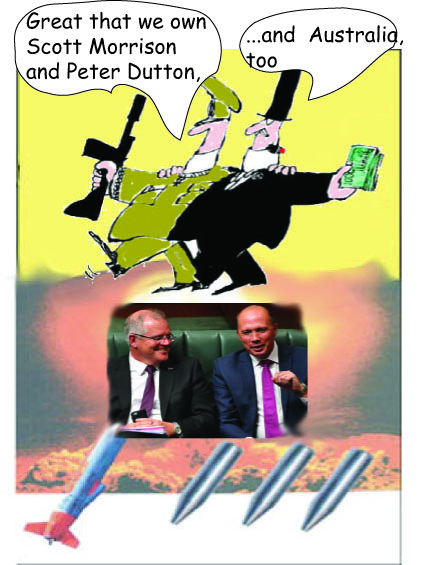
And as for the process, involving a sudden announcement to the Australian public, it is extraordinary that this momentous decision could be made without parliamentary or public scrutiny.
Australia bows down to America for nuclear submarines, Independent AustraliaBy Lee Duffield | 10 December 2021, As tensions between the U.S. and China grow, Australia’s nuclear submarine program has become less to do with our defence and more about placating the American Government, writes Dr Lee Duffield.
DEFENCE INDUSTRY MINISTER Melissa Price, on 9 November, declared the country’s nuclear-powered submarines would be built in South Australia.
How would this be done? Constructing the ships around imported reactors? It added into the brewing of questions and arguments since the sudden announcement of the nuclear plan and immediate cancellation of the French contract for conventional submarines on 16 September.
Trying to make sense of it all, several analysts, mostly through the Lowy Institute publication, The Interpreter, and at think-tanks to the Left and Right, have produced these main points:
- that American policy towards China is the main factor in this mix;
- that Australian sovereignty stands to be diminished, even if its security might be helped; and
- that the insult to France and its consequences, while not the main game, remains important — especially as it affects the standing of the Australian Government.
Sam Roggeveen, Director of the Lowy Institute’s International Security Program, contributed two articles, seeing the China-USA contest as the heart of it, with Australia now brought in more as a great power client, less as itself.
Roggeveen wrote:
‘The defence deal is a clear escalation and indication that Washington views Beijing as an adversary. It also has thrust Australia into a central role in America’s rivalry with China.’
U.S. reacts — Australia goes, too
The deal in question is the full package of the new tripartite defence arrangement, AUKUS (Australia, the United Kingdom, the United States), with Australia obtaining probably eight nuclear submarines at the centre of it.
As Roggeveen explains:
‘…the scale of this agreement and the close strategic and operational links it implies will create expectations from Washington. Australia cannot have this capability while assuming that it does not come with heightened expectations that Australia will take America’s side in any dispute with China.’
And as for the process, involving a sudden announcement to the Australian public, it is extraordinary that this momentous decision could be made without parliamentary or public scrutiny.
Allan Behm, Director of International and Security Affairs at the Australia Institute, gave a similar reading, seeing the decision to build long-range nuclear submarines for Australia as an American game, little to do with the defence of Australia:
The aim is to make possible an Australian contribution to U.S. battle plans against China which that country will view as profoundly threatening with implications also for war planning by Russia, North Korea and other nuclear-armed states.
Even leaving aside the fiscal profligacy and defence opportunity costs for Australia of the literal blank cheque issued by the Morrison Government, the nuclear submarine decision takes Australia into the heart of naval warfighting in East Asia and Southeast Asia.
“Step up to the bully”
Some steps to the right of Behm at the Australia Institute is Rowan Callick writing for the Centre for Independent Studies, a neoliberal and anti-communist lobby, in the current debate articulating much of the confrontationist thinking on how to deal with Beijing. …………
For the U.S., AUKUS is a win. It exemplifies the importance Washington attaches to deepening cooperation with key allies and strengthening their military capabilities to assist in deterring the security challenges posed by China in the region.
A very hard and costly undertaking
Great difficulty running a nuclear submarine program is foreshadowed for a country with no nuclear industry, where the navy for several years was unable to provide specialist crews for each of its Collins class submarines — rotating them ship-to-ship as vessels took turns in maintenance. There is also the long lead time proposed for getting the nuclear boats into service, starting with 18 months reserved for more discussion, for official thinking to get clarified on such questions.
Oriana Skylar Mastro and Zack Cooper have talked about many critics already raising ‘valid concerns’:
Critics of AUKUS… worry that 18 months is a long time to wait for clarity on the plan, and 18 years would be too long to wait for submarines. Nuclear-powered submarines will prove difficult and expensive for Australia to master and could create non-proliferation concerns. Washington, Canberra and London will have to mend ties with Paris as well as concerned friends in Southeast Asia, especially Jakarta. Others have argued that the deal ties Australia too closely to the United States or creates unnecessary tensions with China (although we would dispute these last two assertions)…………
In the vanguard of concerns about the French connection, Richard Ogier saw further risks to Australia’s options as a sovereign state, and considered that:
‘In Europe, and not only in France, the image of Australia has suffered a direct hit. Australia may be a staunch U.S. ally, but under certain circumstances, was prepared to go beyond the old ANZUS alliance. Australians may be warm and welcoming, is the message sent, but watch for the kick when your back is turned.’
A full version of this article has been published in subtropic.com.au. Dr Lee Duffield is a former ABC foreign correspondent, political journalist and academic. https://independentaustralia.net/politics/politics-display/australia-bows-down-to-america-for-nuclear-submarines,15832
Senate inquiry calls for royal commission-like probe into Australia’s media diversity.

Australia has one of the world’s most concentrated media ownership markets with seven of the 12 national or capital city daily newspapers owned by Murdoch’s News Corp, according to a recent fact check.
That’s nearly 60 per cent of the metro and national print media market.
Senate inquiry calls for royal commission-like probe into Australia’s media diversity, Matthew Elmas, Dec 9,
A Senate inquiry has called for a royal commission-like probe into the the concentration of media ownership in Australia and whether a new independent press regulator is needed.
Handing down the findings from a year-long probe into media diversity on Thursday, the Environment and Communications Committee found Australia’s media laws are “weak, fragmented and inconsistent”.
Backing calls from former prime minister Kevin Rudd, the Labor and Greens majority committee recommended “a judicial inquiry, with the powers of a royal commission”.
It would consider whether a new independent media regulator was needed to “harmonise news media standards and oversee an effective process for remedying complaints”.
“Large media organisations have become so powerful and unchecked that they have developed corporate cultures that consider themselves beyond the existing accountability frameworks,” the inquiry report said.
The inquiry also urged the government to guarantee sustainable and adequate funding for public broadcasters the ABC and SBS.
Australia has one of the world’s most concentrated media ownership markets with seven of the 12 national or capital city daily newspapers owned by Murdoch’s News Corp, according to a recent fact check.
That’s nearly 60 per cent of the metro and national print media market.
The government has yet to formally respond to the report. But in a sign it might dismiss the recommendations, Liberal senator and committee deputy chair Andrew Bragg published a statement on Thursday calling the report a “shameless political stunt which should not be taken seriously”………
If the Morrison government resists pressure to create a Murdoch royal commission then Labor and the Greens could take the proposal to the upcoming federal election.
Opposition senators strongly supported the probe in Thursday’s report……….
The committee seized on News Corp’s coverage of the climate crisis as an example of media concentration damaging Australian politics.
……. The committee also highlighted YouTube’s recent ban of News Corp’s Sky News channel as evidence the empire is responsible for spreading misinformation.
“The YouTube ban on Sky News over the publication of public health misinformation highlighted that there is an issue when a private company is able to act swiftly to protect the public from misinformation but the ACMA, the media regulator is not,” https://thenewdaily.com.au/finance/finance-news/2021/12/09/murdoch-royal-commission/

Appeal to UK’s Supreme Court will just lengthen Julian Assange’s legal torment – of course Australia doesn’t care.
Edward Fitzgerald QC, for Assange, previously told the High Court that Australia had not indicated whether it would accept Assange, who “will most likely be dead before it can have any purchase, if it ever could”……..
Assange lawyers eye UK Supreme Court, The North West Star.Jess Glass and Tom Pilgrim, PA
11 Dec 21, Julian Assange’s lawyers intend to take his case to the Supreme Court, his fiancee says, after the High Court allowed the WikiLeaks founder’s extradition to the United States.
Assange, 50, is wanted in the US over an alleged conspiracy to obtain and disclose classified information following WikiLeaks’ publication of hundreds of thousands of leaked documents relating to the Afghanistan and Iraq wars
US authorities brought a High Court challenge against a January ruling by then-district judge Vanessa Baraitser that Assange should not be sent to the US, in which she cited a real and “oppressive” risk of suicide.
After a two-day hearing in October, the Lord Chief Justice Lord Burnett, sitting with Lord Justice Holroyde, ruled in favour of the US on Friday………..
The judges ordered that the case must return to Westminster Magistrates’ Court for a district judge to formally send it to UK Home Secretary Priti Patel.
Assange’s fiancee Stella Moris called the ruling “dangerous and misguided” and said his lawyers intended to seek an appeal at the Supreme Court……..
The legal wrangling will go to the Supreme Court, the United Kingdom’s final court of appeal.
“It is highly disturbing that a UK court has overturned a decision not to extradite Julian Assange, accepting vague assurances by the United States government,” Assange’s lawyer Barry Pollack said.
“Mr Assange will seek review of this decision by the UK Supreme Court.”
Supporters of Assange gathered outside of the court after the ruling, chanting “free Julian Assange” and “no extradition”.
They tied hundreds of yellow ribbons to the court’s gates and held up placards saying “journalism is not a crime”.
If Assange’s lawyers do take his case to the Supreme Court, justices will first decide whether to hear the case before any appeal is heard.
During October’s hearing, James Lewis QC for the US said that the “binding” diplomatic assurances made were a “solemn matter” and “are not dished out like Smarties”.
The assurances included that Assange would not be held in a so-called “ADX” maximum security prison in Colorado or submitted to special administrative measures (SAMs) and that he could be transferred to Australia to serve his sentence if convicted.
But lawyers representing Assange had argued that the assurances over the WikiLeaks founder’s potential treatment were “meaningless” and “vague”.
Edward Fitzgerald QC, for Assange, previously told the High Court that Australia had not indicated whether it would accept Assange, who “will most likely be dead before it can have any purchase, if it ever could”……..
The United Nations’ special rapporteur on torture Nils Melzer sharply criticised the verdict.
“This is a shortcoming for the British judiciary,” Melzer told the DPA news agency on Friday.
“You can think what you want about Assange but he is not in a condition to be extradited,” he said, referring to a “politically motivated verdict”.
with reporting from Reuters and DPA https://www.northweststar.com.au/story/7547237/assange-lawyers-eye-uk-supreme-court/?cs=13136
The latest court case for Australian Julian Assange – and the death of democracy
Assange is too important to the establishment to let get away. No matter that the C.I.A. wanted to kill him; no matter that the C.I.A. spied on his privileged conversations with his lawyers; no matter that the chief witness in the computer conspiracy charge admitted he made it all up.
The Old Boy Network of trust between the rulers of the Anglo-Saxon powers was enough.
To save their hides from more exposure about how they try to violently and deceptively dominate the world, they are willing to sacrifice the last vestiges of their pretend democracy.
Julian Assange is that important to them.
Democracy Dying in the Darkness of the Assange Case https://consortiumnews.com/2021/12/10/democracy-dying-in-the-darkness-of-the-assange-case/ December 10, 2021 The establishment figures on the bench took American promises as “solemn undertakings from one government to another” because Assange is too important to let go, By Joe Lauria.
It is a very dark day indeed for the future of press freedom. If Julian Assange does not find relief at the U.K. Supreme Court, it won’t be an exaggeration to say that democracy, already on life support, is done for. The U.S., and its best ally Britain, have behaved in this affair no better than any tinpot dictator tossing a critical reporter into a dungeon.
This judgement by the High Court today to allow Assange’s extradition to the U.S. comes on U.N. Human Rights Day; the day that Washington concluded its so-called Democracy Summit and the day when the Nobel Prize was awarded to two journalists, one of whom dismissed Julian Assange and said the purpose of journalism is to support national security.
That’s exactly what the national security state wants from its journalists. And they reward them with the highest honors. Assange did the opposite. He fulfilled journalism’s supreme purpose and he may be about to pay for it with his life.
The Choices Available
The High Court could have denied extradition to a country whose intelligence service plotted to kill or kidnap him. It could have sent the case back to magistrate’s court to be reheard.
Instead Lord Chief Justice Ian Burnett and Lord Justice Timothy Holroyde found an extremely narrow way to overturn the lower court’s decision not to extradite Assange.
Continue readingDebunking the false claims that nuclear power is affordable for Australia
Nuclear Power’s Economic Crisis, Jim Green, 9 Dec 21
A new report by Friends of the Earth Australia comprehensively debunks claims that nuclear power is cheap or affordable in the Australian context.
The 32-page report, ‘Nuclear Power’s Economic Crisis and its Implications for Australia’, details catastrophic cost overruns with nuclear power construction projects ‒ including ‘small modular reactors’ (SMR) ‒ over the past decade.
Dr. Jim Green, author of the report and national nuclear campaigner with Friends of the Earth Australia, said: “Nuclear lobbyists base their claims about ‘cheap’ nuclear power on implausible cost estimates for reactor types that have not even been built. Our report aims to ground the nuclear debate in detailed, factual information about reactor construction projects.
“Every reactor project in the U.S. and Western Europe over the past decade has been a disaster. Costs for every one of those projects has ballooned by more than $10 billion. They are all behind schedule, by as much as 13 years.
“SMR projects have also been disastrous: expensive and over-budget, slow and behind schedule. There are disturbing connections between SMRs and nuclear weapons proliferation, and between SMRs and fossil fuel mining. The only operating SMR anywhere in the world is used by Russia to power fossil fuel mining in the Arctic.
“The nuclear ‘renaissance’ of the 2000s has collapsed into corporate carnage including the bankruptcy of American nuclear giant Westinghouse and near-bankruptcy of its parent company Toshiba. In France, Areva was saved with an $8 billion bailout and the other major utility, EDF, is saddled with $66 billion in debts. Nuclear corruption and criminality are evident in many countries operating nuclear power plants.
“The persistence of nuclear support can be attributed to three factors: ignorance, commercial interests, and the ‘culture wars’.
Those are the likely explanations for the Minerals Council of Australia’s ongoing disinformation campaign regarding nuclear power. Member companies such as BHP and Rio Tinto should stop the MCA’s nuclear disinformation campaign or resign their membership from the MCA.”
“Research by CSIRO and the Australian Energy Market Operator conclusively demonstrates that nuclear power is far more expensive than renewables coupled with storage. It’s time for nuclear lobbyists to stop dissembling and to face the facts: Australia’s future is renewable, not radioactive.” Dr. Green said.
The report notes that in 2020, a record 256 gigawatts (GW) of renewable capacity were added to the world’s power grids compared to a net gain of 0.4 GW of nuclear capacity. This year will be another record-setting year for renewables with 290 GW installed so far, and nuclear power has flatlined yet again with the small number of reactor start-ups matched by permanent reactor closures.
The report, ‘Nuclear Power’s Economic Crisis and its Implications for Australia’, is online at https://nuclear.foe.org.au/economics/
Australian superannuation funds still have considerable investments in nuclear weapons companies: some are not disclosing this

John Buckley 9 Dec 21
- Most major super funds have some kind of exposore to nuclear weapons.
- Australian Super, the nation’s largest fund, was found to have $1.5 billion in nuclear weapons holdings.
- Some omit nuclear weapons from their “controversial” investment exclusions.
Most of Australia’s major super funds continue to hold investments in nuclear weapons companies, almost a year after the UN Treaty on nuclear weapon prohibition came into effect.
According to new analysis from the Australia Institute and nuclear weapons prevention non-profit, Quit Nukes, 17 of Australia’s major super funds currently have holdings in nuclear weapons companies.
The funds that do, the analysis found, make opaque attempts — if any at all — to disclose the investments to current and potential members, and in some cases go to great lengths to conceal them.
Australian Super, the nation’s largest super fund both by membership and funds under management, has close to $1.5 billion in nuclear weapons companies.
The fund’s investment policy says Australian Super does not exclude nuclear weapons (or other controversial weapons technology) from its investment pot.
For members with a higher conscience, Australian Super offers a “Socially Aware” membership, but even then, that only excludes landmines and cluster munitions.
Moving through the list, the case was the same in most other corners across the market. Aware Super, Australia’s second largest fund, says that it excludes controversial weapons, but that definition doesn’t cover nuclear weapons.
Aware invests in 12 nuclear weapons companies.
HESTA, meanwhile, only excludes investment in companies which earn more than 5% of their total revenue from nuclear weapons across the whole portfolio, but still has exposure to 14 nuclear weapons companies.
Over at Hostplus, nuclear weapons aren’t classified as controversial weapons either, and therefore aren’t excluded from the fund’s investment prospects.
But the fund says that it plans to recategorise nuclear weapons come January next year, at which point it’ll have to find a way to divest from eight nuclear weapons companies.
It is a popular strategy at most of the market’s major players, where controversial weapons are excluded from investment, but nuclear weapons aren’t considered controversial.
Among them are Rest Super, Telstra Super, and Mercer Super. At Cbus “controversial weapons” are explicitly excluded from fund investment opportunities, but there’s no mention of nuclear weapons. The fund has exposure to six nuclear weapons companies.
A survey undertaken by Quit Nukes found that just under 70% of Australians would expect nuclear weapons to be considered “controversial weapons”, while that same proportion of Australians, when asked, said they’d prefer their super not be invested in nuclear weapons.
Margaret Beavis, co-director at Quit Nukes, said Australia’s $3.4 trillion pension industry has phenomenal power, and their abstinence could go a long way in eliminating nuclear weapons, which are now illegal under international law.
“While there is big money invested in nuclear weapons companies, these investments are usually a tiny percentage of the whole funds under management,” Dr Beavis said.
“There is no evidence to suggest that divestment will negatively impact returns. Some funds are making change, including Hostplus, which recently decided to divest all nuclear weapons holdings by the end of January 2022,” she said.
Bill Browne, a senior researcher at The Australia Institute’s Democracy and Accountability Program, said it’s clear that Australians don’t want their money “invested in weapons of mass destruction”, and that super funds should heed the warning.
“Australians have the right to know exactly how their money is being invested, but most major super funds do not tell their members about their investments,” Browne said.
“Superannuation is one of the great Australian projects, guaranteeing retirement income for millions of workers. Most Australians would have no idea that their retirement money is being used to finance nuclear weapons,” he said.
“It is incumbent upon all funds to invest in the future of Australians — and that future does not include nuclear weapons.”
Some smaller, emerging funds have already pulled the rug on nuclear investments completely. The only six funds that that have either fully divested, or weren’t exposed to nuclear in weapons in the first place are: Active Super, Australian Ethical, Christian Super, Crescent Wealth, Future Super, and Verve Super.
1 This month
7 April – WEBINAR – Australia and the Doomsday Clock – Preventing nuclear war through NoFirstUse and other policies
Online | Tuesday April 7, 4:00-5:30pm, Australian Eastern Time / 8:00-9:30am Central Europe Time
– Access the registration link
15 April – Zoom –Nuclear Power is Not the Solution
Apr 15, 2026 01:00 AM in Canberra, Melbourne, Sydney

Join the International Physicians for the Prevention of Nuclear War (IPPNW) on Tuesday, April 14th for a timely webinar exploring the risks associated with nuclear power and challenging the myth that it offers a simple, safe, carbon-free solution to the climate crisis

21 April Webinar: No Nuclear Weapons in Australia
Start: 2026-04-21 18:00:00 UTC Canberra, Melbourne, Sydney (GMT+10:00)
End: 2026-04-21 19:30:00 UTC Canberra, Melbourne, Sydney (GMT+10:00)
Event Type: Virtual
A virtual link will be communicated before the event.
Host Contact Info: australia@icanw.org

of the week – Australians for War Powers Reform (AWPR)
To see nuclear-related stories in greater depth and intensity
 Antinuclear