Carbon tax will make Australians healthier, cutting health costs and also productivity losses
 Health economists have evaluated the health benefits associated with emissions reductions in Europe, China, India and Britain, and the findings suggest improvements for health are available immediately – and can amount to billions of dollars saved annually from avoided ill health and productivity gains.
Carbon price’s health bonanza, The Age, Fiona Armstrong June 26, 2012 “………There is however an untold story of good news associated with this, the beginnings of our national emissions reduction strategy, which has been completely overlooked in government communications and in other commentary – and that is the improvements in public health and economic savings that accompany emissions reductions. For while there will indeed be climate benefits, they are far off in the future and will only be realised by a considerable ramping up of emissions reductions, far beyond a 5 per cent by 2020 target or a $23/tonne carbon price.
The health benefits however are available much sooner than that. Continue reading
Despite Victorian Government’s opposition, the wind energy industry hopes for a new wind farm
 Wind farm hopes remain http://www.abc.net.au/news/2012-06-26/wind-farm-hopes-remain/4092612 June 26, 2012 A central Victorian renewable energy group says it will hold on for as long as it can, after its government contract runs out at the end of the month.
The Woodend Integrated Sustainable Energy Group has been pushing for a community-owned wind farm to be established in the Macedon Ranges. It erected a 60-metre high wind mast last year with a $50,000 State Government grant. The group’s president, Barry Mann, says the mast can remain in place until November 2014.
“We want to get to that point where we can reinvest money generated from clean energy, our best resource which is our wind, and put it back into other things like revegetation, Landcare type stuff, solar panels on sporting clubs and have a sustainability project,” he said.
Queensland Premier Newman’s war on solar energy
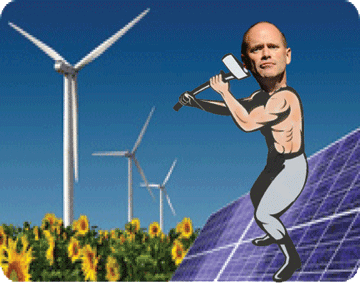 Can-do Campbell slashes Queensland solar PV tariffs, REneweconomy, By Giles Parkinson on 25 June 2012 One of the most depressingly predictable political back-flips has finally come to pass, with the Campbell Newman-led Queensland state government abandoning its commitment to the solar bonus scheme, and announcing it will slash its net feed-in tariff from a 44c/kWh to just 8c/kWh.
The dramatic move means that Queensland is the last state to remove the solar PV FiT, and replace it with a nominal amount. The 8c tariff will be reviewed in July 2013, and will end in July 2014 – leaving retailers to make only a “voluntary contribution.”
This is despite promises by Newman during the campaign that the solar bonus scheme would not be cut. But as we pointed out in this item in March, Can-do Campbell and the art of political risk, Newman intended to cut a whole range of climate and clean energy schemes. Newman has now brought an end to a variety of renewable energy schemes, including a $5 million grant for the Cloncurry solar PV project, and funding for geothermal research.
Newman also sought to exit a $75 million grant for the Solar Dawn project in the solar flagships program, but has found he could not. He may still be able to hold on to the money if Solar Dawn is unable to negotiate a power purchase agreement with the state government-owned utility. Continue reading
Muckaty traditional owners not consulted about nuclear waste plan, – legal case begins

 Nuclear dump court battle begins, SMH, Farah Farouque June 26, 2012 “……While much has been made of the environmental implications of building a nuclear waste facility at Muckaty, less understood is that the takeover ”heralds a significant unwinding of Aboriginal land rights”, according to Sydney lawyer George Newhouse.
”The Commonwealth’s preparedness to accept and act upon a deeply flawed and contested nomination at Muckaty, a home to at least seven Aboriginal family groups, represents a retrograde move in the history of indigenous land rights.”
Maurice Blackburn solicitor Elizabeth O’Shea says a nuclear dump in plain terms ”will mean the traditional people cannot access the land again”. The two lawyers are among a high-octane legal team who have donated their time to advance the cause of the elders. The barristers involved include Melbourne QCs Ron Merkel and Julian Burnside.
A leading issue in the Federal Court challenge, defended by the federal government and Northern Land Council, is that key traditional owners will testify they were never consulted while others say that they were not properly consulted and never consented to the nomination.,,,,,” http://www.smh.com.au/national/nuclear-dump-court-battle-begins-20120625-20ylj.html#ixzz1yyh9D5bG
Community owned solar farm plan for Bacchus Marsh, Victoria
 Solar farm proposed for Bacchus Marsh, Melton Weekly, Moorabool Weekly, BY CLAIRE KNOX, 26 Jun, 2012 STATE and federal governments need to encourage smaller-scale community renewable energy (CRE) projects, according to sustainability leaders. They say promoting community-owned models could be the key to engaging the wider public in lowering carbon emissions.
Deb Porter, secretary of Moorabool Environment Group (MEG), said the group was looking at developing a community solar farm in Bacchus Marsh, with people purchasing shares. Continue reading
The role of the smart meter in Australia’s renewable energy future
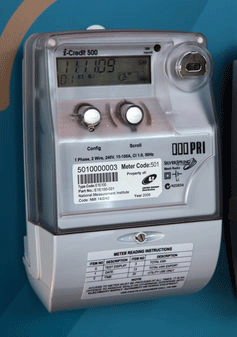 Challenge 13: smart energy demand and renewable supply “….The Conversation, Mark Diesendorf argues that it is high time we got smart about power: how we generate it and how we deliver it. 26 June 12
Global challenge 13: How can growing energy demands be met safely and efficiently?
“……..Question 13 was posed by the Millennium Project in a global context. However, when applied to Australia and other rich countries, the assumption that energy demand should continue to grow must be challenged at the outset.
There is huge potential for increasing the efficiency of energy use through technological improvements (known as “energy efficiency”) and reducing the demand for energy services by fostering behavioural changes (known as “energy conservation”). These are the cheapest and fastest ways of cutting unnecessary energy demand. The key foci are buildings (including the appliances and equipment they contain) and industry.
In the near future, a new tool will become widely available for monitoring and reducing electricity demand: the smart meter as a component of the “smart grid”. Continue reading
Ever subservient to USA, Australia’s Foreign Minister ducks and weaves, pretending to support Julian Assange
 Diplomatic cables released under freedom of information legislation show that in December 2010 the Australian embassy in Washington reported to Canberra that WikiLeaks was the target of an ”unprecedented” US criminal investigation focussed on possible espionage charges
Mr Assange observed that it was “fascinating to note that the government is at odds with popular opinion; it’s not acting in its electoral interests – which makes one wonder what interests it’s really serving.”
Assange seeking US legal guarantee, The Age, Philip Dorling June 25, 20 JULIAN Assange hopes his bid for political asylum at the Ecuadorian embassy in London will elicit diplomatic guarantees that he will not be prosecuted by the United States on espionage and conspiracy charges.
However, Foreign Minister Bob Carr yesterday renewed the Australian government’s strong criticism of WikiLeaks and indicated support for Mr Assange will remain limited to routine consular assistance Continue reading
Australia’s carbon tax changes will benefit middle and lower income earners
the changes redistributed income from high to low income earners more than previous Labor budgets and the tax cuts of last decade under the Howard government
the changes ensured people who needed support were the ones receiving benefits or tax cuts……The 1st of July marks the starting date for major tax changes.
 Carbon tax marks biggest overhaul since the GST , The Age, Clancy Yeates and Peter Martin June 23, 2012 HOUSEHOLDS and businesses face the biggest tax shake-up in more than a decade in just over a week, as the carbon price and major changes to tax rates and family payments take effect.
And unlike the back-to-back tax cuts of the Howard years, the upcoming changes will overwhelmingly benefit low and middle income earners while taxing higher income households more. Under compensation for the carbon tax, everyone earning less than $80,000 a year will receive a tax cut. Continue reading
Tony Abbott’s and Australia’s Liberal Party’s stunts to discredit the carbon tax
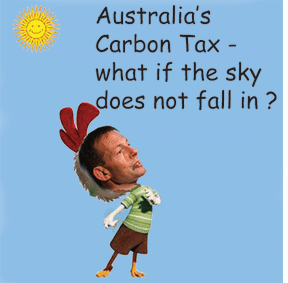 No claim too big, no stunt too outrageous.Tony Abbott has already predicted the tax will wipe out Whyalla and kill off the economy. After July 1 some of the more preposterous claims can be held to account but in the meantime it seems to be a free-for-all in the hysteria stakes.
McGuire: It’s war on Gillard http://www.adelaidenow.com.au/news/opinion/mcguire-no-claim-too-big-in-war-on-gillard/story-e6freai3-1226404821804 Michael McGuire June 21, 2012 JUST when you thought political debate couldn’t slide any lower, along comes George Brandis with a new shovel and keeps digging.
It’s dispiriting really that it’s come to this. This week Senator Brandis, the Liberal’s shadow attorney-general, came to the conclusion that a tax that hasn’t yet been applied is the sole reason that Fairfax is sacking 1900 people and radically restructuring its business.
It flew in the face of common sense and the truth. Nowhere in its 24-page statement did Fairfax mention the carbon tax. Continue reading
Australia a leader in climate change action
 PM commits Australia to green jobs, Herald Sun By Paul Osborne 22 June 12 Prime Minister Julia Gillard had told world leaders she’ll drive a push to end global poverty by creating green jobs, despite green groups and unions accusing the world environment summit of being a failure.
In a seven-minute address to the United Nations sustainable development conference in Rio de Janeiro this morning (AEST), Ms Gillard said that even though government heads had “already lowered other important ambitions”, it was important that the world put in place sustainable development goals (SDGs).
Ms Gillard and the Australian delegation have pushed hard for SDGs to replace eight UN millennium development goals, put in place to fight global poverty in 2000 and which expire in 2015. The prime minister has been appointed to co-chair a taskforce to oversee the final years of the millennium goals and ensure the 191 signatory nations meet their commitments.
“Everyone here knows that collective action is hard – and that global collective action can be even harder,” Ms Gillard said.
But targets work, Ms Gillard said, and create the firmest possible basis for long-term success.Ms Gillard said Australia was playing its part in addressing climate change and creating green jobs by putting in place a carbon pricing
scheme from July 1 and investing in renewable energy technology….. http://www.heraldsun.com.au/news/breaking-news/pm-commits-australia-to-green-jobs/story-e6frf7jx-1226405748931
Australia to reach 20% renewable electricity by 2020
 Among all renewable energy sources, solar PV had the highest revenue share in 2011, while wind power is considered the lowest cost form of large-scale renewable energy generation in the ANZ region. It is noteworthy that Australia has some of the best wind resources in the world.
Renewables to generate a fifth of Australia’s electricity by 2020 http://www.newstatesman.com/business/energy/2012/06/renewables-generate-fifth-australias-electricity-2020 Green energy revenues in Australia and New Zealand to reach $5.04bn over the next four years. NEW STATESMAN 22 JUNE 2012 Revenues from renewable energy markets in the Australia and New Zealand region (ANZ) will reach an estimated $5.04bn by the end of 2016, according to new analysis from the business research and consulting firm Frost & Sullivan.
Renewables in ANZ markets earned revenues of $1.90bn in 2011. Subha Krishnan, research analyst at Frost & Sullivan, said:
Ever since the RET target for 2020 was amended to provide a solar multiplier for rooftop solar systems and some states introduced generous feed-in tariffs, small-scale installations such as [photovoltaic] systems and solar hot water systems have flooded the REC market. Continue reading
Electric cars – no greenhouse emissions IF POWERED BY RENEWABLE ENERGY
 Electric cars silently make a charge in trial , The Age, Adam Carey June 23, 2012 YOU might not see it coming – and you certainly won’t hear it coming – but the day when electric cars start to appear on our roads could be just around the corner.
Small, speedy and near silent, there are just 100 or so electric cars on the road in Victoria now, the Department of Transport says. About half of them are being used in a trial it is doing to learn more about how people might use them here.
One-hundred-and-eighty households and 60 organisations are being given a three-month loan of an electric car during the trial, which is due to wrap up in 2014…..
People in the electric car industry accept price is a sticking point. The Nissan Leaf, which went on sale in Australia this week, retails for $51,500. But about $15,000 of the cost is in the rechargeable
battery….
.. the cars release no direct carbon emissions, and potentially zero emissions if powered by renewable energy.
http://www.theage.com.au/victoria/electric-cars-silently-make-a-charge-in-trial-20120622-20tu7.html#ixzz1yeulK3KA
A New South Wales City Council sets up Australia’s largest solar powered streetlighting project
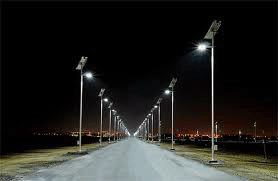 Shining light in renewable energy Goulburn Post, 22 Jun, 2012 GOULBURN Mulwaree Council is leading the way when it comes to combining renewable energy and street safety by installing more than 50 solar powered streetlights along Marys Mount Road.
The 3km stretch of road is believed to be the single largest solar powered streetlighting project for a councilowned and maintained road in Australia. The solar powered streetlights took three weeks to install, with local tradespeople contracted to assist with the project……..
Each stand-alone system comprises primarily the three major electronic
components, all working in unison.
1) Solar Panels – Absorbed radiation sent to through the controller to the batteries. The Solar Panels are monocrystalline and generally do not require maintenance.
2) Sealed Batteries – Supplying daily stored power. The batteries are sealed and require no regular maintenance.
3) Controllers – The Control Centre (operating, monitoring, regulating).
The controller automatically adjusts for the daylight savings throughout the entire year, and no manual adjustment is required.
The Cost of Life Analysis included the poles, solar panels, batteries, controller and fittings. This worked out to be $400 per pole/annum or approx five per cent of the Total Project value.
Goulburn Mulwaree Council has also installed solar panels at its Visitor Information Centre (installed by Ingenero Pty Limited), and is currently investigating options to install panels at its Aquatic Centre. Stage 1 of this process is now complete, with local company Sunup Solar and LED Lighting Systems installing the systems. Council is investigating the possibility of tendering for Stage 2 of an additional 5KW. http://www.goulburnpost.com.au/news/local/news/general/shining-light-in-renewable-energy/2598968.aspx
Lynas rare earths plant in Malaysia to go ahead without plan for long term disposal of radioactive wastes?
 why are we talking about a storage facility in Malaysia when it was made clear that one of the prerequisite to the Temporary Operating License or TOL is that the waste be shipped back to Western Australia?
The Australian government reiterated that it will not accept responsibility for any waste material produced by Lynas, although one of the five conditions attached to the recent approval of its temporary operating license is that it must take full responsibility for waste management from its plant including returning the waste to the source, if necessary.
But in a media briefing, AELB director-general, Raja Abdul Aziz Raja Adnan, gave his assurance that the board would insist on a letter of undertaking from Lynas Australia that it would adhere to this condition.
TOL sell-out by PSC: The final smirk from Lynas Malaysia Chronicle, by Charles Santiago, 19 June 12, We welcome the report of the Parliamentary Select Committee which has produced its recommendations, including the upgrading of the standards used by the AELB. But while we appreciate the effort, this is clearly a document which has only looked at ways to keep the Lynas Advance Material Plant (LAMP) in operation.
The key area – returning the radioactive waste to Western Australia – has not been looked at although it was one of the earliest pre-conditions to the government granting Lynas a Temporary Operating License.
Violating pre-requisite to the Temporary Operating License (TOL) Over a ten-year period of the plant’s operation, the total volume of wastes will amount to 2,766,600 cubic metro. Over a 20-year period, as Lynas continues to enjoy its tax break, the waste would presumably have doubled. And it is highly inconceivable that there will be enough soil and technology available to “dilute” the wastes and remove its radiation level to natural ground level radiation.
This is especially crucial as Lynas plans to store the wastes onside in the Residue Storage Facility (RSF). Continue reading
No sign of a future for Jabiluka uranium mining
 No start on horizon for Jabiluka development, SMH, Peter Ker, June 21, 2012 Development of Australia’s most prospective and controversial uranium deposit, Jabiluka, is unlikely to happen in the next decade despite its leaseholder improving relations with local indigenous groups.
That’s the view of analysts visiting the Northern Territory operations of uranium miner Energy Resources of Australia this week.
ERA is currently hosting major investors on a tour of its mines and leases near Kakadu National Park, in a bid to promote its recent decision to spend $57 million on a ‘pre-feasibility’ study into turning its Ranger open cut mine into an underground operation.
But discussion of ERA’s future inevitably turns to Jabiluka, which has remained untapped for years out of respect for the wishes of the local indigenous Mirrar people…… ERA, which is majority owned by Rio Tinto, has been targeted by environmental groups who believe its proximity to Kakadu is inappropriate. http://www.smh.com.au/business/no-start-on-horizon-for-jabiluka-development-20120621-20pju.html#ixzz1yYEL25eI
1 This month


Help Aunty Sue Protect Her Land and Sacred Sites From Destructive Rocket Testing.
.

Australians deserve the truth
about
AUKUS – https://aukuspublicinquiry.com/

PETITION – To: Prime Minister Anthony Albanese and the Australian Labor Government

of the week – Australians for War Powers Reform (AWPR)
To see nuclear-related stories in greater depth and intensity
 Antinuclear