China uneasy about USA’s increasing militarism in Australia
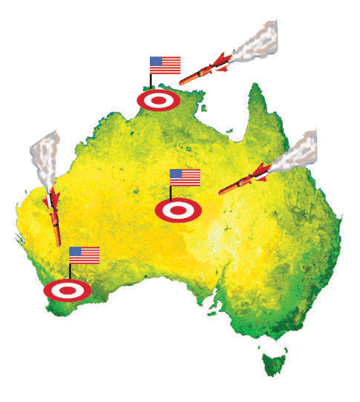 Home-brewed cold war bad for business, WA Today, Patrick Porter,June 18, 2012 PICK
 a godfather. That was the barbed warning of a former senior officer of China’s People’s Liberation Army to Australia. Choose between China (its greatest trading partner) and the US (its greatest ally and security guarantor).
In a recent visit to Beijing, Australia’s defence minister was quizzed by Chinese generals why our country is hosting 2500 marines in rotations through the Northern Territory and strengthening its defence ties with Washington.
They know about Australia’s blueprint for a future war alongside the US against China in the secret chapter of the
2009 Defence white paper, even if it was merely a contingency plan. The hostility of Chinese officials underscores Australia’s strategic dilemma: how to cope within an escalating rivalry between Beijing and Washington, and the threat that our trading interests and military-security interests could come into conflict.
http://www.watoday.com.au/opinion/politics/homebrewed-cold-war-bad-for-business-20120617-20hzt.html#ixzz1yB4na2No
Distributed solar energy is transforming Australia’s electricity system
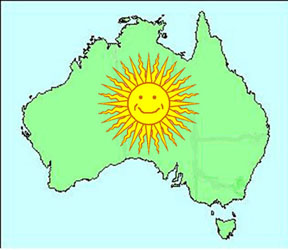 Energy myths exposed: King Coal or King Solar? “ The Conversation, by Ray Wills, Adjunct Professor, School of Earth and Environment at University of Western Australia and Peter Newman Professor of Sustainability at Curtin University 16 June 2012, “…….. A new report was released by the Australian PV Association (APVA)… It reveals a total of 837 MW of PV was installed in Australia in 2011, capacity not considered in the BREE publication. Add 2668 MW from BREE to 837 MW from APVA and we find solar delivered an amazing 25% of new installed capacity in Australia in 2011. Revised proportions for the other generation is gas 29%, wind 33% and coal 14%. Renewables added a remarkable 58% of all electricity generation capacity in Australia in 2011.
King Coal is well and truly on the way out. What’s more, renewables now make up over half of all new power being generated in Australia.
There is a major challenge in Australia, and globally, to understand the rapidly changing scene of energy investment toward sustainable energy. The agencies responsible for reporting these metrics are not reporting the whole picture, because the conventional view of energy markets doesn’t consider you can generate a lot of electricity on homes……. Continue reading
All is not well with Australia’s uranium industry
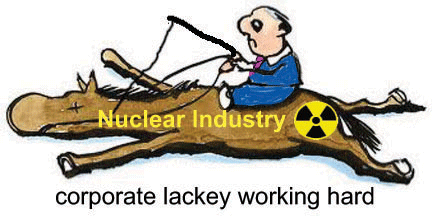 for all the hype, uranium accounts for a lousy 0.3% of Australian export revenue and a negligible 0.02% of Australian jobs. The industry’s future depends on the nuclear power “renaissance”, but global nuclear power capacity has been stagnant for the past 20 years.
The uranium price tanked after the Fukushima disaster and so far there is no sign of a bounce.
Australian uranium industry in trouble after Fukushima, June 2, 2012,Green Left, By Jim Green A protest walk from Wiluna to Perth took place last year against the proposed Wiluna uranium mine.
These are interesting times in the uranium sector. The mining companies have had a few wins in the 14 months since the Fukushima disaster, but they’ve had more losses.
Bill Repard, organiser of the Paydirt Uranium Conference held in Adelaide in February, put on a brave face with this claim: The sector’s hiccups in the wake of Fukushima are now over with, the global development of new nuclear power stations continues unabated, and the Australian sector has literally commenced a U-turn in every sense. Continue reading
New South Wales govt wants Aborigines to get into the uranium business
 Land council looks to far west uranium exploration, Margaret Paul,ABC News, June 15, 2012 The State Government is encouraging the Broken Hill Aboriginal Land Council to apply for uranium exploration licences.
Applications for exploration licences open yesterday, after the government lifted a decades-old ban on uranium exploration earlier this year.
The Energy Minister, Chris Hartcher, says it is very likely large deposits of uranium exist around Broken Hill…… He says he has met with the New South Wales Aboriginal Land Council, and encouraged them to formally apply for an exploration licence. Continue reading
Farming the winds can pump $17 billion into Australia’s economy
 “Wind farming can help farmers generate significant extra funds for local suppliers, contactors, shopkeepers, community facilities and more,”.. can help farmers earn vital extra income, make better use of farming land and insure against downturns in key commodities.”
the construction of the “typical wind farm” of around 25 to 30 turbines can produce 48 direct building jobs and provide indirect employment of around 160 people locally, 504 state-wide and 795 nationwide.
Wind farms to create $17b – study, AAP June 15, 2012 http://www.heraldsun.com.au/news/breaking-news/wind-farms-to-create-17b-study/story-e6frf7jx-1226397181053AAP WIND farms could pump more than $17 billion into
Australia’s economy if proposed projects were to go ahead, a new report says. Continue reading
Carbon Capture and Storage – a failed dream
 ”It was never going to be viable,” Greens leader Senator Christine … the fact is it is not going to work … it’s too expensive, it’s last century and we don’t need it because we have got renewables … Why would you stick with the horse and buggy era when you can move on?”
Australia will not be able to use carbon capture and storage as planned. That means it will need to rework the assumptions underpinning its crucial carbon tax reform – among them the role of coal-fired electricity generation in Australia, the cost of emission reductions, and the idea that we can be part of a global effort to limit global warming while continuing to export
billions of dollars worth of coal.
Climate strategy up in smoke, The Age, Lenore Taylor, June 16, 2012 IT WAS the technology that was going to help underpin the nation’s climate change strategy. In 2009, the then prime minister, Kevin Rudd, pledged to ”lead the world” in carbon capture and storage technology, which traps carbon dioxide emissions, permanently storing them deep underground.
The Rudd and Gillard governments allocated almost $2.5 billion to push the idea, which would be used to ”clean up” coal-fired power stations in Australia and in the countries to which we will export $44 billion worth of coal this year.
But so far there is almost nothing to show for their effort. Instead, the fledgling technology is struggling. Continue reading
Australian rare earths company Lynas backing out of its processing project in Africa
 Lynas Likely To Give Up Rare Earths Project in Africa International Business Times, By Esther Tanquintic-Misa | June 14, 2012 With its highly-controversial Malaysian rare earths processing plant an already ample source of headache, Lynas Corp. has been reported to be likely backing out from another rare earths project, this time in Africa.
Citing unidentified industry sources, The West Australian reported that Lynas Corp. is thinking of shunning the Kangankunde rare earths project in Malawi after a Malawi High Court questioned the authenticity of the Australian miner’s ownership over the project…..
With the recent development, the Australian rare earths miner deemed it might be better to give up the African project altogether, than suffer again the same fate as with its highly controversial rare earths processing plant in Malaysia, The West Australian reported…. Lynas Corp. “is reassessing the project’s risks in the context of Malawi’s present governance and institutional frameworks,” sources told The West Australian. … http://au.ibtimes.com/articles/351984/20120614/lynas-corp-rare-earths-malawi-africa-malaysia.htm
Development of uranium mining in Western Australia is far from assured
Australian uranium industry in trouble after Fukushima, June 2, 2012, Green Left, By Jim Green “………As elsewhere, it has been a miserable year for the uranium mining wannabes in WA. At least two projects have been put on hold. Continue reading
A compelling case for Australian households to adopt solar energy
 The Australian Energy Market Operator report on solar photovoltaics,… recognises that solar PV can provide a compelling economic case for households as its costs fall and retail prices from fossil-fuel-dominated centralised grids continue to rise.
We are missing the boat on clean energy, BY: GILES PARKINSON : The Australian June 15, 2012, THE International Energy Agency was created 40 years ago, soon after the first major oil crisis, to ensure that OECD countries continued to have a secure supply of energy.
In the past few years, however, it has emerged as one of the loudest and most powerful advocates of clean energy.
The more it looks at the issues of climate change and energy security, the less it likes oil, gas and coal, and the more it is attached to what its secretary-general, Maria van der Hoeven, describes as a radical and early transformation of the world’s electricity systems.
A 685-page analysis released this week by the agency contains two important conclusions: renewable energy sources can do the job, Continue reading
CSIRO report dispels negative myths about solar power for Australia
Solar power has bright future – CSIRO, SMH, Ben Cubby, Environment Editor, June 15, 2012 THE myth that solar power is unreliable because clouds sometimes cover the sun has been dispelled by a world-first report produced by the CSIRO. While clouds or rainy weather drastically reduce the amount of electricity produced by solar panels, intelligent management of the power grid means panels and mirrors should still supply 40 per cent of
the nation’s energy in the future, the report said.
“People are worried about the reliability with little evidence, and that is limiting solar,” said Glenn Platt, a senior researcher in local energy systems at the CSIRO. “Solar intermittency is not an issue at the moment, but when it does become an issue there are solutions available to deal with it.” Continue reading
Australia promoting nuclear power in our region
AUSTRALIA PROVIDES ADVICE ON NUCLEAR TECHNOLOGY (FED) 15 June 12, Federal Parliament’s Treaties Committee will examine the extension of an international treaty aimed at improving regional cooperation for the peaceful uses of nuclear material. Australia has been a signatory to the treaty, aimed at strengthening the ability of countries in the Asia-Pacific region to safely and securely use radioactive materials for peaceful purposes.
In order to remain a party to it, Australia needs to ratify an extension to the Regional Cooperative Agreement for Research, Development and Training relating to Nuclear Science and Technology. The principle behind the Agreement is that the signatories cooperate with each other to promote research, development and training projects in nuclear science and technology.
NSW govt excited about uranium exploration only, but oh no, not uranium mining?
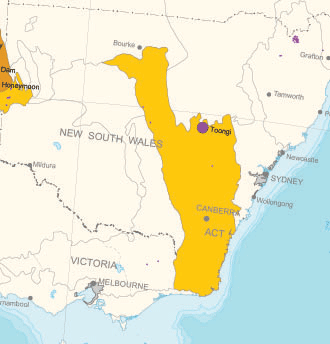
Map shows the potential uranium mining area in NSW (yellow)
Search for uranium looms closer, SMH, June 15, 2012 THE Energy Minister, Chris Hartcher, has called for
a ”rational debate” about uranium while saying the decision to lift the ban on exploration in NSW was not about providing an alternative energy source for electricity generation.
In February the Premier, Barry O’Farrell, announced the state government would overturn a 26-year-old ban on uranium exploration….
Mr Hartcher told a uranium conference in Adelaide yesterday the decision ”presents an exciting opportunity for NSW” and that the government looked forward to ”a vibrant uranium exploration industry”……
When the legislation is proclaimed, companies will have 60 days to seek consent from Mr Hartcher to apply for a uranium exploration licence. Applications will be assessed by a government ”technical panel” overseen by a probity auditor and those who are successful will be invited by Mr Hartcher to apply for an exploration licence for uranium or thorium in the same manner as other minerals. The system mirrors the one in place for companies wishing to apply for coal exploration licences in NSW……
The Greens MP Jamie Parker said the NSW public did not support the government’s decision.
: http://www.smh.com.au/environment/search-for-uranium-looms-closer-20120614-20d68.html#ixzz1xtHOy27X
Wind energy company calls for inquiry into wind energy and health
 Pacific Hydro supports calls for wind farm health probe http://www.abc.net.au/news/2012-06-14/pacific-hydro-supports-calls-for-wind-farm-health/4070878 June 14, 2012 A wind energy company, Pacific Hydro, has backed calls for a study into the health effects of wind farms and power generation. The company’s general manager, Lane Crockett, backed the suggestion during a meeting on wind farms in Portland on Tuesday.
A Senate inquiry last year recommended the Government should fund a health assessment. Mr Crockett says the Government should launch a broad-ranging inquiry into the claimed health problems caused by power generation.
“If you really want to have a broad conversation about what forms of power generation are appropriate to power Australia, then you should do a health review of all forms of power generation,” he said.
Demand for solar PV can only grow in Australia: get used to it!
An increase in electricity costs will increase demand for PV. Reading through AEMO’s report again (which we helped model), they define their “rapid uptake scenario” as being driven by “relatively large” increases in electricity price, “rapid system price reductions” and a “clear incentive” from Government. Under this scenario, they predict 18GW of rooftop PV by 2030.
We now have two out of three and arguably, the Carbon tax is the clear incentive.
get on board with PV or get out of the way. Its coming whether you like it or not.
NSW power price rises underscore case for solar REneweconomy, By Nigel Morris 13 June 2012, The Independent Regulatory and Pricing Tribunal (IPART) today released its final price determination for 2012-2013 electricity prices. Continue reading
Queensland Premier Newman will retain Queensland’s ban on uranium mining
Newman resists calls to lift uranium ban, Brisbane Times, June 13, 2012 Queensland will take note of calls to change its stance on uranium if the prime minister takes up the cause, Premier Campbell Newman says. Federal Resources Minister Martin Ferguson today urged Queensland to lift its mining ban..
…. But Mr Newman intends to keep his promise to the electorate not to mine uranium. “Our position hasn’t changed, we have no plans to mine uranium,” he told reporters in Brisbane. But the premier says he’d be interested in hearing the view of the wider federal government. “I’m interested particularly on what the prime minister’s position is, will she support it as well?” he said…..
Australian Conservation Foundation uranium campaigner Dave Sweeney says Mr Ferguson is out of touch with community opinion, and that of Mr Newman.
“During the campaign Mr Newman said, ‘the LNP has made it crystal clear that we have no plans to approve the development of uranium in Queensland’,” he said. Mr Sweeney called on Mr Ferguson to focus on reviewing and improving
the performance of the existing Australian uranium industry. http://www.brisbanetimes.com.au/queensland/newman-resists-calls-to-lift-uranium-ban-20120613-209ke.html#ixzz1xnJDcyHV
1 This month


Help Aunty Sue Protect Her Land and Sacred Sites From Destructive Rocket Testing.
.

Australians deserve the truth
about
AUKUS – https://aukuspublicinquiry.com/

PETITION – To: Prime Minister Anthony Albanese and the Australian Labor Government

of the week – Australians for War Powers Reform (AWPR)
To see nuclear-related stories in greater depth and intensity
 Antinuclear