Big Solar is NOT more beautiful than Small Solar energy
 “Solar Flagships is an idea full of good intentions, but it is grandiose and cumbersome,” says Giles Parkinson, pointing out the project won’t be up and running until 2015; whereas the ACT Solar Auction will have projects up and running well before then.”
the Australian solar PV industry installed over 800 megawatts in the prior calendar year alone using a market-based policy mechanism which entirely avoided the need for government to get involved in picking a winning project
Solar Flagships – ‘Grandiose And Cumbersome’ http://www.energymatters.com.au/index.php?main_page=news_article&article_id=3247 by Energy Matters, 14 June 12, Seeing large scale solar getting a bit of a helping hand in Australia certainly isn’t a bad thing per se; but just how good a deal is it for the battling Aussie taxpayer?
AGL Energy and USA-based First Solar were recently announced the successful grantees in the Australian Government’s troubled Solar Flagships Program.
The $450 million project will see two solar panel based facilities established – one in Broken Hill and another in Nyngan. Together, the facilities will boast 159 megawatts capacity, enough to supply the electricity needs of approximately 30,000 homes. The Federal government is kicking in $129.7 million and the NSW Government has committed to provide $64.9 million to the projects; totalling $194.6 million in grants – or $1.22 per watt of capacity.
While AGL (and its shareholders), First Solar (and its shareholders) and Minister for Resources and Energy, Martin Ferguson may be rejoicing, some industry commentators haven’t shared the exuberance. Continue reading
Australia’s electricity networks can cope with plenty more Solar PV power
 Networks Should Have Nothing To Fear From Solar PV, Energy Matters, by Giles Parkinson, editor of RenewEconomy.com.au, 14 June 12, A new study led by the CSIRO has questioned the validity of fears that widespread deployment of solar PV could not be supported by the electricity grid, and says Australia could support a lot more solar PV with minimum fuss.
The integration of intermittent renewable energy sources such as wind and solar has been a major issue in discussions about the deployment of clean energy, but the CSIRO study says fears about solar have been overblown, in much the same way as they were about wind energy.
Glenn Platt, the head of CSIRO’s local energy systems division, who oversaw the team that wrote the detailed report, says it was commonly thought that the maximum amount of solar PV that could be supported by the grid without significant upgrades was 20 per cent.
“That’s a very common statement, but I’m not sure we have found much evidence to support that. The analysis shows we can have a heck of a lot more than 20 per cent,” Platt told RenewEconomy .
Deflating Barry Brook’s pro nuclear bubble
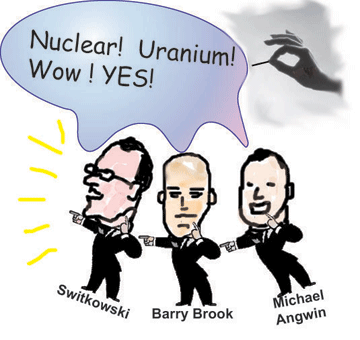 Solar and wind energy projects are going apace in the world right now. And that’s where private investment is going, too, not into nuclear power. I would say that hurdle No 1 would be in persuading people to invest in nuclear power – and that’s a big hurdle. Hurdle 1a would be in getting the government to subsidise nuclear power.
I suspect that even in Australia, solar and wind power systems, both centralised and small, will be well established by 2050, and nuclear power will be a forgotten dream.
Answering Barry Brook on Australia’s nuclear power future, Online Opinion, Noel Wauchope, 13 June 2012 Australia’s nuclear propagandists are at it again, although Ziggy Switkowski, the usual leader of the pack, has been very quiet lately. However, Professor Barry Brook, and his acolyte, Terry Krieg of Australian Nuclear Forum, seem to be taking up the torch now….
Costs Barry Brook claims that there would be “cost benefits” for Australia to adopt these generation 1V nuclear reactors. This is a bald statement. As far as I can tell, nobody at present is able to estimate the costs. Particularly when it comes to the small reactors. One thing is accepted: the only way that these could ever be commercially viable would be if they were to be manufactured and sold in large numbers. The likelihood of this happening, of a mass production and sale of small reactors is dubious.
For fast neutron reactors, large or small, Barry Brook himself admits that there are currently none in commercial operation.
David Biello comments: Fast-neutron reactors would not improve the economics of nuclear power
based on past experience, …. As far back as 1956, Adm. Hyman Rickover, who oversaw both the Navy’s nuclear-propulsion efforts as well as the dawn of the civilian nuclear power industry, cited such sodium-cooled fast-neutron reactors as
“expensive to build, complex to operate, susceptible to prolonged shutdown as a result of even minor malfunctions, and difficult and time-consuming to repair.” That judgment remains despite six decades and $100 billion of global effort, Continue reading
Tony Abbott pledges his troth to BHP Billiton and its uranium mine expansion
BHP Billiton has revealed it is unlikely to go ahead with all of its major resources projects
Tony Abbott vows to clear way for giant Olympic Dam mine, Courier Mail : By Mark Kenny The Advertiser June 13, 2012
FEDERAL Opposition Leader Tony Abbott has committed to removing all obstacles to the Olympic Dam mine’s expansion and making its success a priority of the Coalition if it wins government.

He also said that Prime Minister Julia Gillard must give BHP Billiton a written assurance that the Minerals Resource Rent Tax will never be imposed on copper, gold and uranium – which are central to the expanded mine’s operations. Continue reading
Martin Ferguson urges Queensland to go for uranium mining
 Martin Ferguson calls on Newman to reverse uranium ban vow, BY: SID MAHER The Australian June 13, 2012 RESOURCES Minister Martin Ferguson will today call on Queensland’s new conservative government to lift its ban on uranium mining, arguing it already allows exploration and that Australia is on track to triple its exports by 2030.
In a speech to an international uranium conference in Adelaide this morning, Mr Ferguson will ask Premier Campbell Newman to overturn his pre-election promise to ban uranium mining, arguing the state already has an estimated resource base of at least 37,000 tonnes.
…. Mr Ferguson will argue that uranium exports present a major opportunity for the nation. His call to the Queensland government comes after former Labor premier Anna Bligh resisted calls for uranium mining to be allowed in her state……
Electricity network upgrades, not renewable energy, are causing cost rises
Smart meters, time-of-use tariffs, cutting demand at the peak and localised power generation – for example, from rooftop solar panels – can help cut this network spending. The problem is the network companies have no financial incentive to make this happen
High power rates: it’s a poles and wires story, SMH, Paddy Manning, Brian Robins June 12, 2012 Poor demand management means consumers could be paying for infrastructure that isn’t really needed. Electricity prices have been rising fast and, from July 1, they are set to go higher.
Green schemes such as the renewable energy target and feed-in-tariffs – as well as the coming carbon tax – are often
blamed for pushing up prices, but the reality is they are responsible for only a small part of the increases approved by the Australian Energy Regulator.
By far the largest driver of the price increases is increased spending on electricity transmission and distribution networks (the ”poles and wires”), which is passed on to residential and commercial customers alike. These network costs account for 57 per cent of the average residential electricity bill around the country, the Australian Energy Market Commission says Continue reading
New solar project for Broken Hill will be operational by 2015
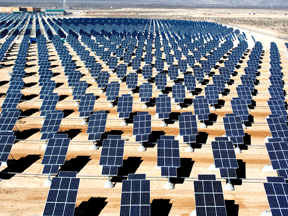 Silver city becomes solar city ABC Broken Hill, By Noah Schultz-Byard, June, 2012 Broken Hill will host one half of the largest solar energy project in the southern hemisphere, it was announced today. The $450 million project will have an ultimate output of 159 megawatts, enough to power 33,000 homes, and will be constructed across two sites; Broken Hill and Nyngan.
The Broken Hill site will consist of nearly a million solar photovoltaic (Solar PV) panels and will be built to the west of the
city. Construction is hoped to begin in 2014 and is expected to bring 150 jobs to Broken Hill and a further 300 to Nyngan.
The solar farm is expected to be operating by 2015 and is a joint venture between the Federal and State Governments and Australian energy company AGL…. Continue reading
Energy research in Australia welcomes the carbon tax
The real cost of carbon-based fuels needs to become apparent and with the carbon tax that will be so. When you see that real cost of carbon then other renewable energy projects like solar or wind or geothermal, they can now become a lot more competitive.
having a background like a carbon tax and all that will definitely help and assist these newer technologies to get to
maturity.
Carbon tax powers energy innovators ABC Radio AM Adam Harvey , June 9, 2012 ELIZABETH JACKSON: At least one person in New South Wales’s mining heartland is looking forward to the carbon tax kicking in. Newcastle University professor Behdad Moghtaderi is developing new technology to cut power bills.
He’s working on ways to use the earth’s heat to power mines and he’s helped devise an ingenious system to warm the university’s swimming pool. He hopes that rising power prices, sparked by the carbon tax, inspires businesses to follow his lead….. Continue reading
Australia’s Carbon Tax: Tony Abbott hopes the sky will fall in
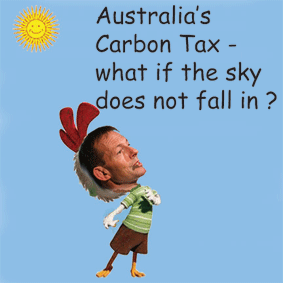 What if Armageddon arrives in three weeks, and nothing happens? Because that is the likely outcome.
The Treasury forecasts that the carbon tax will cut economic growth by 0.1 per cent below what it would be otherwise. Imperceptible, in other words
“Publicly, their leader [Tony Abbott] talks mining stocks down; privately, they snap up the investments … His whole campaign is a complete fraud. As July 1 approaches he is going to get more and more desperate, because he will have no credibility left.”
Merchants of doom, beware, The Age, Peter Hartcher, June 9, 2012 Tony Abbott and the opposition must be careful their wrecking-ball approach doesn’t rebound and hurt them.
It’s strike one against Tony Abbott’s scare campaign on the carbon tax and mining tax. “Australia reported its economy was the fastest-growing in the developed world in the first three months of 2012, sweeping aside growing gloom,” reported The Wall Street Journal this week.
With the new taxes due to take effect in three weeks, the facts on the health of the Australian economy show a very different country to the one that, if Abbott is right, should rightfully be cringing in fearful anticipation.. Continue reading
Another Northern Territory train derailment highlights danger of radioactive materials transport
Of greater concern was the transport of nuclear waste from Lucas Heights in NSW to the proposed nuclear dump at
Muckaty Station…. “we have extreme weather conditions,”
 Crash sparks calls for Adelaide to Darwin rail line probe, BY:REBECCA PUDDY AND DAN BOX The Australian June 11, 2012 THE third derailment on the Adelaide to Darwin railway in just 19 months has reignited demands for an inquiry into the integrity of the track amid plans to increase the amount of uranium the line carries through central Australia. Continue reading
Western Australia governs on behalf of mining companies. as Kimberley’s natural wonderland is threatened
 over the past weeks, the WA Premier Colin Barnett has sent hundreds of police to the once placid town to protect the interests of the mining company Woodside, ….
Is this the way we conduct business in Australia in 2012? The WA Premier has effectively sent his own army to Broome at a cost of over $1 million to Australian tax payers in order to protect the interests of one of our largest mining companies….
Kimberley under threat from mining boom, The Drum, Wade Freeman, 11 June 12 “……. one of the world’s most untouched and iconic regions was granted National Heritage protection last August. Australia’s beautiful Kimberley, which stretches all the way from Broome, north up around the Buccaneer Archipelago, and east as far as the NT border – was declared of great national significance due to its cultural and environmental values to the nation.. Continue reading
Uranium mining will leave Western Australian tax-payers with virtually permanent toxic pollution
Preventing tailings contamination even after a uranium mine has closed has proved impossible in every uranium mine in Australia to date there is no former Australian uranium mine that has been rehabilitated successfully — all are still radioactive no-go zones because of radionuclide dispersal from waste stockpiles and water seepage. We will be fooling ourselves if we think that “best practice” regulation can somehow contain tens of millions of tonnes of finely powdered carcinogenic wastes for thousands of years.
 Uranium mine tailings leave an enduring toxic legacy http://au.news.yahoo.com/thewest/opinion/post/-/blog/13904615/uranium-mine-tailings-leave-an-enduring-toxic-legacy/ Alison Xamon , June 8, 2012, The Environmental Protection Authority’s approval of a uranium mine in Wiluna should concern all West Australians. This is no longer a theoretical discussion. Research shows a serious risk that uranium mining will cause long-term harm to WA communities. Uranium mining has caused a string of accidents across Australia and has proved impossible to regulate appropriately.
Yet the highly radioactive waste produced by uranium mines — known as uranium mine tailings — remain radioactive for thousands of years. The State Government has given a commitment to seek to regulate uranium mining through “world’s best practice”, including isolating uranium tailings for at least 10,000 years. This is a worthy commitment but it is unclear how it will be achieved, especially when it is apparent that no uranium site in Australia has successfully accomplished this for even 10 years.
The best regulations will not stop chronic radioactive waste seepage. Preventing tailings contamination even after a uranium mine has closed has proved impossible in every uranium mine in Australia to date, Continue reading
Economic viability of new giant Olympic Dam uranium mine is in question
 BHP Could Net $6 Billion By Selling Olympic Dam Stake: Deutsche WSJ, By Robb M. Stewart, 8 June 12 With question marks hanging over the timing of BHP Billiton’s massive expansion of the Olympic Dam mine in South Australia, could a sale of a minority stake to a strategic partner offer the answer?….. The expansion of Olympic Dam is one of three $10 billion-plus “mega” projects that BHP’s board is due to decide on by the end of the year.
But with costs in Australia and other countries escalating and commodities prices slumping, the thinking of many analysts is that approval for one or more projects will be deferred.
In a research report, Deutsche valued Olympic Dam after all five phases of its expansion at about $14 billion on a life-of-mine net present value. But the internal rate of return was a modest 11.3% due to the large upfront cost to develop an open pit at the mine site….. http://blogs.wsj.com/dealjournalaustralia/2012/06/08/bhp-could-net-6-billion-by-selling-olympic-dam-stake-deutsche/
BHP investors disillusioned with Olympic Dam uranium mine expansion plans
Sell stake in mine, BHP urged Olga Galacho , Herald Sun June 09, 2012, BHP Billiton should cheer up its shareholders by undertaking a radical sale of 20 per cent of its copper-uranium Olympic Dam mine to a venture partner, broking
house Deutsche Bank suggested yesterday. Analyst Paul Young estimated such a deal could fetch about $6 billion, which the miner could use to fund the first part of its expansion plan for the South Australian mine and boost returns to shareholders.
But his counterpart at UBS, Glyn Lawcock slammed the idea, saying shareholders would be highly disappointed if BHP sold part of a tier-one asset….. BHP chief executive Marius Kloppers this week continued to stoke speculation that the miner might put the giant mine expansion on ice indefinitely..… Deutsche Bank believes investors are reflecting their disillusionment with the value of these long-term projects in the share market.
Call for moratorium on industrial development at Point Lowly, to save Giant Cuttlefish from extinction
 CUTTLEFISH numbers at a key breeding ground in Spencer Gulf have plummeted, the Greens say.http://www.adelaidenow.com.au/news/south-australia/cuttle-fish-numbers-plummet-at-point-lowy-say-australian-greens/story-e6frea83-1226389582466 Greens state MP Mark Parnell said local divers at the Point Lowly site
have reported a huge drop in numbers during the current breeding season.
“This annual marine breeding spectacle is of worldwide significance, not to mention how important it is for the local tourism industry,” Mr Parnell said in a statement on Friday. He said the state government must conduct an immediate investigation
to determine the cause of the slump in numbers. “First step is commissioning some urgent research by marine scientists
to find out exactly what is going on,” he said.
“Next is a moratorium on all industrial development at Point Lowly until the cause of the decline is discovered.” Mr Parnell said the annual breeding of the giant Australian cuttlefish at Point Lowly is the world’s only known mass cuttlefish spawning
event. “The permanent loss of this annual breeding event would be devastating,” he said.
1 This month


Help Aunty Sue Protect Her Land and Sacred Sites From Destructive Rocket Testing.
.

Australians deserve the truth
about
AUKUS – https://aukuspublicinquiry.com/

PETITION – To: Prime Minister Anthony Albanese and the Australian Labor Government

of the week – Australians for War Powers Reform (AWPR)
To see nuclear-related stories in greater depth and intensity
 Antinuclear