Majority of industrialised countries have carbon pricing: Australia not alone in carbon tax
Australia not alone on carbon pricing: Combet, SMH, Adam Morton, June 9, 2012 CLIMATE Change Minister Greg Combet will today counter claims that Australia is acting alone on carbon pricing with an analysis that finds more than 50 jurisdictions will have emissions trading schemes in 2013.
The schemes cover a combined population of about 850 million, according to the analysis by the Department of Climate Change and Energy Efficiency.
They include 30 countries linked under the European Union carbon scheme, regional systems covering 10 US states, including California, and seven pilot schemes in Chinese provinces and cities. Mr Combet said the schemes would cover an estimated 30 per cent of the global economy, showing Australia was joining “the vast majority of the world’s industrialised economies in adopting a policy that reduces emissions in the most economically responsible way”…..
Several European countries, including Britain and Scandinavian nations, have higher prices than Australia on fossil fuel industries once domestic carbon taxes are factored in. Continue reading
Grassroots movement to make Australia’s politicians aware of renewable energy
building this kind of grassroots capacity is central to ensuring that the people’s overwhelming desire for big solar and renewables is heard and acted on in the nation’s parliament.
 Abbott set to catch last wave on clean energy, By Andrew Bray on 8 June 2012 Last week, as the drama of the Craig Thompson affair continued to unfold, our national parliament was reduced to a circus of politicians sprinting around the chamber, and the press gallery struggled to digest each new stunt-filled moment, the 100% Renewable campaign took 30 community representatives to Canberra to talk to our leaders about an issue the public actually cares about – building big solar plants in the sunniest country on earth.
Last Monday, constituents sat down with their local MPs, as well as senior ministers and ministerial advisors, and talked about the widespread support for big solar we found in our big solar poll conducted earlier this year and outlined in the poll report, 12,000 Voices: Australia’s vision for big solar. Continue reading
The future for outback mining energy is in renewables, not nuclear
Green group rejects outback nuclear push http://www.abc.net.au/news/2012-06-08/green-group-rejects-outback-nuclear-energy/4060024?section=sa June 08, 2012 The Australian Conservation Foundation has rejected outright that nuclear power would be a better alternative for parts of South Australia’s outback.
An environmental scientist from the University of Adelaide has this week predicted some outback mines could be nuclear-powered within 20 years. The statement has prompted some support for so-called small modular reactors at places like Olympic Dam.
However, the foundation’s Dave Sweeney says wind and solar power are quite rightly becoming more prominent in regional and remote areas. “Regional Australia is perfectly placed to be using these renewable materials and to be processing minerals, accessing minerals based on a much cleaner production cycle and a much cleaner whole of life
industrial assessment which has far less impact,” he said.
Mr Sweeney says there is simply no place for nuclear power. “There is the real opportunity in regional Australia to use regional sustainable energy systems,” he said. “We’re already seeing mines in regional Australia increasingly using
geothermal, we’re seeing mining operations and other operations and communities using wind and solar.”
Conservation Council and Aboriginal Elder lodge appeals against Wiluna uranium mine
 Appeals lodged against first WA uranium mine SMH, Courtney Trenwith June 7, 2012 – Several appeals against the environmental approval for WA’s first uranium mine have been official lodged.
In a landmark decision , the state’s independent Environmental Protection Authority last month approved mining company Toro’s $280 million project to mine uranium near Wiluna in the South-West. ….However last night, the Conservation Council of WA lodged an appeal claiming the EPA’s decision contained numerous “critical deficiencies”.
Aboriginal elder and Wiluna resident Glen Cooke also lodged a separate challenge.
The appeals will be heard by an appeal convenor and considered by the Minister for Environment Bill Marmion, in line with the EPA decision. The state government is yet to make a final decision on the project.
CCWA director Piers Verstegen claimed the EPA had failed to properly assess the proposal before approving it. “Importantly, the state government has made commitments to ‘world’s best practice’ regulation of uranium mining in WA, but their own independent report has found that the current system fails that test,” CCWA director Piers Verstegen said.
“We do not believe that the EPA assessment adequately deals with critical environmental risks including the management of radioactive mine tailings, contamination of groundwater and the transport of radioactive material through WA communities.” CCWA also claims there was a denial of procedural fairness and the EPA failured to comply with their own procedures during the assessment process.
“West Australians rely on the EPA to prevent environmental harm, yet they have recommended approval for mining and transporting one of the most dangerous materials known to exist by a junior minerals exploration company that has never successfully mined anything and have not completed all necessary environmental management plans,” Mr Verstegen said….: http://www.watoday.com.au/wa-news/appeals-lodged-against-first-wa-uranium-mine-20120607-1zxzz.html#ixzz1xFFVXxMn
Wind farms supported by majority of people in South Australia, Victoria and NSW
those who opposed wind power were “out of step with community thinking”.
Two-thirds (67 per cent) of people believed a farmer’s right to generate income from their land was more important than a resident’s right to a view clear of wind turbines.
 ‘People worrying themselves sick’ over windfarms http://www.adelaidenow.com.au/news/south-australia/people-worrying-themselves-sick-over-windfarms/story-e6frea83-1226388175640 Political Reporter Lauren Novak June 07, 2012 MORE than 80 per cent of people believe health concerns about wind farms will “turn out to be nothing to worry about”, a survey commissioned by the Clean Energy Council says. Continue reading
Solar Dawn project- Concentrated Thermal Power (CSP) in the balance for Australia
as a new report points out, Australia has a unique opportunity to grab a significant share of the global supply chain for solar thermal, a technology recognised by the International Energy Agency,
Industry awaits dawn of federal solar project BY GILES PARKINSON The Australian June 08, 2012 IN the next few weeks, the federal government will learn whether the $1.2 billion Solar Dawn project in Queensland has been able to meet its extended deadline to obtain finance for the 250 megawatt solar thermal project. Continue reading
Christine Milne calls for positive support for Australia’s carbon tax
As she called for public support from business Senator Milne said understood that it was difficult to attract coverage for  positive stories because of “the concentration of media ownership”.
“But nevertheless, we have to rewrite the rules that govern our economy so that we move rapidly to a low and then a zero carbon future and sustainable living.”
 Greens demand ‘progressive businesses’ attack Tony Abbott, BY: MATTHEW FRANKLIN, CHIEF POLITICAL CORRESPONDENT The Australian June 08, GREENS Leader Christine Milne has demanded “progressive businesses”
with investments in renewable energy publicly attack Tony Abbott’s promised direct action plan on carbon change and celebrate the July 1 introduction of Julia Gillard’s carbon tax.
Senator Milne has also criticised the Business Council of Australia for rejecting environmental controls because they might “impede business investment” and attacked the media for not publishing more positive stories about the need for an economic shift toward greater use of renewable energy. Continue reading
Uranium market flat, listless, sluggish and languishing, and getting worse
 Uranium Lacked Energy In May June 5, 2012 International Business Times, The best you can say for the global uranium market in May is; at least it was steady. Other commentators used words like flat, listless, sluggish and languishing, with the slight dip in the spot price over the last week of the month doing little to help matters.
Industry consultant TradeTech reports there were just 17 transactions in the uranium spot market last month, with just a tad over 2 million pounds U3O8 equivalent shifted over the course of May. The level of activity was well down on April, with the previous month seeing 3.2 million pounds being traded.
The bulk of May spot market buyers were traders, with the market seeing few signs of life coming from utilities. ….. There was little in the way of Australian broker commentary on the topic of Uranium last week, although JP Morgan analyst Mark Busuttil did say he thought current uranium spot prices were too low and did little to encourage new production.
The movement for Intelligent energy efficiency
This has special relevance in Australia where customers are witnessing a marked fall in the cost of technologies such as solar PV, as well as being subjected to rising electricity prices, a situation exacerbated by the utilities’ push for time-of-use pricing.
Intelligent efficiency could have a dramatic impact on the demand outlook for Australian utilities, and the sort of new generation needed in coming decades, plus whether or not the tens of billions of dollars being spent on transmission and distribution networks is money well spent.
 Industry awaits dawn of federal solar project, BY GILES PARKINSON The Australian June 08, 2012 “……..Smart thinking HERE’S a new concept in reducing energy consumption: intelligent efficiency. Essentially it refers to a movement beyond energy-efficient light bulbs and other savings devices to a systems-based approach that combines the benefits of a suite of new technologies such as smart meters, renewables such as solar PV and electric vehicles. Continue reading
Promoting renewable energy from the grassroots – The Australian Youth Climate Coalition
 Generation Y promote renewable energy http://www.parramattasun.com.au/news/local/news/general/generation-y-promote-renewable-energy/2582725.aspx BY CALLAN LAWRENCE, 07 Jun, 2012 IF climate change does pan out, with oceans rising, rivers drying and storms causing havoc, it will be Generation Y that lives it, so they are trying to stop it.
The Australian Youth Climate Coalition has small groups in Parramatta and Blacktown to help change how western Sydney is powered. Business by business, school by school, the group of youth wants to convert people to “green” power.
Granville resident and Parramatta climate coalition convener Amy Gordon, 22, said they wanted to raise money to reduce the community footprint.
“We go out in to the community and approach local businesses, whether it’s a cafe, a school or a not-for-profit organisation, and create some sort of event,” she said. “It could be a mufti day, or a band event or whatever, to try and
raise $1000 and help them switch to renewable energy. “It’s about raising an awareness in our own community . . . “it’s
really inspiring to see change from the grassroots up.”
The coalition has worked with inner-west Sydney businesses for two years but Parramatta High School was the first organisation in the region to take part. Deputy principal Paul Taylor said Ms Gordon spoke to students about the environment. “They came away very enthusiastic and empowered from the whole experience,” Mr Taylor said. Students have introduced water and energy saving measures to the school and plan a media campaign.
Marius Kloppers twists and turns as he hangs on to his baby – the big scheme – Olympic Damn uranium mine
Complicated messages from Marius Kloppers as he tries to promote his baby – the planned new giant open cut uranium mine at Olympic Dam:
- Kloppers pays a little lip service to renewable energy – but he doesn’t want BHP Billiton to be involved in that.
- Kloppers says that fossil fuels, especially gas are the go, for now, but nuclear power will come into its own, – later
- Kloppers sees the Olympic Dam development as being 10 years or more away from completely functioning
- Kloppers admits that BHP would withhold investment in Olympic Dam, if necessary
- Kloppers wants a better deal on royalties and taxes – to make the big project work (even more concessions than BHP already has?)
- Kloppers wants “flexibility” in the workforce – I wonder what that flexibility would really mean (?crush the unions, fly-in workers, negotiating conditions – from BHP’s position of relative power)
Kloppers backing down on $80 billion expansion , talking to ABC – talking about solar cells ‘we are going to stick to our knitting: He says that natural gas and nuclear power will have very big roles before renewable energy takes over – quoted on ABC Business News 7 June 12
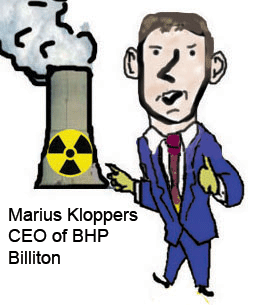 BHP poised to reveal ‘dramatic’ carbon plan SMH Peter Ker June 6, 2012 “… When asked about the world’s future energy choices this morning, Mr Kloppers said fossil fuels were likely to persist as the world’s preferred source of energy, with alternative forms of gas set to enjoy a period of strength……”Longer term the world is going to continue to work on nuclear products and that has to augment the energy mix at some time.”… Olympic Dam in South Australia – expected to be a decade or more away from full exploitation.
BHP vows to stay the course on major projects : By Christopher Russell The Advertiser June 07, 2012 “… Analysts have raised questions about BHP’s ability to invest in three major projects due to go to the BHP board this year – Olympic Dam, expanding the Outer Harbor for iron ore exports from Port Hedland and the Jansen potash
project in Canada…….
BHP would stick to its strategy, but it also would be flexible and withhold investment if necessary. “We will only trigger development of these options (BHP’s pipeline of projects) when our measures of success can be sustainably achieved,”
he said.
To maximise opportunities for Australia, it was important for policy makers to lay a competitive environment. That meant caution on royalties and taxes and the creation of a labour market with high flexibility…
Australian govt helping local councils, low income earners, to get solar hot water systems
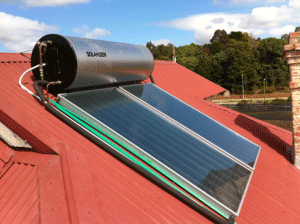 Solar funds redirected to councils, poor, Business Spectator, 6 Jun 2012 The federal government has finally announced what it plans to do with the $45 million left over after the solar hot water rebate program was wound up earlier this year.
Climate change parliamentary secretary Mark Dreyfus said on Wednesday $24 million would be spent on a new program to help local councils install solar or heat pump hot water systems in community facilities. The remaining $20.7 million would be redirected to the existing home energy saver scheme (HESS), which helps poor Australians buy more efficient white goods and air-conditioning systems……
 The Australian Greens claimed credit for forcing the government to spend the money on programs that would continue to support the solar hot water industry. “The Greens highlighted the scheme was underspent and insisted the funding allocation be maintained and not lost to general revenue,” leader Christine Milne said in a statement. “So directing this support to lower income householders and to community facilities is a great way to direct the benefits where they
are needed most.”
The Australian Council of Social Services praised Labor for pumping an extra $21 million into the HESS. “It will assist households to better understand and manage energy use,” council chief executive Cassandra Goldie said in a statement.
“New funds for investment in solar hot water systems are an excellent extension of the scheme that will allow households to take action to reduce energy costs.” Australian Manufacturing Workers Union NSW secretary Tim Ayres said the government had pledged the $45 million would be spent on locally-made products…
http://www.businessspectator.com.au/bs.nsf/Article/Solar-funds-redirected-to-councils-poor-UZBG7?OpenDocument&src=hp7
New South Wales government policies stifle wind energy development, promote coal and gas
Concern over State Government’s wind farm guidelines, ABC News June 06, 2012 The State Opposition says the O’Farrell Government’s planning guidelines for wind farms is putting potential investment in the Hunter at risk. The guidelines include a two-kilometre exclusion zone between homes and wind turbines.
Energy spokesman Luke Foley says planning charges are set to prohibit investment in the industry. He says developers could be paying more than $1 million in planning fees compared to $15,000 in Victoria.
Mr Foley says the planning guidelines for wind energy are much stronger than for the coal and gas industry.
“If a single landholder, one landholder out of hundreds objects to a wind farm proposal the proposal then has to go through all sorts of hoops, that doesn’t apply to coal seam gas or coal or our extractive industries,” he said.
Newcastle based, wind energy consultant Richard Finlay-Jones says the planning guidelines could put local projects at risk…. http://www.abc.net.au/news/2012-06-06/concern-over-state-government27s-wind-farm-guidelines/4056328
Wind farm development stalled in Bailleiu’s Victoria
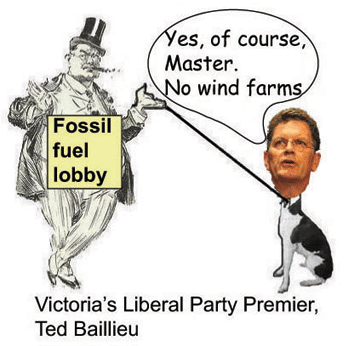 the delay in construction and state government rules giving households right-of-veto over turbines planned within two kilometres of their homes could stop the country meeting the 20 per cent target…..
Country’s largest wind turbine maker sacks 24 workers, The Age, Adam Morton, June 7, 2012 AS AUSTRALIA prepares to launch into what is billed as a clean energy future, its largest wind turbine manufacturer has sacked 24 staff because of a lack of business…
… The market for renewable energy certificates created through clean projects has been flooded with credits from rooftop solar panels.
It has suppressed the certificate price, stymieing the development of
the cheapest large-scale clean energy – wind farms.
Parliament tackled the problem in 2010 by dividing the market into
large and small-scale renewable energy schemes, but the certificate
price is yet to fully recover. Continue reading
Australia will NOT be getting radiation “backscatter” airport scanners.
 Christina Macpherson, 6 June 12, Contrary to a report in the Sun Herald today (http://www.heraldsun.com.au/ipad/full-body-scanners-to-rollout-at-australian-airport/story-fn6bfm6w-1226381431157) the radiation hazards of “backscatter” scanning will not be hitting Australians at our airports.
Australia will be getting the safer type , see https://antinuclear.net/2012/02/05/australias-compulsory-airport-scanning-will-be-of-the-safer-type-not-ionising-radiation/#more-14153
Report on Aviation Transport Security Amendment (Screening) Bill 2012
The report of the Committee into this Bill was issued last week, and recommended against back scatters for people. While it may be possible some time in the future to use them for some special case, this is most unlikely. Australia does not have the radiation type of scanner, and it is highly expensive. The report can be read at . http://www.aph.gov.au/Parliamentary_Business/Committees/Senate_Committees?url=rrat_ctte/aviation_screening_2012/index.htm
1 This month


Help Aunty Sue Protect Her Land and Sacred Sites From Destructive Rocket Testing.
.

Australians deserve the truth
about
AUKUS – https://aukuspublicinquiry.com/

PETITION – To: Prime Minister Anthony Albanese and the Australian Labor Government

of the week – Australians for War Powers Reform (AWPR)
To see nuclear-related stories in greater depth and intensity
 Antinuclear